Nepal appoints first woman prime minister, as UN expresses solidarity amid crisis

Rewrite as per earlier instructions: Nepal’s former Chief Justice Sushila Karki was appointed as Nepal’s first woman Prime Minister by President Ram Chandra Poudel who administered the oath of office on Saturday, in a ceremony attended by youth representatives, officials and foreign diplomats.

According to media reports, she has been tasked with organizing fresh elections within six months. She previously served as the only woman chief justice, leading the Supreme Court from 2016 to 2017.

“At this pivotal moment, the United Nations stands alongside the people of Nepal in their aspirations for peace, justice, transparency, accountability and progress,” said Hanna Singer Hamdy, UN Resident Coordinator in Nepal, in a statement. She also recognised the contributions of the President, the Chief of Army Staff and ‘GenZ’ youth leaders, noting that their efforts “helped make this transition possible.”

The UN remains committed to working with the Government to support stability, human rights and sustainable development, the statement added. An inspiration for girls and women Children’s Fund UNICEF congratulated Ms. Karki, saying her appointment “is an inspiration for girls and women,” and highlighted the importance of placing children’s rights at the centre of Nepal’s recovery.

Similarly, the UN Development Programme (UNDP), gender equality agency UN Women, and reproductive health agency, UNFPA, expressed support for her leadership, emphasising inclusive governance, gender equality, and the protection of women and youth. Nepal army soldiers at the Supreme Court after the complex was set on fire by protesters.

Grave challenges

The appointment comes amid grave challenges. The unrest began Monday as a self-styled “Gen Z protest” against corruption, nepotism and social media restrictions. Security forces opened fire on crowds, resulting in multiple deaths and injuries. Protesters stormed and torched key institutions, including the parliament, Supreme Court, federal and provincial government offices, and political party offices, while also targeting media outlets, schools, businesses and homes.

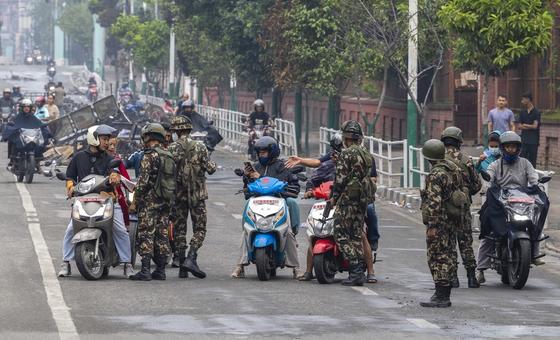
Jailbreaks occurred in several locations, and reports suggest some demonstrations may have been infiltrated by outside actors and groups, further complicating security. In response, the army assumed control of nationwide security late Tuesday, deploying troops across the Kathmandu Valley and imposing movement restrictions to stabilise the situation.

Children’s Fund UNICEF congratulated Ms. Karki, saying her appointment “is an inspiration for girls and women,” and highlighted the importance of placing children’s rights at the centre of Nepal’s recovery.

UN warns of escalation risk after large-scale Russian drone incursion into Poland

She said it was not the first time drones had been spotted beyond Ukraine’s borders “but it is the first time that multiple drones have flown so deep into a neighbouring country’s airspace.

Ms. DiCarlo said the UN had no way of verifying any claims or counter-claims surrounding the incident and could only rely on publicly available information.

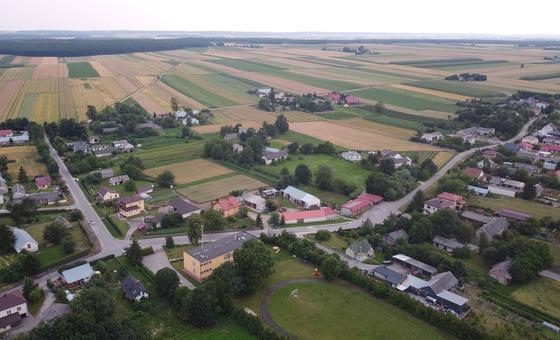
According to Poland, 19 Russian drones entered its airspace overnight on 9 and 10 September during a large-scale missile and drone assault on Ukraine. Polish authorities said some drones were pre-emptively shot down, and debris was later recovered across central and eastern parts of the country.

The episode marked the first time NATO allies used force to neutralize such drones.

Polish authorities reported temporary airport closures in Warsaw and Rzeszów and restrictions on air traffic in the east of the country. While no casualties were reported, residential areas in some villages sustained damage.

Russia’s Defence Ministry acknowledged carrying out strikes against Ukrainian targets during the same period but said it had no intention of engaging any targets in Poland. Belarus reportedly stated that some drones were deflected by Ukrainian countermeasures and veered off course, adding that it had alerted neighbouring countries as drones approached their airspace.

Poland invoked Article 4 of the North Atlantic Treaty (NATO treaty) following the incident, prompting emergency consultations among the 32 member states of the European security pact.

Civilian toll mounts in Ukraine

The briefing came against a backdrop of continued Russian strikes across Ukraine.

President Volodymyr Zelenskyy said more than 400 drones and 40 cruise and ballistic missiles were launched on 15 regions between 9 and 10 September, causing civilian deaths, including at least one in the capital Kyiv.

Impact in Russia and occupied regions

Ms. DiCarlo also highlighted the war’s toll in Russia and in Russian-occupied regions of Ukraine.

She reminded the Council that attacks against civilians and civilian infrastructure, wherever they occur, are prohibited under international humanitarian law and must stop.

“This week’s events underline the dangerous impact of this war on the security of the region and the risk of escalation,” she said.

“We, therefore, once again urgently call for a full, immediate and unconditional ceasefire in Ukraine. The end state must be a just, comprehensive and sustainable peace in line with the UN Charter, international law and relevant UN resolutions.


More to follow…

Source link

SECURITY COUNCIL LIVE: NATO allies rally round Poland in face of Russian incursion, as drone warfare takes centre stage

The Security Council is meeting in emergency session at Poland’s request at 3pm in New York, after some 19 Russian drones violated their and the North Atlantic Treaty Organization’s (NATO) airspace earlier this week. It marked the most serious incursion into NATO territory since Russia’s full-scale invasion of Ukraine began – and highlights the extent to which drone technology has reshaped tactics, logistics and strategy in wars worldwide. Follow the live coverage of the debate around the iconic horseshoe table below.

Source link

General Assembly endorses New York Declaration on two-State solution between Israel and Palestine

The New York Declaration is the outcome of an international conference held in July at UN Headquarters, organized by France and Saudi Arabia, which resumes later this month.

The General Assembly comprises all 193 UN Member States and 142 countries voted in favour of a resolution backing the document.

Israel voted against it, alongside nine other countries – Argentina, Hungary, Micronesia, Nauru, Palau, Papua New Guinea, Paraguay, Tonga and the United States – while 12 nations abstained.

‘Roadmap’ for the future

Prior to the vote, French Ambassador Jérôme Bonnafont recalled that the New York Declaration “lays out a single roadmap to deliver the two-State solution”.

This involves an immediate ceasefire in Gaza, release of all hostages held there, and the establishment of a Palestinian State that is both viable and sovereign.

The roadmap further calls for the disarmament of Hamas and its exclusion from governance in Gaza, normalization between Israel and the Arab countries, as well as collective security guarantees.

Speaking ahead of the vote, Israeli Ambassador Danny Danon said that “this one-sided Declaration will not be remembered as a step toward peace, only as another hollow gesture that weakens this Assembly’s credibility.” 

He said that “Hamas is the biggest winner of any endorsement here today” and will declare it “the fruit of 7 October”.

The high-level international conference in July was held against the backdrop of the war in Gaza and deteriorating prospects for the two-State solution.

In remarks to the opening segment, UN Secretary-General António Guterres noted that “the central question for Middle East peace is implementation of the two-State solution, where two independent, sovereign, democratic States – Israel and Palestine – live side-by-side in peace and security.” 

‘Peace is the most powerful force for a better future’: Guterres

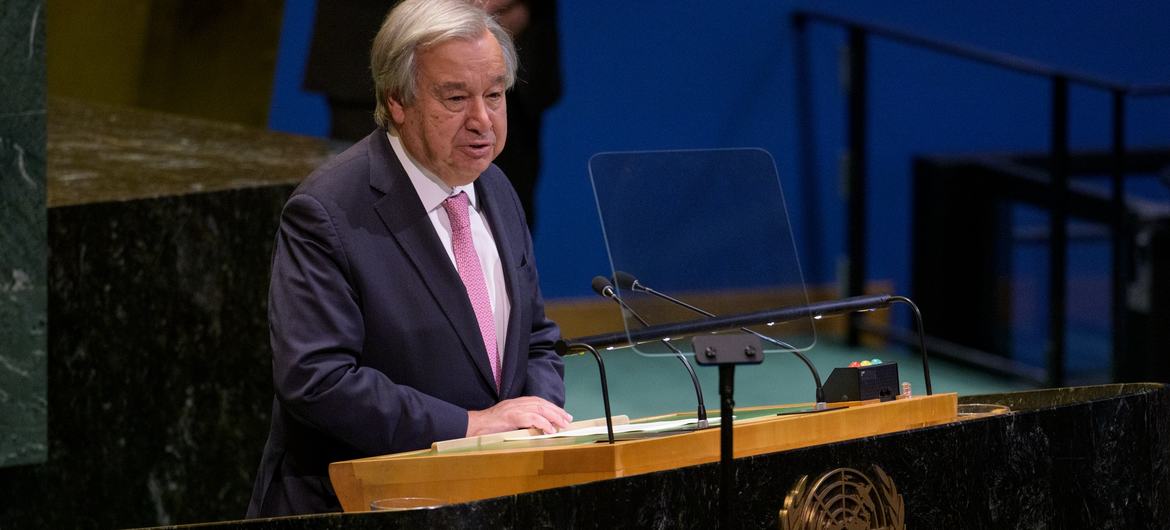
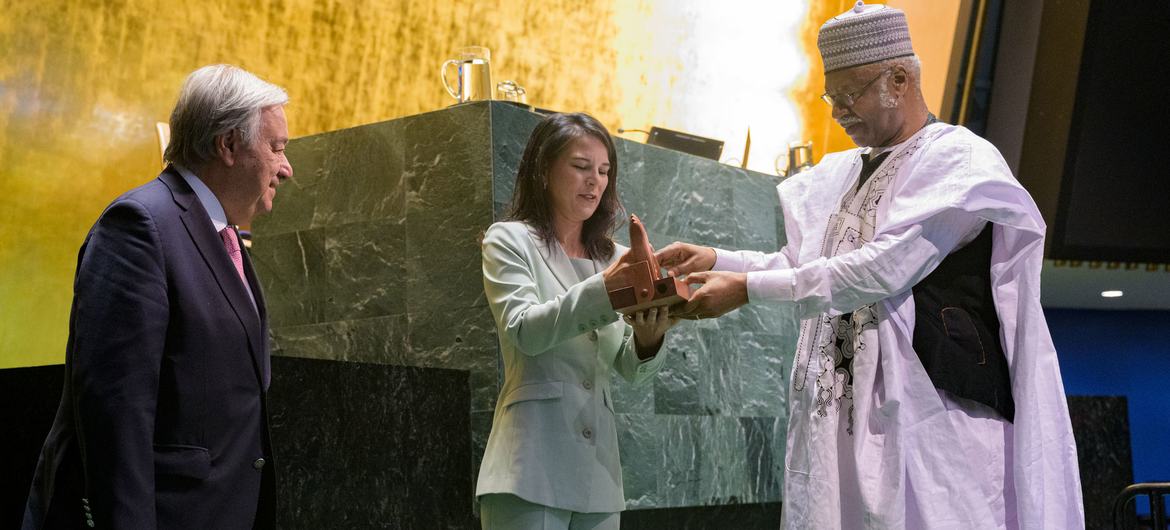
António Guterres issued the call during the annual ceremony on the grounds of UN Headquarters in New York to ring the Peace Bell.

Pursuing the cause of peace is “the beating heart” of the Organization, “but today, peace is under siege,” he said.

“Conflicts are multiplying. Civilians are suffering. Human rights and international law are being trampled – leaving scenes that disgrace our common humanity.” 

Peace requires action

The ceremony comes ahead of the International Day of Peace on 21 September, and the theme this year is “Act Now for a Peaceful World”.

“We know that peace doesn’t happen by accident,” the Secretary-General said. “It is forged – through courage, compromise, and above all, action.”

He called for action “to silence the guns”, amplify diplomacy, protect civilians and uphold the UN Charter.

“We must act – to tackle the root causes of conflict – from inequality and exclusion, to hate speech, and climate chaos. We must act – to invest in prevention, dialogue and trust,” he continued.

“And we must act to support the peacebuilders – especially women and young people – who are on the frontlines of hope.”

Don’t give up: General Assembly President

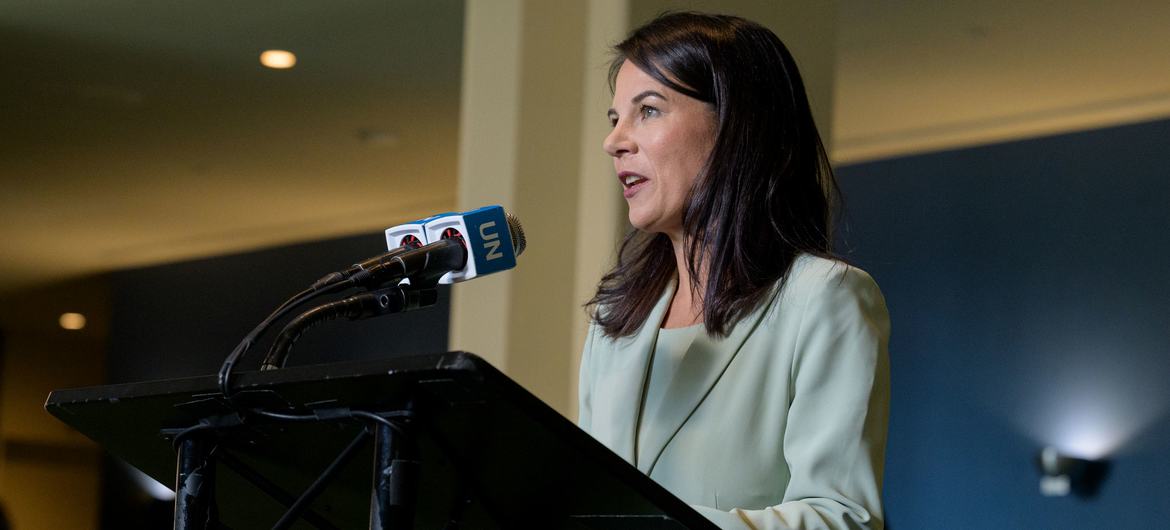
The President of the UN General Assembly, Annalena Baerbock, also addressed the gathering.

Amid numerous conflicts worldwide, she questioned whether there would be less war without the United Nations, responding firmly that “definitely not.”

“This is not the moment to give up,” she said.  “It’s a moment to try even harder.”

‘Let peace ring’

The Secretary-General said that “peace is the most powerful force for a better future,” insisting that “it is within our grasp – if we choose it.”

This is the message of the Peace Bell, he added, cast in 1952 from coins and medals donated by people from all the over the world, “united in their yearning for peace”.

“This Peace Bell reminds us that even the smallest contributions can forge something enduring,” he said.

“Even in a fractured world, we can come together to let peace ring. Let’s answer that call.”

About the Peace Bell

The Japanese Peace Bell was presented as a gift to the United Nations from the UN Association of Japan on 8 June 1954.

On its side are eight Japanese characters that say, “Long live absolute world peace.”  

It is housed in a wooden structure resembling a traditional Shinto shrine.

The bell is rung twice a year on the first day of Spring, at the vernal equinox, and to commemorate the International Day of Peace.   

Source link

DPR Korea: UN report finds human rights situation still dire, a decade on

The rights office, OHCHR, interviewed 314 witnesses who left the DPRK – more commonly known as North Korea – and consulted with several organizations and experts to evaluate the human rights conditions there since 2014.

The situation has not improved, and in many cases has worsened, “bringing even more suffering to the population,” said Spokesperson Liz Throssell, briefing journalists in Geneva.

James Heenan, head of the office working on DPRK, highlighted the severity of the human rights violations, where even a minor offence can result in punishment.

Killed for sharing shows online

We do have credible evidence that individuals have been executed – not  just for watching K-dramas. The crime is for distributing at a certain level, foreign information, foreign media,” he said.

The report found that new laws, policies and practices have been leading to increased surveillance and control over citizens, some of whom have ended up in forced labour camps, as political prisoners.

Working in ‘shock brigades’

In a form of forced labour called “shock brigades,” Authorities in Pyongyang have reportedly used thousands of orphans and street children to work in coal mines and other environments, exposing them to hazardous materials and long working hours, the UN report said.

Mr. Heenan further added that school children are also used to do “backbreaking” work collecting harvests and while they were supposed to be in class.

“The Government says that this is sort of a curriculum to help them learn life skills. But the information we’ve had for many years now is that it meets the qualification of forced labour because the children have no choice,” he said.

The physically demanding and dangerous work of the brigades is also undertaken by people in the military or prison system, as well as by workers from mainly poor families who wish to become party members or improve their social status.

Deaths are reportedly frequent under these conditions but rather than increasing safety measures, the DPRK publicly glorifies deaths as a sacrifice to the leader, according to the report.

Death penalty widely used

In 2014 and 2015, many senior officials were reportedly executed for “anti-State acts,” the report says.

While this trend later decreased, escapees said that from 2020, execution has been used for the distribution of unauthorized media, drugs and economic crimes, prostitution, pornography, trafficking and murder.

Since 2015, there have been six new laws allowing the use of the death penalty for offenses such as a vaguely defined “anti-state” propaganda.

Interviewees said they also witnessed public executions over the last decade. The report explains that the government has organised public trials and executions to instil fear in the population and as a deterrent.

“To block the people’s eyes and ears, they strengthened the crackdowns,” one of the witnesses told OHCHR.

Not enough progress

Escapees expressed that some improvements had been made in the treatment of people in detention facilities. North Korea has also ratified two more human rights treaties, but the report ultimately concludes that it is far from adhering to its obligations under international law.

The DPRK remains more isolated than any other nation, further adding to the difficulty of monitoring and implementing fair human rights standards.

What we have witnessed is a lost decade,” said UN human rights chief Volker Türk. “And it pains me to say that if DPRK continues on its current trajectory, the population will be subjected to more of the suffering, brutal repression and fear that they have endured for so long.”

Source link

Sudan: As children continue to suffer, school remains a distant hope

After more than two years of civil war, more than 25 million people are now acutely hungry and at least 20 million require health services urgently.

The UN World Food Programme (WFP) also warned that displaced families in some areas have not received any aid for three months, as it announced that for the first time, funding shortfalls have forced it to pull back support in areas where it does not have access.

The scale of needs in Sudan are so big that we have to make tough decisions on who receives assistance and who doesn’t. Those are heartbreaking decisions to make,” said WFP’s Leni Kinzli, in an urgent appeal for more international funding to help all those affected by more than two years of war.

Children are especially vulnerable, humanitarians have warned, with malnutrition “surging”, particularly among youngsters and their mothers.

Education the latest victim

According to the UN reproductive health agency UNFPA, and partners working in education, around 13 million of the 17 million youngsters who have remained in Sudan are now out of school.

This includes seven million who are enrolled but unable to attend classes because of the conflict or displacement – plus six million school-age children who haven’t registered for the school year.

Nonetheless, UNFPA said that as of this month, 45 per cent of schools in Sudan – nearly 9,000 – have now re-opened, citing the Global Education Cluster that groups 60 UN and NGO entities.

And while the situation in Sudan remains so dire, going back to school might not appear to be a priority, but aid agencies insist that without it the impact on young lives can be devastating, given how much additional support can be provided in schools, over and above learning.

In schools helped to reopen by UN-partner Save The Children, for instance, additional support includes meals, safe water, sanitation and counselling training for teachers to help youngsters process their trauma.

Picking up the pieces

From November 2024 to July this year, more than two million people have returned to their former homes across Sudan, to some 1,611 locations.

The bulk of these returnees have reached Aj Jazirah (48 per cent), Khartoum (30 per cent), Sennar (nine per cent), Blue Nile (seven per cent) and White Nile (five per cent). The UN migration agency (IOM)’s Displacement Tracking Matrix notes that only around one per cent went to River Nile and West Darfur.

breakdown of IOM data indicates that around 77 per cent (or 1.5 million) returned from temporary homes inside Sudan, while 23 per cent (around 455,000) came back from abroad.

This is a fraction of the more than 4.2 million refugees who crossed into neighbouring countries since war erupted on 15 April 2023, between the Sudanese Armed Forces (SAF) and the paramilitary Rapid Support Forces (RSF).

Other key IOM findings of Sudanese displacement impacting all 18 states:

  • When war erupted, people were uprooted primarily from Khartoum (31 per cent), South Darfur (21 per cent), and North Darfur (20 per cent).   
  • The highest proportion of internally displaced people were in South Darfur (19 per cent), North Darfur (18 per cent), and Central Darfur (10 per cent).
  • Over half (53 per cent) of those fleeing violence were reportedly children.

Case study: Life slipping away

Among the young victims of the conflict, 18-month-old Aysha Jebrellah has been admitted for treatment for severe acute malnutrition in Port Sudan Paediatric Hospital.

Her mother, Aziza, has been by her daughter’s side as medical teams provide lifesaving nutritional support and address the medical complications that Aysha has suffered, linked to her condition.

Aziza was displaced with her family from Khartoum when conflict erupted more than two years ago, fleeing first to Kassala, then moving to Port Sudan where she lives with relatives.

She described how her daughter had diarrhoea and fever for about two weeks before she was admitted to hospital. By that time she had stopped eating and appeared to be slipping away before their eyes.

“When she refused to even taste anything and kept getting weaker, I was afraid I would lose her,” Aziza says. “Now I have hope that she will recover.”

To support health needs in Sudan, the UN World Health Organization (WHO)’s $135 million appeal is just one-fifth funded. “It’s only a fraction of what is urgently needed,” the agency said.

Source link

Afghanistan: Lifesaving services cut as Taliban bars women aid workers

“All of us at the United Nations are suffering from a reinforcement of the ban on females working with us…We are simply unable to operate without females,” said Arafat Jamal, UN refugee agency (UNHCR) Representative to Afghanistan, a day after agencies warned that the de facto authorities’ measures have impacted life-saving assistance for hundreds of thousands of people.

Last Sunday, de facto Afghan security forces prevented national female staff members and contractors of the UN from entering the global body’s compounds in Kabul, the UN Mission in the country, UNAMA, said in a statement on Thursday.

Centres closed

And in light of the restrictions, on Tuesday, UNHCR temporarily closed its cash and support centres for vulnerable Afghans, both at the border and in areas where so many people have been returning from Iran, Pakistan and elsewhere since the start of the year.

The registration process involves providing biometric data, along with screening and interviews – work that would be “entirely impossible without Afghan female workers”, the UNHCR official stressed, noting that more than one in two returnees are women.

This was an operational decision,” Mr. Jamal continued. It is not a decision taken to punish anyone or to make a statement, but simply it demonstrates that we cannot work without female workers in certain circumstances.”

Since the start of the year, some 2.6 million Afghans have returned from neighbouring countries – “many not by choice”, UNHCR said.

Mr. Jamal noted that the pace of returns continues to surge, with nearly 100,000 people crossing back from Pakistan in the first week of September alone, “stretching our capacities and the capacities of this country to the limit”.

Aftershocks reverberate

Echoing those concerns, the UN Children’s Fund (UNICEF) warned that Afghanistan is still reeling from the 6.0 magnitude earthquake that struck Kunar and Nangarhar provinces on 31 August, followed by multiple severe aftershocks.

At least 1,172 children have died, more than half the entire death toll, said UNICEF Country Representative in Afghanistan, Dr. Tajudeen Oyewale.

Briefing journalists in Geneva via videolink, Dr Oyewale described meeting young victims of the disaster in Machkandol in Nangahar, three girls and a young boy rescued from the emergency.

“For the girls it was even more sobering; they were lost; they have lost their families, their homes have been destroyed,” he said. “The family livestock have died. And for these young girls and this young boy, the future is completely bleak.”

The provinces impacted by the earthquake are mountainous and extremely remote, the UNICEF official continued.

Jammed dirt roads

“It is filled with steep terrain, difficult navigation…it took us about three and a half hours’ drive, 40 minutes of which was on paved road and the rest was through rough mountain dirt roads, a lot of turns with jammed with oncoming vehicles and especially with falling rocks on the road.”

Humanitarians warn that the earthquake has compounded Afghanistan’s existing acute problems.

In total, the crisis has claimed more than 2,164 lives, at least 3,428 people have been injured and at least 6,700 homes have either been destroyed or badly damaged.

“Behind these numbers are children left standing alone in the rubble and families torn apart in the blink of an eye… UNICEF is literally going the extra mile and doing whatever it takes to reach these children and families with the support they need,” Dr Oyewale insisted.

What is South-South cooperation, and can it be the gateway to a fairer world?

In practical terms, South-South cooperation is a process whereby developing countries – regardless of their actual geographical location – seek to achieve their individual or shared development goals through the exchange of knowledge, skills, and resources, in partnerships involving governments, regional organisations, civil society, academia, and the private sector.

The experiences and goals of most countries in what is known as the Global South, intersect as they continue to chart their post-colonial future and strive to meet the development needs of their people.

In recognition of mutual cooperation between these nations, the UN established the UN Office for South-South Cooperation (UNOSSC) in 1974, supporting these efforts on the international stage and within the UN system.

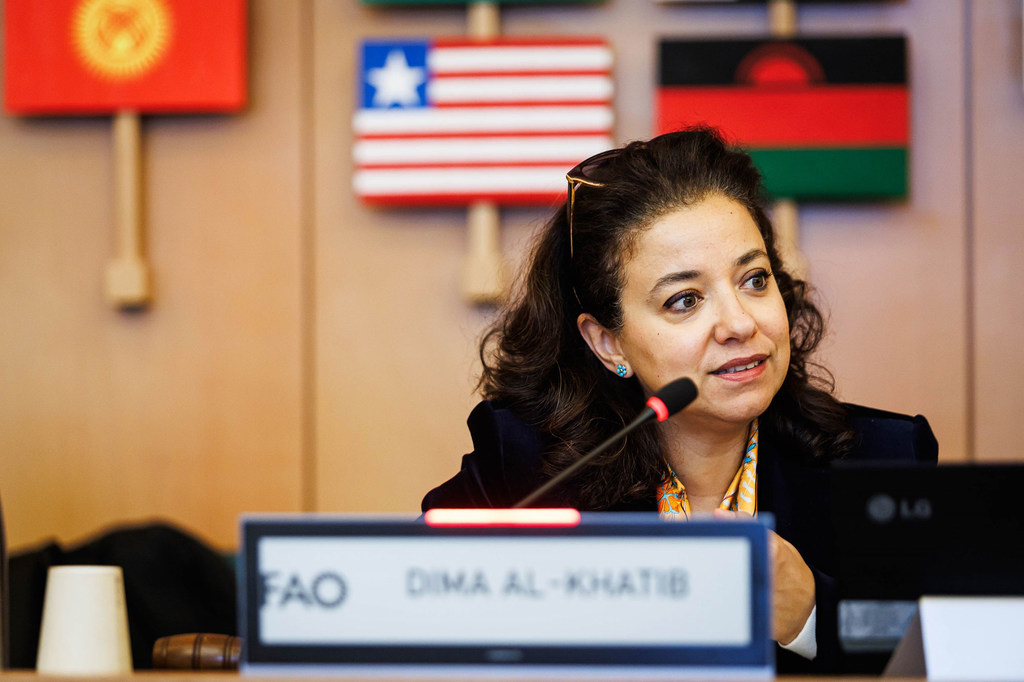
Dima Al-Khatib speaking on South-South and triangular sharing of experiences and innovative approaches in multi-dimensional evaluation, during a conference at FAO Headquarters in Rome, Italy.

Pioneering innovators

Ahead of the International Day for South-South Cooperation, marked on 12 September, UNOSSC Director Dima Khatib told UN News that countries of the South – home to 80 per cent of the world’s population – possess huge levels of untapped human and natural resources, and tremendous potential to drive development forward.

“We believe that countries in the Global South not only have challenges but also have solutions and innovations and we must support, encourage, and highlight their pioneering role in these areas,” she declares.

Nevertheless, the challenges are real and daunting, including rising geopolitical tensions, debt burdens, a widening digital divide, and social complexities, at a time of declining humanitarian and development funding from developed countries.

This harsh landscape is motivating developing countries to look for development financing by cooperating more closely with each other.

Ms. Khatib points to recent studies conducted by her office that demonstrate that South-South cooperation has the potential to change the economic equation, create jobs, and build local capacity, in countries ranging from Ethiopia, to Paraguay, Rwanda and others.

Shot of a 100% electric bus near Expo City in Dubai United Arab Emirates, where the UN Climate Change Conference (COP28) is under way.

Exciting potential in the Middle East

In the Middle East, it’s bearing fruit in areas such as renewable energy, digital transformation, and climate change adaptation. For example, Morocco’s experience with large-scale solar farms has been used as a model for renewable energy projects in parts of sub-Saharan Africa.

Ms. Al-Khatib says that Gulf countries are not only providing financial support in times of crisis but have also become leaders in sharing their expertise.

She points to Saudi Arabia, which shares its extensive experience in seawater purification with countries facing drought, and Masdar City in the United Arab Emirates, which conducts research – and develops capabilities that benefit countries in the Global South.

The UN official also notes that the Islamic Development Bank has been a key driver of progress, facilitating knowledge exchange among its 57 member states and supporting initiatives such as advanced irrigation technologies, sustainable agriculture, and climate-resilient infrastructure.

A driving force for multilateralism

Ms. Khatib notes that countries in the Global South are not only coming together, but also demonstrating their ability to take the lead, citing the India-UN Development Partnership Fund and the India-Brazil-South Africa Fund, both of which are hosted by UNOSSC.

She emphasises that this demonstrates the power of collective action and sends a strong message that cross-border cooperation is both possible and effective.

Amid the tense international political climate the world is witnessing today, South-South cooperation can be a driving force for renewing and strengthening multilateralism, but it is not a replacement for cooperation between all countries.

The senior UN official says there can be no divide between the countries of the Global North and the Global South, but rather, “we must build bridges,” a task to which the United Nations is well suited, given its core mandate to treat all countries equally.

Photo: Dominic Sansoni/World Bank

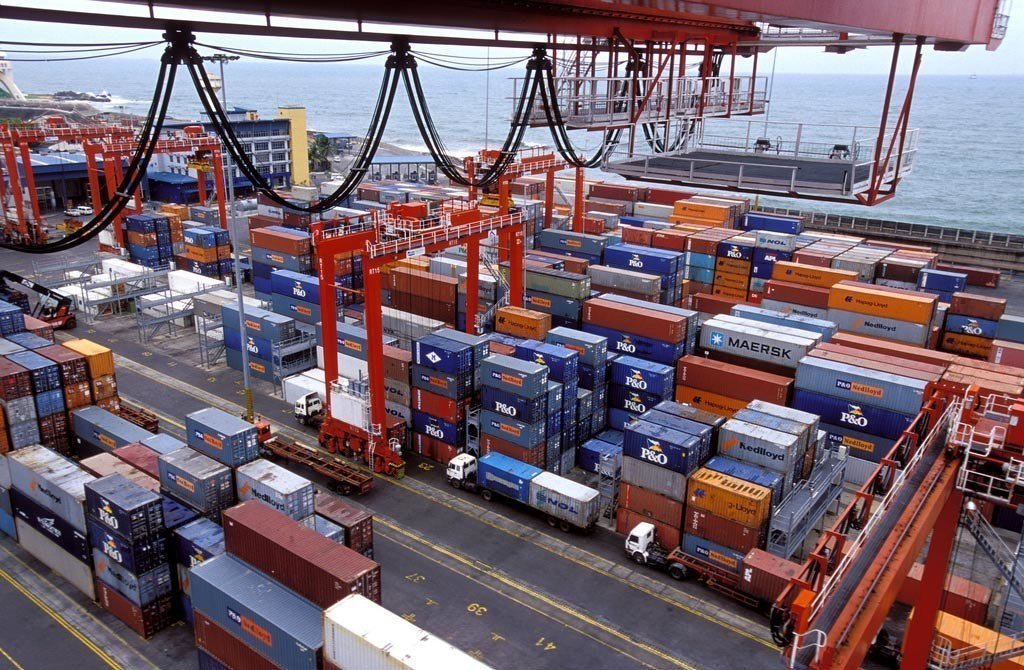
Quay cranes on docks in Sri Lanka. The global economy is critically dependent on the international merchant fleet of carriers and tankers to keep commodities moving swiftly, safely and efficiently.

Source link

World News in Brief: Afghan quake update, diplomacy continues to end Sudan war, UN honours victims of 9/11

Women and children face heightened risks, while operational challenges – including restrictions on female UN staff – threaten life-saving relief efforts.

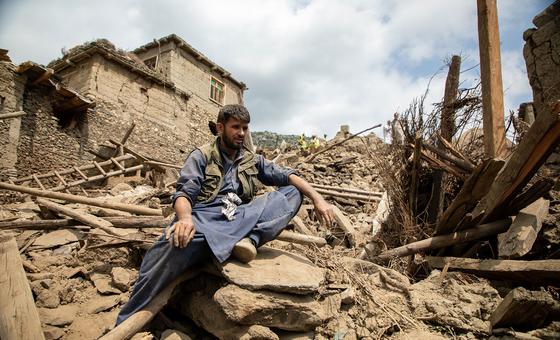
The twin quakes, measuring 6.0 and 6.2, struck on 31 August and 4 September, flattening entire villages in Kunar, Nangarhar, Laghman and Nuristan provinces. Mountainous terrain and landslides blocked key roads, leaving air transport as the only reliable access. 

Assessments indicate over 6,700 homes were destroyed or damaged, forcing most families to shelter in the open without privacy, clean water, or basic services.

Ensuring critical healthcare

UNFPA, the UN reproductive health agency, has deployed health teams to the hardest-hit areas, providing maternal and reproductive healthcare, psychosocial support and counselling. More than 9,500 people have received assistance so far.

“Women and children in particular are extremely traumatized,” said a psychosocial counsellor. “Our goal is to support their emotional and mental health and provide whatever assistance we can, including medicines and dignity kits.”

Among the affected, UNFPA estimates some 11,600 pregnant women face heightened risk due to limited access to health services.

“For pregnant women, a natural disaster can turn an already challenging time into a life-threatening crisis,” said UNFPA Representative Kwabena Asante-Ntiamoah.

World Health Organization (WHO) mobile teams have been deployed to provide trauma care, maternal and child health services, mental health support, immunizations, and emergency nutrition.

The agency has also dispatched 43 tonnes of medical supplies and provided over 4,500 consultations through its clinics.

Sudan: UN envoy heads to region in call for dialogue towards peace

The UN Secretary-General’s Personal Envoy for Sudan, Ramtane Lamamra, has travelled to East Africa to address the ongoing civil conflict there and push for negotiations towards a peace deal.

 In a post on X earlier this week, Mr. Lamamra called on combatants and political actors in Sudan “to engage in constructive dialogue leading to a sustainable solution.”

The goal of the visit is to make progress on the protection of civilians and to strengthen multilateral mediation efforts in the country.

Push for high level consultations

To achieve that, he is working together with the African Union to organize a ministerial-level consultative group meeting in Addis Ababa.

As the rival militaries continue to attack civilians and vital infrastructure, many displaced people and other communities are receiving reduced food assistance, or none at all.

“We continue to reiterate our calls for an end to this conflict that has left 25 million people acutely hungry,” said the UN Secretary General’s Spokesperson Stéphane Dujarric at a press conference on Thursday.

UN honours 9/11 anniversary, stands with New Yorkers

Marking the 24th anniversary of the 11 September terror attacks, the UN reaffirmed its enduring solidarity on Thursday with the people of New York, the city where it has been headquartered for nearly 80 years. 

“New York has hosted the United Nations for 80 years and has been the home to many of our colleagues, as well as to diplomats, staff, and of course all the Secretaries-General. We continue to stand in solidarity with the people of New York, as we did 24 years ago,” said UN Spokesperson Stéphane Dujarric. 

The attacks on the twin towers of the World Trade Center in downtown Manhattan claimed nearly 3,000 lives from over 90 countries and left thousands more injured. 

Decades later, survivors and first responders continue to face long-term health challenges, including respiratory illnesses, cancer, and mental health struggles. 

A place to call home

“New York City has hosted our UN Headquarters for decades and is the place many colleagues call home – so do I,” said Secretary-General António Guterres.

“Today, my thoughts are with everyone who lost loved ones on 9/11, and with all the people of New York City,” he added, in a social media post. 

The UN emphasised its ongoing commitment to commemorate the worst terror attack in US history, honouring the victims, and supporting New Yorkers as the city continues its journey of resilience and healing. 

Source link

Gaza City: Daily bombardment, more displacement amid escalating military offensive

UN Spokesperson Stéphane Dujarric said people are once again on the move after Israel placed the entire city under displacement orders. Aid partners recorded more than 25,000 displacements between Sunday through Wednesday.

Some critical services have already been suspended while some humanitarian facilities have suffered severe damage, disrupting operations and the delivery of essential services.

Aid partners suspend activities

“Our partners working on health, report that some of them have had to suspend activities at primary healthcare centres, while partners working on nutrition say that 12 out of 49 outpatient therapeutic sites have halted services amid the ongoing airstrikes in Gaza City,” he said,

At least two community kitchens have also suspended operations, and three others have had to relocate within the city.

Furthermore, UN partners working on education are concerned that 95 temporary learning sites in northern Gaza serving about 25,000 children may be at imminent risk of closure due to displacement orders and ongoing insecurity.

Child malnutrition worsens

UN child rights agency UNICEF has also warned that child malnutrition in the Gaza Strip continues to worsen at an alarming rate. 

The percentage of children identified as acutely malnourished increased to 13.5 per cent in August, from 8.3 per cent in July – or 12,800 boys and girls.

Mr. Dujarric said UNICEF has been working to scale up the entry of essential nutrition supplies and distribute them, alongside nutrition partners, at about 140 sites across the Gaza Strip.

“While stocks of ready-to-use therapeutic food have recently increased, the current quantities of other critical nutrition supplies for infants and pregnant and breastfeeding women are wholly insufficient,” he said.

Meanwhile, almost half of all functioning hospitals are located in Gaza City, including half of all intensive care unit beds for the entire Gaza Strip, according to the World Health Organization (WHO).

With the Israeli offensive already underway, the Gaza Strip cannot afford to lose any of these remaining facilities, the UN agency said.

Impediments to aid delivery continue

These developments are happening as delays and impediments to humanitarian movements inside Gaza continue.

Missions still take long hours to complete, even when they are approved in advance by the Israeli authorities, meaning that teams have no choice but to wait on roads that are often dangerous or congested.

Additionally, the UN Office for the Coordination of Humanitarian Affairs (OCHA) has recently observed an increase in denials of the participation of Palestinian staff in missions, including both drivers and personnel.

Mr. Dujarric noted that denials are often communicated at the last minute, resulting in operational delays as alternatives must be quickly identified.

“What we need is full facilitation of the work and movement of humanitarian actors into and throughout the Gaza Strip. This must include unimpeded access to the north and to the south alike,” he said, adding that “every delay can cost lives.” 

‘Wars, disasters, displacement, hunger’ continue to burden Myanmar

Four years after the military coup which deposed the democratically elected government, Myanmar’s civil conflict grinds on, leaving millions displaced and without a home.

The suffering of millions of people across Myanmar is immense,” said UNHCR chief Filippo Grandi. “With aerial bombardments, destruction of property, and forced recruitment, they live in daily fear for their lives.”

He added that “civilian men, women and children must be protected from violence, and solutions found so that they can choose to return home in safety and dignity.”

Many crises in need of response

A brutal civil war is not all Myanmar has to face.

In March, a 7.7 magnitude earthquake hit the country affecting multiple regions including the capital, Nay Pyi Taw. The UN relief chief Tom Fletcher said then on X that the humanitarian response “has been hampered by lack of funding.”

Mr. Grandi, who visited the affected communities earlier this year, urged wider humanitarian access and discussed solutions for the forcibly displaced.

“Millions of people forcibly displaced within the country and as refugees throughout the region, want nothing more than to be able to return home. They demand – and are entitled to – the safety and security that comes with peace.” Mr. Grandi said.

Homes destroyed

Thousands of people also had their homes destroyed after floods swept through many regions in July.

“Wars, disasters, displacement, hunger: the forgotten plight of so many people in Myanmar, like the Rohingya, never ends,” Mr. Grandi said in a post on X.

In the last year and a half, 150,000 Rohingya, a mainly Muslim minority in the majority Buddhist country, have fled to neighbouring Bangladesh. This marks the largest exodus to the country since 2017, when 750,000 Rohingya sought refuge from the violence in Rakhine state.

A call for solutions

UNHCR works with other UN agencies, NGO partners and communities in Myanmar to address the basic needs, physical safety and well-being of forcibly displaced and stateless people.

But many communities still suffer from lack of access to vital aid. This year’s UN response plan for Myanmar is currently only funded at 22 per cent.

Later this month in New York, Mr. Grandi will attend a high-level conference on the Rohingya and other minorities in Myanmar, calling for greater regional and international efforts to address the crisis.

All parties – with the support of the international community – must engage seriously to find solutions to their plight. This is particularly needed for the Rohingya, who have not only been attacked and displaced, but deprived of their basic rights for far too long,” the UNHCR chief said.

Source link

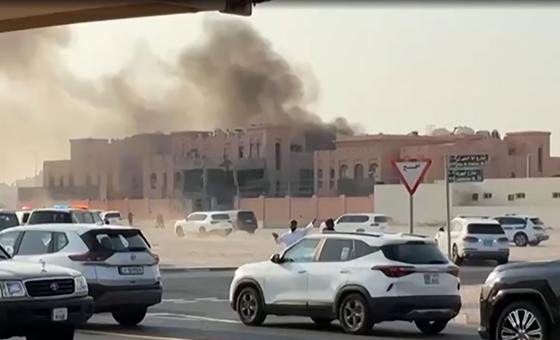
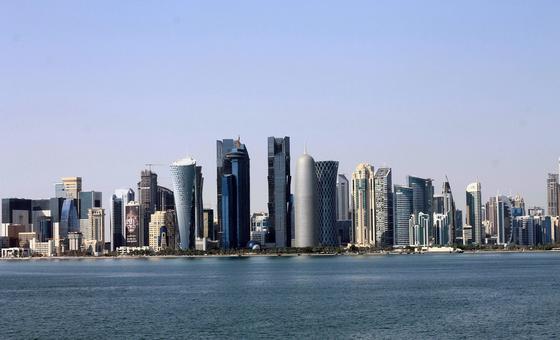
Israeli strike in Doha marks ‘alarming escalation’, warns top UN official, in call to uphold diplomatic norms

Rosemary DiCarlo described Tuesday’s strike in a residential area of the Qatari capital – which targeted Hamas’s political leadership killing several affiliates along with a Qatari security officer – as potentially opening a “new and perilous chapter in this devastating conflict, seriously threatening regional peace and stability.

The attack occurred on 9 September in residential compounds reportedly housing members of the Hamas’ political bureau, including the son of its chief negotiator, Khalil al-Hayya.

While Hamas leaders survived, the organization said, the incident disrupted ongoing negotiations over a US-mediated ceasefire and hostage release agreement to end the war in Gaza.

Respect sovereignty

The sovereignty and territorial integrity of any country, including Qatar – a valued partner in advancing peacemaking and conflict resolution – must be respected,” Ms. DiCarlo told ambassadors.

She urged all parties to exercise restraint and reaffirmed the need to preserve negotiation and mediation channels to prevent further suffering in Gaza and the wider region.

Israel claimed responsibility for the strike, with Prime Minister Benjamin Netanyahu describing it as “a wholly independent operation” following a deadly attack on civilians in Jerusalem on 8 September, which Hamas said it carried out.

Qatar, the Gulf Cooperation Council, the League of Arab States, and the Organization of Islamic Cooperation condemned the action and expressed concern over further escalation.

Confidence undermined

Ms. DiCarlo told ambassadors that Israel’s strike came “at the height of ongoing consultations.”

Any action that undermines the work of mediation and dialogue weakens confidence in the very mechanisms we depend on for conflict resolution,” she said, stressing that durable solutions in the Middle East cannot be achieved through further violence.

She called for renewed commitment to diplomacy, warning that the urgency of a ceasefire and hostage release has never been greater.

I call on all stakeholders to exercise utmost restraint at this sensitive time and recommit to diplomacy. The urgency of a ceasefire and hostage release deal in Gaza has never been greater. Strike a deal. Free the hostages. End the suffering of the people of Gaza.”

Gaza crisis spiralling

Meanwhile, the humanitarian and security situation in Gaza and the occupied West Bank remains critical.

Since the conflict in Gaza erupted in October 2023 – following attacks by Hamas and other Palestinian armed groups on communities in southern Israel, tens of thousands have died – mostly civilians – infrastructure and basic services are largely destroyed, and the enclave lies in ruins while a new offensive to take Gaza City is ongoing.

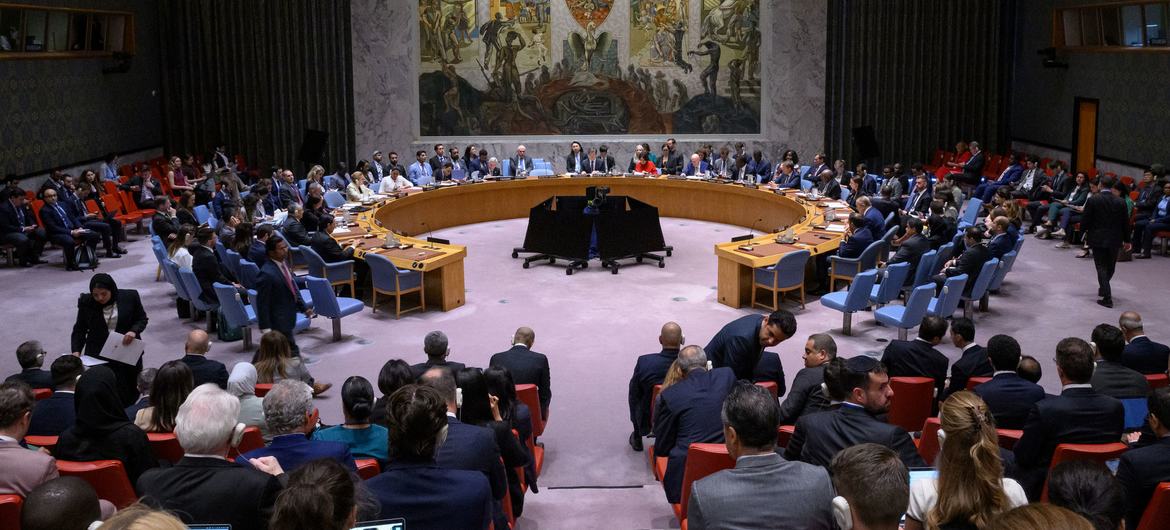
The UN Security Council meets to discuss the situation in the Middle East in the aftermath of an Israeli strike in Doha, the capital of Qatar..

Security Council press statement

Ahead of Thursday’s session, the Security Council issued a press statement expressing condemnation of the strikes in Doha and deep regret over the loss of civilian life.

The statement reaffirmed support for Qatar’s sovereignty and territorial integrity and acknowledges the country’s key role in mediation efforts to end the devastating war, alongside Egypt and the United States.

It emphasised that releasing hostages – including those killed by Hamas – ending hostilities, and ensuring civilian protection in Gaza, remain the Council’s highest priorities.

It also on all parties to seize ongoing diplomatic opportunities for peace.

Source link

MIDDLE EAST LIVE: Israeli attack on Hamas leaders in Doha ‘potentially opens a new and perilous chapter’

The UN Secretary-General has condemned an Israeli strike targeting Hamas leaders in Doha, the capital of Qatar, on Tuesday, while highlighting the “very positive role” played by the country in achieving a ceasefire in Gaza and securing the release of hostages.

Source link

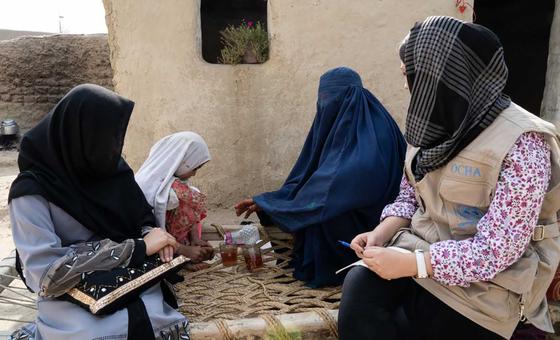
Afghanistan: New restrictions on women nationals working for UN, put aid efforts at risk

These measures are putting life-saving humanitarian assistance and other essential services for hundreds of thousands of people affected by a recent deadly earthquake at risk, the UN Assistance Mission in Afghanistan (UNAMA) warned in a statement.

On Sunday, the de facto security forces prevented women Afghan staff members and contractors from entering UN compounds in the capital, Kabul.

More offices affected

This was extended to field offices across the country, following written or verbal notifications from Taliban leadership.

Furthermore, security forces are visibly present at the entrances of UN premises in Kabul, Herat, and Mazar-i-Sharif to enforce the measure.

This is particularly concerning in view of continuing restrictions on the rights of Afghan women and girls,” the statement said.

Since returning to power four years ago, the Taliban have issued numerous edicts impacting women’s rights such as prohibiting girls from attending secondary school and banning women from most jobs, including working with non-governmental organizations (NGOs).

Travel also curtailed

The UN has also received reports of security forces attempting to bar women national staff from travelling to field locations, including to support women and girls as part of the response to the earthquake that struck eastern Afghanistan last month.

They are also being blocked from accessing operational sites for Afghan returnees from Iran and Pakistan.

Lift the restrictions

The UN is engaging the de facto authorities and calls for the immediate lifting of restrictions to continue critical support to the Afghan people, noting that the current actions disregard “previously communicated arrangements”.

Such arrangements have enabled the United Nations to deliver critical assistance across the country, through a culturally sensitive and principled approach ensuring the delivery of assistance by women, for women,” the statement said.

In the interim, UNAMA and UN agencies, funds and programmes in Afghanistan, have implemented operational adjustments to protect staff and assess options for continuing their essential work.

The statement concluded by recalling that the prohibition on the movement of UN staff and the obstruction of UN operations is a breach of international rules on the privileges and immunities of the organization’s personnel. 

Source link

Ukraine: Guterres greatly concerned over reported Russian incursion into Polish airspace

Speaking at the regular news briefing in New York, UN Spokesperson Stéphane Dujarric said António Guterres is following the ensuing diplomatic fallout across the NATO military alliance “with great concern” the incident, which reportedly occurred amid a large-scale Russian drone and missile attack on Ukraine.

There is an urgent need for a full, immediate and unconditional ceasefire and for a just, comprehensive and sustainable peace in Ukraine – one that fully upholds Ukraine’s sovereignty, its independence and its territorial integrity, in line with the Charter of the United Nations, international law and relevant UN resolutions,” Mr. Dujarric said.

Multiple drones shot down

According to media reports, Polish authorities, with the support of NATO allies, shot down multiple Russian drones that crossed into the country overnight – the first time Russian drones have been downed over NATO territory.

Poland’s Prime Minster Donald Tusk warned that it put his nation at its closest point to open conflict since World War Two.

Poland joined the North Atlantic Treaty Organization, NATO, in 1999 along with Hungary and the Czech Republic as part of the military alliance’s first expansion into Central and Eastern Europe.

While some violations of Polish airspace have been reported since Russia’s full-scale invasion of Ukraine in 2022, the overnight incident highlights the conflict’s growing regional impact.

Media also reported Russia’s Defense Ministry stating that the strikes targeted Ukraine’s military-industrial sites in its western regions and that there were no intended targets in Poland.

The Secretary-General and the UN continue to urge all parties to respect international law.

Mr. Dujarric noted that the situation “again underlines the regional impact and real risk of expansion of this devastating conflict,” reiterating the UN’s call for protection of civilians and adherence to humanitarian norms.

Source link

Nepal crisis: Army deployed as death toll rises amid political turmoil

The unrest began Monday as a self-styled “Gen Z protest” against corruption, nepotism and restrictions on social media. It quickly escalated after security forces opened fire on the crowds.

By Tuesday, protesters had stormed and torched parliament, the Supreme Court and multiple government offices, including Singha Durbar – the central administrative complex. Homes of political leaders were attacked, police stations overrun, and Tribhuvan International Airport briefly closed.

In addition, media outlets and schools were set on fire, while the Ministry of Health and Population was also destroyed, including the National Health Emergency Operation Centre.

UN chief urges dialogue

UN Secretary-General António Guterres said he was “deeply saddened by the loss of life” and urged restraint, dialogue, and a thorough investigation into the violence.

“I call on the authorities to comply with human rights law,” he posted on social media late on Tuesday (New York time).

“Protests must take place in a peaceful manner, respecting life and property.”

Volatile security situation

According to media reports, the updated toll includes both protesters and police, as well as people killed in fires during the demonstrations. Many remain unaccounted for, with hospitals reporting critically injured patients.

The turmoil also triggered jailbreaks in several locations, with some inmates still at large.

Some accounts suggest demonstrations may have been infiltrated by outside actors, further complicating the volatile security environment.

Efforts to restore order

The army assumed control of nationwide security late Tuesday local time, deploying troops across the Kathmandu Valley and imposing movement restrictions to stabilise the situation.

Checkpoints were established, and people have been urged to stay home except for essential travel.

Media also reported the army recovering some of the weapons looted from police personnel, while youth groups helped apprehend escaped prisoners and return firearms. Some inmates voluntarily surrendered.

Tribhuvan International Airport has since reopened, and some police stations are back in operation.

Country at a crossroads

Even amid the chaos, some youth groups were seen clearing debris from their neighbourhoods.

Behind the immediate turmoil, talks are reportedly underway on the possible formation of an interim government to steer the country through the crisis. Discussions also include the dissolution of parliament, investigations into illegally acquired assets, and reform of key institutions.

Source link

Gaza: Ceasefire urgently needed as civilians left with ‘no safe place’ to go

“We are witnessing a dangerous escalation in Gaza City, where Israeli forces have stepped up their operations and ordered everyone to move south,” said the Humanitarian Country Team in the Occupied Palestinian Territory.

Nearly one million people are now left with no safe or viable options – neither the north nor the south offers safety.

The warning comes two weeks after famine was confirmed in Gaza Governorate.

Starving and exhausted

According to latest figures from the World Health Organization-led Health Cluster, 361 Palestinians have died due to malnutrition since the war began nearly two years ago, including 130 children.

Over half a million people are in living with catastrophic conditions marked by starvation, destitution, and death.

Civilians who try to leave northern Gaza face dangerous and barely passable roads, overcrowded shelters, and prohibitive transport costs – sums that most families simply cannot afford.

“Survivors in Gaza are exhausted,” aid agencies said, underscoring that both civilians and the health infrastructure they rely on “must never be targeted.”

Hospitals overwhelmed

Hospitals are overwhelmed and collapsing under the strain.

Al-Shifa and Al-Ahli facilities in Gaza City are operating at nearly three-times capacity, with mass casualty incidents averaging eight per day.

If a wider Israeli offensive proceeds, the Gaza Strip could lose half its remaining hospital beds, the health agencies warned.

Aid restrictions continue

The Humanitarian Country Team also noted ongoing Israeli impediments on aid, stating that “current levels of humanitarian support are wholly insufficient.”

Fuel, water, and supply routes must remain open and uninterrupted, agencies said, warning of “devastating consequences” if access is further obstructed.

“To families in Gaza: the humanitarian community will remain in Gaza City for as long as we can and will remain across the Strip, doing all we can to bring aid and deliver lifesaving services,” they said.

To the international community: Act. Call for an immediate ceasefire. Uphold international humanitarian law, including the release of hostages and those arbitrarily detained. This catastrophe is human-made, and responsibility rests with us all.”

Source link

80 million more children benefiting from school meals, WFP reports

The number of children receiving school meals through government-led programmes has gone up by 20 per cent since 2020, found the latest edition of the WFP’s flagship biennial report The State of School Feeding Worldwide.

Now, nearly 80 million more children are able to enjoy nutritious meals at school, bringing the global total to approximately 466 million.

Beyond health and diet, national programmes can benefit employment, agriculture, and other sectors.

“School meals are so much more than just a plate of nutritious food – important as that is. For the vulnerable children who receive them, they are a pathway out of poverty and into a new world of learning and opportunity,” said Ms. McCain.

“They are proven to be one of the smartest, most cost-effective investments any nation can make to improve the long-term health, education and economic prosperity of future generations,” she added.

Example of what’s possible

The increase in the number of children receiving school meals comes thanks to the expansion of these programmes internationally, and especially by countries that are part of the School Meals Coalition, a network led by over 100 governments with the WFP as its secretariat.

Global funding for school meals has more than doubled, rising from $43 billion in 2020 to $84 billion last year. Africa is leading the surge with an additional 20 million children in the continent now fed through national programmes but domestic funding still remains lower in low-income countries.

“The surge in nationally funded school meal programmes is a powerful sign of what’s possible, even in challenging times. But in low-income countries, where needs are greatest, progress remains at risk as global aid shifts and domestic resources fall short,” said Carmen Burbano, director of school meals at WFP.

Meals improve learning outcomes

Children who are hungry might not attend school or could struggle to focus even if they do, according to the report. Providing meals at school can both incentivize attendance and help students stay engaged and more easily absorb educational material.

The report found that school meals are a significantly more effective way to improve the quality of education compared to other popular programmes and policies like teacher training and tech inputs.

A nutritious diet has also been associated with an increased attention span, higher cognitive function and better attendance.

“It’s only now that we’re really recognizing that the wellbeing of school children and adolescents is key to their learning ability,” said Professor Donald Bundy, co-editorial lead for the report, at a press briefing on Wednesday.

A catalyst for the economy

The report estimates that delivering school meals to 466 million children generates around 7.4 million cooking jobs globally, with further employment across logistics, farming, and supply chains.

On a national level, school meal programmes typically generate approximately 1,500 jobs for every 100,000 children.

Preliminary findings in some African countries suggest that the programmes are cost-beneficial in terms of the gains obtained in the education, health and nutrition sectors. In Malawi, for example, every $1 invested brought economic benefits ranging to $2 to $18 depending on the district.

Local procurement of school food can also create reliable and predictable markets for smallholders and family farmers, which ultimately encourages crop diversification, boosts rural economies, and fosters sustainable agricultural practices.

Haiti: UN relief chief implores ‘we have to do better’ to support gang-ravaged nation

“I’m ashamed on behalf of the world that we cannot find it in ourselves to be more compassionate, to be more kind, to recognise what people here are going through,” said Tom Fletcher, who heads the UN emergency relief agency, OCHA, during a visit to the Caribbean nation.

“I listened to people whose lives have been destroyed by brutal violence,” he said. “They are desperate for security, dignity, hope. I refuse to believe we cannot do better for them.”

A country of 11 million, Haiti continues to face a severe humanitarian and protection crisis amid a cholera outbreak and rising malnutrition rates.

Half of all Haitians face food insecurity and unprecedented levels of forced displacement which tripled last year to over one million people, according to an update by OCHA, which noted that large scale displacements have continued into 2025.

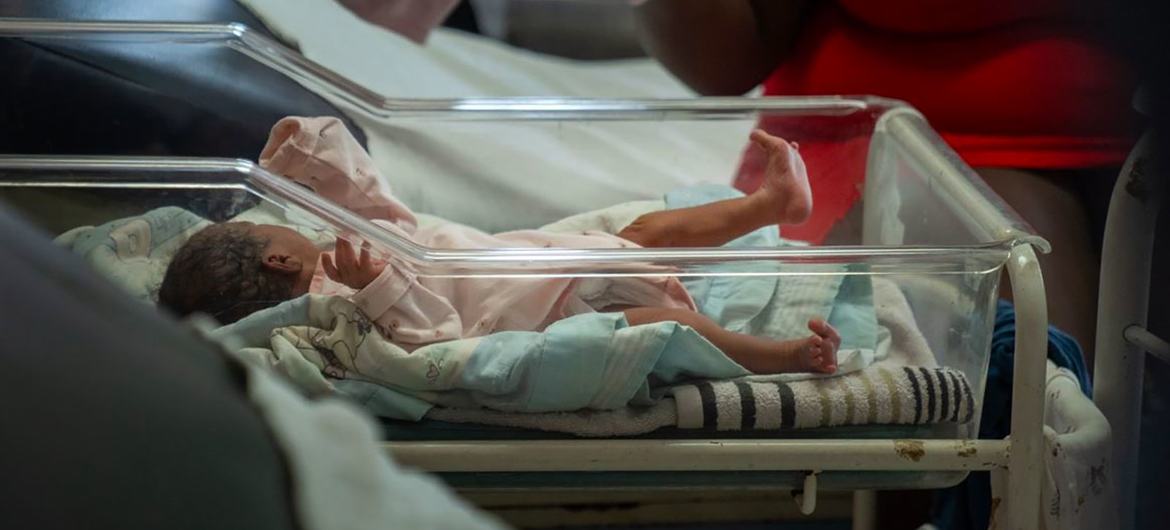
A baby is cared for at a health facitlity in Port-au-Prince, Haiti.

‘They don’t want to be here’

For more than a year, gangs have taken over large swaths inside and outside the capital, Port-au-Prince, raping, killing, pillaging civilian infrastructure, including schools and hospitals, as well as kidnapping child recruits to fight.

“Right now, up to half of all armed group members are children,” OCHA stated. “Fear permeates daily life” as families are forced to leave their homes and seek shelter, food and safety.

“They’ve been displaced multiple times by violence,” said Mr. Fletcher, who met with authorities, partners and affected families living in makeshift shelters. “They want to live their lives like anyone else.

“They don’t want to be here. They want to rebuild their lives. They want education for their kids. They want healthcare they need. They need clean water.”

Living ‘in misery’

Some displaced families shared their plight, including Roudy Jean, who said “we need to be able to live in a normal way, like in the rest of the world.”

Cashmina Jean-Michel, a woman displaced by gang violence, said she once owned a beauty salon and employed staff, but lost it all.

“At 5am, there was a lot of shooting,” she recalled. “I lost everything, my belongings, my business, but the safety of my children was my absolute priority. I had no choice but to get them and run immediately. Today, I live in a very cramped space in misery, where I can only keep one of my children while the others must stay with friends.”

Many families have been displaced two or three times, the UN relief chief said.

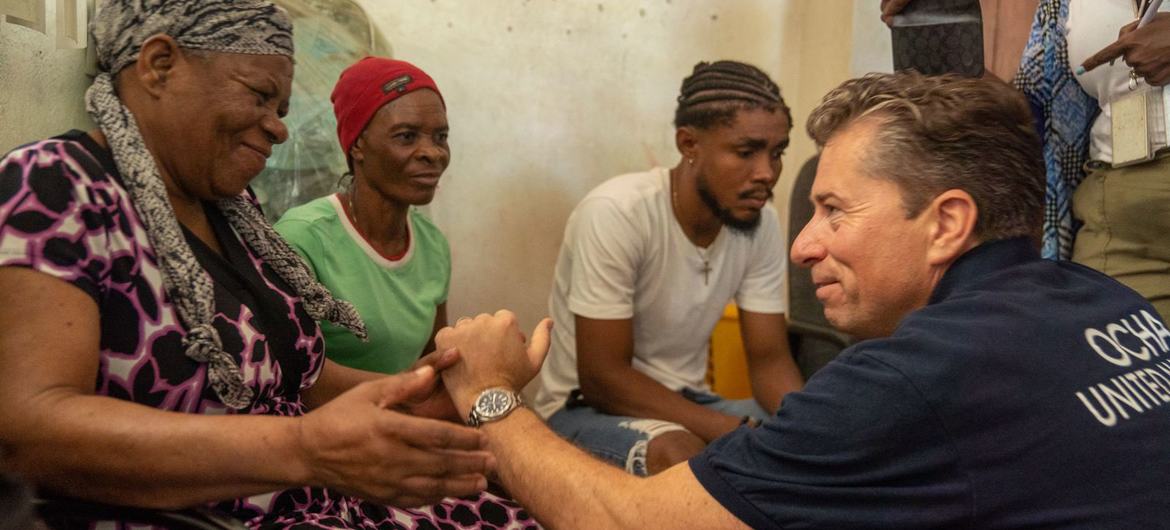
The UN’s relief coordinator, Tom Fletcher, meets a family in Port-au-Prince, Haiti.

Food and shelter shortages

Innocent Fagneau, vice-president of a site for internally displaced people like Mr. Jean and Ms. Jean-Michel, described current challenges.

“Now, with the quantity of people we currently have, this space was not designed for this use,” he said.

“There’s also a food problem at this site. The quantity of food we receive to distribute, for example, we finish the amount by noon, but what about 3 or 4pm? People should still be able to eat something.”

Rebuilding lives, overcoming despair

The OCCED’H youth centre provides rays of hope, specifically targeting adolescents and youth from communities affected by armed violence and those living in sites for internally displaced people in the Port-au-Prince metropolitan area, where access to education and training opportunities is extremely limited.

The centre offers practical and vocational training to nearly 300 students, among them Phanie Sagesse, who is learning leather crafting.

“I love to develop my creative skills, and if you take leathercraft seriously and put all your heart in what you are doing,” she said, “it can help you achieve economic independence.”

‘We have to be here’

On a visit to the youth centre, Mr. Fletcher said “we can find ways to push back against this crisis, against a sense of despair and deterioration because here…these young people, they are cutting hair, they’re doing manicures, they’re learning to pedicure, they’re making bracelets, they are learning to fix motorbikes. But, ultimately, they’re rebuilding their lives.”

He said the world must lend a hand in that regard.

“We can see that people can build back their communities as well, not just as individuals, but as a society, as Haiti, and ultimately, that’s why we have to be here,” he said. “That’s why the world must be here, helping them to rebuild from always despair from the ruins of their lives.”

‘This is not enough’

While UN agencies scramble to provide support and essential goods and services, Mr. Fletcher said more must be done.

To date, the humanitarian appeal for Haiti remains severely underfunded. Of the $908 million required to address urgent needs, only 11 per cent is funded, leaving a $800 million funding gap.

“This is not enough,” the UN relief chief said. “I can’t believe that we’re struggling so much to raise the funds necessary to support these families as they try to rebuild their lives, but we have to be there for them. We have to do better.”

Source link