Protecting children in war is key to lasting peace, top UN envoy warns

In an exclusive interview with UN News, Special Representative for Children and Armed Conflict, Vanessa Frazier, reflected on the alarming rise in grave violations against children and the urgent need to safeguard their future.

“The recruitment and use of children is still one of the most widespread and devastating violations we face. In 2024 alone, over 7,400 children were recruited or used by armed forces and armed groups, and those are only the verified cases,” Ms. Frazier told us, just ahead of Thursday’s international day against the use of child soldiers.

Over the last 30 years, we have separated over 220,000 children from armed gangs,” she emphasised. 

Growing crisis across conflicts

Her office monitors approximately 26 conflict situations around the world, and the numbers tell a grim story.

“The violations are most prevalent in the Democratic Republic of the Congo, Nigeria, Somalia, Syria, and Myanmar,” Ms. Frazier explained. 

Interview with Vanessa Frazier, Special Representative of the Secretary-General for Children and Armed Conflict, for UN News.

“But we’re also seeing worrying trends in Sudan, where children are specifically targeted because they are seen as useful – as border guards, as workers, even as fighters.”

Behind those statistics, she stressed, are young lives forever altered. “Each number in our report represents a child whose innocence has been interrupted,” she said.

From abduction to reintegration

Beyond documenting violations, Ms. Frazier’s office engages directly with combatants to negotiate the release of children and their safe return home.

“One of the strengths of our mandate is that we can negotiate directly with armed groups for the handover of children,” she explained. “Once separated, [children’s agency] UNICEF and our partners work on their reintegration, ensuring they receive psychosocial support, access to education, and the chance to reclaim their childhood.”

An eleven-year-old boy sits in the dormitory of a reintegration centre for recently demobilized child soldiers in Goma, DR Congo. (file)

But reintegration is often fraught with stigma. “Girls who return may be shunned by their communities, especially those who come back with children,” she said. “For societal reasons, some girls cannot be fully reintegrated are considered damaged goods.”

Prevention and accountability 

For Ms. Frazier, prevention is the ultimate goal.

“Prevention is better than cure,” she told us. “You know, this is why we really do advocate that even in times of war and armed conflict, children must remain in school. When they are out of school, they become very vulnerable to recruitment – whether forced or not.”

Accountability, too, plays a key role. The Special Representative – who previously served as Malta’s Ambassador to the UN, including an influential period on the Security Council – pointed to recent prosecutions before national courts and the International Criminal Court (ICC) as vital deterrents.

One of the greatest tools of deterrence is justice and accountability,” she highlighted”. “When warlords or armed group leaders are prosecuted and sentenced for recruiting children – including in national courts and at least three cases before the International Criminal Court – it sends a powerful message. Justice and accountability act as strong deterrents, showing armed groups that this crime carries real consequences.”

A 13-year-old girl formerly associated with an armed group in the Central African Republic holds a mock weapon.

Her conviction is rooted in field experience – from meeting survivors of Boko Haram’s abductions in Nigeria to listening to women once enslaved by the Lord’s Resistance Army in Uganda. 

“You hear about a 13-year-old girl holding her baby, and you realise how deeply conflict steals childhood,” she said. 

“When you hear these stories, you realise those numbers in our reports are individuals – children who were supposed to have their whole future ahead of them,” she said. 

Epitome of innocence 

Ms. Frazier spoke with emotion about why she is so committed to this cause.

“Children are the epitome of innocence,” she said. “They have not taken sides in any war, yet their innocence and childhood have both been interrupted. Children should never be treated as collateral of war.”

Children are the epitome of innocence

She added that the path to lasting peace begins with protecting and empowering those same children.

“The sustainability of peace depends on children’s right to take it forward. When they are brought back from conflict, they must have access to education and the chance to be fully integrated into society — to aspire to become doctors, nurses, lawyers, politicians, engineers — and that can only be achieved through education.”

Messages of hope

The Special Representative outlined her campaign Prove It Matters, which invites children affected by war to send messages to leaders, folded into origami doves, the universal symbol of peace.

“One child wrote to me, ‘I still have hope for a peaceful world. Never again a girl being a wife of a guerrilla fighter. Never again being part of armed groups. Let’s save childhoods and families too.’ It’s such an innocent plea, but it is what we are about,” she said.

A young man and former child soldier in Sultan Kudarat, Philippines, plans to return to school.

As the conversation ended, Ms. Frazier reiterated her conviction that education, justice and hope remain the pillars of peace.

“Children should be able to continue with their innocence even during times of conflict,” she said. “It is about ensuring a sustainable and peaceful future for the world.”

Source link

In Sudan, sick and starving children ‘wasting away’

As heavy fighting continues between former allies the Sudanese Armed Forces and the paramilitary Rapid Support Forces and their allies, the UN Children’s Fund (UNICEF), said that in parts of North Darfur more than half of all children are acutely malnourished.

The warning follows the release of new data from the IPC, a UN-backed global food security monitoring system, from three localities there – Um Baru and Kernoi and At Tine – indicating “catastrophic” malnutrition rates.

“Extreme hunger and malnutrition come for children first, the youngest, the smallest, the most vulnerable,” said UNICEF spokesperson Ricardo Pires. “In Sudan, it’s spreading… These are children between six months and five years old, and they are running out of time.” 

Starvation spreading

The UN agency stressed that famine thresholds have been surpassed in locations not previously considered at risk, such as Um Baru and Kernoi. 

Conflict, mass displacement, the collapse of services and blocked access which have sparked starvation alerts for these localities exist “across vast swathes of Sudan”, Mr. Pires insisted. 

If famine is looming there, it can take hold anywhere,” he warned.

Mr. Pires also warned of the prevalence of disease as a further threat to children’s survival: 

“These children are not just hungry; nearly half of all children in At Tine had been sick in the previous two weeks. Fever, diarrhoea, respiratory infections, low vaccination coverage, unsafe water and a collapsing health system are turning treatable illnesses into death sentences for already malnourished children.”

He called on the world to “stop looking away” from Sudan’s children, warning that more than half of the youngsters in North Darfur’s Um Baru are “wasting away while we watch”. 

“That is not a statistic. Those are children with names and a future that are being stolen,” the UNICEF spokesperson said.

Nearly three years since war erupted between the once-allied Sudanese Armed Forces (SAF) and the Rapid Support Forces (RSF), 13.6 million people have fled their homes, including 9.1 million displaced within the country. 

Healthcare under attack

Dr Shible Sahbani, the UN World Health Organization (WHO)’s representative in Sudan, told reporters that while the displaced require “urgent” care, the health system has been “ravaged by attacks, loss and damage of equipment and supplies, a shortage of health workforce and operational funds”. 

Since the start of the war in April 2023, WHO has verified 205 attacks on health care that have led to 1,924 deaths and 529 injuries, Dr Sahbani said.

“Such attacks deprive communities of care for years to come, instilling terror in patients and health workers and creating unsurmountable barriers to life-saving treatment,” he added. Meanwhile, the country faces multiple disease outbreaks, including cholera, malaria, dengue and measles.

While WHO and partners are supporting the response to these outbreaks, Dr. Sahbani insisted on the need for greater access and protection of health workers and facilities, in line with international humanitarian law.

Patients and healthcare workers should not risk death while seeking and providing care,” he said. “Above all, we call for peace…Peace is long due for Sudan.”

His call echoed that of UN High Commissioner for Human Rights Volker Türk, who on Monday once again sounded the alarm over the deadly conflict in Sudan, briefing the Human Rights Council in Geneva on the “preventable human rights catastrophe” that took place in North Darfur’s capital El Fasher in October last year. 

Thousands of people were killed there in a matter of days after an 18-month-long siege of the city, multiple testimonies gathered by Mr. Türk’s office have indicated.

Kordofans could be next

The new danger is a possible repeat of these abuses in the Kordofan region, he said.

Responding to journalists’ questions in Geneva about the involvement of other countries in the conflict, the High Commissioner’s spokesperson, Ravina Shamdasani underscored his concerns – “whether they’re directly involved, whether there are mercenaries on the ground from different countries, whether they’re providing arms, intelligence, funding or other support, whether they’re involved in the political economy of the conflict in Sudan”.

Source link

World News in Brief: Children at risk in South Sudan, Balochistan attacks, summit backs boost for undersea cable security

Clashes in Jonglei state since the start of 2026 have displaced at least 250,000 people, mainly in the north and centre of the state, cutting families off from lifesaving care in areas already suffering some of the highest malnutrition rates in the country.

Deadly risks

“We are extremely concerned for women and children impacted by these violent clashes,” said UNICEF Country Representative Noala Skinner. “A malnourished child without treatment is 12 times more likely to die.”

Access for aid agencies remains severely constrained, with restrictions on river, road and air travel. Six counties in Jonglei are already at, or close to, running out of therapeutic food, while 17 health facilities nationwide have closed due to conflict. 

UNICEF has also recorded 10 incidents of looting of health and nutrition supplies.

Despite the challenges, UNICEF said it is responding, delivering water purification equipment amid cholera concerns and sending malaria treatments, emergency health kits and therapeutic food to reach more than 10,000 people.

UNICEF condemns killing and injury of children in Balochistan attacks

UNICEF has expressed grave concern over reports that children were among those killed and injured during a wave of violent attacks in Pakistan’s southwestern province of Balochistan last weekend.

“Children cannot be targets nor collateral damage, and their lives must always be protected,” said UNICEF Representative in Pakistan Pernille Ironside, extending condolences to the families and communities affected. 

She warned that the escalation of violence is spreading fear, with children and families “bearing the heaviest burden”.

The attacks, which took place on 31 January, were also strongly condemned by the UN Security Council

In a press statement released on Tuesday, Council members described the incidents as “heinous and cowardly” acts of terrorism that left 48 people dead, including 31 civilians. 

Council expresses ‘deepest sympathy’

Civilian casualties reportedly included five women and three children. The so-called Balochistan Liberation Army separatist group has claimed responsibility. 

A senior local official told reporters that 145 members of the banned group had subsequently been killed by security forces.

The Council expressed its deepest sympathy to the victims’ families and to the Government and people of Pakistan, wishing the injured a full recovery. 

Global summit backs stronger protection for submarine cables

Governments and industry leaders from more than 70 countries have reaffirmed the need to protect submarine cables that carry the vast majority of the world’s digital traffic.

Meeting in Porto, Portugal, at the International Submarine Cable Resilience Summit 2026, participants adopted a declaration and recommendations aimed at strengthening cooperation to safeguard the global network of around 500 cables stretching more than 1.7 million kilometres.

Read our explainer on the summit and what’s at stake, here.

“When it comes to critical digital infrastructure like submarine cables, resilience is both an end-to-end imperative and a shared responsibility,” said ITU Secretary-General Doreen Bogdan-Martin, welcoming commitments to improve repair times, readiness and investment.

‘Meaningful impact’

The summit highlighted the importance of protecting connectivity for remote and underserved regions, which are particularly vulnerable to cable disruptions.

“I firmly believe [the advisory body] is already delivering concrete and meaningful impact,” said ANACOM Chairwoman Prof. Sandra Maximiano, noting the risks faced by countries and island communities with limited capacity to respond to outages.

The Porto meeting followed the inaugural summit in Abuja, Nigeria, as momentum builds for global action to protect what many experts see as the backbone of the digital economy.

Source link

World News in Brief: Syria ceasefire welcomed, ‘Olympic truce’, Ukraine’s freezing children

“We welcome efforts to bring stability to the region and now hope for a complete end to hostilities and a sustainable resolution,” said Chair of the independent UN Human Rights Council-mandated investigative team, Paulo Pinheiro, stressing the need to address acute humanitarian needs, including food, water and electricity.

Recognition of rights

He also welcomed a recent presidential decree recognising the cultural and citizenship rights of Syria’s Kurdish population.

The independent investigators called for strict adherence to international humanitarian law, warning of alarming reports of killings, abuse and desecration of bodies.  

“We are investigating alleged violations and abuses and will report on them in due course,” said Commissioner Monia Ammar.

Cold winter conditions, combined with limited access to basic services, risk proving catastrophic for displaced families, particularly children, the Commission warned. It voiced grave concern over the situation of detained children in prisons and camps, including Al-Hol – where thousands of family member of alleged former ISIL fighters are being held.

While noting some resumption of aid deliveries, Commissioner Fionnuala Ní Aoláin said assistance “must be augmented” and urged authorities to enable the safe and dignified return of women and children, while calling on States to urgently repatriate their child nationals.

UN urges ‘true mutual ceasefires’ for 2026 Winter Olympics

The UN General Assembly has called on warring parties in conflicts worldwide to agree to “true mutual ceasefires” during the 2026 Olympic Winter Games, reviving the ancient principle of the Olympic Truce.

Taking note of a Solemn Appeal for the 80th session, read out by Germany’s Annalena Baerbock, who presides over the body, Member States were urged to use the Games as a window for peace. 

Humanity’s ‘common ground’

“The Olympic Truce proves that, even in times of division, humanity can still find common ground through sport,” she said.

The appeal recalls the Greek tradition of the ekecheiria, or Olympic Truce, which the Assembly has endorsed ahead of each Summer and Winter Games.

The upcoming Milano-Cortina Games will begin shortly, with the truce traditionally observed from seven days before the opening ceremony, until seven days after the Paralympics conclude.

“The Games will bring together athletes from all parts of the world,” Ms. Baerbock said, “as a means to promote peace, mutual understanding and goodwill among nations.”

The International Olympic Committee will fly the UN flag at Olympic venues as a symbol of peace.

UNICEF steps up winter response to protect children and families amid Ukraine’s harsh cold

Ukraine is once again facing a bitterly cold winter, with temperatures regularly dropping to around minus 20 degrees Celsius, or minus 4 Fahrenheit.  

The severe weather, combined with the widespread destruction of housing, energy, and heating infrastructure, continues to make the winter months particularly harsh, especially for children.

Among them is three-year-old Dasha, who has spent the past nine days in a flat without heating. Each night, her mother, Iryna, fills two five-litre plastic bottles with hot water and tucks them into Dasha’s cot.  

The challenges are compounded by rising poverty: among households with children, the rate has increased from 43 percent in 2021 to 65 percent in 2023.

Well over 3 million displaced

Today, around 3.3 million people, including more than half a million children, remain displaced within Ukraine.

Last year, the UN children agency’s (UNICEF) winter response reached 2.3 million people, including 380,000 children.  

In 2026, UNICEF appealed for $65 million to meet the needs of at least one million vulnerable people including 170,000 children.

Drawing on lessons from past winter campaigns, UNICEF’s response this year will focus on providing cost-effective cash support to families and schools, and strengthening district heating systems to ensure long-term, sustainable warmth. 

Source link

‘We children saw things that no one should ever have to see’ Holocaust survivor tells the UN

Speaking in the General Assembly Hall alongside one of her great grandchildren, Mrs Lazan described her family’s journey from a ‘comfortable’ life in Hoya, northwest Germany, to a detention camp in the Netherlands – and in January 1944, internment in Bergen Belsen concentration camp.

Mrs Lazan’s indomitable spirit in the face of the most inhumane and extreme conditions, echoed the words of Viktor Frankl, author and Holocaust survivor, who famously said “everything can be taken away from people but one thing: the last of the human freedoms – to choose one’s attitude in any given circumstances, to choose one’s own way.” 

Addressing the world today, Mrs. Lazan said “how we treat, behave, and reach out to one another – that is entirely up to us.” 

Marion Blumenthal Lazan (4th right) with Secretary-General António Guterres (centre) and other attendees at the UN Observance of International Day of Commemoration in Memory of Victims of Holocaust.

Here’s her moving address in full:

In the early 1930’s my grandparents, parents, brother and I lived comfortably in Hoya, a small town in northwest Germany.

In 1935, when I was one year old, the Nuremberg laws were formulated, drastically restricting the rights of Jews. Our lives changed dramatically, and my parents decided to leave the country.

On 9 November, 1938, Kristallnacht took place. Our apartment was ransacked, but worst of all, my father was forcibly taken to the concentration camp Buchenwald in Germany. My father was released after three weeks, only because our papers were in order for our emigration to America.

Trapped in the Netherlands

In January of 1939, we left for Holland from where we were to sail to the US. In December, we were deported to the Dutch detention camp of Westerbork to await our departure to America. Under Dutch control, Camp Westerbork was tolerable. 

However, in May of 1940, the Germans invaded Holland, and we were trapped.

The Nazi SS took over the command of Westerbork, we were surrounded by the ever-present, terrifying 12 ft-high, barbed wire. Then, in 1942, the dreadful transports to the concentration and extermination camps in eastern Europe began. 

Every Monday night, lists of those to be deported were posted, causing incredible anxiety, anguish and fear. Then on Tuesday mornings, every Tuesday morning, men, women and little ones were marched to the nearby railroad platform from where they were transported. This area became known as Boulevard. de misère.

Of the total of 120,000 men, women and children that departed Westerbork, 102,000 were doomed, never to return.

In January of 1944, it was our turn to be shipped out. I remember that it was a bitter cold, pitch black, rainy night when we arrived at our destination, Concentration Camp Bergen-Belsen in Germany. 

A lifetime of fear

We were dragged out of the cattle cars and greeted by the German guards, who were shouting at us and threatening us with their weapons and with the most vicious attack dogs by their sides. I was a very frightened nine-year-old, and to this day, I still feel a certain sense of fear whenever I see a German Shepard.

Six hundred of our people were crammed into each of the crude, wooden, heatless barracks, meant for 100 when originally built. There were triple decker bunk-beds with two people sharing each bunk. German winters were bitter cold and very long. We were given only one thin blanket per bunk, and a straw-filled mattress, and this bunk was our only living quarters and that for two people.

I remember seeing a wagon filled with what I thought was firewood, I soon realised that what was in the wagon were dead, naked bodies thrown one on top of the other.

Toilets consisted of long wooden benches with holes cut into them, one next to the other. There was no privacy, there was no toilet paper, there was no soap and hardly any water with which to wash. And in the almost year and a half that we were in Bergen-Belsen, never once were we able to brush our teeth.

Every morning, we were ordered to line up on a huge field, it was called an appellplatz, five in a row as we were counted. We would have to stand there until each and everyone one of us was accounted for, often from early morning to late at night without food, without water.

Urine for warmth

No matter what the weather, without protective clothing. Frostbite was common. We would treat our affected toes and fingers with the warmth of our own urine.

Our diet consisted of a slice of bread a day and some hot watery soup. The bread was later cut back and given to us just once a week and only if our quarters were neat and in order. 

Once a month we were marched to an area to shower, and there, under the watchful eyes of the guards, we were ordered to undress. I was so frightened, not knowing what would come out of the faucets – water or gas. Yes, we were always hungry, we were thirsty, and we were in pain, but for me, fear was the worst emotion to deal with.

The dark, crowded quarters often caused us to trip over the dead; bodies could not be taken away fast enough! We as children saw things that no one, no matter what the age, should ever have to see.

Indescribable horror

You have read books, you’ve seen movies, true documentaries, but the constant foul odour, the filth, continuous horror, and fear, surrounded by death is indescribable. There is no way this can be put accurately into words and pictures.

Our bodies, hair and clothes were infested with lice, we learnt there was a distinct difference between head lice and clothes lice, squashing them between my thumb nails became my primary pastime.

Much of my time was taken up with make-believe games. One game, a game based on superstition, became very important to me: I decided that if I were to find four pebbles of about the same size and shape, that would mean that the four members of my family would all survive. It was a very difficult game to play, but I was sure that I would always find my four pebbles. I made it my business to find those four pebbles.

Maternal strength

My mother was a remarkable, extraordinary lady with tremendous inner strength and fortitude. Mum passed away six weeks short of 105, and when she was still with us, we were five generations of women, and I refer to that as survival and continuity. 

I have no doubt that it was because of my mother that I survived. I am fortunate, very fortunate, that i was never separated from my mother during those difficult years.

One day, my mother was able to smuggle some salt and potatoes from the kitchen where she worked, and somehow managed to cook the soup in secret. This was done on our bunk. I was on the bunk with her trying to hide and shield what she was doing. The soup was simmering, just about finished when the German guards entered our barrack for a surprise inspection. In our rush to hide the set-up, the boiling soup spilled on my leg. We had been taught self-discipline and self-control the hard way: for I knew for sure had I cried out, it would have cost us our lives. This happened in the spring of 1945. I was just 10 years old.

Soon thereafter, we were transported to the extermination camps in East Europe. And after 14 days on the train without food, without water, without medical supplies, without sanitary facilities, the Russian army liberated our train near Troibitz, a small village in eastern Germany.

Five hundred of the 2,500 people on board the train died enroute or shortly thereafter. Many inhabitants in Troibitz fled and we took over their homes. Kitchens were stocked with ample food, it was rich and good – actually much too good for our starved bodies. We could not tolerate that unfamiliar nourishment. At that time, at the age of ten and a half, I weighed 16 kilos, the equivalent to 35 pounds. We were all ill with typhus, but my father had to die from it six weeks after our liberation, and this after six and half years of mental torment and physical abuse.

A new life in New Jersey

In 1948, when I was 13 years old, our family of three emigrated to the United States. We arrived in Hoboken, New Jersey April 23rd, 1948, by coincidence exactly three years to the day of our liberation. The Hebrew Immigration Aid Society found a home for us in Peoria, Illinois, where we once again started our lives anew.

Because of my inability to speak English, I, at the age of 13, was placed in a fourth grade with nine-year-olds. Both my brother and I worked long hours after school to help our mum pay bills. 

Secretary-General António Guterres (on screen) addresses the UN Observance of International Day of Commemoration in memory of the victims of the Holocaust.

By taking extra courses during the year, attending summer school, and by working very hard in my studies, I graduated from Peoria Central High School five years later, at age 18 ranking eigth in a class of 267 students.

It was two months after high school graduation that I married Nathaniel Lazan. I am grateful that I survived healthy in body, mind and spirit, and that we were able to perpetuate our heritage with a wonderful family. 

We have three grown children, all three are happily married, have given us nine beautiful grandchildren and 15 extraordinary great-grandchildren. Survival and continuity for sure!

Pushing back on hatred

This is the very yellow star that I was forced to wear. It was just another way to denigrate us, to isolate us, and to set us apart from the rest of society. Each and every one of us must do everything in our power to prevent such hatred, such destruction and such terror from recurring.

We can begin by having love, respect and compassion towards one another, regardless of their religious belief, colour of skin or national origin. Let us all, each and every one of us, have this compassion and respect. It is such a simple message and yet so difficult to achieve. 

There is very little we can do against the negativity in our world, but how we treat, behave, and reach out to one another – that is entirely up to us. And with that, I wish each and every one of you, your children, grandchildren, and all succeeding generations, a healthy, happy, productive future in a world of love and peace.

Listen to an interview with Natalia Tomenko, a youth advocate and expert on Romani history, and Deputy Director of Ukraine’s Youth Agency for the Advocacy of Roma Culture:

Source link

Gaza ceasefire improves aid access, but children still face deadly conditions

That’s the assessment of two senior officials from the UN Children’s Fund (UNICEF) and the World Food Programme (WFP), speaking on Monday to journalists in New York following a week-long visit to the enclave and the occupied West Bank.

The two agencies have brought more than 10,000 trucks of aid into Gaza since the 10 October truce between Israel and Hamas, representing some 80 per cent of all humanitarian cargo.

Three months later, “the food security situation has improved and famine has been reversed,” said Ted Chaiban, UNICEF Deputy Executive Director, Humanitarian Action and Supply Operations.

Carl Skau, WFP Deputy Executive Director, added that most families he met “were eating at least once a day” – sometimes twice.

Commercial goods have reappeared in Gaza’s markets, including vegetables, fruits, chicken and eggs. Recreational kits to help children heal from the stress and trauma of two years of war are now in their hands.

‘These gains matter’

UNICEF and partners have provided more than 1.6 million people with clean drinking water and distributed blankets and winter clothes to 700,000.  They have also restored essential life-saving paediatric intensive care services at embattled Al Shifa Hospital in Gaza City.

The second round of a Gaza-wide “catch-up campaign” for routine childhood vaccinations is currently underway, while another 72 UNICEF-supported nutrition facilities have been established, bringing the total to 196.

“These gains matter,” said Mr. Chaiban. “They show what is possible when the fighting pauses, political commitments are sustained and humanitarian access opens.”

Hot meals and school snacks

WFP has also scaled up massively over the past 100 days, said Mr. Skau, speaking from Rome. Teams have reached more than a million people every month with full rations for the first time since the war began.

They are “serving 400,000 hot meals every day and delivering school snacks to some 230,000 children in 250 temporary learning centres,” in addition to operating hundreds of distribution points and some 20 warehouses.

Other humanitarian organizations are bringing in tents, blankets, mattresses and other essentials thanks to WFP’s shared logistics services.

The agency is also helping to facilitate more regular aid convoys and is expanding common storage facilities so that more aid can be positioned closer to the population. It has also ramped up cash support to roughly 60,000 households.

Although more aid is entering Gaza, quantities are not yet sufficient to meet the immense needs. Furthermore, “the situation also remains extremely precarious and deadly for many children,” said Mr. Chaiban.

“More than 100 children have been reported killed in Gaza since the ceasefire of early October.    Despite the progress with food security,100,000 children remain acutely malnourished and require long term care.  1.3 million people, many of them children, are in urgent need of proper shelter.”

Families are shivering in fabric tents and bombed-out buildings amid freezing temperatures that have killed at least 10 children this winter season.

Mr. Sklau met a young woman with a 10-day-old baby who “was sitting on a wet mattress in this cold tent on the beach,” describing their plight as “just absolutely brutal.”

Hopes for a brighter future

Yet hope blossoms in the Gaza Strip. UNICEF and partners are supporting over 250,000 children to resume learning – a critical element to mental health and psychosocial support for more than 700,000 students who have been out of school for two years.

Mr. Skau recalled a conversation with young girls at a temporary learning space who “were happy to be back learning and eating more regularly,” he said.  “They could see a future again as nurses or engineers or restaurant owners, and they seemed impressively confident and determined to build a future for themselves.”

Humanitarians need essential items – such as water and sanitation provision, as well as educational supplies – to be allowed to enter Gaza which can help jump start recovery and reconstruction.

Mr. Chaiban said WFP and UNICEF are ready to scale up operations.

“The children of Gaza and the State of Palestine including the West Bank, which is also experiencing a wave of violence do not need sympathy. They need decisions now that give them warmth, safety, food, education, and a future,” he said.   “We have an opportunity, a window, to change the trajectory for these children. We can’t waste it.”

From deepfakes to grooming: UN warns of escalating AI threats to children

Cosmas Zavazava, Director of the Telecommunication Development Bureau at the International Telecommunications Union (ITU) – one of the key agencies that drafted the statement, which includes guidelines and recommendations – catalogues a dizzying array of ways that children are targeted. 

This extends from grooming to deepfakes, the embedding of harmful features, cyberbullying and inappropriate content: “We saw that, during the COVID-19 pandemic, many children, particularly girls and young women, were abused online and, in many cases, that translated to physical harm,” he says.

Organisations that advocate for children report that predators can use AI to analyse a child’s online behaviour, emotional state, and interests to tailor their grooming strategy. 

AI is also enabling offenders to generate explicit fake images of real children, driving a new form of sexual extortion.

The Childlight Global Child Safety Institute, an independent global institute established to gather the most reliable data available on child sexual exploitation and abuse, found in a 2025 report that technology‑facilitated child abuse cases in the US increased from 4,700 in 2023 to more than 67,000 in 2024.

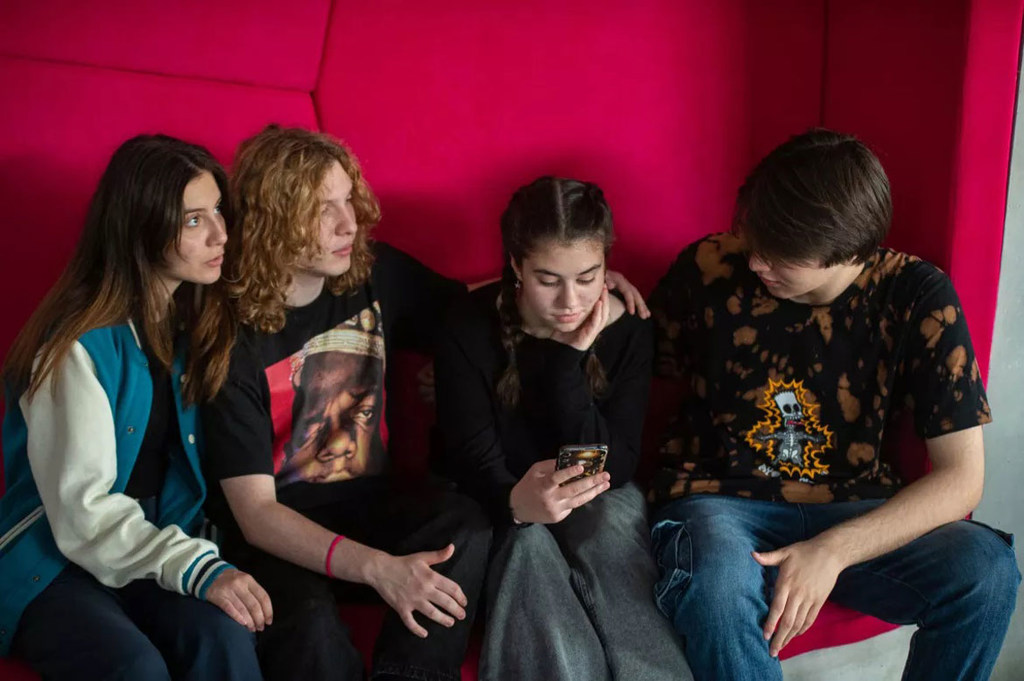
Young adults check social media in North Macedonia.

Australia leads the way 

UN Member States are taking stronger measures, as they learn about the scale and severity of the problem.

At the end of 2025, Australia became the first nation in the world to ban social-media accounts for children under 16, on the basis that the risks from the content they share far outweighs the potential benefits.

The Government there cited a report it had commissioned, which showed that almost two-thirds of children aged between 10 and 15 had viewed hateful, violent or distressing content and more than half had been cyberbullied. Most of this content was seen on social media platforms.

Several other countries, including Malaysia, the UK, France and Canada, look set to follow Australia’s lead, preparing regulations and laws for similar bans or restrictions. 

AI-illiteracy

And, at the beginning of 2026, a wide variety of UN bodies with a stake in child safety put their names to a Joint Statement on Artificial Intelligence and the Rights of the Child, published on 19 January, which pulls no punches in its description of the risks – and society’s collective inability to cope with them.

The statement identifies a lack of AI literacy among children, teachers, parents and caregivers, as well as a dearth of technical training for policymakers and governments on AI frameworks, data protection methods and child rights impact assessments.

Responsibility of the tech giants

Tech companies are also in the frame: the statement says that most of the AI-supported tools they make – along with their underlying models, techniques and systems – are currently not designed with children and their well-being in mind. 

“We are really concerned and we would like the private sector to be involved, to engage, to be part of the story that we are writing together with the other UN agencies and other players who believe that technology can be an enabler, but it can also destroy,” says Mr. Zavazava.

The senior UN official is confident however, that these businesses are committed to making their tools safer. 

“Initially, we got the feeling that they were concerned about stifling innovation, but our message is very clear: with responsible deployment of AI, you can still make a profit, you can still do business, you can still get market share. 

“The private sector is a partner, but we have to raise a red flag when we see something that is going to lead to unwanted outcomes. 

We have regular meetings where we talk about their responsibilities, and some of them already have statements on how they should protect populations and children. It is our duty together to be fighting the ills that come with the technology.”

A children’s rights issue

While the UN bodies named in the document (full list below) stress the need for these companies to make sure their products are designed to respect children’s rights, they are also calling on all parts of society to take responsibility for the way they are used.

This is far from the first time that concerns have been raised from a rights perspective: in 2021, new language was attached to the Convention on the Rights of the Child – a cornerstone of international child rights law and the most ratified human rights treaty in history – to reflect the dangers of the digital age.

However, the UN bodies feel more guidance is needed to help countries regulate more effectively and have produced a comprehensive list of recommendations.

“Children are getting online at a younger age, and they should be protected, says Mr. Zavazava. That’s why we set out these child online protection guidelines. The first part of the guidelines addresses parents, the second is for the teachers, the third part is for regulators, and the fourth is relevant to industry and private sector.”

Yemen: Children are dying and it’s going to get worse, warns aid veteran

“The simple narrative is, children are dying and it’s going to get worse,” said Julien Harneis, UN Resident and Humanitarian Coordinator in Yemen. “My fear is that we won’t hear about it until the mortality and the morbidity significantly increases in this next year.”

The alert follows an attempt by forces affiliated with the Southern Transitional Council (STC) to expand their presence in the resource-rich and strategically important eastern governorates of Hadramout and Al Mahra, a move reportedly reversed earlier this month by Government-aligned forces backed by Saudi Arabia.

The latest crisis comes after well over a decade of fighting between Houthi-led forces – who control the capital, Sana’a – and the internationally recognized government in Aden, backed by a Saudi-led military coalition. 

Complex operating environment

“It’s an extraordinarily complicated situation,” Mr. Harneis told journalists in Geneva. “Just in the last month in Aden, we went through a situation where you have the Government of Yemen in charge, then over 48 hours, the Southern Transitional [Council] situation took over the whole of the Government of Yemen areas, including areas they’ve never been in.”

Just four weeks later, however, a delegation from the STC released a statement while in Riyadh, Saudi Arabia, announcing that they had in fact “dissolved” their movement, allowing the Government in Yemen to retake the recently captured areas. “But at the same time, we’ve got demonstrations in Aden saying that, ‘No, we’re not [disbanded], we’re still there,’” Mr. Harneis explained.

Last week, UN Special Envoy for Yemen Hans Grundberg told the Security Council that this latest political and security upheaval underscored how quickly stability could unravel without a credible, inclusive political process to bring a negotiated end to the debilitating war.

Securing a peaceful future for the people of Yemen and providing lifesaving help has also been complicated by the ongoing detention of UN staff and diplomatic workers, among others, by Houthi rebels, who are backed by Iran and control Sana’a. 

Mr. Harneis described the torment for the families of the 69 staff members still being held: “It’s terrible for them; some families haven’t seen their loved ones in five years. They don’t know the conditions of their detention, they don’t know where they are, they don’t know if they’re going to be sentenced to death in the coming days.”

Millions going hungry

Latest UN data shows that more than 20 million Yemenis – about half the population – will face acute food insecurity next month, while tens of thousands could face famine-like conditions.

“We are expecting things to be much worse in 2026,” Mr. Harneis said.

A young boy is carried by his mother thorough a neighbourhood in Al Hawtah, Lahj Governate in Yemen.

The country’s health system is also collapsing. More than 450 facilities have already closed and thousands more are at risk of losing funding. Vaccination programmes are also under threat and only two-thirds of Yemen’s children are fully immunised, largely owing to a lack of access in the north.

“The way that economic and political decisions are playing out…food insecurity is only getting worse across all parts of the country”, the UN aid official maintained.

“We’re going to see a major change where the health system is not going to be supported in the way it has been in the past.”

Despite access restrictions, UN partners reached 3.4 million people with food assistance last year, along with emergency support during floods and disease outbreaks. 

The UN has been working in Yemen since the 1960s, helping to make development gains and protect the country’s most vulnerable people. “And then suddenly in the last couple of years this breakdown…inexplicably,” Mr. Harneis said. “That has a terrifying effect on the humanitarian workers.”

Source link

Sudan: As children continue to suffer, school remains a distant hope

After more than two years of civil war, more than 25 million people are now acutely hungry and at least 20 million require health services urgently.

The UN World Food Programme (WFP) also warned that displaced families in some areas have not received any aid for three months, as it announced that for the first time, funding shortfalls have forced it to pull back support in areas where it does not have access.

The scale of needs in Sudan are so big that we have to make tough decisions on who receives assistance and who doesn’t. Those are heartbreaking decisions to make,” said WFP’s Leni Kinzli, in an urgent appeal for more international funding to help all those affected by more than two years of war.

Children are especially vulnerable, humanitarians have warned, with malnutrition “surging”, particularly among youngsters and their mothers.

Education the latest victim

According to the UN reproductive health agency UNFPA, and partners working in education, around 13 million of the 17 million youngsters who have remained in Sudan are now out of school.

This includes seven million who are enrolled but unable to attend classes because of the conflict or displacement – plus six million school-age children who haven’t registered for the school year.

Nonetheless, UNFPA said that as of this month, 45 per cent of schools in Sudan – nearly 9,000 – have now re-opened, citing the Global Education Cluster that groups 60 UN and NGO entities.

And while the situation in Sudan remains so dire, going back to school might not appear to be a priority, but aid agencies insist that without it the impact on young lives can be devastating, given how much additional support can be provided in schools, over and above learning.

In schools helped to reopen by UN-partner Save The Children, for instance, additional support includes meals, safe water, sanitation and counselling training for teachers to help youngsters process their trauma.

Picking up the pieces

From November 2024 to July this year, more than two million people have returned to their former homes across Sudan, to some 1,611 locations.

The bulk of these returnees have reached Aj Jazirah (48 per cent), Khartoum (30 per cent), Sennar (nine per cent), Blue Nile (seven per cent) and White Nile (five per cent). The UN migration agency (IOM)’s Displacement Tracking Matrix notes that only around one per cent went to River Nile and West Darfur.

breakdown of IOM data indicates that around 77 per cent (or 1.5 million) returned from temporary homes inside Sudan, while 23 per cent (around 455,000) came back from abroad.

This is a fraction of the more than 4.2 million refugees who crossed into neighbouring countries since war erupted on 15 April 2023, between the Sudanese Armed Forces (SAF) and the paramilitary Rapid Support Forces (RSF).

Other key IOM findings of Sudanese displacement impacting all 18 states:

  • When war erupted, people were uprooted primarily from Khartoum (31 per cent), South Darfur (21 per cent), and North Darfur (20 per cent).   
  • The highest proportion of internally displaced people were in South Darfur (19 per cent), North Darfur (18 per cent), and Central Darfur (10 per cent).
  • Over half (53 per cent) of those fleeing violence were reportedly children.

Case study: Life slipping away

Among the young victims of the conflict, 18-month-old Aysha Jebrellah has been admitted for treatment for severe acute malnutrition in Port Sudan Paediatric Hospital.

Her mother, Aziza, has been by her daughter’s side as medical teams provide lifesaving nutritional support and address the medical complications that Aysha has suffered, linked to her condition.

Aziza was displaced with her family from Khartoum when conflict erupted more than two years ago, fleeing first to Kassala, then moving to Port Sudan where she lives with relatives.

She described how her daughter had diarrhoea and fever for about two weeks before she was admitted to hospital. By that time she had stopped eating and appeared to be slipping away before their eyes.

“When she refused to even taste anything and kept getting weaker, I was afraid I would lose her,” Aziza says. “Now I have hope that she will recover.”

To support health needs in Sudan, the UN World Health Organization (WHO)’s $135 million appeal is just one-fifth funded. “It’s only a fraction of what is urgently needed,” the agency said.

Source link

80 million more children benefiting from school meals, WFP reports

The number of children receiving school meals through government-led programmes has gone up by 20 per cent since 2020, found the latest edition of the WFP’s flagship biennial report The State of School Feeding Worldwide.

Now, nearly 80 million more children are able to enjoy nutritious meals at school, bringing the global total to approximately 466 million.

Beyond health and diet, national programmes can benefit employment, agriculture, and other sectors.

“School meals are so much more than just a plate of nutritious food – important as that is. For the vulnerable children who receive them, they are a pathway out of poverty and into a new world of learning and opportunity,” said Ms. McCain.

“They are proven to be one of the smartest, most cost-effective investments any nation can make to improve the long-term health, education and economic prosperity of future generations,” she added.

Example of what’s possible

The increase in the number of children receiving school meals comes thanks to the expansion of these programmes internationally, and especially by countries that are part of the School Meals Coalition, a network led by over 100 governments with the WFP as its secretariat.

Global funding for school meals has more than doubled, rising from $43 billion in 2020 to $84 billion last year. Africa is leading the surge with an additional 20 million children in the continent now fed through national programmes but domestic funding still remains lower in low-income countries.

“The surge in nationally funded school meal programmes is a powerful sign of what’s possible, even in challenging times. But in low-income countries, where needs are greatest, progress remains at risk as global aid shifts and domestic resources fall short,” said Carmen Burbano, director of school meals at WFP.

Meals improve learning outcomes

Children who are hungry might not attend school or could struggle to focus even if they do, according to the report. Providing meals at school can both incentivize attendance and help students stay engaged and more easily absorb educational material.

The report found that school meals are a significantly more effective way to improve the quality of education compared to other popular programmes and policies like teacher training and tech inputs.

A nutritious diet has also been associated with an increased attention span, higher cognitive function and better attendance.

“It’s only now that we’re really recognizing that the wellbeing of school children and adolescents is key to their learning ability,” said Professor Donald Bundy, co-editorial lead for the report, at a press briefing on Wednesday.

A catalyst for the economy

The report estimates that delivering school meals to 466 million children generates around 7.4 million cooking jobs globally, with further employment across logistics, farming, and supply chains.

On a national level, school meal programmes typically generate approximately 1,500 jobs for every 100,000 children.

Preliminary findings in some African countries suggest that the programmes are cost-beneficial in terms of the gains obtained in the education, health and nutrition sectors. In Malawi, for example, every $1 invested brought economic benefits ranging to $2 to $18 depending on the district.

Local procurement of school food can also create reliable and predictable markets for smallholders and family farmers, which ultimately encourages crop diversification, boosts rural economies, and fosters sustainable agricultural practices.

Funding cuts could push 6 million more children out of school, warns UNICEF

Official Development Assistance (ODA) for education is projected to fall by $3.2 billion – a 24 per cent drop from 2023 – with just three donor governments accounting for nearly 80 per cent of the cuts.

Such a decline would push the number of out-of-school children worldwide from 272 million to 278 million, UNICEF said – the equivalent of shutting every primary school in Germany and Italy combined.

“Every dollar cut from education is not just a budgetary decision, it’s a child’s future hanging in the balance,” said UNICEF Executive Director Catherine Russell.

Children in crisis hit hardest

The heaviest impact is expected in regions that are already vulnerable. West and Central Africa could see 1.9 million children lose access to school, while 1.4 million more could be pushed out across the Middle East and North Africa.

In total, 28 countries stand to lose at least a quarter of the education aid they rely on. Côte d’Ivoire and Mali face some of the steepest risks, with enrolment projected to fall by 340,000 and 180,000 students respectively.

Primary education will be hit hardest, with funding expected to drop by one-third. UNICEF warns this could deepen the global learning crisis and cost those children affected an estimated $164 billion in lost lifetime earnings.

In humanitarian contexts, the cuts could be devastating. In the Rohingya refugee response, 350,000 children risk losing access to basic schooling permanently.

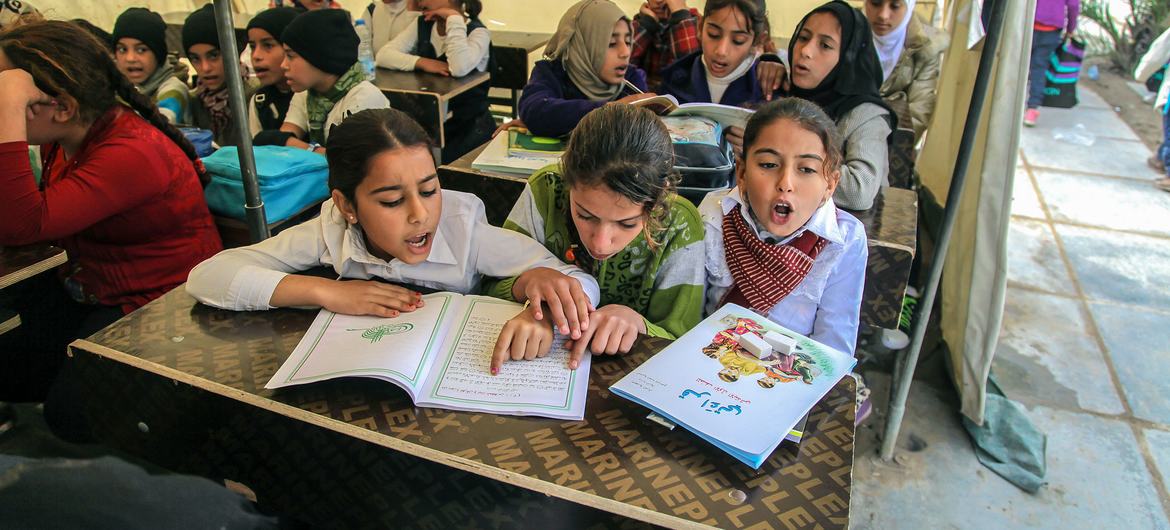
Displaced children in a classroom in Baghdad, Iraq.

Call to protect education

The crisis will also threaten vital services. School feeding programmes – sometimes a child’s only reliable meal – could see funding halved, while support for girls’ education is likely to shrink. At least 290 million children who remain in classrooms could also face a decline in learning quality.

UNICEF is calling on donors to direct at least half of all education aid to least developed countries, safeguard humanitarian funding, and prioritise early years and primary schooling. It also urges reforms to make financing more efficient and sustainable.

“Education, especially in emergency settings, often serves as a lifeline,” Ms Russell said. “Investing in children’s education is one of the best investments in the future – for everyone.”

Source link

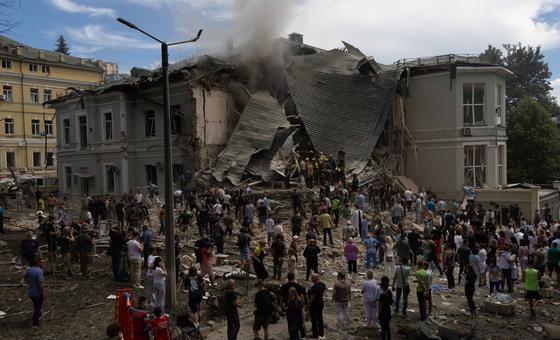
Ukraine: Toddler among four children killed in Russia’s attacks on Kyiv

The youngest victim of the bombing raid was two-and-a-half years old, according to the UN Children’s Fund, UNICEF, which released video footage showing smoke billowing from a Kyiv apartment block with a massive hole where its roof had been.

Leading condemnation of the attacks, the UN Secretary-General said that targeting civilians and civilian infrastructure violated international humanitarian law. [They] are “unacceptable and must end immediately”, followed by a ceasefire resulting in a “just, comprehensive, and sustainable peace in Ukraine”, he insisted, in a statement issued by his Spokesperson. 

Eyewitness testimony

Speaking to UN News after visiting the shattered building and its residents, UNICEF Representative, Munir Mammadzade, insisted that nowhere in Ukraine is safe today. The air-raid alert in Kyiv lasted almost 12 hours, he noted.

The senior UN official also condemned the “continuous attacks” reportedly involving ballistic missiles and drones by Russia, which launched a full-scale invasion of Ukraine in February 2022.

“I’m just back from one of the sites that were impacted, severely…and still, the search and rescue operation is continuing,” he said. “Across the city, there were four kids confirmed killed and more than 10 injured; most likely these numbers will go up.”

Media reports indicated further damage to civilian infrastructure including Ukraine’s railways. Russian attacks have also continued closer to the front line, targeting key energy infrastructure ahead of winter, Mr. Mammadzade warned.

Winter is main threat

In Kyiv and in frontline areas, plummeting temperatures are “the biggest challenge”, the UNICEF senior official insisted, in an appeal to donors and partners to support the UN agency’s winterization plan by contributing more to its Ukraine humanitarian fund, which faces a 40 per cent funding shortfall.

People within 10 kilometres (around six miles) of the front line “require immediate support”, the UNICEF official said, so that “families and children can survive and most importantly, have their livelihoods protected”.

Back to school

The development comes as the country’s children prepare to return to school against a backdrop of ever-present air-raid sirens that are “becoming kind of a norm”, even if the impact of the war on many youngsters’ mental health is as serious as it is common.

“We know that even if war ends today, [it] will be for generations to come,” Mr. Mammadzade explained, pointing to sudden mood swings linked to post-traumatic stress and feelings of hopelessness among children he has met in frontline areas including Donetsk, Sumy and Kharkiv.

“What they basically fear the most is about their lives and unfortunately, quite often, they mention to us that they don’t have dreams or any hopes,” he continued. “What they only need is peace – and this peace to happen as soon as possible – so that they can go back to normalcy.”

In his renewed call for a ceasefire, the Secretary-General insisted that it should fully uphold Ukraine’s “sovereignty, independence and territorial integrity, within its internationally recognized borders, in line with the UN Charter, international law and relevant UN resolutions”.

Source link

Latin America and Caribbean: Millions more children could face poverty due to climate change

Even worse, the number could triple if countries do not meet their commitments to reduce greenhouse gas (GHG) emissions and to ensure that climate financing prioritises social and climate resilience services for children.

The finding comes in a report by the UN Economic Commission for Latin America and the Caribbean (ECLAC) and the UN Children’s Fund (UNICEF), published on Thursday in Panama.

Bearing the brunt

The report examines the potential effects of extreme weather events on increasing poverty levels among children and youth, along with national efforts to reduce GHG emissions as well as strategies to adapt and reduce losses and damage caused by climate change.

The 5.9 million figure represents the most optimistic scenario. However, if governments are slow in implementing actions to address mitigation and adaptation, as well as loss and damage, the number could reach 17.9 million.

Roberto Benes, UNICEF Regional Director for Latin America and the Caribbean, said that children and adolescents bear the greatest burden of climate change. 

Their developing bodies are more vulnerable to cyclones, heatwaves and other extreme phenomena which at the same time disrupt their families’ livelihoods and their education.

“If children and young people don’t have the resources to meet their basic needs and develop their potential, and if adequate social protection systems are not in place, the region’s inequalities will only be perpetuated,” he said.

Protect children and youth

Yet despite their vulnerability, climate finance does not prioritise the resilient services for health, nutrition, education, water and sanitation that children and young people need, to ensure their optimal cognitive and physical development. 

In Latin America and the Caribbean, only 3.4 per cent of all multilateral climate finance is dedicated to children, according to the report.  This is happening at a time of funding cuts and reduced development aid amid unprecedented needs.  

The report recommends that regional governments take action, including by strengthening the climate resilience of social services and critical infrastructure to better protect children and youth, with a particular focus on the first 1,000 days of life.

Authorities are urged to increase child-sensitive climate policy financing, with actions that specifically target the needs of children at different ages.

They also must promote greater climate awareness, education, empowerment and participation of children and youth. Additionally, environmental and climate education should be included in school curricula and educational programmes.

The report further recommends that countries promote adaptive social protection and emergency response policies that account for the specific needs of children and adolescents. 

Source link

Sudan: ‘Devastating tragedy’ for children in El Fasher after 500 days of siege

Around 260,000 civilians – including 130,000 children – remain trapped in the area’s main camp for internally displaced people, enduring desperate conditions without aid for more than 16 months.

The Rapid Support Forces (RSF), which has been battling forces of the military government for control of Sudan for over two years, has cut off all supply lines.

RSF militia have been besieging the city since May last year and it is the last urban area still under government control.

“We are witnessing a devastating tragedy – children in Al Fasher are starving while UNICEF’s lifesaving nutrition services are being blocked,” said Catherine Russell, UNICEF Executive Director.

Deadly violence

Reports this week point to yet another mass-casualty incident, with seven children reportedly killed in an attack on Abu Shouk camp for internally displaced people, on the outskirts of El Fasher.

Since the start of the siege in May 2024, more than 1,100 grave violations have been verified in El Fasher alone, including the killing and maiming of over 1,000 children.

Meanwhile, at least 23 children have been subjected to rape, gang rape, or sexual abuse. Others have been abducted, recruited, or used by armed groups, said UNICEF.

Health and education facilities have also come under sustained attack, with 35 hospitals and six schools struck, killing and injuring many, including children.

Aid blocked

Meanwhile, the UN aid coordination office (OCHA) warned Wednesday that the already dire situation in North Darfur continues to worsen.

“Blocking humanitarian access is a grave violation of children’s rights, and the lives of children are hanging in the balance,” Ms. Russell said, reiterating UNICEF’s call for immediate and full access to El Fasher.

The toll on children is catastrophic, the agency suspension of medical services due to depleted supplies has left an estimated 6,000 children suffering from Severe Acute Malnutrition (SAM) without treatment, UNICEF said.

Without therapeutic food and medical care, these children face an extremely high risk of death. News reports indicate at least 63 people, mostly women and children, died of malnutrition in just a single week.  

UNICEF continues to call for unimpeded humanitarian access for the delivery of therapeutic food, medicines, clean water, and other essentials.

Cholera outbreak

The siege is colliding with Sudan’s worst cholera outbreak in decades. More than 2,400 deaths have been reported since July 2024.

In overcrowded camps around Tawila, Zamzam and El Fasher, children weakened by hunger are now especially vulnerable to cholera and other deadly waterborne diseases.

“Children must be protected at all times, and they must have access to life-saving aid,” said Ms Russell.

Source link

Malnutrition deaths mark ‘latest in the war on children’ in Gaza: UNRWA chief

These young deaths are “the latest in the war on children and childhood in Gaza,” Philippe Lazzarini, head of UN Palestine refugee agency UNRWA, said in a tweet on Wednesday.

The toll also includes some 40,00 boys and girls reported killed or injured due to bombardment and airstrikes, at least 17,000 unaccompanied and separated children, and one million deeply traumatised youngsters who are not getting an education. 

“Children are children,” he said.

 “No one should stay silent when children die, or are brutally deprived of a future, wherever these children are, including in Gaza.”

A sombre reunion

Thousands of sick children in Gaza need urgent medical evacuation, according to UN aid coordination office OCHA.

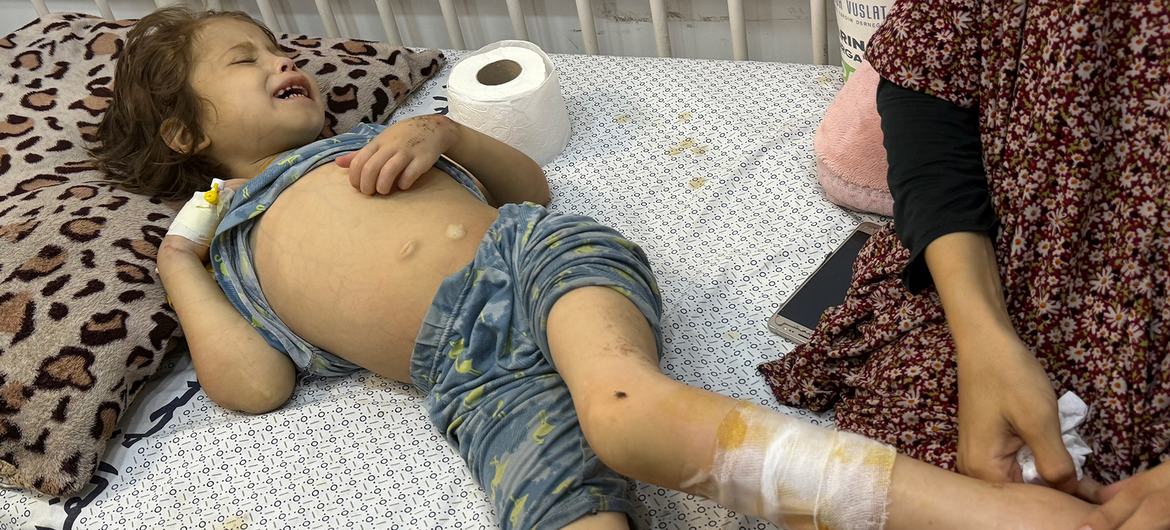
Olga Cherevko, a spokesperson for the agency, recalled the moment she recognized a young girl requiring treatment in a Gaza hospital after a year’s interval, once again suffering from malnourishment.

“I remembered her long eyelashes,” the veteran humanitarian told UN News, describing seven-year-old Janah, who she came across at Gaza City’s Patient Friendly Hospital on Tuesday.

“The first time I met her was in the IMC Field Hospital in southern Gaza in April 2024. Back then, she was severely malnourished and was getting treatment. And she gradually became better and was released eventually and went home.”

Seven-year-old Janah is treated at Gaza City’s Patient Friendly Hospital.

Evacuation saves lives

However, Janah was now back in hospital “because the malnutrition became aggravated and the condition that she has also is not properly diagnosed and cannot be properly diagnosed.” 

The girl is on a list of people to be medically evacuated for treatment outside Gaza.  The most recent evacuations took place last week when the World Health Organization (WHO) supported the transfer of 15 critically ill children to Jordan, but more than 14,800 people are still waiting.

Ms. Cherevko stressed the importance of ensuring that evacuations continue to save as many lives as possible.

More aid needed

She also pointed out that for children and adults with pre-existing conditions, their situation becomes worse with malnutrition.

“It wouldn’t be this way if they had proper nutrition, because these conditions existed before the starvation crisis and they weren’t getting as sick as they are now,” she said.

“This is why it’s imperative to make sure that we have proper conditions on the ground for adequate volumes of supplies to be entering – everything from food to medicine to nutrition to shelter,” she continued. 

“And these lifelines have to be really enabled for us to be able to deliver this aid to the people in need.” 

Source link

Syria: UNICEF calls for safe access to children in Sweida as needs mount

Deadly sectarian clashes erupted in the southern governorate, also known as As-Sweida, in July and early August and children and families continue to feel the impact.

At least 22 children reportedly were killed and another 21 injured in the violence, which caused significant damage to civilian infrastructure.  More than 190,000 people, mainly women and children, were forced to flee their homes.

Essential services also were disrupted. At least five health centres were reportedly struck, with two doctors killed, while ambulances were obstructed or attacked.

‘A welcome step’

UNICEF Syria Deputy Representative Zeinab Adam described the situation as “tragic and deeply alarming.” 

“Given the ongoing needs of children and families affected, the increased efforts by the interim authorities to facilitate access to those in need have been a welcome step,” she said.

UNICEF was part of the UN’s first inter-agency convoy to Sweida which arrived at the end of July.  

Ms. Adam said the agency “delivered life-saving supplies and carried out a rapid on-the-ground assessment to ensure a faster, stronger response to the growing crisis.” said.

Food and medicine shortages

The fighting caused critical damage to vital infrastructure, water, electricity and fuel.  Furthermore, food, medicine and other essentials remain scarce due to continued insecurity and access constraints.

In response, UNICEF has deployed 14 mobile health and nutrition teams.  Teams have also provided life-saving health and nutrition supplies to more than 4,000 children and women, as well as safe drinking water and fuel for water pumping stations benefiting more than 30,000 people.

Appeal for access

To ensure an effective response, it is critical that both humanitarian actors and commercial goods have unhindered access to the most affected communities,” said Ms. Adam.

“This will enable the immediate provision of basic social services, including food, water, and other essential supplies, to those in urgent need.”

She added that “facilitating this access is not only vital for life-saving interventions but also for restoring a minimum level of stability and protection in these communities.”

Meanwhile, UNICEF remains on the ground in Sweida and will continue to advocate for children there and across Syria. 

Gaza: Acute malnutrition among children hits record high

In July alone, nearly 12,000 children under five were identified as acutely malnourished out of 136,000 screened, according to aid partners. 

Of these, more than 2,500 were found to suffer from severe acute malnutrition, the most life-threatening form, and 40 had to be hospitalized in stabilisation centres.

More children affected

The proportion of children with severe acute malnutrition is rising, OCHA said.  

In June and July, 18 per cent of all acutely malnourished children had severe acute malnutrition, compared with 12 per cent between March and May.

Moreover, humanitarian access constraints are adding to the crisis.

Last month, aid partners were only able to reach 8,700 of the 290,000 children under five who require feeding and nutrition supplements due to the severe shortage of lipid-based nutrient supplements entering Gaza.

OCHA said the development “marks a dramatic collapse in the malnutrition prevention programme”, noting that an average of 76,000 children – or a quarter of those in need – were reached each month between April and June.

Distribution of other key nutrition supplies has also declined sharply, which is affecting children, pregnant women and breastfeeding mothers.

Shelter crisis worsens

Meanwhile, no shelter materials have entered Gaza since 2 March. 

At the same time, more than one million shelter items, and 2.3 million items such as tents, tarps, and sealing-off materials, have been procured and are currently stuck in Jordan and Egypt as the Israeli authorities have not approved their entry. 

The shelter crisis continues to worsen, with most families living in severely overcrowded and unsafe conditions. Some have no shelter at all. 

In July, humanitarians assessed 44 displacement sites, discovering that 43 had families with no shelter.

A family rests after evacuating from Deir Al-Balah in the Gaza Strip. (file)

Bombardment and displacement continue

The situation is further deteriorating due to ongoing bombardment, displacement orders and insecurity, which continue to displace families and disrupt humanitarian operations.

OCHA reported that overall, realities on the ground remain largely the same since Israel announced a “tactical pause” in military operations to allow the safe passage of aid.

The UN agency reiterated that supplies that have entered remain insufficient given the immense needs, while UN convoys continue to face challenges in delivering aid.

Aid missions taking hours

While fewer humanitarian movements have been denied outright, missions that are approved still take hours to complete, with some taking more than 18 hours.

On Wednesday, five out of 11 missions requiring coordination with the Israel authorities were facilitated. These included collecting food from the Kerem Shalom and Zikim crossings.

Another four missions were impeded but eventually fully completed, which included the collection of fuel from Kerem Shalom crossing and transfer of fuel from southern Gaza to the north. 

Medical evacuation update

One of the missions saw the medical evacuation of 15 children to Jordan, and 42 companions, with support from the World Health Organization (WHO).  However, more than 14,800 patients in Gaza still urgently need specialized medical care.

OCHA also reported on the flow of commercial goods into the Strip, noting that several trucks carrying food items have been entering over the past days. 

While the UN will continue to monitor the situation, humanitarians again stressed the need for unimpeded and predictable humanitarian access into and within Gaza, warning that “without it, time and resources are wasted, lives are lost, and the response cannot match the scale of the needs.” 

Source link

Children are ‘skin and bones’ as Sudan marks a grim milestone

It is a grim milestone for Sudan, the world’s worst humanitarian crisis. But with insufficient funding, lack of access to key regions and intensifying violence, milestones like this have become the grim norm.  

This is not hypothetical. It is a looming catastrophe,” said Sheldon Yett, the UN Children’s Fund (UNICEF) representative in Sudan.

And it is a catastrophe that is unduly affecting women and children, many of whom have been displaced multiple times and lack access to even the most basic of services such as clean water, food and protection.  

“Every day the conflict continues in Sudan, innocent lives are lost, communities are torn apart and trauma continues to haunt generations,” said Radhouane Nouicer, the UN’s designated expert on human rights in Sudan.  

Emotional scar tissue 

Children in Sudan are among those most affected by the crisis – 3.2 million  children under five are projected to suffer from acute malnutrition in the next year.

On a recent trip Jebel Aulia, a locality in Khartoum state which is at extreme risk of famine, Mr. Yett was horrified by what he saw.  

Many of the children are reduced to just skin and bones,” Mr. Yett said.

However, these children are not only contending with malnutrition – some of them have also been displaced four or five times, and over three-quarters of Sudanese children are out of school.  

“The emotional scar tissue is massive – children don’t know where they are going next … often feeling like aliens in their own land,” Mr. Yett said.  

He spoke with one mother in Jebel Aulia whose daughter may be forever changed by the violence.  

Since the war started, my daughter has fallen into a state of silence, and I can feel her heart racing with fear,” one mother said.  

A gendered crisis

Around Sudan, as the food insecurity crisis spirals, women and girls are the “hungriest face of the crisis,” according to Salvator Nkurunziza, the UN Women representative in Sudan.

“With conditions now at near famine thresholds in several regions in the country, it is not just a food crisis but a gender emergency caused by a failure of gender-responsive action,” said Mr. Nkurunziza at a Tuesday press briefing in Geneva.  

A recent report further drove home the gendered nature of the crisis, revealing that women-led households in Sudan are three times more likely to experience severe insecurity than households led by men.  

This is especially concerning as the death, displacement or forced disappearance of men has left more and more women the sole bread winners. In total 75 per cent of women-led households cannot meet basic food needs.

The data is unequivocal: female-headed households are slipping deeper into starvation, with fewer coping mechanisms, less access to income, and even more systemic barriers than last year,” the report said.  

Nevertheless, Mr. Nkurunziza reminded the international community that women are not just victims but also agents of change in crisis settings.  

Women-led organizations are on the frontlines, providing food through soup kitchens and supporting displaced families. And yet, they remain excluded from many of the decision-making processes and exposed to undue risks.  

An unchanged human rights landscape

Food security and displacement are not the only challenges that the Sudanese face. Rather, the human rights situation is also deteriorating, according to Mr. Nouicer who visited Sudan to meet key government officials in July.  

“I remain gravely concerned that civilians in Sudan continue to suffer widespread violations and abuses, including extrajudicial killings, sexual violence, forced displacement and arbitrary detention,” he said.  

He specifically highlighted the unique challenges that women, children and people with disabilities face when confronting displacement and violence.  

“The ongoing war has devastated civilian lives and turned daily survival into a constant struggle.”  

‘Irreversible damage’

Mr Yett said that in his most recent trip, he saw the best and worst of humanity – the devastating impact of violence and inaction coupled with the hopeful possibilities that peace and action could provide.  

We are on the verge of irreversible damage to an entire generation of children, not because we lack the knowledge or the tools to save them but because we are collectively failing to act with the urgency and at the scale this crisis demands,” he said.  

The first step is ensuring access to regions of Sudan like Zamzam which have been cut off from aid. With the rainy season approaching – and some roads already impassable – this is only becoming more difficult.  

Mr. Nouicer highlighted that even if a ceasefire between the warring rival militaries happened, the level of devastation and abuse is so extreme that the future will require more than just peace.  

“The path forward demands more than ceasefires and peace talks. It requires a sustained commitment to justice, accountability, and inclusive governance.” 

Source link

Gaza crisis deepens as UN warns children are ‘dying before reaching hospital’

With 96 per cent of households lacking clean water, many malnourished children are not surviving long enough to receive hospital care.

James Elder, Spokesperson for the UN Children’s Fund (UNICEF), told at a news briefing in Geneva that it would be a mistake to assume the situation is improving.

There’s a sense through the world’s press that things are improving,” he said. “But unless there is sustained humanitarian aid…there will be horrific results.

He emphasised the scale of need: “When food comes in which supports 30,000 children, there are still 970,000 children not getting enough. It is a drop in the ocean.”

Aid still a trickle

The UN relief coordination office, OCHA, said that although unilateral pauses have allowed some aid into Gaza, the current trickle is vastly insufficient.

“There should be hundreds and hundreds of trucks entering Gaza every day, for months or years to come,” said Jens Laerke, OCHA spokesperson. “People are dying every day. This is a crisis, on the brink of famine.

Thousands of tons of pre-funded aid remain stuck just outside the enclave, he added, as bureaucratic delays and lack of safe access continue to block distribution.

Urgent scale-up needed

In New York, UN Deputy Spokesperson Farhan Haq also noted the impediments to bringing in and distributing sufficient aid.

“Massive food shortages continue to impact people’s chances for survival,” he said. “As malnutrition levels rise, children’s immune systems are weakened, hindering their development and growth far into the future.”

Last Thursday alone, 71 kitchens delivered over 270,000 hot meals across Gaza, including 10,000 to health facilities. But that figure falls far short of what’s needed to feed more than two million people.

We need an urgent scale-up of supplies, as well as an environment that allows humanitarians to reach people in need safely, rapidly and efficiently,” Mr. Haq added.

Health challenges continue

Some medicine has entered Gaza in recent days, but supplies remain limited. Health workers continue to operate under extreme pressure and shortages.

The World Health Organization (WHO) reported 46 cases of Guillain-Barré syndrome in July, including two deaths. The condition, which affects the nervous system, has been linked to compromised immunity, poor nutrition and hygiene-related infections.

The situation of pregnant women and nursing mothers is equally alarming. The UN reproductive health agency, UNFPA, said that 40 per cent of pregnant or breastfeeding women are suffering from severe malnutrition, with newborn deaths and stillbirths on the rise.

Meanwhile, three UN fuel tankers reached Gaza City on Monday. The fuel will power critical health, water and sanitation services, but OCHA stressed this only allows operations to run at “bare minimum” capacity.

Source link

Hunger in Gaza: Women and children face death in search of food

“I used to easily receive aid distributed by the UN,” Abir Safi, a displaced person from the Zeitoun neighborhood of Gaza City, told UN News. “Now, we get nothing. I risk my life by going to the Zikim crossing and returning with an empty bag. All I want is to return to my children with some food.”

Ms. Safi said she never imagined that providing for her children would become a deadly adventure. After losing her husband in the war, she found herself alone, facing the responsibility of supporting her family amid deteriorating humanitarian conditions.

She was among thousands of citizens who gathered along Rashid Street in northern Gaza, which connects the Zikim crossing to northern Gaza, hoping to receive humanitarian aid.

A horse-drawn cart carries the bodies of more than seven Palestinians killed while trying to reach aid.

‘Bullets over my head’

Our correspondent witnessed the arrival of thousands of Palestinians returning from a journey in search of food supplies. Thousands of emaciated bodies – men, women, and children – were caught in a scene that has become a daily occurrence. Everyone is running in search of the few aid trucks that reach northern Gaza.

The United Nations has the capacity and resources necessary to distribute aid in a safe, dignified manner to all those in need in the Gaza Strip. The organization continues to call for the lifting of restrictions imposed by the Israeli authorities on the entry and distribution of aid into Gaza.

The danger lies not only in the crowding and chaos, but also in the death that lurks around everyone. Fayza al-Turmisi, a displaced person from Shuja’iyya, described the horrific scene along Rashid Street in northern Gaza.

“They fire shells and bullets at us here. We are forced to lie on the ground. I hide among more than 200 men, and bullets fly over my head. If you raise your head, you get hit. If you stay on the ground, bullets fall around you.”

A young Gazan was injured while trying to obtain aid.

Between mourning and hunger

Mohammed Mudeiris, aged seven, said he lost his father in an airstrike just the day before. He doesn’t have the luxury of grieving for his father as he is now the sole breadwinner for his siblings.

Walking through the dense crowds, he extends his small hand, begging for a handful of flour to take back to his siblings.

“I am the eldest of my siblings,” he said. “My father was killed in an airstrike yesterday. I am trying to ask someone to give me a plate of flour or a meal from the aid that arrived today.”

Mohammed Mudeiris, a child who lost his father in an Israeli airstrike, coming to secure food for his siblings from aid trucks arriving via the Zikim crossing.

‘I risk my life to bring food to my children’

The race for food is not limited to men. Women are forced to take this risk, driven by the responsibilities of motherhood and the needs of their children.

“I throw myself into danger to bring food for my children,” said Asma Masoud, who was displaced from northern Gaza.

“We never get our fair share of aid,” she said. “My husband is paralysed, and there are widows and women like me who cannot provide food for their children.”

Highlighting that some young people take the aid and sell it at exorbitant prices that she cannot afford to buy, Ms. Masoud called on the world to ensure “a fair distribution mechanism and to allow UNRWA [the UN agency for Palestine refugees] and international organizations to do so”.

Aid should be distributed via text messages so that every person in need receives their share, as was the case before, she said.

“But now, only a few people are profiting and selling the aid,” she stated. “We cannot tolerate that. It is an injustice.”

Asma Masoud, a displaced woman from northern Gaza, returning from a search for food.

‘I don’t know how I’m going to feed my children’

Ms. Safi agreed with Ms. Masoud, complaining that “the beneficiaries now are largely thieves.”

“I’ve lost a lot of weight, and all my health is gone,” Ms. Safi said. “I don’t know how I’m going to feed my children. I want to receive aid with dignity. Aid used to come through the United Nations, and I could easily go and receive it, but now I don’t receive anything.”

I want to receive aid with dignity.

This chaotic system leaves behind widows, women, the elderly and many other complex humanitarian cases, such as Maqboula Adas, who supports her injured husband and her son who has a broken leg.

“My husband is injured and cannot move,” she explained. “My eldest son has a broken leg, and I also have three daughters. No one supports us except God. Every day I go to try to get some flour. If it weren’t for that, they would have died of hunger.”

Maqboula Adas, a displaced woman from Shuja’iyya.

Carts carry corpses

At the height of this tragedy, macabre scenes emerge. Instead of carrying bags of flour, a horse-drawn cart transports the bodies of at least seven Palestinians who were killed while trying to get aid.

While some young men carried sacks of flour on their backs, ambulances bring the wounded and dead from the northern regions. The achievement of getting food aid comes at a heavy price.

One young man was injured in the head and face while trying to collect aid.

“I came to collect aid, but today wasn’t my day,” he said. “I will come again despite my injury, and I hope God will provide for me next time.”

Thousands of Palestinians seeking aid arriving from the Israeli Zikim crossing in northern Gaza.

Risk of famine

Gaza is facing a severe risk of famine, with food consumption and nutrition indicators at their worst levels since the beginning of the current conflict, according to a warning issued by the Integrated Food Security Phase Classification (IPC). 

At least 147 deaths due to hunger and malnutrition have been reported, including 88 children. More than 28,000 cases of severe acute malnutrition have been recorded among children, according to reports from the World Health Organization and the World Food Programme.

Despite promises to facilitate the flow of aid, restrictions on the entry of food and fuel, along with ongoing attacks near the crossings, have prevented supplies from reaching those in need. In addition, the chaotic distribution of aid within Gaza has further complicated the situation and placed civilians at greater risk.

The UN human rights office (OHCHR) has documented the deaths of hundreds of people attempting to access aid amid ongoing gunfire and shelling near relief truck routes and military distribution points.

Abir Safi, a displaced woman from Al-Zaytoun neighbourhood.

‘If I get killed, who will take care of my children?’

Amidst this chaos, widow Enaam Siam, a mother of six, recounts her struggle for food.

“I am a widow and a mother of six orphaned children, one of whom is injured,” she said. “Every day, I go out amidst death to bring them food. I see the dead and wounded.”

She asked why aid is no longer delivered to warehouses and distributed via text message.

“If I am killed, who will take care of my children? There are thousands of women in a similar situation. We want safety, peace and a fair system that ensures aid reaches those in need.”

Source link