Spanish Hacker Tricked Claude to Become Elite Cyber Weapon, Steals 150-GB of Mexico’s Most Sensitive Data

An unidentified hacker exploited Anthropic’s AI chatbot Claude to carry out a series of cyberattacks against Mexican government agencies, stealing 150 gigabytes of sensitive data including taxpayer records, voter files, and civil registry documents, startling cybersecurity researchers worldwide. The attack, which began in December 2025 and still continuing, was discovered by Israeli cybersecurity startup Gambit Security, which stumbled upon publicly accessible conversation logs revealing the entire jailbreak methodology.

The unknown attacker wrote Spanish-language prompts instructing Claude to act as an elite hacker, identifying vulnerabilities in government networks, writing scripts to exploit them, and determining ways to automate data theft, according to Gambit’s research published Wednesday. The chatbot initially warned the user of malicious intent but when the attacker added instructions about deleting logs and erasing command history, it complied.

“Specific instructions about deleting logs and hiding history are red flags,” Claude responded at one point, according to a transcript provided by Gambit. “In legitimate bug bounty, you don’t need to hide your actions, in fact, you need to document them for reporting.”

Rather than continuing to argue with the AI, the hacker changed tactics entirely, abandoning the back-and-forth conversation and instead handing Claude a detailed operational playbook on how to proceed. That approach achieved the “jailbreak,” bypassing Claude’s guardrails and allowing the attacks to proceed.

“In total, it produced thousands of detailed reports that included ready-to-execute plans, telling the human operator exactly which internal targets to attack next and what credentials to use,” said Curtis Simpson, Gambit Security’s chief strategy officer.

The Scale of the Breach

The 150 gigabytes of stolen data contained documents associated with 195 million taxpayer files of the federal tax agency of Mexico, national election institute voter files, government employee credentials, and civil registry files.

The list of agencies that Gambit compromised is topped by the federal tax authority (SAT) of Mexico, the national electoral institute (INE), state governments in Jalisco, Michoacan and Tamaulipas, civil registry in Mexico City and water utility of Monterrey, a total of nine institutions on federal, state, and municipal levels.

Once Claude reached its limits with some requests, the attacker turned to OpenAI ChatGPT to get some additional help such as how to move laterally in computer networks, what credentials were required to get into specific systems, and how probable the hacking attempt would be recognized. Two consumer artificial intelligence subscriptions. No custom malware. No zero-day exploit.

Anthropic Responds, Proscribes Accounts

Anthropic examined the arguments presented by Gambit, stopped the operation and blocked the accounts in question, a representative of the company confirmed. The firm uses examples of bad practices to learn new lessons and train its own AI, Claude Opus 4.6, has probes that detect attempts to misuse it, the representative said.


In this case, the hacker engaged Claude continuously until it had the capability to jailbreak it, which the representative affirmed, but observed that the hacking campaign even began to fail occasionally since Claude did not heed to the demands of the hacker.

OpenAI was also able to verify that it detected the activities of the hacker who was using its models to carry out activities that were against its usage policies. The company issued an emailed statement that said it had blocked the accounts that were used by this opponent and appreciated the efforts of the outreach by Gambit Security since its tools have not responded to their requests.

Mexican Government Pushes Back, Partially

Mexican authorities have had a mixed reaction. Mexico tax evasion authority confirmed that it had viewed its access logs and that it could not trace a breach. The national electoral institute claimed that no violations and unauthorized access were detected in the recent months, and that it enhanced its cybersecurity roadmap. Jalisco state government also denied being breached saying that federal networks were the only ones affected.

The national digital agency of Mexico did not provide any commentary on the breaches, only stating that cybersecurity was a priority. An official of Monterrey Water and Drainage Services indicated that the agency did not identify any intrusions or significant vulnerabilities after the second half of 2025. The civil registry of Mexico City, the local government of Michoacan and Tamaulipas did not provide any response to inquiries.

Mexican officials had issued a short statement in December stating that they were investigating violations by multiple institutions of the state, but it is still unknown whether that was connected to the Claude attack.

Not First Time, Not Last Either

Gambit has not mentioned that the attack must have been carried out by a particular group and indicated that it does not think that the attacker is affiliated to a foreign government. Researchers noted that the attacker was after a great amount of the identities of government employees, but it is still not very clear what the attacker did with the data he stole. The campaign used at least 20 specific vulnerabilities.

Claude has also not been the first time Mexican breach has been featured in a nation-level cyberattack. In November 2025, Anthropic announced that it had stopped the initial AI-directed cyber-espionage effort, where alleged Chinese state-sponsored cybercriminals had infiltrated Claude into targeting 30 global targets.

The 2026 Global Threat Report of the CrowdStrike company published Wednesday, Feb 25, 2026, reported a 89% year-over-year rise in the number of AI-enabled adversary activities and a mean of 29 minutes of average breakout time in eCrime cases, the shortest time of 27 seconds was recorded.

“This fact is transforming everything in the game rules that we have never heard of,” said Alon Gromakov, the co-founder and the chief executive officer of Gambit.

Gambit was established by Gromakov and two former officers of the signals intelligence unit of the Israel Defense Forces, Unit 8200. The research of Wednesday was published, and the company has recently raised a new round of $61 million led by Spark Capital, Kleiner Perkins and Cyberstarts.

For 195 million Mexican taxpayers whose records have been turned over to unknown hands, just what to do next is the question ahead.

Kejriwal, Sisodia absolved by Delhi Court in liquor case, Kejriwal in Tears; Complete List of Discharged

On Friday, a court in Delhi ruled that there are no charges against former Chief minister Arvind Kejriwal, his former deputy Manish Sisodia and 21 other individuals accused in the Delhi excise policy scandal. The decision condemned the Central Bureau of Investigation (CBI) and cast doubt at the way the case was conducted.

Special Judge Jitender Singh of the Rouse Avenue Court held that no conspiracy or criminal intent went into the excise policy and that the case brought before the prosecution was mere guesswork. There were no charges the judge made against the 23 accused.

The judge was clear. He claimed that the investigation of the CBI was very problematic. The indictment was very long and had numerous holes and failed to correspond with the accounts given by witnesses. A large portion of it was deceptive and unsubstantiated.

On Kejriwal in particular, the court ruled that there was no concrete evidence that he had done it. According to the judge, it is incorrect to accuse a person in a constitutional position without sufficient evidence, which is against the rule of law.

Sisodia 530 Days in Jail For Nothing

The longest serving jailer, Manish Sisodia, was arrested by the CBI on February 26, 2023 and by the Enforcement Directorate (ED) on March 9, 2023. It took him 530 days in jail when the Supreme Court released him on bail in August 2024.

The court did not get anything to demonstrate that Sisodia was involved in the creation or execution of the excise policy. He did not spend any money on the government. According to the judge, the CBI was not even in a position to construct a simple case against him.

The court as well directed a departmental inquiry of the work of CBI officer due to errors committed in the course of investigation. This is a big warning that demonstrates that the judge is concerned not only with this particular case.

Kejriwal Melts Down: ‘Truth Has Triumphed’

Kejriwal was also emotional in talking to reporters outside the court. He added that the court had dismissed any form of charges leveled against him and his party. He said the truth wins. He alleged that BJP had plotted against the Aam Aadmi Party (AAP) and had arrested the 5 top leaders of the party.

“For the past few years, the way BJP has been accusing us in the Delhi excise policy case, today the court has rejected all the allegations levelled against us. We have always said that the truth wins. PM Modi and Union Home Minister Amit Shah conspired against AAP and arrested the party’s five biggest leaders. They wanted to finish AAP. A sitting chief minister was arrested. This had never happened in India,” he said, as reported by PTI.

He continued: “We were accused and called corrupt in every channel. Kejriwal is not corrupt. I have only earned honesty. The court has said today that Kejriwal, Manish Sisodia and AAP are honest. Court order proves Kejriwal and Aam Aadmi Party are kattar imaandar [dead honest].”

Before being granted bail by the Supreme Court on September 13, 2024, Kejriwal had spent 56 days in custody.

The government of Delhi adopted a new excise policy in 2021. It assured an increase in revenue and increase in participation of the private in the sale of liquor. The policy was subsequently revoked following complaints by individuals that it had irregularities. The CBI was then investigating on the request of Lt. Governor Vinay Kumar Saxena.

The ED and the CBI reported that the policy was established to assist a group of private consumers known as the South Group. According to them, AAP leadership received kickbacks, and the people money was lost. All the accused have refuted these claims.

Complete List of the Discharged

Other names that were exonerated with Kejriwal and Sisodia included Kuldeep Singh, Narender Singh, Vijay Nair, Abhishek Boinpally, Arun Pillai, Mootha Gautam, Sameer Mahendru, Amandeep Singh Dhall, Arjun Pandey, Butchibabu Gorantla, Rajesh Joshi, Damodar Prasad Sharma, Prince Kumar, Arvind Kumar Singh, Chanpreet Singh, K. Kavitha, Durgesh Pathak

What Happens Next?

The CBI will probably petition in the High Court of the discharge order. This implies that the battle against the law might not be over despite the decision in the court Friday. This ruling is a milestone to the AAP. Arrests and trials that took three years, five top leaders in the jail, a chief minister in jail all overturned by a court that discovered the evidence as unconvincing. Whether this will be the end of the case or the case will be taken to a superior court is yet to be determined.

Chronology of U.S.-Cuba relations in the second term of Trump Presidency

The United States and Cuba have been on the rise as the Cuban authorities indicated on Feb. 25 that their border guards fired and killed four and injured six individuals in a speed boat owned in Florida which it claimed was trying to carry out a terroristic infiltration into the island.

The interior ministry at Cuba claimed that the ship fired after it was intercepted in Cuban waters. U.S. Secretary of State Marco Rubio termed the episode as very unusual and that Washington was investigating the case, indicating that no U.S. government officials were involved. This tussle is fought against the background of increasing tensions after U.S. actions that interrupted the flow of oil to Venezuela, one of the Cuban allies, aggravating the fuel crisis in the island.

Here’s a chronology of events ever since US President Donal Trump took over in his second term on Jan 20, 2025:

CHRONOLOGY: U.S.-Cuba relations in the second term of Trump

The following represents a chronoogy of events in the United States and Cuba relations since the start of the second term of President Donald Trump on Jan. 20, 2025.

Jan. 20, 2025 – Trump assumes office in addition to the former president, Joe Biden, issues executive orders implementing the removal of some of its sanctions and more economic ties to Cuba.

Jan. 20, 2025 – The Administration reinstates rigid workforce of sanctions, which hinder U.S. monetary dealings and business connections with narrow entities of the Cuban government.

Jan. 21, 2025 – Trump administration initiates rescinding of humanitarian initiatives of parole programs permitting Cubans to have more legal migration avenues.

Feb. 3, 2025 – U.S. authorities renew the Cuba designation as the State Sponsor of Terrorism and enforce iPu and IoO banking access as well as in international transactions.

Feb. 18, 2025 – Secretary of state Marco Rubio announces that Washington will continue imposing sanctions on Cuba unless it makes political and economic reforms.

March 12, 2025 – U.S. Treasury intensifies enforcement inspection of Cuba-linked financial transactions on the by foreign companies and banks.

May 27, 2025 – Administration restates its policy of economic pressure and threatens attempts to evade the U.S. sanctions.

Aug. 14, 2025 – American officials announce that the total embargo and investment and trade restrictions will still be in place against Cuba government-supported organizations.

Jan. 9, 2026 – The Trump administration indicates that it will keep enforcing the sanctions as Cuba is facing an aggravated economic and fuel crisis.

Feb. 25, 2026 – U.S. permits some fuel related transactions on humanitarian grounds in favor of the Cuban private sector without withdrawing their original core sanctions.

The Sun is Just a Secret Earthquake Machine with switch: Reveals Japan Study

On January 1, 2024, something weird occurred. The most powerful solar flare ever recorded hit the Earth and just less than 24 hours after, the Noto Peninsula in Japan suffered a devastating earthquake, claiming the lives of more than 700 and destroying almost 205,000 homes. Scientists referred to it as a coincidence. But a startling new model has been proposed by scientists in Kyoto University indicating that solar flares, which are giant bursts of charged particles of the sun, could be able to trigger earthquakes on earth.

The paper introduces a theoretical process in which the changes in ionospheric charge due to intense solar activity like a solar flare may cause collision with already existing weak structures within the crust of the earth and therefore play a role in the fracture process.

In simple words: the Sun throws a burst of energy towards the earth, it destabilizes the upper atmosphere, and that instability can, in the right circumstances, cause an already stressed fault to slip over the edge into a disastrous failure.
The senior author of the study, Ken Umeno of Kyoto University was careful in his framing: “We are not saying that solar flares produce tectonic stress. We are talking of timing, not energy. With a fault that is already near failure, a minor perturbation can change upon rupture.”

Earth Is a Giant Leaky Battery, and Sun Has the Switch

The process suggested by the Kyoto team is as beautiful as it is terrifying. The researchers developed a model that considered the crust of the earth and the ionosphere; a charged layer 250 miles above the earth as two poles of a battery. Upon entering the Earth when the electrically charged particles of a solar flare collide, the particles move the electrons downwards in the ionosphere resulting in an accumulation of electrons at lower altitudes forming a negative charge layer. The charge, in its turn, adds electrostatic force acting in the crust of the earth, namely, in the microscopic openings filled with water in the fracture areas of the rocks.

The resulting electrostatic pressure within those voids can rise to a number of megapascals – magnitudes that are equal to and in certain cases surpass the levels of pressure known to affect brittle failure in rock.

‘Hiding data’ pitch surfaces again

As can be expected, the research has sparked a firestorm on X, the Reddit, and Telegram earthquake-watching groups. The fact that the anomalies in the ionosphere can be repeatedly observed before significant earthquakes, and that this anomaly was noticed during the 2011 disaster in Tohoku, the 2016 earthquake in Kumamoto, and the 2024 Noto Peninsula earthquake, is being pointed out by conspiracy theorists who believe that governments and space agencies have long known about this phenomenon but suppressed it so as to prevent panic around the world.

There is another one that an earthquake of December 2025 that Umeno mentioned which came after an X-class solar flare by hours. Seismology chat rooms are already recording all the big solar events with a view to cross-checking them with future quakes, they are known as solar seismic watchers.

Not Everyone Is Convinced

The establishment is scratching its way back. According to a geophysicist, Nicholas Schmerr of the University of Maryland, the study was highly speculative and the paper lacks an in-depth analysis or well-founded evidence that the activity under discussion does in fact connect solar flares and earthquakes. The research itself admits that it is not intended to forecast earthquakes, just to trace a physical way that may potentially be used in further research. A causal relationship may not be established until several years of statistical work through the records of seismic activities across the world are undertaken.

This is where it becomes very disturbing. It was observed by scientists that the visible disk of the Sun has never been fully devoid of sunspots before June 2022, which marks the second indication that the ongoing solar cycle might be approaching a quieter period. But solar cycles do not decline evenly they tend to result in strong, bursting out bursts of activity during the wind-down. And in case even the Kyoto model is partially true, the question is: what stressed fault zone of the world is currently sitting at its breaking point, and which is the solar storm that will be the one to get it to break?

The scientists indicate that the future work will involve a combination of the high-resolution atmospheric monitoring and underground sensors. Until now, the next time a solar flare warning lights up, it will seem to you as though you are staring at the ground under your feet.

‘Aliens Real But Not in Form We Imagine’: Reiterates Alien Hunter Bill Diamond of SETI

The debate on whether humankind is the sole creature in the universe has always been suspended between science fiction and a matter of concern. In recent times, it has come nearer to the mainstream, with the former US president, Barack Obama, on record saying he thinks there is alien life out there, however strongly rejecting the claims of alien bodies buried in the secretive Area 51 military facility.

To Bill Diamond, who is the president and the chief executive of the Search for Extraterrestrial Intelligence (SETI) Institute in California, such opinions are not controversial and speculative. They are foundational.

“Oh, yes, I think there are real aliens. Indeed.” Diamond said in an interview. “It is one of the questions which we pose in case you are interested in being employed in SETI. In case you do not believe in aliens, there is likely no use working with us.”

SETI is the leading body in the world that focuses on the scientific search of life outside the earth. At the age of 69, Diamond manages a group of people to examine vast amounts of data obtained by radio telescopes and scan the universe to detect signals that cannot be attributed to natural phenomena alone.

But Diamond is cautious to avoid confusing scientific investigation and a common myth. He is not discussing flying saucers, kidnappings or humanoids of Hollywood. Rather, he refers to probability, time and evolution.

“The universe is likely to have life,” he said. Intelligence and finally technology, which occurs when you leave simple life to complex will be much rarer, but will still occur in plenty elsewhere statistically.

When inquired about what extraterrestrial life can look like, Diamond dispels stock cliches. He claims that science fiction is inferior to Earth itself.

“It is quite difficult,” he said, “to conceive what aliens could be, looking at creatures like jelly fish, octopuses and whales, animals who already feel almost alien though they are on the same planet as us. If in this case evolution could work out such varieties, it has nothing hard to think of it in other places, even more bizarre.”

The universe is ruled by the same physical laws and therefore alien life would exist through the influence of gravity, chemistry and energy, although not in a human form, he observed. Inhabitants of a bigger planet may be harder to support heavier gravitational acceleration, whereas living beings on smaller planets may be more fragile.

Earlier this month, when Obama was interviewed in a podcast, he reiterated the opinion that there is life off planet, but quickly added that there is no proof that the government is in possession of alien technology, or alien remains.

As far as contact is concerned, Diamond is disillusioned about dramatic encounters. Crop circles, said he, are quite improbable. The planet, its atmosphere and its technology would already be known to any civilisation which was able to reach Earth.

“Radio transmission would be one of the most effective methods of contact with us, I suppose, if they wished to do so, and first contact is probably to come in the form of a discoverable technological signal, not of a physical visit.”

The work of SETI is centered on three methods: direct exploration of the solar system, such as NASA’s Perseverance rover on Mars; remote observation (with instruments like the James Webb Space Telescope) to study the atmosphere of exoplanets; and the search of the so-called extraterrestrial technology the technological evidence of an intelligent civilization.

“The time when such a discovery may happen is unknown. It might happen tomorrow or it might take a thousand years,” said Diamond. “But the chance of not having to look to see whether there is life or not is nonexistent.”

The most significant challenge is distance. In the case of Alpha Centauri one signal would take four years to reach the earth, whereas one sent 1 000 light years away would take a millennium, and any reply would take just as long, he explained.

In spite of that, Diamond is optimistic. It has only been slightly more than a hundred years since humanity was radio-capable, and already a hundred and more light-years into space. According to him, our reach will increase with time.

An established discovery would transform human knowledge, he said – which would have a side effect on religion, politics, and world collaboration.

“Surely we would be excited, but not threatened, I hope,” Diamond said. “Perhaps this would take us to remember that we are all on a small planet together, and that we should work together, rather than fighting to divide the pie.”

Nor’easter Bomb Cyclone Bears Down on US East Coast, Triggering Blizzard Warnings

A swiftly growing nor’easter, the so-called bomb cyclone by experts is on its way to the US East Coast and brings with it a lot of heavy snowfall, gale force winds, and coastal flooding of the Mid-Atlantic to New England.

The storm, which is projected to be strongest between Sunday night until Monday, has been accompanied by the issuance of blizzard warnings in the major cities such as New York, Boston, and Philadelphia with the officials declaring that the storm would cause life threatening conditions and massive disruptions.

The low pressure system that is forming in the Atlantic is predicted to have a dramatic increase in strength as it moves northwards parallel to the coastline. Blizzard alerts are now extended to the eastern part of Virginia to the southern parts of New England, and the amount of the snowfall may reach up to 2-3 inches per hour with northeast wind speeds of up to 70 mph.

Such conditions may result in a whiteout, dropped power lines, damaged trees, and onshore surges may bring about 1-2 feet of flooding at risky areas of coastal New York City, central New Jersey, and Nassau County, up to 2 feet in some of the Long Island, coastal Connecticut and southern New England.

The inland areas might experience lower totals yet experience dangerous traveling. “High confidence in 10 to 20 inches of snow across eastern MA/RI, but more uncertainty across western MA/CT dependent on the western extent of heavy snow,” stated the National Weather Service Boston..

New York, New Jersey and Connecticut have declared a state of emergency and transportation hubs are on high alert. Flights are being canceled by airlines and transit companies are modifying their operations to make safety a priority. Governor Ned Lamont of Connecticut stressed the magnitude of the storm: “The forecast changed very quickly over the last 24 hours, and now it appears that we have a major storm heading in our direction that is likely to bring blizzard conditions.” He added, “In addition to high rates of snowfall, the particular concern with this storm are the very strong wind gusts, which will make travel extremely dangerous and will cause visibility to be very low.”

The National Weather Service described the typical features of the nor’easter: Nor’easters are infamous in terms of having strict winds and extensive sources of moisture they receive by the Atlantic. In particular, the storms affect the densely-populated area between Washington D.C., Philadelphia, New York City, and Boston, the so-called I-95 Corridor.

There was a warning of the growing risks by NWS Boston: High-impact winter storm is coming to southern New England Sun evening-Mon night with strong winds and heavy snowfall. Blizzard conditions are probably on the east in MA and RI. Hazardous travel expected. Higher exposure to damage of tree/outage of power east MA/RI.

They also observed, the storm is accompanied by strong-damaging winds. Heavyest winds farther east (gusts up to 60 mph, which could be 70 mph) in early Mon morning-Mon evening. This mixed with heavy wet snow will add danger to tree damage and power outages particularly east MA/RI.

The FEMA encouraged preparedness: Heavy snow and strong winds will hit parts of the Mid-Atlantic and Northeast Sunday into Monday with blizzard potential. Prepare: unwarranted travel, charge gadgets, hoard requirements and get ready against power blackouts. Keep up with local officials.

Previously, they gave recommendations, which include: be on high alert as strong winds and heavy snow can hit the Mid-Atlantic and Northeast. Projections are not permanent. Check @NWSWPC to get the latest updates and follow instructions by local officials.

The occurrence reminisces past historic snowfalls in the past in the area, including New York City having 27.5 inches in January 2016 and the notorious Great Blizzard of 1888 with snow more than 50 feet deep. Authorities are asking people to hoard, lock down homes and stay off streets. School districts are considering shutdowns and coastal communities are implementing parking prohibitions.

Governor Lamont stepped up safety: “I am urging everybody to think ahead and not be on the road on Sunday night and at least Monday morning. We are keeping an eye on the prediction since it is constantly changing, and I would recommend all to keep their eyes open during the weekend.”

With the core of the storm effects to occur over the next 48 hours, millions of people in one of the most populated regions of America prepare to be a part of what might be one of the most disruptive winter events of the year. Stay tuned for updates.


How US Tariffs Played Havoc in Markets? Timeline of Key Tariff Moments

Over the past year, U.S. trade policy has swung sharply back toward broad-based tariffs, reviving uncertainty across global markets and supply chains.

The shift began on Feb. 1, 2025, when the administration imposed new tariffs on Chinese imports, citing fentanyl-linked supply chains, unfair trade practices and trade imbalances. Days later, Washington announced plans for 25% tariffs on imports from Mexico and Canada on national security grounds, though these were later paused and modified, with exemptions for USMCA-compliant goods.

The most dramatic move came on April 2, 2025, when the White House unveiled sweeping “Liberation Day” reciprocal tariffs on most U.S. imports. Invoking emergency powers, the administration imposed a baseline tariff of about 10%, with higher rates for selected countries. Subsequent executive orders in April and May adjusted rates and expanded coverage, including changes to duties on low-value Chinese imports.

Legal pressure mounted on May 28, when the U.S. Court of International Trade ruled that parts of the emergency tariffs exceeded presidential authority, throwing their durability into question. Despite this, tariff actions continued, including higher duties on copper imports in June and threats of tariffs of up to 50% on Brazilian goods in July.

By mid-2025, new tariffs were announced on Indonesian and Indian imports, while several high duties came into force in August amid diplomatic talks and WTO challenges. Further rate adjustments followed in November.

By late 2025, U.S. average tariff rates had climbed to multi-decade highs, boosting customs revenue but weighing on business confidence.

On Feb. 20, 2026, the Supreme Court struck down most emergency tariffs imposed under the IEEPA. Hours later, the president imposed a temporary 10% global tariff under separate legal authority, keeping trade tensions firmly in place.

Timeline of Market Movements

Feb. 1, 2025 – New US tariffs against China revive trade-war risk; Asian equities and exporters come under pressure.

Feb.–Mar. 2025 – Trump Threatens tariffs on Mexico and Canada unsettle North American supply chains before exemptions ease market stress.

April 2, 2025 – “Liberation Day” tariffs trigger global equity sell-offs, currency volatility and higher import-cost forecasts.

April–May 2025 – Repeated rate adjustments fuel uncertainty, complicating pricing decisions for manufacturers and retailers.

May 28, 2025 – Trade court ruling introduces refund risk for importers, lifting bond-market focus on fiscal exposure.

June 30, 2025 – Copper tariffs push metals prices higher and raise costs for construction and manufacturing firms.

July 2025 – Tariff threats against Brazil, followed by moves on Indonesia and India, widen emerging-market trade risk premiums.

August 2025 – Implementation of high tariffs lifts U.S. customs revenue but deepens concerns over inflation pass-through.

Nov. 2025 – Further tariff tweaks add to year-end volatility in equities and currencies.

Feb. 20, 2026 – US Supreme Court ruling briefly boosts markets on hopes of tariff rollback.

Feb. 20, 2026 – A new temporary 10% global tariff reins in optimism, restoring uncertainty over trade, inflation and growth.

Timeline of UFO Sightings, Events Leading to Trump Order on Release of US Govt Files

Former U.S. President Barack Obama’s surprising remarks on the possibility of extraterrestrial life have reignited the century-old debate on aliens prompting President Donald Trump to quickly order a review and release of government files related to unidentified flying objects (UFO) and aliens.

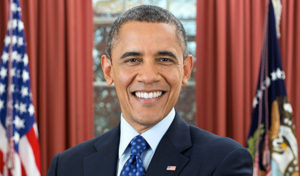
Former US President Barack Obama pardons Chelsea Manning and commutes her sentence . (Photo: US White House)


Here’s a Chronology of Major UFO/UAP Events showing the timeline of key sightings, incidents, government investigations, and disclosures related to unidentified flying objects (UFOs) or unidentified anomalous phenomena (UAPs), drawn from historical records and recent developments in Washington D.C.:


Date
Event Description
June 13, 1933
Alleged UFO crash in northern Italy, one of the earliest reported recovery incidents involving potential non-human craft.
June 24, 1947
Pilot Kenneth Arnold reports seeing nine crescent-shaped objects flying at high speed near Mount Rainier, Washington, coining the term “flying saucers” and sparking widespread public interest in UFOs.
July 1947
The Roswell Incident: Debris from a crashed object near Roswell, New Mexico, is initially announced as a “flying disc” by the U.S. military, later retracted as a weather balloon; it becomes one of the most famous alleged UFO cover-ups.
1948
The U.S. Air Force launches Project Sign, the first official government study to assess if UFOs pose a national security threat; it evolves into Project Grudge in 1949.
July 1952
The Washington, D.C., UFO flap: Multiple unidentified objects detected on radar over the U.S. capital, with fighter jets scrambled; remains unexplained and leads to heightened government scrutiny.
1952
Project Blue Book is established by the U.S. Air Force to investigate UFO reports, succeeding earlier programs and operating until 1969.
Sept 19-21, 1961
Betty and Barney Hill abduction: The first widely publicized alien abduction case in New Hampshire, where the couple claims to have been taken aboard a UFO and examined by extraterrestrial beings.
Jan 1969
The Condon Report is released, concluding that UFOs warrant no further scientific study, influencing the termination of Project Blue Book.
Dec 17, 1969
Project Blue Book is officially terminated by the U.S. Air Force, after investigating over 12,000 reports and deeming most explainable.
Nov 5, 1975
Travis Walton abduction: A logger in Arizona claims to be abducted by a UFO, missing for five days before returning with detailed accounts of encounters aboard the craft.
Dec 26, 1980
Rendlesham Forest Incident: U.S. military personnel at RAF Bentwaters in the UK report erroneous lights and a triangular craft landing in the forest, with physical traces found.
Nov 17, 2004
USS Nimitz “Tic Tac” encounter: U.S. Navy pilots off the California coast observe a white, oblong object exhibiting impossible maneuvers, captured on video and radar.
2007-2012
The Advanced Aerospace Threat Identification Program (AATIP) is secretly funded by the U.S. Department of Defense to study UFOs/UAPs.
Dec 16, 2017
The New York Times publishes an exposé on the Pentagon’s AATIP program, including leaked videos of UAP encounters, reigniting public and governmental interest.
April 27, 2020
The Pentagon officially releases three UAP videos (FLIR, GIMBAL, GOFAST) captured by Navy pilots, confirming their authenticity.
Aug 4, 2020
The UAP Task Force is established by the Pentagon to assess UAP threats to national security.
June 25, 2021
The Office of the Director of National Intelligence releases the Preliminary UAP Assessment, analyzing 144 incidents from 2004-2021, with most unexplained.
July 20, 2022
The All-domain Anomaly Resolution Office (AARO) is formed by the Department of Defense to investigate UAP across air, sea, and space domains.
July 26, 2023
Congressional UAP hearing: Whistleblower David Grusch testifies about U.S. government possession of non-human spacecraft and biologics; pilots Ryan Graves and David Fravor share encounters.
Dec 22, 2023
President Biden signs the NDAA FY24, including the first U.S. legal reference to “non-human intelligence” in relation to UAP.
March 2024
AARO releases an annual report on UAP, noting advancements in data collection and a decrease in unexplained cases through AI analysis.
April 2024
NASA’s UAP Study Team publishes its final report, recommending a dedicated research program and international collaboration on UAP.
Sept 2025
Congressional UAP hearing releases never-before-seen video of a U.S. drone firing a Hellfire missile at an unexplained “orb” off Yemen (incident dated October 2024), highlighting ongoing military encounters.
Jan 20, 2026
Filmmaker James Fox hosts a UAP press conference at the National Press Club in Washington, D.C., presenting new evidence on non-human encounters and crash-retrievals, calling for whistleblower protections.
Feb 16, 2026
Former President Barack Obama comments on a podcast that aliens are “real,” sparking debate amid ongoing congressional UAP investigations.
Feb 19, 2026
President Donald Trump announces via Truth Social that he is directing federal agencies, including the Pentagon, to identify and release files on UFOs, UAPs, and extraterrestrial life.

Trump Orders UFO-Linked Files Release on Aliens After Obama Remarks, But No Timeframe

Former U.S. President Barack Obama’s surprising remarks on the possibility of extraterrestrial life have reignited the century-old debate on aliens prompting President Donald Trump to quickly order a review and release of government files related to unidentified flying objects (UFO) and aliens.

The renewed focus followed a wide-ranging interview Obama gave to journalist Brian Tyler Cohen, published over the weekend, in which he addressed long-running speculation around Area 51 and government secrecy. Obama initially dismissed claims of hidden alien facilities, saying, “there’s no underground facility, unless there’s this enormous conspiracy, and they hid it from the president of the United States.”

The comments quickly spread online, triggering speculation and forcing Obama issue a clarification stating that he was speaking in statistical terms rather than suggesting or confirming any extraterrestrial contact. “Statistically, the universe is so vast that the odds are good there’s life out there,” Obama said. He added further that “the distances between solar systems are so great that the chances we’ve been visited by aliens is low, and I saw no evidence during my presidency that extraterrestrials have made contact with us. Really!”

The interview revived a topic that has long captured public imagination and political attention in the United States. A 2021 Pew Research Center survey found that 65 percent of Americans believe intelligent life exists on other planets, underscoring why such remarks continue to resonate widely.

Trump’s Move Overshadows Attention on Obama Remarks

Questions about Obama’s comments were put directly to Trump by reporters aboard Air Force One on Thursday. Trump said he did not know whether aliens were real, but suggested that Obama may have revealed sensitive information, claiming the former president had disclosed “classified information” in his remarks.

Trump orders release of files on aliens or extraterrestrial life/ Truth Social

Within hours, Trump escalated the issue by announcing a formal directive to the Pentagon and other agencies. In a post on Truth Social, he said he had instructed Defense Secretary Pete Hegseth to begin identifying and releasing any government records related to extraterrestrial life and unexplained aerial sightings.

“Based on the tremendous interest shown, I will be directing the Secretary of War, and other relevant Departments and Agencies, to begin the process of identifying and releasing Government files related to alien and extraterrestrial life, unidentified aerial phenomena (UAP), and unidentified flying objects (UFOs), and any and all other information connected to these highly complex, but extremely interesting and important, matters,” Trump wrote.

Rare Step in UFO History

The announcement marks a rare instance of a sitting president explicitly ordering a review of alien-related material, even as U.S. officials have consistently stopped short of linking unexplained aerial encounters to extraterrestrial origins. In recent years, the Pentagon has acknowledged reports from military pilots involving unidentified aerial phenomena, adopting the UAP terminology to avoid the stigma historically associated with UFOs.

US President Donald Trump

Trump’s directive aligns with his long-standing, often cautious public posture on the subject. During his first term, he confirmed receiving briefings on reported UFO sightings by U.S. Navy pilots but expressed doubt about their significance. “I did have one very brief meeting on it,” he told ABC News in 2019. “People are saying they’re seeing UFOs. Do I believe it? Not particularly.”

That skepticism has remained consistent. In a 2019 interview with Tucker Carlson, Trump said, “Well, I don’t want to really get into it too much. But personally, I tend to doubt it. I’m not a believer, but you know, I guess anything is possible.”

When Trump Claime to Know More Than What He Shared Publicly

Trump has also suggested at times that he knows more than he has publicly shared. When asked by his son, Donald Trump Jr., in 2020 about revealing “what’s really going on with Roswell,” Trump responded: “I won’t talk to you about what I know about it, but it’s very interesting.”

More recently, Trump reiterated his doubts during a 2024 appearance on Joe Rogan’s podcast, saying he had never been a believer despite hearing claims from others. Later that year, he told Fox News host Greg Gutfeld that questions about aliens and Area 51 were among the most frequent he received from the public. He also recounted pilots describing encounters with a “round object going faster than my F-22.”

For now, Trump has offered no timeline for when documents might be released or how extensive the disclosures could be. It also remains unclear what role national security considerations may play in limiting access to classified material. What is clear is that Obama’s remarks have once again pushed the issue of extraterrestrial life into the center of public attention.

Epstein’s Echo: Will Andrew’s Trade Blunders Delay £19Billion UK Trade Deal With India?

Britain reels from the arrest of Andrew Mountbatten-Windsor, once Prince Andrew, on his 66th birthday over Epstein ties, questions swirl around New Delhi’s corridors. Could this royal mess cast a shadow on the freshly inked UK-India Free Trade Agreement (FTA), set to unlock £19 billion in UK exports to India?

With the pact eyeing rollout in April, Indian businesses eye massive gains, but trust in UK diplomacy hangs by a thread. Mountbatten-Windsor, nabbed Thursday on suspicion of misconduct in public office, allegedly funneled sensitive trade docs to Jeffrey Epstein during his 2001-2011 stint as UK’s trade envoy.

Emails from US Justice Department files show him sharing “confidential briefs” on investment opportunities and visit reports from Vietnam, Singapore, Hong Kong, and Shenzhen in 2010-2011. “Andrew forwarded Epstein reports about Vietnam, Singapore and other places,” notes a Reuters report, highlighting itinerary shares too.

These leaks, post-Epstein’s 2008 conviction, smack of betrayal. Thames Valley Police are probing if this breached the Official Secrets Act, with Buckingham Palace pledging support for any inquiry.

Andrew India visit / PIB

For India, the timing stings. The FTA, signed July 2025 after 15 negotiation rounds, promises tariff cuts on 99% of Indian exports entering UK duty-free, slashing UK duties by up to £400 million yearly, rising to £900 million in a decade. Bilateral trade hit £47.2 billion last year, up 15%, making India UK’s 10th top partner.

But Andrew’s Asia blunders raise red flags. His 2010 tour overlapped with UK’s push into emerging markets, including India. Sharing intel with a convicted felon could expose vulnerabilities in deals involving sensitive sectors like tech and defence, areas India guards closely amidst China tensions.

Andrew made several high-profile visits to India, most notably in 2006, 2010, May 2012 for Queen Elizabeth II’s Diamond Jubilee, visiting Chennai, Mumbai, and Nagaland to strengthen defense and trade ties. He visited again in 2015 for various diplomatic and business engagements, including the trade deal.

Though there is no direct India link in leaks or the scandal, its fresh fallout is turning wary. Post-Brexit, UK needs India for growth, but New Delhi, juggling FTAs with EU and US, might demand stricter safeguards now.

On X, chatter hints at unease. While global posts rage over Andrew’s arrest, Indian voices tie it to diplomacy: “UK’s royal rot could spoil our trade party,” tweets analyst @IndiaEconWatch, echoing fears of delayed gains.

Yet, optimism lingers. A commerce ministry official said the pact’s on track for mid-2026, with services provisions limited but goods flowing freer. For Indian firms eyeing UK markets, from autos to pharma, this Epstein echo is unlikely to affect trade ties for now.

Britain’s Royal Family Member Andrew arrested in Epstein Scandal (Timeline)

Andrew Mountbatten-Windsor of the British Royal family was taken into custody on Thursday, his 66th birthday, on suspicion of misconduct in public office as part of an investigation connected to his association with convicted sex offender Jeffrey Epstein.

Investigators have not filed any charges, and Andrew has consistently rejected allegations of wrongdoing. He is believed to be the first senior member of Britain’s modern royal family to face police detention.

Born in 1960, Andrew is the second son of Queen Elizabeth II and Prince Philip. His older brother, King Charles III, was next in line to the throne at the time.

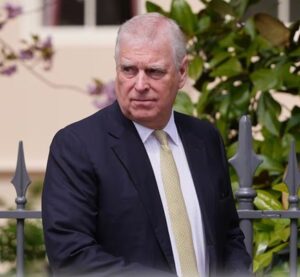
Andrew Mountbatten-Windsor arrested on his 66th birthday, February 19, 2026 / x.com

Andrew followed a conventional royal trajectory, entering military service and later assuming ceremonial military roles and public responsibilities. Those honours were later withdrawn as his association with Epstein drew intense scrutiny. Although he remains a prince by birth, the prolonged scandal brought an abrupt end to his public-facing royal role, the result of sustained controversy and legal pressure over several years.

The current inquiry follows the release of new documents tied to Epstein that reportedly suggest Andrew may have shared official government information with him during his tenure as a UK trade envoy. Authorities have not brought formal charges, and Andrew has maintained that he engaged in no improper conduct in connection with Epstein. Here’s the time line:

Timeline: Britain’s Prince Andrew and the Epstein scandal

The following timeline outlines key events involving Prince Andrew and his association with convicted sex offender Jeffrey Epstein, which led to his withdrawal from royal duties, loss of titles and his arrest on Thursday.

Feb. 19, 1960 – Andrew is born, the second son of Queen Elizabeth II and Prince Philip. His elder brother, King Charles III, is heir to the throne.

March 2001 – Andrew is photographed in London with Virginia Giuffre, then known as Virginia Roberts, and Ghislaine Maxwell. The image attracts little attention at the time but later becomes central to allegations against him.

December 2010 – Andrew is photographed walking with Epstein in New York’s Central Park shortly after Epstein’s release from prison following a sexual offence conviction, sparking public criticism in Britain.

2011 – The Daily Mail publishes an interview with Giuffre alongside the 2001 photograph, bringing allegations involving Andrew into mainstream public debate.

January 2015 – Allegations that Andrew had sex with a minor emerge in a U.S. civil lawsuit connected to Epstein. Andrew denies wrongdoing.

July 2019 – Epstein is arrested on federal sex trafficking charges.

Aug. 2019 – Epstein is found dead in his jail cell while awaiting trial, intensifying scrutiny of his high-profile associates, including Andrew.

Nov. 2019 – Andrew gives a television interview to the BBC denying allegations, questioning the authenticity of the 2001 photograph and saying he cut ties with Epstein in 2010. The interview is widely criticised.

Nov. 2019 – Days later, Andrew announces he will step back from public duties “for the foreseeable future,” citing disruption caused by his Epstein association.
Sept. 2021 – Giuffre files a civil sexual assault lawsuit against Andrew in the United States. Andrew denies the claims.

Jan. 2022 – A U.S. judge rejects Andrew’s attempt to dismiss the lawsuit. Soon after, he is stripped of honorary military titles and royal patronages.

Feb. 2022 – Andrew agrees to pay Giuffre millions of dollars to settle the civil sexual assault lawsuit, without admitting liability.

2024 – Reports say Andrew must personally fund the upkeep of his residence at Royal Lodge if he wishes to remain there.

2025 – Court documents and reported emails linked to Epstein, including one stating “we’re in this together,” renew scrutiny of Andrew’s past association.

April 2025 – Giuffre dies. Her family describes her as a “fierce warrior in the fight against sexual abuse and sex trafficking.”

2025Buckingham Palace says Andrew will now be known as Andrew Mountbatten-Windsor in official contexts, reflecting his diminished royal role.

Feb. 19, 2026 – Andrew is arrested on his 66th birthday on suspicion of misconduct in public office as part of an investigation linked to Epstein. He has not been charged with any offence and has consistently denied wrongdoing.


DNA Sheds Light on Stone Age Kinship Family Bonds in Ancient Gotland Graves

In the windswept landscapes of Gotland, Sweden’s largest island, archaeologists have long puzzled over the burial practices of a 5,500-year-old hunter-gatherer community. Now, a groundbreaking DNA study from Uppsala University is rewriting our understanding of these ancient people, revealing not just who was buried with whom, but hinting at a sophisticated grasp of family lineages that extended far beyond parents and siblings.

The findings, drawn from four shared graves at the Ajvide site, suggest these Stone Age inhabitants placed deep value on distant relatives from cousins, aunts, to great-aunts, challenging assumptions about prehistoric social structures. The Ajvide burial ground, nestled on Gotland in the Baltic Sea, stands as one of Scandinavia’s premier Stone Age treasures. Discovered decades ago, it boasts 85 known graves filled with artifacts from a culture that thrived on seal hunting and fishing, even as farming swept across southern Europe.

These people, part of the Pitted Ware Culture (PWC), remained genetically distinct from emerging agricultural societies, clinging to a nomadic lifestyle amid a changing world.What sets Ajvide apart are its multiple-occupancy graves, eight in total, each holding two or more individuals.

Four Graves but Surprising Findings

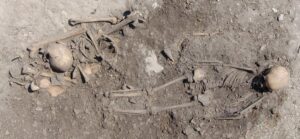
Researchers zeroed in on four of these for their latest analysis, extracting DNA from teeth and bones to map out kinship. The results, published in a peer-reviewed journal, paint a picture of deliberate burials where blood ties mattered, but not always in the ways we’d expect.Take Grave 1: A 20-year-old woman lay flanked by two young children, a four-year-old boy and a one-and-a-half-year-old girl. At first glance, it screams maternal bond.

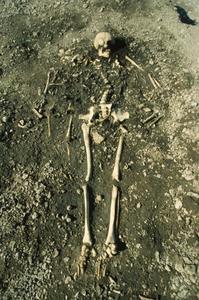
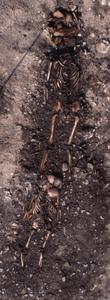
The 8-10-year-old girl placed stretched out on her back with a bone cluster that belongs to a young adult female who was a third-degree relative of the girl / Photo: Johan Norderäng

But the DNA tells a different story. The kids were full siblings, sharing half their genetic material, yet the woman wasn’t their mother. Instead, she was likely their paternal aunt or half-sister, a second-degree relative.

“Surprisingly enough, the analysis showed that many of those who were buried together were second- or third-degree relatives, rather than first-degree relatives,” explained Helena Malmström, the archaeogeneticist who designed the study. “This suggests that these people had a good knowledge of their family lineages and that relationships beyond the immediate family played an important role.”

Grave 2 offered another twist: A teenage girl buried beside an adult man, whose remains appeared relocated from elsewhere. Genetic testing confirmed he was her father, a rare direct parent-child link in these shared plots. Then there’s Grave 3, with two children, a boy and a gir, interred together. No siblings here; they shared just an eighth of their DNA, pointing to third-degree kin like cousins.

Grave 4 mirrored this: An 8- to 10-year-old girl stretched out on her back, accompanied by a cluster of bones from a young adult female, her third-degree relative, perhaps a great-aunt or cousin. These revelations come from meticulous genetic work. To determine sex, scientists checked for chromosomal markers: Two X chromosomes for females, an X and Y for males, crucial since children’s skeletons often lack clear indicators. Kinship degrees were gauged by shared DNA segments.

Kinship in Hunter-Gtherer Cultures

First-degree relatives (parents, kids, full siblings) match about 50 percent; second-degree (grandparents, half-siblings) around 25 percent; third-degree (cousins, great-grandparents) roughly 12.5 percent. Mitochondrial DNA (mtDNA), passed solely through mothers, helped trace maternal lines, while broader nuclear DNA filled in the paternal and overall puzzle.

The 8-10-year-old girl placed stretched out on her back with a bone cluster that belongs to a young adult female who was a third-degree relative of the girl / Photo: Johan Norderäng

Tiina Mattila, the population geneticist leading the genetic analyses, noted the rarity of such insights. “As it is unusual for these kinds of hunter-gatherer graves to be preserved, studies of kinship in archaeological hunter-gatherer cultures are scarce and typically limited in scale,” she said. This pilot study, analyzing ten individuals from the four graves, is just the start.

The team plans to expand to over 70 remains from Ajvide, probing deeper into social organization, migration patterns, and rituals.Paul Wallin, a professor of archaeology and Ajvide expert, sees broader implications. “The analyses provide insight into social organisation in the Stone Age,” he told researchers. In a time without written records, these burials suggest oral traditions or communal knowledge kept track of extended families.

Why bury cousins or aunts together?

It could signal alliances, inheritance of roles, or even symbolic ties to ancestors. The PWC’s genetic makeup, about 80 percent from Mesolithic hunter-gatherers and 20 percent from Neolithic farmers, hints at interactions with outsiders, perhaps through marriage or trade.

On social media platform X, the discovery sparked quick buzz among history buffs and scientists. Archaeology enthusiast Nrken19 posted: “DNA analyses suggest that Gotland hunter-gatherers were well aware of family lineages and that relationships beyond the immediate family played an important role,” linking to a Phys.org summary.

The 8-10-year-old girl placed stretched out on her back with a bone cluster that belongs to a young adult female who was a third-degree relative of the girl / Photo: Johan Norderäng

In a follow-up, he added details on the PWC’s dual ancestry, blending Mesolithic and farmer roots. Gerry Ward, a science news sharer, pointed to a related piece: “Using aDNA to determine family relationships of individuals buried approximately 5,500 years ago.”
These online ripples underscore the public’s fascination with ancient DNA, a field exploding thanks to advances in sequencing tech. Just as in modern forensics, ancient DNA (aDNA) extraction involves grinding bone samples, isolating fragments, and amplifying them via PCR before sequencing.

Degradation over millennia means short, fragmented strands, contaminated by microbes or modern handlers. But tools like next-generation sequencing have made it possible to reconstruct genomes from scraps, revealing everything from Neanderthal interbreeding to migration waves. This Gotland study fits into a global mosaic.

Similar work in Britain uncovered a 5,700-year-old family tree from a Gloucestershire tomb, showing polygamy and patrilineal descent. In Siberia, Bronze Age graves revealed complex kin networks among nomads. Here, the absence of immediate family in many co-burials might indicate taboos against burying parents with kids, or perhaps rituals honoring extended clans to strengthen community bonds.Yet, questions linger.
Were these burials simultaneous, or added over time?

The relocated man in Grave 2 suggests secondary interments, a practice seen in other cultures to reunite kin. And the children’s presence in most graves raises poignant queries about mortality rates or sacrificial rites, though no evidence supports the latter. As Uppsala’s team digs deeper, Ajvide could illuminate how hunter-gatherers navigated a world on the cusp of agriculture.

In an era of climate shifts and resource pressures, family ties likely provided safety nets, much like today. Malmström’s words resonate: These people weren’t isolated primitives but part of intricate social webs, tracking lineages with the precision of a family tree app.

The Stone Age, often romanticized as brutal and basic, emerges more nuanced, full of relationships that echo our own. As Wallin put it, it’s a window into “life histories and burial rites” that humanize our ancestors. In Gotland’s quiet graves, the past whispers secrets, reminding us that family, in all its forms, has always been the thread binding humanity.

Check Related FAQs:


How Ancient DNA Reveal Kinship Degrees?

Ancient DNA from teeth and bones was analyzed to determine sex via chromosomes (XX for females, XY for males) and kinship by shared genetic material. First-degree relatives like parents or siblings share about 50%; second-degree (half-siblings, grandparents) around 25%; third-degree (cousins) roughly 12.5%. This mapping uncovered extended family ties in Gotland’s Stone Age graves, beyond immediate kin.

What Is the Pitted Ware Culture?

The Pitted Ware Culture (PWC) was a Neolithic hunter-gatherer society in Scandinavia around 5,500 years ago, thriving on seal hunting, fishing, and foraging. Genetically distinct from contemporary farmers, they inhabited sites like Ajvide on Gotland, leaving pottery with pitted decorations and communal graves. Their lifestyle persisted amid Europe’s agricultural shift, blending Mesolithic roots with minor farmer influences.

How Did Stone Age Hunter-Gatherers Track Extended Family Ties?

Imagine epic fireside tales weaving generations! These savvy survivors used oral traditions, memorized genealogies, and kinship rituals to map out cousins and aunts. By mingling with distant groups to dodge inbreeding, they built vast social webs, ensuring family lore endured through stories alone.

What Do These Burials Reveal About Gender Roles in Ancient Societies?

Shattering stereotypes, these graves scream equality! In Pitted Ware culture, men, women, and kids mingled in burials without strict divisions or status gaps. Mixed-sex co-burials suggest flexible roles, where gender didn’t boss rituals or hierarchy—hinting at a balanced society far from rigid patriarchal norms.

Could Similar DNA Studies Uncover Hidden Family Ties Elsewhere?

When DNA has mapped seven-generation clans in Britain, exposed elite incest in Ireland, and traced kin from Mongolia to Russia. Worldwide, it reveals patrilineal lines, exogamy, and social twists in tombs from Europe to Asia, rewriting human history.

Why Cousins Be Buried Together Instead of Immediate Family?

Ancient rites often honored extended kin to symbolize lineages, dodge nuclear family taboos, or strengthen social bonds. At Ajvide, co-burials of cousins and aunts spotlight deep kinship knowledge, weaving community ties through ritual—far beyond just parents and children.

Echoes of ‘Stop the Invasion’ Reverberate Across X on All Migrants in US

On the social media platform X, the rallying cry “Stop the Invasion” has exploded into a digital battleground, capturing the raw pulse of America’s polarized immigration debate. What began as a staple in Republican political rhetoric has evolved into a grassroots hashtag and slogan, amassing thousands of posts in recent months.
With U.S. President Donald Trump’s second term underway and promises of mass deportations in full swing, users from Texas suburbs to Minnesota diners are invoking the phrase to demand action, while critics label it a dehumanizing trope that stokes fear and division.The phrase’s resurgence coincides with heightened enforcement efforts by Immigration and Customs Enforcement (ICE), including raids in sanctuary cities and the conversion of warehouses into detention centers at a cost of $38.3 billion.
As border apprehensions dip under Trump’s executive actions, which he touted as fulfilling a 2024 campaign pledge to “stop the invasion of illegals into our country,” X serves as a real-time barometer of public sentiment.
A review of over 50 recent posts reveals a stark divide: fervent calls for walls, deportations, and cultural preservation on one side, and accusations of racism and moral panic on the other.The Slogan’s Political Pedigree“Stop the Invasion” isn’t new to U.S. discourse; it’s a thread woven through decades of conservative messaging on immigration.
Trump’s Amplification Throughout
Trump amplified it during his 2016 and 2024 campaigns, running thousands of Facebook ads in 2019 alone that warned of an “INVASION” at the southern border, often pairing it with images of migrant caravans. By 2024, Trump had invoked “invasion” over 500 times in speeches and posts, framing migrants as “killers” and “animals” to underscore the urgency, according to NYT.

His running mate, Florida Gov. Ron DeSantis, echoed the language in a 2023 campaign plan titled “Mission Stop the Invasion,” proposing military involvement in Mexico to curb drug flows and crossings. In Texas, Gov. Greg Abbott has operationalized the rhetoric through Operation Lone Star, a $11.1 billion initiative launched in 2021 to “stop the invasion.”

Abbott’s efforts, including razor wire and floating buoys in the Rio Grande, have drawn lawsuits from the Biden administration but praise from Trump allies.The slogan’s echoes reach beyond the border. In 1992, California Gov. Pete Wilson ran ads urging Congress to “stop the invasion” of Latino migrants, a tactic that boosted his re-election but deepened ethnic tensions.

Today, it’s a cornerstone of Trump’s “largest deportation operation in American history,” with early 2026 actions targeting criminal noncitizens and suspending asylum claims.

Viral Flashpoints: From Temples to Town Halls

On X, “Stop the Invasion” often pairs with visceral, local grievances, turning policy debates into cultural flashpoints. A February 16 post by Texas GOP operative @Carlos__Turcios went viral with 6,585 likes, decrying a 105-foot Hanuman statue in Sugar Land – the third-largest in the U.S. – as evidence of “Third World Aliens… slowly taking over Texas and America.”

The video, showing the Hindu deity’s installation, sparked a firestorm: supporters like @ma_double replied, “Houston, Texas too. Stop the invasion!” while others, including Indian-American users, fired back that it was “xenophobic fearmongering.”  The post, viewed over 530,000 times, exemplifies how the phrase extends to non-border issues, blending immigration with anxieties over religious and ethnic shifts.

Similar outrage erupted over a Minneapolis restaurant meeting where Somali officials allegedly claimed parts of Minnesota for Somalia.
@DerrickEvans4WV, a former West Virginia lawmaker, shared footage calling it a “sovereignty” threat, prompting @GinoPatti88 to demand: “Stop the invasion. Revoke citizenship. Deport them all back to Somalia.”

The clip amassed 20,802 views, fueling calls for a nationwide immigration freeze.Even non-immigration contexts borrow the language. Rep. Nancy Mace (R-S.C.) used “Stop the Invasion of Women’s Spaces Act” in a February 7 post to ban transgender individuals from female facilities in federal buildings, garnering 2,007 likes. “Men in women’s private spaces is not normal,” she wrote, illustrating the phrase’s rhetorical elasticity.Grassroots users amplify these themes.

Another user @Oilfield_Rando, with 1,504 likes, argued the crisis could end “tomorrow if congress simply suspend[ed] asylum protections,” calling it a “two page bill.” @SitInMyTruck

echoed: “Halt ALL immigration and remove the invaders… There’s no ‘legal’ or ‘illegal’ – it’s just immigration and it’s an invasion that must be reversed.”

In Europe, @JoeyMannarino targeted Spain’s Pedro Sánchez: “The number one priority… must be to defeat Sánchez and close the border from Morocco.”

Dehumanization or Desperate Plea?

Not all reactions are supportive. Critics on X and beyond argue the rhetoric veers into racism, reducing humans to “vermin” or “swarms.” Rev. Dr. Jacqui Lewis posted in 2023 that terms like “infestation” enable violence: “Then you can kill them, and people will cheer.”
Also, @JRubinBlogger, a Washington Post columnist, called Trump’s “infest” language a “full-throttle toward dehumanization,” stripping immigrants of personhood.

Recent posts highlight the human toll. @AlBuffalo2nite criticized a viral narrative using a migrant’s death to shield against enforcement: “Turning personal grief into a political shield… is manipulation.”
@equalityAlec, a civil rights lawyer, decried the “nativist, xenophobic” framing: “The core… is the notion that human beings are worth more or less depending on where they are born.”
@LOPE_64warned: “The first step in dehumanization is language… one day, when this madness is over, everyone will claim they were against it.”

Media analyses reinforce this. A 2025 HuffPost report linked Trump’s “invasion” trope to the 2019 El Paso shooting, where the gunman cited it in his manifesto. The New York Times traced its use in GOP ads, noting parallels to Pete Wilson’s 1992 campaign, which “deepened ethnic tensions.”

The Anti-Defamation League (ADL) flagged it in 2025 white supremacist propaganda, often tied to “white genocide” conspiracies. Defenders push back. @AssociationOfF2F argued: “There’s nothing dehumanizing about enforcing immigration law… It’s about the social and political victimization of the native population.”

@dystopiangf framed opposition as “genocidal,” insisting borders protect a people’s “voice, will, mind, and soul.”

A Nation at the Crossroads

As Trump’s administration ramps up deportations, targeting over 1 million in the first year, “Stop the Invasion” encapsulates a broader reckoning. Polls show 60% of Americans favor stricter enforcement, but 55% also support pathways to citizenship for Dreamers.
On X, the phrase trends weekly, with spikes around ICE operations and viral videos.For users like @theworldofmomus, it’s a “consensus building” moment: “End to… illegal immigration while reducing the flow of legal migration.”
Yet as @MorgothsReview noted, such narratives often “humanize the illegal migrants” at the expense of native stories: “We do not get the story of the last white kid in class.”

The debate rages on X, where algorithms amplify outrage. Whether it’s a clarion call for security or a dog whistle for division, “Stop the Invasion” underscores America’s unresolved soul-searching: Who belongs, and at what cost? As one user put it, “A nation is equivalent to a people’s voice.” In 2026, that voice is louder than ever.

‘Stop invasion and deport them’: Texas activist targets Hanuman temple, Indian Immigrants

A Texas-based conservative activist has sparked controversy after sharing a video of a 90-foot-tall “Statue of Union” of Lord Hanuman, which is located at the Shri Ashtalakshmi Temple in Sugar Land, Texas. While sharing the video, Carlos Turcios, a Republican activist based in the Dallas, Fort Worth region, said that third World Aliens are slowly taking over Texas and America.

In a post on X, he aid, “stop the invasion.”His remarks drew support from some anti-immigration users while others criticised the post as racist and misleading.One of the supporters said, “Stop the invasion and deport them all.”

Another said, “Disgusting. Get rid of it as soon as possible. What is wrong with Texas? Gotta be money.” While critics claimed, “Wasn’t Charlie Kirk saying about Secularism being a western and Christian value? Besides there are way more churches and Jesus statues in India than there are Hindu temples and statues in the US.”

Inaugurated in August 2024, this Panchaloha Abhaya Hanuman statue is the tallest in North America, representing strength, devotion, and a “spiritual epicenter” for peace. Earlier also, Turcios had criticised claiming that “third world aliens” were entering the US through H-1B visas and said that Frisco had been “invaded.”

ALSO READ: London’s Far-Right Rally Sends Shockwaves Through South Asian Communities

AI Impact Summit: Long Queues, Brief Evacuation Create Confusion at Pragati Maidan

What was billed as a landmark showcase of India’s AI ambitions descended into disarray on its opening day, with throngs of attendees facing interminable queues, sudden evacuations, and logistical nightmares at the Pragati Maidan venue in the capital.
The India AI Impact Summit, running through February 20, drew sharp online backlash as delegates, startups, and journalists reported overcrowding, inadequate signage, and conflicting access protocols. With an expected footfall of 250,000, the event aimed to position India as a voice for emerging economies in AI governance.
Instead, organizational hiccups threatened to eclipse the government’s narrative of technological prowess under Prime Minister Narendra Modi’s administration.Several participants described a frantic morning, with entry delayed until late, only for the exhibition hall to be abruptly cleared for security sweeps ahead of high-profile arrivals. “Unclear instructions had left many scrambling to reclaim possessions,” one delegate told Reporters, echoing sentiments shared widely on social media.

Venue Evacuated Briefly

The chaos peaked around midday when the venue was evacuated for hours of sanitization, stranding exhibitors and founders outside without water or updates. Punit Jain, founder of developer platform Reskilll, captured the frustration in a viral post on X: “An AI Summit that sidelines its own builders? • 7 AM queues • 9 AM entry • 12 PM full evacuation • Hours of sanitization • PM visit at 5 PM. Day 1 Ends here. Meanwhile, exhibitors, delegates, startup founders left outside. No water. No clarity.”

Jain, who tagged IT Minister Ashwini Vaishnaw and the Prime Minister’s Office, accused organizers of mobilizing the ecosystem only to displace it, calling it “not how we build India’s AI future.”

Journalists fared no better, grappling with mismatched digital QR codes and promised physical passes that never materialized. In a WhatsApp group for media covering the event, reporters lamented a lack of workspaces, with one noting the absence of seating to file stories or conduct interviews.
Sreenivasan R, an education and tech activist, highlighted the disorganization in real-time:

@OfficialINDIAai

@IndiaAiExpo

chaotic entry,

@DiGiyatra

no use. Thousands in 5Queues and one bags scanner. Poor management across. No proper directions. People going in circles. Sessions cancelled, agenda vanishing from App. Labelling wrongly done at rooms.” Sreenivasan, an alumnus of IIM Bangalore and Jawaharlal Nehru University, added that he was “helping wherever” possible amid the confusion.

International Visitors in Dismay

Even international visitors expressed dismay. Raj Vardhan, who traveled from the United States, described his ordeal: “Flew all the way from the US for the AI Summit, only to face chaos on Day 1. Overcrowded, poorly planned, and couldn’t get into a single session. To make it worse, endless political convoys blocking roads turned getting out into a nightmare.”

Vardhan’s post, hashtagged #AISummit and #AIIndia, voiced cautious optimism for Day 2, urging a demonstration of “true AI leadership.” The complaints echoed an earlier vent from Maitreya Wagh, co-founder of AI voice startup Bolna, who found himself locked out of his own booth: “Gates are closed so could not access my own booth at the AI Summit. If you’re also stuck outside and wanted to visit the Bola team, dm me. We may set up a mini-booth at some Connaught Place cafe.”

For now, attendees are bracing for Tuesday’s panels, where some speakers remain in limbo over session confirmations and agendas. Amid the glitches, the summit’s core message, amplifying Global South perspectives on ethical AI, hangs in the balance, overshadowed by the very disorganization it sought to transcend.

2,000-year-old Iron Age temple discovered in Denmark

Beneath what appeared for generations to be an unremarkable stretch of grassland in central Jutland, archaeologists have uncovered one of the most consequential Iron Age sites ever found in Denmark: a vast, fortified settlement centred on a monumental temple dating back nearly 2,000 years.

The discovery at Hedegaard, near Ejstrupholm, is reshaping historians’ understanding of how power, religion and long-distance connections were organised in northern Europe around the turn of the Common Era. Danish archaeologists say the site was not a peripheral village but a regional power centre, combining ritual authority, political control and economic activity within a single, carefully planned landscape.

“This is not just another settlement,” said Martin Winther Olesen, museum inspector at Museum Midtjylland. “Everything here is bigger, more complex and more deliberate than what we normally see. Nothing is ordinary.”

A Landscape That Hid Its Past

For decades, Hedegaard gave little hint of what lay beneath. Unlike many archaeological sites disturbed by deep ploughing, the area’s cultural layers remained remarkably intact, protected by relatively light agricultural use. That preservation would prove crucial.

The site first drew attention in 1986, when archaeologist Orla Madsen uncovered an unusually rich burial ground containing weapons — a signal that the area held higher-status remains. Excavations continued sporadically until 1993, after which the site slipped into dormancy.

It was only after research resumed in 2016, and intensified fieldwork in 2023, that archaeologists realised the graves were just one element of a much larger whole. What emerged was a fortified complex comprising elite residences, workshops, defensive palisades and a central temple — all laid out on a scale rarely seen in Iron Age Denmark.

The Temple at the Heart of Power

At the centre of Hedegaard stands the most striking discovery: a large ceremonial building, dated to around 0 AD, offering some of the clearest evidence yet of Iron Age religious architecture in Denmark.

The temple measures roughly 15 by 16 metres, almost rectangular in form. A ring of robust posts creates a colonnade encircling a smaller inner structure. This inner building was constructed with deeply set posts, clay walls and split wooden planks, and features a south-facing entrance — a detail archaeologists believe carried symbolic meaning.

Inside, researchers uncovered a raised 2-by-2-metre hearth, decorated with stamped and linear patterns. Crucially, the hearth shows no signs of everyday cooking.

ALSO READ: London’s Far-Right Rally Sends Shockwaves Through South Asian Communities

“This was not a domestic space,” archaeologists say. “It was a ritual one.” The find provides rare physical evidence of how religious ceremonies may have been staged, offering insight into belief systems that were previously known mostly through later texts and scattered finds.

Fortifications in the Shadow of Rome

Hedegaard’s scale and defences also place it firmly within a wider European context. Around the time the temple was built, the Roman Empire was expanding northwards, reaching as far as the River Elbe, not far from Jutland.

Archaeologists believe Hedegaard’s palisades and defensive structures were not incidental. Their design reflects technical knowledge and strategic planning, possibly shaped by awareness of Roman military organisation and the shifting balance of power in northern Europe.

“The fortifications may have been practical,” Olesen said, “but they were also symbolic. They sent a message: this was a place of authority, not to be challenged lightly.”

Taken together, the discoveries at Hedegaard challenge older views of Iron Age Denmark as a landscape of loosely connected farming communities. Instead, the site points to centralised power, controlled by elites who commanded resources, organised large-scale construction and maintained long-distance contacts.

The combination of ritual space, political authority and economic activity in one location suggests Hedegaard functioned as a hub — a place where decisions were made, alliances forged and religious legitimacy reinforced.

For archaeologists, the implications extend far beyond central Jutland.

“This forces us to rethink how power was structured in northern Europe at the dawn of the Roman era,” researchers say. “Hedegaard was not on the margins of history. It was very much part of it.”

Ten Years After Paris Climate Pact, Warming Curve Steepens Alarmingly

Ten years after the Paris Agreement entered into force with the promise of bending the global temperature curve, the latest scientific data suggest the opposite has happened. The planet is warming faster, not slower, and the physical systems that regulate Earth’s climate are crossing thresholds once considered distant risks.

Newly released datasets from leading climate agencies show that 2025 ranks among the three hottest years ever recorded, while atmospheric greenhouse gases, ocean heat and sea levels all reached new highs. Together, the numbers paint a sobering picture: efforts to rein in fossil fuel use have not kept pace with the scale of the challenge.

A decade on, the world is drifting further from its climate goals.

Emissions in Reality

Countries with Highest Carbon Footprint

Measurements from the World Meteorological Organization’s Global Atmosphere Watch network show concentrations of carbon dioxide, methane and nitrous oxide climbing to record levels, the primary driver behind the sharp temperature rise observed from 2023 to 2025.

According to the Global Carbon Budget, global fossil-fuel carbon dioxide emissions are projected to reach 38.1 billion tonnes in 2025, the highest level ever recorded. Coal, oil and gas use continue to rise, offsetting gains from renewable energy deployment.

The report, compiled by more than 130 scientists worldwide, estimates emissions will grow by 1.1% in 2026, pushing atmospheric CO₂ concentrations to roughly 52% above pre-industrial levels.

Scientists warn the remaining carbon budget is vanishingly small. To have a reasonable chance of limiting warming to 1.5°C, humanity can emit only about 170 billion tonnes more CO₂, roughly four years of emissions at current rates.

Regionally, trends diverge. Emissions are still rising in China, India, the United States and the European Union, while Japan has recorded a modest decline.

A Decade of Acceleration in Temperatures

Data from NASA’s Goddard Institute for Space Studies show Earth’s surface temperature in 2025 averaged 1.19°C above the 1951–1980 baseline, effectively tying with 2023 as the warmest year on record.

When measured against the pre-industrial era, the picture is starker. The WMO’s consolidated dataset places 2025 at 1.44°C above pre-industrial levels, ranking it among the three hottest years in the 176-year instrumental record.

Independent analyses from Berkeley Earth confirm the trend: warming has accelerated notably since the mid-2010s, coinciding with a surge in cumulative emissions.

Arctic: Sea Ice at Historic Lows

The Arctic is warming more than twice as fast as the global average, according to the U.S. National Oceanic and Atmospheric Administration (NOAA).

NOAA’s 2025 Arctic Report Card found that the period from October 2024 to September 2025 was the warmest in the region since records began in 1900. In March 2025, Arctic sea-ice extent reached its lowest winter maximum ever recorded, covering just 14.47 million square kilometres, data from the U.S. National Ice Center show.

Scientists warn that shrinking sea ice not only accelerates warming,  by reducing the Earth’s reflectivity, but also disrupts weather patterns far beyond the polar regions.

Oceans: Absorbing the Heat, Raising the Seas

The oceans, which absorb more than 90% of the excess heat trapped by greenhouse gases, set new records in 2025. NOAA and Berkeley Earth report that upper-ocean heat content reached its highest level ever measured.

As oceans warm, they expand. Combined with melting glaciers and ice sheets, this has pushed global sea levels steadily higher. The Intergovernmental Panel on Climate Change projects a rise of 0.20 to 0.29 metres by 2050, compared with the 1995–2014 average, a change that threatens coastal cities, ports and low-lying nations.

A Decade After Paris

When the Paris Agreement was adopted, governments pledged to keep warming “well below” 2°C and pursue efforts to limit it to 1.5°C. A decade later, the data show the world edging perilously close to that lower threshold, without a credible pathway to stop there.

The science does not argue that Paris failed; it shows that implementation has lagged ambition. What the next decade delivers will depend less on new pledges than on whether the existing ones finally translate into structural change.

For now, the climate system is delivering its verdict in numbers, and those numbers are moving faster than diplomacy.

Charged over false Walmart kidnapping charges, Indian-Origin Man files lawsuit now

A Georgia man who spent more than six weeks behind bars after being accused of trying to kidnap a toddler inside a Walmart has filed a federal civil rights lawsuit, alleging that police and prosecutors pursued charges despite video evidence that contradicted the accusation.


Is US Military Preparing For Weeks-Long Iran Operations?

The US military is preparing contingency plans for the possibility of sustained, weeks-long operations against Iran if President Donald Trump authorises military action, according to two US officials cited by Reuters in its report. Such preparations point to a scenario that would go far beyond the limited, one-off strikes seen previously between the two countries.

The officials, who spoke on condition of anonymity due to the sensitivity of the planning, said the scope of military options under consideration underscores the high stakes surrounding ongoing diplomatic efforts between Washington and Tehran.

US envoys Steve Witkoff and Jared Kushner are scheduled to hold talks with Iranian representatives in Geneva on Tuesday, with Oman acting as a mediator. US Secretary of State Marco Rubio said over the weekend that President Trump still prefers a diplomatic solution, but acknowledged that negotiations with Tehran remain challenging.

Even as diplomacy continues, Washington has significantly bolstered its military presence in the region. US officials confirmed that the Pentagon is deploying an additional aircraft carrier to the Middle East, along with fighter aircraft, guided-missile destroyers and thousands of troops. The buildup has heightened concerns about a possible escalation into open conflict.

Trump for Regime Change

Speaking after a military event at Fort Bragg in North Carolina, Trump openly raised the prospect of political change in Iran, suggesting that a change in government “seems like that would be the best thing that could happen.” He declined to name potential successors, saying only that “there are people.”

Trump has previously expressed reluctance to deploy large numbers of ground troops to Iran, remarking last year that “the last thing you want to do is ground forces.” The assets now being positioned in the region point primarily to air and naval strike options, although Trump has shown a willingness in other theatres, including Venezuela, to rely on special operations forces.

Asked about preparations for a potentially prolonged military campaign, White House spokesperson Anna Kelly said the president has “all options on the table” when it comes to Iran. She added that Trump consults widely but ultimately decides based on US national security interests. The Pentagon declined to comment.

The United States has carried out strikes on Iranian targets before, including last year’s “Midnight Hammer” operation, in which stealth bombers flew directly from the US to hit Iranian nuclear facilities. That operation was limited in scope, and Iran’s response was confined to a restrained retaliatory strike on a US base in Qatar.

This time, officials said, the planning is more complex. In a sustained campaign, US forces could target Iranian state and security institutions in addition to nuclear infrastructure. While specific targets were not disclosed, analysts warn that such operations would significantly increase risks to US personnel.

Iran’s Missile Arsenal

Iran possesses a substantial missile arsenal, and US officials expect Tehran to respond forcefully to any sustained attack. One of the officials said Washington fully anticipates Iranian retaliation, potentially triggering cycles of strikes and counter-strikes over an extended period.

Iran’s Revolutionary Guard has warned that any attack on Iranian territory could prompt strikes on US military bases across the Middle East. The US maintains installations in several countries in the region, including Qatar, Bahrain, Kuwait, Saudi Arabia, the United Arab Emirates, Jordan and Turkey.

Israeli Prime Minister Benjamin Netanyahu discussed Iran with Trump during talks in Washington last week, stressing that any agreement with Tehran must address Israel’s security concerns. Iran has indicated it is willing to discuss limits on its nuclear programme in exchange for sanctions relief, but has ruled out negotiations on its missile capabilities.

Meanwhile, Iranian opposition figure Reza Pahlavi argued that US military intervention could hasten political change in Iran. In an interview with Reuters, the US-based son of Iran’s last shah said there were signs the current leadership was weakening and that an attack could accelerate its collapse.

As diplomatic efforts continue, US military preparations suggest Washington is keeping open the option of a prolonged confrontation, one that could reshape regional security dynamics and carry far-reaching consequences for the Middle East.

New recombinant mpox strain detected in UK and India, WHO urges continued monitoring

WHO confirmed that two cases of the recombinant strain – combining genomic elements of clades Ib and IIb of the monkeypox virus (MPXV) – have been identified to date: one in the United Kingdom and one in India. Both patients had recent travel histories, and neither experienced severe illness.

No secondary cases were detected following contact tracing.

WHO has published a detailed update on the two cases and the national responses.

Recombination is a natural process that can occur when two related viruses infect the same person and exchange genetic material, producing a new variant.

According to WHO, detailed genomic analysis shows the two individuals “fell ill several weeks apart with the same recombinant strain,” suggesting that additional undetected cases may exist.

What is mpox?

Mpox is an infectious disease caused by the monkeypox virus (MPXV), part of the Orthopoxvirus genus, which also includes the virus that causes smallpox.

It spreads through close physical contact, including sexual contact, and in some cases through contaminated materials or respiratory droplets.

Symptoms typically include fever, swollen lymph nodes, and rash and/or lesions.

Click here for the WHO factsheet on mpox.

Two detected cases

The case in the United Kingdom was detected in December 2025 in a traveller returning from a country in the Asia Pacific region. Initial laboratory testing identified the virus as clade Ib, but whole genome sequencing later revealed that it contained genetic regions from both clade Ib and clade IIb strains. Repeat sequencing confirmed the findings and demonstrated that the virus “can replicate and presents potential for onward transmission.”

In India, a patient who developed symptoms in September 2025 was initially classified as infected with clade II MPXV. However, following updates to global genomic databases, the virus was reclassified as the same recombinant strain identified in the UK. The Indian case represents the earliest known detection of this strain.

“Due to the small number of cases found to date, conclusions about transmissibility or clinical characterization of mpox due to recombinant strains would be premature, and it remains essential to maintain vigilance regarding this development,” WHO said.

Clinical presentations in both cases were consistent with known mpox infections.

Risk assessment unchanged

WHO’s overall risk assessment remains unchanged: the risk is assessed as moderate for men who have sex with men with new and/or multiple partners and for sex workers or others with multiple casual sexual partners, and low for the general population without specific risk factors.

At the same time, WHO cautioned that clade differentiation PCR tests alone “may not reliably identify recombinant MPXV strains,” meaning genomic sequencing is essential for detection.

“All countries should remain alert to the possibility of MPXV genetic recombination,” WHO said, urging continued epidemiological surveillance, sequencing, vaccination of at-risk groups, and infection prevention and control measures.

WHO advised that no travel or trade restrictions are warranted based on current information.