‘A wave of truth’: COP30 targets disinformation threat to climate action

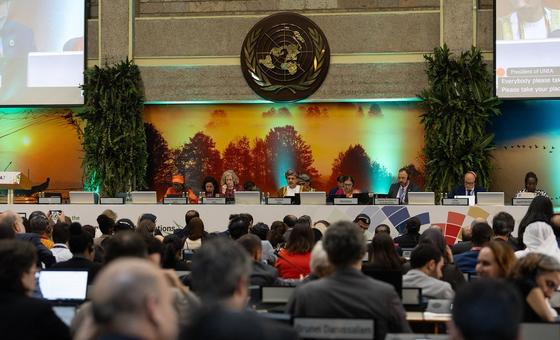
Brazil’s President Luiz Inácio Lula da Silva set the tone at the opening session, declaring that the battle for truth has become just as critical as the fight to cut emissions. COP30 must mark “a new defeat for climate denialists,” he said. 

On Wednesday, 12 nations – including Brazil, Canada, France, Germany and Spain – signed onto the first-ever Declaration on Information Integrity on Climate Change, pledging to fight back against the flood of false content and protect those on the frontlines of truth: environmental journalists, scientists and researchers.

The declaration, unveiled under the Global Initiative for Information Integrity on Climate Change, calls for concrete steps to dismantle networks of climate lies and shield evidence-based voices from harassment and attacks.

João Brant, Brazil’s Secretary for Digital Policies, said the goal is simple but urgent: to “create a wave of truth.”

The initiative, launched this past November, is a partnership between Brazil, the UN Department of Global Communications and UNESCO

“Disinformation, the harassment of expert voices, polarizing echo chambers, and the demise of independent journalism are eroding trust in what is real. At the same time, powerful interests are weaponizing climate change to stall and sabotage action,” said Charlotte Scaddan, Senior Adviser on Information Integrity at the United Nations.

She warned that climate disinformation goes far beyond denial. “It undermines climate action by attacking researchers and journalists, questioning scientific consensus, and creating false narratives around solutions,” she said. “We’re seeing sophisticated ‘information laundering’ – false claims cycled through multiple platforms to appear credible.”

The UN’s new Global Initiative for Information Integrity on Climate Change aims to turn the tide. Built on three pillars – research funding, evidence gathering, and integration into COP processes – the initiative has already secured a breakthrough: information integrity is now part of the COP Action Agenda for the first time. “We cannot achieve climate action and a liveable future without information integrity,” Ms. Scaddan stressed.

“The coming months will determine whether we can preserve the information environment essential for democratic decision-making and global cooperation.”

Disinformation: a direct threat to COP30 

Frederico Assis, COP30’s Special Envoy for Information Integrity, warned that the stakes could not be higher. “Disinformation, driven by obscurantist worldviews, fuels political extremism and puts lives at risk,” he told UN News, adding that there is a real danger of interference in climate negotiations.

“There is broad recognition that disinformation can affect and compromise every part of the COP process – process diplomatic negotiations, the action agenda, or mobilization and summits. All our efforts will be at risk if we fail to tackle disinformation properly, which stems from denialism,” Mr. Assis said.

He flagged the role of algorithms amplifying “conspiratorial and manipulative” content, often using “sophisticated tactics to spread false messages.” His mandate: keep the issue in the public eye and mobilize political, religious and social leaders, civil society and the media to push back. 

Cracking the code behind climate lies 

For the first time, information integrity has made it onto the official COP agenda – a milestone UNESCO’s Guilherme Canela says is long overdue.

Speaking to UN News, Mr. Canela stressed that the global initiative aims to expose the machinery driving climate disinformation.

“We still know very little about what’s behind this. For example, who funds these posts, and why do they spread faster than other types of content? How does that happen? If we don’t understand these mechanisms, it’s very difficult to design effective strategies to combat this phenomenon. The core of this global initiative is precisely to finance, especially in the Global South, investigative journalism and research projects to uncover what’s really happening,” he said.

The Global Fund for Information Integrity on Climate Change, created under the initiative, has already attracted 447 proposals from nearly 100 countries. Backed by an initial $1 million from Brazil, the fund is supporting its first round of projects – almost two-thirds from developing nations.

Mr. Canela called it “very rewarding” to see the issue “embraced so strongly at COP30.” 

Disinformation’s shape-shifting tactics 

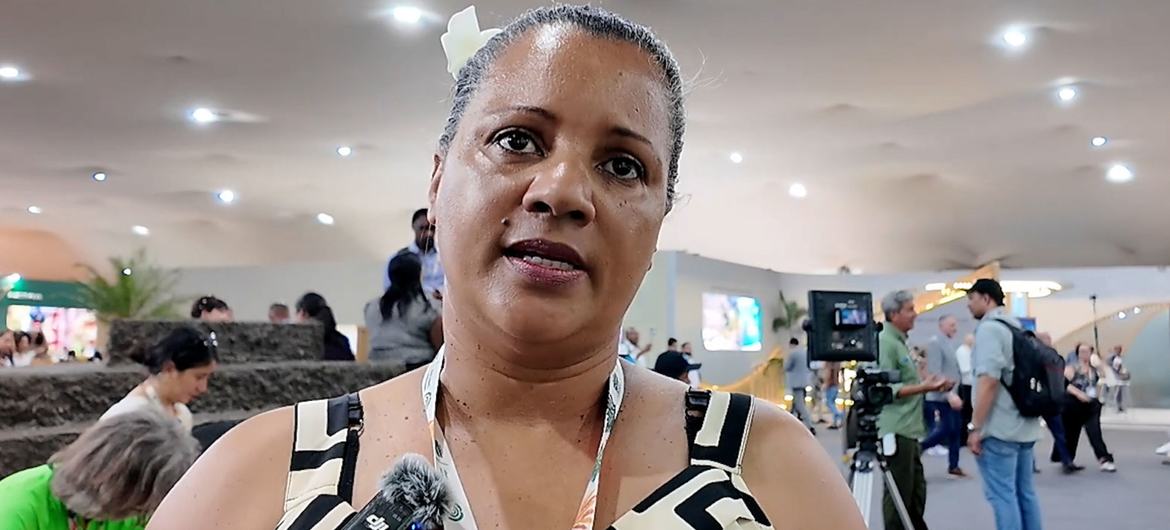
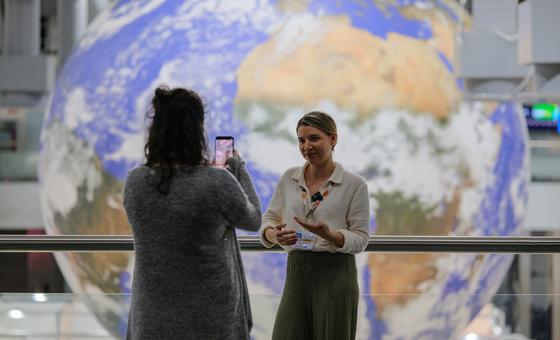
Maria Clara Moraes, a UN Verified Champion and co-founder of the Marias Verdes platform, knows the battle well. With over half a million TikTok followers, she says the fight against climate disinformation is “completely possible, but also extremely challenging.”

She warns that these campaigns are highly organized and “backed by powerful forces, particularly the fossil fuel industry.” Their narratives, she says, “change their disguise” over time.

“There are several types of disinformation. One of the most powerful is saying that it’s too late – that nothing can be done, or that these events like COP30 don’t make a difference. That’s also disinformation. Saying, ‘This isn’t working, it’s too slow, too complex, too frustrating.’ But yes – it’s important. We must constantly reaffirm the value of multilateralism and the importance of spaces like this one,” she said. 

A generation that refuses to give up 

Despite the challenges, Ms. Moraes told us that she sees hope in younger generations. By producing content rooted in science and sustainability, she says awareness of the climate emergency is growing fast.

According to her, young people are “a great source of hope and optimism.” She urges everyone to play their part in creating “micro-revolutions” through everyday choices that support climate action and drive systemic change. 

UN News is reporting from Belém, bringing you front-row coverage of everything unfolding at COP30.

At-risk mountain vipers and iguanas, in rare company at key wildlife talks

Ethiopian mountain vipers, Galapagos iguanas and Brazil’s Pernambuco tree – prized by violin bow-makers – and are just three of the more than 30 species that could be listed for special protection under the Convention on International Trade in Endangered Species of Wild Fauna and Flora (CITES).

“Because the trade in wild animals and plants crosses borders between countries, the effort to regulate it requires international cooperation to safeguard certain species from over-exploitation,” CITES said in a statement.

Today, the Convention covers the trade of more than 40,000 species of wild animals and plants. States parties to CITES can add more species by submitting proposals which are considered at meetings held every three years. 

“The proposals to be discussed highlight how scientists continue to address conservation and sustainable use across species that are not only biologically unique, but also culturally, economically and ecologically significant,” said Thea Carroll, CITES Secretariat Science Unit Chief, speaking in Geneva.

The final proposals slated for discussion in the Uzbek city of Samarkand include a range of perennially endangered wildlife such as elephants and rhinos, along with what must surely be the latest CITES pin-up candidate, the Golden-bellied mangabey monkey. 

Additional protection requests alongside these natural born charmers include arguably less obvious candidates, including the giant Galli wasp – all 32 centimetres of it – moths, frogs, sea cucumber, abalone and other commercially exploited aquatic species.

It’s been 50 years since the CITES convention entered into force, although it was originally conceived a decade earlier at a meeting of the International Union for Conservation of Nature. 

The Convention is just one of several international accords aimed at protecting the planet’s biodiversity. It specifically addresses regulation of the international wildlife trade that’s estimated to be worth billions of dollars and to include hundreds of millions of plant and animal specimens.

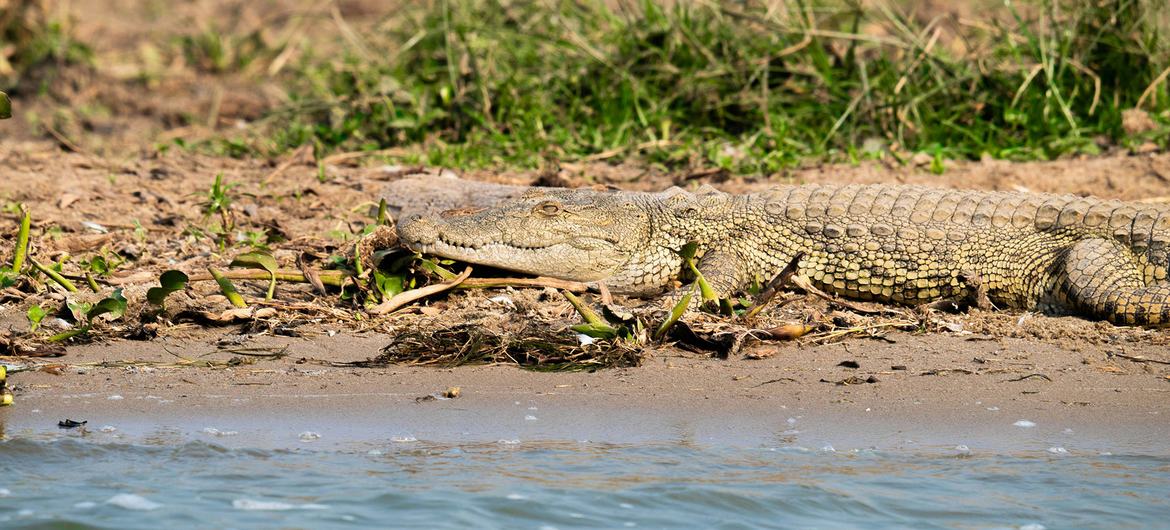
A young Nile crocodile rests on the riverbank by the Kazinga channel in Uganda.

Success stories

The Convention has been behind conservation success stories including the South American vicuña – a small camel – and the Nile crocodile. 

Their survival was assured when CITES supported national efforts to turn their wool and skins respectively into valuable and sustainably managed commodities that benefit local communities.

Overexploitation for international trade presents a major threat to wildlife but other risk factors include disease, pollution, a loss of habitat or the fragmentation of habitats.

Who protects the protectors

The fundamental biodiversity protection role played by CITES has not shielded it from a dire funding crisis for multilateral work everywhere, warned the organization’s Secretary-General, Ivonne Higuero.

“We’re all struggling,” she told journalists in Geneva. “All the entities of the UN are struggling right now with budgetary issues. There’s a falling of contributions from the Member States, from our Parties, and this is becoming very difficult for us to be able to operate.”

Ms. Higuero added: “We have not been receiving the expected contributions from the parties that have that is assessed according to the UN scale and of course we have arrears and payments. So this is one of the things that we will also be discussing.”

Explainer: What is CITES?

  • CITES is a UN-backed treaty that regulates the global trade of wildlife to ensure the sustainability of species and their prevention from extinction. CITES is short for the Convention on International Trade in Endangered Species of Wild Fauna and Flora.
  • The international agreement brings together 185 States Parties and is one of the world’s most powerful conservation tools. It marks its 50th anniversary this year at its 20th meeting (COP20) in Samarkand, Uzbekistan, beginning 24 November.

Key CITES facts:

  • Scope: The treaty provides protection for more than 40,000 species of animals and plants.
  • Goal: To make wildlife trade legal, sustainable and traceable.
  • How it works: Species are listed in “Appendices” I and II, based on the level of threat they face.
  • Meetings: Parties meet every three years to vote on new rules and listings in the Appendices. Appendix I includes species threatened with extinction and commercial trade is generally prohibited; Appendix II covers species not yet endangered but which risk becoming so without regulation.
  • Success story: Conservation works – the Guadalupe fur seal, once reduced to just 200 animals, today numbers more than 34,000.
  • Global reach: CITES works in conjunction with other UN bodies and treaties to advance biodiversity goals, sustainable livelihoods and implementation of the Kunming‑Montreal Global Biodiversity Framework. Find out more here:

From Haiti to Ethiopia: voices of climate displacement at COP30

At COP30 in Belém, Brazil, the UN International Organization for Migration (IOM) is pressing negotiators to make climate mobility a core part of adaptation plans.

“People and communities who choose to stay must be safe, and those who decide to move must have the option to do so with dignity,” Ugochi Daniels, IOM’s Deputy Director General said on Thursday.

Across 80 countries, IOM runs projects that put local communities in charge of solutions. Ms. Daniels hopes COP30 will be “a turning point to place human mobility as a key area of climate action,” especially in national adaptation plans and financing for loss and damage.

‘Ten seconds that changed my life forever’

For Robert Montinard from Haiti, this debate is personal. The 2010 earthquake lasted just 10 seconds, but shattered lives for generations. Seeking safety, he fled to Brazil as a refugee. Today, he leads the Mawon Association, helping others rebuild far from home.

At COP30, Robert insists on one thing: refugee voices must be heard.

“We want to be part of the solution. We want migrants and refugees to be heard. Those affected by the consequences of climate change – refugees, Indigenous Peoples, Black communities, women – have the solutions,” he said.

This week, Robert handed a proposal to Brazil’s First Lady, Rosângela Janja da Silva, and Environment Minister Marina Silva. It calls for municipal climate councils, action against environmental racism, and community brigades to respond to disasters.

He calls Haiti’s plight “climate injustice.” The same hurricanes that strike Florida, he said, leave destruction behind in his homeland – but while the US rebuilds swiftly, buildings ruined in Haiti’s 2010 quake still lie in rubble.

A crisis feeding conflict in Ethiopia

From another corner of the Global South, Makebib Tadesse sees the same pattern in Ethiopia, where climate pressures are intensifying conflicts over land and resources.

He described a “continuous cycle of violence and displacement” as food and water grow scarce. In northern Ethiopia, where he was born, the impact of climate change now rivals – or even surpasses – the devastation of the civil war from 1974 to 1991.

“Climate change is pushing people out of Ethiopia in ways we’ve never,” he said.

Both Robert and Makebib are part of the UN refugee agency (UNHCR) delegation at COP30, alongside Venezuelan Indigenous leader Gardenia Warao.

‘Brazil’s openness to refugees should be celebrated’

Giving voice to their message is Alfonso Herrera, Mexican actor and Latin America Goodwill Ambassador for UNHCR, formally known as the Office of the UN High Commissioner for Refugees.

“The voices of refugees have been silenced — and they must be heard,” he told UN News.

Mr. Herrera has traveled across the region – from Mexico to Venezuela, Honduras and El Salvador -witnessing the human cost of climate displacement and the UN’s efforts to restore hope through education and legal support.

He believes Brazil’s openness to welcome refugees deserves recognition, especially “when so many other countries take the completely opposite attitude.”

As COP30 debates how to adapt to a changing planet, displaced people remind the world that climate action is not just about saving ecosystems – it’s about protecting lives, preserving dignity, and ensuring no one is left behind by the rising tide.

UN News is reporting from Belém, bringing you front-row coverage of everything unfolding at COP30.
On Brazil’s Combu Island, chocolate makers hold clues to climate action

But this lush harmony carries a warning. If negotiators at COP30 hope to protect the world’s forests, they must first safeguard the people who sustain them.

Chocolate, community and a vision for the future

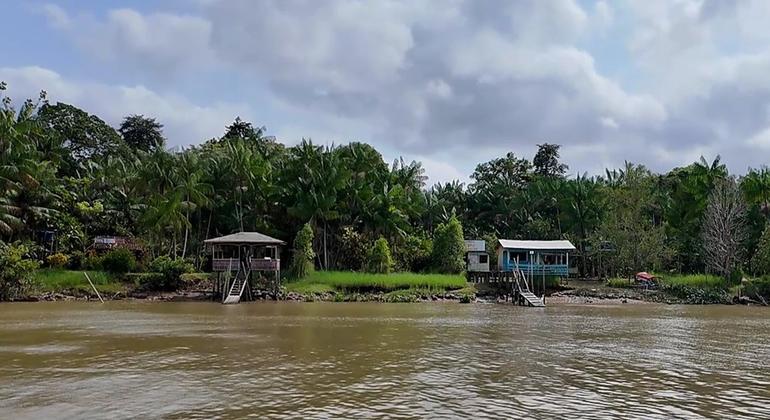
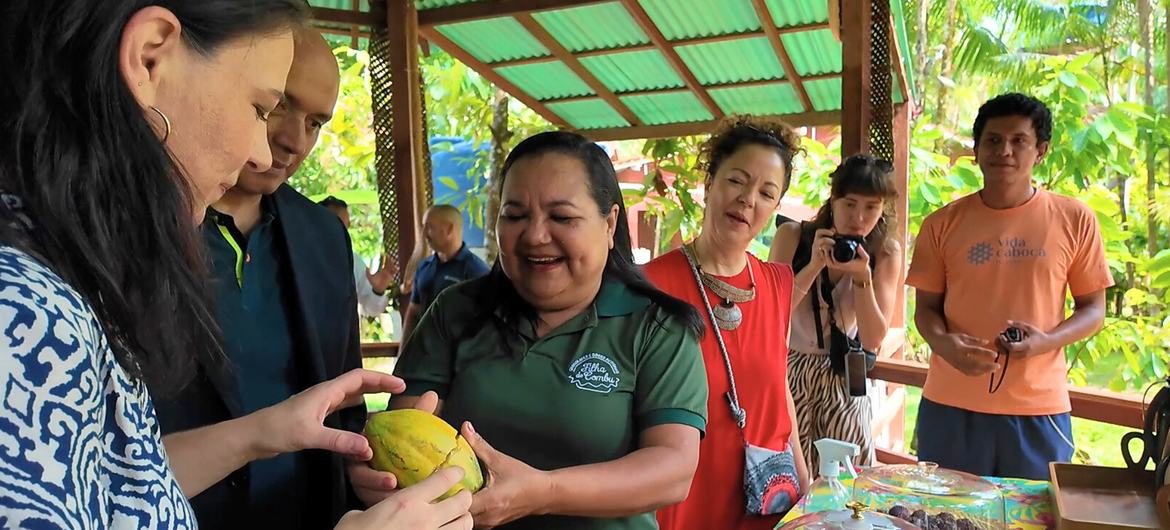
Just 30 minutes by boat from Belém – known as the ‘gateway to the Amazon’ rainforest and host city of this year’s UN climate conference – Combu is home to the Filha do Combu Association, created by Izete Costa, known affectionately as Dona Nena. Her initiative is proof that community-led solutions can power global climate action.

What began as a modest effort to turn traditional knowledge into income has grown into a thriving enterprise. Starting with small-scale chocolate production using Amazonian cacao, Dona Nena sold at local fairs before completing professional training to expand her business.

Today, she runs a small factory and a tourism programme that invites visitors to see how chocolate is made in the rainforest. Of the 20 workers employed at the site, 16 are women.

The production system is agroecological: native species collaborate to strengthen yields. Rows of banana trees, for example, are planted to attract pollinating bees essential to cacao.

“I usually enrich the forest with what’s working well, because here we didn’t cut down the forest to plant trees,” Dona Nena told us. “We work with the forest standing, and we look for and plant trees where there’s a natural decline.”

UN News/Felipe de Carvalho

President of the 80th session of the General Assembly, Annalena Baerbock (foreground), tasting cocoa from Combu Island, near Belém, Brazil.

Solar power and scaling up

The chocolate factory – whose products are sold across Brazil – runs eight hours a day on solar energy. But power outages remain a challenge. When a fallen tree cuts electricity, machines can sit idle for days. Dona Nena hopes to double solar capacity to prevent damage and keep production steady.

Dealing with a shaky electrical grid is one thing, but Combu is also not immune to climate impacts. Recently, cacao harvests have shrunk; fruits and trees are drying, shrinking and deforming. And the fear of losing access to drinking water grows by the day. Despite the rainy season, not a single drop has fallen on Combu in over 15 days, Dona Nena says.

From local solutions to global action

This was the setting for Annalena Baerbock’s visit on Sunday, her second trip to Combu after first meeting Dona Nena as Germany’s Foreign Minister.

Upon arriving, Ms. Baerbock told UN News she was glad to see the project thriving, generating “production chains … in the heart of regional communities [so] the benefits [can stay here] for the indigenous, for the local people.”

For Ms. Baerbock, the initiative is proof that real solutions already exist – solutions that unite economic growth, sustainable development and the fight against the climate crisis. She stressed that connecting these models at scale is essential to keeping global warming below 2°C, ideally at 1.5°C.

“Forest destruction is the destruction of humanity’s life insurance,” she warned, and added: “COP30 has to be a COP where we show around the world that especially in geopolitical challenging times the vast majority of countries but also people around the businesses, finance actors are joining hands to fight the climate crisis and by that deliver on sustainable growth for everybody.”

UN News/Felipe de Carvalho

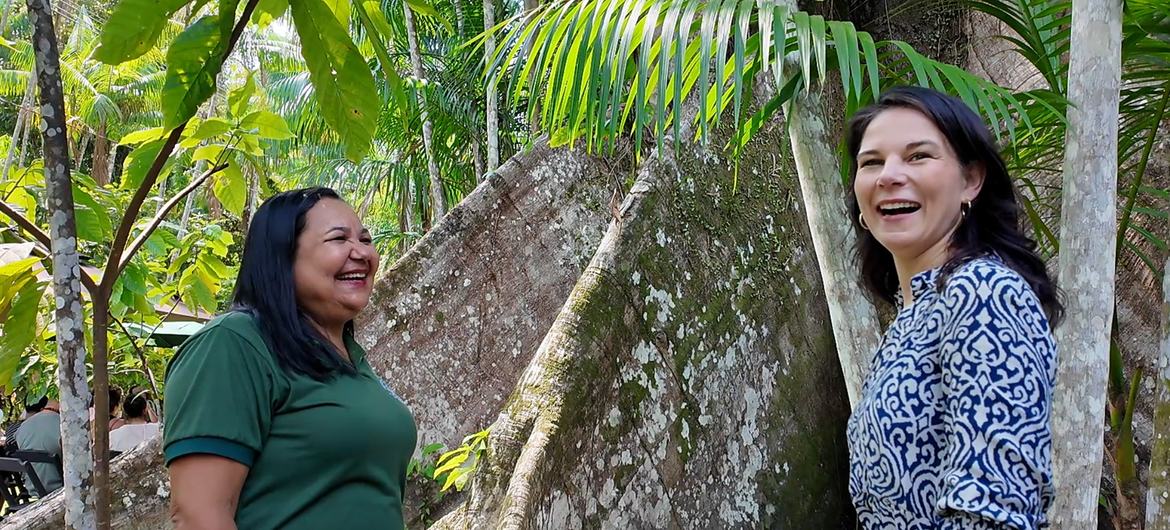
President of the 80th session of the UN General Assembly, Annalena Baerbock, meets the Brazilian entrepreneur Dona Nena on Combu Island, near Belém.

Lessons from the forest

After sampling Amazonian fruits and several chocolate recipes prepared on site, Dona Nena led Ms. Baerbock on a trail through the forest, where the two had met with a group of women producers two years earlier.

They discussed the project’s emphasis on empowering the women who sell their products through the Filha do Combu Association. Dona Nena highlighted that the women bring a unique energy of care and dedication that shapes the quality of the chocolate.

Along the trail, the forest itself offered symbolism. Together, they observed a taperebá tree slowly dying under the grip of a parasitic vine.

Dona Nena remarked that once the tree dies, the vine will die too, deprived of its only source of nutrients. Ms. Baerbock reflected that this was a diplomatic lesson in disguise, one that could even be linked to the emissions devastating the planet.

But the forest also offered hope. They paused before a sumaúma, a giant of the Amazon thought to be more than 280 years old. These trees can soar to 70 meters and have witnessed centuries of history, and could witness centuries more, if COP30 succeeds.

UN News is reporting from Belém, bringing you front-row coverage of everything unfolding at COP30.

In the Amazon, a school becomes a beacon of climate resilience

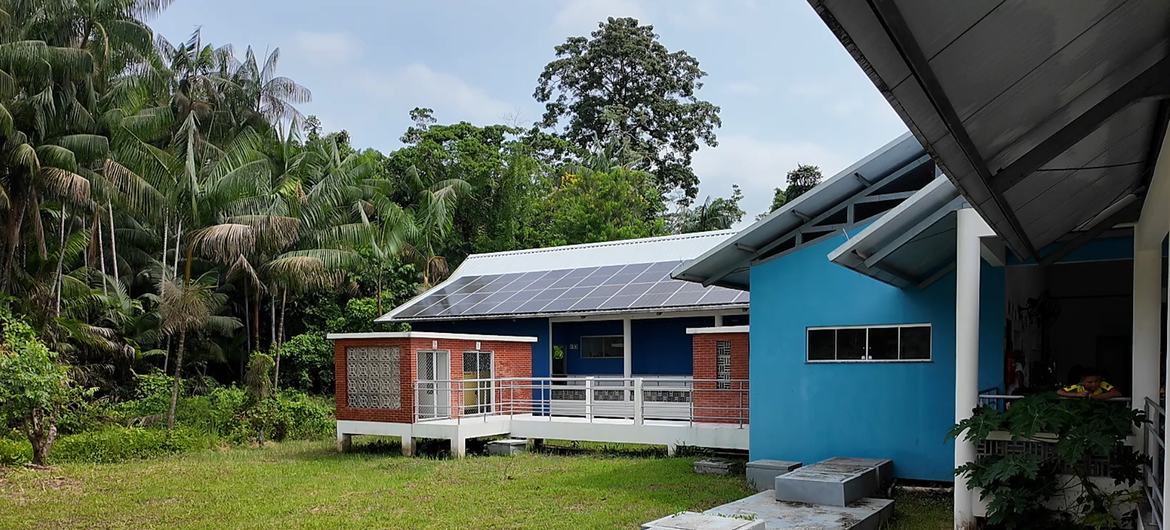
On a sandy riverbank, a modest school crowned with a solar-paneled roof tells a different story – one of resilience, ingenuity, and hope for the next generation.

A school built for the future

For three years, the Maria Naura Gouvêa Municipal School has been living out one of COP30’s central themes: adaptation.

Its flood- and erosion-resistant walls, insulated roofing, solar-powered energy systems, and satellite internet make it a rare safe haven. A 150-meter well ensures clean water – a luxury in many parts of the region.

During our visit, Kamal Kishore, head of the UN Office for Disaster Risk Reduction (UNDRR), called the school “a guiding light,” adding: “I would like to see at least 100,000 schools like this one across the globe.”

Droughts, erosion and rising seas

Barcarena’s mayor, Renato Ogawa, explained that climate impacts here are subtle, but disruptive:

“The main event is the drought of rivers and streams. One week, students manage to arrive by boat; the next, because of tidal variations, they cannot reach school on time and must walk along slopes and freshwater beaches that, due to sea-level rise, have started to flood, causing erosion.”

Containment walls now line the riverbanks, but Mr. Ogawa warned: “If nothing is done, over the years we will need to raise and expand that wall.”

Sea-level rise is also altering fish movements, threatening local diets as river water grows saltier.

These challenges have pushed Barcarena to the forefront of climate adaptation, earning it global recognition.

UN News/Felipe de Carvalho

For the past three years, the Maria Naura Gouvêa Municipal School, in Pará, Brazil, has been putting into practice one of the themes debated at the COP30: adapting to a world full of dangerous climate events.

Local leadership on the global stage

In 2023, Barcarena became the world’s 25th Resilience Hub – and the first in the Amazon. These UNDRR-identified hubs are cities recognized for their strong track record in disaster risk reduction and climate adaptation, and they commit to mentoring other municipalities by sharing practical solutions and expertise.

UN-Habitat Executive Director Anaclaudia Rossbach stressed why COP30 must amplify voices like Mr. Ogawa’s: “We must protect people to protect the planet. And another key point is the importance of local governments, local action and local leadership.”

Recognition, she added, is not enough: “It must be accompanied by solid and robust mechanisms for implementation.”

UN News/Felipe de Carvalho

‘An exception in the Amazon’

Brazil’s Minister of Cities, Jader Filho, praised Barcarena’s progress but noted: “The school is an exception and does not reflect the educational reality of the wider Amazon. But it shows what is possible when financing and political will align.”

Students showcased projects turning cooking oil into soap, creating natural dyes from vegetables, and planting trees to combat heat.

Lyndisse Wandra Santos summed up their spirit: “Each tree planted is a gesture of love and hope; to adapt is to keep moving forward despite difficulties.”

Kamal Kishore said he was inspired by their vision: “Brazil is a success story,” he noted, citing more than 2,000 cities worldwide in the Making Cities Resilient campaign, many of them Brazilian.

COP30’s legacy in Barcarena

Mayor Ogawa revealed that COP30 has already accelerated investments: “By the end of the year, we will achieve 90 per cent sewage treatment coverage and potable water for 95 per cent of the municipality. These goals would otherwise take 10 to 15 years.”

Next on his agenda: transitioning public transport boats to clean energy.

UN-Habitat chief Ms. Rossbach warned that similar investments are urgently needed elsewhere, especially in housing, as millions live in precarious conditions under growing climate threats.

UN News/Felipe de Carvalho

From ‘Forest COP’ to ‘Cities COP’

She pointed to Rio’s Maré slum, where temperatures can routinely soar 6°C above the city average, based on data collected by residents themselves.

Her hope is that “this Forest COP [as COP30 is billed because it is being held in Belém, Brazil, near the Amazon rainforest] must also strengthen the urban agenda, prioritizing protection for the most vulnerable.”

As COP30 unfolds in Belém, Barcarena’s story offers a powerful lesson: climate resilience begins at the local level. From solar-powered classrooms to student-led projects, this Amazon municipality shows that adaptation is not just possible – it’s already happening. And in a world facing rising seas and shifting tides, these lessons matter more than ever.

UN News is reporting from Belém, bringing you front-row coverage of everything unfolding at COP30.
‘The world is watching’: Guterres and Lula urge unity as COP30 talks near deadline

Amid reports of deadlocks on fossil fuels, climate finance and other key issues, both leaders urged negotiators to act decisively on phasing out fossil fuels and boosting adaptation finance, insisting that fairness and ambition must guide the final hours of COP30.

Guterres: 1.5°C is the ‘non-negotiable red line’

Speaking to reporters on Thursday, Mr. Guterres urged countries to “follow the science and put people before profit,” calling for tripling adaptation finance and credible emissions cuts. “Ministers and negotiators must show leadership, boldness and good faith,” he said, stressing that 1.5°C remains “the only non-negotiable red line.”

He warned that an agreement must balance concerns over adaptation resources with the need to curb soaring emissions. For millions, he said, adaptation means “the difference between replanting or going hungry, between remaining on ancestral land or losing it forever.”

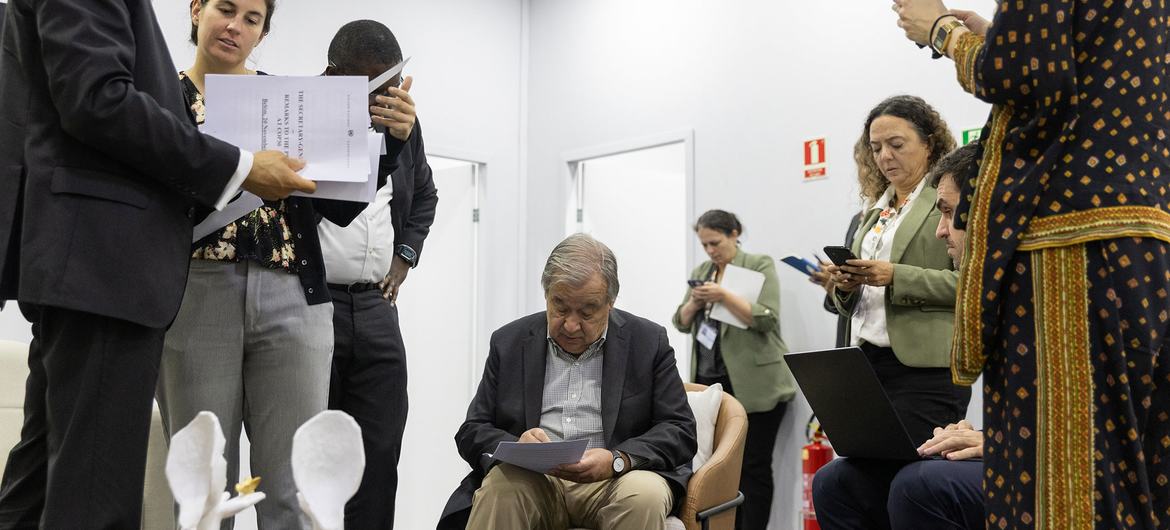
The UN Secretary-General António Guterres (centre) reviews documents with his colleagues at the UN Climate Conference in Brazil.

On fossil fuels, the UN chief called for a “just, orderly and equitable” transition, as agreed at COP28. “There can be no solution if there is not, at the same time, a just transition from fossil fuels to renewable energy,” he said, urging an end to “market distortions that favour fossil fuels” and disinformation “designed to sabotage the transition.”

A few hours after the Secretary-General’s press briefing, a fire broke out in a pavilion at the COP30 venue in Belém, forcing evacuations and briefly disrupting tense negotiations. Brazilian and UN security teams assisted in clearing the area. The blaze was quickly brought under control, and no injuries were reported. The cause of the fire was not immediately known. More here.

Lula: ‘We must start thinking about how to live without fossil fuels’

At a press conference Wednesday night, President Lula said any roadmap for the energy transition “must be taken seriously.” Brazil introduced the idea of a roadmap, he explained, “because we need to show society that we are serious. We do not want to impose anything on anyone, nor set deadlines. Each country must decide what it can do within its own timeframe and capacities.”

He added: “If fossil fuels generate [a majority of greenhouse] emissions, we must start thinking about how to live without them – and how to build that path. And I say this very comfortably, as the leader of a country that has oil, that extracts five million barrels a day.”

President Lula highlighted Brazil’s use of ethanol and biodiesel and called for oil companies, mining firms and the “super-rich” to contribute their share. He urged multilateral banks to stop charging “exorbitant interest rates” to African nations and the poorest countries in Latin America, converting part of those debts into investments.

The President praised public engagement at COP30, noting the 15 November ‘Peoples March’ was “exceptionally beautiful and orderly,” and celebrated record participation of 3,500 Indigenous people and “full participation” of women.

UN News is reporting from Belém, bringing you front-row coverage of everything unfolding at COP30.
What’s at stake in the COP30 negotiations?

In practical terms, the debates at COP30 revolve around three big questions:

1. How can countries ramp up climate action?

With the planet heating at record speed and climate disasters intensifying, cutting emissions and adapting to impacts dominate the agenda. Delegates are looking at key tools:

Nationally Determined Contributions (NDCs): National climate plans updated every five years. At COP30, countries are weighing new ways to boost ambition and speed up implementation.

Phasing out fossil fuels: COP28 agreed to “transition away from fossil fuels.” Now, negotiators are debating whether to set a clearer, context-based roadmap for that shift.

National Adaptation Plans (NAPs): 72 countries have submitted plans, but most lack funding. One proposal: triple adaptation finance by 2025.

Global Goal on Adaptation: Talks focus on roughly 100 indicators to track progress on adaptation worldwide.

Forest Finance Roadmap: Already backed by 36 governments representing 45 per cent of global forest cover and 65 per cent of GDP. It aims to close a $66.8 billion annual gap for tropical forest protection and restoration.

2. How can money and technology reach those who need it most?

Political promises alone won’t solve the climate crisis – they need real resources. COP30 negotiators are exploring ways to unlock finance and technology:

Article 9.1 of the Paris Agreement: Developed countries must support developing nations financially. Delegates are considering an action plan and accountability tools.

Baku-to-Belém Roadmap to $1.3 trillion: A proposal to mobilize $1.3 trillion annually for developing countries, with five action areas and debt-free instruments under discussion.

Loss and Damage Fund: Created at COP27 and launched at COP28 to help countries hit hardest by climate impacts. The Fund arrives at COP30 underfunded, sparking calls for more contributions.

Green Climate Fund: The world’s largest climate fund, but its latest replenishment cycle showed signs of decline.

Global Environment Facility: Provides grants to developing countries, but current funding is seen as inadequate.

Technology Implementation Programme: Aims to improve access to climate technologies, but negotiations remain divided over financial and trade barriers.

Trade-restrictive unilateral measures: Climate-related trade policies that may disadvantage developing countries. One idea: create a platform to assess their impact.

3. How can climate action be fair and inclusive?

Even with funding, big transitions risk deepening inequalities unless they protect vulnerable communities. Negotiators are working on frameworks to ensure fairness:

Just Transition Work Programme: Promotes social justice, decent work, and sustainable development. Countries expect a practical framework aligned with workers’ and communities’ realities.

Gender Action Plan: Guides the integration of gender perspectives into climate action. The first plan was adopted in 2017; an updated version is due at COP30.

Why what happens in Belém matters

The choices made in Belém will shape how the Paris Agreement moves from words to action, and whether global climate goals remain within reach. Behind closed doors, the mood is clear: time is short, and compromise cannot wait. These decisions will shape not only the pace of emissions cuts but also whether justice is delivered for indigenous peoples, as well as Africa and developing nations, who bear the brunt of climate impacts despite contributing least to the crisis.

UN News is reporting from Belém, bringing you front-row coverage of everything unfolding at COP30.
Can industrial growth and climate action go hand in hand?

In Namibia’s Daures region, a bold experiment aims to prove economies can create jobs without fossil fuels. 

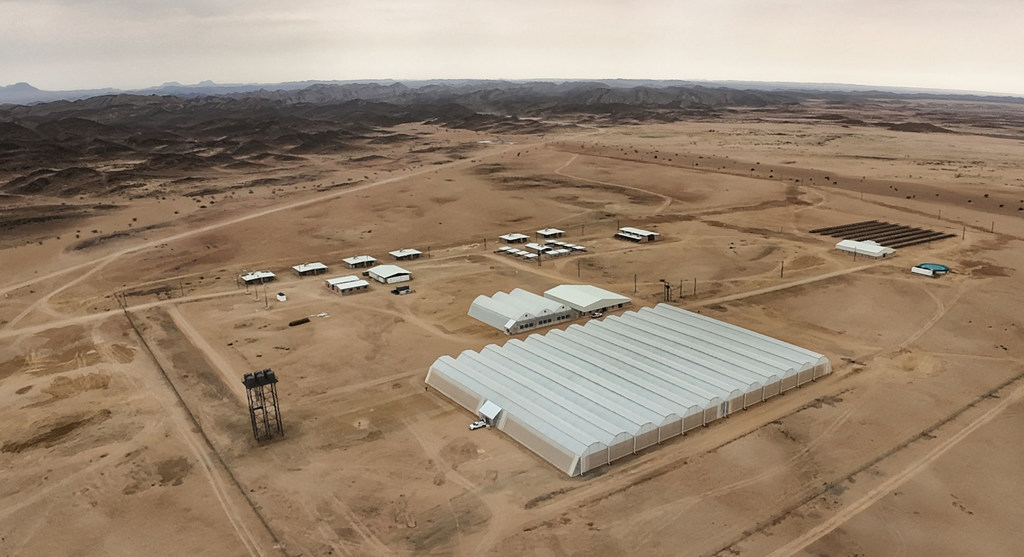
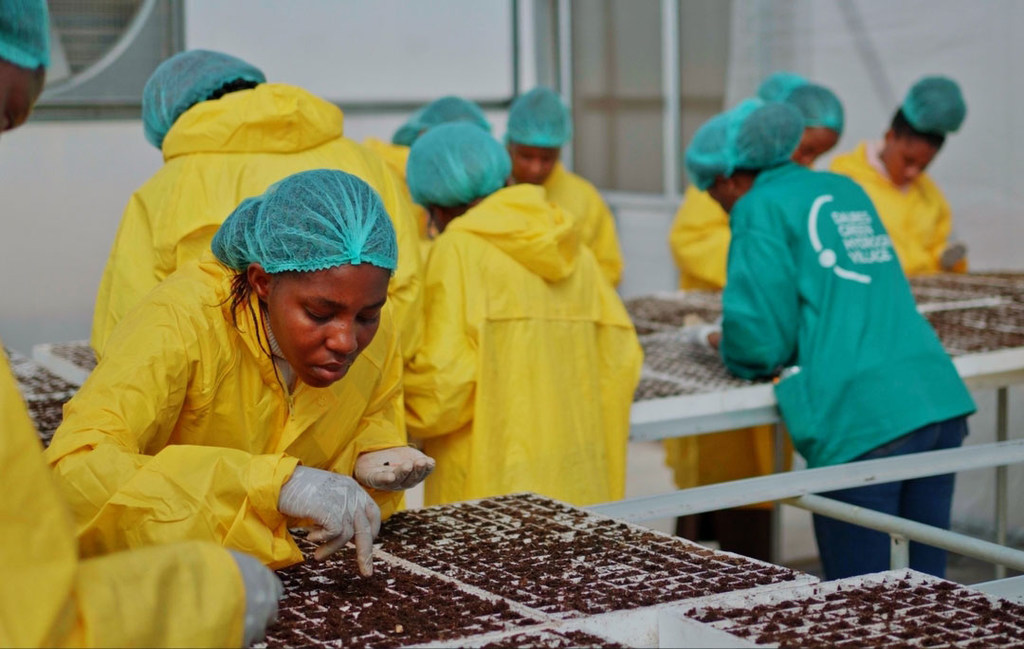
When completed, Daures Green Hydrogen Village will sustainably produce hydrogen and ammonia from renewable sources, which will be used to make the country’s first carbon-free green fertiliser, reducing the need for imports. 

The project is designed to benefit the whole community, with training on horticulture and crop production, and a solar-powered tomato paste processing plant to add value to local fresh produce and create more local employment. More than 1,000 people are expected to benefit from sustainable jobs and food security. 

Projects like this are part of a wider push to rethink industry for a low-carbon future. 

© Daures Green Hydrogen Village

Site picture Daures Green Hydrogen Village

What ​UNIDO does, and why it matters

Daures Green Hydrogen Village is just one example of how the UN Industrial Development Organization (UNIDO) is working with countries in the global south to achieve inclusive and sustainable industrial development. 

Countries as varied as Costa Rica and Morocco are benefiting from UNIDO’s Global Programme for Hydrogen in Industry (GPHI), which helps overcome barriers and develop a just and sustainable economy with green hydrogen at its core.  

Since its establishment in 1966, UNIDO has championed inclusive and sustainable industrial development as a cornerstone of economic and social progress. 

© Daures Green Hydrogen Village

Agronomy training sessions held at the project held in partnership with the Accelerate-2-Demonstrate Facility implemented with UNIDO.

A platform for transformation 

From 23 to 27 November, the UN agency will have the opportunity to show how it is realising its mission to support developing countries and emerging economies in building and transforming their industries, at the Global Industry Summit in Riyadh, Saudi Arabia. 

As the countdown to Riyadh begins, expectations are high for bold commitments and partnerships that can drive a fair global economy — one anchored in sustainability, equality, and shared prosperity. 

The conference will also address gender equality and the empowerment of women, UNIDO’s role in a reformed UN development system, alongside discussions on financing and digital platforms for monitoring results. 

What to look out for at the Summit

The event, hosted at the King Abdulaziz International Conference Centre, will include three days of thematic forums on critical issues: 

  • Investment and Partnerships Day – spotlighting international cooperation and artificial intelligence as drivers of industrial transformation,
  • Women’s Empowerment Day – showcasing women’s leadership in shaping the future of industry,
  • Youth and Young Talent Day – focusing on the creativity and entrepreneurship of the next generation. 

From waste pickers to courtrooms: Women demand a gender focus at COP30

Women’s voices are rising with clarity and urgency, pressing negotiators to ensure the conference leaves a lasting mark on the link between gender and climate policy.  

At the heart of talks is the Belém Gender Action Plan – a proposed blueprint that acknowledges climate change hits women hardest and sets out measures for financing, training, and leadership roles.

“Climate justice only exists when gender equality does too,” says Ana Carolina Querino, Acting Representative of UN Women in Brazil, echoing a sentiment heard across the halls and venues since the summit opened last Monday, 10 November.

If adopted, the plan would run from 2026 to 2034, embedding gender-responsive approaches into just transitions, adaptation and mitigation strategies, and mechanisms for loss and damage.

UN News/Felipe de Carvalho

Nanci Darcolete is an autonomous waste picker from São Paulo and advocacy advisor for Movimento de Pimpadores.

Waste pickers on the frontline of emissions cuts

On the streets of São Paulo, Nanci Darcolete has been a waste picker since 1999.  

Today, she leads Pimp My Carroça, an organisation fighting for the rights of workers who turn discarded materials into resources – preventing mountains of waste from being dumped or burned.

Waste pickers, she says, played a historic role at COP30 by showing how their work slashes emissions and eases pressure on natural resources.  

“We now see how important it is for waste pickers to also work on composting organic waste,” she explains. “That’s going to save municipalities money, provide income for waste pickers, and capture tons and tons of gases [and] delivering major mitigation by removing heavy pollutants from the environment.”

Women leading the recycling chain

In Brazil, women make up most waste pickers and head most cooperatives. Yet they still face racism and gender-based violence on the streets, often while juggling care for homes and families.

For Nanci, climate change is making their work harder. Rising heat and flooding hit low-income neighbourhoods hardest, adding strain to already tough conditions. She wants COP30’s adaptation agenda to recognise waste pickers as “agents of transformation,” with better urban logistics, hydration points, and paid contracts.

Litigation as a weapon for climate justice

Across the Atlantic, 24-year-old Portuguese lawyer Mariana Gomes is using the law as what she calls “the most important tool” to fight the climate crisis. She founded Último Recurso, the group behind Portugal’s first climate litigation case – now leading more than 170 lawsuits.

Mariana believes litigation can turn promises into binding action, especially after the International Court of Justice’s (ICJ) recent opinion requiring states to act to keep global warming under 1.5°C.  

“I believe that in the future we’ll see many lawsuits against States, especially those who must raise ambition, adopt climate laws, and align their targets with the Paris Agreement. Because now, more than ever, we are carrying on our backs the weight of the International Court of Justice,” she tells us.

UN News/Felipe de Carvalho

Portuguese lawyer Mariana Gomes is a social entrepreneur and climate activist.

The right to a clean, healthy environment

Mariana argues citizens can demand their governments guarantee the right to a clean, healthy environment and a stable climate. In Portugal, she is pushing for Municipal Climate Action Plans to help local authorities prepare for droughts, wildfires, floods, and other disasters.

For her, adaptation and mitigation must recognise that climate disasters hit women hardest, increasing risks of gender-based violence, displacement, and care burdens. Litigation, she says, can do more than cut emissions or stop extractive projects, it can unlock funding and compensation for affected communities, protecting women’s rights along the way.

UN News is reporting from Belém, bringing you front-row coverage of everything unfolding at COP30. 

Belém COP30 delivers climate finance boost and a pledge to plan fossil fuel transition

  • Climate disinformation: Commitment to promote information integrity and counter false narratives.

The final decision emphasises solidarity and investment, setting ambitious financial targets while leaving energy transition for later discussion. The burning of fossil fuels emits greenhouse gases that are by far the largest contributors to global warming, making this omission a point of concern for many nations, including negotiators from South America and the EU, as well as civil society groups.

Expectations were high that COP30’s final decision would include explicit reference to phasing out fossil fuels. More than 80 countries backed Brazil’s proposal for a formal ‘roadmap.’

A draft text had included it – until the final hours of talks. The adopted outcome refers only to the ‘UAE Consensus’, the COP28 decision calling for “transitioning away from fossil fuels.”

Before the final plenary, Brazilian scientist Carlos Nobre issued a stark warning: fossil fuel use must fall to zero by 2040 – 2045 at the latest to avoid catastrophic temperature rises of up to 2.5°C by mid-century. That trajectory, he said, would spell the near-total loss of coral reefs, the collapse of the Amazon rainforest and an accelerated melt of the Greenland ice sheet.

A closer look

After two weeks of intense negotiations, the adopted text calls for mobilizing at least $1.3 trillion per year by 2035 for climate action, alongside tripling adaptation finance and operationalizing the loss and damage fund agreed at COP28.  

It also launches two major initiatives – the Global Implementation Accelerator and the Belém Mission to 1.5°C – to help countries deliver on their nationally determined contributions (NDCs), or national climate action plans, and adaptation plans.

For the first time, the decision acknowledges the need to tackle climate disinformation, pledging to promote information integrity and counter narratives that undermine science-based action.  

Last week, Brazil’s President, Luiz Inácio Lula da Silva, opened the summit declaring it would be known as “the COP of truth,” and this landmark decision marks a significant step toward safeguarding public trust in climate policy – even as the absence of fossil fuel transition language underscores the complexity of energy negotiations.

Two new roadmaps

In the closing meeting, COP30 President André Corrêa do Lago acknowledged what was left out of the deal:  

“We know some of you had greater ambitions for some of the issues at hand,” he said, adding, “I know the youth civil society will demand us to do more to fight climate change. I want to reaffirm that I will try not to disappoint you during my presidency.”  

Reflecting on President Lula’s call at the opening of COP30 for ambition, Mr. do Lago announced plans to create two roadmaps: one to halt and reverse deforestation; and another to transition away from fossil fuels in a just, orderly and equitable manner, mobilizing resources for these purposes in a “just and planned manner.”

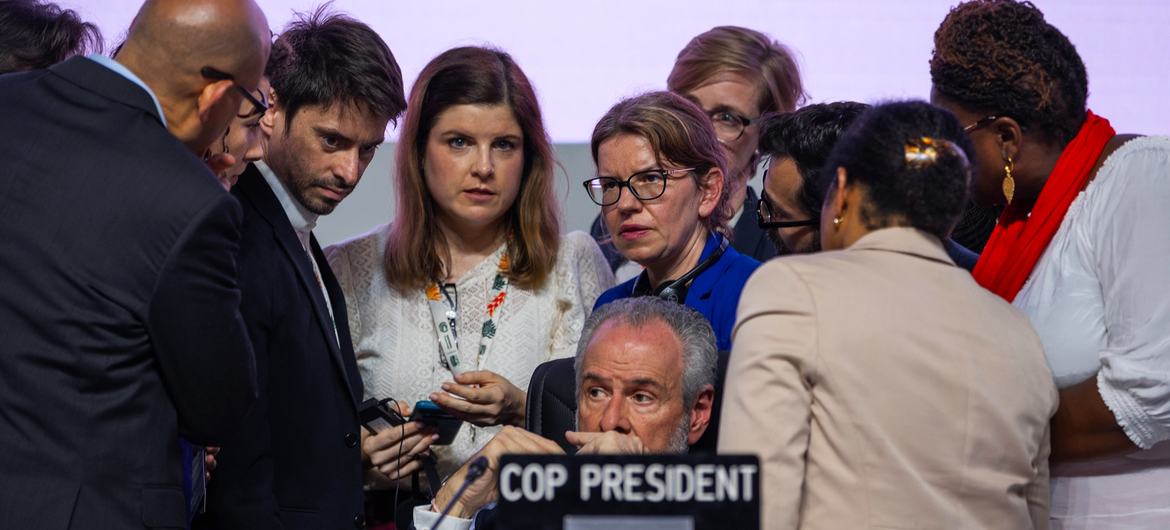
COP30 President André Corrêa do Lago (centre) confers with his team at the closing of the UN Climate Conference.

The road to consensus

The road to consensus at the latest Conference of the Parties to the UN Framework Convention on Climate Change (UNFCCC), as the annual COPs are formally known, was anything but smooth.  

Late last week, Indigenous groups staged blockades demanding stronger protections for the Amazon, and late Thursday afternoon, a fire at the conference venue disrupted talks during a critical phase. 

Negotiators worked through the night on Friday – to bridge gaps on finance and ambition, with Brazil’s presidency steering discussions toward a politically workable outcome focused on support and implementation of agreements from past COPs.

‘Multilateralism is alive’

From the G20 Summit in Johannesburg, UN Secretary-General António Guterres sent a clear message to COP30: At the gateway of the Amazon, Parties reached an agreement that shows nations can still unite to confront challenges no country can solve alone.  

The UN chief said that COP30 delivered progress, such as the launch of the Global Implementation Accelerator to close ambition gaps and reaffirmed the UAE Consensus, including a just, orderly and equitable transition away from fossil fuels.

“But COPs are consensus-based – and in a period of geopolitical divides, consensus is ever harder to reach. I cannot pretend that COP30 has delivered everything that is needed.” Overshoot of 1.5°C is a stark warning: deep, rapid emission cuts and massive climate finance are essential. “COP30 is over, but the work is not,” he said.  

Mr. Guterres vowed to keep pushing for higher ambition and solidarity, urging all who marched, negotiated and mobilized: “Do not give up. History – and the United Nations – are on your side.

Holding the line at 1.5 in ‘turbulent geopolitical waters’

UN climate chief Simon Stiell pointed to a series of major gains as COP30 closed in Belém: new strategies to accelerate Paris Agreement implementation, a push to triple adaptation finance, and commitments toward a just energy transition.

And despite what he called “turbulent geopolitical waters” – marked by polarization and climate denial – 194 nations stood together, “keeping humanity in the fight for a livable planet, determined to hold the line at 1.5°C.”

At the heart of this momentum is COP30’s flagship outcome: the Mutirão text, a sweeping deal that bundles four contentious negotiation tracks – from mitigation to finance and trade barriers – into a single, consensus-based agreement. Seventeen additional decisions were adopted alongside it.

The final document declares that the global shift toward low-emissions and climate-resilient development is “irreversible and the trend of the future.” It reaffirms that the Paris Agreement is working – and must “go further and faster” – strengthening the role of multilateral climate cooperation.

The text also recognizes the economic and social benefits of climate action, from growth and job creation to improved energy access, security and public health. Mr. Stiell pointed to a decisive trend: investments in renewable energy now outpace fossil fuels two to one – “a political and market signal that cannot be ignored,” he said.

A robust action agenda beyond negotiations

The Brazilian Presidency underscored that COP30’s success extends beyond negotiated agreements, highlighting a wave of voluntary commitments under the Action Agenda.

Among them:

  • Tropical Forests Forever Fund: Raised $5.5 billion and now includes 53 participating countries; at least 20 per cent of resources go directly to Indigenous Peoples and local communities.
  • Belém Health Action Plan: The first global initiative targeting climate-related health threats, launched with $300 million from 35 philanthropic organizations.
  • UNEZA Alliance: Public utility companies pledged $66 billion annually for renewable energy and $82 billion for transmission and storage.
  • Cities, regions and companies: A coalition spanning 25,000 buildings reported cutting over 850,000 tons of CO₂ in 2024.

Climate justice at the forefront

Countries also agreed to develop a just transition mechanism, enhancing cooperation, technical support and capacity-building.

Somalia declares drought emergency as millions face hunger after failed rains

On 10 November, the Federal Government of Somalia formally declared a drought emergency and appealed for urgent international assistance as conditions continued to deteriorate across northern, central and southern regions, according to the UN relief coordination office, OCHA.

Puntland is among the worst affected areas, where authorities estimate that nearly one million people need support, including 130,000 in immediate life-threatening need.

A UN assessment mission to Bari and Nugaal regions earlier this month found communities grappling with acute water and food shortages, with residents warning that catastrophe could unfold in the coming months.

“We have not received rain since last year; this is the worst drought in years,” said Abdiqani Osman Omar, the mayor of Shaxda village in Bari region.

“Hundreds of displaced families moved here three months ago, and more are coming. The new arrivals are mostly women and children as the men have moved to nearby Ethiopia in search of pasture and water.”

The village has no capacity to support them, he added, stating that even host communities need water and food assistance.

Dried up water sources, abandoned settlements

Across Puntland, water points have dried up, vegetation has withered and once-inhabited pastoral settlements now stand abandoned.

In Dhaxan town, where brief Gu’ season (April-June) showers offered short-lived hope earlier this year, residents are now dependent on expensive trucked water after the local borehole was found to be contaminated.

Community leader Jama Abshir Hersi said around 150 families moved to the town after the rains.

“We used to receive food and nutrition assistance, and medical supplies for our health unit. All that assistance has dwindled,” he said.

Funding shortfalls

Funding shortfalls are compounding the crisis.

As of 23 November, Somalia’s 2025 Humanitarian Response Plan was only 23.7 per cent funded, forcing major reductions in assistance. The number of people receiving emergency food aid plunged from 1.1 million in August to just 350,000 this month.

In Puntland alone, 89 supplementary feeding sites and 198 health and stabilization centres are facing severe supply shortages.

Millions going hungry

The drought is unfolding amid an already dire humanitarian landscape. At least 4.4 million people are projected to face acute food insecurity through December, while 1.85 million children under five are expected to suffer acute malnutrition through mid-2026.

Weather forecasts indicate little immediate relief. The UN Food and Agriculture Organization (FAO) warned that dry and hot conditions are expected to persist across most of the country, particularly in central and northern regions.

“The prevailing high temperatures and poor rain are likely to exacerbate water stress and limit pasture regeneration in most areas,” the agency said.

Cyclone Ditwah brings worst flooding in decades to Sri Lanka, killing hundreds

According to the UN relief coordination office, OCHA, 998,918 people across all 25 districts have now been affected, with 212 deaths reported and 218 people missing. More than 180,000 people from over 51,000 families are sheltering in 1,094 government-run safety centres as search and rescue efforts continue.

Cyclone Ditwah made landfall on 28 November before moving back over the Bay of Bengal, triggering some of the most severe flooding Sri Lanka has seen since the early 2000s.

The hardest-hit districts include Gampaha, Colombo, Puttalam and Mannar, as well as Trincomalee and Batticaloa, while deadly landslides in the central hill country have devastated Kandy, Badulla and Matale.

Homes destroyed, infrastructure shattered

Initial assessments indicate that more than 15,000 homes have been destroyed. Over 200 roads remain impassable, at least 10 bridges have been damaged, and sections of the rail network and national power grid affected.

Flooding along the Kelani River, which runs through Colombo and surrounding low-lying areas, continues to hamper access and disrupt information flow from affected communities, complicating rescue and relief operations.

Severe disruption to electricity, mobile and communications, and transport networks are reported in northern districts such as Jaffna, with entire villages isolated

Access to clean water also remains a major concern, with several areas reporting little or no supply.

Health system under strain, food insecurity looms

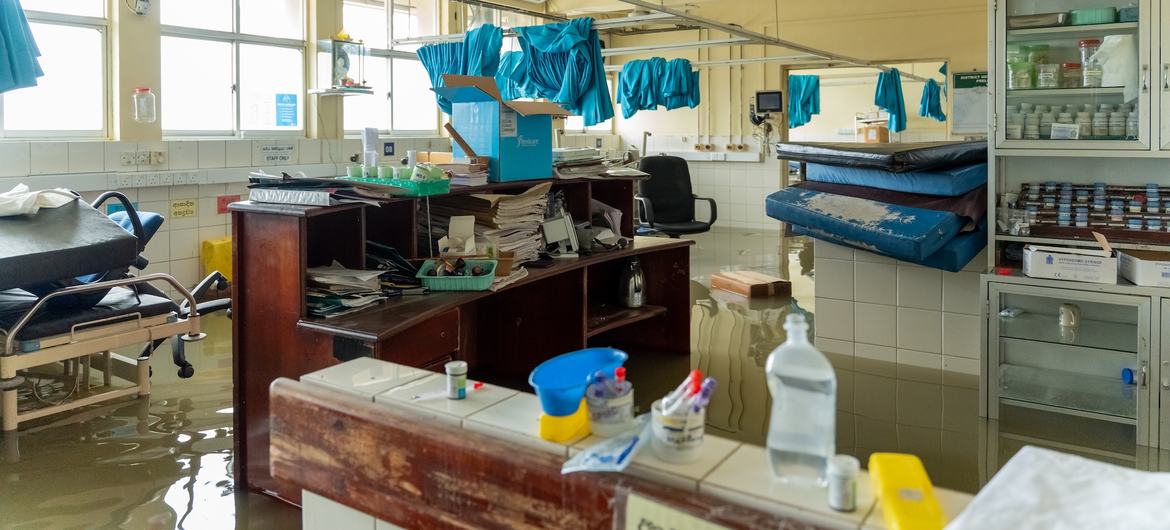
Sri Lanka’s already fragile health system is under severe pressure, OCHA said. Several district hospitals remain flooded and are receiving only limited supplies, with critically ill patients being airlifted to functioning facilities.

Response is further hindered by recurring landslides and the breach of multiple tank bunds (embankments or barriers), including at Mavilaaru, heightening risks in Trincomalee and Batticaloa.

Authorities have also warned of rising food insecurity, as submerged farmland, damaged storage facilities and severed supply routes threaten shortages and price increases in the weeks ahead.

The World Health Organization (WHO) warned that floods significantly raise the risk of vector-borne, food-borne and water-borne diseases, urging communities to prevent mosquito bites, ensure food safety and use safe drinking water wherever possible.

Floodwaters have entered several hospitals across Sri Lanka, further straining the health system.

UN mobilises coordinated response

The United Nations in Sri Lanka activated its emergency coordination system on Sunday to scale up a unified response with government agencies and humanitarian organizations.

Sector coordination has been set up across food security, health, water and sanitation (WASH), education, protection, shelter and early recovery, while a multi-sector needs assessment is under way with disaster management authorities to identify the most urgent gaps.

“The UN in Sri Lanka is mobilising its teams across the system to support national rescue and early recovery efforts, in coordination with authorities. We stand in solidarity with all affected communities,” said UN Resident Coordinator Marc-André Franche.

Despite access challenges, the UN Children’s Fund (UNICEF) has delivered portable water to 25 safety centres in Badulla in the central hills, which had been cut off from the rest of the country by floods and infrastructure damage.

To support government-led efforts, India and Pakistan have deployed emergency teams to work alongside Sri Lanka’s armed forces in the worst-hit districts.

Meanwhile, in the wider Asian region

Severe monsoon flooding continues across Thailand and Malaysia, affecting more than two million people in southern Thailand alone and displacing nearly 25,000 people in Malaysia, according to OCHA. People have been evacuated in several hard-hit Thai provinces, while the rainfall is expected to ease in coming days.

In Indonesia, media reports cite at least 440 deaths from floods and landslides, with more than 400 people missing, particularly in parts of Sumatra, where thousands remain stranded without access to food and water.

Asia: Lives upended by cyclones, ‘extreme’ rainfall on the rise, warn UN agencies

World Meteorological Organization (WMO) spokesperson Clare Nullis told reporters in Geneva that Indonesia, the Philippines, Sri Lanka, Thailand and Viet Nam are among the countries most affected by what she described as “a combination of monsoon-related rainfall and tropical cyclone activity”.

UN Secretary-General António Guterres expressed his deep sadness over the tragic loss of life across the region.

In a statement released by his Spokesperson he conveyed condolences to the families of the victims and expresses his solidarity with all those impacted.

UN ready to support all relief efforts

The United Nations is in close contact with authorities in all four countries and stands ready to support relief and response efforts. UN Country Teams remain at the disposal of Governments to provide necessary assistance.”

“Asia is very, very vulnerable to floods,” WMO’s Ms. Nullis said, explaining that flooding consistently tops the list of climate hazards in the region, according to WMO’s annual State Of The Climate reports.

However, she said that tropical cyclones such as Senyar, which last week brought “torrential rainfall and widespread flooding and landslides” across northern Sumatra in Indonesia, peninsular Malaysia and southern Thailand, are rare so close to the Equator.

“It’s not something that we see very often and it means the impacts are magnified because local communities… have got no experience in this,” she stressed.

Hundreds killed

The UN weather agency spokesperson quoted Tuesday’s figures from the Indonesian National Disaster Office indicating 604 fatalities, 464 people missing and 2,600 injured. In total, some 1.5 million people have been affected in Indonesia and more than 570,000 have been displaced.

Turning to Viet Nam, Ms. Nullis said that the south Asian nation has been “battered now for weeks” and is “bracing for yet more heavy rainfall”.

“Exceptional rains in the past few weeks have flooded historic sites, popular tourist resorts and caused massive damages,” she said.

1.79 metres of rain in a day

In late October, one meteorological station in central Viet Nam recorded a national 24-hour rainfall record of 1,739 millimetres, which Ms. Nullis described as “really enormous”.

“It’s the second-highest known total anywhere in the world for 24-hour rainfall,” she said.

This exceptionally high value is currently subject to a formal WMO extremes evaluation committee. According to the agency, a value above 1,700 mm would constitute a record for the Northern Hemisphere and Asia.

Ricardo Pires, spokesperson for the UN Children’s Fund (UNICEF), described what he called a “fast-moving humanitarian emergency” in Sri Lanka, after Cyclone Ditwah made landfall on the country’s east coast last week, affecting some 1.4 million people including 275,000 children.

“With communications down and roads blocked, the true number of children impacted is likely even higher,” Mr. Pires warned. “Homes have been swept away, entire communities isolated, and the essential services children rely on, such as water, healthcare and schooling have been severely disrupted.”

The UNICEF spokesperson stressed that displacement has forced families into unsafe and overcrowded shelters, while the flooding and damaged water systems are increasing disease outbreak risks.

“The needs far outweigh the available resources right now,” he insisted, in an appeal for additional humanitarian funding and support for the most vulnerable.

Commenting on the intensity of the devastating weather events WMO’s Ms. Nullis explained that rising temperatures “increase the potential risk of more extreme rainfall because a warmer atmosphere holds more moisture”.

“That’s the law of physics…we are seeing more extreme rainfall and we will continue to do so in the future,” she concluded.

Deadly storms sweep South and Southeast Asia, leaving over 1,600 dead

Since mid-November, overlapping tropical storms and intensified monsoon systems have triggered catastrophic flooding and landslides across Sri Lanka, Indonesia, Thailand, Malaysia and Viet Nam.

UN teams across the region are supporting government-led emergency operations with food, health, water and sanitation aid, medical deployments and early recovery assessments, as heavy rains continue and fears grow that the crisis could deepen.

“We continue to closely monitor the situation and remain in close contact with national authorities,” UN Spokesperson Stéphane Dujarric told reporters in New York on Thursday.

The UN stands ready to support any ongoing efforts.

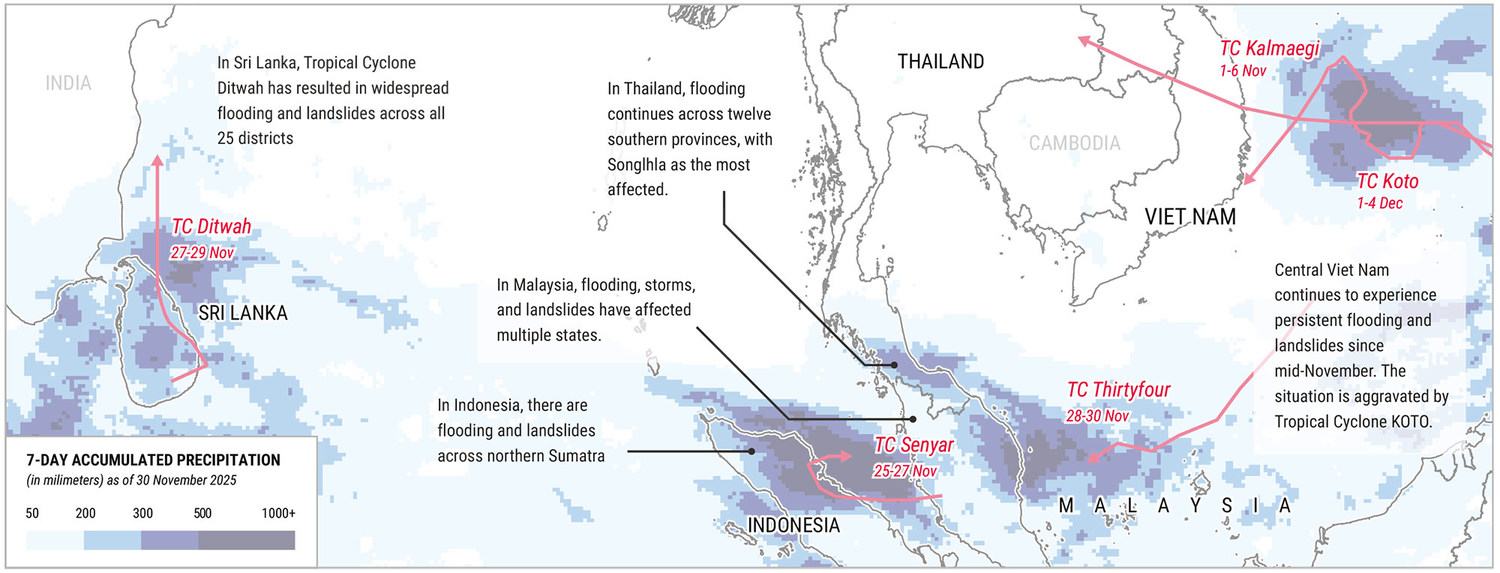
Storms and cyclones across south and southeast Asia from 17 November to 3 December.

Overlapping storms

Experts say the disasters were driven by an unusual convergence of powerful weather systems, including Cyclones Ditwah and Senyar, alongside a strengthened northeast monsoon.

Warm ocean temperatures and shifting storm tracks have produced extreme rainfall in areas that historically faced lower cyclone risk.

Across the region, nearly 11 million people have been affected, including about 1.2 million forced from their homes into shelters, while roads, utilities and farmlands have been washed away.

Heavy toll on children

Children are bearing a devastating share of the storms, with millions cut off from schools, clean water and basic services. More than 4.1 million children across the region have had their education disrupted since late November alone, according to the UN Children’s Fund (UNICEF).

Some three million students in Viet Nam have been unable to attend class, while nearly one million were affected in the Philippines, and hundreds of thousands more in Indonesia, Thailand and Malaysia.
Many children are now living in overcrowded evacuation shelters, exposed to disease, malnutrition and heightened protection risks.

Children are sitting at the frontline of the climate crisis, experiencing firsthand what it means when extreme weather becomes more frequent, more intense, and less predictable,” UNICEF Deputy Spokesperson Ricardo Pires said, calling for urgent action to protect them and their futures.

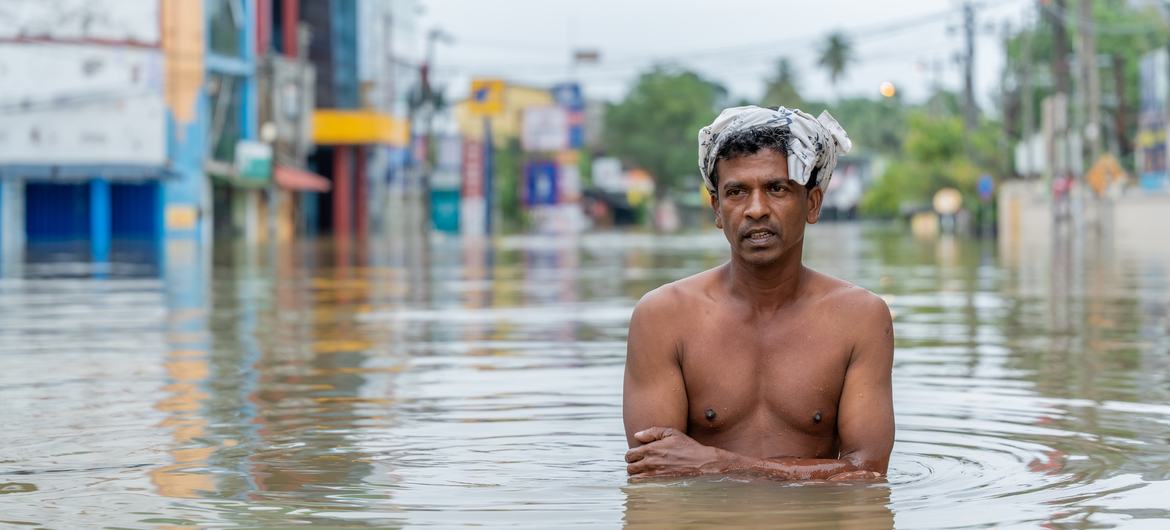
A man stands in over three feet of floodwaters in Gampaha, Sri Lanka.

Sri Lanka: Nationwide devastation

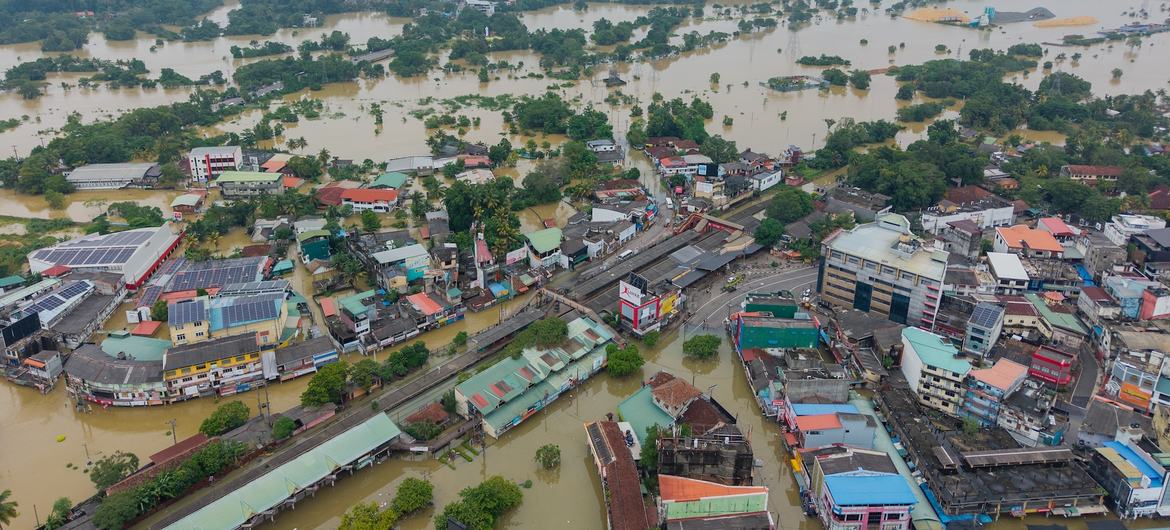
Sri Lanka bore some of the worst impacts after Cyclone Ditwah made landfall on 28 November, triggering floods and landslides across nearly the entire island.

The highest death tolls were reported in the hill districts of Kandy, Nuwara Eliya and Badulla, where landslides swept through plantation communities. Severe flooding also inundated western and north-western districts – including Colombo’s outer suburbs – disrupting markets, transport and water supplies.

Early assessments point to heightened gender-specific risks in the aftermath of the disaster.

With livelihoods disrupted and thousands sheltering in overcrowded centres, women and girls face increased exposure to gender-based violence, economic insecurity and interruptions to sexual and reproductive health services, particularly in rural and plantation communities already grappling with poverty and limited access to care.

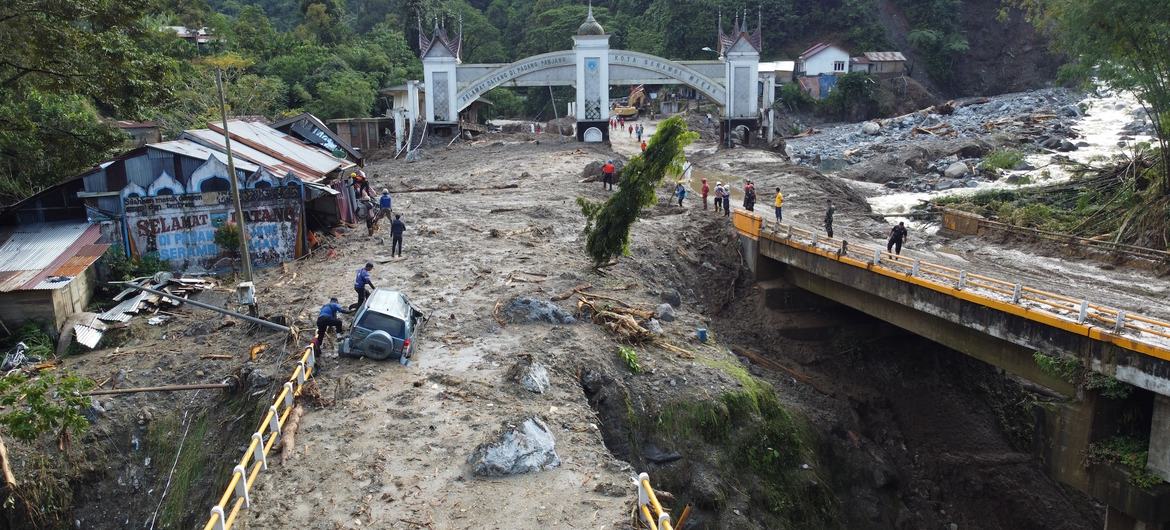
Bridges and access roads swept away by a landslide in West Sumatra, Indonesia.

Indonesia: Flash floods and landslides

In Indonesia, relentless downpours between 22 and 25 November triggered deadly floods and landslides across Aceh, West Sumatra and North Sumatra, devastating dozens of districts.

Official figures indicate more than 830 deaths, with at least 500 people still missing, and more than 880,000 displaced. In total, over three million people have been affected by floodwaters, collapsed hillsides and destroyed infrastructure.

Entire villages have been submerged, bridges washed away and roads cut off, isolating communities and slowing rescue efforts. Emergency teams are relying on helicopters and boats to deliver aid to areas unreachable by land.

“We are working closely with the government on water, sanitation and hygiene (WASH), logistics, and coordination with local partners,” UN Spokesperson Dujarric said.

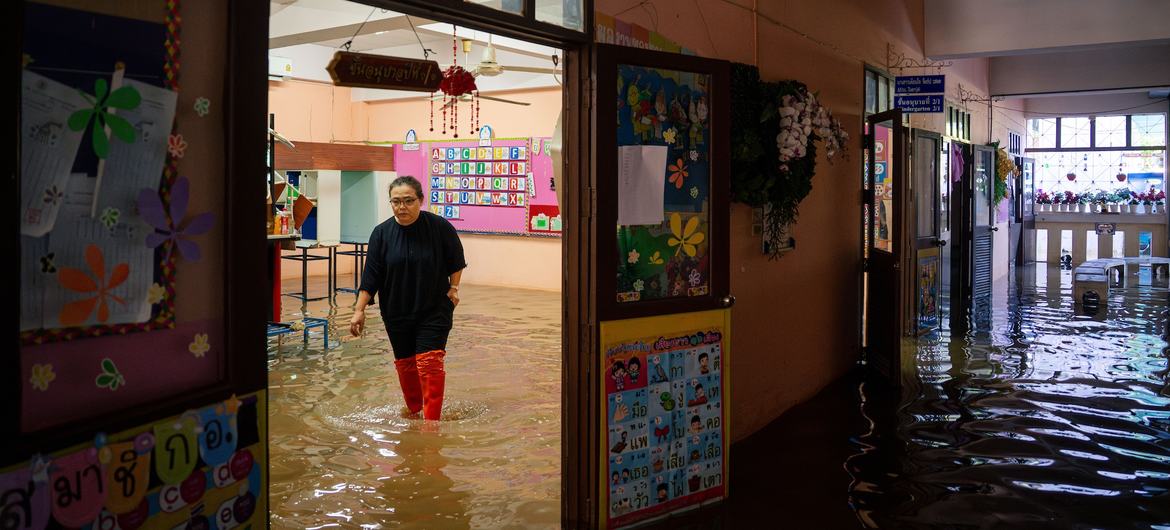
A teacher inspects the damage in a kindergarten classroom at a school in Thailand.

Thailand and Malaysia: Mass evacuations

Moving east, intensified monsoon rains have battered southern Thailand, where 12 provinces have been affected.

At least 185 people have died, with 367 missing and over four million people impacted. More than 219,000 residents have been displaced as rivers burst their banks and low-lying coastal areas flooded.

In neighbouring Malaysia, flooding across eight northern and central states has displaced around 37,000 people. Authorities continue to issue evacuation orders and weather warnings as rain persists.

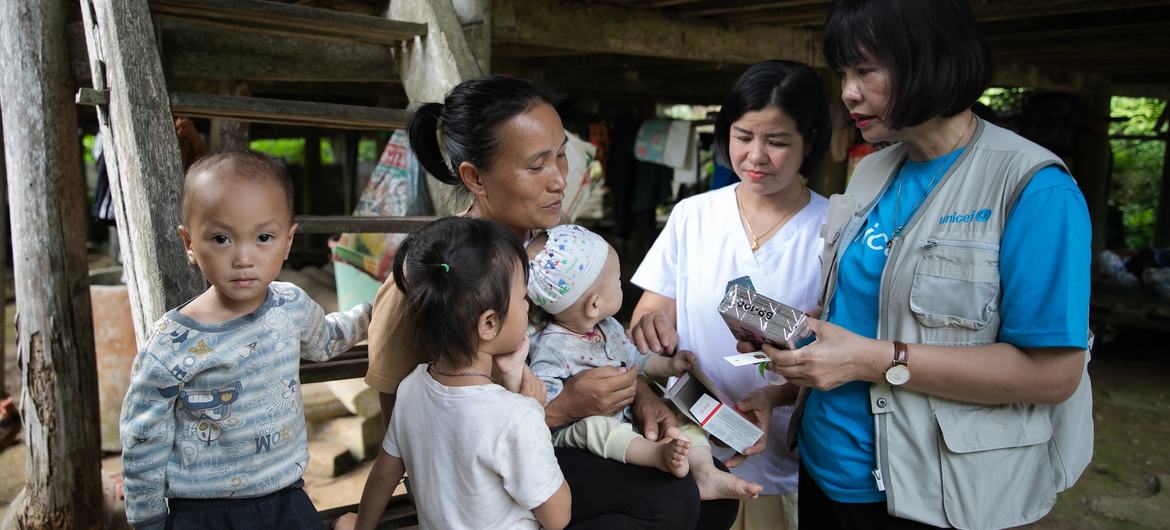
A UNICEF staff member hands ready to eat food to a family in Tuyên Quang, Viet Nam.

Viet Nam: A relentless typhoon season

Viet Nam is confronting the cumulative toll of one of its harshest typhoon seasons in years. Since October, a succession of storms has flooded and damaged large swathes of the country, particularly in northern and central provinces.

Persistent downpours since mid-November, compounded by Tropical Cyclone Koto, have triggered new landslides and prolonged displacement. A national joint response plan is under way to address food insecurity, health risks and damaged infrastructure.

To support the response, $2.6 million has been allocated from the UN Central Emergency Response Fund (CERF).

Gampaha (pictured), a district on Colombo’s outskirts, has been among the areas hardest hit by flooding after Cyclone Ditwah.

Disasters supercharged by climate change

UN agencies say the storms reflect a broader shift toward more intense and unpredictable weather across the Asia-Pacific. Cyclone Ditwah tracked unusually far south along Sri Lanka’s coast, while Cyclone Senyar formed near the equator in the Strait of Malacca – a rare occurrence.

The UN Economic and Social Commission for Asia and the Pacific (ESCAP), in its latest report issued last week, warned that rising temperatures are fundamentally reshaping the region’s risk landscape.

Warmer ocean waters are increasing the potential for extreme rainfall, while rapid urban growth, deforestation and wetland loss are magnifying flood impacts. Even where early warnings were issued, fast-rising waters overwhelmed evacuation routes in some locations.

Arab region pushed to limits by climate extremes as 2024 smashes heat records

The World Meteorological Organization’s (WMO) first State of the Climate in the Arab Region report paints a stark picture of a region under constant pressure from rising temperatures and increasingly extreme weather.

The UN agency noted that “a number of countries [in the Arab region] reported temperatures of above 50°C (122°F) last year, while average regional temperatures for 2024 were 1.08°C higher than from 1991 to 2020.
Highlighting the significance of this data, WMO Secretary-General Celeste Saulo noted that scorching temperatures marked by intense and longer-lasting heatwaves “are pushing society to the limits…it is simply too hot to handle,” she said.
“Human health, ecosystems and economies can’t cope with extended spells of more than 50°C,” the WMO chief continued. “Droughts are becoming more frequent and severe in one of the world’s most water-stressed regions. And at the same time, we have seen some disruptive and dangerous deluges.”

Hostile climate

The UN report indicates an 83 per cent rise in recorded disasters in Arab nations between 1980-1999 and from 2000-2019. 

In addition to record-breaking heat, the region – which encompasses 15 of the world’s most water-scarce countries – has endured dust storms, prolonged drought and destructive floods.

Drought worsened in 2024 in western North Africa after six consecutive failed rainy seasons, especially over Morocco, Algeria and Tunisia, WMO said. Whereas in otherwise arid countries including Saudi Arabia, Bahrain and the United Arab Emirates, extreme rainfall and flash floods caused death and destruction. 

These weather shocks have deepened pressure on communities already grappling with conflict, rapid population growth, urbanisation and economic fragility. WMO warned that without stronger adaptation measures, these pressures will only intensify as temperatures continue their rapid upward trajectory.

2024 was the Arab region’s hottest year on record
• Temperatures rising nearly twice global average
• Heat, drought and extreme rain all intensified last year
• Nearly 60 per cent of Arab countries now have early warning systems
• WMO urges greater coordination on climate action

These rising extremes are already reshaping daily life across the Arab region where water shortages are worsening as higher temperatures accelerate evaporation and strain groundwater reserves.

Daily life imperilled

Urban centres face growing threats to energy provision, transport networks and public health, particularly for people working outdoors or living in informal housing. In rural areas, prolonged drought is eroding food production and forcing difficult trade-offs between agriculture, domestic water use and environmental protection.

Claire Ransom, Associate Scientific Officer at WMO’s Climate Monitoring & Policy Section, stressed that extreme heat is only of many extreme weather threats. “Dust storms, severe flooding, and other climate extremes placed immense pressure on communities all across the region in 2024, disrupting lives and impacting millions of people,” she said.

These events have inflicted major economic losses, displacing families, damaging crops and overwhelming emergency response systems, which are unevenly distributed across the region.

Coordinated action

Despite these challenges, the WMO assessment identifies areas of progress. Many countries have expanded preparedness systems and begun investing more strategically in adaptation. “There is progress; nearly 60 per cent of Arab countries now have multi-hazard early warning systems in place, and many are prioritizing water security strategies to cope with the mounting climate risks that we’ve seen in 2024 and beyond,” Ms. Ransom said.

While adaptation efforts are growing, the report concludes that only swift, sustained and collaborative action will be enough to prevent the harsh climate of 2024 from becoming the new normal.

Pressure for coordinated solutions is mounting as temperatures climb. The combination of extreme heat, water scarcity and fast-growing populations is amplifying existing vulnerabilities and threatening development goals across multiple countries. Many governments already struggle to maintain essential services during heatwaves, while poorer communities face the greatest risks from both rising temperatures and worsening storms.

“The key message from the report is clear. The Arab region really stands on the front lines of climate change, and timely information and coordinated action are no longer optional. They’re absolutely essential,” Ms. Ransom said.

The report was produced by the UN agency in partnership with the Economic and Social Commission for Western Asia and the League of Arab States. It is the first climate assessment dedicated entirely to the Arab region and aims to provide actionable science-based information to support decision-makers in the water-scarce region.

Communities struggle to rebuild following Pakistan’s worst floods

As communities struggle to rebuild, many have little time to grieve the immense losses they have suffered.  

Since June, over six million people in Pakistan have been affected by what have been described as “unusually heavy monsoon rains” which have claimed nearly 1,000 lives, including about 250 children.

Residents are still recovering from flash floods that turned streams into roaring rivers of mud, with many displaced still sheltering in Government-run camps or with host families who are already stretched to their limit.

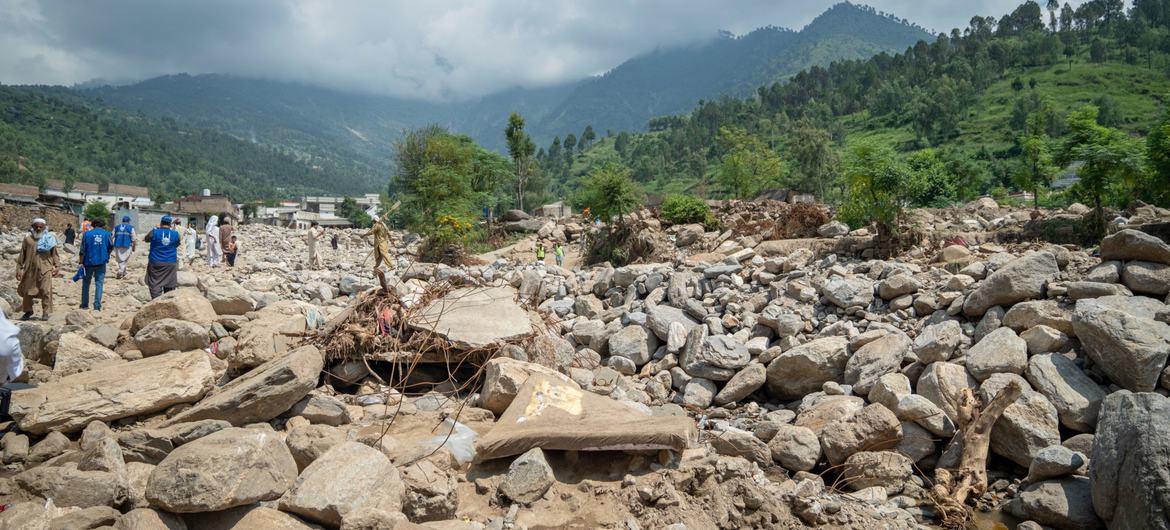
In the Buner district of northern Pakistan, dozens perished in Bishnoi village under boulders and debris when flash floods came crashing down the slopes, sweeping away homes and lives in a matter of minutes.

In Buner, northern Pakistan, flash floods turned mountain streams into fields of boulders, with iron rods protruding like rusted crops.

“We had never seen anything like this,” said 35-year-old Habib-un-Nabi, a teacher from Bishnoi village.  

His simple words carry the weight of grief and disbelief. Habib lost eighteen family members in a single day, including his parents and brother.

Those who survived barely had time to mourn. “We were too busy trying to dig out others, to help whoever we could,” recalled Habib.  

IOM support  

The International Organization for Migration (IOM) in Pakistan began humanitarian operations in the northern flood-affected areas, where hundreds of lives were lost and thousands were left homeless.  

In Punjab – Pakistan’s most populous province and the hardest hit in terms of infrastructure damage during the 2025 floods – IOM worked with partners and through the Common Pipeline, a shared humanitarian logistics system that stores and delivers emergency goods.  

Between August and September 2025, the UN migration agency distributed nearly 14,000 family relief kits tailored to local needs across all four provinces under a single project.

These interventions are part of broader efforts to help communities adapt to a climate crisis that is increasingly human-driven, fuelled by deforestation, rapid urbanisation, and the degradation of natural drainage systems.  

In Naseer Khan Lolai, a village in Kashmore, 65-year-old Ali Gohar has lived through many floods, yet none has been as devastating as this one.  

Entire homes collapsed, cattle were swept away, and the land – owned by local landlords – left farmers like him with little control over their recovery.  

As floods and heatwaves intensify across Pakistan, communities are showing that adaptation is not only possible but essential, turning the human cost of climate change into a call for shared responsibility and stronger action.  

From ruins to rebuilding: Three Jamaican mothers face the future after hurricane

Three women in Jamaica whose lives were upended by the destructive force of a hurricane which battered the Caribbean island are looking to rebuild their future. 

Right before Hurricane Melissa swept across Jamaica in late October 2025, Rose* took her two children to a friend’s sturdy concrete home to keep them safe. When they returned the next morning, everything had vanished.

“The house was gone,” she said. “I didn’t even see the roof, just a piece of lumber.”

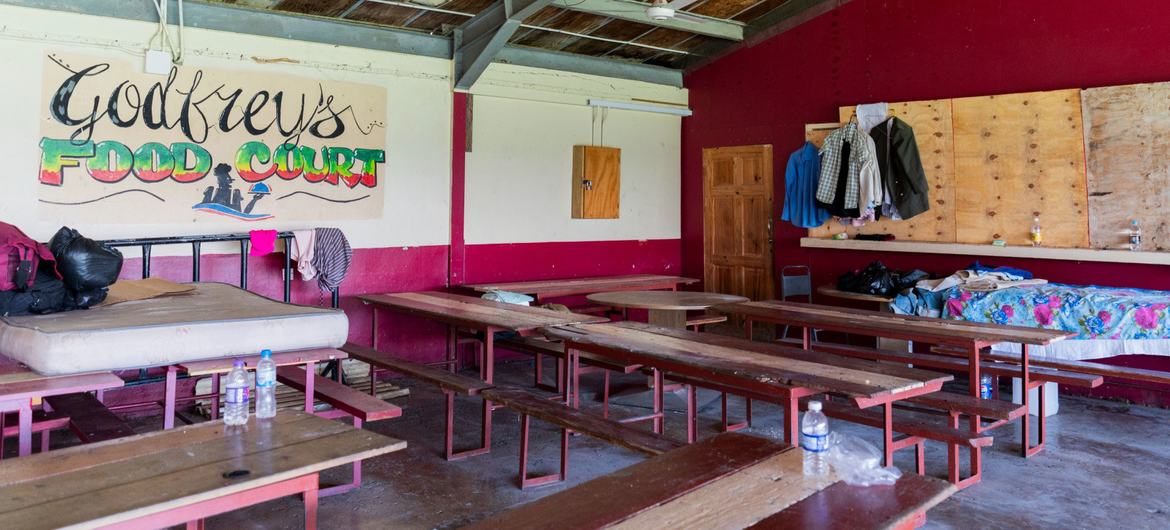
A school serves a temporary shelter for people whose lives were upended by Hurricane Melissa.

Entire neighbourhoods were reduced to splinters by the hurricane which left 36 per cent of houses in the western part of the country either damaged or destroyed.

Schools became shelters overnight, turning classrooms into temporary homes. Roads disappeared under water, power outages spread, and thousands were cut off for days. 

Nearly half a million people were left in precarious living conditions, facing profound uncertainty.

Among them are Rose, Sharon, and Sonia – three mothers whose lives changed overnight.

‘I have a key but no house’

For nine years, Rose lived in her small wooden home, a donated structure that had become her family’s refuge. 

Now, only the foundation remains. “I have a key to the house but no house,” she said. The air reeked of mud and decay. Nothing could be saved.

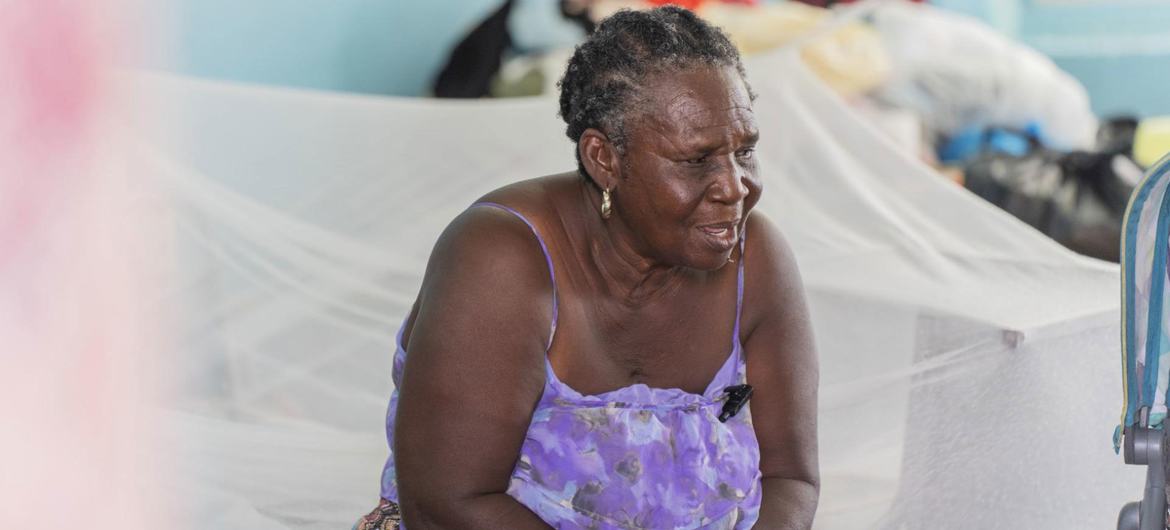
Sonia sits on a bed at a shelter for people who lost their homes due to Hurricane Melissa.

Before the storm, Rose worked as a cruise dispatcher in Negril, and her son as a hotel photographer. Both lost their jobs when the tourism industry shut down.

A few classrooms away, Sharon* faces a similar struggle. She arrived at the shelter with her two small children the same day her home, and her father’s collapsed. 

Before the storm, she worked as a gas station supervisor, now her workplace is closed indefinitely. Her children sleep on desks in the sweltering heat.

Between the rows of desks and makeshift beds, families share what little they have: a meal, a blanket, a few words of comfort. Amid loss, small acts of kindness create fragile connections.

Living in limbo 

More than 1,100 people remain in 88 shelters in Jamaica, and over 120,000 households need urgent repairs after Melissa’s destruction. 

Among them is Sonia*, who fled her coastal home carrying her grandson with a heart condition. 

“I can’t swim, so I grabbed him and ran,” she recalled.

Since the start of the emergency, the International Organization for Migration (IOM) teams have supported the Government of Jamaica and the wider UN response, delivering tarpaulins, shelter repair materials, hygiene kits, generators, and other essentials to families whose homes were damaged or destroyed.

For women like Rose, Sharon, and Sonia, each day is a test of endurance and solidarity. Their homes are gone, but the support of their communities helps them move forward. 

Their lives, once far apart, are now linked by loss, uncertainty, and the slow process of rebuilding.

*Names changed to protect identities


A sustainable future requires new thinking: UN environment report

The Global Environment Outlook lays out a simple choice for humanity: continue down the road to a future devastated by climate change, dwindling nature, degraded land and polluted air, or change direction to secure a healthy planet, healthy people and healthy economies,” said UNEP Executive Director Inger Andersen.

The report has input from 287 multi-disciplinary scientists from 82 countries and stretches to well over 1,000 pages.

Looking beyond GDP

The report makes a case for interconnected ‘whole-of-society’ and ‘whole-of-government’ approaches to transform economy and finance, materials and waste, energy, food and the environment.

Taking this path starts with moving beyond gross domestic product (GDP) as a measure of economic wellbeing and instead using inclusive indicators that also track the health of human and natural capital.

It continues with a transition to circular economy models; a rapid decarbonisation of the energy system; a shift towards sustainable diets, reduced waste and improved agricultural practices; and expanding protected areas and restoring degraded ecosystems – all backed by behavioural, social and cultural shifts that include Indigenous and local knowledge.

Two pathways to change

The report lays out a social and a technological pathway to transformation.

  1. Behaviour-focused transformation pathway: lifestyle, behavioural and value changes. Social awareness of the environmental crises drives a shift in worldview.
  2. Technology-focused transformation pathway: innovation and technological solutions. An urbanized world with significant global trade and technological spill-over.

Why it matters

According to UNEP:

  • The state of the environment will dramatically worsen if the world continues to power economies under a business-as-usual pathway.
  • Without action, global mean temperature rise is likely to exceed 1.5°C above pre-industrial levels in the early 2030s, exceed 2.0°C by the 2040s and keep climbing.
  • Climate change would cut 4 per cent off annual global GDP by 2050 and 20 per cent by the end of the century.
  • If made, the changes have the potential to avoid nine million pollution-related premature deaths, lift 200 million people out of undernourishment, and move 150 million people out of extreme poverty by 2050.

The agency called on countries to follow the whole-of-society and whole-of-government approaches laid out in the report to achieve a sustainable future.

“This sounds like, and indeed is, a massive undertaking. But there is no technical reason why it cannot be done,” Ms. Andersen said.

Five climate trailblazers: UNEP’S 2025 Champions of the Earth

As the world moves to slow climate change and create a more sustainable future, the UN Environment Programme (UNEP) named five new climate visionaries on Wednesday as its 2025 Champions of the Earth — the UN’s highest environmental honour.

These five extraordinary leaders, who work on issues ranging from climate justice to sustainable cooling and forest protection, show that bold action can drive real change for people and planet.

“As the global impacts of the climate crisis intensify, innovation and leadership across every sector of society have never been more essential,” said Inger Andersen, Executive Director of UNEP. 

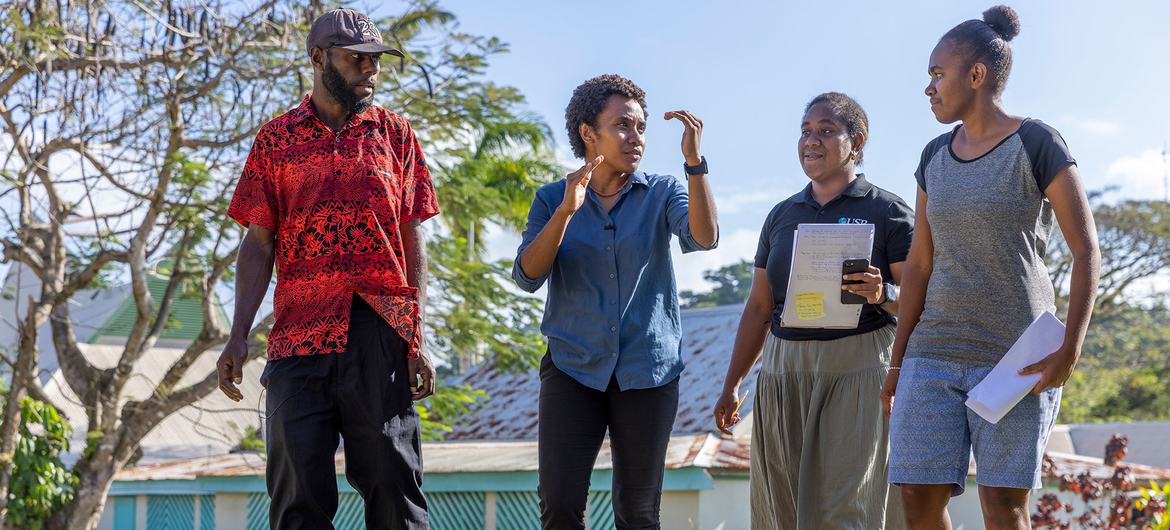
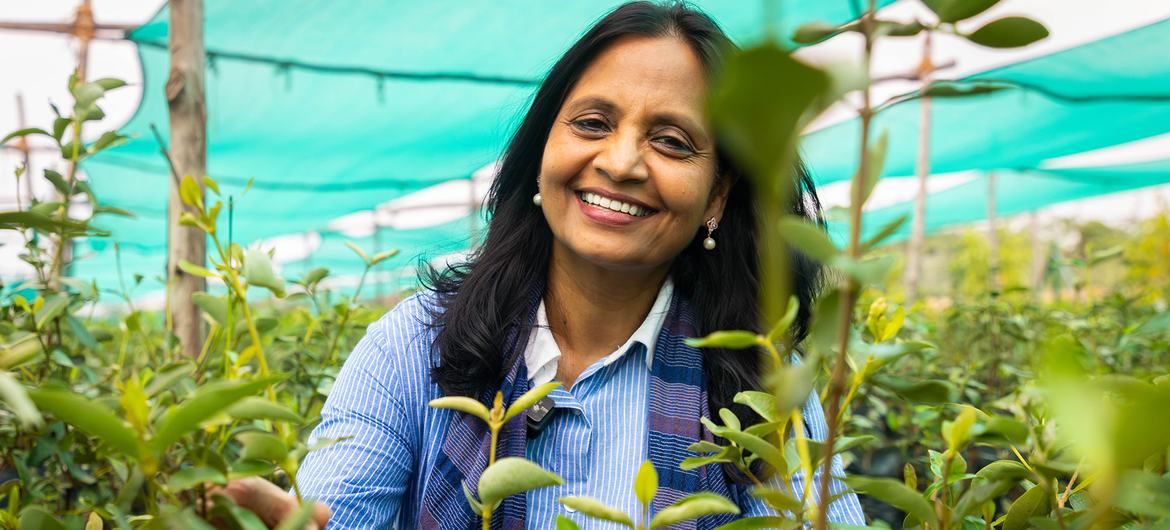
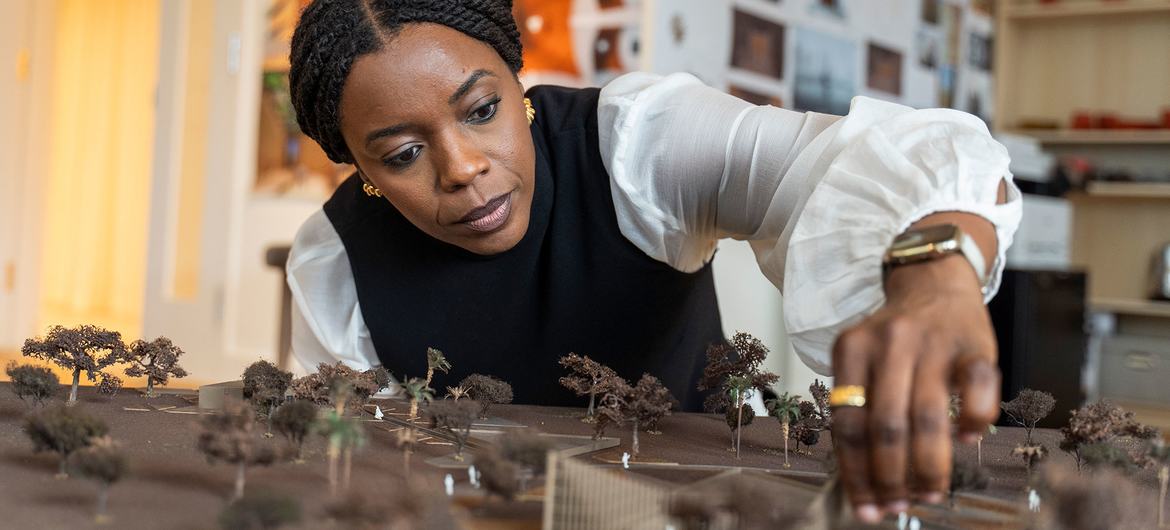
“Young students demanding climate justice, subnational governments and architects leading on sustainable cooling and smart building design, research institutes slowing deforestation – and passionate individuals driving methane emissions reductions – this year’s Champions of the Earth show the kind of leadership that will inspire the world to face down the challenge of climate change.”

This year, the laureates are tackling some of the most urgent challenges of our time: climate justice, methane emissions, sustainable cooling, resilient buildings, and forest conversation, according to the UN’s environment agency.

UNEP’s 2025 Champions of the Earth are: 

Pacific Islands Students Fighting Climate Change – Policy Leadership

When Cynthia Houniuhi addressed the International Court of Justice in The Hague a year ago, she spoke plainly: climate change is devastating Pacific Island nations like her home, the Solomon Islands.  

Through her youth-led NGO, which secured a landmark International Court of Justice (ICJ) opinion affirming states’ legal duties to prevent climate harm and uphold human rights, she is helping to reshape global climate law and empower vulnerable nations. 

Champions of the Earth Award winner Cynthia Houniuhi, a climate justice advocate from the Solomon Islands who co-founded and led Pacific Islands Students Fighting Climate Change.

Supriya Sahu, Additional Chief Secretary, Government of Tamil Nadu – Inspiration and Action

Indian environmentalist Ms. Sahu is redefining how communities adapt to extreme heat – restoring nature to cool cities, redesigning schools for safety, and promoting climate-smart infrastructure.  

Her sustainable cooling and restoration initiatives have created 2.5 million green jobs, expanded forest cover, and improved resilience for 12 million people. 

© UNEP/Florian Fussstetter

Champions of the Earth Award winner Supriya Sahu is recognized for her groundbreaking leadership in subnational climate action, restoring ecosystems and scaling sustainable cooling innovations across Tamil Nadu.

Mariam Issoufou, Principal and Founder, Mariam Issoufou Architects, Niger/France – Entrepreneurial Vision

By grounding her architecture in local materials and cultural heritage, Ms. Issoufou is redefining sustainable, climate-resilient buildings across the Sahel and inspiring a new generation of designers shaping Africa’s built environment.  

Through projects like the Hikma Community Complex in Niger, she pioneers passive cooling techniques that keep buildings up to 10°C cooler without air conditioning. 

Champions of the Earth Award winner Mariam Issoufou is a Nigerien architect whose work redefines the relationship between contemporary design and cultural heritage.

Imazon, Brazil – Science and Innovation

Imazon has developed AI deforestation prediction models that inform policies and help law enforcement protect the Amazon rainforest, while promoting sustainable economic growth.        

By combining science and AI-driven geospatial tools to curb deforestation, Imazon’s non-profit research institute has strengthened forest governance, supported thousands of legal cases, and revealed the scale of illegal deforestation, driving systemic change in the Amazon basin. 

Champions of the Earth Award winner Cynthia Houniuhi is awarded for pioneering forest monitoring systems that combine cutting-edge geospatial science and AI to prevent deforestation in the Amazon.

Manfredi Caltagirone (posthumous) – Lifetime Achievement

Mr. Caltagirone has dedicated his career to one of the most urgent challenges of our time. Guided by his vision for open, reliable, and actionable data, he has driven efforts to turn knowledge into climate action.  

As the former head of UNEP’s International Methane Emissions Observatory, he advanced transparency and science-based policy on methane emissions, helping shape the EU’s first regulation on methane emissions and shaping global energy policy. 

Manfredi Caltagirone, posthumously honoured with the Lifetime Achievement Award for his visionary leadership in founding the International Methane Emissions Observatory and advancing global action on methane.


UN environment assembly wraps up in Nairobi

The assembly is the world’s highest-level decision-making body for matters related to the environment. 

More than 6,000 people – representing 186 countries – took part in the week-long gathering which was held at the headquarters of the UN Environment Programme (UNEP).

Wide-ranging resolutions

The UNEA-7 resolutions cover issues such as the sound management of minerals and materials essential to the shift to clean energy, international cooperation to combat wildfires, and greater protection of coral reefs and glaciers.

The ministerial declaration outlined commitment to bold actions that drive sustainable solutions, such as promoting local and national zero-waste initiatives.

It also called for implementing obligations under multilateral environmental agreements and frameworks, as well as advancing equitable and inclusive participation in all efforts. 

Rising above differences

In her closing remarks, UNEP Executive Director Inger Andersen recalled that participants came to Nairobi to show the determination and solidarity needed to tackle environmental challenges that threaten to undermine economies and societies.

“You have succeeded,” she said.  “The beacon of environmental multilateralism that rises above the fog of geopolitical differences today shines a little brighter.”

She noted that the assembly had also approved UNEP’s Medium-Term Strategy (MTS) for the next four years.

Support UN environment agency

As Member States also handed new mandates to UNEP, on top of existing ones, she urged countries to make their full contributions so that it can deliver “with results and impact.”

“You will now return to the world outside the negotiation halls. A world in which – let us not forget amid our euphoria – people are dying, homes and livelihoods are being destroyed, economies are being damaged, and inequity is growing because action on environmental challenges has not been fast or strong enough,” Ms. Andersen said. 

“Yes, you have brightened the beacon and better lit the path forward. But we must now, together, hurry down this path to make good on our collective promise to deliver real solutions for a resilient planet and resilient people.” 

Paris Agreement turns 10

Friday also marked 10 years since the adoption of the Paris Agreement on climate change, which Ms. Andersen also highlighted in her remarks.

The landmark treaty, signed by 194 countries and the European Union, aims to limit global temperature rise to 1.5 degrees Celsius above pre-industrial levels.

UN Secretary-General António Guterres used the anniversary to call for more climate action.

“A decade ago, the world found the courage to adopt the Paris Agreement – a pillar of hope for humanity,” he said in a tweet.

“Today, we must find courage once again. The climate crisis is one of the defining challenges of our time. Together, we can – and we must – build a livable future for all.”