Cyclone Ditwah brings worst flooding in decades to Sri Lanka, killing hundreds

According to the UN relief coordination office, OCHA, 998,918 people across all 25 districts have now been affected, with 212 deaths reported and 218 people missing. More than 180,000 people from over 51,000 families are sheltering in 1,094 government-run safety centres as search and rescue efforts continue.

Cyclone Ditwah made landfall on 28 November before moving back over the Bay of Bengal, triggering some of the most severe flooding Sri Lanka has seen since the early 2000s.

The hardest-hit districts include Gampaha, Colombo, Puttalam and Mannar, as well as Trincomalee and Batticaloa, while deadly landslides in the central hill country have devastated Kandy, Badulla and Matale.

Homes destroyed, infrastructure shattered

Initial assessments indicate that more than 15,000 homes have been destroyed. Over 200 roads remain impassable, at least 10 bridges have been damaged, and sections of the rail network and national power grid affected.

Flooding along the Kelani River, which runs through Colombo and surrounding low-lying areas, continues to hamper access and disrupt information flow from affected communities, complicating rescue and relief operations.

Severe disruption to electricity, mobile and communications, and transport networks are reported in northern districts such as Jaffna, with entire villages isolated

Access to clean water also remains a major concern, with several areas reporting little or no supply.

Health system under strain, food insecurity looms

Sri Lanka’s already fragile health system is under severe pressure, OCHA said. Several district hospitals remain flooded and are receiving only limited supplies, with critically ill patients being airlifted to functioning facilities.

Response is further hindered by recurring landslides and the breach of multiple tank bunds (embankments or barriers), including at Mavilaaru, heightening risks in Trincomalee and Batticaloa.

Authorities have also warned of rising food insecurity, as submerged farmland, damaged storage facilities and severed supply routes threaten shortages and price increases in the weeks ahead.

The World Health Organization (WHO) warned that floods significantly raise the risk of vector-borne, food-borne and water-borne diseases, urging communities to prevent mosquito bites, ensure food safety and use safe drinking water wherever possible.

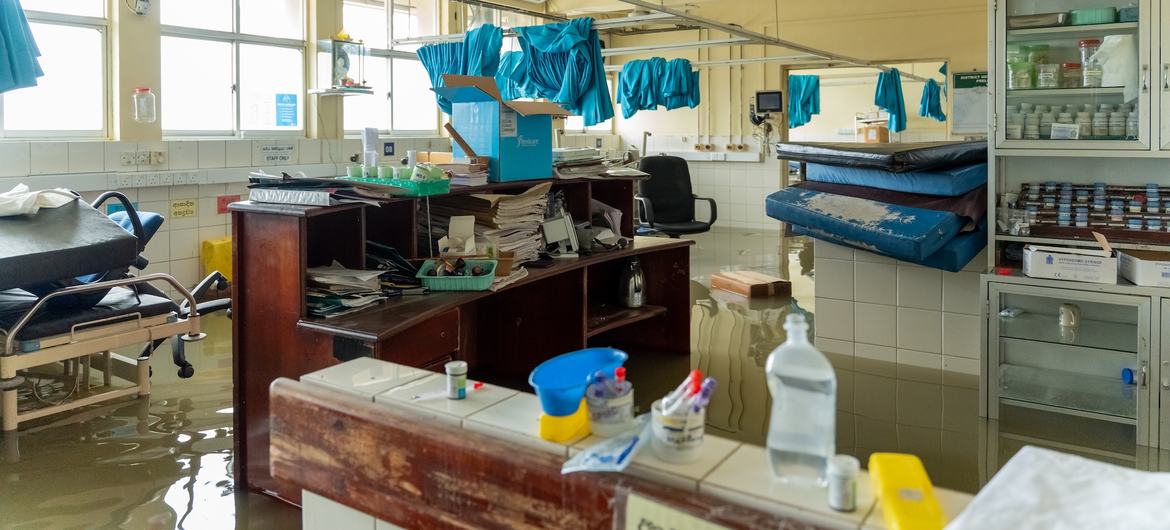
Floodwaters have entered several hospitals across Sri Lanka, further straining the health system.

UN mobilises coordinated response

The United Nations in Sri Lanka activated its emergency coordination system on Sunday to scale up a unified response with government agencies and humanitarian organizations.

Sector coordination has been set up across food security, health, water and sanitation (WASH), education, protection, shelter and early recovery, while a multi-sector needs assessment is under way with disaster management authorities to identify the most urgent gaps.

“The UN in Sri Lanka is mobilising its teams across the system to support national rescue and early recovery efforts, in coordination with authorities. We stand in solidarity with all affected communities,” said UN Resident Coordinator Marc-André Franche.

Despite access challenges, the UN Children’s Fund (UNICEF) has delivered portable water to 25 safety centres in Badulla in the central hills, which had been cut off from the rest of the country by floods and infrastructure damage.

To support government-led efforts, India and Pakistan have deployed emergency teams to work alongside Sri Lanka’s armed forces in the worst-hit districts.

Meanwhile, in the wider Asian region

Severe monsoon flooding continues across Thailand and Malaysia, affecting more than two million people in southern Thailand alone and displacing nearly 25,000 people in Malaysia, according to OCHA. People have been evacuated in several hard-hit Thai provinces, while the rainfall is expected to ease in coming days.

In Indonesia, media reports cite at least 440 deaths from floods and landslides, with more than 400 people missing, particularly in parts of Sumatra, where thousands remain stranded without access to food and water.
Communities struggle to rebuild following Pakistan’s worst floods

As communities struggle to rebuild, many have little time to grieve the immense losses they have suffered.  

Since June, over six million people in Pakistan have been affected by what have been described as “unusually heavy monsoon rains” which have claimed nearly 1,000 lives, including about 250 children.

Residents are still recovering from flash floods that turned streams into roaring rivers of mud, with many displaced still sheltering in Government-run camps or with host families who are already stretched to their limit.

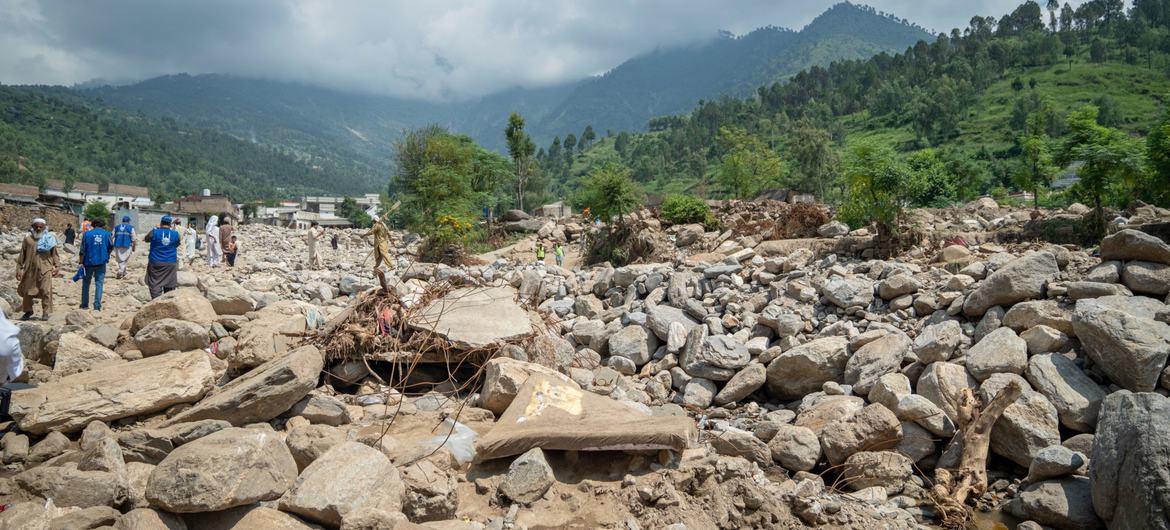
In the Buner district of northern Pakistan, dozens perished in Bishnoi village under boulders and debris when flash floods came crashing down the slopes, sweeping away homes and lives in a matter of minutes.

In Buner, northern Pakistan, flash floods turned mountain streams into fields of boulders, with iron rods protruding like rusted crops.

“We had never seen anything like this,” said 35-year-old Habib-un-Nabi, a teacher from Bishnoi village.  

His simple words carry the weight of grief and disbelief. Habib lost eighteen family members in a single day, including his parents and brother.

Those who survived barely had time to mourn. “We were too busy trying to dig out others, to help whoever we could,” recalled Habib.  

IOM support  

The International Organization for Migration (IOM) in Pakistan began humanitarian operations in the northern flood-affected areas, where hundreds of lives were lost and thousands were left homeless.  

In Punjab – Pakistan’s most populous province and the hardest hit in terms of infrastructure damage during the 2025 floods – IOM worked with partners and through the Common Pipeline, a shared humanitarian logistics system that stores and delivers emergency goods.  

Between August and September 2025, the UN migration agency distributed nearly 14,000 family relief kits tailored to local needs across all four provinces under a single project.

These interventions are part of broader efforts to help communities adapt to a climate crisis that is increasingly human-driven, fuelled by deforestation, rapid urbanisation, and the degradation of natural drainage systems.  

In Naseer Khan Lolai, a village in Kashmore, 65-year-old Ali Gohar has lived through many floods, yet none has been as devastating as this one.  

Entire homes collapsed, cattle were swept away, and the land – owned by local landlords – left farmers like him with little control over their recovery.  

As floods and heatwaves intensify across Pakistan, communities are showing that adaptation is not only possible but essential, turning the human cost of climate change into a call for shared responsibility and stronger action.  

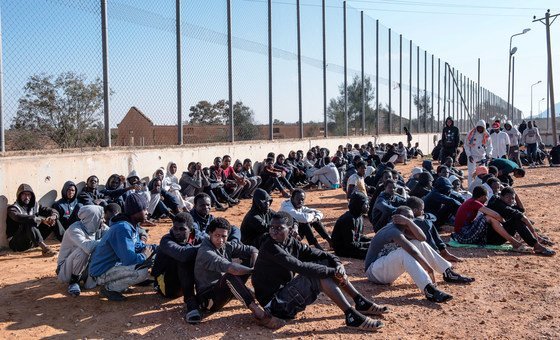
‘Our worst held fears are being confirmed’: Dozens of bodies discovered in Libya mass graves

“Our worst held fears are being confirmed: dozens of bodies have been discovered at these sites, along with the discovery of suspected instruments of torture and abuse, and potential evidence of extrajudicial killings,” Türk said.

The sites where bodies were discovered are run by the Stabilization Support Apparatus (SSA), an armed group tasked with increasing Government security in the capital, Tripoli.  They have long been suspected by the UN Support Mission in Libya (UNSMIL) – and independent rights experts – to be sites of torture and enforced disappearance.

Mr. Türk called for these sites to be sealed for forensic investigations to support accountability.

Libya has endured turmoil since the fall of the Muammar Gaddafi regime 15 years ago and the emergence of rival administrations in 2014: the UN-recognized Government of National Unity (GNU) in Tripoli and the Government of National Stability (GNS) based in Benghazi. 

The UN has supported many ultimately unsuccessful attempts to reunite the country and transition to democratic governance.

Over 80 bodies discovered

In May, the leader of the SSA – Abdul Ghani al-Kikli – was killed, triggering clashes between armed groups and state security forces. Protests also emerged, calling for an end to violence in Tripoli. Multiple civilians were killed and infrastructure – including hospitals – damaged. 

In the wake of this violence, 10 badly charred bodies were discovered at the SSA headquarters in the Abu Salim neighbourhood. 67 more bodies were discovered at hospitals in Abu Salim and Al Khadra hospitals, all in refrigerators and in various states of decay. 

The UN human rights office OHCHR also said that a burial site was discovered at the Tripoli Zoo, which is run by the SSA. 

The identities of the bodies are not known at this stage. 

Human rights abuses, at all levels

These were not the first mass graves discovered in Libya. In February, two mass graves were discovered in Jakharrah and Al-Kufra with 10 and 93 bodies respectively. Many of these bodies were migrants who are uniquely vulnerable to human trafficking, forced disappearance and killings.

The International Organization for Migration (IOM) recorded over 1,000 migrant deaths and disappearances in Libya in 2024 alone.

Mr. Türk expressed concern not only about the bodies discovered recently in Tripoli and the human rights abuses they confirm, but also about the force with which protests were met near the end of last month.

“We have received reports that these protests were themselves met with unnecessary force, raising serious concerns with respect to the guarantee of the fundamental rights of freedom of expression and assembly,” he said.

The High Commissioner for Human Rights also noted that images and videos of the bodies are circulating on social media, prompting him to call for preserving the dignity and privacy of victims.

Seal the sites, preserve the evidence

The Government of National Unity, the internationally-recognized administration based in Tripoli, announced the creation of two committees to investigate human rights abuses committed by State security forces, both in relation to the bodies and the protests.

While Türk noted this, he expressed concern that forensic authorities have not been allowed into the sites to examine and preserve related evidence.

He called on Libyan authorities to seal the recently discovered sites and promote immediate accountability efforts.

“Those responsible for these atrocious acts must be brought to justice without delay, in accordance with international standards,” he said.

Mr. Türk also urged all stakeholders to commit once more to transition attempts in order to move Libya towards an inclusive democracy once and for all, ending the “recurring cycle of transitional agreements.”

“The people of Libya have clearly expressed their demand for truth and justice, and their yearning for a peaceful and safe way of life with human rights and freedoms at the front and centre,” the High Commissioner added.  

Source link

‘Worst is over’, says Byju Raveendran after FY22 results

New Delhi, Sep 16 (IANS) After six stressful and tough learning months, Byju Raveendran is back in the game, consolidating the loss-making acquisitions like WhiteHat Jr and optimising the rest, while doubling down on opening more physical tuition centres. According to him, “the worst is finally over” and there is only “growth ahead” as seen in the company’s FY22 financial results.

The edtech company with nearly $22 billion valuation went through an ordeal as it delayed the audited FY21 financial reports for nearly 18 months, inviting government scrutiny and serious questions from the public.

The FY21 report is out, with massive losses to the tune of Rs 4,500 crore, while BYJU’s needs to pay the rest of the acquisition amount (about Rs 2,000 crore) to global VC firm Blackstore in the $950 million Aakash acquisition by September 23.

Raveendran told IANS that he is not worried at all about paying the rest of the acquisition money as the core education business is doing excellent and the company has a healthy cash reserve of more than $1 billion.

“The losses that you see in FY21 is because 40 per cent of the revenue got deferred on account of two things: revenue recognition change because of streaming revenue getting recognised over the period of consumption of the product,” Raveendran explained in a free-wheeling interview.

He said that the other reason for the audit delay was that EMI or credit sales were getting recognised after the complete significant collection was done.

“There are the main reasons for audit delay, apart from the initial reasons like Covid and then the complexity of our business moving from a single product, single geography offering to multi-product, multi subsidiary offering across the world,” emphasised Raveendran, adding that while the revenue got pushed out, the cost expenses during the financial year did not.

In 2007, he founded the test preparation business Byju’s Classes, and in 2011 Raveendran founded BYJU’s with his wife, Divya Gokulnath.

Last year, he went on an acquisition spree. The edtech unicorn made at least 10 acquisitions for a cumulative transaction value of about $2.5 billion — including Delhi-based offline test preparatory services provider Aakash for $950 million.

Raveendran said that loss-making acquisitions like WhiteHat Jr, the beleaguered coding platform BYJU’s acquired for $300 million, are now being consolidated.

“WhiteHat Jr is underperforming as it has a very high marketing cost attached to it. This is one of the businesses where we are seeing Covid pull-back. We have the structural challenges as it has an inefficient cost structure,” he told IANS.

Raveendran said that they don’t have the product challenge with WhiteHat Jr as they added Maths with coding on the platform.

The edtech major clocked gross revenues of nearly Rs 10,000 crore in FY22, leaving its investors happy and Raveendran, a relieved man.

“From here on, we will double down on growth as our core business is booming. Both Aakash Institute and Great Learning are doing excellent and have doubled their revenues,” Raveendran stressed.

In June, BYJU cut at least 600 jobs — asking 300 employees at its Toppr learning platform and another 300 at coding platform WhiteHat Jr to go.

On any future job cuts, Raveendran said that apart from getting rid of few redundant roles and some functions becoming optimised, BYJU’s is actually hiring more people while absorbing the right mix of workers into other products.

“We today have 50,000-plus employees, that’s up from 20,000-plus 18 months back. The total number of employees in the ecosystem is growing. Several new functions and initiatives have been created where we are hiring a lot of teachers, because of the hybrid learning centres like Akash which are really growing well,” the BYJU’s CEO told IANS.

He said BYJU’s is hiring at least 1,000 employees on a month-to-month basis, even more.

Raveendran is confident that the remaining amount in the Aakash deal will reach Blackstone soon, as he charts a new course for BYJU’s in months to come, as the next big funding raise is in the offing.