‘The extraordinary power of ordinary people’: World leaders spotlight youth as agents of progress

Annalena Baerbock, President of the General Assembly and one of the youngest persons to ever hold the office, stressed that youth are “the designers of their future” but should not have to build it alone.

Drawing on conversations with young leaders from Ethiopia to Afghanistan, she highlighted the challenges today’s youth face – from conflict and crisis to cyberbullying and unemployment – as well as the transformative change they are driving, such as digital innovation and climate advocacy.

The recent landmark International Court of Justice (ICJ) advisory opinion on climate obligations, prompted by youth activists, underscores how determined young people can reshape global policy. Their commitment can spark hope and intergenerational solidarity.

Bangladesh: Youth driving democratic renewal

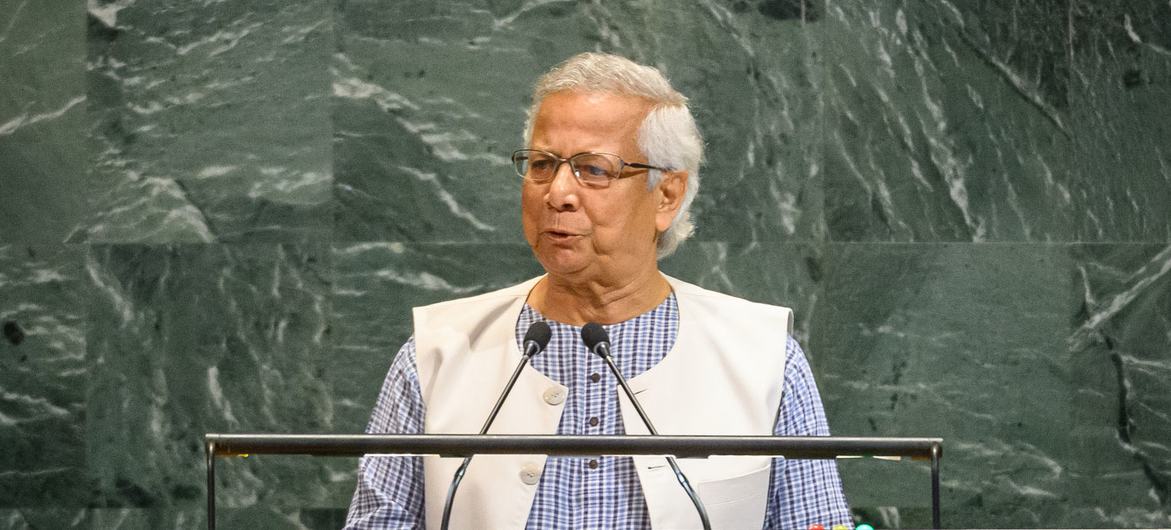
Muhammad Yunus, Chief Adviser of the interim Government of Bangladesh, addresses the general debate of the General Assembly’s eightieth session.

The transformative potential of youth was starkly evident in Bangladesh, one year after the ‘July Revolution’ ended decades of authoritarian rule.

At the Assembly’s general debate fourth day, Chief Adviser Muhammad Yunus described the uprising as “a reminder of the extraordinary power of ordinary people,” crediting the country’s young majority with defeating tyranny and opening the path toward a more just and equal society.

Stemming from the demands of the movement, 11 independent commissions – addressing themes that ran from governance to women’s rights – have now been established and over 30 political parties signed a ‘July Declaration’ pledging to uphold democratic reforms.

Looking ahead, he stressed the importance of empowering Bangladesh’s young majority and women, noting that the country aims “to shape every young person, not only as a job seeker, but also as a job creator,” while advancing protections against harassment and expanding women’s public roles.

▶ Watch the address.

Greece: Safeguards in the digital age
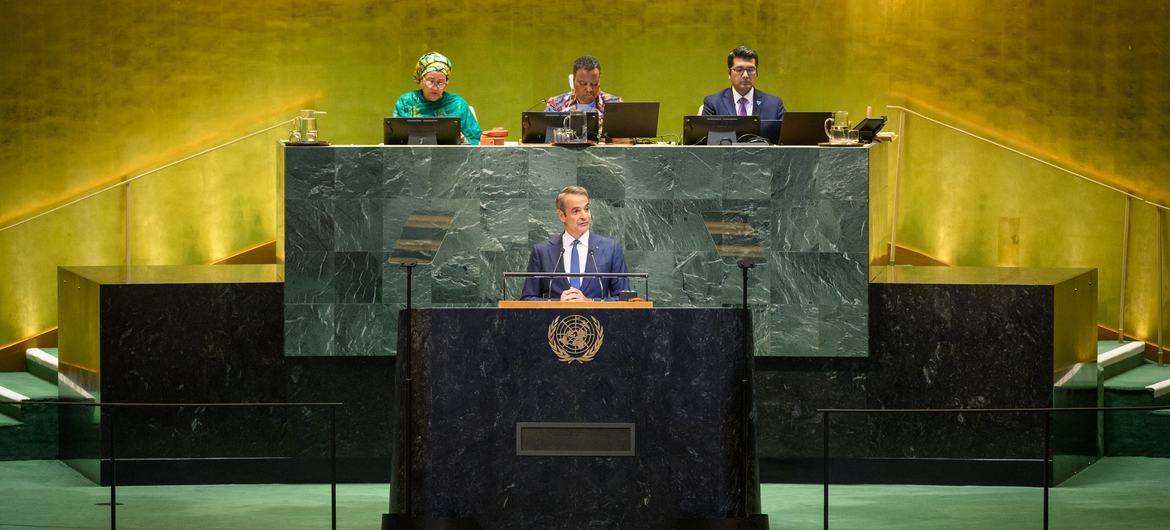
Prime Minister Kyriakos Mitsotakis of Greece addresses the general debate of the General Assembly’s 80th session.

Prime Minister Kyriakos Mitsotakis of Greece emphasized the mental health and safety of children in an era dominated by digital technology and artificial intelligence.

Warning that “we are running a massive unsupervised experiment with the brains of our children and teenagers,” he highlighted the dangers of cyberbullying, addictive content and harmful material online.

Greece has banned phones in schools and launched Kids Wallet, a government-backed app enabling parents with simple, effective tools to manage their children’s smartphone use.

Mr. Mitsotakis also proposed a pan-European “digital age of majority” to ensure age-appropriate access to online platforms, framing these measures as part of a broader effort to protect young minds while supporting safe engagement with technology.

“Just as society once set firm rules for smoking, drinking or wearing a seatbelt, we must now confront today’s challenge with equal clarity: big platforms can no longer profit at the expense of our children’s mental health,” he said.

▶ Watch the address.

Solomon Islands: Youth leading climate action
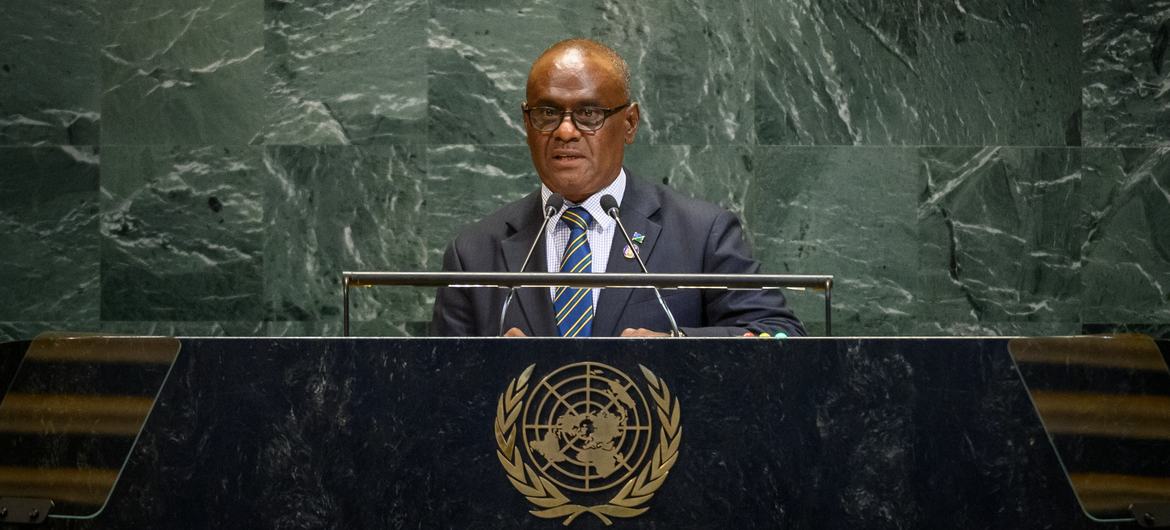
Prime Minister Jeremiah Manele of Solomon Islands addresses the general debate of the General Assembly’s 80th session.

The pivotal role of youth in global challenges was further highlighted by Prime Minister Jeremiah Manele of the Solomon Islands.

He noted that the youth in the Pacific “have stood at the forefront of this initiative, reminding us that the strength of the Pacific lies in our unity,” referencing the youth-led campaign that prompted the International Court of Justice (ICJ)’s landmark advisory opinion on climate obligations.

Mr. Manele emphasized that the ruling, which affirmed States’ responsibilities to protect the climate for present and future generations, is more than a legal finding – it is “a call to the international community that only together can we honour the 1.5°C commitment, protect the most vulnerable, and secure a just and sustainable future for all nations and peoples.”

Youth-led advocacy, he said, has brought the urgency of small island communities’ climate plight to the global stage, demonstrating how collective action can protect the most vulnerable and safeguard the planet for future generations.

▶ Watch the address.

Trinidad and Tobago: Small nations, global impact
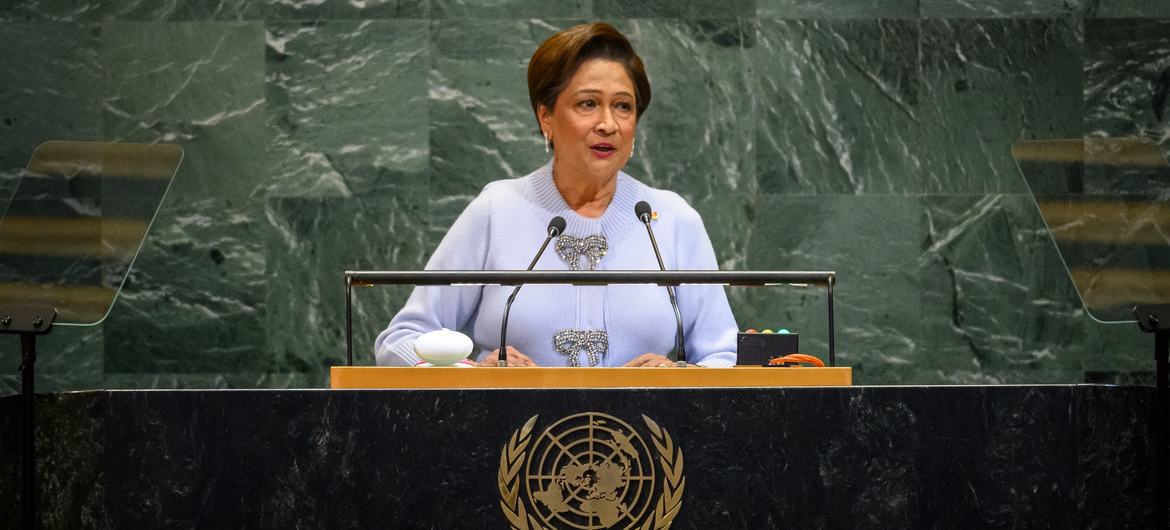
Prime Minister Kamla Persad-Bissessar of Trinidad and Tobago addresses the general debate of the General Assembly’s 80th session.

Prime Minister Kamla Persad-Bissessar of Trinidad and Tobago illustrated how even smaller nations can wield global influence when youth and children’s welfare are prioritized.

She highlighted domestic initiatives such as the Children’s Authority and Children’s Life Fund, expanded early childhood education and alignments with the global development agenda – all efforts aimed at ensuring the next generation thrives.

The Prime Minster also stressed that gender equality is inseparable from sustainable peace and development, noting that “women and girls must be equal partners in peace and sustainability.”

▶ Watch the address.

Malta: Real benefits of multilateralism
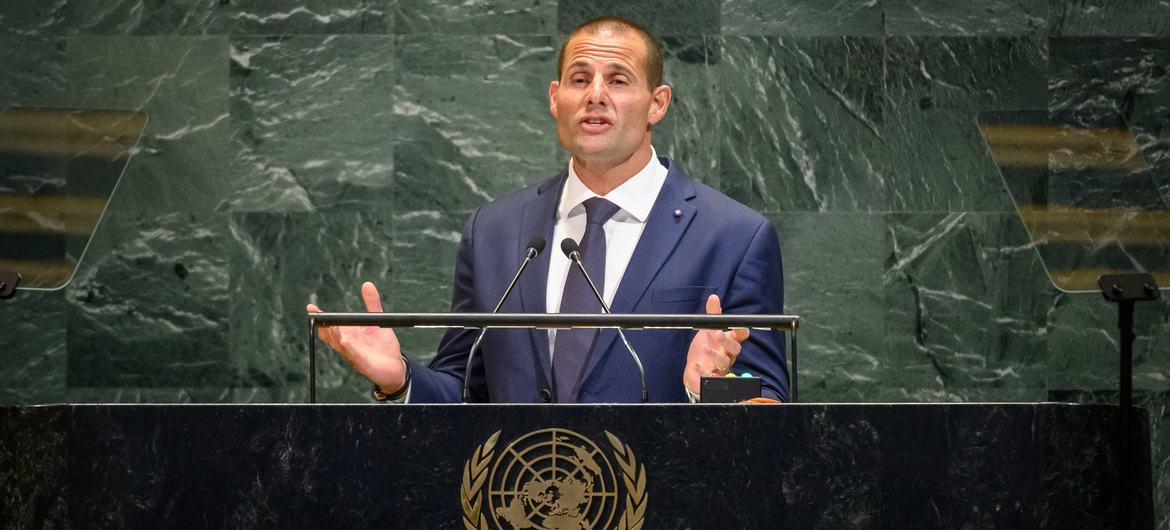
Prime Minister Robert Abela of Malta addresses the general debate of the General Assembly’s 80th session.

Prime Minister Robert Abela of Malta offered a reminder that words alone cannot end conflict, hunger, or child malnutrition – but collective action can.  

He said the life expectancy of children born in 1945, which hovered in the mid-forties, with those born in 2025, who can now expect to live into their mid-seventies.  

“That didn’t happen by luck or accident,” Mr. Abela said. “It happened by will and resolve. It happened by effort. And it happened also because of the positive work conducted by the agencies of this United Nations.”  

Reflecting on these gains, he emphasized that multilateralism remains critical:  

“We won’t keep our peoples safe, our planet protected or our prosperity preserved unless we work together, listen to each other and act in concert.”
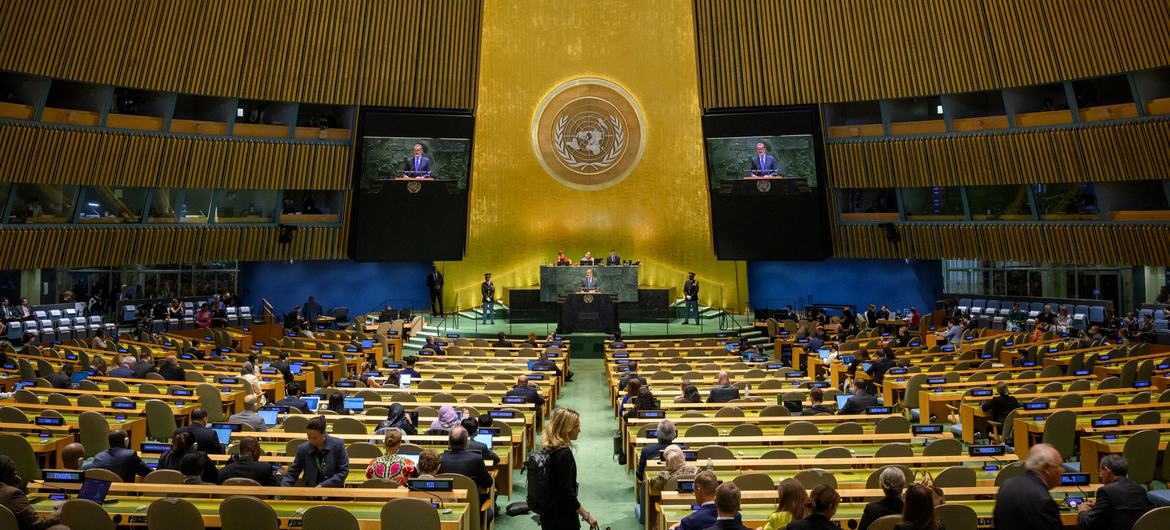
▶ Watch the address.

Sinking islands, vanishing forests: World leaders call for urgent climate action

Their appeals, sharpened by rising seas, failed harvests and disappearing ecosystems, echoed Secretary-General António Guterres’s warning at a climate summit that the world is already in the “dawn of a new energy era” – one where clean energy must replace fossil fuels, and where finance and justice remain at the heart of the global response.

“The bottom-line: clean is competitive and climate action is imperative,” he declared, calling for “dramatic emissions cuts” aligned with 1.5°C goal of the landmark Paris Agreement on climate change, agreed by all nations in 2015.

“We know it can be done … COP30 in Brazil must conclude with a credible global response plan to get us on track,” he added, referring to the 30th UN climate change conference in November, which aims to accelerate global efforts to limit temperature rise and advance commitments on emissions, adaptation and climate finance.

The UN chief’s urgency provided the backdrop as world leaders presented compelling accounts of climate peril and promise on the second day of the Assembly’s annual general debate.

Spain – Accelerate energy transition

King Felipe VI of Spain addresses the general debate of the General Assembly’s eightieth session.

The “triple planetary crisis” – climate change, pollution and biodiversity loss – featured prominently in the address by King Felipe VI of Spain, who underscored that governments must accelerate a just energy transition.

He pressed for tripling renewable capacity, doubling efficiency and advancing decarbonisation in time for COP30, where Spain hopes to see consensus and ambition.

“These objectives are as ambitious as they are necessary,” he said, cautioning that hesitation can no longer be part of the global equation.

▶ Watch the address.

Panama – Nature, the first line of defense

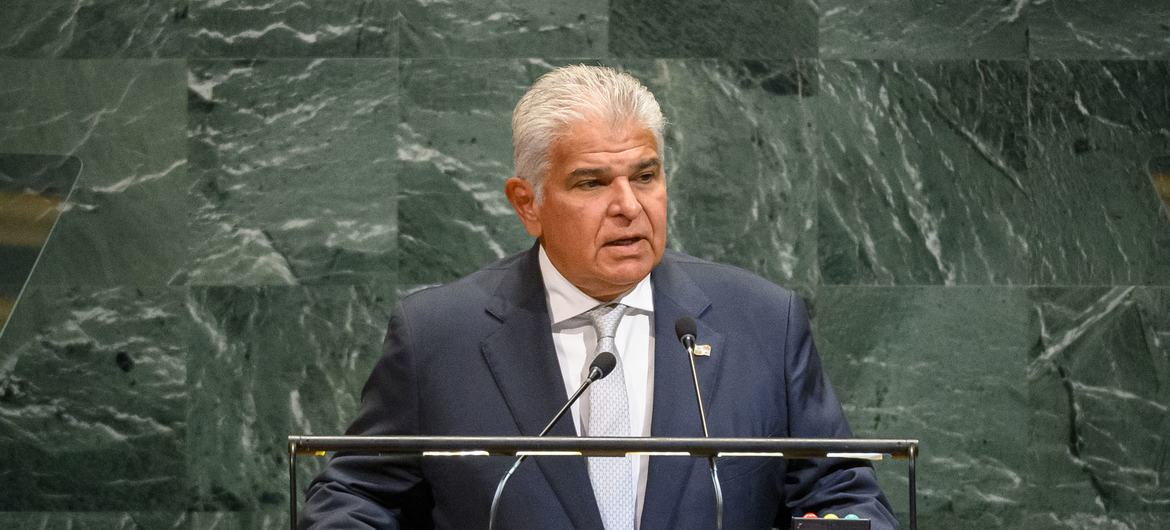
President José Raúl Mulino Quintero of Panama addresses the general debate of the General Assembly’s eightieth session.

For Panama, which has long championed conservation despite contributing little to global emissions, the call was for integrated action.

President José Raúl Mulino Quintero unveiled the country’s ‘Nature Pledge,’ a single framework, uniting commitments on climate, biodiversity and land.

He stressed that as a carbon-negative country, Panama will go even further by restoring 100,000 hectares of priority ecosystems, from mangroves to watersheds.

“Nature is our first line of defense against climate change,” he said, linking national resilience to global solidarity.

▶ Watch the address.

Comoros – Small island, big stakes

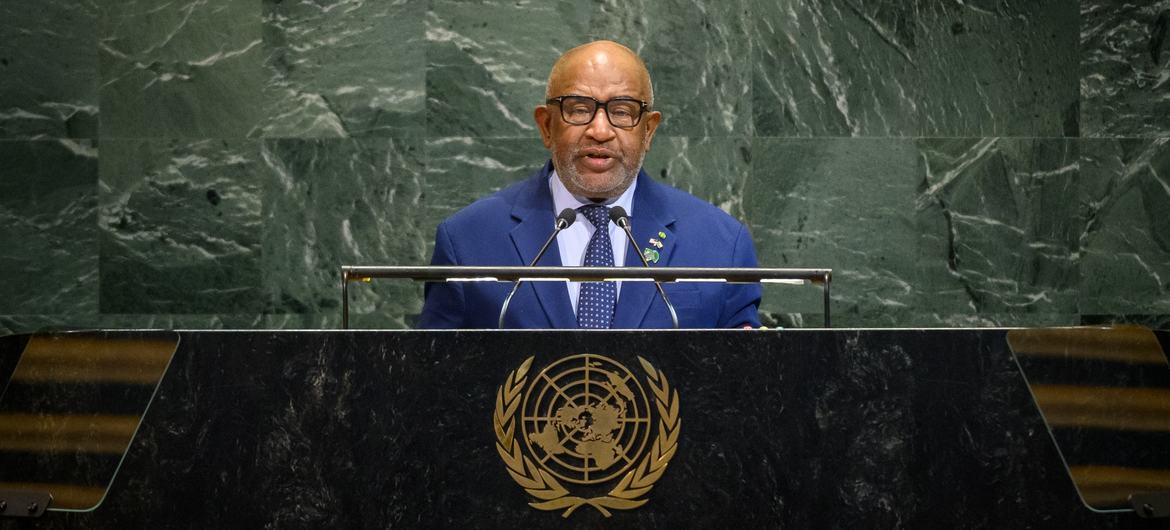
President Azali Assoumani of Comoros addresses the general debate of the General Assembly’s eightieth session.

In the Indian Ocean, the Comoros faces a different frontline.

President Azali Assoumani spoke of rising seas, coastal erosion and intensifying cyclones that threaten the archipelago’s villages and ecosystems.

He urged equitable, simplified access to climate finance, insisting that small island states cannot wait on cumbersome mechanisms while their homes wash away.

At the same time, he highlighted his country’s ‘Emerging Comoros Plan,’ built on renewable potential, blue economy resources and digital transition.

But without international support, he warned, such plans risk being hampered by debt and global inaction.

▶ Watch the address.

Namibia – Linking climate action to desertification

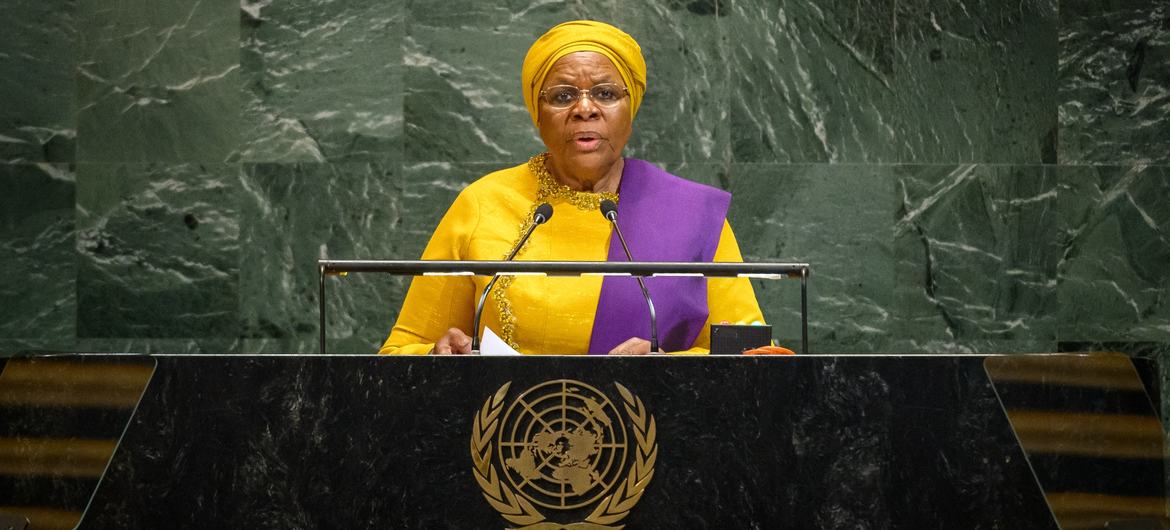
President Netumbo Nandi-Ndaitwah of Namibia addresses the general debate of the General Assembly’s eightieth session.

Namibia’s President Netumbo Nandi-Ndaitwah tied climate impacts directly to her country’s daily struggles, citing prolonged droughts and floods that have dried rivers and disrupted lives.

She announced Namibia’s bid to host the Africa regional hub of the Green Climate Fund, positioning the country as a bridge for climate finance on the continent.

And she reinforced the need to implement the ‘Namib Declaration’ to combat land degradation, linking climate action with the fight against desertification.

▶ Watch the address.

Guyana – Nature’s tangible value

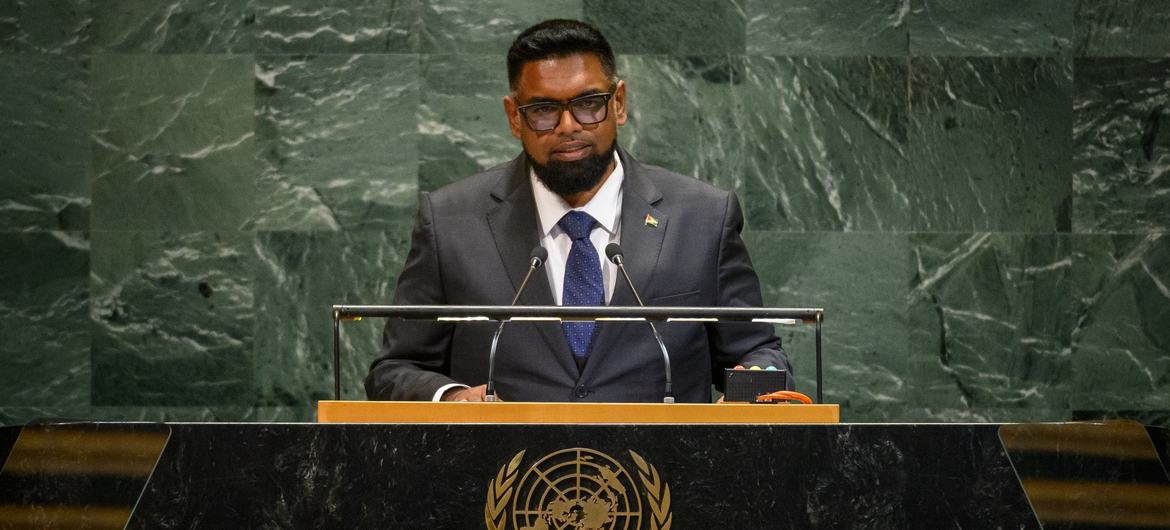
President Mohamed Irfaan Ali of Guyana addresses the general debate of the General Assembly’s eightieth session.

In South America, Guyana’s President Mohamed Irfaan Ali emphasised that climate and development cannot be separated.

He described how his country is protecting forests, strengthening sea defenses and advancing a low carbon development strategy to prove that economic growth can go hand-in-hand with environmental stewardship.

Guyana, he noted, has become a seller of carbon credits under international standards, showing that “nature has tangible value.”

▶ Watch the address.

Marshall Islands – Promises won’t save sinking atolls

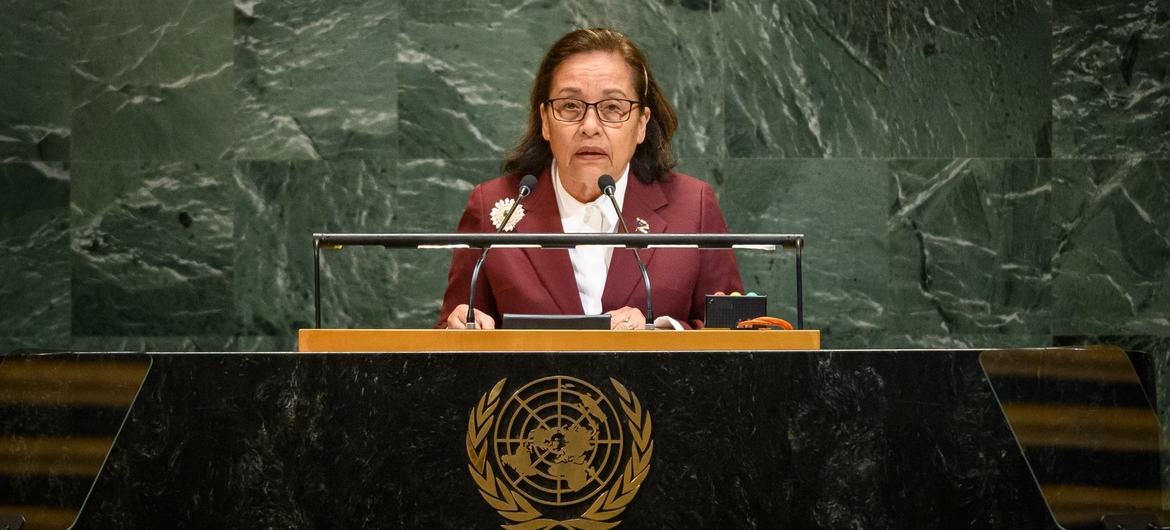
President Hilda Heine of Marshall Islands addresses the general debate of the General Assembly’s eightieth session.

For the Marshall Islands, a Pacific nation of more than 1,200 islands and 29 coral atolls climate change is a question of survival.

President Hilda Heine delivered one of the day’s most urgent interventions, warning that promises alone cannot save sinking atolls.

“We’ve heard the promises – but promises don’t reclaim land in atolls. They don’t develop mangrove defenses, shore up our hospitals and schools against rising seas or preserve cultural stability tied to land that is slipping under waves,” she said.

“Those things require money.”

Ms. Heine pressed the international community to close the trillion-dollar climate finance gap, particularly for adaptation and loss and damage.

As COP30 approaches, she said nations must not only honor their pledges but also deliver stronger plans that show a clear pathway to phasing out fossil fuels and halving global emissions within this decade.

▶ Watch the address.

New national climate plans unveiled at high-level summit ahead of COP30 conference

The game-changing summit was convened by Secretary-General António Guterres alongside President Luiz Inácio Lula Da Silva of Brazil, host of the COP30 conference which kicks off in November in the Amazonian city of Belém.

At the outset, leading climate scientists Johan Rockström and Katharine Hayhoe provided a stark assessment of global efforts so far to honour the Paris Agreement, the landmark 2015 treaty that seeks to limit global temperature rise to 1.5 degrees Celsius above pre-industrial levels.

‘A deep concern’

Ten years on, greenhouse gas emissions that cause global warming continue to rise, and annual global temperature change exceeded 1.5 degrees for the first time last year.

“This is a deep concern,” said Professor Rockström, chief scientist at Conservation International. “An even deeper concern is that warming appears to be accelerating, outpacing emissions.”

Yet it is still possible to meet the1.5-degree goal and the two experts highlighted solutions, including transitioning from fossil fuels to clean energy sources and transforming food systems to eliminate waste. 

We cannot prevent this catastrophe alone. But together, we can. By setting stronger targets, moving on faster timelines, and making deeper commitments,” said Professor Hayhoe, a winner of the 2019 UN Champions of the Earth Prize.

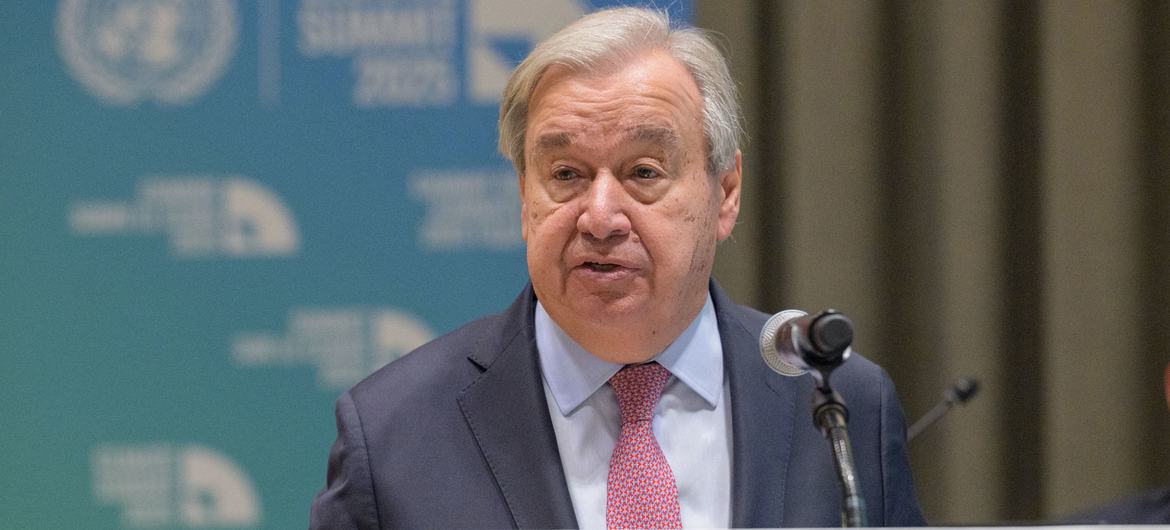
Secretary-General António Guterres addresses the Climate Summit 2025, a high-Level special event on Climate Action.

More action needed: Guterres

Under the Paris Agreement, governments are required to submit climate plans called Nationally Determined Contributions (NDCs) laying out bold action for the next decade.

The treaty has made a difference, the Secretary-General said, as projected global temperature rise dropped from four degrees to less than three over the past 10 years, if current plans are fully implemented.

“Now, we need new plans for 2035 that go much further, and much faster,” he said. “Delivering dramatic emissions cuts aligned with 1.5 degrees; covering all emissions and sectors; and accelerating a just energy transition globally.”

He stressed that COP30 “must conclude with a credible global response plan to get us on track” and outlined five crucial areas for action: accelerating the transition to clean energy, drastically cutting methane gas emissions, forest conservation, cutting emissions from heavy industry, and ensuring climate justice for developing nations.

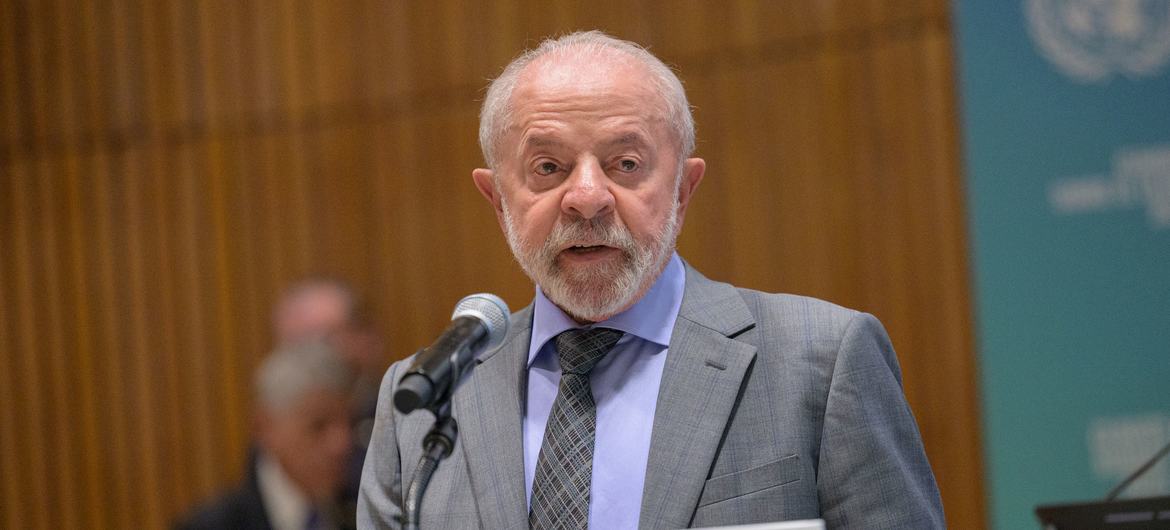
President Luiz Inácio Lula da Silva of Brazil addresses the Climate Summit 2025, a high-Level special event on Climate Action.

Do your ‘homework’, urges Lula

With just a few weeks until COP30, President Lula wondered “whether the world will arrive in Belém with its homework done.”

He said that “the energy transition opens the door to a productive and technological transformation comparable to the Industrial Revolution” and NDCs “are the road map that will guide each country through this change.”

For its part, Brazil has committed to reducing all greenhouse gas emissions between 59 per cent and 67 per cent, covering all sectors of the economy, he said, and continues efforts to end deforestation by 2030.

Commitment from China and Europe

At the meeting, President Xi Jinping of China announced that by 2035, the country will reduce economy-wide net greenhouse gas emissions by seven to 10 per cent from peak levels.  

The country will also increase the share of non-fossil fuels in total energy consumption to over 30 per cent, expand wind and solar power capacity sixfold compared to 2020 levels, and make “new energy vehicles” the mainstream in new vehicle sales, he said in a video message.

Meanwhile, “the clean transition is moving on” in the European Union, where emissions are down nearly 40 per cent since 1990, said European Commission President Ursula von der Leyen. 

European countries are also “doubling down on global partnerships” and will remain the world’s largest providers of climate finance, she said, while also mobilizing up to 300 billion Euros to support the clean energy transition worldwide.

Vulnerable nations ‘between hope and hardship’

For Belize, the 1.5-degree goal “is not an aspiration” but “a threshold between hope and hardship, between flourishing communities and forced displacement, between shared prosperity and irreversible loss,” said Prime Minister Johnny Briceño.

Its new NDC covers concrete actions, such as expanding renewable electricity generation to cover 80 per cent of domestic needs by 2035, restoring some 25,000 hectares of degraded forest, and planting a million trees over the next three years. 

“But let me be clear, ambition can only succeed if matched by support for small climate vulnerable nations like Belize. 

“This means scaled up, predictable finance; accessible technology and genuine partnerships,” he said, noting that “success depends on all of us acting with unprecedented urgency, solidarity and climate justice.” 


Shipping faces ‘stormy seas’ as trade slows and costs rise

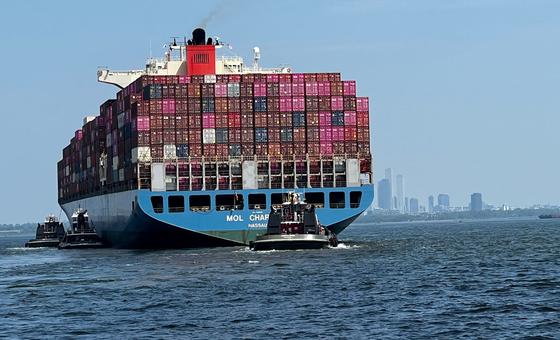
After firm expansion last year, seaborne trade volumes are forecast to rise by just 0.5 per cent in 2025, the slowest pace in years, according to the agency’s Review of Maritime Transport 2025, launched in Geneva.

The slowdown comes as geopolitical tensions, new trade barriers and climate pressures reshape shipping routes, push up costs and expose vulnerabilities in the global economy.

The transitions ahead – to zero carbon, to digital systems, to new trade routes – must be just transitions,” said UNCTAD Secretary-General Rebeca Grynspan. “They must empower, not exclude. They must build resilience, not deepen vulnerability.”

Routes in flux, costs rising

Shipping carries over 80 per cent of the world’s merchandise for export and import, making it a critical barometer of global commerce.

UNCTAD reported that rerouting caused by crises in the Red Sea in 2024 and continuing tensions near the Strait of Hormuz have forced ships onto longer journeys, adding delays and costs.

At the Geneva launch, Regina Asariotis, Chief of UNCTAD’s Trade Logistics Branch, warned that vulnerable economies are paying the heaviest price:

“The global environment has become more complex. Geopolitical tensions are forcing costly reroutings, tariffs are disrupting trade flows, and freight rates are high and volatile.

Small island developing States, least developed countries, and net food importing nations are the most vulnerable, because higher freight costs quickly translate into more expensive imports and food insecurity.”

Ports under pressure

Global ports are struggling with congestion, longer waiting times and the pressure to modernise. UNCTAD highlighted the urgent need to invest in digital systems such as maritime single windows and port community platforms to cut costs and delays.

But many developing countries continue to lag behind in digitalisation. With cyber threats on the rise, the report warns that cybersecurity has become a critical priority for maritime logistics.

Climate challenge

The shipping industry’s greenhouse gas emissions rose by five per cent in 2024, the report said. Yet only eight per cent of the world fleet’s tonnage is currently equipped to use alternative fuels.

The International Maritime Organization will consider a Net-Zero Framework in October, including a global fuel standard and carbon pricing mechanism. UNCTAD says clear regulatory signals, fleet renewal and new fuel infrastructure are vital to reduce emissions.

Human cost at sea

Beyond trade flows and emissions, the report stressed the human toll. Seafarer abandonment cases reached a record high in 2024, leaving crews stranded without pay or support.

Amendments to the Maritime Labour Convention entering into force in 2027 will strengthen rights to repatriation and shore leave, but UNCTAD stressed that effective enforcement is essential.

Policy priorities

The review calls for governments and industry to work together on:

  • Stable trade policies to reduce uncertainty and restore confidence in supply chains;
  • Investment in sustainable, green and resilient port and shipping infrastructure;
  • Faster digitalisation and stronger cybersecurity;
  • Fleet renewal and cleaner fuels; and
  • Support for vulnerable economies to mitigate higher costs.

“Persistent high transport costs risk hitting developing countries the hardest,” Ms. Grynspan said. “Maritime transport must be resilient, inclusive and sustainable if we are to weather the turbulent waters ahead.”

Climate Summit 2025: The path to COP30

The summit, which takes place on 24 September at UN Headquarters, is designed as a launchpad for COP30 but, unlike the sprawling negotiations of a UN climate conference, this is a targeted high-level event where Heads of State, Government leaders, businesses, and civil society are expected to present concrete pledges and new national climate plans. 

‘Bold action for the next decade’ 

According to the organisers, the summit has a clear mandate: parties to the Paris Agreement – the landmark 2015 pledge to climate change treaty – must bring forward new or updated NDCs (Nationally Determined Contributions, or pledges to take measures to address the climate crisis) that reflect “bold action for the next decade.”  

UN chief António Guterres has made it plain: existing pledges are nowhere near sufficient, and only a fraction of member states have up-to-date NDCs for 2025. Current national plans, according to the UNFCCC, would only cut global emissions by 2.6 per cent by 2030 compared to 2019 levels, a tiny fraction of the 43 per cent reduction that scientists say is needed to keep global temperatures to no more than 1.5 degrees Celsius above pre-industrial levels. 

The summit therefore serves as both a pressure point and an opportunity. Leaders are expected not just to restate commitments, but to announce new NDCs, show how they will be implemented, and highlight how they align with the accelerating clean energy transition. 

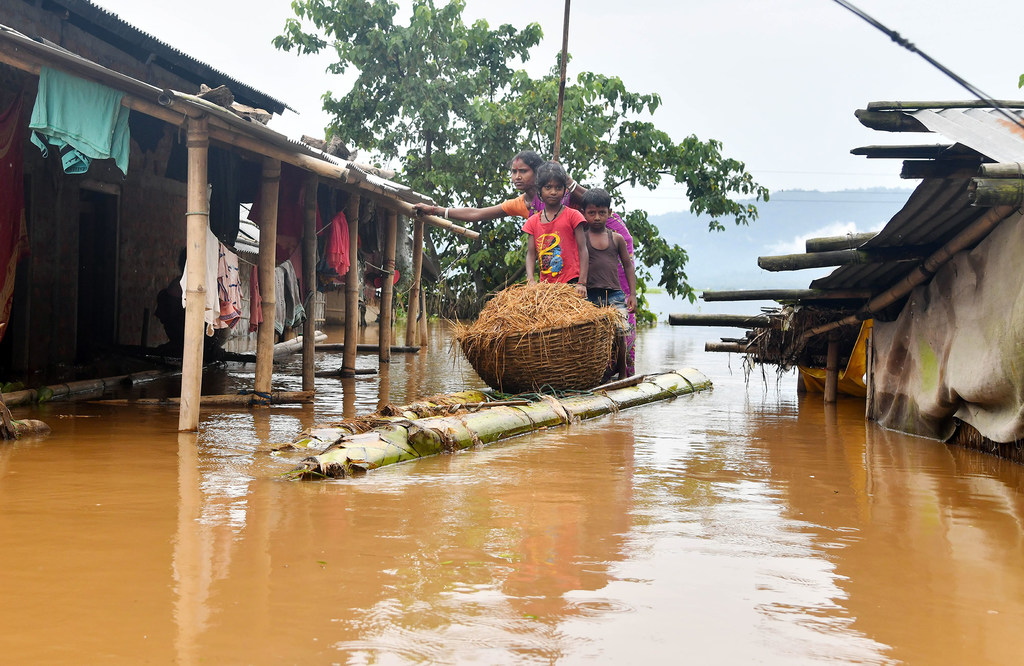
Floodwaters in Morigaon, India (file 2020)

Why Now? 

The urgency of the summit is sharpened by both scientific and political realities. The UN World Meteorological Organization reported that 2024 was the hottest year on record, with average global temperatures 1.6 degrees Celsius above pre-industrial levels. Meanwhile, the international political landscape has grown more fractured. 

The United States, which withdrew from the Paris Agreement in early 2025, remains one of the largest historical emitters. Its retreat from climate finance and clean-energy commitments has left developing nations questioning whether the promised flows of support will materialise. 

At the same time, real momentum exists. Clean energy investment topped $2 trillion in 2024, outpacing fossil fuels for the first time, and initiatives such as the proposed Fossil Fuel Non-Proliferation Treaty are gaining traction. The summit will test whether these positive trends can be harnessed and scaled. 

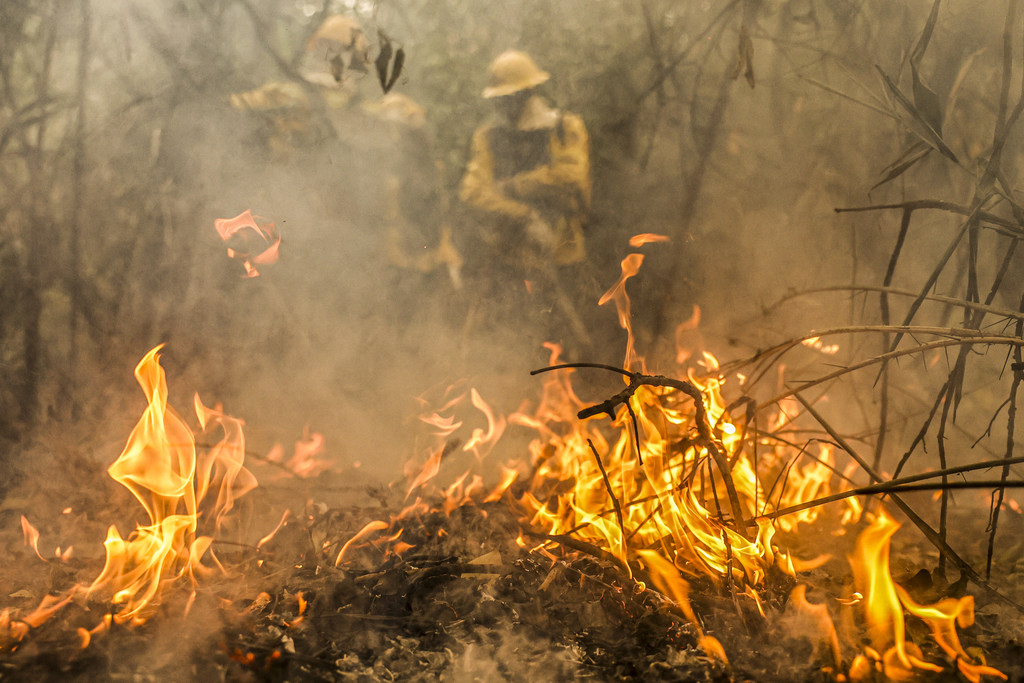
Marcelo Camargo/Agência Brasil

Firefighters in the Pantanal, Brazil (file 2024)

Reading between the lines 

The Climate Summit is not a negotiating session, but its outcomes will set the tone for COP30 in Belém. Brazil has promised to centre that conference on climate justice, forest protection, and renewable energy. Yet success in Belém will depend heavily on what happens in New York this week. 

Observers will watch closely for three signals. First, will major emitters bring plans that close the emissions gap?  Second, is climate finance scaled up beyond symbolic pledges, especially for the Loss and Damage Fund (which has attracted just under $789 million in pledges so far, far short of what is needed)?  And finally, will leaders acknowledge that expanding coal, oil, and gas is incompatible with Paris targets?   

Without progress on these fronts, COP30 risks becoming another forum of unmet expectations. 

High stakes 

For the UN Chief, the summit is about more than process. It is about rebuilding trust in multilateralism at a time when global divides are widening and demonstrating that climate action can unlock economic and social benefits. “The opportunities of climate action have never been clearer,” the UN has stressed, pointing to job creation, health improvements, and energy security linked to clean energy expansion. 

Still, for communities in Pakistan and India displaced by destructive floods, or for farmers in the Horn of Africa facing drought, the summit is less about opportunity than survival. The gap between climate impacts and the political response has never felt wider. 

From words to action 

The UN Climate Summit of September 2025 is not a substitute for COP30, but it may prove just as decisive. It is the arena where leaders can reset ambition, inject credibility, and build momentum toward Brazil. 

If it can deliver bold new pledges, credible finance, and a clear direction on fossil fuels, it could help salvage the promise of Paris. 

Sudan War: Cholera Vaccination Campaign Begins in Darfur

The World Health Organization (WHO)’s Deputy Representative to the country Hala Khudari reported on Tuesday that the outbreak, which started in July 2024 in Kassala, has spread to all 18 states of the country.

More than 113,600 cases have been registered so far and over 3,000 deaths – a “concerning case fatality rate” of 2.7 per cent.

Speaking from Port Sudan, she said that the past year saw surges in White Nile and Khartoum among other states, resulting from the impact of the conflict and increased population movement. This critical situation has been compounded by severely limited basic services such as water, food and health, caused by ongoing heavy fighting between the Sudanese army and the paramilitary Rapid Support Forces.

Cholera is an acute intestinal infection that spreads through bacteria-contaminated food and water. According to WHO, it can kill within hours when not treated, and case fatality rates above one per cent indicate “serious gaps in case management and delayed access to care”.

Conditions ripe for disease

The resurgence of cholera in Sudan has been fuelled by heavy rains and flooding, overcrowding and lack of access to clean water in displacement sites and within communities.

In the Darfur region, where cholera has been spreading since May, the number of cases continues to increase amid “severe access constraints” which are impeding the response, including inaccessible roads due to the rainy season, Ms. Khudari said. As of two days ago 12,739 cases and 358 deaths were reported in more than half of all the localities of the five Darfur states.

In certain localities in West Darfur, the case fatality rate has been as high as 11.8 per cent, she said.

Ms. Khudari explained that WHO and partners have been working to control the outbreak with a vaccination campaign in the worst-hit communities. It began last Sunday “after weeks of preparations to overcome access, transport and logistical challenges”.

The campaign aims to protect 1.86 million people in six priority localities of the Darfurs.

The WHO representative said that the “biggest challenge” in launching the campaign was to “actually get the vaccines there”. She described the difficulties in delivering the life-saving immunizations and supporting supplies via “long routes” to Nyala in South Darfur state earlier this month, amid ongoing security concerns.

El Fasher survivors

Preparations are ongoing to launch the campaign by the end of September in Tawila in North Darfur State, which hosts more than 575,000 internally displaced people, most of whom have fled from the besieged city of El Fasher.

The vaccines are being deployed in Sudan with the support of the UN Children’s Fund (UNICEF), whose spokesperson Ricardo Pires raised the alarm over the severe risks of cholera for children.

Children under five have been “disproportionately affected”, he told reporters, and so far at least 380 have died.

Access to life-saving treatment for cholera in Sudan is limited as the almost two-and-a-half-year-old violent conflict has devastated the health system.

The outbreak comes at a time when “more than 70 per cent of hospitals in conflict-affected areas are non-operational, with health centres being damaged or destroyed during the conflict, lacking supplies and even staff, as well as facilities being often used as shelter,” Mr. Pires stressed.

The UNICEF spokesperson also underscored the impact of “relentless” attacks on the country’s power and water infrastructure which have off cut millions of people including many children from safe and clean water, forcing families to collect water from unsafe and contaminated sources.


France Joins UK, Canada, Australia and Portugal in Recognising Palestinian Statehood

France joins UK, Canada, Australia and Portugal in recognising Palestinian statehood at UN-backed conference

United Nations/New York: UN Secretary-General António Guterres on Monday reiterated that nothing can justify the October 7, 2023 Hamas attacks on Israel, nor the “collective punishment” inflicted on the Palestinian people in their aftermath. Calling for an “immediate” ceasefire in Gaza, he urged the release of all hostages and the opening of safe, unconditional and unhindered humanitarian corridors.

Speaking at the resumed international conference on Palestine, co-chaired with Saudi Arabia, Guterres warned that the viability of a two-state solution is being undermined by “relentless” settlement expansion, the “creeping threat of annexation” and a surge in settler violence in the West Bank.

“The time for peace has come because we are just a few moments away from no longer being able to seize peace,” he told delegates. “Let’s be clear: statehood for the Palestinians is a right, not a reward. Denying it would be a gift to extremists everywhere.”

France Backs Palestinian Statehood

The conference, held after the General Assembly overwhelmingly endorsed the first phase outcome declaration in July, saw fresh diplomatic momentum. The United Kingdom, Canada, Australia and Portugal formally recognised the State of Palestine on Sunday. French President Emmanuel Macron announced that Paris would follow suit, a declaration that drew lengthy applause.

“The recognition of the legitimate rights of the Palestinian people takes nothing away from the rights of the people of Israel, which France has supported from Day One,” Macron said. “This recognition is the only solution that will allow Israel to live in peace.”

Saudi Foreign Minister Faisal bin Farhan Al Saud praised the countries that had recognised Palestine and urged others to “take a similar historic step.” Such recognition, he said, would “support efforts towards the implementation of the two-State solution, achieve permanent and comprehensive peace in the Middle East, and create a new reality of stability and prosperity.”

ALSO READ: London’s Far-Right Rally Sends Shockwaves Through South Asian Communities

UN General Assembly President Annalena Baerbock acknowledged scepticism around the two-state formula, noting that the UN’s earliest resolutions on the issue date back to its founding years. But she stressed that pursuing the alternative would mean conceding to “evil” and risk “the end of this institution.”

“This is not a naïve wish,” Baerbock insisted. “The international community is committed not only to the principle of two states but to identifying tangible, timebound and irreversible steps for its realisation, backed by decisive measures and international guarantees.”

The conference underscored a growing shift among Western powers towards recognising Palestinian statehood, even as conditions on the ground remain volatile. For Guterres and other leaders, the message was clear: without urgent steps, the two-state solution risks slipping out of reach, with grave consequences for peace and security in the Middle East and beyond.

Palestine Issue Dominates UNGA, Overshadowing Other Global Crises

The question of Palestine has taken centre stage at the United Nations, overshadowing the annual high-level week of the General Assembly where world leaders traditionally outline their global visions from the iconic green marble podium.

Even as wars rage in Ukraine and elsewhere, and the UN itself confronts crises on its 80th anniversary, the Palestinian statehood debate has seized the spotlight. A summit on Palestine is set for Monday, a day before the formal opening of the high-level session.

The momentum accelerated on Sunday when Britain and several other Western nations announced formal recognition of Palestine. France, co-convening Monday’s summit with Saudi Arabia, is expected to follow suit, joining 152 of the UN’s 193 member states — including India — that already recognise Palestinian statehood.

US Denies Visa to Palestine President

Yet, Palestinian President Mahmoud Abbas will not attend in person. The US denied him a visa, forcing the Assembly to vote on allowing him to speak remotely. In a striking show of support, 145 countries backed the move, with only the US, Israel and three others opposed, and six abstentions.

The strong endorsement reflects the growing tide of sympathy for Palestinians amid Israel’s offensive in Gaza, where nearly 75,000 people — most of them civilians — are reported killed. Israeli Prime Minister Benjamin Netanyahu has further inflamed tensions by vowing to expand Jewish settlements in the West Bank.

Still, the surge of recognition will remain largely symbolic. The US is expected to veto any Security Council bid for full UN membership, while Netanyahu appears unmoved by international censure.

Beneath the headlines, the UN faces its own existential questions. Secretary-General Antonio Guterres had hoped the 80th anniversary would spotlight his UN80 reform agenda, “Shifting Paradigms: United to Deliver”, which seeks to streamline the body’s work around peace and security, sustainable development and human rights. The official theme of this year’s high-level week, “Better Together: 80 Years and More for Peace, Development and Human Rights,” reflects that ambition.

ALSO READ: Canada, Australia and UK Recognise Palestine’s Statehood, Palestine Welcomes

But enthusiasm is tempered. The UN confronts a severe financial crunch, worsened by US President Donald Trump’s threat to cut Washington’s contributions, and global confidence in the institution has waned, a recent poll found only 58% of people worldwide still trust it.

Modi Skips This Year’s Gathering

Adding to the uncertainty, key global leaders, Prime Minister Narendra Modi, Russian President Vladimir Putin and Chinese President Xi Jinping, are skipping this year’s gathering.

By tradition, Brazil will open the debate, with President Luiz Inácio Lula da Silva barely making it to New York after US visa complications hit members of his delegation. Trump will follow, also by tradition, and his speech is expected to set the tone, given his confrontational trade policies and geopolitical brinkmanship.

Meanwhile, real diplomacy will unfold on the sidelines, in bilateral and multilateral meetings aimed at navigating the increasingly unpredictable Trump era.

Representing India, External Affairs Minister S. Jaishankar began his diplomatic outreach on Sunday with a meeting with Philippine Foreign Secretary Theresa Lazaro. She later posted on X that the discussion “reaffirms our 2 countries’ commitment as Strategic Partners to actively develop cooperation in political, defence and security, the maritime domain, etc.”

As the General Assembly opens, the world’s attention may officially be on the UN’s 80th anniversary, but it is Palestine’s long-contested statehood that is commanding the spotlight.

Canada, Australia and UK Recognise Palestine’s Statehood, Palestine Welcomes

Palestine has hailed the coordinated move by Canada, Australia and the United Kingdom to formally recognise it as an independent and sovereign state, calling the decision a step in line with international law and legitimacy resolutions.

In a statement shared on X, Palestine’s Mission to the United Nations said its Ministry of Foreign Affairs “welcomes and expresses gratitude” to the three countries for what it described as “courageous decisions” that affirm the Palestinian right to statehood.

The recognition was announced on Sunday in synchronised declarations from Ottawa, Canberra and London, marking a significant diplomatic shift aimed at reviving prospects for a two-state solution in the Middle East.

Australian Prime Minister Anthony Albanese and Foreign Minister Penny Wong, in a joint statement, said recognition was effective immediately and underscored Australia’s “longstanding commitment” to the two-state framework. “Australia recognises the legitimate and long-held aspirations of the people of Palestine to a state of their own,” they said, adding that the move was tied to international efforts to secure a Gaza ceasefire and the release of hostages taken during the October 7, 2023 attacks.

Palestine Authority pledges reforms

They stressed that the Palestinian Authority had renewed its recognition of Israel’s right to exist and pledged reforms in governance, elections, finance and education, while making clear that Hamas would have “no role in Palestine.”

UK Prime Minister Keir Starmer echoed that position in a video message, saying Britain’s recognition was intended to “revive the hope of peace for Palestinians and Israelis” and to lay the ground for renewed dialogue.

Canadian Prime Minister Mark Carney, in a statement, sharply criticised Israel’s current policies, accusing its government of systematically blocking Palestinian statehood through settlement expansion and a prolonged military campaign in Gaza. He said Canada’s recognition was rooted in “principles of self-determination and fundamental human rights” and aligned with Ottawa’s longstanding foreign policy traditions.

“This recognition is not a panacea,” Carney cautioned, “but it is a necessary step to preserve the possibility of a two-state solution and to help build the promise of a peaceful future for both Israel and Palestine.”

The joint move by three major Western powers is expected to intensify international pressure on Israel, which has consistently opposed recognition of Palestinian statehood outside a negotiated settlement.

The Great American Dream Now Carries a Steep Price Tag

The American dream, long pursued by Indian engineers and graduates, has suddenly become costlier. A new proclamation by US President Donald Trump has imposed a $100,000 annual surcharge on H-1B visa applications, sending shockwaves through India’s education and technology sectors.

The fee hike strikes hardest at early-career professionals. With median salaries for computer science graduates in the US ranging between $65,000 and $80,000, employers say the surcharge makes it unviable to sponsor young hires. Immigration experts warn approvals may now be limited to senior, high-value executives.

“Effectively, this closes the door for younger engineers who once formed the backbone of US tech companies,” said a New Delhi-based consultant. “The future Satya Nadellas or Sundar Pichais may never get the chance to begin that journey.”

India Bears the Brunt

Nearly 70% of all H-1B approvals go to Indian nationals, far ahead of other countries. Estimates suggest about 442,000 Indians currently hold these visas, mainly in software, data, and AI roles. Lawyers say the new levy acts as a filter, concentrating approvals among elite profiles at multinationals while squeezing out recruits from mid-tier outsourcing firms.

Education consultants in India report growing anxiety among families weighing the cost of US degrees with uncertain career pathways. IT giants, traditionally the largest H-1B sponsors, are now recalibrating staffing strategies. “Expect a pivot to offshore delivery hubs in Bengaluru, Hyderabad, and even Mexico,” noted a Mumbai-based strategist.

A Gold Card for the Wealthy

In contrast, Trump has unveiled a “Gold Card” programme for wealthy foreigners. Those donating $1 million individually, or $2 million corporately, can secure expedited immigrant visas. Critics call it a system skewed toward the rich.

“This is meritocracy turned on its head,” said a Washington policy analyst. “The message is clear — the middle class faces barriers, while the wealthy can buy their way in.”

The administration defends the move citing job data. A Federal Reserve Bank of New York study showed unemployment rates of 6.1% among computer science graduates and 7.5% among computer engineering graduates aged 22–27 — double the rates in some non-technical fields. Underemployment, too, was high at over 16%.

Officials argue the US produces enough technical graduates and must prioritise domestic hiring. But industry leaders caution that layoffs and restructuring in 2023–24, coupled with AI-driven changes, have already reshaped demand. Companies still require talent but may now prefer to keep it offshore.

The H-1B pipeline has historically powered both corporate America and Indian aspirations. It gave US firms cost-efficient talent and helped create communities of Indian origin that flourished across industries. Analysts warn that shutting this route will choke the next generation of global leaders.

“A country that once opened its doors to talent is now signalling that opportunity is for the wealthy, not the aspiring,” said a senior Indian IT executive.

H-1B Fee To Apply Only For New Petitions, Not Renewals, Says White House

The White House has clarified that the newly announced $100,000 H-1B visa fee will apply only to fresh petitions, not to renewals or current visa holders. “This is a one-time fee that applies only to new visas. It will first be levied in the next lottery cycle,” a senior official told Indian media on Saturday.

White House spokeswoman Taylor Rogers said the intent was to curb misuse by firms filing mass petitions. “This action discourages spamming the system and ensures fairness for American workers,” she added.

President Donald Trump, who signed the proclamation on Friday, said the measure would ensure companies considered local talent first. “We need workers, we need great workers — and this ensures that,” he remarked.

Commerce Secretary Howard Lutnick defended the steep cost, saying it would push firms to train domestic graduates instead of over-relying on foreign hires. “It’s just not economic to keep bringing in people when we have skilled graduates here,” he said.

The US issues about 85,000 new H-1B visas annually, with India-born professionals accounting for nearly three-fourths of approvals in 2023. The fee announcement has sparked unease in India’s IT industry, which depends heavily on the program to deploy skilled staff in the US. Experts warn the new costs may force firms to rethink business models or raise client fees.

‘Warring world crying out for peace’ says UN chief as leaders gather in New York

UN Secretary-General António Guterres has called for a renewed global push to end wars and divisions, stressing that “peace cannot wait” as the world observes the International Day of Peace.

“Lives are being ripped apart, childhoods extinguished, and basic human dignity discarded, amidst the cruelty and degradations of war,” Mr. Guterres said in his message for the Day. “All they want is peace.”

He noted that modern conflict is no longer confined to battlefields, with its consequences spilling across borders, driving displacement, poverty, and instability. “We must silence the guns. End the suffering. Build bridges. And create stability and prosperity,” he urged.

Theme Calls for Collective Action

The International Day of Peace was first established by the UN General Assembly in 1981 as a day devoted to non-violence and ceasefire. This year’s theme, Act Now for a Peaceful World, emphasizes the need for urgent action to prevent conflicts, counter hate and disinformation, and strengthen peacebuilding efforts, particularly through the involvement of women and young people.

Mr. Guterres underscored the close relationship between peace and sustainable development, pointing out that nine of the ten countries lagging most in development are also plagued by conflict. He warned against racism and dehumanisation, advocating instead for “the language of respect” and dialogue.

The observance comes on the eve of the UN General Assembly’s annual high-level week, where leaders from across the world gather in New York to debate pressing global challenges, from ongoing wars and climate disruption to gender equality and the risks and opportunities posed by artificial intelligence.

“The timing underlines the need for a concerted international push for peace, as divisions widen and instability grows,” the Secretary-General said. Concluding his message, he reminded nations and communities alike: “Where we have peace, we have hope. Peace cannot wait — our work starts now.”

UNDP: Peace and Development Intertwined

In a statement issued the same day, UNDP’s Acting Administrator Haoliang Xu stressed that peace is the foundation of development. Xu highlighted that in 2024, governments spent approximately US$2.7 trillion on military budgets, while only a small fraction—about US$47.2 billion, was allocated to peacebuilding and prevention efforts.

UNDP further argued that development actors are crucial partners in stabilisation: by investing in justice, governance, and inclusive institutions, and by supporting women and youth roles in conflict-affected regions, peace becomes more durable.

Civil Society Voices

Labour unions, non-governmental organisations, and other civil society actors underscored that peace is not simply the absence of war but requires fairness and equality.

For example, Unifor, a large Canadian trade union, released a statement affirming that peace must rest on dignity, justice, and human rights. The union observed that civilians—in particular workers, health care personnel, families, children—bear disproportionate burden during conflicts. Unifor called for ceasefires, de-escalation of violence, and increased support for humanitarian and development agencies.

These actors also spoke out against trends of rising militarisation at the expense of essential services—health, education, housing—and warned that neglect in these areas undermines long-term peace and stability.

Beyond the UN Secretariat and civil society, organisations that represent countries or regions emphasised that peace must go hand in hand with democracy, human rights, and inclusion.

The Community of Democracies (CoD) reaffirmed its commitment to the UN’s Sustainable Development Goals (SDGs), particularly SDG 16 (peace, justice, and strong institutions). Its Secretary-General Thomas E. Garrett stressed that sustainable peace requires the meaningful participation of women, youth, and marginalized groups, and that democratic governance bolsters efforts toward reconciliation and enduring peace.

Several member states (implicitly through these organisations and joint statements) echoed that investing in peace-building, prevention, and inclusive development is not merely moral but pragmatic: peace is foundational to stability, prosperity, and human wellbeing.

Also Read: London’s Far-Right Rally Sends Shockwaves Through South Asian Communities

Thai Woman in US Targeted in Sophisticated Phone Scam Involving Fake Embassy, Police Officials


A Thai national living in the United States was recently lured into an elaborate phone scam after receiving a call from fraudsters posing as embassy staff and police officers, who falsely accused her of being linked to an international money laundering case.

Wannapa Suprasert, known as Bow, said the ordeal began when she received a call from a woman claiming to be from the Thai Embassy in Washington, D.C. The caller alleged that her recently renewed passport had been misused, putting her at risk of identity theft.

The call was then transferred to a man who introduced himself as an officer from Thailand’s Central Investigation Bureau in Bangkok. He demanded personal identification documents, bank details, and financial records, claiming these were necessary for an investigation.

“They made a threat that they would be tapping my phone. The mind is very powerful because once you’re in that delusion, I guess I couldn’t think clearly and I was just very concerned about my family safety,” Ms. Suprasert recalled.

The situation escalated when she was told she was the prime suspect in an international money laundering scheme. The alleged officer demanded that she prove her innocence by transferring funds from her bank account to theirs, with the assurance that the money would be returned after a “deeper investigation.”

“They promised to give it back. I didn’t quite understand because I thought I could just send them my pay stub and they could see I earned the money legally in the US,” she said.

Shaken but suspicious, Ms. Suprasert attempted to call the Thai Embassy directly to confirm the claim. However, as it was late Friday afternoon in San Francisco and the embassy on the East Coast had closed for the day, she was unable to verify the information immediately.

Only later did she realize that the scammers had deliberately timed their call to exploit the time zone gap and her inability to reach officials.

Authorities worldwide have repeatedly warned about such scams, in which fraudsters impersonate embassy or law enforcement officials to extort money. Victims are often told they are under investigation and face jail time unless they comply with demands.

Sophisticated sting

“I guess the story just kind of built from there and that’s how I ended up sending five wires totaling over $300,000,” she said.

Bow fell victim to a sophisticated operation which according to the UN Office on Drugs and Crime (UNODC) is being increasingly adopted by international organized crime networks to con the unsuspecting out of thousands of dollars.

UNODC said that the transnational organized crime groups in Asia which carry out these types of scams are expanding their operations deeper into the region and far beyond.

“We are seeing a global expansion of East and Southeast Asian organized crime groups,” said Benedikt Hofmann, UNODC Acting Regional Representative for Southeast Asia and the Pacific.

“This reflects both a natural expansion as the industry grows and seeks new ways and places to do business, but also a hedging strategy against future risks should disruption continue and intensify in the region,” he added.

ALSO READ: London’s Far-Right Rally Sends Shockwaves Through South Asian Communities

The three-month-long scam that Bow endured resulted not just in the loss of over $300,000 but also intense emotional despair which led to depression, sleepless nights and nightmares.

Bow has come to terms with the reality that she will not get her money back. There is nothing US law enforcement can do to recover the funds, and she decided against hiring a private investigator. In going public with her story, she hopes that others can learn from her experience.


GST 2.0 Rollout Leaves Key Categories Unchanged Despite Major Rate Overhaul

The Goods and Services Tax (GST) 2.0 regime, set to come into force on September 22, 2025, will bring sweeping changes to India’s indirect tax system, but several key items will remain untouched.

The 56th GST Council meeting, chaired by Finance Minister Nirmala Sitharaman, approved a restructuring of the tax slabs by merging the 12% and 28% brackets into two simplified rates of 5% and 18%. A new 40% de-merit slab has been created for luxury and sin goods, while essentials such as food staples will continue at a nil (0%) rate.

However, certain categories have been deliberately kept out of the reform. Precious metals such as gold, silver, and jewelry remain taxed at 3%, while items already aligned with the new structure, such as fresh produce at 0% and mobile phones at 18%, are unchanged. Sin goods like cigarettes, bidis, and chewing tobacco will continue under the existing 28% plus compensation cess until state borrowing obligations are cleared, delaying their eventual shift to 40%.

Essentials Hold Steady
Unpacked grains, milk, eggs, fruits, vegetables, salt, and sanitary napkins will continue to be exempt. “Maintaining the 0% slab for daily-use essentials ensures no additional burden is placed on lower-income households,” an official said, citing affordability as a key reason for stability.

Industry bodies have broadly welcomed the move. The Federation of Indian Chambers of Commerce and Industry (FICCI) described GST 2.0 as “a long-awaited simplification,” while the Confederation of Indian Industry (CII) noted that unchanged rates on electronics and telecom services could limit the broader consumption stimulus.

Key Unchanged Items Under GST 2.0

Slab Item/Category Old Rate (%) New Rate (%)
0% Fresh fruits, vegetables, unpacked grains, milk, eggs, salt, sanitary napkins 0 0
3% Gold, silver, precious stones, jewelry 3 3
5% Sugar, tea, coffee (unpackaged), edible oils, spices (unpackaged), electric vehicles 5 5
18% Mobile phones, laptops, liquid handwashes, telecom services, banking services, hotel rooms above ₹7,500/night 18 18
28% + Cess Cigarettes, bidis, chewing tobacco, pan masala 28 + Cess 28 + Cess

Experts say the unchanged slabs reflect the government’s balancing act. While over 375 items are set to become cheaper from Monday, holding certain categories steady protects tax revenues. “This is a pragmatic approach. It brings relief for households without undermining state finances,” said a tax policy analyst.

Retailers expect the steady rates to keep prices predictable during the festive season. While reduced categories may drive consumer spending, unchanged rates on sin goods and gadgets ensure revenue streams remain intact.

However, billed as a “Diwali gift” for the middle class, GST 2.0 offers simplification and relief, even as debates continue over deferred hikes on tobacco and other de-merit products.

UN ‘high seas’ treaty clears ratification threshold, to enter into force in January

Morocco and Sierra Leone joined the list of States ratifying on Friday, becoming the 60th and 61st parties to the pact.

The treaty, formally known as the Agreement under the United Nations Convention on the Law of the Sea on the Conservation and Sustainable Use of Marine Biological Diversity of Areas beyond National Jurisdiction (BBNJ agreement), was adopted by UN Member States in June 2023 after nearly two decades of negotiations.

Secretary-General António Guterres welcomed the development, calling it a “historic achievement for the ocean and for multilateralism…  In two years, States have turned commitment into action – proving what is possible when nations unite for the common good,” he said in a statement.

“As we confront the triple planetary crisis of climate change, biodiversity loss, and pollution, this agreement is a lifeline for the ocean and humanity.”

The pact, also called the “high seas treaty,” covers two-thirds of the world’s ocean area that lies beyond national boundaries. It establishes legally binding rules to conserve and sustainably use marine biodiversity, share benefits from marine genetic resources more fairly, create protected areas, and strengthen scientific cooperation and capacity building.

UN Environment Programme (UNEP) Executive Director Inger Andersen also hailed the milestone. “Our ocean is the foundation of our very existence. Today we took an important step forward to save our ocean, and to save our future,” she said in a post on social media.

Safeguarding humanity’s future

The BBNJ agreement builds on the UN Convention on the Law of the Sea, regarded as the “constitution for the oceans.”

Once the high seas treaty enters into force on 17 January 2026, it will provide a global framework to help achieve international biodiversity targets, including the pledge to protect 30 per cent of land and sea areas by 2030 under the Kunming-Montreal Global Biodiversity Framework.

Mr. Guterres urged all remaining UN Member States to join the treaty without delay and called on partners to support its swift and full implementation. “The ocean’s health is humanity’s health,” he said.

ALSO READ: London’s Far-Right Rally Sends Shockwaves Through South Asian Communities

What to know ahead of Sept 22 UN summit on Palestine

Held on the opening day of the UN General Assembly’s high-level week, the annual September gathering of world leaders, the initiative comes amid a deeply worrying regional backdrop of  intensified Israeli military operations that have allegedly killed more than 60,000 people in Gaza since October 7, 2023, Israel’s strikes against Hamas officials in Qatar on September 9, and accelerating settlement expansion in the West Bank.

Despite the volatile regional context, the two-state solution is regaining diplomatic traction. On September 12, the General Assembly adopted by a wide margin the “New York Declaration,” following a July conference also co-hosted by France and Saudi Arabia. It called for “just and lasting peace grounded in international law and based on the two-state solution.”

To end the war, it urged Hamas to “end its role in Gaza, and handover its weapons to the Palestinian Authority.” The United States and Israel, which had boycotted the July conference, voted against the text.

The September 22 summit will likely build on that momentum, French President Emmanuel Macron is expected to announce France’s recognition of the State of Palestine, and several other Western countries, including the UK, Canada, Belgium, and Australia, are reportedly considering following suit.

In short, the summit’s impact could inject new momentum into efforts to establish a UN roadmap towards two states.

ALSO READ: London’s Far-Right Rally Sends Shockwaves Through South Asian Communities

Fragile progress in Syria, at risk from exclusion and foreign interference, UN warns

They warned that foreign military action, political exclusion and dwindling resources threaten to undo fragile gains.

UN Special Envoy Geir Pedersen – who announced that he will be stepping down from his role during the meeting – told ambassadors that interim authorities in Damascus have inherited “not just the ruins of shattered buildings, but the deeper wreckage of a battered social fabric, decayed institutions and a hollowed-out economy.

He stressed that the success of Syria’s transition will depend on political stability, inclusivity and international support at a scale commensurate with the country’s needs.

“The international community must support Syria and robustly stand against foreign intervention,” he said. “But equally: the success of the transition will above all rest on the State acting as a State for all, not just in word but also in deed.

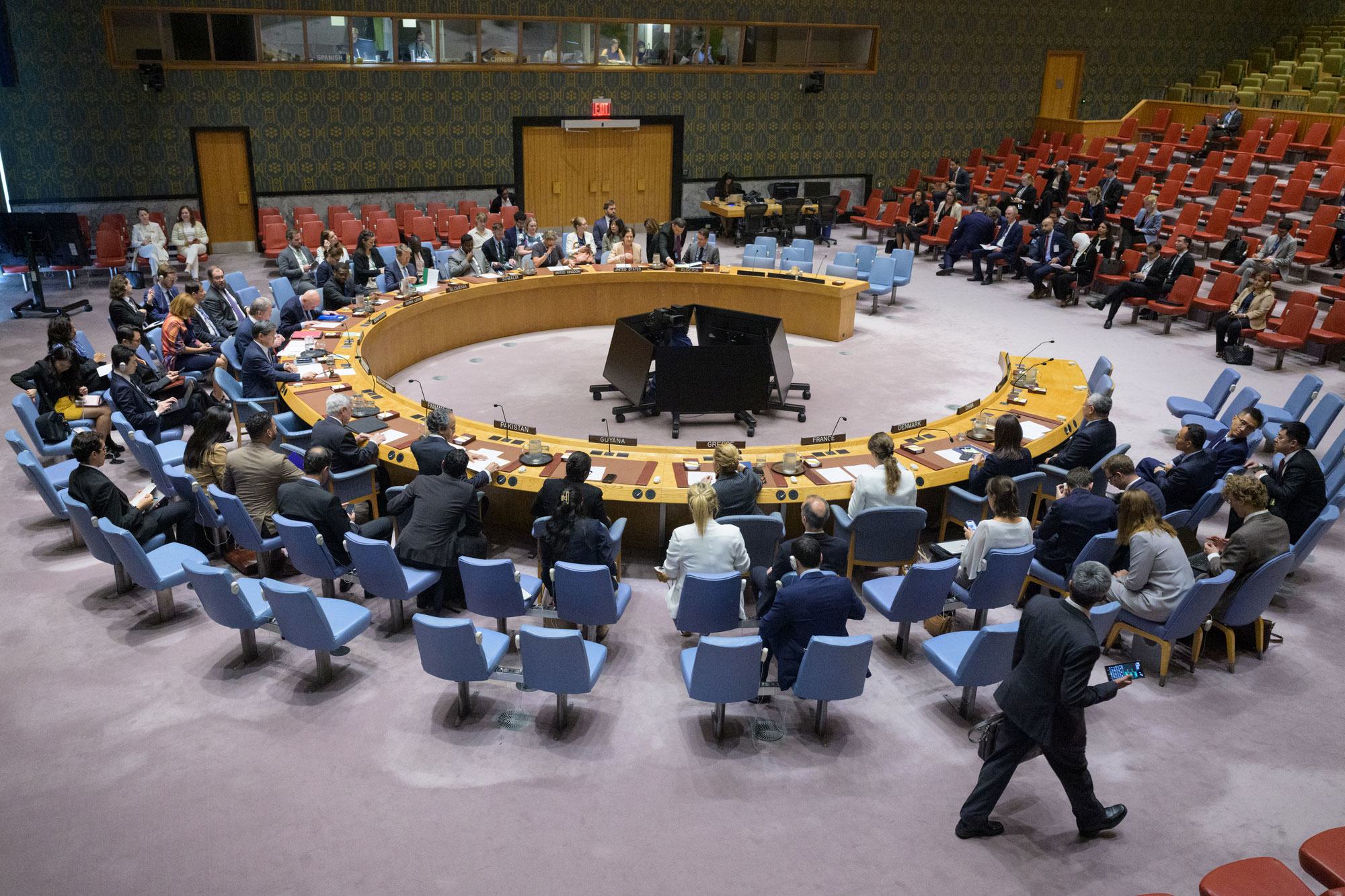
Geir Pedersen, Special Envoy of the Secretary-General for Syria, briefs the Security Council meeting on the situation in the country.

Call to bar interlopers

Mr. Pedersen urged respect for Syria’s sovereignty and territorial integrity amid ongoing external military action, including further reported Israeli strikes this month.

Any security concerns, he said, must be addressed through diplomacy, warning that mishandling them could leave Syria “indefinitely gridlocked, unable to heal or rebuild – and at worst, slipping into fresh waves of strife and external intervention.”

He pointed to the Druze-minority region of Sweida – where a ceasefire following brutal clashes has largely held since July – and welcomed a roadmap agreed last week by Syria, Jordan and the United States to address accountability, humanitarian access and reconciliation.

But he cautioned that fears within the Druze community must be addressed through dialogue and confidence-building.

He also highlighted reports of abuses in Damascus neighbourhoods and calls for accountability in Sweida – and along the coast following sectarian violence there.

The Syrian public needs to see that abuses are both acknowledged and addressed in accordance with international standards,” he said.

Humanitarian emergency continues

Speaking alongside Mr. Pedersen, UN Emergency Relief Coordinator Tom Fletcher described Syria as “one of the largest humanitarian emergencies globally.

More than 70 per cent of the population requires some form of aid, nine million are acutely food insecure seven million remain displaced inside the country and four million refugees abroad.

Despite these figures, he highlighted signs of progress. Thanks to more practical engagement with the interim authorities, aid is now reaching communities inaccessible a year ago.

Movements that last year would have required lengthy navigation of frontlines are happening routinely,” Mr. Fletcher said, citing food assistance for one million people each month and subsidized bread for two million more.

Nearly 900,000 refugees and 1.9 million internally displaced people have returned to their communities since December, though many face destroyed housing, lack of jobs and insecurity.

Funding gaps remain

Funding gaps however threaten these gains, with the UN’s humanitarian appeal for Syria only 18 per cent funded. The shortfall has forced closures of hospitals, safe spaces for women and community centres.

Just when organizations are seeking to expand their operations and have the opportunity to work more efficiently, they are instead forced to cut programmes, reduce support, lose staff,” Mr. Fletcher warned.

The UN Security Council meets to discuss the situation in Syria.

‘Unity is within reach’

Both officials warned that Syria’s fragile moment of progress could easily unravel.

“If this central challenge is mishandled, the consequences could be dire,” Mr. Pedersen cautioned. “But if met with genuine negotiation and bold compromise, unity is within reach and success against the odds is possible.

Mr. Fletcher echoed that message, urging Member States to “preserve stability, fund the humanitarian response and enable Syrian-led recovery.

“This time next year,” he added, “I want to report that we are substantially scaling down our emergency humanitarian operations in Syria – not because funding cuts have forced our hand, but because the international community has made the necessary investments in Syria’s future.”

Healing the ozone layer: ‘Guided by science, united in action’

Last century, scientists confirmed the alarming reality of a significant depletion in the ozone layer – an invisible shield of gas which surrounds the earth and protects it from the sun’s UV rays.

The collection of ozone-depleting substances included CFCs, or chlorofluorocarbons, which in the mid-1980s were commonly found in everyday products such as air conditioners, fridges and aerosol cans.

Science led to global action. Realising that harmful UV radiation was entering the atmosphere through what was potentially a damaged ozone layer, countries made a commitment under the Vienna Convention in 1985, to do what was needed for the protection of the people and the planet.

The Vienna Convention and its Montreal Protocol became a landmark of multilateral success,” said the UN Secretary General António Guterres in a message for this year’s World Ozone Day.

“Today, the ozone layer is healing,” he said.

What is the Vienna Convention?

Forty years ago, countries came together to take the first step in protecting the ozone layer, “guided by science, united in action,” the UN chief continued.

The Vienna Convention for the Protection of the Ozone Layer, adopted and signed by 28 countries on 22 March 1985, formalised universal cooperation over the protection of the fragile ozone layer.

It is the first treaty to be signed by every country in the world and the precursor to the Montreal Protocol.

The objective of the Montreal Protocol is to monitor the global production and consumption of substances that deplete the ozone layer – and eventually eliminate them.

Multilateralism at its best

In a video message, Inger Andersen, Executive Director of the UN Environment Programme (UNEP), highlighted that through action under the conventions “ozone depleting substances have now been virtually eradicated and the hole in ozone layer is closing.”

After scientists sounded the alarm, countries, nations, and businesses came together and took action for the planet.

“That is multilateralism at its very, very best,” she added.

The Montreal Protocol has been progressing well in both developed and developing countries with most phase-out schedules – the time given for each country to gradually stop the production of harmful substances – adhered to or even surpassed.

This achievement reminds us that when nations heed the warnings of science, progress is possible,” remarked Mr. Guterres.

Next in line, the Kigali Amendment

In his message, Mr. Guterres urged governments to ratify and implement the Kigali Amendment to the Montreal Protocol, which commits to phase down, or reduce, hydrofluorocarbons (HFCs), greenhouse gases used mainly in cooling technologies.

“Implementing the Kigali Amendment could avoid up to 0.5 degrees Celsius of warming by the end of the century,” he said. “Paired with energy-efficient cooling, we could double these gains.”

As outlined in the Paris Agreement, countries have agreed to try and limit the rise of global temperature to 1.5 degrees Celsius.

“On this World Ozone Day, let’s recommit to preserving our ozone layer and to protecting people and planet for generations to come,” the UN chief said. 

Thirsty and starving, Gazans face ‘inhumane’ evacuation; UNICEF

The development followed reports that the Israeli military has stepped up its ground offensive in Gaza City, ordering residents to leave the area.

Speaking from the south of the enclave, UNICEF’s Tess Ingram described the forced mass displacement of families as a “deadly threat for the most vulnerable”.

It is inhumane to expect nearly half a million children battered and traumatized by over 700 days of unrelenting conflict to flee one hellscape to end up in another,” she insisted.

150,000 go south in a month

According to the UN’s humanitarian affairs coordination office, OCHA, over the past few days, partners monitoring the movement of people in Gaza counted almost 70,000 displacements heading south, and about 150,000 over the past month. The only available route, Al Rashid Road, was “very busy” when Ms. Ingram was there on Monday, she said.

The UNICEF spokesperson described meeting a mother who had walked for more than six hours from Gaza City to the South with her five children, “all dirty, thirsty and starving”, two of them with no shoes.

They are being pushed along with tens of thousands of others to “a so-called humanitarian zone” encompassing Al-Mawasi and surrounding areas, she said.

Sea of despair

Ms. Ingram described their destination as “a sea of makeshift tents, human despair” and services which are “insufficient” to support the hundreds of thousands already living there.

Child malnutrition in Gaza is “spiralling”, Ms. Ingram continued, pointing out that according to UNICEF estimates, some 26,000 children in the enclave currently require treatment for acute malnutrition – more than 10,000 in Gaza City alone.

Famine was confirmed late last month in Gaza City by UN-backed food insecurity experts.

Feeding centres closed

UNICEF’s Ms. Ingram said that owing to evacuation orders and military escalation more nutrition centres in Gaza City have been forced to shut this week, “cutting off children from a third of the remaining treatment sites that can save their lives”.

While humanitarians remain on site and continue responding to the crisis, “it is becoming harder with every bombardment and every denial”, she stressed.

According to OCHA, last Sunday out of 17 missions that humanitarian teams coordinated with the Israeli authorities, only four were facilitated, while seven missions were denied and others were impeded on the ground or had to be cancelled.

Ms. Ingram spoke of the dilemma desperate Gazans face: “stay in danger or flee to a place that they also know is dangerous.” She recalled that Al-Mawasi came under attack some two weeks ago, when eight children were killed while lining up for water; the youngest victim was three years old.

More to follow…

Asteroid 2025 FA22 Set for Close Flyby on September 18

The night sky often brings a sense of awe, but every so often, a rocky visitor from deep space captures global attention. This week, astronomers are tracking asteroid 2025 FA22, which will sweep past Earth on Thursday, 18 September, 2025, in one of the year’s most closely monitored celestial events.

According to NASA, FA22 is about 520 feet (160 metres) wide and hurtles through space at over 24,000 miles per hour. On its closest approach, it will pass at a distance of 523,000 miles (841,900 km), tht is slightly farther than the Moon. While that might not sound close, in astronomical terms, it qualifies as a near miss.

The asteroid is part of the Aten group, a class of Near-Earth Objects (NEOs) whose orbits cross Earth’s path. Because of their trajectories, they are among the most carefully tracked objects in the solar system.

Despite its size, experts stress that FA22 poses no risk. NASA designates an asteroid as hazardous if it comes within 7.4 million kilometres of Earth and measures more than 85 metres across. Although FA22 fits the size category, its trajectory keeps it well outside the danger zone.

Still, scientists emphasise that close monitoring is essential. Even small shifts in an asteroid’s orbit, caused by gravitational nudges or solar radiation effects, can change its future path dramatically.

ALSO READ: London’s Far-Right Rally Sends Shockwaves Through South Asian Communities

NASA noted that shortly after its discovery in March 2025, FA22 briefly reached Torino Scale 1, a category that flags objects worth monitoring, though unlikely to impact Earth. Further observations quickly ruled out any threat.

2025 – A Busy Year for Sky Watchers

The September encounter comes during a year filled with notable asteroid activity.

  • January 2025: Asteroid 2025 AB10, a 200-foot rock, passed at 1.2 million kilometres, offering astronomers early tracking practice for the year.

  • March 29, 2025: FA22 was first spotted by the Pan-STARRS 2 telescope in Hawaii, triggering the global observing campaign now underway.

  • July 2025: A smaller asteroid, 2025 JX3, skimmed within 400,000 kilometres, just inside the Moon’s orbit, sparking public interest.

  • September 2025: FA22 now headlines as the largest close-approaching asteroid of the year.

  • Later in 2025: Astronomers also anticipate the flyby of 2025 QH5 in December, which, while smaller, will pass even closer than FA22.

These encounters remind us that the Blue Planet shares a dynamic neighbourhood with thousands of NEOs, most harmless, but all worth studying.

Why Should We Care About Every Flyby?

Even when no danger exists, each asteroid provides a chance to refine tracking systems and test planetary defense protocols. The International Asteroid Warning Network (IAWN) has organised a worldwide observing campaign around FA22. Telescopes across the globe will collect data on its orbit, size, spin, and surface features.

IAWN explained: “For the purpose of the exercise, we will treat this object as a current virtual impactor with a hypothetical impact on September 19, 2089.” In reality, updated orbital calculations show no risk of impact.

Beyond FA22, attention is building toward Apophis, a much larger asteroid due in 2029. In fact, ISRO chief S. Somanath recently outlined India’s plans to join NASA, ESA, and JAXA in asteroid exploration, including potential landing missions. The goal is to understand their makeup, test resource extraction technologies, and sharpen defense strategies.

Past close approaches, such as 2019 OK, which flew within 73,000 kilometres, and 2020 QG, which zipped by at just 3,000 kilometres—show how unexpectedly close asteroids can appear. While FA22 will pass at a safe distance, its visit underscores why constant vigilance is critical.

For amateur astronomers, the event is also a spectacle. On September 18–19, FA22 is expected to reach magnitude 13, visible through small backyard telescopes. The Virtual Telescope Project will livestream the passage for global audiences.

Though harmless, FA22’s arrival highlights a core truth about our place in the cosmos: the skies above are far from static. Each asteroid encounter is both a reminder of Earth’s vulnerability and a chance to sharpen humanity’s readiness for the unexpected.