In Sudan, sick and starving children ‘wasting away’

As heavy fighting continues between former allies the Sudanese Armed Forces and the paramilitary Rapid Support Forces and their allies, the UN Children’s Fund (UNICEF), said that in parts of North Darfur more than half of all children are acutely malnourished.

The warning follows the release of new data from the IPC, a UN-backed global food security monitoring system, from three localities there – Um Baru and Kernoi and At Tine – indicating “catastrophic” malnutrition rates.

“Extreme hunger and malnutrition come for children first, the youngest, the smallest, the most vulnerable,” said UNICEF spokesperson Ricardo Pires. “In Sudan, it’s spreading… These are children between six months and five years old, and they are running out of time.” 

Starvation spreading

The UN agency stressed that famine thresholds have been surpassed in locations not previously considered at risk, such as Um Baru and Kernoi. 

Conflict, mass displacement, the collapse of services and blocked access which have sparked starvation alerts for these localities exist “across vast swathes of Sudan”, Mr. Pires insisted. 

If famine is looming there, it can take hold anywhere,” he warned.

Mr. Pires also warned of the prevalence of disease as a further threat to children’s survival: 

“These children are not just hungry; nearly half of all children in At Tine had been sick in the previous two weeks. Fever, diarrhoea, respiratory infections, low vaccination coverage, unsafe water and a collapsing health system are turning treatable illnesses into death sentences for already malnourished children.”

He called on the world to “stop looking away” from Sudan’s children, warning that more than half of the youngsters in North Darfur’s Um Baru are “wasting away while we watch”. 

“That is not a statistic. Those are children with names and a future that are being stolen,” the UNICEF spokesperson said.

Nearly three years since war erupted between the once-allied Sudanese Armed Forces (SAF) and the Rapid Support Forces (RSF), 13.6 million people have fled their homes, including 9.1 million displaced within the country. 

Healthcare under attack

Dr Shible Sahbani, the UN World Health Organization (WHO)’s representative in Sudan, told reporters that while the displaced require “urgent” care, the health system has been “ravaged by attacks, loss and damage of equipment and supplies, a shortage of health workforce and operational funds”. 

Since the start of the war in April 2023, WHO has verified 205 attacks on health care that have led to 1,924 deaths and 529 injuries, Dr Sahbani said.

“Such attacks deprive communities of care for years to come, instilling terror in patients and health workers and creating unsurmountable barriers to life-saving treatment,” he added. Meanwhile, the country faces multiple disease outbreaks, including cholera, malaria, dengue and measles.

While WHO and partners are supporting the response to these outbreaks, Dr. Sahbani insisted on the need for greater access and protection of health workers and facilities, in line with international humanitarian law.

Patients and healthcare workers should not risk death while seeking and providing care,” he said. “Above all, we call for peace…Peace is long due for Sudan.”

His call echoed that of UN High Commissioner for Human Rights Volker Türk, who on Monday once again sounded the alarm over the deadly conflict in Sudan, briefing the Human Rights Council in Geneva on the “preventable human rights catastrophe” that took place in North Darfur’s capital El Fasher in October last year. 

Thousands of people were killed there in a matter of days after an 18-month-long siege of the city, multiple testimonies gathered by Mr. Türk’s office have indicated.

Kordofans could be next

The new danger is a possible repeat of these abuses in the Kordofan region, he said.

Responding to journalists’ questions in Geneva about the involvement of other countries in the conflict, the High Commissioner’s spokesperson, Ravina Shamdasani underscored his concerns – “whether they’re directly involved, whether there are mercenaries on the ground from different countries, whether they’re providing arms, intelligence, funding or other support, whether they’re involved in the political economy of the conflict in Sudan”.

Source link

Thirsty and starving, Gazans face ‘inhumane’ evacuation; UNICEF

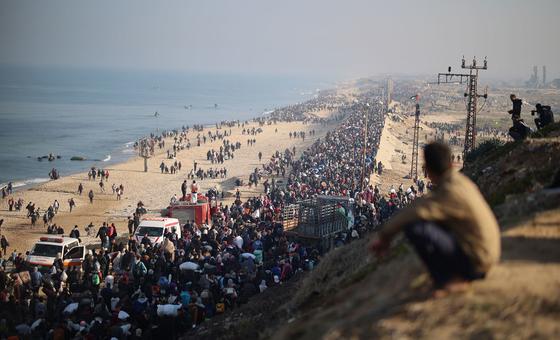
The development followed reports that the Israeli military has stepped up its ground offensive in Gaza City, ordering residents to leave the area.

Speaking from the south of the enclave, UNICEF’s Tess Ingram described the forced mass displacement of families as a “deadly threat for the most vulnerable”.

It is inhumane to expect nearly half a million children battered and traumatized by over 700 days of unrelenting conflict to flee one hellscape to end up in another,” she insisted.

150,000 go south in a month

According to the UN’s humanitarian affairs coordination office, OCHA, over the past few days, partners monitoring the movement of people in Gaza counted almost 70,000 displacements heading south, and about 150,000 over the past month. The only available route, Al Rashid Road, was “very busy” when Ms. Ingram was there on Monday, she said.

The UNICEF spokesperson described meeting a mother who had walked for more than six hours from Gaza City to the South with her five children, “all dirty, thirsty and starving”, two of them with no shoes.

They are being pushed along with tens of thousands of others to “a so-called humanitarian zone” encompassing Al-Mawasi and surrounding areas, she said.

Sea of despair

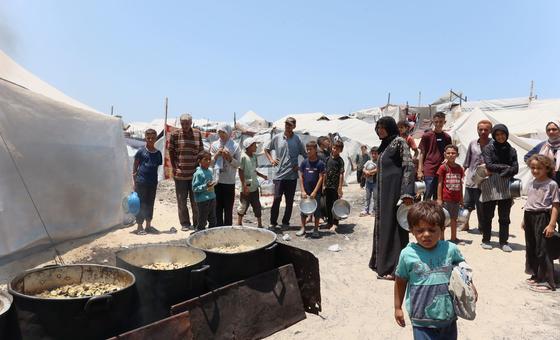
Ms. Ingram described their destination as “a sea of makeshift tents, human despair” and services which are “insufficient” to support the hundreds of thousands already living there.

Child malnutrition in Gaza is “spiralling”, Ms. Ingram continued, pointing out that according to UNICEF estimates, some 26,000 children in the enclave currently require treatment for acute malnutrition – more than 10,000 in Gaza City alone.

Famine was confirmed late last month in Gaza City by UN-backed food insecurity experts.

Feeding centres closed

UNICEF’s Ms. Ingram said that owing to evacuation orders and military escalation more nutrition centres in Gaza City have been forced to shut this week, “cutting off children from a third of the remaining treatment sites that can save their lives”.

While humanitarians remain on site and continue responding to the crisis, “it is becoming harder with every bombardment and every denial”, she stressed.

According to OCHA, last Sunday out of 17 missions that humanitarian teams coordinated with the Israeli authorities, only four were facilitated, while seven missions were denied and others were impeded on the ground or had to be cancelled.

Ms. Ingram spoke of the dilemma desperate Gazans face: “stay in danger or flee to a place that they also know is dangerous.” She recalled that Al-Mawasi came under attack some two weeks ago, when eight children were killed while lining up for water; the youngest victim was three years old.

More to follow…

Gaza children starving despite Israeli ‘tactical pauses’, UN says

Speaking at the regular news briefing in New York, UN Deputy Spokesperson Farhan Haq said that even four days into the announced pauses, “we are still seeing casualties among those seeking aid and more deaths due to hunger and malnutrition.”

He added that parents are “struggling to save their starving children” and warned that the current conditions for aid delivery are “far from sufficient”.

The UN Office for the Coordination of Humanitarian Affairs (OCHA) said that while it is using every available window to deliver supplies during the unilateral pauses, the scale of need vastly outpaces what is getting through.

“A permanent ceasefire is needed more than ever,” Mr. Haq said, emphasising that “unilateral tactical pauses alone do not allow for the continuous flow of supplies required to meet immense needs levels in Gaza.”

Access a major hurdle

Access remains one of the biggest hurdles.

Entry through the Kerem Shalom/Karem Abu Salem crossing requires multiple layers of approval from Israeli authorities, including safe passage, cessation of bombardment and the literal opening of locked gates.

“Yesterday, three facilitated missions allowed our staff to collect cargo containing food from the Kerem Shalom and Zikim crossings and allowed for fuel to be transferred within Gaza,” Mr. Haq said.

“However, the others faced impediments, particularly delays in receiving the green light to move by the Israeli authorities, and one had to be cancelled.”

Extreme hunger haunts children

The situation was echoed by Ricardo Pires, UNICEF’s communication manager, who returned from Gaza this week.

“It’s absolutely apocalyptic,” he told UN News. “Children are being injured and killed while trying to get food and aid while suffering from malnutrition and hunger.”

Mr. Pires said that two out of the three criteria for a famine declaration have been met, according to the latest alert by food security experts.

UNICEF and other agencies are also grappling with the collapse of basic infrastructure.

Perfect storm of suffering for children

“We’re at the brink of a man-made drought,” Mr. Pires said, with only 40 per cent of water production functioning and children turning to contaminated sources, risking deadly disease.

“Children are dehydrated. They are reverting to contaminated water, which will make them sick, with deadly diseases or diarrhoea outbreaks and in some cases, even meningitis,” he added.

“It is a complete perfect storm of suffering for children.”

UN News interview with UNICEF Communication Manager Ricardo Pires.

Source link

Children in Gaza ‘going to bed starving’ amid blockade

“The siege on Gaza is the silent killer of children, of older people,” said Juliette Touma, spokesperson for the UN agency for Palestine refugees, UNRWA.

“Families – whole families, seven or eight people – are resorting to sharing one can of beans or peas,” she told journalists in Geneva. “Imagine not having anything to feed your children. Children in Gaza are going to bed starving.

Today, thousands of trucks carrying relief supplies continue to be denied entry to Gaza. “We have just over 5,000 trucks in several parts of the region with lifesaving supplies that are ready to come in,”Ms. Touma continued.

“This decision is crippling the humanitarian efforts…and threatening the lives and survival of civilians in Gaza, who are also going through heavy bombardment day in, day out.”

Rafah levelled

Destruction to the southern city of Rafah has left it “obliterated”, UNRWA said. Formerly the largest entry point for aid into the enclave via Egypt, aerial videos purportedly of Rafah show buildings levelled as far as the eye can see.

“Rafah is nothing like the city it used to be…In every direction there is only destruction,” the UN agency said.

Forced displacement orders have been in place for 97 per cent of the city, uprooting around 150,000 people.

Almost 12 months ago, the Israeli military moved in displacing 1.4 million people, leaving homes, health facilities and shelters damaged or destroyed.

Starting from scratch

Across Gaza, more than 90 per cent of the population have been displaced “not once, not twice, some people have been displaced 12 times or 13 times…so they have to start from scratch.”

Before the war erupted in October 2023, Gazans relied on 500 trucks a day to deliver the food and other basic goods that they needed. But no humanitarian or commercial supplies have entered since 2 March.

This is by far the longest ban on aid moving into the Strip since the start of the war in October 2023, following deadly Hamas-led terror attacks on Israel that killed some 1,250 people and left more than 250 taken hostage.

The blockade has emptied warehouses of food, medical supplies, shelter materials and safe water – fuelling a black market “where prices have increased from 10 to 20, sometimes 40 times…You cannot give anything to your children and you’re seeing your children starving”, Ms. Touma said.

According to the UN World Food Programme (WFP) food prices rose 1,400 per cent increase in recent weeks compared to the ceasefire period from 19 January to 18 March 2025.

Last Friday, the UN agency delivered its last remaining stocks to community kitchens that provide hot meals of lentil soup and rice. The kitchens are expected to fully run out of food within days while another 16 closed over the weekend. In addition, all 25 WFP-supported bakeries have now closed.

“We’re likely to see more community kitchens closing down for the simple reason that they need supplies,” Ms. Touma explained.

Daily challenges for Gazans include finding food and fuel to cook, because of a lack of cooking gas. “Families are resorting to burning plastic to cook their meals,” UNRWA’s Ms. Touma said. 

Source link