Aid blockade deepens Gaza crisis as malnutrition deaths rise, warns UNRWA

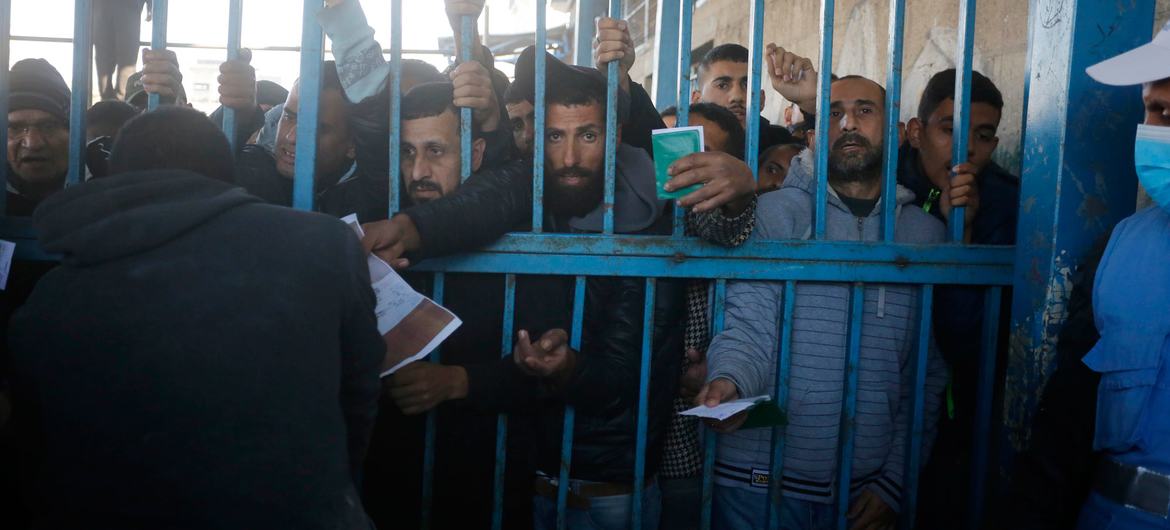
“For over 150 days, not a single truck from UNRWA has been permitted to deliver food, medicine or other essentials into Gaza,” the agency said on Friday. “This denial of access is costing lives every single day.”

Nearly 100 children dead from malnutrition

According to Gaza’s Ministry of Health, cited by the UN, at least 61,158 Palestinians have been killed and more than 151,000 injured since October, amid relentless Israeli bombardment and ground operations.

UNRWA said nearly 350 of its own staff are among the dead since Israel’s military operation in Gaza began following the 7 October 2023 Hamas-led terror attacks.

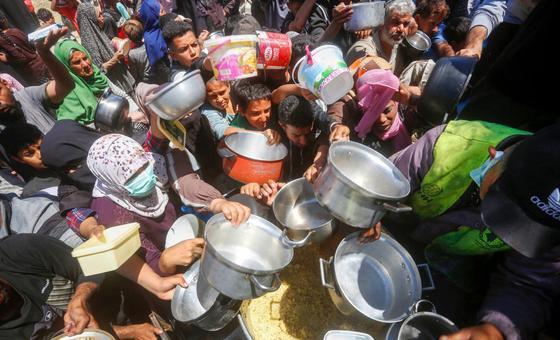
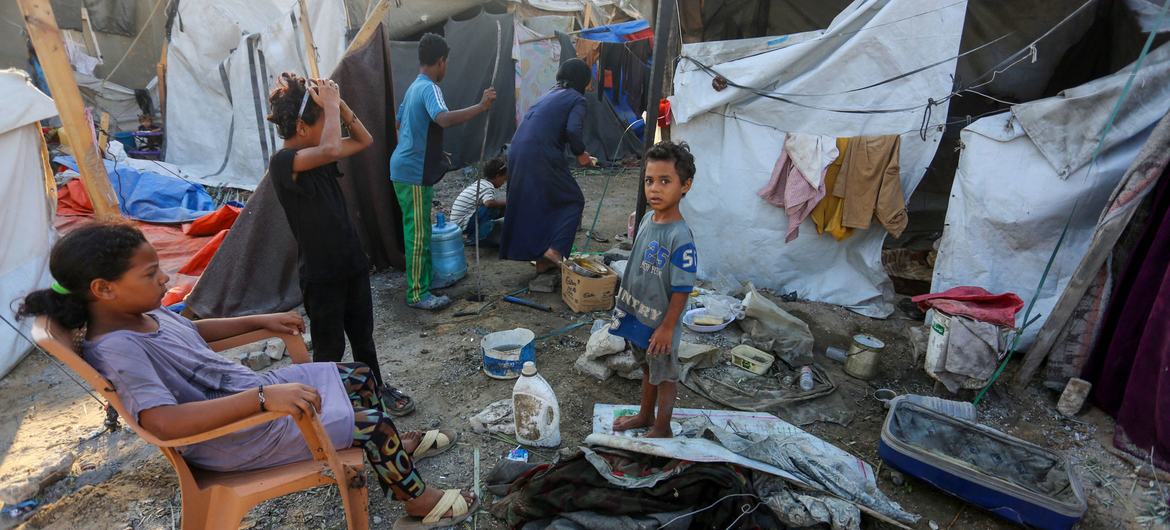
Many civilians have been killed while sheltering in schools or tents, or while queuing for food.

Food insecurity is now acute. UN data show 193 people — including 96 children — have died from malnutrition since the start of August, with July seeing the highest monthly rate of acute malnutrition recorded in children under five.

Soaring prices

Wheat flour prices have soared by up to 15,000 per cent compared to pre-war levels. “Sustained, large-scale deliveries are the only way to stabilise food supplies and prices,” UNRWA stressed.

Health services are close to collapse. More than half of essential medical supplies are already out of stock, and hospitals have been forced to ration fuel for generators. UNRWA teams have nevertheless managed over 1.5 million health consultations since March, but “without resupply, our ability to save lives is dwindling,” the agency warned.

Vast scale of displacement

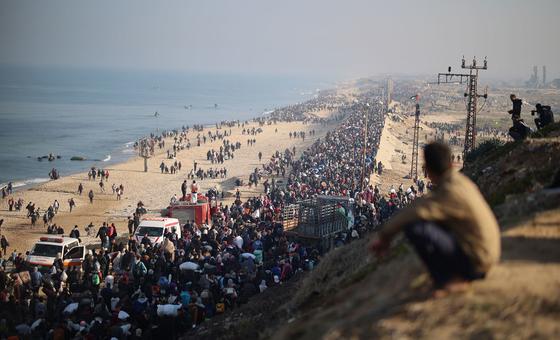
Displacement is on a vast scale: 1.9 million people — around 90 per cent of Gaza’s population — have been forced from their homes, many repeatedly. Nearly 100,000 are crammed into over 60 UNRWA-run shelters.

In the northern Israeli-occupied West Bank, around 30,000 people from Nur Shams, Tulkarm and Jenin refugee camps remain unable to return home due to Israel’s “Iron Wall” military operation, ongoing since January.

The agency urged immediate, unhindered humanitarian access. “We need the world to act — to open the crossings, to stop the suffering, and to uphold the most basic principles of humanity,” it said.

The UN Security Council is due to meet in New York in emergency session on Sunday morning local time to discuss the Israeli cabinet’s endorsement of a military takeover of Gaza City which is home to around one million Palestinians.

Lifting of Israeli blockade ‘the only way to avert mass starvation’ in Gaza: UNRWA chief

Philippe Lazzarini posted on social media saying that aid distribution “has become a death trap,” citing reports from international medical staff on the ground and local health authorities who reported at least 31 deaths and more than 150 injured as civilians were lining up to receive aid from the Israel and United States-backed Gaza Humanitarian Foundation – which bypasses existing aid agencies.

‘Humiliating system’

“A distribution point by the Israeli-American plan was put far south in Rafah,” Mr. Lazzarini said on X.

This humiliating system has forced thousands of hungry and desperate people to walk for tens of miles to an area that’s all but pulverized due to heavy bombardment by the Israeli army.”

He said aid delivery and distribution “must be at scale and safe. In Gaza, this can be done only through the United Nations including UNRWA.”

Gaza’s defence agency said Israeli forces had been responsible for the gunfire. The Gaza Humanitarian Foundation – which uses private contractors and involves Israel Defense Forces (IDF) to secure its sites – has strongly denied that civilians were fired on, accusing Hamas militants of misinformation.

Disputed events

The IDF said on social media that reports of them firing towards residents receiving aid from the foundation were false: “Findings from an initial inquiry indicate that the IDF did not fire at civilians while they were near or within the humanitarian aid distribution site.”

The IDF posted video which it said showed gunmen shooting at civilians collecting aid, adding that “Hamas is doing everything in its power to prevent the successful distribution of food in Gaza.”

Medical staff at Nasser hospital in nearby Khan Younis told media outlets that around 79 people were admitted on Sunday, mostly with gunshot wounds, along with the bodies of some of those killed. Journalists on the scene posted video footage of bodies being carried on carts along with wounded arrivals.

‘Lift the siege’

UNRWA chief Lazzarini called on Israel to lift the three-month old aid blockade and allow safe and unhindered access. “This is the only way to avert mass starvation including among one million children.”

Highlighting the difficulties of clearly establishing facts on the ground due to Israel’s ban on international media from entering the Gaza Strip, the UNRWA chief said that amid competing narratives and “disinformation campaigns in full gear,” the ban on eyewitness reporting must be lifted immediately.

GAZA LIVE: Security Council to meet on aid crisis amid ‘critical risk of famine’ due to Israeli blockade

The Security Council is set to meet this afternoon at 3 PM in New York to discuss the deepening crisis in Gaza, where humanitarians warn of “a critical risk of famine” and aid shipments have been blocked for over 70 days. UN relief chief Tom Fletcher is expected to brief ambassadors. Follow live for key updates from UN Headquarters and reports from the region. App users can follow coverage here.

Gaza: ‘Worst-case scenario’ unfolds as brutal aid blockade threatens mass starvation

Speaking from Gaza City OCHA spokesperson Olga Cherevko told journalists in Geneva that a friend of hers “saw people burning a few days ago from the explosions – and there was no water to save them.”

Since all entry points into the war-torn enclave were “sealed by the Israeli authorities for the entry of cargo” in March, the “worst-case scenario” was triggered, Ms. Cherevko said: supplies are depleting while the conflict rages on.

Food stocks have now mainly run out, water access has become impossible,” she told journalists in Geneva.

As the veteran aid worker spoke, she noted that a “very violent fight” for access to water was taking place downstairs from her, with people throwing rocks and firing shots at a water truck which was pulling away.

No childhood

The OCHA spokesperson said that every day she was seeing children “who have been deprived of their childhood for many months,” and elderly people “rummaging through piles of trash” in search of food and combustible material for cooking, in the absence of fuel.

During a visit on Thursday to Patient Friends Hospital, a paediatric hospital in Gaza City which had been attacked several times during the war, she heard reports of rising malnutrition rates.

Hospitals report running out of blood units, as mass casualties continue to arrive,” Ms. Cherevko stressed, while precious fuel is being rationed.

Malnutrition cases among children in Gaza are increasing due to a lack of food.

Running on empty

“Gaza is inching closer to running on empty,” she added.

Ms. Cherevko said that UN humanitarians are “in constant contact” with the Israeli authorities and are advocating for border crossings to reopen. “We have mechanisms that mitigate diversion [and] ensure that aid reaches the people it’s intended to reach,” she said.

“We are ready to resume delivery at scale as soon as the crossings reopen, Ms. Cherevko insisted. “We stand by our pledge to remain principled and continue relieving people’s suffering, wherever they may be.”

In an appeal to the Israeli authorities on Thursday, the UN’s top humanitarian official and OCHA chief Tom Fletcher said, “Lift this brutal blockade. Let humanitarians save lives”.

Mr. Fletcher reaffirmed the urgent need for the release of hostages taken by Hamas on 7 October 2023, who “should never have been taken from their families” and stressed that “aid, and the civilian lives it saves, should never be a bargaining chip”.

Gazans queue for food in January 2025 when it was more widely available in the enclave.

Generational horror

Ms. Cherevko said that over the past one and a half months, 420,000 people have been “once again forced to flee, many of them with only the clothes on their backs, shot at along the way, arriving in overcrowded shelters, as tents and other facilities where people seek safety, are being bombed”.

“I worry that five, 10, 20 years from now, we will look at our children and grandchildren in shame and we will not be able to explain to them why we could not stop this horror,” she concluded.

How much more blood must be spilled before enough becomes enough?”

Source link

Children in Gaza ‘going to bed starving’ amid blockade

“The siege on Gaza is the silent killer of children, of older people,” said Juliette Touma, spokesperson for the UN agency for Palestine refugees, UNRWA.

“Families – whole families, seven or eight people – are resorting to sharing one can of beans or peas,” she told journalists in Geneva. “Imagine not having anything to feed your children. Children in Gaza are going to bed starving.

Today, thousands of trucks carrying relief supplies continue to be denied entry to Gaza. “We have just over 5,000 trucks in several parts of the region with lifesaving supplies that are ready to come in,”Ms. Touma continued.

“This decision is crippling the humanitarian efforts…and threatening the lives and survival of civilians in Gaza, who are also going through heavy bombardment day in, day out.”

Rafah levelled

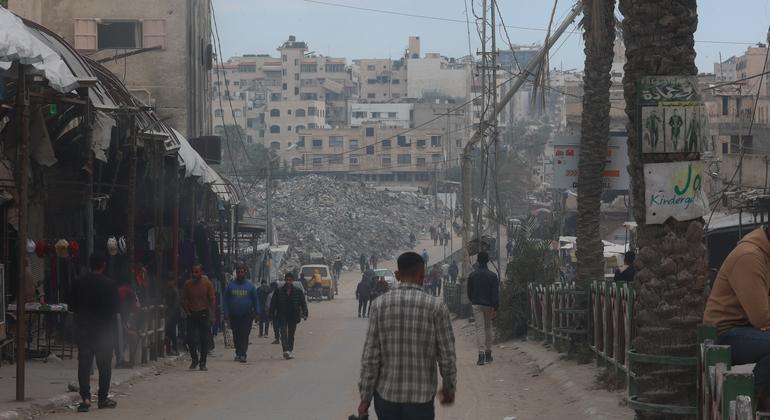
Destruction to the southern city of Rafah has left it “obliterated”, UNRWA said. Formerly the largest entry point for aid into the enclave via Egypt, aerial videos purportedly of Rafah show buildings levelled as far as the eye can see.

“Rafah is nothing like the city it used to be…In every direction there is only destruction,” the UN agency said.

Forced displacement orders have been in place for 97 per cent of the city, uprooting around 150,000 people.

Almost 12 months ago, the Israeli military moved in displacing 1.4 million people, leaving homes, health facilities and shelters damaged or destroyed.

Starting from scratch

Across Gaza, more than 90 per cent of the population have been displaced “not once, not twice, some people have been displaced 12 times or 13 times…so they have to start from scratch.”

Before the war erupted in October 2023, Gazans relied on 500 trucks a day to deliver the food and other basic goods that they needed. But no humanitarian or commercial supplies have entered since 2 March.

This is by far the longest ban on aid moving into the Strip since the start of the war in October 2023, following deadly Hamas-led terror attacks on Israel that killed some 1,250 people and left more than 250 taken hostage.

The blockade has emptied warehouses of food, medical supplies, shelter materials and safe water – fuelling a black market “where prices have increased from 10 to 20, sometimes 40 times…You cannot give anything to your children and you’re seeing your children starving”, Ms. Touma said.

According to the UN World Food Programme (WFP) food prices rose 1,400 per cent increase in recent weeks compared to the ceasefire period from 19 January to 18 March 2025.

Last Friday, the UN agency delivered its last remaining stocks to community kitchens that provide hot meals of lentil soup and rice. The kitchens are expected to fully run out of food within days while another 16 closed over the weekend. In addition, all 25 WFP-supported bakeries have now closed.

“We’re likely to see more community kitchens closing down for the simple reason that they need supplies,” Ms. Touma explained.

Daily challenges for Gazans include finding food and fuel to cook, because of a lack of cooking gas. “Families are resorting to burning plastic to cook their meals,” UNRWA’s Ms. Touma said. 

Source link

Gazans face hunger crisis as aid blockade nears two months

Both the UN agency that assists Palestine refugees, UNRWA, and the World Food Programme (WFP) report that food stocks are now exhausted, even as supplies of lifesaving assistance pile up at border crossings waiting to be brought in.

Humanitarians continue to warn that hunger is spreading and deepening in the enclave, amid the blockage, access constraints, ongoing Israeli military operations and a rise in looting.

Scarcity, sharing and shame

UNRWA shared the testimony of a woman called Um Muhammad who is staying at a shelter in Gaza City and prepares food for 11 family members daily. Although she still has some flour, most families nearby have already run out.

“When I knead and bake, I feel very ashamed of myself, so I distribute some bread to the children who come asking for a piece of bread,” she said.

“We eat one meal a day, dividing bread among each person daily. We eat canned goods, lentils, and rice. When this stock runs out, I don’t know what we will do because what is available in the market is scarce.”

Longest blockade

Gaza has a population of more than two million people who mostly depend on aid, but no humanitarian or commercial supplies have entered since 2 March when Israel imposed a full blockade on the territory.  

This is by far the longest ban on aid moving into the Strip since the start of the war in October 2023, following the deadly Hamas-led terror attacks on Israel.

The situation has led to shortages – not just of food, but other items including medicine, shelter supplies and safe water.  WFP recently noted a 1,400 per cent increase in food prices when compared to the ceasefire period, which lasted from 19 January to 18 March of this year.

Malnutrition and looting

On Friday, the UN agency delivered its last remaining stocks to hot meals kitchens, which have been a lifeline in recent weeks. The kitchens are expected to fully run out of food within days, and another 16 closed over the weekend.  Furthermore, all 25 WFP-supported bakeries are now shuttered.

There has been an increase in reports of looting incidents, the UN humanitarian affairs office OCHA said on Monday. Over the weekend, armed individuals reportedly ransacked a truck in Deir Al-Balah and a warehouse in Gaza City.

Meanwhile, the latest famine review analysis by the Integrated Food Security Phase Classification (IPC) got underway this week.

Humanitarian partners warn that the nutrition situation across Gaza is worsening. Since January, about 10,000 cases of acute malnutrition among children have been identified, including 1,600 cases of severe acute malnutrition

Although treatment supplies remain available in the south, accessing them continues to be extremely challenging due to operational and security restrictions.

Healthcare also affected

OCHA stressed that the depletion of critical stocks in Gaza goes far beyond food. For example, trauma-related medical supplies are running out at a time when the number of people injured in mass casualty incidents continues to increase. 

Gaza also lacks surgical supplies, including gowns, drapes and gloves.  The World Health Organization (WHO) informed that their warehouse has run out of therapeutic milk, intravenous antibiotics and painkillers, as well as spare parts for ambulances and oxygen stations. 

Partners working in health add that an increasing number of critical staff are being denied access to Gaza, with a rise in the denial of entry for emergency medical teams, particularly highly specialized professionals – including orthopedic and plastic surgeons – and a recent restriction of movement across the enclave.  

Aid awaiting entry

As the aid ban continues, humanitarians are doing everything possible to reach people with whatever supplies remain available.

They also have stocks of food and other lifesaving items ready and waiting to enter the Gaza Strip as soon as border crossings re-open.

This includes nearly 3,000 UNRWA trucks of aid, while WFP has more than 116,000 metric tonnes of food assistance – enough to feed one million people for up to four months. 

Source link

Gaza: UN official warns of ‘assault on dignity’ as blockade cripples humanitarian response

Speaking to journalists in Gaza City, Jonathan Whittall, OCHA‘s local Head of Office, painted a dire picture of life under what he called a “total and complete blockade” now approaching its third month.

“The coming days in Gaza are going to be critical. Today people are not surviving in Gaza, those that aren’t being killed with bombs and bullets are slowly dying,” he said.

Whittall stressed that humanitarian agencies are unable to meet the soaring needs of civilians due to the collapse of supply lines. Hospitals are overwhelmed, but medicines and equipment are running out. People are going hungry, but food warehouses are empty and bakeries are closing. Clean water is desperately needed, but water wells are inaccessible.

He noted that solid waste is piling up in the streets with no equipment to remove it, and that rescue efforts after airstrikes are impossible without fuel and machinery. Displaced families are forced to live in rubble without shelter materials, and fishermen are being shot at sea, while humanitarian organisations lack the resources to assist them. “Nowhere in Gaza today is safe”, he said.

He added that children need to learn, but schools have been destroyed or are inaccessible, and that education supplies are not available. Prices of the remaining goods in Gaza continue to rise, but there is no cash available. There is no cooking gas or fuel, forcing families to burn trash to generate some energy.

“This is not only about humanitarian needs, but it’s about dignity. There is an assault on people’s dignity in Gaza today,” he warned.

“We also know that humanitarian workers, first responders, you as journalists, should be protected, like all civilians, but we’re being killed in a war that appears to be fought without any limits,” he added.

Whittall emphasised that the situation in Gaza does not even resemble a war. “People in Gaza are telling me that they feel like it’s the deliberate dismantling of Palestinian life in plain sight, for all to see, documented every day by you as journalists,” he said.

He described the devastation witnessed daily — including children’s bodies thrown by explosions, families burnt alive, and colleagues killed — as part of what he termed “everyday atrocities.”

“As humanitarians we can see that aid is being weaponised through its denial,” he warned. “There’s no justification for the denial of humanitarian assistance. And humanitarian aid should never be weaponised.”

Despite the catastrophic conditions, he stressed that humanitarian organisations are continuing to operate where possible, but “we have less and less and less supplies and less and less capacity to be able to meet the growing and growing needs that are intensifying across Gaza.”

“Lives depend on the blockade being lifted, on aid being allowed to enter into Gaza, on the ceasefire being reinstated,” he said, calling for real accountability rather than waiting for history to judge the international community’s response.

Hunger and malnutrition surging

In a separate statement, OCHA warned of a “severe decline” in food availability across Gaza, as malnutrition rates escalate rapidly, particularly among children.

A UN partner organisation recently screened around 1,300 children in northern Gaza and identified over 80 cases of acute malnutrition, representing more than double the rate recorded in previous weeks.

“Nutrition partners report a critical shortage of supplies due to the obstruction of aid entry and challenges in transporting essential materials within Gaza,” OCHA said. Access to key facilities, including UNICEF’s main warehouse in Rafah, remains heavily restricted.

Journalists who visited the United Nations Relief and Works Agency for Palestine Refugees (UNRWA) main warehouses this week found them largely empty of food supplies, including flour.

Call for accountability and action

“Nothing can justify the collective punishment of the Palestinian people,” UNRWA said in a separate statement, stressing that international law prohibits indiscriminate attacks, the obstruction of humanitarian assistance, and the destruction of vital civilian infrastructure.

The agency reiterated its call for a renewed ceasefire, the dignified release of all hostages, and the immediate, unhindered flow of humanitarian aid and commercial goods into Gaza.

Source link