NASA’s Webb Cameras Explore Largest Star-Forming Cloud in Milky Way

The difference longer wavelengths of light make, even within the infrared spectrum, are stark when comparing the images from Webb’s MIRI and NIRCam (Near-Infrared Camera) instruments. Glowing gas and dust appear dramatically in mid-infrared light, while all but the brightest stars disappear from view.

In contrast to MIRI, colorful stars steal the show in Webb’s NIRCam image, punctuated occasionally by bright clouds of gas and dust. Further research into these stars will reveal details of their masses and ages, which will help astronomers better understand the process of star formation in this dense, active galactic center region. Has it been going on for millions of years? Or has some unknown process triggered it only recently?

Astronomers hope Webb will shed light on why star formation in the galactic center is so disproportionately low. Though the region is stocked with plenty of gaseous raw material, on the whole it is not nearly as productive as Sagittarius B2. While Sagittarius B2 has only 10 percent of the galactic center’s gas, it produces 50 percent of its stars.

“Humans have been studying the stars for thousands of years, and there is still a lot to understand,” said Nazar Budaiev, a graduate student at the University of Florida and the co-principal investigator of the study. “For everything new Webb is showing us, there are also new mysteries to explore, and it’s exciting to be a part of that ongoing discovery.”

More about Webb and MIRI

The James Webb Space Telescope is the world’s premier space science observatory. Webb is solving mysteries in our solar system, looking beyond to distant worlds around other stars, and probing the mysterious structures and origins of our universe and our place in it. Webb is an international program led by NASA with its partners, ESA (European Space Agency) and CSA (Canadian Space Agency).

Webb’s MIRI was developed through a 50-50 partnership between NASA and ESA. A division of Caltech in Pasadena, California, JPL led the U.S. contribution to MIRI. JPL also led development of MIRI’s cryocooler, done in collaboration with Northrop Grumman in Redondo Beach, California, and NASA’s Goddard Space Flight Center in Greenbelt, Maryland.

Cosmic girls: UN nurtures next generation of space professionals

Now 18, she’s involved in aerospace projects with other young women through the Shakthi SAT initiative and she’s keen to explore the intersection between computer engineering and science, particularly artificial intelligence (AI), autonomous robotics and embedded systems that control satellites, drones and rockets.

“I’m learning things I once only dreamed of, and we’re going to launch our own satellite. How cool is that!” she told UN News.

But, prospects at home in Nepal, an impoverished nation with a nascent space industry, are very limited.

“Our parents usually don’t want us to pursue ‘risky’ careers,” she said.

‘My interest is to make humans multiplanetary’

As a little girl growing up in Hasselt, Belgium, Kaat DeGros thought becoming an astronaut in the highly competitive, male-dominated space field would never happen.

Today, at 15, she’s already designed her own sustainable research base on Mars, hailed by the Oxford Academy of Excellence.

“My interest is to make humans multiplanetary,” she said.

Demystifying space careers

A new partnership between the Space4Women project of the UN Office for Outer Space Affairs (UNOOSA) and the Cosmic Girls Foundation is bringing together young women and girls like Ms. Maharjan and Ms. DeGros from across the globe to explore how they can shape the future of space and thrive in diverse roles, from space economics and law to engineering, policy and innovation.

Over 30 girls participated in a global webinar in late July on “demystifying space careers: not just astronauts”, the first in a series of collaborations to unite UNOOSA’s global reach and Cosmic Girls’ grassroots network.

Two women leaders, a space economist at the European Bank for Reconstruction and Development and legal officer at the Kenya Space Agency, shared practical advice on how to enter the sector regardless of background and fielded questions on academic and professional paths, networking, accessing resources and dealing with rejection.

NASA astronauts Tracy Caldwell Dyson, Dorothy Metcalf-Lindenburger, Naoko Yamazaki and Stephanie Wilson pose for a photo at the International Space Station.

Building a space ecosystem

The girls left with several messages: be your own cheerleader, seek out mentors and allies, stay disciplined but follow your passion and join space communities.

“We are building an ecosystem that equips girls worldwide with STEM skills, astronaut training and the mindset to innovate for humanity’s future among the stars,” said Mindy Howard, founder and chief executive officer of the Netherlands- and US-based Cosmic Girls Foundation.

The partnership will influence policymakers to adopt a new vision of the space sector where men and women are equal partners, said UNOOSA programme officer Anne-Claire Grossias.

“It’s a very human-focused project. Through this connection we can move forward toward gender equality,” she explained.

Landmark study: Space sector still gender blind

Despite progress in recent years, women are still significantly under-represented in the field, especially in leadership roles. Only 11 per cent of astronauts have been women, and they represent just 30 per cent of the workforce in public space sector organizations, according to the Space4Women project’s 2024 landmark study on gender equality.

Ensuring a meaningful role for women not only fuels productivity and profit; it leads to greater global collaboration, consensus-building and lasting peace, the study found.

The idea for the survey was conceived at the 2023 Space4Women Expert Meeting. The meeting united global experts to prepare the UN’s first gender mainstreaming toolkit to help space organizations dismantle gender bias and discriminatory practices and create environments where women can succeed alongside male colleagues in space science, technology, innovation and exploration.

Mindy Howard during parabolic flight training.

Fostering the female astronaut pipeline

Since its inception in 2017, the Space4Women project has worked with committed space sector professionals to mentor over 270 girls from 68 countries.

Ms. Howard, a mentor since 2020, has brought together nearly 1,000 girls from 139 countries through her Cosmic Girls educational and networking forum. With programme partners in Africa, Asia, Europe, the Americas and Oceania, the Cosmic Girls Foundation has launched the first global competition to train six girls, one from each continent, with the rocket science knowledge, life skills and mental preparedness to become astronauts. The grand prize for one will be a trip to space.

“The competition is such a dream come true,” said Ms. DeGros. “It gave me hope that I will succeed as an astronaut and astrophysicist.”

Building confidence in a safe environment

Supporting girls from an early age in a welcoming, nurturing environment is crucial to help them gradually test the waters and bring much-needed feminine traits and collaborative approaches for problem-solving to the field, said Ms. Howard.

“Girls are often told by their parents they are not good enough, not smart enough. This is a safe environment for them to hone their skills, which will help them later on,” she said.

Already they are feeling confident.

“This feels like something extraordinary – a real step towards a future I once thought was out of reach,” said Ms. Maharjan.

“I think there will be equality in space exploration in not so long of a time,” added Ms. DeGros.

London’s Far-Right Rally Sends Shockwaves Through South Asian Communities

Global alliance meets in Doha to confront hunger crisis

Addressing heads of state, ministers and international partners, President of the UN General Assembly Annalena Baerbock said today’s hunger crisis is not the result of scarcity, but of inequality, conflict and policy choices.

Last year, more than 670 million people experienced hunger, and 2.3 billion faced moderate or severe food insecurity. “That is billions wondering where their next meal will come from. Parents having to see their children go to bed hungry,” she said.

This is occurring in a world that wastes over one billion meals every day.

“The crisis of hunger is not lack of food. It is entirely preventable,” she stressed, pointing to failures in access, affordability and social protection.

The meeting took place as Doha hosts the Second World Summit for Social Development, where nearly 14,000 attendees are discussing how to strengthen social systems, expand opportunity and reduce inequality.

As the planet heats, hunger spreads

Ms. Baerbock highlighted climate change as a rapidly accelerating driver of hunger. Recalling a recent visit to the Sahel, she described fertile land turned to dust as heat rises and rains fail. “This is the new frontline of food insecurity,” she said.

If global warming continues unchecked, as many as 1.8 billion additional people could face food insecurity, she warned. But limiting warming to 1.5°C, backed by investment in adaptation and resilience, could prevent millions from falling deeper into poverty.

Launched under Brazil’s G20 Presidency in 2024, the Global Alliance Against Hunger and Poverty now includes nearly 200 members – over 100 countries, regional organizations, international agencies and civil society groups. Monday’s meeting was its first at leaders’ level, aimed at accelerating practical cooperation, from scaling up social protection to strengthening climate-resilient agriculture.

“In a world of plenty – where there should be more than enough to go around – ensuring that everyone, everywhere has enough to eat is entirely possible,” Ms. Baerbock said. “A world free from hunger and poverty is not a distant aspiration. It is within reach, if we reach for it together.”


UN aid push continues across Gaza despite Israeli airstrikes


“Our humanitarian colleagues tell us that their partners continue their scale-up efforts, despite reported Israeli airstrikes across the Strip,” he said, noting that some strikes hit areas near the so-called ‘Yellow Line’ – a buffer zone marked by the Israeli military inside Gaza as part of the ceasefire agreement.

“We stress again that all parties must refrain from any activities that put civilians, including aid workers, at risk.”

Despite the insecurity, UN operations have managed to move significant volumes of relief into the enclave. According to the UN’s so-called 2720 delivery mechanism authorised by the Security Council, more than 24,000 metric tonnes of aid – including food, medicine, nutritional supplements and shelter materials – have been collected from Gaza’s crossings since the truce began several weeks ago.

Looting subsides

Encouragingly, looting and interception of aid have sharply declined. Between 10 and 28 October, only five per cent of supplies were intercepted, compared with around 80 per cent in the months before the ceasefire.

The World Health Organization (WHO) has also delivered over 840 pallets of life-saving medical supplies, including insulin, surgical kits and essential medicines, and is supporting nutrition services to treat some 2,500 children.

But Mr. Dujarric warned that Gaza’s health system remains “under immense strain”, with the local Ministry of Health reporting that more than 1,700 health workers have been killed since the start of the war.

On education, agencies are working to restore “minimum teaching and learning conditions” for over 630,000 school-aged children who have missed more than two years of classes.

Over 90 classrooms have been rehabilitated, though Israeli restrictions on educational materials continue to hamper efforts.

“We continue to call for all crossing points to be open and more UN agencies and organizations authorized to bring in aid supplies into Gaza,” Mr. Dujarric said.

Fragile window to resume food production

Despite catastrophic destruction across Gaza’s farmlands, the current ceasefire has created a fragile but vital window to revive food production, the UN Food and Agriculture Organization (FAO) and satellite agency UNOSAT said on Thursday.

New satellite analysis shows nearly 87 per cent of cropland, 80 per cent of greenhouses and almost 87 per cent of irrigation wells have been damaged since the start of the conflict. But the pause in fighting has opened access to 37 per cent of affected farmland – some 600 hectares of which remain undamaged – allowing farmers to begin rehabilitating their land.

“The ceasefire has opened a window of opportunity,” said FAO Deputy Director-General Beth Bechdol. “Urgent support is needed to restore agricultural land and infrastructure, enable farmers to resume fresh food production, and rebuild fisheries and livestock so families can feed themselves again.”

FAO stressed that rebuilding food systems now could help stabilise livelihoods and prevent deeper hunger in Gaza.

However, its $75 million appeal to support recovery remains only 10 per cent funded, highlighting the need for swift international backing to seize this brief moment of hope amid widespread devastation.

US strikes in Caribbean and Pacific breach international law, says UN rights chief

More than 60 people have reportedly been killed in the continuing series of attacks since early September “in circumstances that find no justification in international law,” Volker Türk said in a statement.

He urged the US to halt its “unacceptable” operations and take measures to prevent the “extrajudicial killing of people aboard these boats, whatever the criminal conduct alleged against them.”

Beyond the law

The United States has defended the operations as part of its ongoing efforts to combat drug trafficking and terrorism, asserting that they fall within the framework of international humanitarian law.

Mr. Türk rejected that argument, stressing that countering illicit drug trafficking is a law-enforcement matter, governed by careful limits on lethal force set out in international human rights law.

He emphasised that the intentional use of lethal force is lawful only as a last resort when individuals pose an imminent threat to life.

Call for investigations

“Based on the very sparse information provided publicly by the US authorities, none of the individuals on the targeted boats appeared to pose an imminent threat to the lives of others or otherwise justified the use of lethal armed force against them under international law,” Mr. Türk said.

The High Commissioner called for prompt, independent and transparent investigations into the reported attacks.

While acknowledging the serious challenges posed by drug trafficking, Mr. Türk urged the US to ensure that all counter-narcotics operations respect international law, including the treaties to which it is party.

“The United States should investigate and, if necessary, prosecute and punish individuals accused of serious crimes in accordance with the fundamental rule-of-law principles of due process and fair trial, for which the US has long stood,” he concluded.


PHDCCI Seeks Creation Of Critical Minerals Dept, Calls For Aggressive Resource Diplomacy

The PHD Chamber of Commerce and Industry (PHDCCI) has urged the Centre to establish a dedicated Department of Critical Minerals and adopt a policy of “aggressive mineral diplomacy” to safeguard India’s economic interests amid mounting global supply-chain risks.

At a brainstorming session hosted by the chamber, industry experts underscored the urgency of developing a complete value chain for critical minerals—covering exploration, extraction, refining, value addition, and marketing—similar to the integrated strategy followed by China under its National Mission framework.

Anil Chaudhary, Senior Member of the Minerals & Metals Committee at PHDCCI and former Chairman of SAIL, lauded the government for shortlisting 30 critical minerals but insisted that coking coal be added to the list.

“India has been importing 90 per cent of the coking coal requirement, worth $15 billion, every year, which is likely to double in the next 10–12 years,” Chaudhary cautioned.

He further noted that critical mineral supplies are increasingly vulnerable to geopolitical tensions and trade restrictions, adding that India must build strategic partnerships with smaller, resource-rich nations such as Congo, Mozambique, Afghanistan, and several Latin American countries to cut reliance on China.

Speakers at the event also pressed for stronger coordination among ministries, stockpiling of key minerals, and the creation of buffer inventories, akin to how the United States manages its oil and gas reserves. They emphasised simplifying regulations and offering incentives to private players for exploration, extraction, and downstream processing.

Deepak Bhatnagar, Secretary General of the Pellet Manufacturers’ Association of India, advocated a mission-driven approach for the sector.

“We need a holistic and time-bound mission-mode approach for the development of critical minerals, on the lines of Mission Agni started by former President Dr APJ Abdul Kalam,” he said.

Linking the minerals strategy to India’s clean energy ambitions, Abhinav Sengupta, Associate Director at PricewaterhouseCoopers, pointed out that renewable technologies and electric vehicles (EVs) are far more resource-intensive than their conventional counterparts.

“The energy transition will be critical mineral-intensive, as EVs are six times more mineral-intensive than conventional vehicles due to batteries, and solar PV and onshore wind are around three times more mineral-intensive than conventional sources,” Sengupta explained.

Experts agreed that without a structured policy framework and international partnerships, India’s renewable energy, defence, and advanced manufacturing goals could face major hurdles.

They urged the government to adopt a comprehensive national mission integrating technology-led exploration, resource diplomacy, and private sector collaboration to secure India’s long-term mineral security and industrial competitiveness.

Jamaica: International support ‘crucial’ to hurricane recovery says Guterres

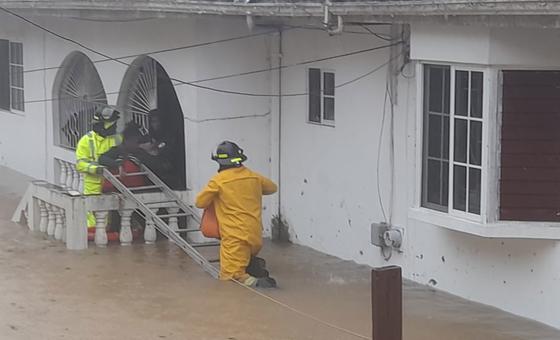
António Guterres spoke by phone to Jamaica’s Prime Minister Andrew Holness earlier in the day emphasising afterwards in a statement that “international support is crucial” as the country deals with the effects of the category 5 storm which brought rain, storm surges and catastrophic flooding.

He calls for the mobilisation of massive resources to deal with the loss and damage from the hurricane,” said the Deputy UN Spokesperson.

UN provides $4m aid injection

The UN Emergency Relief Coordinator, Tom Fletcher, has allocated $4 million from the Central Emergency Response Fund (CERF) so agencies and their partners can rapidly scale up humanitarian operations in Jamaica.

Five days after the most powerful storm in the island’s history made landfall in the west, many residents are still waiting for aid to arrive, according to local news reports, with many roads still inaccessible and communities without power and running water.   

The Government reported on Saturday that the death toll has risen to at least 28. The top UN official on the island, Dennis Zulu, told UN News on Friday that around 13 UN agencies were working as quickly as possible alongside authorities to clear roads and make essential repairs.

“My team here remains committed…to ensure that Jamaica gets back on its feet,” he said.

Support for vulnerable children

UN children’s agency, UNICEF, said on Saturday more than 700,000 children across the Caribbean had been impacted by the hurricane, which also made landfall in Cuba and caused chaos across western Haiti.

UNICEF is supporting the Jamaican Government to reach more than 284,000 children to address urgent nutrition needs, access to safe water, sanitation and hygiene including mental health support.

In Haiti, UNICEF is deploying hygiene and emergency health kits, cash to households at risk and engaging communities.

UN aid coordination office, OCHA, accompanied UNICEF at José Martí airport in Cuba on Saturday to unload supplies for over 90,000 people affected by Melissa – alongside national authorities – working as a single team, driving emergency response.

International solidarity ‘a lifeline’

UN relief chief Tom Fletcher, said on Friday: “In times like this, international solidarity isn’t just a principle – it’s a lifeline.”

An OCHA team has been deployed to Jamaica to strengthen coordination and information management.

UN agencies and NGOs are helping restore access, deliver emergency health and water services, and assist communities whose homes, schools and hospitals have been hit hard.

Well-prepared in Cuba

A $4 million allocation from the OCHA-managed CERF for Cuba, allowed UN agencies to position life-saving support before the storm hit.

  • The World Food Programme (WFP) provided food for 180,000 people;
  • UNICEF deployed mobile water-treatment units and hygiene kits for thousands;
  • the Pan-American Health Organization (PAHO) airlifted medical supplies and generators;
  • the Food and Agriculture Organization (FAO) and UN Development Programme (UNDP) moved seeds and tarpaulins to protect livelihoods and homes;
  • and reproductive health agency, UNFPA, distributed health and dignity kits.

The Cuban Red Cross assisted with preventive evacuations, early-warning messages and psychosocial support, in coordination with the International Federation of Red Cross (IFRC).

Early-warnings across Haiti

In Haiti, a country reeling from a massive humanitarian crisis and deadly armed violence, humanitarian teams are working alongside national authorities to respond to the urgent needs. Several days before the hurricane struck a $4 million CERF allocation allowed aid to be pre-positioned.

In addition, over 3.5 million alerts were sent out to vulnerable populations, saving lives. UN agencies and partners are now supporting temporary shelters and providing food, shelter, non-food items and cash assistance.

“Local leadership, global solidarity, and early action are saving lives across the region,” Mr. Fletcher said. “This is the humanitarian reset at work – acting together with greater impact.”