World News in Brief: Deadly strikes in Sudan, health systems in South Sudan near the brink, Guterres calls for unity ahead of Ramadan.

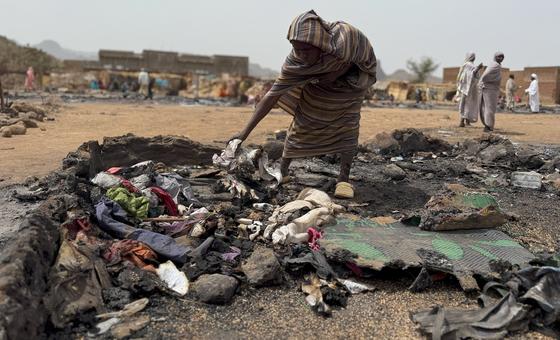
Over the past week, North Kordofan state recorded more than a dozen attacks in and around the towns of El Obeid, Bara, Rahad and Um Rawaba.  

In South Kordofan, suspected drone strikes hit health facilities in the state capital, Kadugli, and in Kuweik town, reportedly killing four medical workers, injuring more than 20 people. 

Concerns over the conflict continue to deepen after a report today from the UN Human Rights Office revealed the “sustained” and “systematic attacks” to civilians in the neighbouring Darfur region in late 2025 that may “amount to crimes against humanity”. 

Growing humanitarian concerns 

“The violence is triggering a new wave of displacement, with reports of many fleeing homes, in need food, health care and protection,” warned the Spokesperson for the Secretary-General Stéphane Dujarric on Friday. 

While the humanitarian situation in Dilling and Kadugli continues to deteriorate, he emphasised that “rapid, safe, unhindered and sustained humanitarian access is essential for us to scale up our response.” 

Commercial vehicles, telecommunications infrastructure and key transport routes have been affected the drone strikes, disrupting humanitarian movements and supply chains. 

Mr. Dujarric called for “the protection of humanitarian infrastructure, in line with international humanitarian law” and urged for more funding through UN aid coordination office OCHA to support displaced families across Sudan. 

Violence pushes South Sudan’s health system to the brink 

Since late December 2025, a devasting escalation of violence has swept across northern and central parts of South Sudan, the UN children’s agency (UNICEF) said on Friday. 

In Jonglei state alone, at least 280,000 people have been displaced – the majority being women and children.

“They fled with nothing. They are sleeping in displacement camps left over from the not-so-distant civil war – camps where there are barely any services. Others are out in the open, in remote locations, with nothing at all,” said UNICEF’s representative in South Sudan, Obia Acheng. 

Children were believed to make up 53 percent of those displaced.

“These children face killing and maiming. Recruitment into armed groups. Separation from their families. Gender-based violence. And profound psychological distress that will mark them for years,” Mr. Acheng emphasised.

Delivering for children

South Sudan’s health system is on the verge of collapse, with 11 health facilities attacked or looted since fighting intensified and many nutrition centres forced to close, UNICEF said.

Cholera cases have surged to 479 nationwide, with treatment centres overwhelmed and resources running low.

Around 825,000 children across Jonglei, Unity, and Eastern Equatoria states are now at risk of acute malnutrition — conditions that make children 12 times more likely to die without treatment.

Pregnant and nursing mothers are increasingly cut off from care, and humanitarian infrastructure is under assault.

Despite these grim numbers, UNICEF continues to run primary healthcare, nutrition, water and sanitation, and child protection programmes across the country. 

The UN Security Council also issued a statement expressing grave concern about the escalating violence in Jonglei, Eastern Equatoria, and throughout South Sudan. 

Members strongly called on all parties to de-escalate and immediately cease renewed hostilities and to resolve issues through peaceful dialogue.  

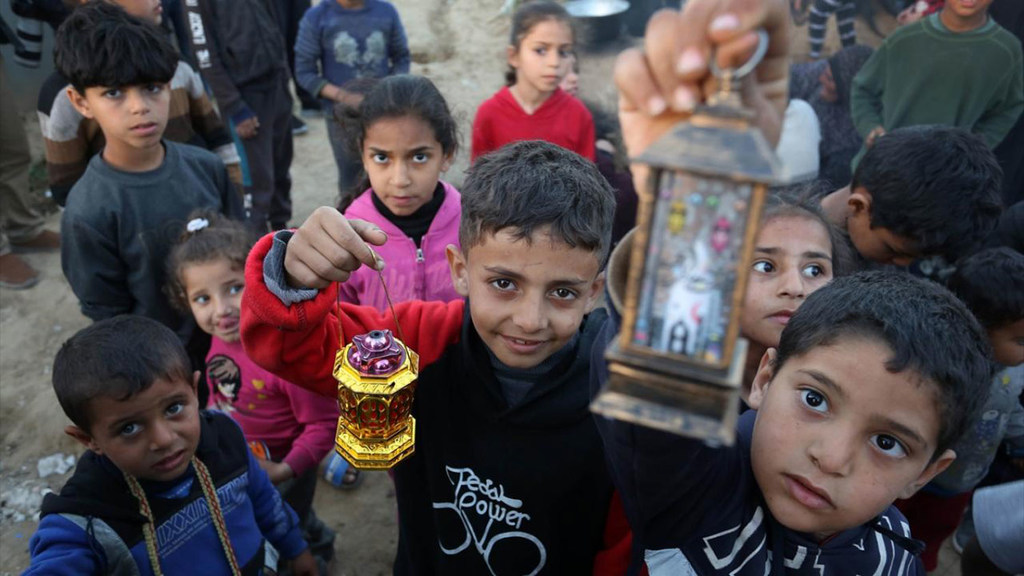
Children in Gaza hold lanterns to celebrate the advent of Ramadan. (file)

UN chief calls for unity and compassion ahead of Ramadan 

UN Secretary-General António Guterres has urged people worldwide to embrace the spirit of peace, compassion and solidarity as Muslims prepare to observe the holy month of Ramadan.  

“For Muslims around the world, the holy month of Ramadan is a sacred period of reflection and prayer. Ramadan also represents a noble vision of hope and peace.” Mr. Guterres said in a message ahead of the start on Tuesday.  

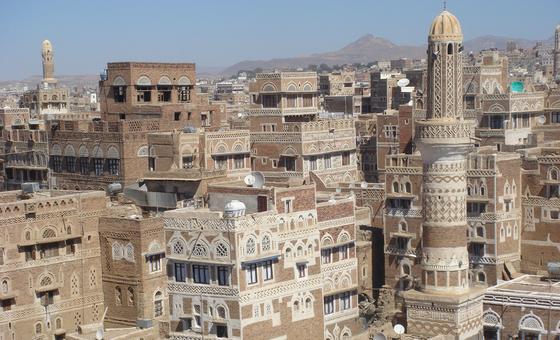
He noted, however, that for many — from Afghanistan to Yemen, Gaza, and Sudan — this vision of hope and unity remained distant amid conflict, hunger, and displacement. 

The UN chief called on the global community to bridge divides, deliver aid to those in need, and uphold human rights and dignity for all. 

“May this Holy Month inspire us to work as one to build a more peaceful, generous and just world for all people,” he said. 

Source link

Guterres condemns escalating violence in South Sudan as aid operations come under fire

In a statement issued by his Deputy Spokesperson, Farhan Haq on Saturday, the UN chief said nearly 10 million people – “more than two thirds of the population” – now require life-saving humanitarian assistance and “continue to bear the brunt of the conflict”.

He expressed grave concern over fighting, attacks and looting affecting humanitarian and health facilities, as well as movement restrictions and insecurity along key supply routes. 

These conditions, the statement said, are “crippling humanitarian operations and shutting down essential services, placing civilians, including aid workers, at serious risk”.

Healthcare services attacked

Since late December, at least 11 healthcare facilities have been attacked in Jonglei State alone, disrupting critical services for communities already under severe strain. The assaults have also involved the seizure of 12 vehicles, including an ambulance.

“In the past week alone,” the statement noted, incidents have included “repeated attacks on a World Food Programme (WFP) convoy, an airstrike on a hospital run by the leading NGO Médecins Sans Frontières, and the burning of a Save the Children field office and destruction of its health centre”.

The Secretary-General said that “this clear disregard for medical and humanitarian operations is unacceptable and must stop”, stressing that such work “must be facilitated and respected”.

The violence has driven mass displacement, with more than 370,000 people reportedly forced from their homes so far this year, including over 280,000 in Jonglei State, amid a rapidly worsening cholera outbreak.

South Sudan, the world’s youngest nation, gained independence from Khartoum in 2011 but soon descended into a brutal civil conflict marked by political rivalry, ethnic violence and repeated peace deal breakdowns. 

‘Immediate and decisive’ end to fighting needed

Despite a 2018 agreement, insecurity and localised fighting have continued to undermine stability and recovery.

The UN chief called on all parties to “immediately and decisively halt all military operations”, de-escalate tensions through dialogue, uphold international law, protect civilians and ensure safe, sustained humanitarian access, including the security of aid workers and UN peacekeepers.

Source link

Pakistan: Guterres condemns deadly suicide bombing at Islamabad mosque

In a statement issued by his spokesperson, Secretary-General António Guterres said he condemned the bombing “in the strongest terms.”

Call for accountability

The Secretary-General reiterates that attacks against civilians and places of worship are unacceptable,” the statement said, stressing that those responsible “must be identified and brought to justice.”

Mr. Guterres extended his condolences to the families of the victims and wished “a full and speedy recovery to those injured.” He also reaffirmed “the solidarity of the United Nations with the Government and people of Pakistan in their efforts to combat terrorism and violent extremism.

Attack during Friday prayers

According to media reports, at least 31 people were killed and more than 160 injured when a suicide bomber detonated the explosive device at a Shia mosque in the Tarlai area of Islamabad.

Police said the attacker opened fire at the gates of the mosque before triggering the explosion after being confronted by security guards.

A state of emergency has been declared in the capital and hospitals have appealed for blood donations. The attack has been described as the deadliest of its kind in Islamabad in over a decade.

‘Deeply shocked and saddened’

The UN Resident Coordinator in Pakistan, Mo Yahya, said he was “deeply shocked and saddened by the horrifying attack at an Imambargah in Islamabad, where people were gathered for Friday prayers.”

“I extend my deepest sympathies to the victims and their families,” he said, adding: “We should stand together in opposing such senseless violence.

Source link

AI ‘moving at the speed of light’ warns Guterres, unveiling recommendations for UN expert panel

“AI is moving at the speed of light,” said UN Secretary-General António Guterres, underscoring the urgency of regulating the breakthrough technology. “We need shared understandings to build effective guardrails, unlock innovation for the common good, and foster cooperation. The Panel will help the world separate fact from fakes, and science from slop.”

The roots of the Panel stretch back to 2023, in the wake of the release of ChatGPT in the United States and other pioneering technology, heralding a new era in the field of artificial intelligence. 

Mr. Guterres convened a group of leading technologists and academics and tasked them with advancing recommendations for safe governance. 

After a series of in-depth discussions, the experts came back with a vision for an approach to AI governance that could benefit humanity. Amongst the ideas was the creation of the International Scientific Panel – independent but supported by the UN.

The Panel, says Mr. Guterres, will be the “first global, fully independent scientific body dedicated to helping close the AI knowledge gap and assess the real impacts of AI across economies and societies.”

Panellists will exchange ideas, run “deep dives” into priority areas such as health, energy and education, and share the latest leading-edge research.

Diverse candidates

On Wednesday, Mr. Guterres and Amandeep Gill, his Special Envoy on Technology, informed journalists that the names of 40 prospective members  would be submitted to the General Assembly, which will have the ultimate say over the panel’s membership.

Mr. Gill said the experts on the list were chosen for their globally recognised expertise in AI. Geographical representation and gender balance also came into play.

The nominees – 19 women and 21 men – include Sonia Livingstone (United Kingdom), a professor at the London School of Economics and an advisor on media literacy and rights in the digital environment; Balaraman Ravindran (India), head of the Department of Data Science and AI at the Indian Institute of Technology in Madras; and Maria Ressa (Philippines), the renowned journalist and Nobel Peace Prize laureate.

Finding consensus

With its large and diverse membership, diverging attitudes towards regulation and growing geopolitical tensions, the ability to forge consensus could prove challenging.

But Mr. Gill pointed out that, even during the Cold War, scientists from across the world were able to work together on issues of international importance. “It’s one of the value-adds of the United Nations to provide those mechanisms where scientific understanding, common understanding can be advanced,” he said.

The General Assembly is expected to make the final decision on membership on 12 February, and the Panel’s first report is due to be delivered by July.

Source link

Choose peace over chaos, Guterres urges as he sets out final-year priorities

2026 “is already shaping up to be a year of constant surprises and chaos,” he told journalists in New York.

Mr. Guterres – who trained as a physicist before entering public life – said that during times of profound flux, he returns to fixed principles that explain how forces act.

Broadcast of the press conference.

Generating ‘positive reactions’

Among them is Newton’s Third Law of Motion which states that for every action, there is an equal and opposite reaction.

“As we begin this year, we are determined to choose actions that generate concrete and positive reactions,” he said.

“Reactions of peace, of justice, of responsibility, and of progress in our troubled times.”

Chain reaction

Today, impunity is driving conflicts – fueling escalation, widening mistrust, and allowing powerful spoilers to enter from every direction.

“Meanwhile, the slashing of humanitarian aid is generating its own chain reactions of despair, displacement, and death,” as inequalities deepen.

He highlighted climate change – “the most literal and devastating illustration of Newton’s principle” – as actions that heat the planet trigger storms, wildfires, hurricanes, drought and rising seas.

Power shift

The world is also witnessing “perhaps the greatest transfer of power of our times”, namely from governments to private tech companies.

“When technologies that shape behaviour, elections, markets, and even conflicts operate without guardrails, the reaction is not innovation, it is instability,” he warned.

Secretary-General’s opening remarks at the press conference (click here to download from SoundCloud).

Hegemony is not the answer

These challenges are happening as systems for global problem-solving continue to reflect economic and power structures of 80 years ago and this must change.

“Our structures and institutions must reflect the complexity – and the opportunity – of these new times and realities,” he said.

Global problems will not be solved by one power calling the shots. Nor will they be solved by two powers carving the world into rival spheres of influence.”

He stressed the importance of accelerating multipolarity – “one that is networked, inclusive by design, and capable of creating balance through partnerships” – but it alone does not guarantee stability or peace.

“For multipolarity to generate equilibrium, prosperity and peace, we need strong multilateral institutions where legitimacy is rooted in shared responsibility and shared values,” he said.

Shared values

Additionally, in the pursuit of reform, “structures may be out of date – but values are not,” he said.

In this regard, the people who wrote the UN Charter “understood that the values enshrined in our founding documents were not lofty abstractions or idealistic hopes” but “the sine qua non of lasting peace and enduring justice.”

He said that “despite all the hurdles, the United Nations is acting to give life to our shared values” and will not give up.

Peace, reform and development

“We are pushing for peace – just and sustainable peace rooted in international law. Peace that addresses root causes. Peace that endures beyond the signing of an agreement.”

The UN is also pressing to reform and strengthen the Security Council – “the one and only body with the Charter-mandated authority to act on peace and security on behalf of every country.”

Stating that there is no lasting peace without development, he highlighted action to speed up progress to achieve the Sustainable Development Goals (SDGs) and reform the global financial architecture,

“That includes ending the crushing cycle of debt, tripling the lending capacity of multilateral development banks, and ensuring developing countries just participation and real influence in global financial institutions,” he said.

Climate support

On climate action, he stressed the need for deep emissions cuts this decade along with a just and equitable transition from fossil fuels to renewable energy sources.

We are demanding far greater support for countries already confronting climate catastrophe, expanded early warning systems, opportunities for nations rich in critical minerals to climb global value chains,” he said.

The UN is also working urgently towards a framework for technology governance, including through global dialogue, capacity support for developing countries and the new International Scientific Panel on Artificial Intelligence (AI).

The names of 40 proposed panel members will be submitted to the General Assembly soon.

AI for the developing world

Mr. Guterres has also called for the creation of a Global Fund on AI Capacity Development for developing countries, with a target of $3 billion.

“As we begin this year, we are determined to choose actions that generate concrete and positive reactions,” he said.

“Reactions of peace, of justice, of responsibility, and of progress in our troubled times.”

Source link

‘Decisive battle’: Guterres calls for youth power in fight to phase out fossil fuels

On Tuesday in Belém, ministers from Colombia, Germany, Kenya, the Marshall Islands, Sierra Leone, the United Kingdom and several other countries, voiced strong support for Brazil’s proposal to elevate the issue in this year’s round of UN climate negotiations.

The coalition called on negotiators to reinforce language around the fossil fuel transition in the draft text, slated for approval on Wednesday. Their aim: to accelerate action and keep global warming within 1.5°C.

Then a hush fell. The ministers listened as COP30 Youth Champion Marcele Oliveira stepped forward, carrying the urgency of an entire generation.

“Fossil fuels are destroying dreams,” she warned, calling the shift away from them “the most important climate justice mobilization of this generation.”

COP30 Youth Climate Champion, Marcele Oliveira, speaks at the UN Climate Change Conference taking place in Belém, Brazil.

Protecting the future

Speaking with UN News, Ms. Oliveira stressed that children and young people must be at the heart of every COP30 discussion.

“We had a decision from the International Court of Justice stating that countries’ inaction on climate change constitutes an environmental crime. Therefore, we need to pressure countries to make better climate decisions, and this is also a priority,” she told us.

“Of course, we need to move away from fossil fuels, invest in forest protection, and protect those who protect them. And of course, for young people, recognition of collective action at the local level, led by young people, is very important.”

Participants during UN Secretary-General António Guterres’s Youth Roundtable at COP30 in Belém, Brazil.

Guterres: A ‘decisive battle’

Later in the day, UN Secretary-General António Guterres met with youth delegates and offered an apology – one heavy with recognition. Past generations, he said, failed to contain the climate crisis. Scientific projections confirm temperatures will surpass the 1.5°C threshold.

Now, he urged young people to stand with him in what he called the “decisive battle” to ensure that this overshoot is as short as possible.

The transition from fossil fuels to renewables, he emphasized, is essential, and requires confronting powerful lobby groups that “put profits above the well-being of the international community and the planet.” Youth pressure, he said, is indispensable at COP30.

‘We just want to be children!’

Sixteen-year-old João Victor da Silva, from Brazil, told the UN chief: “We don’t want to be activists, we just want to be children and adolescents, but unfortunately adults are not making the right decisions.”

From Aruba, Nigel Maduro shared a painful truth: the beaches where he learned to swim are disappearing. Negotiations, he warned, move slowly – perhaps too slowly for his island nation, which faces soaring temperatures and rising seas.

Youth from several countries echoed the same plea: act now to secure a habitable future.

The Secretary-General agreed that greater youth participation – especially from Indigenous communities – would lead to better outcomes. He acknowledged calls for more direct, less bureaucratic financing for Indigenous peoples and pledged to improve conditions to make that possible.

Children make their voices heard at the UN Climate conference in Belém, Brazil.

‘Protests are a defining feature of COP30’

Indigenous leader Txai Suruí described the youth meeting as one of the most hopeful moments of COP30. But she warned that the Amazon is dangerously close to a tipping point that could push the forest toward desertification.

“The protests are a distinguishing feature of this COP, because [though] some countries may not like them, but Brazil is a democratic country, and the protests also serve to ensure that these leaders actually make decisions in favor of life.”

Ms. Txai noted that corporate lobbying remains larger than all delegations combined – and certainly larger than Indigenous representation – creating an imbalance of voices. Yet she sees growing recognition of Indigenous communities as guardians of nature.  

A ‘just transition’

Meanwhile, for Ms. Oliveira, the transition away from fossil fuels must be just—an approach that “listens to, welcomes, and hears the territories.” Measures such as demarcating Indigenous lands, she said, are essential to ensure this shift does not further harm populations already affected.

UN News is reporting from Belém, bringing you front-row coverage of everything unfolding at COP30. 

‘The world is watching’: Guterres and Lula urge unity as COP30 talks near deadline

Amid reports of deadlocks on fossil fuels, climate finance and other key issues, both leaders urged negotiators to act decisively on phasing out fossil fuels and boosting adaptation finance, insisting that fairness and ambition must guide the final hours of COP30.

Guterres: 1.5°C is the ‘non-negotiable red line’

Speaking to reporters on Thursday, Mr. Guterres urged countries to “follow the science and put people before profit,” calling for tripling adaptation finance and credible emissions cuts. “Ministers and negotiators must show leadership, boldness and good faith,” he said, stressing that 1.5°C remains “the only non-negotiable red line.”

He warned that an agreement must balance concerns over adaptation resources with the need to curb soaring emissions. For millions, he said, adaptation means “the difference between replanting or going hungry, between remaining on ancestral land or losing it forever.”

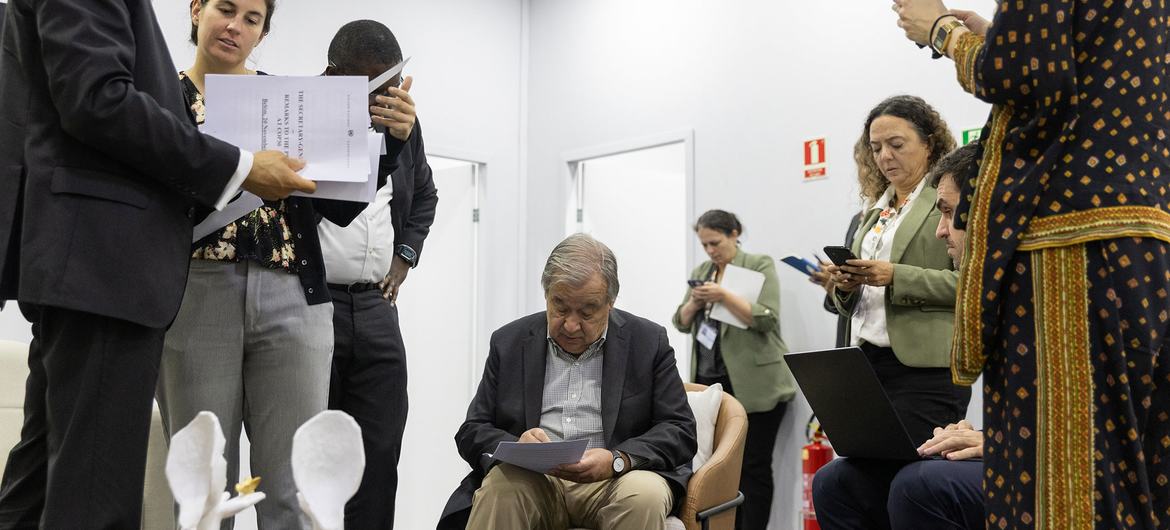
The UN Secretary-General António Guterres (centre) reviews documents with his colleagues at the UN Climate Conference in Brazil.

On fossil fuels, the UN chief called for a “just, orderly and equitable” transition, as agreed at COP28. “There can be no solution if there is not, at the same time, a just transition from fossil fuels to renewable energy,” he said, urging an end to “market distortions that favour fossil fuels” and disinformation “designed to sabotage the transition.”

A few hours after the Secretary-General’s press briefing, a fire broke out in a pavilion at the COP30 venue in Belém, forcing evacuations and briefly disrupting tense negotiations. Brazilian and UN security teams assisted in clearing the area. The blaze was quickly brought under control, and no injuries were reported. The cause of the fire was not immediately known. More here.

Lula: ‘We must start thinking about how to live without fossil fuels’

At a press conference Wednesday night, President Lula said any roadmap for the energy transition “must be taken seriously.” Brazil introduced the idea of a roadmap, he explained, “because we need to show society that we are serious. We do not want to impose anything on anyone, nor set deadlines. Each country must decide what it can do within its own timeframe and capacities.”

He added: “If fossil fuels generate [a majority of greenhouse] emissions, we must start thinking about how to live without them – and how to build that path. And I say this very comfortably, as the leader of a country that has oil, that extracts five million barrels a day.”

President Lula highlighted Brazil’s use of ethanol and biodiesel and called for oil companies, mining firms and the “super-rich” to contribute their share. He urged multilateral banks to stop charging “exorbitant interest rates” to African nations and the poorest countries in Latin America, converting part of those debts into investments.

The President praised public engagement at COP30, noting the 15 November ‘Peoples March’ was “exceptionally beautiful and orderly,” and celebrated record participation of 3,500 Indigenous people and “full participation” of women.

UN News is reporting from Belém, bringing you front-row coverage of everything unfolding at COP30.

Jamaica: International support ‘crucial’ to hurricane recovery says Guterres

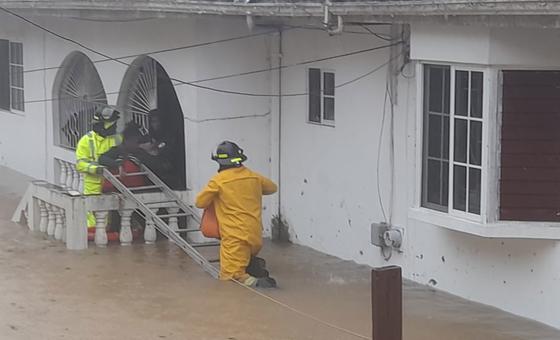
António Guterres spoke by phone to Jamaica’s Prime Minister Andrew Holness earlier in the day emphasising afterwards in a statement that “international support is crucial” as the country deals with the effects of the category 5 storm which brought rain, storm surges and catastrophic flooding.

He calls for the mobilisation of massive resources to deal with the loss and damage from the hurricane,” said the Deputy UN Spokesperson.

UN provides $4m aid injection

The UN Emergency Relief Coordinator, Tom Fletcher, has allocated $4 million from the Central Emergency Response Fund (CERF) so agencies and their partners can rapidly scale up humanitarian operations in Jamaica.

Five days after the most powerful storm in the island’s history made landfall in the west, many residents are still waiting for aid to arrive, according to local news reports, with many roads still inaccessible and communities without power and running water.   

The Government reported on Saturday that the death toll has risen to at least 28. The top UN official on the island, Dennis Zulu, told UN News on Friday that around 13 UN agencies were working as quickly as possible alongside authorities to clear roads and make essential repairs.

“My team here remains committed…to ensure that Jamaica gets back on its feet,” he said.

Support for vulnerable children

UN children’s agency, UNICEF, said on Saturday more than 700,000 children across the Caribbean had been impacted by the hurricane, which also made landfall in Cuba and caused chaos across western Haiti.

UNICEF is supporting the Jamaican Government to reach more than 284,000 children to address urgent nutrition needs, access to safe water, sanitation and hygiene including mental health support.

In Haiti, UNICEF is deploying hygiene and emergency health kits, cash to households at risk and engaging communities.

UN aid coordination office, OCHA, accompanied UNICEF at José Martí airport in Cuba on Saturday to unload supplies for over 90,000 people affected by Melissa – alongside national authorities – working as a single team, driving emergency response.

International solidarity ‘a lifeline’

UN relief chief Tom Fletcher, said on Friday: “In times like this, international solidarity isn’t just a principle – it’s a lifeline.”

An OCHA team has been deployed to Jamaica to strengthen coordination and information management.

UN agencies and NGOs are helping restore access, deliver emergency health and water services, and assist communities whose homes, schools and hospitals have been hit hard.

Well-prepared in Cuba

A $4 million allocation from the OCHA-managed CERF for Cuba, allowed UN agencies to position life-saving support before the storm hit.

  • The World Food Programme (WFP) provided food for 180,000 people;
  • UNICEF deployed mobile water-treatment units and hygiene kits for thousands;
  • the Pan-American Health Organization (PAHO) airlifted medical supplies and generators;
  • the Food and Agriculture Organization (FAO) and UN Development Programme (UNDP) moved seeds and tarpaulins to protect livelihoods and homes;
  • and reproductive health agency, UNFPA, distributed health and dignity kits.

The Cuban Red Cross assisted with preventive evacuations, early-warning messages and psychosocial support, in coordination with the International Federation of Red Cross (IFRC).

Early-warnings across Haiti

In Haiti, a country reeling from a massive humanitarian crisis and deadly armed violence, humanitarian teams are working alongside national authorities to respond to the urgent needs. Several days before the hurricane struck a $4 million CERF allocation allowed aid to be pre-positioned.

In addition, over 3.5 million alerts were sent out to vulnerable populations, saving lives. UN agencies and partners are now supporting temporary shelters and providing food, shelter, non-food items and cash assistance.

“Local leadership, global solidarity, and early action are saving lives across the region,” Mr. Fletcher said. “This is the humanitarian reset at work – acting together with greater impact.”

In Southeast Asia, Guterres presses the case for climate action

Addressing a joint summit between the UN and Southeast Asian nations in Kuala Lumpur on Monday, Secretary-General António Guterres described the region as “a beacon of cooperation” and a vital pillar of global stability.

With Timor-Leste’s accession, he said, the collective spirit of the regional organization known as ASEAN had “grown stronger,” making the bloc an essential partner in shaping “a more balanced and interlinked world.”

The Association of Southeast Asian Nations now has 11 full members, alongside partners which include China, India, the European Union, Russia and Australia.

The UN, for its part, has a comprehensive partnership framework with the bloc as well as plans for joint action.

Peace, Myanmar and regional stability

Mr. Guterres outlined four areas of deepening collaboration – peace and prevention; sustainable development and financial justice; climate action and digital transformation.

He commended ASEAN countries for their strong contributions to peacekeeping and regional mediation efforts.

The UN chief praised Malaysia for helping to facilitate a ceasefire between Cambodia and Thailand, and reiterated the importance of dialogue and restraint in the South China Sea to uphold international law and freedom of navigation.

Turning to Myanmar, the Secretary-General condemned ongoing violence, describing the humanitarian situation as “appalling.”

“Thousands are dead. Millions displaced. Humanitarian needs are soaring,” he said, calling for an immediate halt to hostilities, protection of civilians, and “the release of those arbitrarily detained, including democratically elected leaders.”

He reaffirmed the UN’s support for ASEAN’s 2021 Five-Point Consensus to resolve Myanmar’s protracted conflict following the coup – and the Security Council resolution demanding a ceasefire that same year.

A fairer financial system

The Secretary-General also made a strong call for overhauling what he described as an “outdated and unfair” global financial architecture that leaves developing nations “locked out of prosperity.”

“It is high time for reform,” he said, noting that ASEAN economies remain underrepresented in global financial institutions despite their growing economic weight.

Climate change target ‘on life support’

In his keynote address, the Secretary-General warned that the target on limiting global warming to 1.5 degrees Celsius above pre-industrial levels “is on life support,” urging both developed and developing nations to step up climate ambition ahead of COP30 in Brazil next month.

On digital transformation, he underscored the UN’s commitment to ensuring artificial intelligence serves humanity.

Standing together

At a press conference following the Summit, Mr. Guterres said ASEAN “offers a vision of hope” amid global uncertainty.

“The United Nations is proud to be ASEAN’s partner,” he said, “as we work to ensure a better, more peaceful future for people across the southeast Asian region and around the world.”

Indirect disaster effects cost the world nearly $2 trillion per year, Guterres says on International Day

Most of the exorbitant costs of disaster are preventable with proper funding and planning —one of the main messages for this year’s International Day for Disaster Risk Reduction, themed Fund Resilience, Not Disasters, observed on Monday.

“Every dollar invested in resilience saves many more in avoided losses and protects the dignity of those most at risk. The choice is ours. We can continue to fund disaster response or we can invest in resilience,” said Amy Pope, chief of the International Organization for Migration (IOM).

In 2024 alone, nearly 46 million people were displaced by disasters, the highest number ever recorded, but disaster risk reduction efforts remain severely underfunded, according to the IOM. 

Preventable disaster costs

“As the climate crisis accelerates, disasters are multiplying and amplifying – devastating lives and livelihoods, erasing decades of development gains in an instant,” said UN Secretary-General António Guterres in his message to mark the Day. 

“The cost to the global economy is staggering: an estimated $2 trillion every year, when indirect costs are taken into account.”

Indirect costs include the wider social and ecosystem losses that come as a result of natural catastrophes. Earthquakes, floods, storms, droughts and heatwaves made up 95 per cent of direct costs in the past two decades, according to the report. 

“Wildfires in Europe and the Americas, and devastating earthquakes in Myanmar and Afghanistan prove that no country is immune, but the heaviest toll falls on communities already struggling with conflict, poverty, and hunger,” said Ms. Pope.

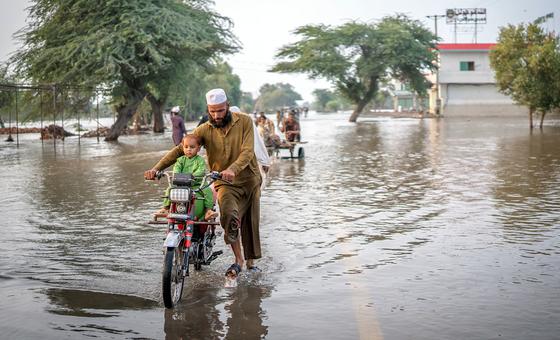
Different natural catastrophes affect different regions in the world. In South Sudan, annual floods can submerge houses, farmland and schools, forcing people to flee their homes and increasing food insecurity. 

As a disaster prevention measure, dykes have been constructed in South Sudan with the support of the IOM, protecting farmland and restoring livelihoods. 

Promoting disaster reduction 

The International Day for Disaster Risk Reduction was established in 1989 to foster a global culture of risk-awareness and celebrate how communities around the world are reducing their exposure to disasters. 

“The impact of disasters depends in large part on the choices we make, how strong our infrastructure is, how much we invest in prevention, and how well we protect the most vulnerable,” said Ms. Pope.

With planning and funding, the negative impacts of disasters can be reduced. Accordingly, this year’s Day call is for an increase in disaster risk funding and for the development of risk-adapted and resilient private investment. 

Mr. Guterres stressed that for every decision they make, the public and private sectors must take risk into account to minimise exposure and vulnerability to hazards. 

“On this Day, let’s commit to meet surging risk with a surge in funds, and build a safer and more equitable future for all,” he said. 

Guterres urges countries to ‘seize this historic opportunity’ as renewable energy use grows

The latest push follows the release of two reports on Tuesday which affirmed that the so-called “renewables revolution” is accelerating at unprecedented rates.

For the first time ever, renewable energy has generated more power than coal, according to new analysis by Ember, a global think tank working to speed up the clean energy transition.

Energy shift underway

Solar and wind outpaced the growth in global electricity demand in the first half of this year, resulting in a small decline in coal and gas when compared to the same period in 2024.

This represents “a crucial turning point,” according to Ember’s Senior Electricity Analyst, Małgorzata Wiatros-Motyka.

“Solar and wind are now growing fast enough to meet the world’s growing appetite for electricity. This marks the beginning of a shift where clean power is keeping pace with demand growth,” she said in a press release.

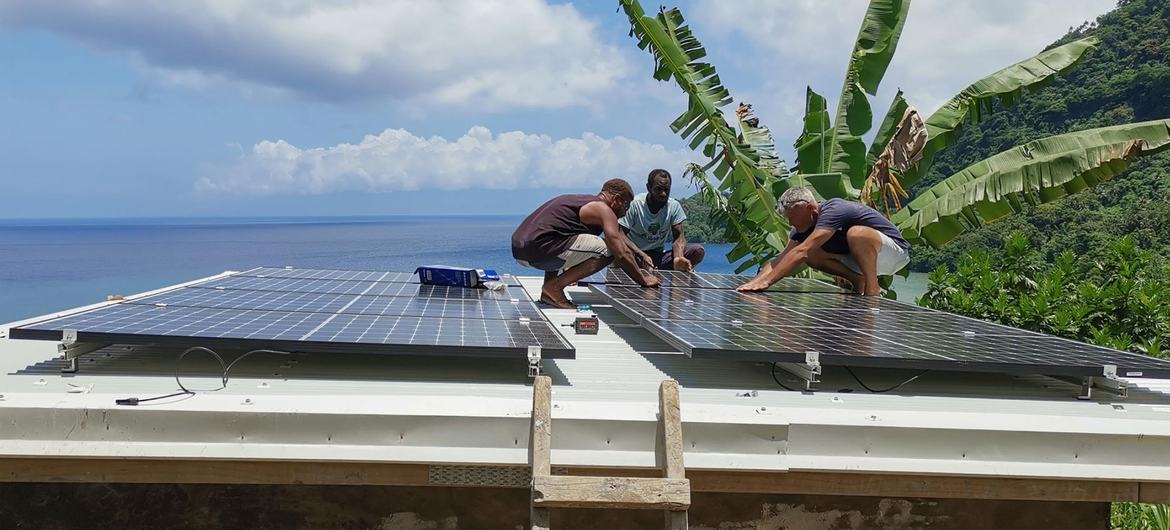
People in Vanuatu in the southwestern Pacific install solar panels on a roof.

Solar-powered success

In a separate report, the International Energy Agency (IEA) revealed how installed renewables power continues to grow and is expected to double by 2030.

Global renewable power capacity is projected to increase by 4,600 gigawatts (GW) – “roughly the equivalent of adding China, the European Union and Japan’s total power generation capacity combined,” the agency said.

Growth is being led by the rapid rise of solar PV (photovoltaic) technology, which converts sunlight into energy.  It will account for around 80 per cent of the increase, followed by wind, hydro, bioenergy and geothermal.

‘A better future for all’

In response to the news, UN Secretary-General António Guterres tweeted that “the clean energy future is no longer a distant promise – it’s here.” 

He urged the international community to “seize this historic opportunity and supercharge the global shift towards a better future for all.”

The reports echo the findings of the Secretary-General’s Moment of Opportunity report, issued in July.

They also reflect messages by world leaders attending his Climate Summit held last month during high-level week as part of the lead-up to the COP30 conference in Brazil this November. 

However, the UN chief has consistently stressed that whilst progress has been made, the energy transition is not yet fast or fair enough

Therefore, efforts need to be stepped up if the world is to meet the goal of limiting global temperature rise to 1.5 degrees Celsius above pre-industrial levels, as outlined in the Paris Agreement on climate change. 

France Joins UK, Canada, Australia and Portugal in Recognising Palestinian Statehood

France joins UK, Canada, Australia and Portugal in recognising Palestinian statehood at UN-backed conference

United Nations/New York: UN Secretary-General António Guterres on Monday reiterated that nothing can justify the October 7, 2023 Hamas attacks on Israel, nor the “collective punishment” inflicted on the Palestinian people in their aftermath. Calling for an “immediate” ceasefire in Gaza, he urged the release of all hostages and the opening of safe, unconditional and unhindered humanitarian corridors.

Speaking at the resumed international conference on Palestine, co-chaired with Saudi Arabia, Guterres warned that the viability of a two-state solution is being undermined by “relentless” settlement expansion, the “creeping threat of annexation” and a surge in settler violence in the West Bank.

“The time for peace has come because we are just a few moments away from no longer being able to seize peace,” he told delegates. “Let’s be clear: statehood for the Palestinians is a right, not a reward. Denying it would be a gift to extremists everywhere.”

France Backs Palestinian Statehood

The conference, held after the General Assembly overwhelmingly endorsed the first phase outcome declaration in July, saw fresh diplomatic momentum. The United Kingdom, Canada, Australia and Portugal formally recognised the State of Palestine on Sunday. French President Emmanuel Macron announced that Paris would follow suit, a declaration that drew lengthy applause.

“The recognition of the legitimate rights of the Palestinian people takes nothing away from the rights of the people of Israel, which France has supported from Day One,” Macron said. “This recognition is the only solution that will allow Israel to live in peace.”

Saudi Foreign Minister Faisal bin Farhan Al Saud praised the countries that had recognised Palestine and urged others to “take a similar historic step.” Such recognition, he said, would “support efforts towards the implementation of the two-State solution, achieve permanent and comprehensive peace in the Middle East, and create a new reality of stability and prosperity.”

ALSO READ: London’s Far-Right Rally Sends Shockwaves Through South Asian Communities

UN General Assembly President Annalena Baerbock acknowledged scepticism around the two-state formula, noting that the UN’s earliest resolutions on the issue date back to its founding years. But she stressed that pursuing the alternative would mean conceding to “evil” and risk “the end of this institution.”

“This is not a naïve wish,” Baerbock insisted. “The international community is committed not only to the principle of two states but to identifying tangible, timebound and irreversible steps for its realisation, backed by decisive measures and international guarantees.”

The conference underscored a growing shift among Western powers towards recognising Palestinian statehood, even as conditions on the ground remain volatile. For Guterres and other leaders, the message was clear: without urgent steps, the two-state solution risks slipping out of reach, with grave consequences for peace and security in the Middle East and beyond.

UN’s Guterres condemns gang attack in Haiti that killed at least 40

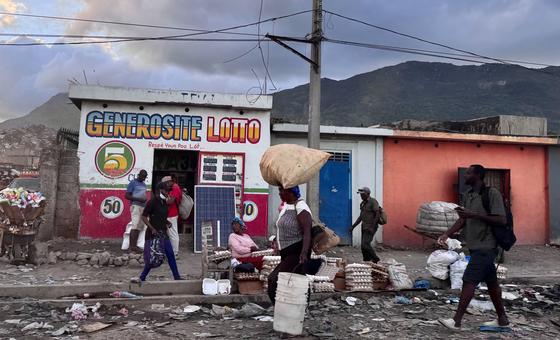
Representational Picture: Civilians left with no space safe to live in Haiti

The overnight assault on September 11 is the latest in a string of brutal incidents and ongoing gang violence that have plagued Haiti since last year.  In a statement issued by his spokesperson, Mr. Guterres expressed “condolences” to the victims’ families and urged Haitian authorities to pursue justice.

“The Secretary-General is alarmed by the levels of violence rocking Haiti,” said Stéphane Dujarric. “He calls on Member States to expedite support for the Multinational Security Support mission to assist the Haitian National Police.”

Just two weeks ago, Mr. Guterres addressed the UN Security Council, painting a grim picture of Haiti’s unraveling state. “State authority is crumbling,” he said, as armed groups tighten their grip on Port-au-Prince and surrounding regions, forcing families to flee and disrupting daily life.

With six million people in need of aid and 1.3 million displaced, Haiti’s humanitarian crisis is deepening. Yet less than 10 percent of the $908 million appeal has been funded. “Shamefully overlooked and woefully underfunded,” the UN chief said, warning that 1.7 million people may receive no assistance at all.

Violence unabated turns risky in future

The latest massacre in Labodrie, where dozens were killed this week, underscores the growing brutality of gangs such as Viv Ansanm, which now dominate major neighborhoods and supply routes. Kidnappings, extortion, and targeted attacks have surged, forcing families to abandon homes and seek refuge in makeshift shelters.

Since the 2021 assassination of President Jovenel Moïse, Haiti has struggled to restore political order. A Transitional Presidential Council governs today, but its legitimacy is widely questioned. Elections have been repeatedly delayed, fueling frustration and allowing gangs to fill the vacuum.

The Haitian National Police remain outnumbered and outgunned, even as international backers try to bolster its capacity. A U.N.-authorized security mission led by Kenya has deployed, but with limited personnel and resources, its ability to restore order remains in doubt. Proposals to expand the force to 5,500 troops are still under discussion.

The humanitarian fallout is staggering. According to U.N. estimates, nearly 1.3 million Haitians are displaced within the country. Food insecurity has reached emergency levels, with shortages worsened by blocked roads, gang control of supply chains, and inflation that has put basic staples out of reach for many. Hospitals and clinics are closing or operating at half capacity due to insecurity and lack of supplies.

International donors, including the United States, Canada, and members of CARICOM, have pledged support, but relief has been slow to materialize on the ground. Washington sees the crisis not only as a humanitarian catastrophe but also as a potential migration trigger that could push thousands toward U.S. shores.

Analysts warn that without a decisive and coordinated effort, Haiti risks sliding further into state collapse. “The longer the vacuum persists, the more gangs will consolidate power and the harder it will be to rebuild institutions,” a regional expert noted.

For now, ordinary Haitians face the brunt of the crisis, caught between a fragile state, predatory gangs, and an international community struggling to mount an effective response.


‘Peace is the most powerful force for a better future’: Guterres

António Guterres issued the call during the annual ceremony on the grounds of UN Headquarters in New York to ring the Peace Bell.

Pursuing the cause of peace is “the beating heart” of the Organization, “but today, peace is under siege,” he said.

“Conflicts are multiplying. Civilians are suffering. Human rights and international law are being trampled – leaving scenes that disgrace our common humanity.” 

Peace requires action

The ceremony comes ahead of the International Day of Peace on 21 September, and the theme this year is “Act Now for a Peaceful World”.

“We know that peace doesn’t happen by accident,” the Secretary-General said. “It is forged – through courage, compromise, and above all, action.”

He called for action “to silence the guns”, amplify diplomacy, protect civilians and uphold the UN Charter.

“We must act – to tackle the root causes of conflict – from inequality and exclusion, to hate speech, and climate chaos. We must act – to invest in prevention, dialogue and trust,” he continued.

“And we must act to support the peacebuilders – especially women and young people – who are on the frontlines of hope.”

Don’t give up: General Assembly President

The President of the UN General Assembly, Annalena Baerbock, also addressed the gathering.

Amid numerous conflicts worldwide, she questioned whether there would be less war without the United Nations, responding firmly that “definitely not.”

“This is not the moment to give up,” she said.  “It’s a moment to try even harder.”

‘Let peace ring’

The Secretary-General said that “peace is the most powerful force for a better future,” insisting that “it is within our grasp – if we choose it.”

This is the message of the Peace Bell, he added, cast in 1952 from coins and medals donated by people from all the over the world, “united in their yearning for peace”.

“This Peace Bell reminds us that even the smallest contributions can forge something enduring,” he said.

“Even in a fractured world, we can come together to let peace ring. Let’s answer that call.”

About the Peace Bell

The Japanese Peace Bell was presented as a gift to the United Nations from the UN Association of Japan on 8 June 1954.

On its side are eight Japanese characters that say, “Long live absolute world peace.”  

It is housed in a wooden structure resembling a traditional Shinto shrine.

The bell is rung twice a year on the first day of Spring, at the vernal equinox, and to commemorate the International Day of Peace.   

Source link

Ukraine: Guterres greatly concerned over reported Russian incursion into Polish airspace

Speaking at the regular news briefing in New York, UN Spokesperson Stéphane Dujarric said António Guterres is following the ensuing diplomatic fallout across the NATO military alliance “with great concern” the incident, which reportedly occurred amid a large-scale Russian drone and missile attack on Ukraine.

There is an urgent need for a full, immediate and unconditional ceasefire and for a just, comprehensive and sustainable peace in Ukraine – one that fully upholds Ukraine’s sovereignty, its independence and its territorial integrity, in line with the Charter of the United Nations, international law and relevant UN resolutions,” Mr. Dujarric said.

Multiple drones shot down

According to media reports, Polish authorities, with the support of NATO allies, shot down multiple Russian drones that crossed into the country overnight – the first time Russian drones have been downed over NATO territory.

Poland’s Prime Minster Donald Tusk warned that it put his nation at its closest point to open conflict since World War Two.

Poland joined the North Atlantic Treaty Organization, NATO, in 1999 along with Hungary and the Czech Republic as part of the military alliance’s first expansion into Central and Eastern Europe.

While some violations of Polish airspace have been reported since Russia’s full-scale invasion of Ukraine in 2022, the overnight incident highlights the conflict’s growing regional impact.

Media also reported Russia’s Defense Ministry stating that the strikes targeted Ukraine’s military-industrial sites in its western regions and that there were no intended targets in Poland.

The Secretary-General and the UN continue to urge all parties to respect international law.

Mr. Dujarric noted that the situation “again underlines the regional impact and real risk of expansion of this devastating conflict,” reiterating the UN’s call for protection of civilians and adherence to humanitarian norms.

Source link

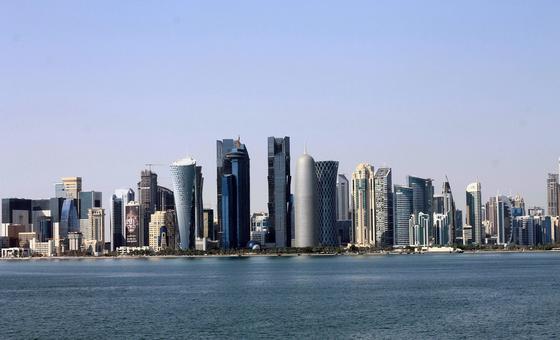
Guterres condemns Israeli strike on Hamas leaders in Qatar as ‘flagrant violation’

In a statement, António Guterres spoke out against what he called a “flagrant violation” of Qatari sovereignty and territorial integrity.

He insisted that all parties must focus on achieving a permanent ceasefire in Gaza, “not (on) destroying it”.

No senior leaders killed, claims Hamas

Hamas reported that six people had been killed, including the son of one of its exiled leaders from the Gaza Strip – but added that its senior negotiators and top officials had all survived.

Prime Minister Benjamin Netanyahu said that the attack had been Israel’s sole responsibility, although the White House Spokesperson said that the President of the United States had been informed in advance and directed his officials to alert Doha – but the message was conveyed too late to stop the attack.

President Donald Trump said in a social media post that bombing Qatar, a “sovereign nation and close ally” of the US, does not advance the goals of either Israel or the US.

‘Blatant violation’: Qatar

The Qatari Government condemned the attack as a “blatant violation of international law” and the Qatari Prime Minister said at a press conference that “there must be a response from the entire region to such barbaric actions.”

Qatar – alongside the US and Egypt – had brokered extensive efforts to end the Gaza war which began on 7 October 2023 when Hamas and other militants attacked settlements in southern Israel.

Source link

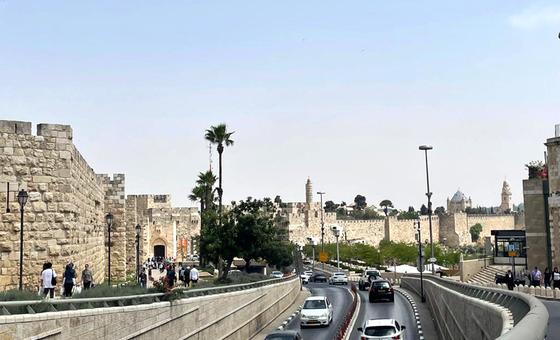
Guterres strongly condemns terror attack in Jerusalem

UN Secretary-General António Guterres strongly condemned the terror attack, his Spokesperson said in a statement.

“He conveys his heartfelt condolences to the families of the victims and wishes a full and speedy recovery to those who were wounded,” it said.

The incident took place at a busy intersection in Ramot, located in the northern outskirts of Jerusalem, on Monday morning.

Shot waiting for the bus

The gunmen reportedly opened fire on passengers waiting to board buses. Video footage from the scene showed that several buses had been hit extensively during the assault.

The attackers were identified by authorities as two Palestinians from the occupied West Bank. They were killed by a soldier and a civilian who were at the scene.

A Spanish national was among the victims, according to the country’s foreign ministry.

The shooting took place against the backdrop of the ongoing war in Gaza which has killed more than 63,000 Palestinians and injured more than 161,000 others, according to the local health authorities.


Source link

World News in Brief: Afghanistan quake update, Guterres in Papua New Guinea, Ebola returns to DR Congo, UN condemns attack on peacekeepers in South Sudan

Since the initial earthquake on Sunday in eastern Nangarhar province, landslides and several strong aftershocks have disrupted the work of rescue teams.

In an update, the UN Children’s Fund, UNICEF, said that access routes remain blocked in various locations including the districts of Chawkay and Nurgal, both in Kunar province, although the authorities have deployed earth-moving machinery to restore access.

Latest estimates indicate that approximately half a million people have been affected – including 263,000 children – while at least 5,000 homes have suffered partial or total damage.

Tremors continue

Among the UN agencies operating there, UN Habitat noted that the earthquake had caused massive upheaval in a remote region where recent returnees from Pakistan and Iran were just beginning to settle.

“There are still more earthquakes every day in the region, causing landslides and making access even harder,” said UN Habitat’s Stephanie Loose in the capital, Kabul.

She noted that women and girls were the main victims because of strict rules preventing them from leaving their homes alone.

“Many of them, due to cultural norms or restrictions imposed, didn’t dare to leave their houses; nor are there sufficient female doctors in the country, and I understand they are not able to reach the women who would need it,” Ms. Loose said.

Papua New Guinea’s on the frontline of climate change, warns Guterres

Papua New Guinea and the Pacific islands are climate change’s “Ground Zero” whose precious rain forests and ecosystems deserve the world’s support to ensure they’re protected, the UN Secretary-General said on Thursday.

Speaking from Papua New Guinea where he visited the world’s third largest rainforest and sat down with civil society representatives, António Guterres highlighted the challenges brought about by climate change in the region.

It’s the first ever visit to the southwest Pacific nation by a sitting Secretary-General.

Earlier, he repeated his warning that the 1.5 degree limit on the rise in global temperatures agreed to under the 2015 Paris Agreement remains in jeopardy.

And although scientists say that it is still possible to limit global warming, the UN chief urged countries to unveil their new national climate plans to reduce emissions and “seize the opportunities” arising from the renewable energy revolution.

New Ebola outbreak declared in DR Congo

Health authorities in the Democratic Republic of the Congo (DRC) have declared an outbreak of Ebola virus disease in Kasai province where 28 suspected cases and 15 deaths – including four health workers – have been reported as of Thursday.

The outbreak is concentrated in the Bulape and Mweka health zones in Kasai Province, in the south-central region of DRC. Symptoms of the rare – but severe – and often fatal illness, include fever, vomiting, diarrhoea and haemorrhaging.

Samples tested on 3 September at the country’s National Institute of Biomedical Research in the capital Kinshasa confirmed the cause of the outbreak as the Ebola Zaire strain.

Experts deployed

A national Rapid Response Team assisted by UN World Health Organization (WHO) experts in epidemiology, infection prevention and control – as well as case management – has been deployed to Kasai province.

Communication experts have also been deployed to reach communities and help them understand how to protect themselves.

Additionally, WHO is delivering two tonnes of supplies including personal protective equipment, mobile laboratory equipment and medical supplies.

The area is difficult to reach and at least a day’s drive from the provincial capital Tshikapa, with few air links.   

“We’re acting with determination to rapidly halt the spread of the virus and protect communities,” said Dr Mohamed Janabi, WHO Regional Director for Africa.

“Banking on the country’s long-standing expertise in controlling viral disease outbreaks, we’re working closely with the health authorities to quickly scale up key response measures to end the outbreak as soon as possible.”

Cases likely to rise

Case numbers are likely to increase as transmission is ongoing.

The country has a stockpile of treatments, as well as 2,000 doses of the Ervebo Ebola vaccine already prepositioned in the capital city Kinshasa that will be quickly moved to Kasai to vaccinate contacts and frontline health workers.   

The DRC’s last outbreak affected the northwestern Equateur province in April 2022.

It was brought under control in under three months thanks to the robust efforts of the health authorities. In Kasai province, previous outbreaks of Ebola virus disease were reported in 2007 and 2008. In the country overall, there have been 15 outbreaks since the disease was first identified in 1976.

UN condemns attack on peacekeepers in South Sudan

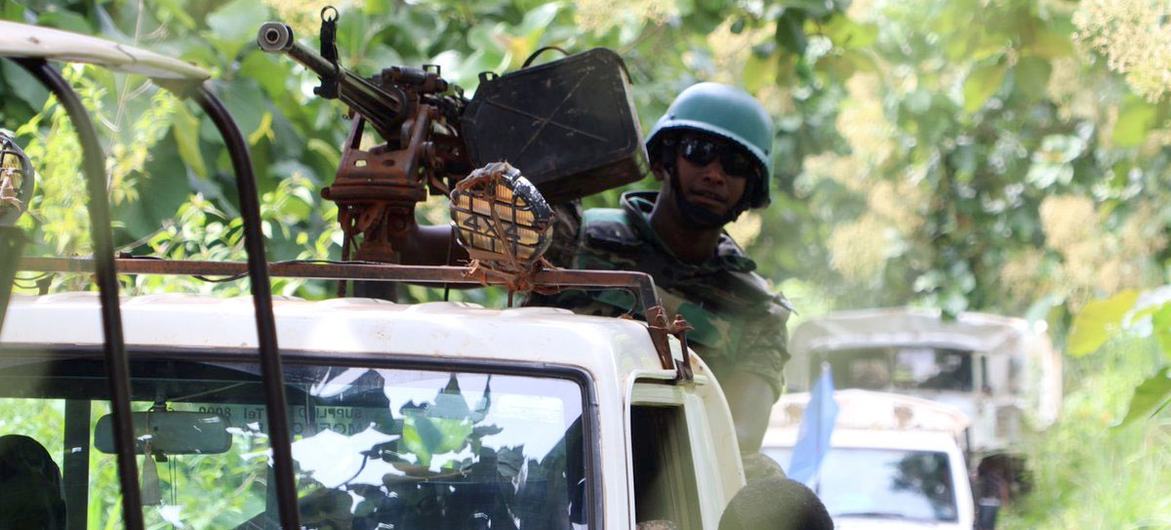
The UN peacekeeping mission in South Sudan, UNMISS, has condemned an attack by a local armed group which targeted “blue helmets” in Western Equatoria state.

The militants subsequently seized a small cache of weapons and ammunition. The incident occurred while peacekeepers were conducting a patrol between Tambura and Mapuse.

“We emphasise that any attack against peacekeepers may constitute a war crime,” UN Spokesperson Stéphane Dujarric said at the daily press briefing in New York on Thursday.

“These peacekeepers are deployed to protect civilians at a time when access and security remain fragile across Western Equatoria,” he added.

Meanwhile, widespread flooding is also impacting hundreds of thousands of people in several parts of the world’s youngest nation, which became embroiled in civil war soon after gaining independence in 2011.

A fragile 2018 peace accord is in danger of unravelling amid fresh offensives and deteriorating humanitarian conditions.

Flooding affects 270,000

Local reports suggest that over 270,000 people are affected by flooding in 12 counties across four states.

These areas were already grappling with floods, displacement, food security and cholera, said Mr. Dujarric, with farmland, homes and humanitarian facilities now submerged, disrupting access to education, health, nutrition and water services.

UN humanitarians say overcrowding at relocation sites has led to tensions among displaced families at the same time, reports of waterborne diseases and snake bites are increasing public health risks.

Peacekeepers serving with the UN Mission in South Sudan (UNMISS) have increased their presence and intensified vehicle patrols, navigating treacherous, rain-soaked routes both day and night.

Guterres hails Papua New Guinea as an example of diversity, dialogue and climate action

António Guterres is the first serving UN Secretary-General to visit the country, which is celebrating 50 years of independence.

He praised its tremendous diversity, with over 800 languages spoken and countless traditions.

Commitment to peace, dignity and progress

“And yet, you have a shared commitment to speak with one voice – to having ‘one talk’ – for peace, for dignity and for progress,” he said.

“You are champions of multilateralism and international solutions. And that spirit is urgently needed in our world today.”

He said that “Papua New Guinea offers a number of powerful lessons to the world”, with the first being forging consensus through dialogue.

The country has spent the past half century working to build “a single nation out of many traditions, many islands, many tongues”, which has not been easy.

Last Saturday, 30 August, marked 24 years since the signing of the Bougainville Peace Agreement. The accord between the Government and separatists ended a decade of conflict and established the autonomous Bougainville region.

Mr. Guterres said that while the conflict left deep scars, Papua New Guinea and Bougainville have stayed the course of peace for more than two decades.

“You have shown the world the path of healing through dialogue, perseverance and mutual respect,” he said, adding that people in Bougainville will go to the polls on Thursday in the fifth autonomous election since the agreement.

Leadership in climate action

Another lesson from Papua New Guinea has been bold climate action.

This was the Secretary-General’s first visit to the Pacific region since the International Court of Justice (ICJ), the UN’s highest judicial body, issued a landmark advisory opinion affirming that addressing the climate crisis is a legal obligation under international law.

As Pacific countries played a central role, the advisory opinion “is a testament to the leadership of Papua New Guinea, Melanesia and the wider Pacific region, particularly your young people, who make up 60 per cent of your population”, he said.

A crucial voice

“Your voice will be integral again during the annual UN climate conference in Belem, Brazil,” he said, warning that efforts to limit global temperature rise to 1.5 degrees Celsius are in jeopardy.

He urged countries to submit new national climate plans that align with this goal, cover all emissions across their economies and accelerate the transition from fossil fuels.

Mr. Guterres also called for action on climate finance, including stepping up contributions to the loss and damage fund, while richer countries must honour their promise to double adaptation finance and deliver $300 billion each year over the next decade.

Furthermore, as many developing countries are “drowning in unsustainable debt”, reform of the current international financial architecture is needed to make it fairer and more representative. The same applies to the UN Security Council and other international institutions.

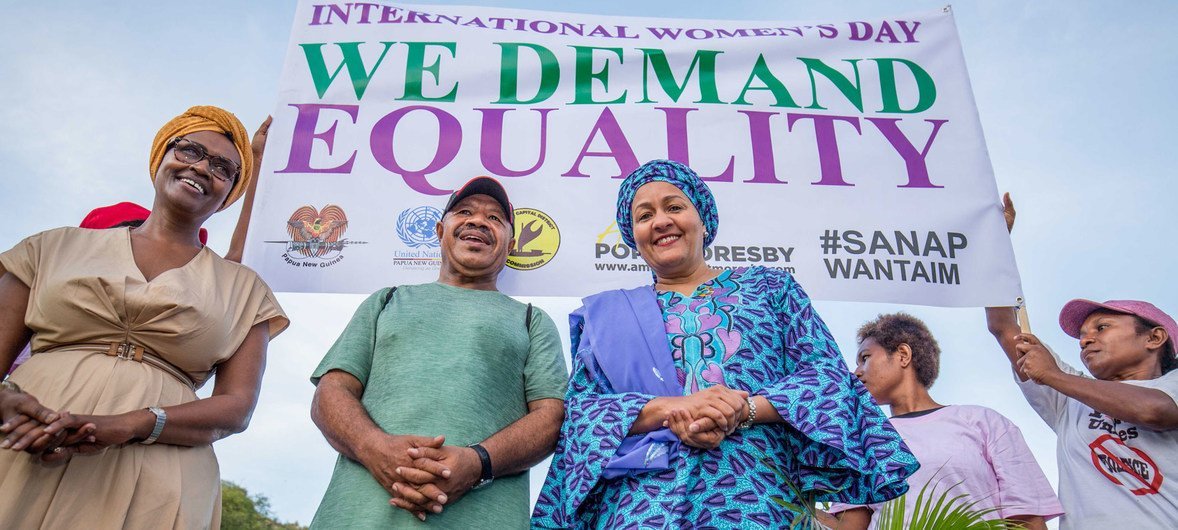
The UN Deputy Secretary-General, Amina Mohammed (centre right) joined a march in support of International Women’s Day in Port Moresby, Papua New Guinea, in March 2020.

Representation of women

The UN chief noted that Papua New Guinea once hosted peacekeepers, but today is a champion of peacebuilding and sustainable development.

He stressed, however, that “no story of peace or progress is complete without fully including half of the population”, highlighting another area where the country can set an example.

He recalled that UN Deputy Secretary-General Amina Mohammed was there five years ago for the national launch of the Spotlight Initiative — part of the world’s largest effort to end all forms of violence against women and girls, a challenge that exists in all societies.

In March, parliament devoted an entire day to testimonies on gender-based violence, marking a vital step.

“Ensuring greater voice and representation of women is not only a matter of justice — it is a matter of national strength,” he said.

“Families thrive. Communities grow stronger. And institutions become more responsive when we uphold the rights of all.”  

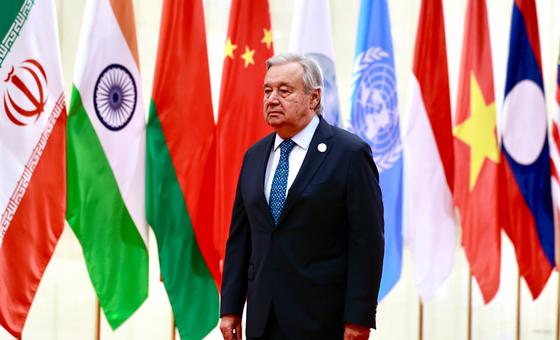
Shanghai Cooperation Organization summit: Guterres calls for strengthening multilateralism

The Eurasian bloc, comprising 10 member states, is the world’s largest regional organization by population and geography.

Mr. Guterres told leaders that “we are moving towards a multipolar world”, which is both a reality and an opportunity.

He said emerging economies are reshaping trade, diplomacy and development, but at the same time, injustices and divisions are widening.

Principled leadership needed

He stressed the need for principled leadership to strengthen multilateralism, uphold the rule of law, and deliver for people everywhere.

“The Shanghai Cooperation Organization is uniquely positioned to help shape a more peaceful, inclusive, and sustainable future,” he said.

The UN chief highlighted four priority areas, starting with peace and security.

Peace in Gaza and beyond

He pointed to the situation in Gaza, where the scale of death and destruction is horrific and famine has taken hold.

“We need an immediate and permanent ceasefire; the immediate and unconditional release of all hostages; and unimpeded, safe and sustained humanitarian access,” he said.

“And we must advance concrete and irreversible steps toward a two-State solution – the only path to a just and lasting peace for both Palestinians and Israelis.”

Mr. Guterres also addressed the war in Ukraine, saying “it is past time for a ceasefire leading to a just, comprehensive and sustainable peace – in line with the UN Charter, international law, and UN resolutions.”

He also called for protection of civilians, fostering dialogue and securing peace in Sudan, Myanmar, the Sahel, Afghanistan and beyond.

“Your leadership in diplomacy and de-escalation is essential, as are your efforts against terrorism and transnational threats,” he told leaders.

Reform and climate action

The Secretary-General called for reform of the global financial architecture to ensure fair representation for developing countries.

“We are no longer in 1945 – and our institutions must reflect today’s realities,” he said.

The third area for action concerns confronting climate change.

“We are reaching a tipping point and need meaningful reductions of emissions. G20 countries – responsible for 80 per cent of global emissions – must lead,” he said.

He urged all governments to submit new climate action plans before the COP30 UN climate conference in Brazil this November. 

“We must also set a clear path to delivering $1.3 trillion by 2030.  Developed countries must honour their commitments. And we need a breakthrough on adaptation,” he added.

He called for doubling adaptation finance, scaling up early warning systems, building resilient infrastructure and phasing out fossil fuels while speeding up the transition to renewable energy.

Cooperation on technology

The final area for action is digital cooperation as new technologies bring both opportunities and risks.

He said the UN General Assembly has just established two mechanisms – an Independent Scientific Panel and a Global Dialogue on governance of artificial intelligence (AI) – to give all countries a voice and prevent fragmentation.

“These mechanisms mark a breakthrough for global AI cooperation – leveraging the unique convening power of the United Nations,” he said.

Put people first

In conclusion, he said that as the UN marks its 80th anniversary, countries must strengthen international cooperation for the 21st century and always put people first.

In this regard, he welcomed China’s Global Governance Initiative, announced that day, which “is anchored in multilateralism and underscores the importance of safeguarding the international system with the UN at its core and the international order underpinned by international law.”

Source link