
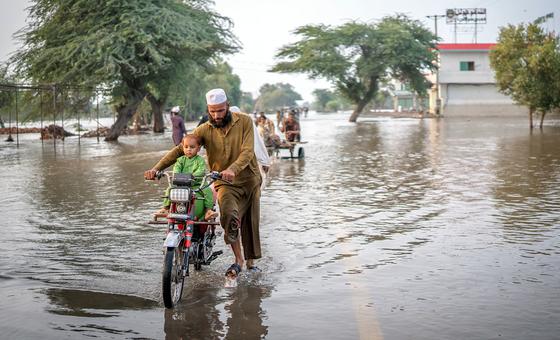
From shelter to strength: How disaster refuges protect lives in Palau

Palau’s biodiversity is threatened by rising sea levels.

Climate change, a personal issue

For Techitong, these climate related hazards are deeply personal.

“I fear the places I grew up in might be underwater in the next decades,” he said. “I don’t want future generations to only hear stories about what Palau used to be. That’s what drives me.”

Today, he works with the International Organization for Migration (IOM) in Palau alongside the National Emergency Management Office (NEMO), overseeing the strengthening of climate-resilient disaster shelters across the country.

Techitong visits one of the IOM-supported disaster shelters.

Strengthening national resilience

Techitong’s work is part of a broader effort by the United Nations to support Palau’s resilience to the adverse effects of extreme weather events through an integrated, long-term approach.

The UN works alongside the Government of Palau and civil society across four interconnected pillars: People, planet, prosperity, and peace.

Building community resilience to extreme weather events and strengthening disaster risk reduction cuts across all four of these pillars, as resilience is not only environmental, but also social, economic and institutional.

The shelters Techitong oversees put this vision into practice.

Techitong speaks to one of the construction workers building shelters.

The shelters are designed to function as a connected national network of safe spaces accessible to all people during emergencies.

Built to withstand high winds, heavy rainfall and flooding, they will be equipped with typhoon shutters, rainwater catchment systems, solar lighting, generators, and water filtration systems.

Four out of the eight shelters have already been strengthened and handed over to the community in Palau.

“The strengthened shelters consider the needs of persons with disabilities and other vulnerable people, so no one is left behind during emergencies,” said Alex Iyar, a community member involved in the consultations that led to the development of this project.

Beyond infrastructure, the project is strengthening local capacity. Community-based Red Cross Disaster Action Teams are being trained to manage shelters before, during and after emergencies, reinforcing local leadership and ownership.

It gives me hope that my children still be able to enjoy the best parts of Palau that I grew up with.

Addressing displacement risk and protecting social cohesion

Across the Pacific, climate displacement is increasingly common. According to IOM data on global displacement trends, weather-related disasters have triggered hundreds of millions of internal displacements over the past decade.

Disaster events are fundamentally reshaping patterns of mobility worldwide, disproportionately affecting small island States like Palau.

While disaster shelters cannot stop the sea from rising, they can buy time, protect lives and help communities remain rooted for as long as possible.

For Di Maech, a local Palauan conservation worker, this matters deeply. “In Palau, our communities are learning, growing, and finding ways to be resilient in the face of disasters thanks to UN-supported projects.

“It gives me hope that my children still be able to enjoy the best parts of Palau that I grew up with.”

UN Micronesia/Carlota Nunez

Di Maech is a Palauan conservation worker.

Investing in youth leadership

IOM’s Techitong believes the shelters are central to national resilience. “These shelters are not just emergency refuges, they are community hubs that support preparedness, connection and adaptation,” he said.

Techitong still swims in the ocean when he can. The water remains beautiful, powerful and deeply familiar, even as it carries new uncertainty.

“I grew up learning how to move with the waves,” he says. “Now my work is about making sure our communities can do the same. Adapt, protect each other, and keep Palau standing.”

UN Micronesia/Carlota Nunez

Young Palauans play volleyball in Kuabes park, an area that could be underwater in the next 30 years.

Indirect disaster effects cost the world nearly $2 trillion per year, Guterres says on International Day

Most of the exorbitant costs of disaster are preventable with proper funding and planning —one of the main messages for this year’s International Day for Disaster Risk Reduction, themed Fund Resilience, Not Disasters, observed on Monday.

“Every dollar invested in resilience saves many more in avoided losses and protects the dignity of those most at risk. The choice is ours. We can continue to fund disaster response or we can invest in resilience,” said Amy Pope, chief of the International Organization for Migration (IOM).

In 2024 alone, nearly 46 million people were displaced by disasters, the highest number ever recorded, but disaster risk reduction efforts remain severely underfunded, according to the IOM. 

Preventable disaster costs

“As the climate crisis accelerates, disasters are multiplying and amplifying – devastating lives and livelihoods, erasing decades of development gains in an instant,” said UN Secretary-General António Guterres in his message to mark the Day. 

“The cost to the global economy is staggering: an estimated $2 trillion every year, when indirect costs are taken into account.”

Indirect costs include the wider social and ecosystem losses that come as a result of natural catastrophes. Earthquakes, floods, storms, droughts and heatwaves made up 95 per cent of direct costs in the past two decades, according to the report. 

“Wildfires in Europe and the Americas, and devastating earthquakes in Myanmar and Afghanistan prove that no country is immune, but the heaviest toll falls on communities already struggling with conflict, poverty, and hunger,” said Ms. Pope.

Different natural catastrophes affect different regions in the world. In South Sudan, annual floods can submerge houses, farmland and schools, forcing people to flee their homes and increasing food insecurity. 

As a disaster prevention measure, dykes have been constructed in South Sudan with the support of the IOM, protecting farmland and restoring livelihoods. 

Promoting disaster reduction 

The International Day for Disaster Risk Reduction was established in 1989 to foster a global culture of risk-awareness and celebrate how communities around the world are reducing their exposure to disasters. 

“The impact of disasters depends in large part on the choices we make, how strong our infrastructure is, how much we invest in prevention, and how well we protect the most vulnerable,” said Ms. Pope.

With planning and funding, the negative impacts of disasters can be reduced. Accordingly, this year’s Day call is for an increase in disaster risk funding and for the development of risk-adapted and resilient private investment. 

Mr. Guterres stressed that for every decision they make, the public and private sectors must take risk into account to minimise exposure and vulnerability to hazards. 

“On this Day, let’s commit to meet surging risk with a surge in funds, and build a safer and more equitable future for all,” he said. 
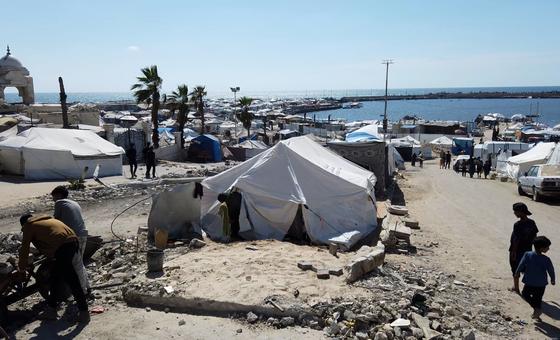
More Gazans killed trying to get food, healthcare near to ‘full disaster’

 “We are walking the fine grey line between operational capacity and full disaster, every day,” said Dr Thanos Gargavanis, WHO trauma surgeon and emergency officer, speaking from the enclave.

The veteran UN medic’s comments came amid new reports on Tuesday morning that more Palestinians had been killed trying to access food, this time near an aid distribution site in Khan Younis in southern Gaza.

The mass casualty event left “hundreds of casualties, completely overwhelming Nasser Medical Complex” in Khan Younis, said WHO’s Representative in the occupied Palestinian territory, Dr Rik Peeperkorn.

No-go zone

Across Gaza today, health services are “barely available” and difficult to access, Dr Peeperkorn said, since more than 80 per cent of Gaza’s territory is under evacuation orders.

“The shrinking humanitarian space makes every health activity way more difficult than the previous day,” Dr Gargavanis added.

Nasser Medical Complex is the largest referral hospital in Gaza and the only remaining main hospital in Khan Younis. It is situated within the evacuation zone announced by the Israeli military on 12 June.

The nearby Al-Amal Hospital – operated by the Palestinian Red Crescent Society (PRCS) – continues to provide services to patients already there, but it is unable to admit anyone else because of ongoing military operations.

“It is what we call a completely minimal functional hospital,” Dr Peeperkorn said.

Deadly impact of fuel shortages

Only 17 of Gaza’s 36 hospitals are currently partially functional, medical supplies are critically low and no fuel has entered the Strip for more than 100 days.

The latest mass casualty event is just the latest involving Gazans trying to access aid amid ongoing severe restrictions placed on the amount of aid allowed into the Strip by Israel.

On Monday, more than 200 patients arrived at the Red Cross Field Hospital in Al Mawasi – the highest number received by the facility in a single mass casualty incident. Of that number, 28 patients were reportedly declared dead, WHO’s Dr Peeperkorn said.

Just one day earlier, on 15 June, the same hospital received at least 170 patients, who reportedly had been trying to access a food distribution site.

“The recent food distribution initiatives by non-UN actors every time result in mass casualty incidents,” WHO’s Dr Gargavanis insisted.

Private aid plan fallout

Since late May, the UN and humanitarian partners have been sidelined in Gaza as a new aid distribution model backed by Israel and the United States began operations under the framework of the Gaza Humanitarian Foundation (GHF), which uses private military contractors. 

The WHO trauma surgeon highlighted a “constant correlation” between the locations of food distribution spots and the mass casualty incidents in Rafah, in Khan Younis and along the Netzarim corridor.

Asked about the type of injuries sustained by those seeking aid, and who is responsible, Dr Garavanis stressed that WHO is not a forensic agency.

“We’re not in a position to clearly identify from the nature of the injury” who has caused it, he said. “What we can say, though, is that we’re talking of gunshot wound injuries, and we’re talking of very few incidents of shrapnel injuries.”

The UN has repeatedly warned that the new aid distribution system does not meet humanitarian principles of humanity, impartiality, independence and neutrality. The global body has also called for aid restrictions to be lifted.

Dr Peeperkorn insisted that the WHO must be facilitated to move supplies into Gaza in a cost-effective manner “via all possible routes” to prevent further shutdowns of medical services. He said that 33 WHO trucks with supplies are waiting at Al Arish in Egypt to be granted passage into the enclave, with another 15 standing by in the occupied West Bank.

Source link

Massive 7.6-magnitude earthquake hits Papua New Guinea, 4 dead, several others seriously injured

Port Moresby, Sep 12 (IANS) At least four people killed and several others seriously injured after a massive 7.6-magnitude earthquake hit Papua New Guinea (PNG), authorities said on Monday.

The UN Office for the Coordination of Humanitarian Affairs’ regional branch in the Asia-Pacific said that among the fatalities were one in the Rai Coast district of the Madang province, and three in the town of Wau of the Morobe province, reports Xinhua news agency.

All were buried in landslides.

Some other people in Morobe were injured due to falling structures or debris, and there was damage reported to health centres, homes, rural roads and highways, according to the provincial disaster management agency.

The regional power grid, Internet cables, and the regional highway were damaged, but regional commercial airports have remained in operation, said the report.

Parts of the Highlands Highway, which connects the second largest city of Lae to the Highlands provinces, were damaged.

Areas along Markham and Ramu in Eastern Highlands were espeinjuredcially affected.

Local newspaper Post-Courier reported on Monday that many shops in Lae remained closed due to their stock being damaged.

PNG Prime Minister James Marape said that national and provincial disaster agencies had begun to assess the damage done to buildings and infrastructure such as roads and power supplies.

Marape said the estimated cost of the damage would not be known until at least Tuesday but assured the public that no expense would be spared to “restore our services and our people’s livelihoods”.

PNG is one of the world’s most geologically and seismically active areas and is usually hit with more than 100 earthquakes of magnitude 5 or greater each year.