UN chief ‘deeply concerned’ by escalation of violence in South Sudan

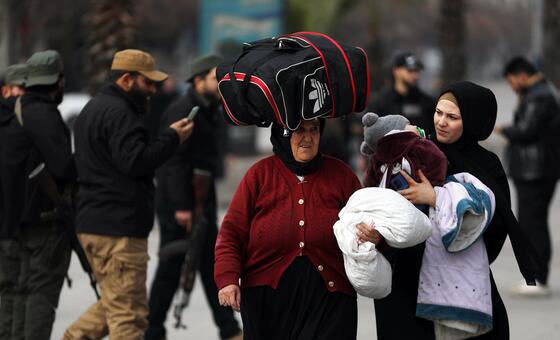
The tensions are concentrated in South Sudan’s Jonglei State, where many deaths and injuries have been reported in response to renewed fighting between opposition militia and army forces, leading to the displacement of 180,000 people. 

According to news reports, the army launched a major offensive in Jonglei against opposition forces, ordering civilian evacuations on Sunday and telling aid agencies to leave areas where military operations are ongoing. 

Secretary-General António Guterres said in a statement released on Thursday by his Spokesperson that he is “deeply concerned regarding the impact of the escalating violence”, adding that it “will further harm civilian populations who are already in a vulnerable situation”.

Aid and protection at risk

Mr Guterres emphasised the need to prioritise the protection of civilians and ensure the safe delivery of humanitarian aid and security in a country where two-thirds of the population are projected to require some form of aid. 

Calling on the military operations to stop, the Secretary-General urged the Government of South Sudan and opposition forces to take “immediate and decisive action to halt all military operations and deescalate the situation through inclusive dialogue.”

Political solution 

In the wake of a 2018 peace agreement between the president and his vice-presidential rival and following the establishment of a Revitalised Transitional Government in February 2020, elections have continued to be postponed. 

Mr Guterres’s statement reminded relevant parties to find a “political not military solution” and pave the way for a path to credible elections. 

The Secretary-General has welcomed efforts from the African Union and East African regional bloc IGAD in their support for inclusive dialogue.

Source link

Violence roiling Nigeria extends beyond religious lines, amid a deepening humanitarian crisis

The strikes thrust Nigeria’s long-running sectarian bloodshed into the global spotlight – and revived claims that a “Christian genocide” is unfolding in Africa’s most populous country.

But in an interview, the UN’s top humanitarian official in the country has told UN News that the current crisis extends far beyond any single community or conflict. Violence, he cautioned, has spread across much of the country, leaving millions displaced and fuelling what aid agencies describe as one of Africa’s largest – and most overlooked – humanitarian emergencies.

“Security remains one of Nigeria’s major challenges,” said Mohamed Malik Fall, the UN resident and humanitarian coordinator. “You can no longer associate it with a single region. It is almost everywhere.”

A conflict that spread

The crisis began in the northeast in 2009, with an insurgency led by the jihadist group Boko Haram, later joined by splinter factions, including the Islamic State-West Africa (ISIS-WA). 

Nearly two decades in, the violence has reshaped large parts of the country.

More than two million people remain displaced in the northeast alone, many of them for years. “An entire generation has grown up in displacement camps, knowing nothing else,” Mr. Fall said.

The human toll is extensive: more than 40,000 people killed since the start of the insurgency, thousands of schools and health centres destroyed, and vast agricultural areas rendered inaccessible. But Mr. Fall said the deeper damage has been economic and social.

“People have been cut off from all economic activity,” he said. “They are deprived of the ability to live from their work and preserve their dignity.”

Children walk through the mud in a displaced persons camp in Maiduguri in northeast Nigeria.

Untargeted violence

What was once a localized insurgency has morphed into something broader and more diffuse.

In Nigeria’s northwest – in states such as Zamfara, Katsina and Sokoto – armed criminal groups have seized control of rural areas, carrying out mass kidnappings and extortion, a phenomenon authorities describe as banditry. 

Entire villages have been abandoned, and around one million people are now displaced in the region, according to United Nations estimates.

In the country’s central belt, clashes between farmers and herders over land, intensified by climate pressure and environmental degradation, have triggered further displacement. 

Elsewhere, separatist movements and attacks linked to oil production continue to destabilize communities.

The cumulative result is a country with roughly 3.5 million internally displaced people – nearly 10 percent of all displacement across Africa.

A loaded claim

Recent attacks against churches and Christian schools have revived international attention. In January, more than 160 worshippers were abducted during Sunday services in Kaduna State. 

Days earlier, villages in the northwest were attacked, killing dozens, while students near a Catholic school in Papiri were again targeted.

The violence revived memories of the 2014 abduction of 276 schoolgirls from Chibok, most of them Christian, by Boko Haram – a moment that once galvanized global outrage.

Citing the need to protect Christians from Islamist militants, the US administration ordered airstrikes on Christmas Day against jihadist positions in northern Nigeria. In Washington, some officials have since argued that a “Christian genocide” is underway.

The UN is refraining from that characterisation.

“Attributing this violence to the targeted persecution of a religious group – I would not take that step,” Mr. Fall said. “The vast majority of the more than 40,000 people killed in the insurgency are Muslims. They were attacked and killed in mosques.”

He pointed to an attack in Maiduguri, the historic centre of the insurgency, carried out on Christmas Eve in an area “between a mosque and a market,” which killed Muslim worshippers as they left prayers.

“Insecurity affects everyone, without distinction of religion or ethnicity,” he said, warning that oversimplified narratives risk deepening social fractures rather than addressing their causes.

© WFP/Arete/Siegfried Modola

Internally displaced mothers with their children attend a WFP famine assessment exercise in Borno State, northeastern Nigeria.

A crisis measured in millions

Behind the violence lies a humanitarian emergency of enormous scale. In the northeastern states alone, 7.2 million people need assistance – nearly six million of them in severe or critical condition, according to U.N. figures.

Food insecurity has become the defining threat. Aid agencies project that up to 36 million Nigerians could face varying levels of food insecurity in the coming months. Among children under five, more than 3.5 million are at risk of acute malnutrition.

“The consequences are not only immediate,” Mr. Fall said. “Malnutrition affects cognitive development, education, and continues to shape lives well into adulthood.”

Climate shocks – including droughts and floods – have compounded the crisis, alongside recurring cholera and meningitis outbreaks and a fragile health system.

Aid shrinks as needs grow

Despite the scale of the emergency, funding has collapsed.

“A few years ago, Nigeria’s humanitarian response plan raised close to $1 billion annually,” Mr. Fall said. “In 2024, it was $585 million. Last year, barely $262 million. This year, we are not even certain we will reach $200 million.”

The decline comes as donor attention has shifted to higher-profile crises elsewhere, including Ukraine and Sudan.

A test for Africa’s largest economy

Nigeria’s predicament exposes a stark paradox: one of Africa’s largest economies confronting a humanitarian crisis more often associated with far poorer states.

“Nigeria is not Sudan. It is not Somalia. It is not South Sudan,” Mr. Fall said. “This is a country with resources. The primary responsibility for responding to humanitarian needs lies with the government.”

The UN is now urging Nigerian federal and state authorities to take greater ownership of the response, even as it presses donors not to turn away.

“No one wants to live on aid,” Mr. Fall said. “People would rather be helped to access economic opportunities than remain dependent. Giving a fish is good. Teaching how to fish is better.”

Source link

South Sudan: ‘All the conditions for a human catastrophe are present’

Briefing journalists based at UN Headquarters in New York on Friday, Anita Kiki Gbeho, Officer in Charge of the UN Mission in South Sudan (UNMISS), said Jonglei has become a ‘flashpoint’ for fighting, with civilians caught in the crossfire.

With over 200,000 people displaced by the conflict this month, the senior official – who also serves as Resident Coordinator – warned of a ‘sharp surge’ in cholera cases. 

Over 500 were reported nationwide this month whilst treatment centres are ‘overwhelmed’ and ‘critically short’ of supplies. 

Aid delivery difficulties

Although aid efforts are continuing with government support, access continues to be ‘severely challenged’ by road and river restrictions that are preventing aid distribution and medical evacuations. 

The world’s youngest nation gained independence in 2011 but soon slid into civil war with fighting between forces loyal to the national army under President Salva Kiir and those supporting main opposition leader Riek Machar, who is currently on trial facing serious charges, including murder, which he denies. 

Check out our explainer on the long running conflict, here.

A Government offensive got underway this week in three counties of Jonglei following opposition gains. All civilians and aid workers were urged to evacuate.

Humanitarian facilities ‘looted’ 

Ms. Gbeho told reporters that “humanitarian facilities are being looted and damaged (including at least seven [sites] in Jonglei), assets are being confiscated, and aid workers intimidated,” while the UN peacekeeping force is facing “similar challenges”. 

The disruptions to aid and peacebuilding efforts are having an “intolerable impact on people,” with the mission warning that “all the conditions for a human catastrophe are present.”

Speaking online from South Sudan, Ms. Gbeho underscored that despite the release of $10 million to support the humanitarian response from the Central Emergency Relief Fund, “more support is needed.” 

Restore peace 

Despite the shortages of supplies, Ms. Gbeho stated that the priority is “to stop the fighting, protect civilians and preserve the peace process” and to work with the African Union and the IGAD bloc of nations in the region to “restore adherence to the [2018] peace agreement.” 

Echoing the remarks of the Secretary-General on Thursday, Ms. Gbeho reiterated that “the solution to the current crisis is political, not military”, calling on the country’s leaders to take “urgent, immediate action to cease hostilities, de-escalate tensions through inclusive dialogue, and return to consensus-based decision-making”. 

‘A defining moment’

To conclude, Ms. Gbeho emphasised that “the power to make positive change rests with the South Sudanese themselves.” 

She described the juncture as “a defining moment – a critical junction for South Sudan. The decisions it makes now could either lead them on a path towards peace or to further conflict.” 

Source link

UN watchdog warns Ukraine war remains world’s biggest threat to nuclear safety

Addressing the International Atomic Energy Agency (IAEA) Board of Governors, Director General Rafael Grossi said the agency remains focused on preventing a nuclear accident as fighting continues to endanger critical infrastructure.

“The conflict in Ukraine is about to enter its fifth year,” Mr. Grossi said. “It continues to pose the world’s biggest threat to nuclear safety.

IAEA teams remain deployed at all nuclear power plants affected by the conflict and publish regular updates on nuclear safety and security conditions.

The Board of Governors is the IAEA’s main decision-making body, bringing together representatives of 35 countries to oversee nuclear safety, security and safeguards, and to guide the work of the UN nuclear watchdog. Its current membership includes, among others Russia, the United States, United Kingdom, and France.

Off-site power a critical safety lifeline

Mr. Grossi stressed that a central safety requirement is reliable off-site power – the electricity a plant receives from the national grid. Without it, nuclear sites must rely on backup systems to run cooling and other essential safety functions.

“There must be secure off-site power supply from the grid for all nuclear sites,” he said, pointing to the IAEA’s “Seven Pillars” guidance for nuclear safety during armed conflict, where off-site power is pillar number four.

He also cited Principle 3 of the IAEA’s Five Principles for protecting the Zaporizhzhya Nuclear Power Plant (ZNPP) that “all efforts should be made to ensure off-site power remains available and secure at all times.”

Mr. Grossi said both sets of guidance have broad international support, including from the parties directly involved, and that he has repeatedly called for adherence to them, including at the UN Security Council.

Progress at Zaporizhzhya amid ongoing risks

He reported recent progress at ZNPP, where Europe’s biggest plant was reconnected on 19 January to its last remaining 330-kilovolt backup power line after repairs were carried out under a temporary ceasefire negotiated with Ukrainian and Russian counterparts.  

The line had been damaged and disconnected since 2 January, reportedly due to military activity.

Until the reconnection, ZNPP relied on its last remaining 750-kilovolt main line to provide off-site power for safety systems needed to cool its six shutdown reactors and spent fuel pools. IAEA teams are also monitoring the plant’s ability to manage winter conditions, including keeping water in cooling and sprinkler ponds from freezing.

Beyond the plants themselves, Mr. Grossi warned that Ukraine’s electrical substations are also crucial to nuclear safety. “Damage to them undermines nuclear safety and must be avoided,” he said. An IAEA expert mission is now assessing 10 substations vital to nuclear safety amid ongoing strikes on the country’s power infrastructure.

Other nuclear sites also affected

IAEA teams have also reported military activity near other nuclear facilities, including the Chornobyl site, where damage to a critical substation disrupted multiple power lines and forced temporary reliance on emergency diesel generators. The affected lines have since been reconnected.

Mr. Grossi said the IAEA has shown how international institutions can help reduce risks and provide predictability in a volatile war. But, he added, technical measures have limits.

“The best way to ensure nuclear safety and security,” he said, “is to bring this conflict to an end.

Source link

World News in Brief: Syria ceasefire welcomed, ‘Olympic truce’, Ukraine’s freezing children

“We welcome efforts to bring stability to the region and now hope for a complete end to hostilities and a sustainable resolution,” said Chair of the independent UN Human Rights Council-mandated investigative team, Paulo Pinheiro, stressing the need to address acute humanitarian needs, including food, water and electricity.

Recognition of rights

He also welcomed a recent presidential decree recognising the cultural and citizenship rights of Syria’s Kurdish population.

The independent investigators called for strict adherence to international humanitarian law, warning of alarming reports of killings, abuse and desecration of bodies.  

“We are investigating alleged violations and abuses and will report on them in due course,” said Commissioner Monia Ammar.

Cold winter conditions, combined with limited access to basic services, risk proving catastrophic for displaced families, particularly children, the Commission warned. It voiced grave concern over the situation of detained children in prisons and camps, including Al-Hol – where thousands of family member of alleged former ISIL fighters are being held.

While noting some resumption of aid deliveries, Commissioner Fionnuala Ní Aoláin said assistance “must be augmented” and urged authorities to enable the safe and dignified return of women and children, while calling on States to urgently repatriate their child nationals.

UN urges ‘true mutual ceasefires’ for 2026 Winter Olympics

The UN General Assembly has called on warring parties in conflicts worldwide to agree to “true mutual ceasefires” during the 2026 Olympic Winter Games, reviving the ancient principle of the Olympic Truce.

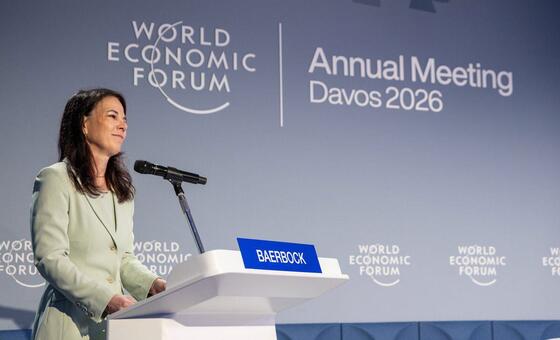
Taking note of a Solemn Appeal for the 80th session, read out by Germany’s Annalena Baerbock, who presides over the body, Member States were urged to use the Games as a window for peace. 

Humanity’s ‘common ground’

“The Olympic Truce proves that, even in times of division, humanity can still find common ground through sport,” she said.

The appeal recalls the Greek tradition of the ekecheiria, or Olympic Truce, which the Assembly has endorsed ahead of each Summer and Winter Games.

The upcoming Milano-Cortina Games will begin shortly, with the truce traditionally observed from seven days before the opening ceremony, until seven days after the Paralympics conclude.

“The Games will bring together athletes from all parts of the world,” Ms. Baerbock said, “as a means to promote peace, mutual understanding and goodwill among nations.”

The International Olympic Committee will fly the UN flag at Olympic venues as a symbol of peace.

UNICEF steps up winter response to protect children and families amid Ukraine’s harsh cold

Ukraine is once again facing a bitterly cold winter, with temperatures regularly dropping to around minus 20 degrees Celsius, or minus 4 Fahrenheit.  

The severe weather, combined with the widespread destruction of housing, energy, and heating infrastructure, continues to make the winter months particularly harsh, especially for children.

Among them is three-year-old Dasha, who has spent the past nine days in a flat without heating. Each night, her mother, Iryna, fills two five-litre plastic bottles with hot water and tucks them into Dasha’s cot.  

The challenges are compounded by rising poverty: among households with children, the rate has increased from 43 percent in 2021 to 65 percent in 2023.

Well over 3 million displaced

Today, around 3.3 million people, including more than half a million children, remain displaced within Ukraine.

Last year, the UN children agency’s (UNICEF) winter response reached 2.3 million people, including 380,000 children.  

In 2026, UNICEF appealed for $65 million to meet the needs of at least one million vulnerable people including 170,000 children.

Drawing on lessons from past winter campaigns, UNICEF’s response this year will focus on providing cost-effective cash support to families and schools, and strengthening district heating systems to ensure long-term, sustainable warmth. 

Source link

Reaching a child in Darfur is ‘hard-won and fragile’, says UNICEF

Briefing journalists in Geneva on Friday, Eva Hinds, the UN child agency’s Chief of Communications, described a humanitarian response that is fragile, painstaking and essential, following her return from a 10-day mission to Darfur.

For nearly three years, rival militaries who were former allies have been battling for control of the shattered country, engaged in a brutal civil conflict that has destablised multiple countries bordering Sudan. 

In Darfur today, reaching a single child can take days of negotiation, security clearances, and travel across sand roads under shifting frontlines,” she said. “Nothing about this crisis is simple: every movement is hard-won, every delivery fragile.

City built from fear

Ms. Hinds had just returned from Tawila, in North Darfur, where she witnessed what she described as an entire city rebuilt from desperation. Hundreds of thousands of people have fled violence and erected makeshift shelters from sticks, hay and plastic sheeting.

“Over 500,000 to 600,000 people are sheltering there,” she reported. “But standing inside that vast expanse of makeshift shelters was overwhelming. It felt like an entire city uprooted and rebuilt out of necessity and fear.

Despite the insecurity and logistical hurdles, UNICEF and its partners are still reaching children.

Effective aid operation

In just two weeks, more than 140,000 children were vaccinated, thousands treated for illness and malnutrition, safe water restored to tens of thousands, and temporary classrooms opened.

“It is painstaking, precarious work – delivered one convoy, one clinic, one classroom at a time – but for children in Darfur, it is the thin line between being abandoned and being reached,” Ms Hinds said.

She described meeting Doha, a teenage girl newly arrived from Al Fasher, who dreams of returning to school and one day teaching English. “Her name refers to the soft light just after sunrise,” Ms Hinds said. “She embodies that image – hopeful and determined.”

‘The children are freezing’

At a nutrition site, she met Fatima, a young girl being treated for malnutrition after losing her mother to the conflict.

At a centre for women and girls, mothers spoke of having no food, blankets or warm clothes for their children. “The children are freezing,” one mother told her. “We have nothing to cover them with.”

“These personal stories reflect only a small part of a much wider situation,” Ms Hinds said, stressing that Sudan is now the world’s largest humanitarian emergency, yet one of the least visible.

What I witnessed is a humanitarian catastrophe unfolding on a massive scale,” she warned.

Sudan’s children urgently need international attention and decisive action. Without it, the horrors facing the country’s youngest and most vulnerable will only deepen.”

Source link

Potential turning point for Gaza as peace plan enters second phase: UN envoy

Ramiz Alakbarov warned that risks of violence escalating again remain high, while the situation in the occupied West Bank continues to deteriorate.

The Deputy Special Coordinator for the Middle East Peace Process said he was addressing ambassadors “at a moment of both profound opportunity and considerable risk,” pointing to cautious diplomatic progress on Gaza alongside deepening instability elsewhere.

“In front of us we see a potential turning point for Gaza, a genuine chance for a better future,” Mr. Alakbarov said. “But many uncertainties remain.”

He heralded the second phase of President Donald Trump’s 20-point Comprehensive Plan as “a critical step in consolidating the ceasefire in Gaza,” alongside the establishment of new transitional bodies, including the National Committee for the Administration of Gaza and the Office of the High Representative for Gaza.

Deputy Special Coordinator Alakbarov briefs the Security Council members via video link.

Monumental task ahead

Mr. Alakbarov said he had just returned from Cairo, where he met members of the National Committee to discuss how the UN could support efforts to restore essential public services, facilitate humanitarian aid and begin planning for reconstruction, in line with Security Council resolution 2803.

He cautioned that the task ahead is “monumental” and will require close coordination among all stakeholders, considering existing systems and capacities.

The UN envoy welcomed the recovery of the remains of the last hostage held in Gaza, expressing condolences to the family of Ran Gvili and said he hoped that with all hostages returned, “the process of healing for the families and all those affected may begin.”

He also said Israel’s announcement that the Rafah crossing would open for pedestrian movement in both directions was encouraging, while stressing that demilitarisation of the Gaza Strip and effective security arrangements remain essential for the next phase to succeed.

Mr. Gvili was among more than 250 Israeli and foreign nationals abducted by Hamas and other Palestinian armed groups during their 7 October 2023 attack on southern Israel, in which more than 1,250 people were also killed.

The ensuing Israeli military offensive in Gaza resulted in widespread devastation and a massive loss of Palestinian life, with tens of thousands reported killed and countless others wounded, many suffering life-long injuries.

Gazans want a better, stable future

Despite continued hardship, Mr. Alakbarov said his recent visit to Gaza underscored the determination of its people.

The people in Gaza are ready and eager to lead the way to a better, more stable future,” he told the Council, describing students taking exams under extreme conditions, farmers finding ways to plant despite shortages, and small business owners adapting to a devastated market.

At the same time, he emphasised that humanitarian needs remain severe. Nearly the entire population of Gaza still requires assistance, with more than 1.5 million displaced people exposed to winter rains and cold temperatures.

Mr. Alakbarov warned that humanitarian operations are still unable to function at scale, citing insecurity, access restrictions and delays at crossings.

Occupied West Bank unravelling

Turning to the occupied West Bank, the senior UN official said the situation is “unravelling,” marked by ongoing violence, settlement expansion, demolitions and displacement.

These trends, he warned, are undermining prospects for peace and could jeopardise progress on implementing the second phase of the ceasefire plan.

The implementation of the second phase of the Gaza ceasefire plan is critical,” Mr. Alakbarov said, urging the Council to act collectively.

He reaffirmed the UN’s commitment to supporting Palestinians and Israelis in advancing toward a two-State solution, in line with international law and UN resolutions.

Click here for in-depth coverage of this meeting, including national and regional positions.

Source link

World News in Brief: IOM warning for Sudan returnees, Nipah virus alert for India, food security in Afghanistan

They did so despite extensive damage to housing, basic services, vital infrastructure, and an uncertain future. 

The highest number of returns were recorded in Khartoum State, where more than 1.3 million people have made the journey home, followed by nearby Aj Jazirah State, according to IOM’s latest data.

Pockets of security

IOM says the number of returnees is rising, signaling pockets of perceived relative security in parts of the country. 

Overall, 83 per cent of returnees had been internally displaced, while 17 per cent returned from neighbouring countries, including Egypt, South Sudan, and Libya, as well as from the Gulf States. 

However, across areas in Darfur and Kordofan where violence continues to escalate, increased displacement has been recorded.

IOM warns that without adequate resources and renewed efforts toward peace, millions of families will remain trapped in protracted displacement and instability.

WHO: India on alert with two cases of Nipah virus in January

India has confirmed two cases of the sometimes-fatal Nipah virus this month in the eastern state of West Bengal, according to an update by the World Health Organization (WHO). 

This is the seventh documented Nipah outbreak in India and the third in West Bengal, following outbreaks in 2001 and 2007.

The infected individuals are a male and a female nurse working at the same private hospital. As of last week, the male patient is recovering, while the female patient remains in critical condition.

Nipah is a virus transmitted mainly from bats to humans, sometimes through contaminated food or close contact. It can also spread from animals such as pigs to humans, and in some cases between people.

Nipah virus infection can range from asymptomatic illness to severe respiratory disease and fatal encephalitis.

Low transmission risk

 Historically, Nipah outbreaks in the WHO Southeast Asia Region have been limited to Bangladesh and India, occurring sporadically or in small clusters. There have been no known instances of international spread through travel.

WHO says India has demonstrated its capacity to manage previous outbreaks well and public health measures are currently being implemented.

As of 27 January, no additional cases have been detected. The national government has deployed an outbreak response team to West Bengal to work closely with state authorities.

For Nipah, no licensed vaccine or treatment is currently available, making early detection and prevention essential.

$100 Million initiative launched to strengthen food security in Afghanistan

In Afghanistan, the UN food agency (FAO) and the Asian Development Bank (ADB) are implementing a $100 million initiative to bolster food and nutrition security and restore agricultural livelihoods for more than one million vulnerable people over the next two years.

Backbone of the economy

Although agriculture remains the backbone of Afghanistan’s rural economy, it continues to face challenges such as low productivity, restricted market opportunities, and repeated natural disasters. 

The project will reach over 151,000 households – that’s just over a million people – including returnees, host communities, and disaster-affected families. 

With millions of Afghans already facing mounting pressures and at risk of slipping into deeper acute food insecurity and malnutrition, there is an urgent need for sustained investment that goes beyond emergency response to strengthen long-term resilience.

In 2026, 17.4 million people are projected to face acute food insecurity, including 4.7 million classified as being in the emergency phase – just one away from famine conditions. 

FAO has supported about 5.6 million people since 2022. 

Through its partnership with ADB, millions more rural households will gain the tools and resources needed to produce food, safeguard livestock, and secure their families’ nutrition.

Source link

Choose peace over chaos, Guterres urges as he sets out final-year priorities

2026 “is already shaping up to be a year of constant surprises and chaos,” he told journalists in New York.

Mr. Guterres – who trained as a physicist before entering public life – said that during times of profound flux, he returns to fixed principles that explain how forces act.

Broadcast of the press conference.

Generating ‘positive reactions’

Among them is Newton’s Third Law of Motion which states that for every action, there is an equal and opposite reaction.

“As we begin this year, we are determined to choose actions that generate concrete and positive reactions,” he said.

“Reactions of peace, of justice, of responsibility, and of progress in our troubled times.”

Chain reaction

Today, impunity is driving conflicts – fueling escalation, widening mistrust, and allowing powerful spoilers to enter from every direction.

“Meanwhile, the slashing of humanitarian aid is generating its own chain reactions of despair, displacement, and death,” as inequalities deepen.

He highlighted climate change – “the most literal and devastating illustration of Newton’s principle” – as actions that heat the planet trigger storms, wildfires, hurricanes, drought and rising seas.

Power shift

The world is also witnessing “perhaps the greatest transfer of power of our times”, namely from governments to private tech companies.

“When technologies that shape behaviour, elections, markets, and even conflicts operate without guardrails, the reaction is not innovation, it is instability,” he warned.

Secretary-General’s opening remarks at the press conference (click here to download from SoundCloud).

Hegemony is not the answer

These challenges are happening as systems for global problem-solving continue to reflect economic and power structures of 80 years ago and this must change.

“Our structures and institutions must reflect the complexity – and the opportunity – of these new times and realities,” he said.

Global problems will not be solved by one power calling the shots. Nor will they be solved by two powers carving the world into rival spheres of influence.”

He stressed the importance of accelerating multipolarity – “one that is networked, inclusive by design, and capable of creating balance through partnerships” – but it alone does not guarantee stability or peace.

“For multipolarity to generate equilibrium, prosperity and peace, we need strong multilateral institutions where legitimacy is rooted in shared responsibility and shared values,” he said.

Shared values

Additionally, in the pursuit of reform, “structures may be out of date – but values are not,” he said.

In this regard, the people who wrote the UN Charter “understood that the values enshrined in our founding documents were not lofty abstractions or idealistic hopes” but “the sine qua non of lasting peace and enduring justice.”

He said that “despite all the hurdles, the United Nations is acting to give life to our shared values” and will not give up.

Peace, reform and development

“We are pushing for peace – just and sustainable peace rooted in international law. Peace that addresses root causes. Peace that endures beyond the signing of an agreement.”

The UN is also pressing to reform and strengthen the Security Council – “the one and only body with the Charter-mandated authority to act on peace and security on behalf of every country.”

Stating that there is no lasting peace without development, he highlighted action to speed up progress to achieve the Sustainable Development Goals (SDGs) and reform the global financial architecture,

“That includes ending the crushing cycle of debt, tripling the lending capacity of multilateral development banks, and ensuring developing countries just participation and real influence in global financial institutions,” he said.

Climate support

On climate action, he stressed the need for deep emissions cuts this decade along with a just and equitable transition from fossil fuels to renewable energy sources.

We are demanding far greater support for countries already confronting climate catastrophe, expanded early warning systems, opportunities for nations rich in critical minerals to climb global value chains,” he said.

The UN is also working urgently towards a framework for technology governance, including through global dialogue, capacity support for developing countries and the new International Scientific Panel on Artificial Intelligence (AI).

The names of 40 proposed panel members will be submitted to the General Assembly soon.

AI for the developing world

Mr. Guterres has also called for the creation of a Global Fund on AI Capacity Development for developing countries, with a target of $3 billion.

“As we begin this year, we are determined to choose actions that generate concrete and positive reactions,” he said.

“Reactions of peace, of justice, of responsibility, and of progress in our troubled times.”

Source link

World News in Brief: UN Support Office in Haiti, Goodwill Ambassador Theo James in Syria, urgent appeal for millions in DR Congo

The office established through a resolution in September, will provide support to the new Gang Suppression Force and the UN political mission in the country (BINUH).

The Spokesperson’s updates included that Stephen McOwan has been selected as interim director of the office and he joined some 37 staff members already up and running in Port-au-Prince over the weekend. 

Furthermore, a second office was established in Santo Domingo, capital of the neighbouring Dominican Republic last week, to provide resources, finance and travel services.

The country will also serve as a designated medical evacuation destination should the organization need it. 

Mr. Dujarric added that the first air asset to be delivered, a helicopter, is now in Port-au-Prince, while more equipment is coming from the UN Logistics Base in Brindisi and from the UN’s now closed mission in Iraq (UNAMI).

Goodwill Ambassador Theo James ‘hopeful’ after visit to Syria 

Walking through Damascus, the Syrian capital currently being rebuilt after years of conflict, British actor Theo James contemplated his own grandfather’s journey years ago, who was welcomed in Syria after escaping war in Greece. 

“It’s a reminder that we all have the choice to provide safety to those fleeing conflict and persecution,” said the Hollywood star and UN refugee agency (UNHCR) Goodwill Ambassador. 

Renewed clashes over the past weeks in northeast Syria have forced thousands to flee their homes, a year after the fall of the Bashar al-Assad regime. 

Mr. James visited the country this week in his capacity as a top advocate for UNHCR’s work, which is on the ground providing assistance to Syrian families. He visited Damascus, Zabadani and Eastern Ghouta, meeting families who have recently returned home.

Optimism despite crisis 

“I am hopeful for the future after meeting with Syrians who chose to return to their homes – though for many people, not much is left,” said Mr. James. 

However, almost 90 per cent of the population needs humanitarian assistance, according to UNHCR.

Mr. James added that much of the infrastructure is destroyed and access to basic services remains limited, among other struggles. 

“That’s why UNHCR’s work in Syria is critical to ensure that those who return receive support,” he said.

New funding appeal for DR Congo 

The Democratic Republic of Congo (DRC) and the humanitarian community have launched an urgent appeal for $1.4 billion to support millions in the country this year, the UN aid coordination (OCHA) agency announced on Wednesday. 

In what OCHA characterised as one of the ‘most neglected humanitarian crises’, nearly 15 million people are in need of aid. Due to limited funding, however emphasis is on reaching the 7.3 million most vulnerable, down from 11 million last year.

Impossible choices

The UN Humanitarian Coordinator in the DRC, Bruno Lemarquis, said “the combination of immense needs and limited resources, forces us to make extremely difficult, sometimes impossible, choices.” 

The funding appeal focuses exclusively on areas affected by three major shocks: conflict, climate hazards, and recurrent epidemics. It covers 228 health zones, compared to 332 in 2025.  

This drastic reduction comes in a humanitarian context that is already deeply disrupted, particularly in the east where the situation has continued to deteriorate since January 2025 following an offensive by M23 rebels.

Source link

‘We children saw things that no one should ever have to see’ Holocaust survivor tells the UN

Speaking in the General Assembly Hall alongside one of her great grandchildren, Mrs Lazan described her family’s journey from a ‘comfortable’ life in Hoya, northwest Germany, to a detention camp in the Netherlands – and in January 1944, internment in Bergen Belsen concentration camp.

Mrs Lazan’s indomitable spirit in the face of the most inhumane and extreme conditions, echoed the words of Viktor Frankl, author and Holocaust survivor, who famously said “everything can be taken away from people but one thing: the last of the human freedoms – to choose one’s attitude in any given circumstances, to choose one’s own way.” 

Addressing the world today, Mrs. Lazan said “how we treat, behave, and reach out to one another – that is entirely up to us.” 

Marion Blumenthal Lazan (4th right) with Secretary-General António Guterres (centre) and other attendees at the UN Observance of International Day of Commemoration in Memory of Victims of Holocaust.

Here’s her moving address in full:

In the early 1930’s my grandparents, parents, brother and I lived comfortably in Hoya, a small town in northwest Germany.

In 1935, when I was one year old, the Nuremberg laws were formulated, drastically restricting the rights of Jews. Our lives changed dramatically, and my parents decided to leave the country.

On 9 November, 1938, Kristallnacht took place. Our apartment was ransacked, but worst of all, my father was forcibly taken to the concentration camp Buchenwald in Germany. My father was released after three weeks, only because our papers were in order for our emigration to America.

Trapped in the Netherlands

In January of 1939, we left for Holland from where we were to sail to the US. In December, we were deported to the Dutch detention camp of Westerbork to await our departure to America. Under Dutch control, Camp Westerbork was tolerable. 

However, in May of 1940, the Germans invaded Holland, and we were trapped.

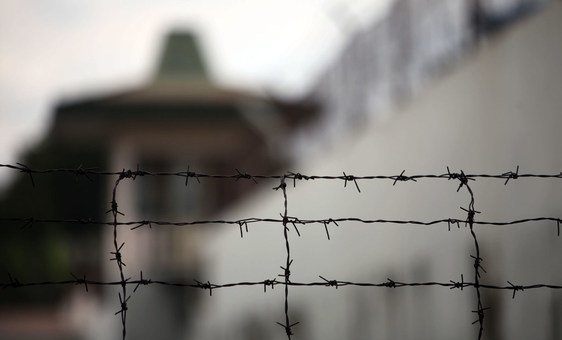
The Nazi SS took over the command of Westerbork, we were surrounded by the ever-present, terrifying 12 ft-high, barbed wire. Then, in 1942, the dreadful transports to the concentration and extermination camps in eastern Europe began. 

Every Monday night, lists of those to be deported were posted, causing incredible anxiety, anguish and fear. Then on Tuesday mornings, every Tuesday morning, men, women and little ones were marched to the nearby railroad platform from where they were transported. This area became known as Boulevard. de misère.

Of the total of 120,000 men, women and children that departed Westerbork, 102,000 were doomed, never to return.

In January of 1944, it was our turn to be shipped out. I remember that it was a bitter cold, pitch black, rainy night when we arrived at our destination, Concentration Camp Bergen-Belsen in Germany. 

A lifetime of fear

We were dragged out of the cattle cars and greeted by the German guards, who were shouting at us and threatening us with their weapons and with the most vicious attack dogs by their sides. I was a very frightened nine-year-old, and to this day, I still feel a certain sense of fear whenever I see a German Shepard.

Six hundred of our people were crammed into each of the crude, wooden, heatless barracks, meant for 100 when originally built. There were triple decker bunk-beds with two people sharing each bunk. German winters were bitter cold and very long. We were given only one thin blanket per bunk, and a straw-filled mattress, and this bunk was our only living quarters and that for two people.

I remember seeing a wagon filled with what I thought was firewood, I soon realised that what was in the wagon were dead, naked bodies thrown one on top of the other.

Toilets consisted of long wooden benches with holes cut into them, one next to the other. There was no privacy, there was no toilet paper, there was no soap and hardly any water with which to wash. And in the almost year and a half that we were in Bergen-Belsen, never once were we able to brush our teeth.

Every morning, we were ordered to line up on a huge field, it was called an appellplatz, five in a row as we were counted. We would have to stand there until each and everyone one of us was accounted for, often from early morning to late at night without food, without water.

Urine for warmth

No matter what the weather, without protective clothing. Frostbite was common. We would treat our affected toes and fingers with the warmth of our own urine.

Our diet consisted of a slice of bread a day and some hot watery soup. The bread was later cut back and given to us just once a week and only if our quarters were neat and in order. 

Once a month we were marched to an area to shower, and there, under the watchful eyes of the guards, we were ordered to undress. I was so frightened, not knowing what would come out of the faucets – water or gas. Yes, we were always hungry, we were thirsty, and we were in pain, but for me, fear was the worst emotion to deal with.

The dark, crowded quarters often caused us to trip over the dead; bodies could not be taken away fast enough! We as children saw things that no one, no matter what the age, should ever have to see.

Indescribable horror

You have read books, you’ve seen movies, true documentaries, but the constant foul odour, the filth, continuous horror, and fear, surrounded by death is indescribable. There is no way this can be put accurately into words and pictures.

Our bodies, hair and clothes were infested with lice, we learnt there was a distinct difference between head lice and clothes lice, squashing them between my thumb nails became my primary pastime.

Much of my time was taken up with make-believe games. One game, a game based on superstition, became very important to me: I decided that if I were to find four pebbles of about the same size and shape, that would mean that the four members of my family would all survive. It was a very difficult game to play, but I was sure that I would always find my four pebbles. I made it my business to find those four pebbles.

Maternal strength

My mother was a remarkable, extraordinary lady with tremendous inner strength and fortitude. Mum passed away six weeks short of 105, and when she was still with us, we were five generations of women, and I refer to that as survival and continuity. 

I have no doubt that it was because of my mother that I survived. I am fortunate, very fortunate, that i was never separated from my mother during those difficult years.

One day, my mother was able to smuggle some salt and potatoes from the kitchen where she worked, and somehow managed to cook the soup in secret. This was done on our bunk. I was on the bunk with her trying to hide and shield what she was doing. The soup was simmering, just about finished when the German guards entered our barrack for a surprise inspection. In our rush to hide the set-up, the boiling soup spilled on my leg. We had been taught self-discipline and self-control the hard way: for I knew for sure had I cried out, it would have cost us our lives. This happened in the spring of 1945. I was just 10 years old.

Soon thereafter, we were transported to the extermination camps in East Europe. And after 14 days on the train without food, without water, without medical supplies, without sanitary facilities, the Russian army liberated our train near Troibitz, a small village in eastern Germany.

Five hundred of the 2,500 people on board the train died enroute or shortly thereafter. Many inhabitants in Troibitz fled and we took over their homes. Kitchens were stocked with ample food, it was rich and good – actually much too good for our starved bodies. We could not tolerate that unfamiliar nourishment. At that time, at the age of ten and a half, I weighed 16 kilos, the equivalent to 35 pounds. We were all ill with typhus, but my father had to die from it six weeks after our liberation, and this after six and half years of mental torment and physical abuse.

A new life in New Jersey

In 1948, when I was 13 years old, our family of three emigrated to the United States. We arrived in Hoboken, New Jersey April 23rd, 1948, by coincidence exactly three years to the day of our liberation. The Hebrew Immigration Aid Society found a home for us in Peoria, Illinois, where we once again started our lives anew.

Because of my inability to speak English, I, at the age of 13, was placed in a fourth grade with nine-year-olds. Both my brother and I worked long hours after school to help our mum pay bills. 

Secretary-General António Guterres (on screen) addresses the UN Observance of International Day of Commemoration in memory of the victims of the Holocaust.

By taking extra courses during the year, attending summer school, and by working very hard in my studies, I graduated from Peoria Central High School five years later, at age 18 ranking eigth in a class of 267 students.

It was two months after high school graduation that I married Nathaniel Lazan. I am grateful that I survived healthy in body, mind and spirit, and that we were able to perpetuate our heritage with a wonderful family. 

We have three grown children, all three are happily married, have given us nine beautiful grandchildren and 15 extraordinary great-grandchildren. Survival and continuity for sure!

Pushing back on hatred

This is the very yellow star that I was forced to wear. It was just another way to denigrate us, to isolate us, and to set us apart from the rest of society. Each and every one of us must do everything in our power to prevent such hatred, such destruction and such terror from recurring.

We can begin by having love, respect and compassion towards one another, regardless of their religious belief, colour of skin or national origin. Let us all, each and every one of us, have this compassion and respect. It is such a simple message and yet so difficult to achieve. 

There is very little we can do against the negativity in our world, but how we treat, behave, and reach out to one another – that is entirely up to us. And with that, I wish each and every one of you, your children, grandchildren, and all succeeding generations, a healthy, happy, productive future in a world of love and peace.

Listen to an interview with Natalia Tomenko, a youth advocate and expert on Romani history, and Deputy Director of Ukraine’s Youth Agency for the Advocacy of Roma Culture:

Source link

Yemen: Security Council votes on final extension of Hudaydah Mission

Resolution 2813 (2026), submitted by the United Kingdom, received 13 votes in favour and none against. Two countries – China and Russia – abstained. 

It calls for the effective, efficient and safe drawdown of the UN Mission to Support the Hudaydah Agreement (UNMHA), as well as planning and preparation for transitioning any residual functions to the Office of the Secretary-General’s Special Envoy for Yemen. 

Liquidation will commence on 1 April. 

Tireless efforts 

UNMHA was established by the Council in 2019 to support implementation of an agreement signed by the Yemeni Government and Houthi rebels in Stockholm, Sweden, the previous year. 

The UN brokered the accord at a time when a battle over Hudaydah – critical for the entry of food and medicine into war-ravaged Yemen – appeared imminent.  

UK Deputy Permanent Representative Archie Young welcomed the mandate extension.  

He also thanked “those UNMHA officials who have worked tirelessly since 2019, especially in the face of continued Houthi restrictions which inhibited the Mission’s ability to fulfill its mandate.” 

Concern for UN personnel 

He stressed that the safety of UN personnel in Yemen “remains of the utmost importance” and reiterated the UK’s condemnation of arbitrary detentions by the Houthis. 

The rebel movement which controls much of the country, including the capital, is holding 69 UN staff, alongside personnel from non-governmental organizations (NGOs), civil society and diplomatic missions.  

UN Secretary-General António Guterres, his Special Envoy Hans Grundberg and other senior officials have repeatedly called for their immediate and unconditional release

Important stabilising role 

Russia’s Deputy Permanent Representative Anna Evstigneeva explained why Moscow abstained from voting. 

“We did not block the adoption of this resolution purely due to the request of representatives of Yemen, as the host state, as well as from some of our regional partners,” she said. 

“In principle, we do not agree with the idea set out by the authors of this document:  the idea that UNMHA is ineffective and incapable of duly fulfilling the mandate entrusted to it by the Council, hence the need to sunset the Mission.”  

She said the Mission “has played and continues to play an important stabilising role on the ground, notwithstanding the operational difficulties linked to implementation of its mandate, which arise from time to time.”  

Among its “still relevant functions” are monitoring implementation of the Stockholm Agreement; facilitating maintenance of the civilian nature of the ports of Hudaydah, Salif and Ras Isa, and oversight of mine clearance operations.  

Source link

From lunch tray to lifelong health: WHO sets global standards for school meals

The UN agency’s new global guidance on evidence-based policies and interventions shows that healthy food in schools can help children develop healthy dietary habits for life. 

“The food children eat at school, and the environments that shape what they eat, can have a profound impact on their learning, and lifelong consequences for their health and well-being,” said Tedros Adhanom Ghebreyesus, WHO Director-General. 

Food habits start early 

Overweight childhood obesity and obesity are rising globally, while undernutrition remains a persistent challenge. 

Child obesity levels surpassed underweight cases around the world for the first time in 2025. 

Around one in 10 school-aged children and adolescents were living with obesity last year, and one in five – or 391 million – were overweight.

Additionally, a recent WHO report revealed that diabetes now affects over 800 million people globally and one in 6 pregnancies. 

As of October 2025, 104 Member States had policies relating to healthy school food, but only 48 countries had policies that restrict the marketing of foods high in sugar, salt or unhealthy fats, according to WHO. 

For the millions of children that spend a large chunk of their day at school, the food environment they are exposed to can shape their future dietary habits. 

Getting nutrition right at school is critical for preventing disease later in life and creating healthier adults,” said Tedros. 

More pulses, less sugar

WHO recommends increasing the availability of healthy foods and beverages while reducing unhealthy foods. That means limiting free sugars, saturated fats and sodium, while offering more whole grains, fruits, nuts and pulses

Other recommendations include implementing ‘nudging interventions’ – changes  in the packaging, placement or portion size of foods designed to encourage children to select healthier foods.

The organisation will support countries with technical assistance, knowledge-sharing and other collaborative measures, to realise the new guidance. 

‘We must stand up for our shared humanity – each and every day’: UN human rights chief

Tuesday’s solemn commemoration marks the day 81 years ago that the Auschwitz-Birkenau concentration and extermination camp – where over a million people were murdered – was liberated by Allied forces towards the end of World War Two. 

Commenting on the disturbing rise of antisemitism in recent years – including the “heinous attacks” targeting Jewish communities in Sydney and Manchester – Mr. Türk warned that “hatred and dehumanization are creeping into our daily lives.” 

He urged people to remember the lessons of the Holocaust, during which six million Jews were killed by the Nazis and their collaborators. 

“The genocide did not begin with concentration camps and gas chambers; it started with apathy and silence in the face of injustice, and with the corrosive dehumanization of the other.”

The need for remembrance

The central theme of this year’s commemoration is Holocaust Remembrance for Dignity and Human Rights.

Reflecting this theme and addressing some of today’s challenges, the High Commissioner emphasised the need for “laws that prohibit discrimination, and politicians who do not polarize by calling out differences – but unite by calling out injustice.”

To protect humanity from repeating its darkest chapters, Mr Türk stated: “We need education about the Holocaust, human rights for all ages, and robust, inclusive systems to moderate digital content, so that people can express their concerns without fear.”

Reasons for hope 

Calling on the world to use available tools today such as international human rights law, unprecedented access to verifiable information and “the memory of how exclusion can turn into annihilation”, Mr Türk demanded action to counter the “plague” of racism, antisemitism, and dehumanisation.

Together, we must challenge exceptionalism, supremacy, and bigotry wherever we encounter them: at the dinner table, at our workplaces, and on social media,” the rights chief continued.

“Each of us can be an architect of a world free from discrimination and intolerance.”

Echoing the words of Anne Frank and remembering her step sister, Eva Schloss, who died a few weeks ago, Mr Türk emphasised that “nobody needs to wait a single moment before starting to improve the world.” 

Listen to our interview with Ms. Schloss, who spoke to UN News in Geneva in 2018, here

The UN commemorates

New York – United Nations Holocaust Memorial Observance

  • Start Time: 11:00am EST, General Assembly Hall, United Nations Headquarters

Exhibition: Between Life and Death: Stories of Rescue during the Holocaust | Visitors’ Lobby, United Nations Headquarters |15 January – 20 February 2026

Exhibition: Holocaust Remembrance – A Commitment to Truth | Visitors’ Lobby, United Nations Headquarters | 15 January – 8 February 2026

Geneva – Holocaust Remembrance 

  • Start Time: 1pm CET, Palais des Nations, Room XVI

Source link

Remembering the Holocaust: ‘You are here because you choose hope over hate’

In his 10th Holocaust Remembrance Day address, Secretary-General António Guterres told survivors and their families gathered in the General Assembly Hall that honouring the dead “and the fight against the ancient poison of antisemitism – is not abstract, but personal”. 

Every year on the day the concentration camps were liberated in 1945, the world unites to honour the memory of the six million Jews – mothers, fathers, sons, daughters, grandparents – who perished at the hands of the Nazis and their collaborators.

Included in the commemoration are the Roma and Sinti communities, people with disabilities, LGBTIQ+ individuals, and all others who suffered from the systemic violence, torture, and genocide of the Nazi regime.

Mr. Guterres emphasised that the lessons of the Holocaust must never be forgotten.

“Remembrance is more than honouring the past. It is a duty and a promise – to defend dignity, to protect the vulnerable, and to keep faith with those whose names and stories we refuse to forget.”

Secretary-General António Guterres addresses the UN Holocaust Memorial Ceremony, held in observance of the international day of commemoration in memory of the victims.

Combat antisemitism 

Reiterating his condemnation of the horrific Hamas-led terror attacks on southern Israel of 7 October 2023, Mr. Guterres said although we are haunted by those horrors, coming together to commemorate the victims of the Holocaust brings hope. 

You are here because you choose hope over hate. You choose remembrance as a living force – a shield against prejudice, a spark for justice, a pledge to protect every human being,” he told the assembly. 

Reminding that the Holocaust began with words, not killing, the Secretary-General underscored that “this dark chapter of our common history reveals sobering truths”. 

When those with power fail to act, evil goes unpunished,” he added, calling for widespread condemnation of antisemitism and all forms of hatred, anywhere and everywhere. 

“Our duty is clear: to speak the truth. To educate new generations. To confront antisemitism, and all forms of hatred and discrimination. And to defend the dignity of every human being”, he concluded.

‘Never again’, etched into our DNA

The President of the UN General Assembly Annalena Baerbock recounted that ahead of the ceremony she had met death camp survivor, Blumenthal Lazan, who was deported to Bergen-Belsen as a child during World War Two.

Ms. Baerbock – former German foreign minister – said she had visited the notorious concentration camp as a young student, which left a powerful impression on her.

Reminding that the ‘Never Again’ promise is “etched into the very DNA of the United Nations, its Charter, and its Universal Declaration of Human Rights”, Ms. Baerbock said that it is “our duty to speak out, even louder than before, when signs of dehumanization emerge”.

Quoting Holocaust survivor Simon Wiesenthal, Ms. Baerbock added that “for evil to flourish, it only requires good men to do nothing”. 

She said that ‘Never Again’ had to represent more than a slogan: “It is a duty to speak up, to stand up, and to defend the dignity and human rights of every member of our human family, everywhere, every day”.

Remembering the lessons of the Holocaust

As part of ongoing efforts to combat hate speech, UN Holocaust commemorations worldwide highlight the importance of educating future generations.


Source link

Independent experts alarmed by child rights violations in US immigration procedures

Thousands of children remain in custody without access to legal counsel; a situation the experts warn is forcing minors to navigate complex immigration proceedings alone and undermining their fundamental rights.  

The three Special Rapporteurs, appointed by the UN Human Rights Council, said they are in contact with the US Government on the issue. 

Duty to care 

They explained that under the 2008 Trafficking Victims Protection Reauthorization Act (TVPRA), the US Office of Refugee Resettlement is responsible for the care and custody of unaccompanied children.  

The law requires the Department of Homeland Security (DHS) to protect children from mistreatment, exploitation and trafficking in persons.  

It also guarantees that unaccompanied children in federal custody have access to legal counsel and should not be subjected to expedited removal – that is, deportation without a court hearing. 

Legal support ended 

The experts noted, however, that on 18 February 2025, the US Department of the Interior ordered nonprofit legal service providers to halt work and ended funding for attorneys representing unaccompanied children.  

Although the development has been challenged in the courts, many of the 26,000 affected children lost legal counsel and remain at risk of forced removal.  

Reports indicate that young migrants are being held in windowless cells, denied adequate medical care and separated from their parents or caregivers for long periods. 

In fact, between January and August 2025, average custody time rose from roughly one month to six, while releases to family caregivers dropped by more than half: from approximately 95 per cent to 45 per cent. 

Pressured or paid to self-deport 

“There have been consistent accounts of unlawful deportations of unaccompanied children, in breach of the obligation of non-refoulement, including child victims of trafficking, and children at risk of trafficking in persons,” the independent experts said.  

Children have been reportedly pressured to either accept a $2,500 cash payment to self-deport or face indefinite detention and transfer to US Immigration and Customs Enforcement (ICE) custody upon turning 18. 

 The experts stressed that children should have access to administrative and judicial remedies against decisions affecting their own situation, or that of their parents or caregivers. 

Measures should be taken also to avoid undue procedural delays that could negatively affect their rights. 

 “Expedited proceedings should only be pursued when they are consistent with the child’s best interests and without restricting any due process guarantees,” they said. 

Independent voices 

The three Special Rapporteurs receive separate mandates from the UN Human Rights Council to report on trafficking in persons, especially women and children; the human rights of migrants, and the independence of judges and lawyers. 

They are not UN staff and do not receive payment for their work. 

Source link

Gaza ceasefire improves aid access, but children still face deadly conditions

That’s the assessment of two senior officials from the UN Children’s Fund (UNICEF) and the World Food Programme (WFP), speaking on Monday to journalists in New York following a week-long visit to the enclave and the occupied West Bank.

The two agencies have brought more than 10,000 trucks of aid into Gaza since the 10 October truce between Israel and Hamas, representing some 80 per cent of all humanitarian cargo.

Three months later, “the food security situation has improved and famine has been reversed,” said Ted Chaiban, UNICEF Deputy Executive Director, Humanitarian Action and Supply Operations.

Carl Skau, WFP Deputy Executive Director, added that most families he met “were eating at least once a day” – sometimes twice.

Commercial goods have reappeared in Gaza’s markets, including vegetables, fruits, chicken and eggs. Recreational kits to help children heal from the stress and trauma of two years of war are now in their hands.

‘These gains matter’

UNICEF and partners have provided more than 1.6 million people with clean drinking water and distributed blankets and winter clothes to 700,000.  They have also restored essential life-saving paediatric intensive care services at embattled Al Shifa Hospital in Gaza City.

The second round of a Gaza-wide “catch-up campaign” for routine childhood vaccinations is currently underway, while another 72 UNICEF-supported nutrition facilities have been established, bringing the total to 196.

“These gains matter,” said Mr. Chaiban. “They show what is possible when the fighting pauses, political commitments are sustained and humanitarian access opens.”

Hot meals and school snacks

WFP has also scaled up massively over the past 100 days, said Mr. Skau, speaking from Rome. Teams have reached more than a million people every month with full rations for the first time since the war began.

They are “serving 400,000 hot meals every day and delivering school snacks to some 230,000 children in 250 temporary learning centres,” in addition to operating hundreds of distribution points and some 20 warehouses.

Other humanitarian organizations are bringing in tents, blankets, mattresses and other essentials thanks to WFP’s shared logistics services.

The agency is also helping to facilitate more regular aid convoys and is expanding common storage facilities so that more aid can be positioned closer to the population. It has also ramped up cash support to roughly 60,000 households.

Although more aid is entering Gaza, quantities are not yet sufficient to meet the immense needs. Furthermore, “the situation also remains extremely precarious and deadly for many children,” said Mr. Chaiban.

“More than 100 children have been reported killed in Gaza since the ceasefire of early October.    Despite the progress with food security,100,000 children remain acutely malnourished and require long term care.  1.3 million people, many of them children, are in urgent need of proper shelter.”

Families are shivering in fabric tents and bombed-out buildings amid freezing temperatures that have killed at least 10 children this winter season.

Mr. Sklau met a young woman with a 10-day-old baby who “was sitting on a wet mattress in this cold tent on the beach,” describing their plight as “just absolutely brutal.”

Hopes for a brighter future

Yet hope blossoms in the Gaza Strip. UNICEF and partners are supporting over 250,000 children to resume learning – a critical element to mental health and psychosocial support for more than 700,000 students who have been out of school for two years.

Mr. Skau recalled a conversation with young girls at a temporary learning space who “were happy to be back learning and eating more regularly,” he said.  “They could see a future again as nurses or engineers or restaurant owners, and they seemed impressively confident and determined to build a future for themselves.”

Humanitarians need essential items – such as water and sanitation provision, as well as educational supplies – to be allowed to enter Gaza which can help jump start recovery and reconstruction.

Mr. Chaiban said WFP and UNICEF are ready to scale up operations.

“The children of Gaza and the State of Palestine including the West Bank, which is also experiencing a wave of violence do not need sympathy. They need decisions now that give them warmth, safety, food, education, and a future,” he said.   “We have an opportunity, a window, to change the trajectory for these children. We can’t waste it.”

A new blow for UNRWA as headquarters in East Jerusalem ‘set on fire’

It comes after Israeli authorities “stormed and demolished” buildings in the compound last week, UNRWA Commissioner-General Philippe Lazzarini said.

“Allowing this unprecedented destruction is the latest attack on the UN in the ongoing attempt to dismantle the status of Palestine Refugees in the Occupied Palestinian Territory and erase their history,” Mr. Lazzarini said.

In a short statement, the senior UN official added that there were “no limits to the defiance of the United Nations” and international law in the Occupied Palestinian Territory.

Last Tuesday’s move by Israeli authorities to send bulldozers into the Sheikh Jarrah compound where they tore down UNRWA structures prompted swift condemnation from senior UN officials including Secretary-General António Guterres and UN High Commissioner for Human Rights, Volker Türk.

Ahead of that dramatic development, on 14 January, Israeli forces entered an UNRWA health centre in East Jerusalem and ordered it to close. The agency reported that its workers were “terrified” and that the deteriorating situation was a direct result of legislation passed by the Israeli parliament in December, stepping up existing anti-UNRWA laws adopted in 2024.

UNRWA premises have also been targeted by arsonists amid a “large-scale disinformation campaign” against it by Israel, the agency’s Commissioner-General has previously maintained.

This was despite a ruling last October by the UN’s top court, the International Court of Justice, which restated that Israel was obliged “to facilitate UNRWA’s operations, not hinder or prevent them. The court also stressed that Israel has no jurisdiction over East Jerusalem,” Mr. Lazzarini noted.

Between fear and survival: Women and girls flee violence in northern Syria

Now eight months pregnant and sheltering in a makeshift camp, the mother of three said her biggest fear isn’t the biting cold – it’s what will happen if she goes into labour. 

“I worry about my health, but I worry more about where to go if something happens,” said Fatima. “Displacement is not just losing your home. It’s losing your privacy, your safety and access to healthcare, especially as a woman.” 

Every step we took felt like it could be our last

She is one of tens of thousands of women and girls affected by the uptick in violence and insecurity around Aleppo in the past few weeks, which has forced large numbers to flee, disrupted essential services and shut down hospitals. 

“We fled under bombardment, with nothing but our fear,” Farida, 39, told the United Nations Population Fund (UNFPA), which is the UN’s sexual and reproductive health agency. 

“Every step we took felt like it could be our last.”

A UNFPA-supported health worker delivers essential healthcare at a clinic in Al-Hassakeh, for women and girls forced to flee Aleppo in Northern Syria.

Unbearable cold 

In Aleppo, some 58,000 are still displaced following recent clashes between the transitional Government’s security forces and the mostly-Kurdish Syrian Democratic Forces (SDF), with insecurity spreading to surrounding areas. 

To make matters worse, winter conditions have only deepened the suffering: thousands are now enduring freezing temperatures, sheltering in makeshift camps, former schools and unfinished buildings across the country. 

Ruhan, a mother of three from Aleppo, fled with only what she could carry. 

 “The cold is unbearable. My biggest fear is keeping my children warm and safe,” she told UNFPA aid workers, who provided her with reproductive health services, counselling and a dignity kit. 

Delivering aid 

More than 890,000 people had been newly displaced as of December 2025 in Syria, adding to almost seven million already displaced inside the country. 

Fourteen years of conflict, climate shocks, and economic decline have left Syria’s recovery fragile and uneven, with immense humanitarian needs and severely damaged healthcare systems.

In response, UNFPA and its partners have sent mobile health teams to reach displaced communities with life-saving sexual and reproductive healthcare, dignity kits with essential hygiene items, and psychosocial counselling. 

Around 400,000 pregnant women in Syria are struggling to access essential maternity services – a situation worsened by deep funding cuts which began last year that have further restricted access.

Women and girls displaced by violence receive reproductive health support and dignity kits in a neighbourhood in Aleppo, Syria.

Source link

UN chief warns ‘law of the jungle’ is replacing rule of law

António Guterres was addressing a high-level open debate of the UN Security Council convened by Somalia, which holds the Council presidency for January.

The discussion comes as conflicts multiply, global tensions rise, and confidence in international institutions and rules is fading – even as the UN marks 80 years since the adoption of its founding Charter, which set out principles meant to prevent wars and reduce suffering.

The rule of law is a cornerstone of global peace and security,” Mr. Guterres said, calling it “the beating heart” of the UN Charter.

For eight decades, he said, the Charter, alongside the Universal Declaration of Human Rights, the Geneva Conventions and other core legal instruments, has helped humanity avoid another world war and limit the toll of countless conflicts.

Secretary-General Guterres addresses the Security Council.

Flagrant violations

But the Secretary-General warned that commitments to international law are increasingly being ignored.

Around the world, the rule of law is being replaced by the law of the jungle,” he said, pointing to what he described as flagrant violations of the UN Charter and international law, including the illegal use of force, attacks on civilian infrastructure, human rights abuses and the denial of life-saving humanitarian aid.

From Gaza to Ukraine and beyond, he said, the rule of law is being treated as “an à la carte menu,” with States choosing which rules to follow. Such violations, he warned, set dangerous precedents, encourage impunity and erode trust among nations.

A lifeline and a guardrail

For smaller and less-powerful countries, particularly those affected by historical inequities and the legacies of colonialism, international law is “a lifeline promising equal treatment, sovereignty, dignity and justice,” Mr. Guterres said.

“For powerful countries, it is a guardrail defining what is acceptable – and what is not, in times of disagreement, division and outright conflict,” he added.

He underscored the unique responsibility of the Security Council, the only body with Charter-mandated authority to adopt decisions binding on all Member States and to authorize the use of force under international law.

“Its responsibility is singular. Its obligation is universal,” he said.

Priorities for action

Looking ahead, the UN chief outlined three priority areas for action.

First, he urged countries to honour the commitments they made under the Charter, including settling disputes peacefully, safeguarding human rights and respecting the sovereign equality of States.

Second, he called for the use of peaceful tools to settle disputes – negotiation, mediation and judicial settlement, alongside stronger partnerships with regional organizations – and more investment in development to address the root causes of inequality and exclusion.

Third, he stressed the need for fair, independent judicial proceedings. He encouraged greater reliance on independent courts and tribunals, including the International Court of Justice (ICJ) and stronger support for international criminal justice.

“There can be no sustainable or just peace without accountability,” Mr. Guterres said. “The rule of law must prevail.”

Source link