General Assembly President urges Europeans to ‘stand up’ for the UN

In a key address to the European Parliament in Strasbourg, France, Annalena Baerbock repeated her call to uphold multilateralism amid “trying times” globally. 

She noted that just 40 days into 2026, the world has already seen crises around Venezuela, Iran and Greenland, on top of continuing devastation in Ukraine, Gaza, Sudan and elsewhere.

International order ‘under attack’ 

The international order is not only under pressure, it is under attack,” she told lawmakers.  

“And we face a new and more troubling kind of crisis: conflicts waged not even under the pretence of self-defence or respect for international law but often carried out in open defiance of it.” 

She warned that at precisely the moment the world most needs cooperation and the UN, “powers – even those who have a special responsibility to protect peace and security – are pulling away from it or even outright attacking it.”  

Protect the UN Charter 

Ms. Baerbock recalled that four years ago, when she was Germany’s Foreign Minister, she addressed the General Assembly and called for the UN to stand up for Europe’s peace as Russia launched its full-scale invasion of Ukraine. 

“Today, I’m coming as President of the General Assembly to Europe, calling for Europe to stand up for the United Nations because the world needs the UN. But right now, the UN and its principles as enshrined in the Charter, needs the world too,” she said, referring to all continents. 

“It needs you to form a cross-regional alliance to protect, defend and champion the Charter and the international rules-based system that benefits us all individually and collectively.” 

Defend the truth 

First and foremost, the EU must defend the truth in a world where “fake news, falsities, mis- and disinformation” are everywhere.  

“Defending the truth means we cannot negotiate the facts; we cannot ‘go along to get along’ in the hope that it will avoid a tariff,” she said.  

Ms. Baerbock acknowledged that defending the truth “is easier said than done, especially when you’re faced with blackmail or coercion, or threats and intimidation.”   

European unity over Ukraine 

She stressed, however, that “no one can do it alone”, highlighting European Union (EU) collective action in this regard. 

“Four years ago, Europe watched as 100,000 troops amassed on Ukraine’s borders, shocked into paralysis. Nobody could have imagined the EU, which has been described as ‘too slow and too bureaucratic, too divided’ would unite over a weekend,” she said. 

The invasion began on a Thursday and by that Monday morning “the EU collectively passed one of the largest sanctions packages ever recorded because it responded as one, with conviction and purpose.” 

‘The world is calling’ 

But Europe did not act alone as she pointed to late-night calls and pleas made to other countries around the world.  

Today dear colleagues, the world is calling. It’s not only about Greenland, it’s also about Latin America, about Africa. Once again, it’s about the international peace order, once again it’s about the UN Charter,” she said. 

“The UN needs Europe and I count on your answer to be a clear and resounding: yes, we will be there for our peace, for the international peace order, for the United Nations.” 

Support UN reform 

The Assembly President said the UN also needs Europe “to reform it, to make it better, to make it more effective and efficient.”  While the 80-year-old Organization is not perfect, she insisted that the world would not be better off without it. 

“Imperfection is an opportunity to strengthen and refine, not to cut down and demolish,” said Ms. Baerbock. 

“We cannot allow those who would weaponize failings or setbacks to use existing inefficiencies or duplications as justification to unravel all that we have built, nor allow exclusive clubs to hold responsibilities for world peace.”  

Lead by example 

The UN is also “dealing with an existential liquidity crisis,” with some Member States not paying their assessed contributions – whether late, or not at all, for years. 

She noted that UN financial rules further require any “unspent” budgeted money to be returned to Member States, even if it was never received in the first place. 

“If the EU wants to preserve and strengthen the UN, then the EU should lead by example,” she said.  This includes paying dues on time and in full and proposing ways “to overhaul this Kafkaesque financial rule of reimbursing funds never received”. 

Similarly, the EU should step up when it comes to the selection of the next Secretary-General “as one might wonder how in 80 years the UN has never selected a woman to serve its highest office, despite there being four billion potential candidates on Earth.” 

Source link

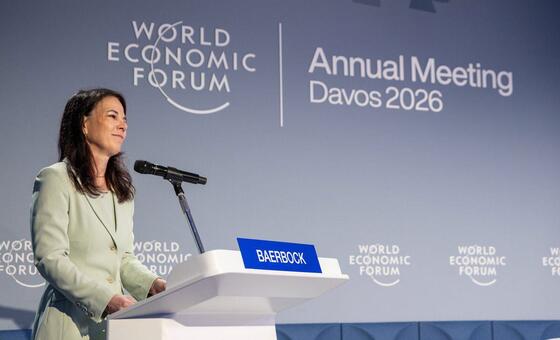
UN Assembly president defends multilateralism, UN Charter in Davos

Speaking at the session Who Brokers Trust Now? at the World Economic Forum, Annalena Baerbock warned that multilateral institutions – long seen as the brokers of global trust – are under unprecedented strain as conflicts multiply and respect for international law erodes.

“Who brokers trust?” she asked. “In ordinary times, there would be a simple answer: multilateral institutions like the United Nations.” But, she added, these are “not ordinary times”.

Ms. Baerbock said the world is facing more conflicts than at any point in recent history. Since the start of 2026, she said, divisions have deepened further, leaving some Member States hesitant to act when circumstances demand principled conviction.

Voices that were once outspoken in their support for all the three pillars of the United Nations Charter – peace and security, sustainable development, and human rights – fall more and more silent in the face of their erosion,” she said.

The UN is not only under pressure but under outright attack.

Facts and truths not up for negotiation

Ms. Baerbock stressed that trust cannot exist without truth and shared facts – foundations she said are increasingly undermined by deliberate disinformation.

“Without facts, you can’t have truth. Without truth, you can’t have trust,” she said, quoting Nobel Peace Prize laureate Maria Ressa.

She cautioned that falsehoods are rarely accidental, but are often deployed to “weaponize mis- and disinformation”, while diplomatic silence in the face of obvious falsehoods only deepens mistrust.

We do not negotiate truths and facts,” Ms. Baerbock said. “We use them to negotiate, to broker trust.

She highlighted the risks posed by artificial intelligence, noting that while AI offers enormous benefits, it is also being used to blur the line between truth and lies. Deepfakes, she said, are “systematically attacking women”, citing figures showing that the overwhelming majority of such content is pornographic and targets women.

UN Charter – ‘world’s life insurance’

Ms. Baerbock also highlighted that trust is impossible without common rules, arguing that respect for international law is not naïve idealism but a matter of enlightened self-interest.

Trust is built on rules,” she said, likening the global system to competitive sports or markets where predictability and fairness are essential. “Why would you put your money into a business if the competition rules are totally unpredictable?

Recalling the founding of the United Nations 80 years ago, she said leaders at the time chose cooperation after witnessing the catastrophic consequences of a lawless international order.

The UN Charter, she added, remains “the world’s common life insurance”, just as a rules-based economic order underpins global business and investment.

A call for broad alliance

The General Assembly President concluded by calling for a broad alliance – spanning governments, businesses and regions – to stand up for the international order and defend shared principles, even when it is politically or economically costly.

“Trust is brokered by those who hold up the common rules and principles, even when it is hard,” she said. “By those who act when action is required…and by those who speak the truth, when silence or distortion would be easier.”

The challenge now, Ms. Baerbock emphasised, is whether today’s leaders can act with the same courage and conviction as those who built the post-war international system.

The founders of the United Nations understood that because they had seen what the alternative would mean, in a world where might makes right, there can be only one outcome: chaos and war.

Source link

Leadership of women crucial to UN’s reinvention at 80, says former Assembly President

On Tuesday, Germany’s Annalena Baerbock will become the first European woman to hold the post and only the fifth female President in the Assembly’s history.

On the eve of Baerbock’s inauguration, UN News spoke with one of her predecessors. María Fernanda Espinosa, a former Minister of Defence and Foreign Affairs of Ecuador, led the Assembly from 2018 to 2019 as the first woman from Latin America and the Caribbean to do so.

Hard work and skilled diplomacy

Espinosa described the General Assembly as “the laboratory of international law,” noting that the role of President demands “hard work, good diplomacy, and the ability to conduct fair negotiations.”

The last woman to preside over the Assembly said she sees in Annalena Baerbock all the qualities needed for a “brilliant performance” as the next President. She stressed that the German leader takes office at a time of “profound structural change within the institution, linked in part to financial challenges.”

Espinosa believes Baerbock will play an “absolutely central” role in implementing reforms under the UN80 process, as well as advancing commitments related to the Pact for the Future, adopted in 2024.

For Espinosa, the UN’s own history proves that it is “an irreplaceable organization, one humanity cannot do without – but which nonetheless must be reinvented.”

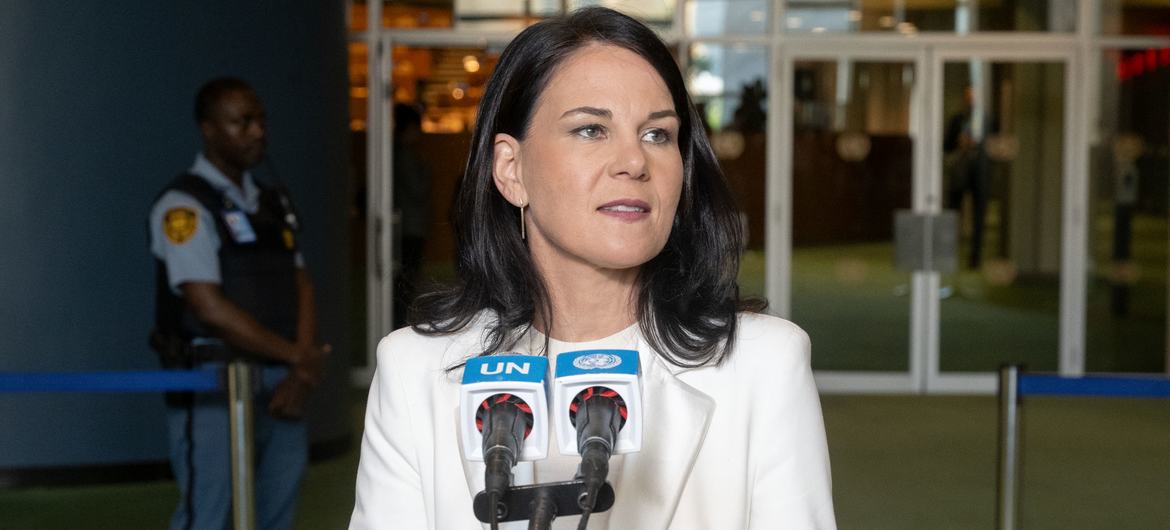
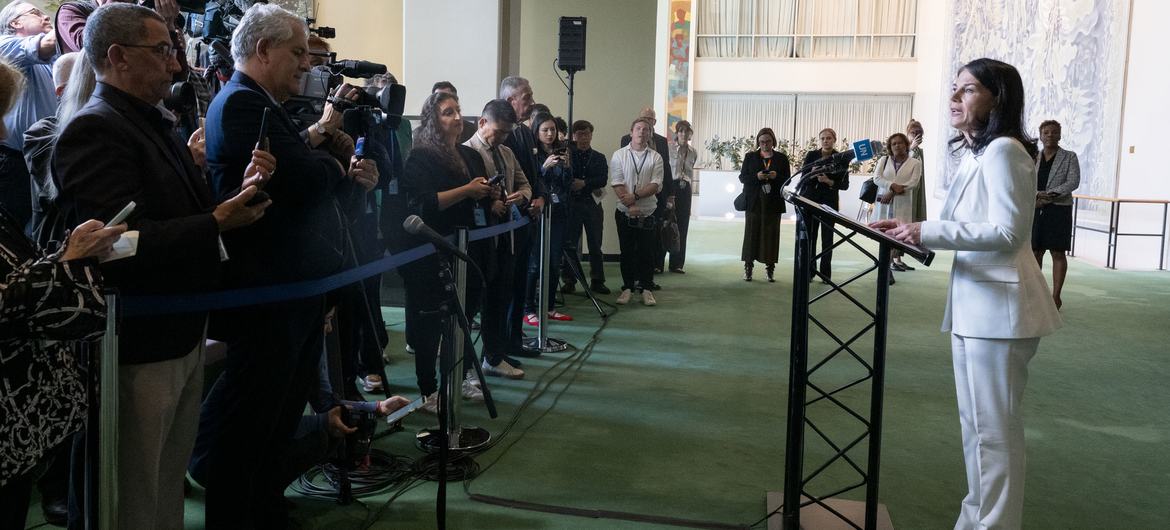
Annalena Baerbock, President-elect of the eightieth session of the UN General Assembly, addresses the reporters following her election.

‘Why not a woman as Secretary-General?’

While welcoming the election of the Assembly’s fifth female President in New York, Espinosa said this restructuring also provides an opportunity to rethink leadership styles and to finally consider a woman for the post of Secretary-General. The next appointment is expected in 2026.

“The real question is: why not?” she asked, stressing that a woman could bring qualities such as “strong management and bridge-building.” She added that a female Secretary-General would also represent an act of “historic justice,” after 80 years of male leadership at the UN’s helm.

The former Ecuadorian diplomat acknowledged one of the UN’s biggest challenges: the gap between resolutions adopted in the General Assembly and their translation into national policies and regulations. This, she said, prevents multilateral decisions from producing tangible improvements in people’s lives.

To address this, she called for a “more inclusive and networked multilateralism,” in which citizens are informed about, engaged with, and able to monitor the international decisions being made.

Building consensus behind the scenes

Espinosa emphasized that “most of the work of the Presidency takes place behind the scenes,” dealing with divisions and forging consensus.

She noted that the incoming President will increasingly face responsibilities linked to peace and security, as well as sustainable development.

Espinosa recalled that the very first resolution adopted by the General Assembly concerned the discovery of atomic energy, underscoring the need to adapt to a new force that could be harnessed for peaceful purposes but also cause “terrible effects.”

She highlighted defining moments during her own presidency, including the difficult negotiations that led to the adoption of the first Global Compact for Migration in 2018.

The diplomat also expressed pride in internal advances, such as the decision to phase out single-use plastics at the UN, recognizing the harm they cause to human health and ecosystems. 

Source link

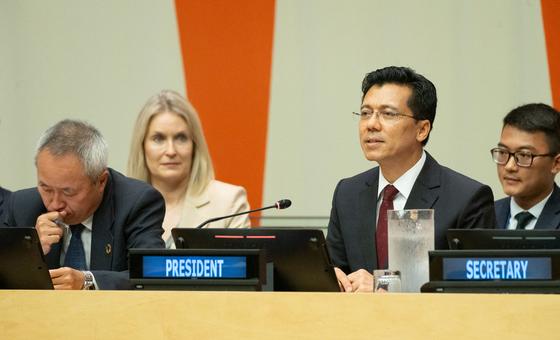
‘Delivering better’: New ECOSOC president emphasises climate action, food security

Mr. Thapa said that the motto of his presidency will be “Delivering Better,” which requires strengthening partnerships and multilateralism to achieve more effective implementation of initiatives, including the 2030 Agenda adopted 15 years ago.  

“Delivering better is not an option — it is an imperative. It is our pathway to restoring trust in multilateralism, bridging divides, empowering the most vulnerable and translating commitments into action,” he said.  

Four vice-presidents were also elected for the coming year: Amar Bendjama (Algeria), Héctor Gómez Hernández (Spain), Wellington Darío Bencosme Castaños (Dominican Republic) and Paruyr Hovhannisyan (Armenia).

80 years of ECOSOC 

The UN Economic and Social Council (ECOSOC) is one of the six principal organs of the United Nations, responsible for promoting international economic and social cooperation and development.

It has 54 member States, elected by the General Assembly for three-year terms on a rotating basis, with seats distributed by region.

ECOSOC coordinates the work of UN specialized agencies, commissions and bodies on issues ranging from sustainable development and human rights. It also serves as a central platform for fostering debate, forging consensus, and promoting action on global economic and social issues.

For Mr. Thapa, this body is central to shaping the world’s development agenda and ensuring that no one is left behind.  

“ECOSOC is our place. It needs dedication, participation and active engagement of all UN membership and stakeholders,” he said.  

Five ways to deliver better

While “delivering better” will be the motto of Mr. Thapa’s presidency, he outlined five specific areas upon which he and the Council will focus in the coming year.

With over 735 million people worldwide experiencing hunger, his first priority area is transforming agriculture to strengthen rural resilience and end hunger.  

Digital entrepreneurship and youth engagement are tied to this — and are his second priority area. He noted the “youth bulge” in many developing countries which he said will be a powerful demographic asset if it can be taken advantage of.  

Like ECOSOC presidents before him, his third priority area deals with climate action and resilience. This time, however, he would like ECOSOC to focus specifically on glacier lakes and floods.  

His final two priority areas are reforming the international financial architecture so that it is more inclusive and commemorating the 80th anniversary of ECOSOC.  

Mr. Thapa noted that he and ECOSOC’s membership will be working to achieve these challenges in the midst of multiple, interlinking crises including accelerating climate change, rising geopolitical tensions and decreasing trust in the multilateral system.  

“These challenges are systemic and interconnected. They demand integrated, inclusive and forward-looking responses,” Mr. Thapa said.  

Fix, repair, mend

Before Mr. Thapa’s remarks, Bob Rae, the outgoing president of ECOSOC and Canada’s Ambassador to the UN, reflected on his tenure. He acknowledged that the world is currently in a time of great hardship and genuine anguish.  

But he said that it must be the job of ECOSOC — and UN Member States more broadly — to not only give voice to this anguish and hardship but to actually find solutions for it as well.  

“We hear a lot in the UN discourse about how things are broken, how things have fallen apart, how things are unhinged … But our job is to fix, it’s to repair, it’s to mend, it’s to allow things to heal, it’s to make change happen,” Mr. Rae said.  

Both Mr. Thapa and Mr. Rae affirmed that multilateralism can work and that ECOSOC should play a unique role in rewriting the narrative surrounding international cooperation.  

“We must reaffirm our collective belief in the power of multilateralism — not as an abstract ideal, but as a pragmatic tool for delivering better outcomes for all,” Mr. Thapa said.  

Source link

‘Jerusalem is not for sale’ Palestinian President Abbas tells world leaders at UN Assembly

President Abbas underscored his commitment to peace and the two-state solution, as well as the path of negotiation to achieve them, reiterating that peace in the Middle East cannot be realized without an independent Palestinian state, with East Jerusalem as its capital.

“We have always fully and positively engaged with the various initiatives of the international community aimed at achieving a peaceful solution between us and the Israelis, including the Arab Peace Initiative,” he told world leaders gathered for the Assembly’s annual debate, noting that he also engaged with United States President Donald Trump and his administration from the start of his tenure.

However, the US administration’s decision to close office of the Palestine Liberation Organization (PLO) in Washington D.C., the proclamation of Jerusalem as the capital of Israel, and transferring of the US embassy from Tel Aviv to Jerusalem, not only violate UN resolutions, they have also undermined the two-state solution, added President Abbas.

Those decisions, have also caused the US administration to lose its eligibility as the mediator in the Middle East peace process, he said.

“The path to peace is enshrined in your [the UN] resolutions, including resolution 67/19 of 29 November 2012, which was adopted by an overwhelming majority and refers to the State of Palestine on the basis of the 1967 borders,” he stressed.

Mr. Abbas also highlighted what he called “racist” laws enacted recently in Israel, which not only discriminate against the Palestinian-Arab citizens, but, will also lead to the “inevitable” nullification of the two-state solution.

Palestinian people and the territory of the state of Palestine are in urgent need of international protection, he said, and while he welcomed economic and humanitarian support in the West Bank and the Gaza Strip but added that such support cannot be a substitute to a political solution to bring an end to the Israeli occupation.

President Abbas also highlighted the importance of the work of the UN Relief and Works Agency for Palestine Refugees in the Near East (UNRWA) and urged all countries as well as the General Assembly to support the agency.

Full statement available here.


Germany’s Annalena Baerbock elected President of the 80th General Assembly

She assumes the role at a challenging time, with ongoing conflicts, faltering development goals, mounting financial pressures, and the upcoming selection of the next Secretary-General.

Ms. Baerbock received 167 votes following the secret ballot. Write-in candidate Helga Schmid (also from Germany) received seven. Fourteen delegations abstained.

She becomes the first woman from the Western European group to hold the post and the fifth woman overall to lead the General Assembly. The presidency rotates among the world body’s five regional groups.

At 44 years, Ms. Baerbock is also one of the youngest leaders to secure the top job.

Crucial juncture

Ms. Baerbock’s election comes at a critical juncture for the multilateral system, spearheaded by the United Nations.

With the Security Council deadlocked – especially on moves to help end the wars in Ukraine and Gaza – the Assembly has become a vital forum for diplomatic engagement and consensus-building, even without binding authority on peace and security issues.

As conflicts rage, the Assembly has passed a series of resolutions calling for ceasefires, humanitarian access and the protection of civilians.

Many now see the Assembly as an essential platform for accountability and maintaining international focus on intractable crises, especially through the “Veto Initiative” adopted in 2022 which ensures that issues blocked by permanent members on the Security Council are debated in the Assembly as a priority.

A power wielded by the five permanent members – China, France, Russia, the United Kingdom, and the United States – a veto (or negative vote) can block Council action even when all other members support a motion.

Pledge to be an honest broker

In her acceptance speech, President-elect Baerbock acknowledged the current global challenges and pledged to serve as “an honest broker and a unifier” for all 193 Member States, emphasising her theme of “Better Together.”

She outlined three priorities for her presidency: making the Organization more efficient and effective; advancing the 2030 Agenda for Sustainable Development; and making the Assembly a “truly inclusive forum”.

She called for a UN “that embraces everyone. I see the diversity of the General Assembly as our strength. This is the place where all nations come together and where every country has a seat and a voice.”

She also highlighted the importance of promoting gender equality, multilingualism, and engagement with civil society and youth.

UN Video | Annalena Baerbock elected to lead 80th session of the UN General Assembly

UN80 initiative

Ms. Baerbock also touched on the UN80 initiative, which was launched by Secretary-General António Guterres in March.

The UN80 Initiative should not be a mere cost-cutting exercise,” she said, stressing the need for bold ambition and readiness to take difficult decisions.

Our common goal is a strong, focused, nimble and fit-for-purpose organization. One that is capable of realising its core objectives – we need a United Nations that delivers on peace, development and justice.”

A career defined by multilateralism

In congratulating Ms. Baerbock, current President Philemon Yang described her as a leader defined by “an unwavering commitment to multilateralism”, praising her “Better Together” vision.

Mr. Yang, who steered the Assembly through a year marked by the Summit of the Future and persistent global crises, expressed confidence in her ability to build trust and foster dialogue across divides.

Secretary-General António Guterres said Mr. Yang’s successor was taking the gavel amid a “difficult and uncertain moment for the multilateral system,” noting she was only the fifth woman to lead the body.

The UN chief warned that “conflicts, climate catastrophe, poverty and inequality continue to challenge the human family,” and called on the Assembly to unite in forging common solutions.

Annalena Baerbock, President-elect of the eightieth session of the UN General Assembly, speaks to the media following her election.

The world parliament

The General Assembly remains the UN’s most representative body, where each Member State has an equal voice – and an equal say in decisions.

While its resolutions are non-binding, the GA – as the acronym goes in New York – helps define global diplomatic norms, convenes dialogues on worldwide challenges and holds the Security Council to account.

The 80th session, starting 9 September, is expected to be pivotal – not only for sheer number and intensity of crises ongoing – but for advancing long-term reforms, including the UN80 initiative and the selection of the next Secretary-General before his term ends in 2026.

Source link

Children who Arrived at Rashtrapati Bhavan from Rameswaram by the bus ‘Dr Kalam Sandesh Vahini Vision 2020’ call on President

Children who arrived at Rashtrapati Bhavan from Rameswaram by the bus ‘Dr Kalam Sandesh Vahini Vision 2020’ called on the President of India, Shri Ram Nath Kovind, at Rashtrapati Bhavan on October 15, 2017.

Speaking on the occasion, the President said that Dr Kalam is one of the greatest personalities ever. He said that he saluted Dr Kalam and his monumental achievements as a scientist, a scholar and as the President of India. One of the best ways of building the character of the youth of any country is to inspire them to read biographies of great personalities.

The President said that Dr Kalam was one of India’s greatest visionaries and is fondly remembered as ‘The Missile Man of India’ and ‘People’s President’. He has made momentous contribution to India’s scientific heritage through his involvement in varied fields ranging from nuclear technology to designing low cost stents for the heart or lightweight calipers for polio victims. India will never forget the remarkable contributions of Dr Kalam. He had a great passion for teaching and education and truly ignited young minds with the power to think and innovate. He enjoyed being with people. He was adored by people and youngsters. He loved students and spent his final moments among them.

The President said that the Dr Kalam Sandesh Vahini bus presents the life story of Dr Kalam in a very interesting manner. He appreciated the effort. He said he was sure that a large number of Indians, especially the young people have benefited by seeing the mobile exhibition on the life, works and the vision of Dr Kalam.

The Kalam Sandesh Vahini was launched by House of Kalam and Chinmaya University. The Vahini depicts various incidents from Dr Kalam’s life as well as key highlights of India’s scientific achievements, with an aim to educate and inspire the masses. It was flagged off by Prime Minister, Shri Narendra Modi from Rameswaram on July 27, 2017, during the inauguration ceremony of Dr Kalam’s memorial. The Vahini has travelled from Rameswaram, through various states, to finally arrive at Rashtrapati Bhavan in New Delhi.

Earlier in the day, the President paid floral tributes at the portrait of Dr APJ Abdul Kalam, former President of India, on the occasion of his birth anniversary at Rashtrapati Bhavan. Officers and staff of Rashtrapati Bhavan along with family members of Dr Kalam also paid floral tributes on the occasion.

President to Inaugurate India Water Week 2017

Five Day International event to be attended by 1500 delegates from 13 countries.

President Shri Ram Nath Kovind will inaugurate India Water Week – 2017 on October 10, 2017 in New Delhi in the presence of Union Minister of Water Resources, River Development and Ganga Rejuvenation Shri Nitin Gadkari and Union Ministers of State for Water Resources, River Development and Ganga Rejuvenation Shri Arjun Ram Meghwal and Shri Dr. Satya Pal Singh. About 1500 delegates from India and 13 other countries will attend the five day international event. The theme of India Water Week – 2017 is “Water and Energy for Inclusive Growth”.
The 5th edition of India Water Week (IWW) will be celebrated with a multi disciplinary conference and a concurrently running exhibition enriching the theme and showcasing the technologies and solutions available for the areas under deliberation of the meet. The event will have the following major components:
Water, Food and Energy Security – Essential requirement for sustainable development.
Water for inclusive Growth
Sustainable energy development – Key for all round economic growth.
Water and Society
A large group of international and national persons of eminence are being invited for sharing their experiences in the field of Water and Power Management, Technical and Sociological interventions for achieving water and energy security in their individual areas and manage the assets created on a participatory basis. In addition, there will be special sessions involving dignitaries, delegates, politicians, experts from the fields related to the event. Expert professional bodies and think tanks are invited to put up Side Events addressing specific issues under the theme.
State Governments of Andhra Pradesh, Goa, Karnataka, Maharashtra, Madhya Pradesh, Manipur, Gujarat, Rajasthan, Tamil Nadu, Telangana, Uttar Pradesh have confirmed their participation as sponsor. Department of Agriculture, Cooperation and Farmers Welfare, Department of Science and Technology, Damodar Valley Corporation from Central Government Ministries/Organisations/Departments have also confirmed their participation as sponsor.
The Business to Business Exhibition “India Water Expo 2017” co-located with the conference will also be organized from 11 to 14 October, 2017 to focus on the latest technologies providing solutions to the water management issues.

Water Resources are the prime input to the growth and prosperity of the nation. Keeping in view the vital role of water in all aspects of life and also in assuring the development of economy, the Ministry of Water Resources has been observing “World Water Day” on the national level. During the year 2011, Ministry of Water Resources decided that the national level of celebrations be transformed to international level on the lines of the events taking place at Singapore and Stockholm.

Water and energy are essential needs in day to day life. At the same time, these are most important inputs for any efforts for social upliftment and economic growth of the country. With the increasing demand by the growing population and improvement in economic status, the demands on the available resources are increasing and we have to constantly strive towards stretching the same water to satisfy larger needs. As a result, there is an urgency to conserve and utilize the limited availability of water resources in an optimum and efficient manner. As a community resources, water needs to be managed and deployed in an equitable manner. The effective and efficient water management is possible through better understanding of issues, mutual cooperation among all stakeholders and adoption of comprehensive and integrated approach.

In order to establish an international event focused on water resources of India, Ministry of Water Resources, River Development and Ganga Rejuvenation, Government of India has been organising India Water Week since 2012 as an annual international event. Four editions of India Water Week have been organised so far in 2012, 2013, 2015 and 2016.

The recommendations/action points emerged during earlier events of India Water Week have been sent to all concerned Ministries of Central Government as well as to all State Governments for their appropriate implementation.

It is planned to make the IWW-2017 event more participatory by involving farmers and Water User Association (WUA), NGOs, Experts and other stakeholders. The Inaugural function will be followed by Plenary Session. It is proposed to have a presentation of theme paper, presentation by Foreign Partner European Union, Platinum Sponsor Netherlands and presentations by invited speakers. Also World Water Forum will make small presentation on forthcoming 8th World Water Forum to be held in Brazil in March, 2018.

President of India to visit Andhra Pradesh on September 1 to 2, 2017

The President of India, Shri Ram Nath Kovind will visit Andhra Pradesh on September 1 and 2, 2017.

On September 1, 2017, the President will inaugurate the new hospital building of the Sri Venkateswara Institute of Medical Sciences (SVIMS) – Sri Padmavathi Medical College for Women. On the same day, he will also attend a civic reception and public meeting at Sri Venkateswara Arts College Ground, Tirupati.

On September 2, 2017, the President will have a darshan of Sri Varaha Swamy Varu, Tirumala, before returning to Delhi.

Independence Day Correctional Service Medals Announced

The President of India has approved the conferment of Correctional Service Medals to 20 prison personnel on the occasion of Independence Day, 2017. The list of awardees include one President’s Correctional Service Medal for Distinguished Service and 19 Correctional Service Medal for Meritorious Service. Following is the complete list of awardees:

President’s Correctional Service Medal for Distinguished Service

1. Smt. A. Prameela Bai, Chief Head Warder, Special Prison for Women, Hyderabad, Telangana.

Correctional Service Medal for Meritorious Service

1. Shri Madan Lal, Head Warder, Central Jail No.15, Manodli, Delhi.

2. Shri Subhash Chander Batra, Deputy Superintendent, Prisons Headquarter, Tihar, New Delhi

3. Shri Bahadursinh Bhupatsinh Zala, Jailor Group 2, District Jail, Mehsana, Gujarat.

4. Shri Suresh Pal, Head Warder, Central Jail, Ambala, Haryana.

5. Shri Diwan Singh, Head Warder, District Jail, Sirsa, Haryana.

6. Shri M.S. Hosur, Chief Warder, Central Prison, Bangalore, Karnataka.

7. Shri Viswanatha Kurup K., Superintendent, District. Jail, Kollam, Kerala.

8. Shri C.M. Unnikrishnan, Asstt. Superintendent Grade II, Sub Jail, Viyyur, Kerala.

9. Shri Prakash Baburao Ukarande, Jailor Gr.II, Yerawada Open District Prison, Maharashtra.

10. Shri Ramesh Parshuram Dhumal, Havildar, Kolhapur Central Prison, Maharashtra.

11. Shri Anil Kumar Aggarwal, Deputy Jail Superintendent, Central Jail, Narasinhpur, Madhya Pradesh.

12. Shri Harpal Singh Rathore, Asstt. Jail Superintendent, Sub-Jail, Amarwara, Madhya Pradesh.

13. Shri Sitaram Aathiya, Chief Head Warder, Central Jail, Indore, Madhya Pradesh.

14. Shri Phool Singh Garwal, Head Warder, Central Jail, Ujjain, Madhya Pradesh.

15. Shri Satish Prasad Tiwari, Head Warder, Central Jail, Ujjain, Madhya Pradesh

16. Shri Ociwell Majaw, Warder, District Jail, Shillong, Meghalaya.

17. Shri Indrajit Rout, Warder, Sub-Jail, Athagarh, Odisha.

18. Shri S. Murugesan, Warder Gr.I, Central Prison, Trichy, Tamil Nadu.

19. Shri S. Kandasamy, Chief Head Warder, Sub Jail, Tiruchendur, Tamil Nadu.

President Kovind to address nation on Aug 15 eve of Independence Day 2017

The President of India, Shri Ram Nath Kovind will address the nation tomorrow (August 14, 2017) on the eve of the 71st Independence Day.

The address will be broadcast from 1900 hrs. on the entire national network of All India Radio (AIR) and telecast over all channels of Doordarshan in Hindi followed by the English version. Broadcast of the address in Hindi and English on Doordarshan will be followed by broadcast in regional languages by regional channels of Doordarshan. AIR will broadcast regional language versions from 2000 hrs. onwards on its respective regional networks.

Profile of President Shri Ram Nath Kovind

A lawyer, veteran political representative and long-time advocate of egalitarianism and integrity in Indian public life and society, Shri Ram Nath Kovind was born on October 1, 1945, in Paraunkh, near Kanpur, Uttar Pradesh. His parents were Shri Maiku Lal and Smt Kalawati.

Before assuming charge of the office of the 14th President of India on July 25, 2017, Shri Kovind served as the 36th Governor of the state of Bihar from August 16, 2015, to June 20, 2017.

Educational and Professional Background

Shri Kovind completed his school education in Kanpur and obtained the degrees of B.Com and L.L.B. from Kanpur University. In 1971, he enrolled as an Advocate with the Bar Council of Delhi.

Shri Kovind was Union Government Advocate in the Delhi High Court from 1977 to 1979 and Union Government Standing Counsel in the Supreme Court from 1980 to 1993. He became Advocate-on-Record of the Supreme Court of India in 1978. He practised at the Delhi High Court and Supreme Court for 16 years till 1993.

Parliamentary and Public Life

Shri Kovind was elected as a member of the Rajya Sabha from Uttar Pradesh in April 1994. He served for two consecutive terms of six years each till March 2006. Shri Kovind served on various Parliamentary Committees like Parliamentary Committee on Welfare of Scheduled Castes/Tribes; Parliamentary Committee on Home Affairs; Parliamentary Committee on Petroleum and Natural Gas; Parliamentary Committee on Social Justice and Empowerment; and Parliamentary Committee on Law and Justice. He was Chairman of the Rajya Sabha House Committee.

Shri Kovind also served as Member of the Board of Management of the Dr B.R Ambedkar University, Lucknow, and Member of the Board of Governors of the Indian Institute of Management, Kolkata. He was part of the Indian delegation at the United Nations and addressed the United Nations General Assembly in October 2002.

Positions Held

2015-17: Governor of Bihar

1994-2006: Member of the Rajya Sabha, representing the state of Uttar Pradesh

1971-75 and 1981: General Secretary, Akhil Bharatiya Koli Samaj

1977-79: Union Government Advocate at the Delhi High Court

1982-84: Union Government Junior Counsel in the Supreme Court

Personal Details

Shri Kovind married Smt Savita Kovind on May 30, 1974. They have a son, Shri Prashant Kumar, and a daughter, Miss Swati. An avid reader, the President has keen interest in reading books on politics and social change, law and history, and religion.

During his long public career, Shri Kovind has travelled widely across the country. He has also visited Thailand, Nepal, Pakistan, Singapore, Germany, Switzerland, France, the United Kingdom and the United States in his capacity as a Member of Parliament.

President of India receives first copy of book ‘President’s Lady’

The President of India, Shri Pranab Mukherjee received the first copy of the book “President’s Lady” (Pranaber Preyosi) on his wife Late Smt. Suvra Mukherjee today (July 13, 2017) from Vice President of India, Mohd. Hamid Ansari who formally released it at a function held at Rashtrapati Bhavan.

Speaking on the occasion, the President said that he was grateful to Ms. Sangeeta Ghosh, author of the book and all those who have brought out the publication. He said that Late Smt. Suvra Mukherjee was essentially a private person with a strong interest in music (particularly Tagore music) and paintings.

He said that she was not into politics but came to know a large number of political personalities. However, she confined herself to music, painting and writing. She tried to take Tagore music to a non-Bengali audience. He wished those who brought out the book the very best for their future endeavours.

President Congratulates DRDO Test-firing of Indigenous Nuclear-Capable Prithvi-II Missile

President Pranab Mukherjee congratulated DRDO on the successful test-firing of the indigenously developed nuclear-capable Prithvi-II Missile.

In a message to Dr. S. Christopher, Secretary, Department of Defence Research & Development & Director General, DRDO, the President has said, “I extend my hearty congratulations to all those associated with the successful test-firing of the indigenously developed nuclear-capable Prithvi-II Missile.

The nation is proud of this achievement made by the DRDO and looks upon the Organization to take India into the ranks of the leading nations of the world in the field of defence programme.

Kindly convey my greetings and felicitations to the members of your team of scientists, engineers, technologists and all others associated with this mission. I wish the DRDO continued success in the coming years”.

What President of India Said on Demonetisation?

In his New Year message to Governors and Lt. Governors, President Pranab Mukherjee on January 5, 2017 clearly indicated his unhappiness over the slowdown it will have on Indian economy though he termed it temporary. The message is a clear signal that the President, also former finance minister himself, is unhappy at the prolonged impact on people, who are not soldiers but citizens of the country.

He gave an advice to the centre over its adventure towards demonetisation.

Poor people need to fill their stomachs first and then roped in our long march towards transition to entrepreneurial approach. In his refined words, it read:  “We all will have to be extra careful to alleviate the suffering of the poor which might become unavoidable for the expected progress in the long term.”
The President said while he appreciates the thrust on transition from entitlement approach to an entrepreneurial one for poverty alleviation, he is not too sure that the poor can wait that long. “They need to get succour here and now, so that they can also participate actively in the national march towards a future devoid of hunger, unemployment and exploitation,” he said.
In addition, the President pondered over the state assembly elections in as many as seven states in 2017 as the dates for elections in five states have already been announced. “Elections reflect the attitudes, values and beliefs of the people towards their political environment. They symbolize the sovereignty of the people and provide legitimacy to the authority of the government. They also serve the purpose of regulation of public policies and mobilization of public opinion,” he noted hinting at the outcome in these elections would be the vox populi on demonetisation.
The President advised Governors and Lt. Governors to play an important role in easing the tensions in the society. Goodwill must prevail between different communities. “In a pluralistic democracy like ours, tolerance, respect for contrary views and patience are a must. These values have to be preserved. The multiplicity in culture, faith and language is what makes India special. Governors/Lt. Governors can, through their calm influence, inculcate amongst the citizens of their state this fundamental ethos of our civilization,” he said.