Amid escalating attacks in Gaza, UN rights chief calls on US to withdraw sanctions against Palestinian rights groups

The measures announced on Thursday target Al-Haq group, the Palestinian Centre for Human Rights (PCHR) and Al-Mezan Center for Human Rights, in relation to their support of the work of the International Criminal Court (ICC) on the situation in the Occupied Palestinian Territory, following other sanctions imposed by the US Government in June on renowned Palestinian non-governmental organization (NGO) Addameer.

For decades now, these NGOs have been performing vital human rights work, particularly on accountability for human rights violations,” that is “all the more important when international humanitarian and human rights laws are being violated systematically in Gaza and the West Bank, including East Jerusalem”.

Mr. Türk urged the US to immediately withdraw its sanctions “as well as the ones imposed earlier on the UN Special Rapporteur on the situation of human rights in the Palestinian territory occupied since 1967, and on multiple Judges and Prosecutors of the ICC.”

He added that the sanctions will have a “chilling effect” not only on civil society in the Occupied Palestinian Territory and Israel, but potentially worldwide.

Attacks, famine spread across Gaza

The ongoing Israeli offensive to take full control of Gaza City further intensified on Friday, increasing civilian casualties and attacking facilities on which they depend to survive, the UN Spokesperson Stéphane Dujarric said during a press briefing at UN Headquarters.

Earlier on Friday, Israeli forces attacked a high-rise building that they say was used to launch attacks against them, damaging tents sheltering displaced people nearby, according to initial information collected by the UN aid coordination office (OCHA).

“Our humanitarian colleagues tell us that in the north, people are simply exhausted; they can’t afford to move south, not only because displacement sites are overcrowded, but also because transport can cost up to $1,000,” Mr. Dujarric said, announcing that nearly 41,000 people have been displaced from Gaza City since 14 August.

‘Catastrophe Israel could have prevented’: WHO chief

Reminding that the offensive is running alongside the spread of famine, World Health Organization (WHO) chief Tedros Adhanom Ghebreyesus said it was “a catastrophe that Israel could have prevented and could stop at any time.”

Starvation ‘will not make Israel safer’

Starvation of civilians as a method of war is a war crime that can never be tolerated. Doing so in one conflict risks legitimising its use in future conflicts.”

Since the conflict began in October 2023, at least 370 people have died from malnutrition in Gaza, including more than 300 just in the past two months, according to the UN health agency, which said the lack of food and clean water and cramped living conditions are leaving people with weakened immune systems.

It’s also exposing the population to more disease, with more than 100 cases of Guillain-Barré Syndrome, including 11 deaths, reported in the last month.

“The most intolerable part of this man-made disaster is that it could be stopped right now,” he said.

“People are starving to death while the food that could save them sits on trucks a short distance away. And for what? The starvation of the people of Gaza will not make Israel safer, nor will it facilitate the release of the hostages.”

While WHO is doing the best it can to alleviate suffering in Gaza, supporting medical evacuations of over 7,640 patients, more than 15,000 others need urgent specialised care, including 3,800 children.

More than 700 people have died while waiting for evacuations, Tedros said, calling for countries to “open their arms to these critically ill patients” and on Israel to allow people to be treated in the nearby West Bank and East Jerusalem.

“Above all, we call on the Government of Israel to end this inhumane war,” he said. “If it will not, I call on its allies to use their influence to stop it.”

Gaza: Security Council meets on hostage crisis amid ‘unbearable’ conditions facing Palestinian civilians

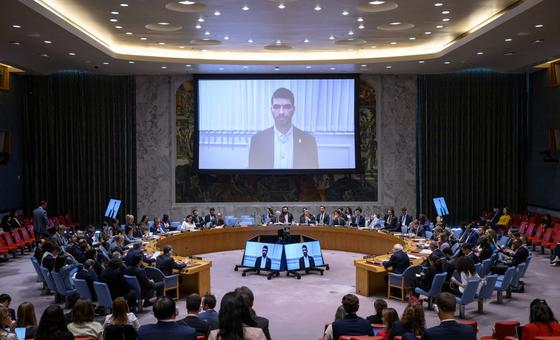
Assistant Secretary-General Miroslav Jenča briefed a Security Council meeting on Tuesday called by Israel to discuss the plight of hostages still being held in the war-ravaged enclave.

It comes after Hamas and Palestinian Islamic Jihad released images and videos of two emaciated hostages, Evaytar David and Rom Braslavsky, sparking outrage and condemnation. 

‘An affront to humanity itself’

The scenes of Evaytar apparently being forced to dig his own grave are appalling,” he said.

“These images, and their own accounts of their treatment, have horrified us all. They are an affront to humanity itself.”

Mr. Jenča acknowledged the presence of Mr. David’s brother, Ilay, who participated in the meeting via videoconference, saying the UN recognises “the profound pain and hardship endured by the families and loved ones of those who remain in captivity.”

He recalled that this week the Jewish community commemorated Tisha B’Av, a day of mourning and remembrance of tragedies endured throughout its history.

“I pay tribute to your courage and determination, and I share your dearest wish: for your brother, and all hostages held in Gaza, to be immediately and unconditionally released,” he said.

A war crime

Currently, 50 hostages continue to be held by Hamas and other Palestinian armed groups in horrific conditions and 28 are thought to be deceased, while freed hostages “have relayed distressing accounts of deprivation, ill-treatment, and abuse.”

Since the conflict began, Hamas and other armed groups have circulated dozens of videos of hostages, including statements made under duress and while clearly suffering, including the most recent footage of the two men.

“International law is clear,” said Mr. Jenča.  “Hostage-taking is prohibited – it is a war crime.”

He stressed that people deprived of their liberty must be treated humanely and with dignity and allowed to be visited by the International Committee of the Red Cross (ICRC). 

“They must never be subject to ill-treatment, abuse, or humiliation, as these would also constitute violations of relevant rules of international law,” he added, before reiterating UN Secretary-General António Guterres’s call on Hamas and other Palestinian armed groups for the immediate and unconditional release of all hostages. 

Gaza situation ‘unbearable’

Meanwhile, “the situation in Gaza is horrifying – it is unbearable,” he continued, noting that “Palestinians are subjected to squalid, inhumane conditions on a daily basis.”

More than 60,000 Palestinians have been killed since the conflict began, according to local health authorities.

Since the end of May, over 1,200 Palestinians have been killed and over 8,100 injured while trying to access food supplies, including in the vicinity of militarized aid distribution sites,” said Mr. Jenča.

“The deaths and injuries continue to mount, day by day, with no end in sight to the suffering.”

This is happening as Israel continues to severely restrict humanitarian assistance entering Gaza, while the aid that is allowed to enter “is grossly inadequate.”

‘Hunger is everywhere’

He told the Council that “hunger is everywhere in Gaza, visible in the faces of children and in the desperation of parents risking their lives to access the most basic supplies.”

Here, he echoed the Secretary-General’s condemnation of the ongoing violence in Gaza, including the shooting, killing, and injuring of people trying to get food. 

“International law is clear. Civilians must be respected, protected and never targeted or deliberately deprived of food or access to other lifesaving aid – doing so is a war crime,” he said.

“Israel must immediately allow and facilitate rapid and unimpeded passage of sufficient amounts of humanitarian relief for civilians in need, to avert further suffering and loss of life.”

Potential military expansion ‘deeply alarming’

Mr. Jenča also addressed latest reports regarding Israeli Prime Minister Benjamin Netanyahu’s possible decision to expand military operations through the entire Gaza Strip.

If true, they are “deeply alarming,” he said, as “this would risk catastrophic consequences for millions of Palestinians and could further endanger the lives of the remaining hostages in Gaza.”

He again turned to international law, which is clear that Gaza is and must remain an integral part of a future Palestinian State.

He cited the July 2024 Advisory Opinion by the International Court of Justice (ICJ) which declared that Israel is under an obligation to immediately cease all new settlement activities, evacuate all settlers from the Occupied Palestinian Territory, and to bring an end to its unlawful presence there as rapidly as possible.

No military solution

Mr. Jenča concluded his briefing by underlining the UN’s position that the only way to end the violence and humanitarian catastrophe in Gaza is through a full and permanent ceasefire, the immediate and unconditional release of all hostages and allowing aid to enter at scale and without obstruction.  

Civilians also must be guaranteed safe, unhindered access to assistance.

He stressed that there is no military solution to the conflict in Gaza or the broader Israel-Palestine conflict. 

“We must establish political and security frameworks that can relieve the humanitarian catastrophe in Gaza, start early recovery and reconstruction, address the legitimate security concerns of Israelis and Palestinians, and secure an end to Israel’s unlawful occupation and achieve a sustainable two-State solution,” he said.

This would mean “Israel and a fully independent, democratic, contiguous, viable and sovereign Palestinian State, of which Gaza is an integral part – living side by side in peace and security within secure and recognized borders, on the basis of the pre-1967 lines, with Jerusalem as the capital of both States.” 

Source link

Israeli actions in Palestinian territories constitute war crimes, Human Rights Council hears

“The goal of the Israeli government is abundantly clear: the destruction of life in Gaza.”

That’s how Navi Pillay, Chair of the Commission of Inquiry on the Occupied Palestinian Territory, opened her statement to the 59th session of the Council on Tuesday.

Calling the war in Gaza “the most ruthless, prolonged and widespread attack against the Palestinian people since 1948,” Ms. Pillay addressed the findings of the Commission’s report, released to the HRC on 6 May.

Attacks on educational facilities in Gaza

It found that 90 per cent of Gaza’s schools and universities have been damaged or destroyed by Israeli attacks – including airstrikes, shelling, burning and controlled demolitions.

“With the loss of education, Palestinians are also losing their source of stability, hope and possibility of a future,” said Ms. Pillay.

By not issuing adequate warnings to civilians sheltering inside, these attacks caused extensive casualties, amounting to war crimes, including knowingly launching attacks that caused excessive and disproportionate civilian harm, and the crime against humanity of extermination.

The Commission found no military necessity to justify the destruction of schools, concluding that the intent was to restrict long-term Palestinian access to education.

Notably, while Israeli forces often claimed they were targeting Hamas operatives allegedly based in schools, the Commission verified only one instance of Hamas using a school for military purposes, compared to the systematic Israeli use of schools as military bases.

Education restrictions in the West Bank

Ms. Pillay also warned that education in the West Bank remains under threat. Demolition orders, military raids, restrictions, and operations have significantly reduced school days, while settler violence has endangered students and teachers. The Israeli government has either incited or failed to prevent such violence, she said.

Attacks on religious and cultural sites

In Gaza, Israeli forces have damaged 53 per cent of religious and cultural sites.

Many were being used for refuge or worship, causing further civilian casualties, constituting war crimes and, in some cases, the crime against humanity of extermination.

This completely avoidable damage “has a cascading effect and deeply affects intangible cultural elements, such as religious and cultural practices, memories and history, undermining the identity of Palestinians as a people,” said Ms. Pillay.

Because Israeli forces should have known where these sites were and planned their assaults accordingly, the Commission found these acts constituted war crimes including intentionally targeting historic and religious sites and widespread destruction without military necessity.

Seizure of cultural heritage sites in the West Bank

In the West Bank and East Jerusalem, the Commission documented repeated cases of Israeli authorities or settlers seizing cultural heritage sites, displacing Palestinians, excluding non-Jewish history and restricting Palestinian access.

The report highlights increasing restrictions and assaults on Palestinians at Haram al-Sharif/Temple Mount, a long-standing flashpoint in East Jerusalem.

Ms. Pillay argued that through these actions, “Israel has been using cultural heritage and settlements as leverage for its unlawful territorial claims in the occupied West Bank, in flagrant defiance of multiple United Nations resolutions and the 2024 advisory opinion of the International Court of Justice (ICJ).”

These actions violate international law, including the right to cultural life, freedom of religion, and protection of cultural heritage.

Recommendations

Ms. Pillay concluded her speech by underscoring that Israel’s attacks on education, infrastructure and heritage sites aim to “erode Palestinians’ historical ties to the land and weaken their collective identity, thereby hindering their right to self-determination” and the possibility of a peaceful, sustainable two-State solution.

Accordingly, the Commission calls for Israel to end the unlawful occupation and enable Palestinian self-determination; stop attacks and seizures of educational, religious and cultural sites; end the systematic erasure of Palestinian history; and comply fully with international law, including the 2024 ICJ ruling.

Sudan’s war intensifies amid starvation, rights probe warns

Meanwhile in Sudan, heavy fighting continues to escalate as a “direct result” of the continued flow of arms into the country meaning that the war is far from over, top independent human rights investigators said on Tuesday, ahead of briefing the Human Rights Council.

In an update on the emergency in the northeast African nation, the Independent International Fact-Finding Mission for the Sudan highlighted the increased use of heavy weaponry in populated areas – and a sharp rise in sexual violence.

“Many Sudanese are dying from hunger and especially those who have been detained and in detention – they are dying and millions affected,” said Joy Ngozi Ezeilo, Expert Member of the Fact-Finding Mission.

“In terms of international responsibility, we urge all States to respect and enforce the arms embargo of the United Nations Security Council Resolution 1556,” she added.

Humanitarian relief continues to be weaponized and hospitals and medical facilities remain under siege, warned the investigators, whose mandate was established by the Council in October 2023.

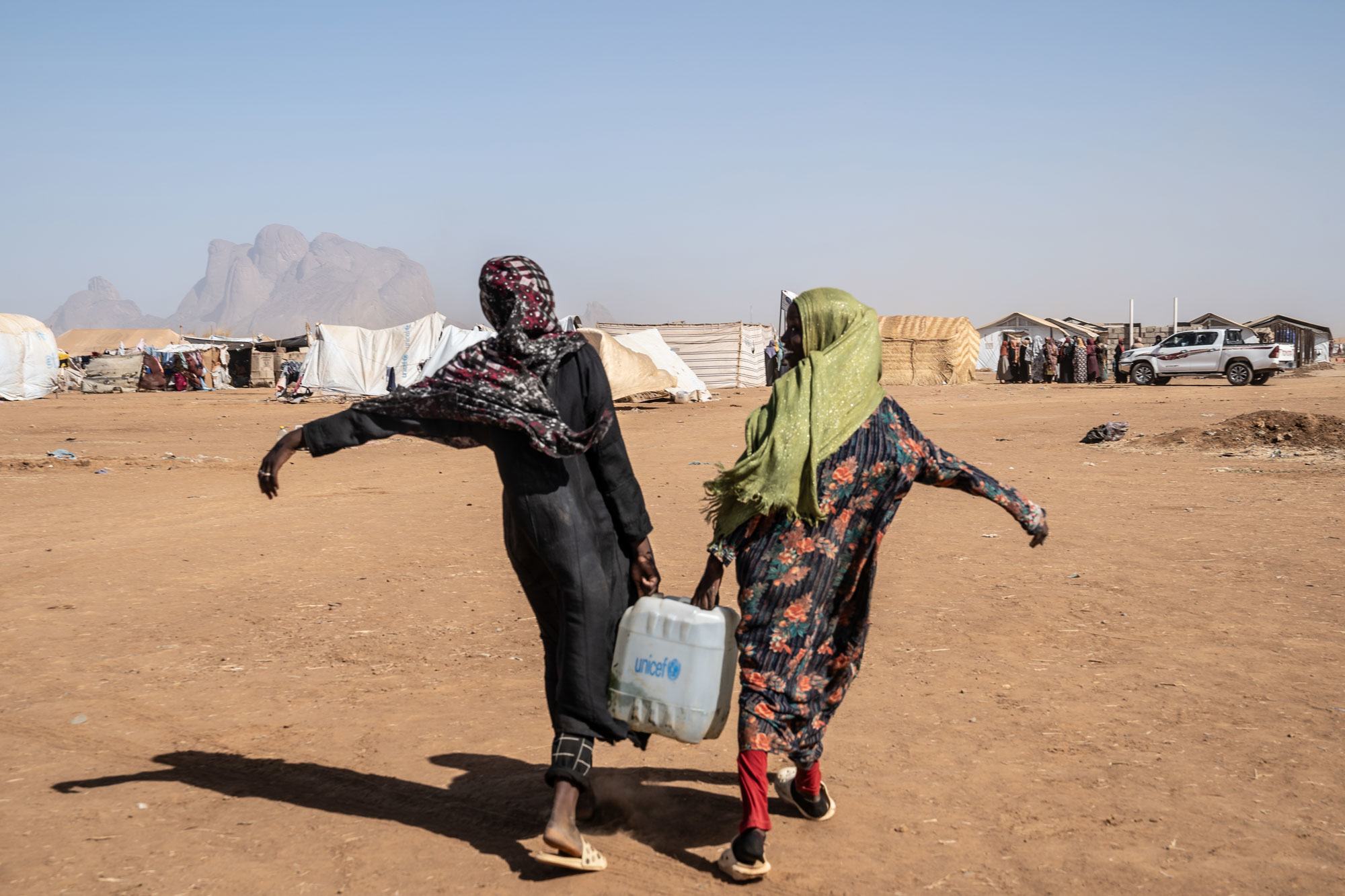
Two young women carry water at a site for displaced people in eastern Sudan.

Direct link

There is a direct link between the flow of arms in Sudan, armed hostilities and the resulting violence amounting to violations of international humanitarian law and human rights violations,” said Mohamed Chande Othman, Chair of the Fact-Finding Mission.

We know the kind of arms that are being used: heavy artillery, modern warfare, drones and in fact, they have escalated.”

Fellow investigator Mona Rishmawi insisted that testimonies gathered pointed to “both sides” continuing to commit war crimes – a reference to the Sudanese Armed Forces (SAF) and the Rapid Support Forces (RSF) which turned on each other in April 2023, following a breakdown in transition to civilian rule.

Around El Fasher, for instance, civilians have been “assaulted, detained and killed while villages have been attacked, burned and looted” by the RSF. During one RSF attack from 10 to 13 April, more than 100 civilians were reportedly killed, while a SAF bombing in Al Koma killed at least 15 civilians.

Now into its third year, the war has killed tens of thousands of civilians so far, displacing over 13 million Sudanese and subjecting many more to sexual violence, looting and the destruction of homes, health facilities, markets and other infrastructure. 

Crimes against humanity continue, “particularly in the context of persecution of certain ethnic groups”, Ms. Rishmawi insisted.

The result of restrictions to aid relief has been to drive famine, “especially in Darfur”, said the investigators, who are respected human rights experts and not UN staff.

In their latest update to the Human Rights Council, the investigators documented a sharp rise in sexual and gender-based violence, with women and girls subjected to rape, gang rape, abduction, sexual slavery and forced marriage, mostly in RSF-controlled displacement camps.

About UN experts

The members of both the Commission of Inquiry on the Occupied Palestinian Territory and the Fact-Finding Mission for the Sudan receive their mandates from the UN Human Rights Council.

They are not UN staff and do not receive payment for their work. 

Source link

‘Jerusalem is not for sale’ Palestinian President Abbas tells world leaders at UN Assembly

President Abbas underscored his commitment to peace and the two-state solution, as well as the path of negotiation to achieve them, reiterating that peace in the Middle East cannot be realized without an independent Palestinian state, with East Jerusalem as its capital.

“We have always fully and positively engaged with the various initiatives of the international community aimed at achieving a peaceful solution between us and the Israelis, including the Arab Peace Initiative,” he told world leaders gathered for the Assembly’s annual debate, noting that he also engaged with United States President Donald Trump and his administration from the start of his tenure.

However, the US administration’s decision to close office of the Palestine Liberation Organization (PLO) in Washington D.C., the proclamation of Jerusalem as the capital of Israel, and transferring of the US embassy from Tel Aviv to Jerusalem, not only violate UN resolutions, they have also undermined the two-state solution, added President Abbas.

Those decisions, have also caused the US administration to lose its eligibility as the mediator in the Middle East peace process, he said.

“The path to peace is enshrined in your [the UN] resolutions, including resolution 67/19 of 29 November 2012, which was adopted by an overwhelming majority and refers to the State of Palestine on the basis of the 1967 borders,” he stressed.

Mr. Abbas also highlighted what he called “racist” laws enacted recently in Israel, which not only discriminate against the Palestinian-Arab citizens, but, will also lead to the “inevitable” nullification of the two-state solution.

Palestinian people and the territory of the state of Palestine are in urgent need of international protection, he said, and while he welcomed economic and humanitarian support in the West Bank and the Gaza Strip but added that such support cannot be a substitute to a political solution to bring an end to the Israeli occupation.

President Abbas also highlighted the importance of the work of the UN Relief and Works Agency for Palestine Refugees in the Near East (UNRWA) and urged all countries as well as the General Assembly to support the agency.

Full statement available here.