‘Like a scene out of a horror movie’: UN report warns of war crimes in Sudan’s El Fasher

Persistent impunity fuels continued cycles of violence,” said UN High Commissioner for Human Rights Volker Türk, calling for credible investigations and accountability for perpetrators. 

Sudan’s national army and the Rapid Support Forces (RSF) militia have been fighting each other for control of the country for almost three years. The new report details widespread atrocities committed during the RSF assault on the besieged city of El Fasher in North Darfur. 

The RSF and allied Arab militia carried out mass killings and summary executions, sexual violence, abductions for ransom, torture and ill-treatment, detention, disappearances, pillage and the use of children in hostilities. Many attacks were directed against civilians and persons hors de combat based on ethnicity or perceived affiliation. 

Documented atrocities  

Based on hundreds of interviews with victims and witnesses in late 2025, OHCHR documented more than 6,000 killings in the first three days of the RSF offensive. The report however warns the overall death toll during the weeks-long offensive is “undoubtedly significantly higher”. 

The report revealed that in one incident around 500 people were killed when RSF fighters opened fire using heavy weapons on a crowd of 1,000 sheltering at Al-Rashid dormitory in El Fasher University on 26 October. One of the witnesses reported seeing bodies thrown into the air “like a scene out of a horror movie”. 

RSF fighters also carried out summary executions within El Fasher of civilians, targeting young boys and men under 50, accused of “collaboration” with the Sudanese Armed Forces (SAF) and Joint Forces, often determined on the basis of their non-Arab ethnicity, such as the Zaghawa community.  

Survivors and witnesses recounted patterns of rape and gang rape, abductions for ransom using sexual violence, and sexual assault during invasive body searches, with women and girls from the Zaghawa and other non-Arab communities at particular risk.   

Possible crimes against humanity  

According to the report, the violations at El Fasher mirror other RSF offensives during the war, such as at the Zamzam camp in April 2025. The “organized and sustained course of conduct” suggested a systematic attack against the civilian population in the Darfur region.  

The acts of violence knowingly committed as part of such an attack would amount to crimes against humanity”, OHCHR said. 

Calls for justice 

Mr. Türk urged parties to the conflict to end violations by forces under their command and called on States with influence to help prevent further atrocities, including by respecting the arms embargo and halting the supply of weapons. 

He called on States to do everything possible to support local, regional, and international mediation efforts, to achieve a cessation of hostilities and a pathway towards inclusive civilian governance.  

“In a protection crisis of this scale, human rights must remain central to efforts to achieve a durable resolution of the conflict,” he said. 

Source link

Syria: Violence in Alawite areas may be war crimes, say rights investigators

Many of the victims were Alawite, a minority community in Syria, which the former ruling Assad family belonged to.  

Some community members are believed to have been killed in March by forces or individuals loyal to the country’s new leadership, the National Transitional Authority, which is headed by interim President Ahmed Al-Sharaa.

In response to the “arrest operation” launched on 6 March, fighters loyal to toppled President Bashar al-Assad responded by capturing, killing and injuring hundreds of interim government forces, the commissioners said.

Looting was also widespread, while homes were set alight, leaving tens of thousands of civilians displaced, the commissioners continued.

In total, approximately 1,400 people were reported killed in the ensuing massacres, predominantly civilians.

“The vast majority were adult men, but victims included approximately 100 women, the elderly and the disabled, as well as children,” the UN Commission of Inquiry on Syria said.

Still a target

It also warned that the Alawite community which formed former Mr. al-Assad’s power base is still being targeted today. Alawites make up about 10 per cent of the majority Sunni country. 

According to the commissioners’ latest report, the victims killed in March were murdered and tortured, while the bodies of the dead were also mutilated.

They added that some acts were filmed and published on social media, along with footage of civilians being abused and humiliated.

Chair of the UN panel, Paulo Pinheiro, condemned the scale and brutality of the violence which reportedly involved Alawite men being identified and singled out before being led away to be shot and killed in multiple majority Alawite villages and neighbourhoods.    

Bodies were left in the streets for days, with families prevented from conducting burials in accordance with religious rites, while others were buried in mass graves without proper documentation,” the commissioners’ report stated.

Meanwhile, hospitals became overwhelmed “as corpses piled up”.

Eye-witnesses

The Commission’s latest report is based on extensive investigations, including more than 200 interviews with victims and witnesses, including in Latakia and Tartus.  

The investigators also visited three mass grave sites and met senior Syrian government officials.

Today, Alawite communities still live in fear and face ongoing abductions of women, arbitrary arrests, enforced disappearances and looting and occupation of their property, investigators noted.  

Protection must be a priority

They should be protected by the new authorities in charge of Syria, commissioners insisted.  

The affected communities need to see urgent action to increase their protection. Beyond referral of suspected perpetrators to criminal justice, individuals suspected of involvement in violations during the March events should be immediately removed from active duties pending investigation,” said Commissioner Lynn Welchman.

Additionally, screening processes need to be expanded so that known or suspected perpetrators of grave violations in the past are not recruited into the ranks of the interim government security forces, she maintained.

After 14 years of civil war which ended last December when opposition forces including Hayat Tahrir al-Sham (HTS) – led by interim Prsident al-Sharaa – the  swept into Damascus, forcing out Mr. al-Assad, lasting damage has been done to Syria’s unity.

“The extreme violence that occurred has deepened existing rifts between communities, contributing to a climate of fear and insecurity amongst many Syrians throughout the country,” the Commissioners said.

“We call on the interim authorities to continue to pursue accountability for all perpetrators, regardless of affiliation or rank,” Mr. Pinheiro continued. “While dozens of alleged perpetrators of violations have reportedly since been arrested, the scale of the violence documented in our report warrants expanding such efforts.”  

Two ex-militia leaders in Central African Republic sentenced for war crimes, crimes against humanity

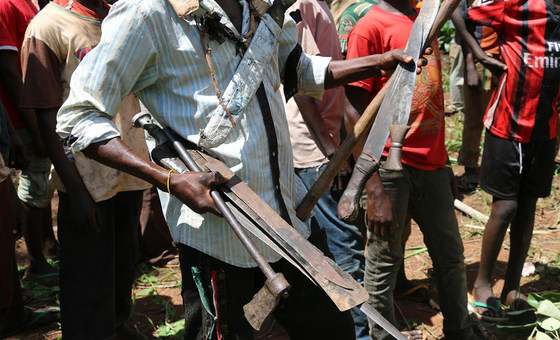
Alfred Yekatom and Patrice-Edouard Ngaïssona received prison sentences of 15 and 12 years for their roles in brutal attacks against civilians – primarily from the country’s mainly Muslim Seleka population – during the 2013-14 civil war.

They were found guilty “beyond any reasonable doubt” of leading and facilitating attacks on civilians in the capital, Bangui, and the country’s west.

Thousands of people were killed in the violence that swept CAR following a 2012 coup led by the mainly Muslim rebel coalition, Séléka. The fighting took on a deeply sectarian tenor as Anti-Balaka militia started a brutal campaign of reprisal attacks.

Long list of crimes

The ICC’s Trial Chamber V found Mr. Yekatom responsible for a number of crimes he committed in the context of the attack on Bangui (the capital of CAR), the events at Yamwara (a school where he had established a base), and during the advance of his group on the PK9-Mbaïki axis.

These included murder, torture, forcible transfer and deportation, directing an attack against a building dedicated to religion and persecution.

Mr. Ngaïssona was convicted for aiding and abetting many of the same crimes, including persecution, forcible displacement and cruel treatment.

Both men were also found to have targeted Muslims based on the Anti-Balaka’s perception of collective guilt for Seleka abuses.

The judges sentenced Mr. Yekatom to 15 years and Mr. Ngaïssona to 12 years, with time already served to be deducted.

Charges of war crimes of pillaging and directing an attack against a religious building during the attack on Bossangoa were not upheld against Mr. Ngaïssona, and those of conscription, enlistment and use of children were not upheld against Mr. Yekatom.

‘Instrumentalization of religion’

The Chamber noted that while religion was instrumentalised by armed groups during the conflict, the violence was not initially religious in nature.

Many witnesses testified that Muslims and Christians had lived peacefully together prior to the conflict.

The convictions mark the conclusion of a trial that began in February 2021. Over the course of proceedings, the Prosecution called 114 witnesses, while the Defense teams called 56. A total of 1,965 victims participated in the trial through legal representatives.

Source link

Israeli actions in Palestinian territories constitute war crimes, Human Rights Council hears

“The goal of the Israeli government is abundantly clear: the destruction of life in Gaza.”

That’s how Navi Pillay, Chair of the Commission of Inquiry on the Occupied Palestinian Territory, opened her statement to the 59th session of the Council on Tuesday.

Calling the war in Gaza “the most ruthless, prolonged and widespread attack against the Palestinian people since 1948,” Ms. Pillay addressed the findings of the Commission’s report, released to the HRC on 6 May.

Attacks on educational facilities in Gaza

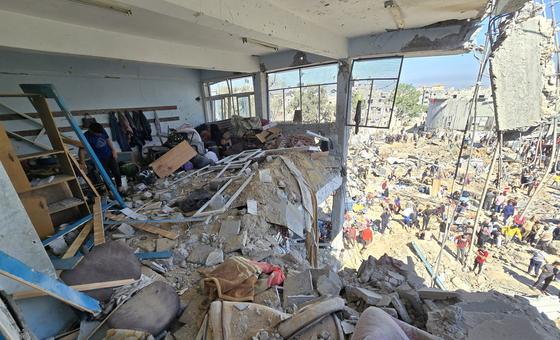
It found that 90 per cent of Gaza’s schools and universities have been damaged or destroyed by Israeli attacks – including airstrikes, shelling, burning and controlled demolitions.

“With the loss of education, Palestinians are also losing their source of stability, hope and possibility of a future,” said Ms. Pillay.

By not issuing adequate warnings to civilians sheltering inside, these attacks caused extensive casualties, amounting to war crimes, including knowingly launching attacks that caused excessive and disproportionate civilian harm, and the crime against humanity of extermination.

The Commission found no military necessity to justify the destruction of schools, concluding that the intent was to restrict long-term Palestinian access to education.

Notably, while Israeli forces often claimed they were targeting Hamas operatives allegedly based in schools, the Commission verified only one instance of Hamas using a school for military purposes, compared to the systematic Israeli use of schools as military bases.

Education restrictions in the West Bank

Ms. Pillay also warned that education in the West Bank remains under threat. Demolition orders, military raids, restrictions, and operations have significantly reduced school days, while settler violence has endangered students and teachers. The Israeli government has either incited or failed to prevent such violence, she said.

Attacks on religious and cultural sites

In Gaza, Israeli forces have damaged 53 per cent of religious and cultural sites.

Many were being used for refuge or worship, causing further civilian casualties, constituting war crimes and, in some cases, the crime against humanity of extermination.

This completely avoidable damage “has a cascading effect and deeply affects intangible cultural elements, such as religious and cultural practices, memories and history, undermining the identity of Palestinians as a people,” said Ms. Pillay.

Because Israeli forces should have known where these sites were and planned their assaults accordingly, the Commission found these acts constituted war crimes including intentionally targeting historic and religious sites and widespread destruction without military necessity.

Seizure of cultural heritage sites in the West Bank

In the West Bank and East Jerusalem, the Commission documented repeated cases of Israeli authorities or settlers seizing cultural heritage sites, displacing Palestinians, excluding non-Jewish history and restricting Palestinian access.

The report highlights increasing restrictions and assaults on Palestinians at Haram al-Sharif/Temple Mount, a long-standing flashpoint in East Jerusalem.

Ms. Pillay argued that through these actions, “Israel has been using cultural heritage and settlements as leverage for its unlawful territorial claims in the occupied West Bank, in flagrant defiance of multiple United Nations resolutions and the 2024 advisory opinion of the International Court of Justice (ICJ).”

These actions violate international law, including the right to cultural life, freedom of religion, and protection of cultural heritage.

Recommendations

Ms. Pillay concluded her speech by underscoring that Israel’s attacks on education, infrastructure and heritage sites aim to “erode Palestinians’ historical ties to the land and weaken their collective identity, thereby hindering their right to self-determination” and the possibility of a peaceful, sustainable two-State solution.

Accordingly, the Commission calls for Israel to end the unlawful occupation and enable Palestinian self-determination; stop attacks and seizures of educational, religious and cultural sites; end the systematic erasure of Palestinian history; and comply fully with international law, including the 2024 ICJ ruling.

Sudan’s war intensifies amid starvation, rights probe warns

Meanwhile in Sudan, heavy fighting continues to escalate as a “direct result” of the continued flow of arms into the country meaning that the war is far from over, top independent human rights investigators said on Tuesday, ahead of briefing the Human Rights Council.

In an update on the emergency in the northeast African nation, the Independent International Fact-Finding Mission for the Sudan highlighted the increased use of heavy weaponry in populated areas – and a sharp rise in sexual violence.

“Many Sudanese are dying from hunger and especially those who have been detained and in detention – they are dying and millions affected,” said Joy Ngozi Ezeilo, Expert Member of the Fact-Finding Mission.

“In terms of international responsibility, we urge all States to respect and enforce the arms embargo of the United Nations Security Council Resolution 1556,” she added.

Humanitarian relief continues to be weaponized and hospitals and medical facilities remain under siege, warned the investigators, whose mandate was established by the Council in October 2023.

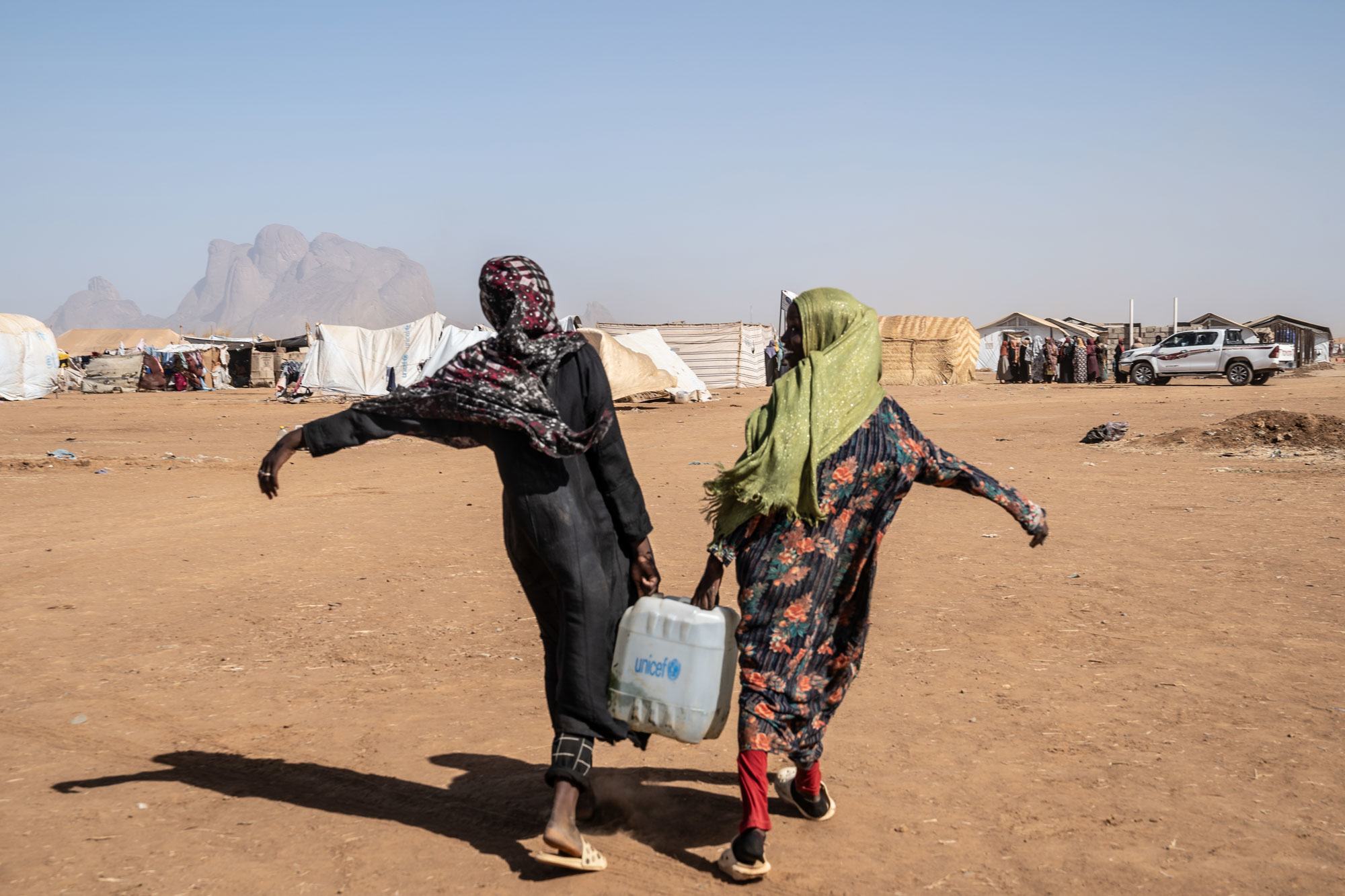
Two young women carry water at a site for displaced people in eastern Sudan.

Direct link

There is a direct link between the flow of arms in Sudan, armed hostilities and the resulting violence amounting to violations of international humanitarian law and human rights violations,” said Mohamed Chande Othman, Chair of the Fact-Finding Mission.

We know the kind of arms that are being used: heavy artillery, modern warfare, drones and in fact, they have escalated.”

Fellow investigator Mona Rishmawi insisted that testimonies gathered pointed to “both sides” continuing to commit war crimes – a reference to the Sudanese Armed Forces (SAF) and the Rapid Support Forces (RSF) which turned on each other in April 2023, following a breakdown in transition to civilian rule.

Around El Fasher, for instance, civilians have been “assaulted, detained and killed while villages have been attacked, burned and looted” by the RSF. During one RSF attack from 10 to 13 April, more than 100 civilians were reportedly killed, while a SAF bombing in Al Koma killed at least 15 civilians.

Now into its third year, the war has killed tens of thousands of civilians so far, displacing over 13 million Sudanese and subjecting many more to sexual violence, looting and the destruction of homes, health facilities, markets and other infrastructure. 

Crimes against humanity continue, “particularly in the context of persecution of certain ethnic groups”, Ms. Rishmawi insisted.

The result of restrictions to aid relief has been to drive famine, “especially in Darfur”, said the investigators, who are respected human rights experts and not UN staff.

In their latest update to the Human Rights Council, the investigators documented a sharp rise in sexual and gender-based violence, with women and girls subjected to rape, gang rape, abduction, sexual slavery and forced marriage, mostly in RSF-controlled displacement camps.

About UN experts

The members of both the Commission of Inquiry on the Occupied Palestinian Territory and the Fact-Finding Mission for the Sudan receive their mandates from the UN Human Rights Council.

They are not UN staff and do not receive payment for their work. 

Source link

DR Congo: Human rights violations could amount to war crimes, UN experts say

Volker Türk told the Human Rights Council that the investigation and analysis undertaken by his office, OHCHR, had revealed “an apparent total disregard for the protection of civilians during and after military operations.”

The OHCHR’s Fact-Finding Mission in the eastern DRC is also investigating other alleged violations of international humanitarian law, “many of which may amount to war crimes,” he said.  

Arbitrary Arrests

After capturing cities and villages in early 2025, the M23 Rwanda-backed rebels arbitrarily arrested police officers and large numbers of other civilians, including children, the UN human rights office reported.  

According to witnesses, those captured were, and are, still being held in “inhumane conditions,” and many were forcibly recruited into the ranks of the M23.  

The Mission is also investigating alleged arbitrary arrests and enforced disappearances of suspected M23 supporters by the military intelligence arm of the DRC armed forces.  

Extrajudicial Killings

OHCHR also reported that members of the M23 carried out summary and extrajudicial executions, which likely amount to war crimes, said Mr. Türk.  

The Mission is also investigating alleged summary executions by members of the DRC armed forces and DRC-backed Wazalendo militias.  

UN human rights is also investigating reports of death threats, detention and other reprisals against human rights defenders, journalists, and members of civil society perceived as critical of the M23; including the alleged killings of at least two activists.  

Sexual Violence

The Mission received reports of “horrific” use of sexual violence by all parties as a means of reprisal against communities, relatives of perceived opponents, and people from other ethnic groups, said Mr. Türk.  

In North and South Kivu, nearly 40 per cent of survivors of sexual and gender-based violence are children. The UN International Children’s Emergency Fund (UNICEF) estimated that during the most intense phase of the conflict, a child was raped every 30 minutes.  

Mr. Türk called on “all parties to the conflict to commit immediately to a ceasefire and resume negotiations, and to respect international humanitarian and human rights law.” 

Source link

Israeli attacks on Gaza schools could be crimes against humanity: UN probe

The UN Human Rights Council-mandated Independent International Commission of Inquiry (COI) report found that Israeli forces have used airstrikes, shelling, burning, and controlled demolitions to damage or destroy more than 90 per cent of schools and university buildings across Gaza.

This destruction in the wake of the 7 October 2023 Hamas-led terror attacks on Israel has made education impossible for over 658,000 children, many of whom have been out of school for nearly two years.

“We are seeing more and more indications that Israel is carrying out a concerted campaign to obliterate Palestinian life in Gaza,” said Navi Pillay, Chair of the Commission.

“Israel’s targeting of the educational, cultural and religious life of the Palestinian people will harm the present generations and generations to come, hindering their right to self-determination.”

Classroom-turned military base

The COI documented cases where Israeli forces seized and used educational institutions as military bases, including the conversion of part of Al-Azhar University’s Al-Mughraqa campus into a synagogue for troops.

The report also noted one instance where Hamas militants used a school for military purposes. Such conduct is a breach of international humanitarian law, which mandates the distinction between civilian objects and military targets.

Targeting of religious sites

More than half of Gaza’s religious and cultural sites have been damaged or destroyed, including places serving as refuges for civilians – killing hundreds, including women and children.

The Commission stated that Israeli forces knew or should have known the cultural significance of these sites and failed to prevent harm.

In the occupied West Bank, including East Jerusalem, Israeli authorities appropriated, developed and profited from cultural heritage sites representing Palestinian, Jewish and other cultures, while displaced Palestinian residents.

They have also blocked or severely restricted Palestinians from accessing the sites.

“Attacks on cultural and religious sites have deeply impacted intangible culture, such as religious and cultural practices, memories and history,” said Ms. Pillay.

“The targeting and destruction of heritage sites, the limiting of access to those sites in the West Bank and the erasure of their heterogenic history erode Palestinians’ historical ties to the land and weaken their collective identity.”

Recommendations

The Commission called on Israel to immediately cease attacks on cultural, religious, and educational institutions and to end the seizure and military use of such facilities. It urged Israel to end its occupation and settlement activities, especially near religious and cultural sites, and to comply fully with International Court of Justice (ICJ) orders.

Investigators also urged Palestinian authorities to protect and preserve cultural heritage sites, including those of diverse origins, calling on de facto authorities in Gaza to stop using civilian objects for military purposes.

Humanitarian crisis spiralling

UN agencies continue to warn of a worsening humanitarian crisis in Gaza.

The UN Children’s Fund (UNICEF) highlighted the case of a five-year-old malnourished child whose recovery depends on adequate food and sustained care.

Aid at scale must be allowed into Gaza for children’s health and survival,” the agency urged.

‘Another day of death traps’

Philippe Lazzarini, head of the UN agency assisting Palestine refugees, expressed deep concern over delays and obstacles in aid delivery, urging Israel to allow the UN safe and unhindered access to bring in supplies and distribute it safely.

“This is the only way to avert mass starvation including among one million children,” he said.

Mr. Lazzarini warned that casualties and injuries continue to be reported daily at US-backed distribution points managed by Israeli and private security forces – creating in effect, daily death traps.

He described the system as humiliating, forcing thousands of hungry and desperate people to walk tens of miles, while excluding the most vulnerable and those living too far from aid centres.

Source link

‘My husband died in my arms’: Russian drone attacks on Ukrainians amount to crimes against humanity, UN investigators report

“Russian armed forces have committed the crimes against humanity of murder and the war crimes of attacking civilians, through a months-long pattern of drone attacks targeting civilians on the right bank of the Dnipro River in Kherson Province,” the Independent International Commission of Inquiry on Ukraine said.

Attacks have been carried out since July 2024 in Kherson city and 16 localities stretching over more than 100 kilometres in river front areas under Ukrainian Government control. 

They are ongoing and nearly 150 civilians have been killed and hundreds more injured to date, according to official sources.

Attacks ‘planned and organised’

“The recurrence of these attacks for over 10 months, against multiple civilian targets and in a wide geographic area, demonstrates that they are widespread and systematic and have been planned and organised, requiring the mobilisation and allocation of necessary resources,” the report said.

The Commission examined over 300 publicly available videos of attacks and over 600 text posts on Telegram channels and, where possible, identified victims. 

Over 90 residents from affected areas were interviewed, including victims, witnesses, local authorities and medical personnel. 

Civilians were targeted “in various circumstances, mainly when they were outdoors, both on foot or while using any type of vehicles” the report said. Most victims were men, but women and children also were affected.

‘My husband died in my arms’

A woman from Poniativka village recounted that in September 2024, she was walking home with her husband and suddenly heard a drone. It was already above their heads and immediately dropped an explosive, giving them no time to seek shelter. Both were injured. 

My husband died in my arms, bleeding to death, because the ambulance did not arrive on time. I tried to stop the bleeding with a T-shirt, but it was not enough,” she said.

Videos posted on Telegram

Russian forces mostly used civilian drones that are widely commercially available, which were then modified.

The weaponized versions of these drones allow their operators, via an embedded camera, to remotely track, aim, and drop explosives on targets. They can return to their point of origin to be reused,” the report said.

“Occasionally, perpetrators employed suicide drones that are also equipped with cameras but that explode upon impact on their targets.”

Hundreds of the video feeds have been regularly disseminated on Russian Telegram channels, some of which have thousands of subscribers. 

“The video footage that they posted displays the attacks and the resulting death, injury, damage, or destruction, and is styled like video games, often accompanied by background music and threatening text,” the report said.

Ambulances targeted

Furthermore, ambulances also have been targeted and struck by drones to prevent them from reaching victims, and some have died because they could not get to a medical facility in time. 

“A 45-year-old man from Stanislav village recounted that in November 2024, a drone dropped an explosive near him as he was riding a moped, badly injuring his leg. An ambulance arrived, and while he was receiving first aid, a drone dropped two explosives on the ambulance,” the report said.

The Commission stressed that the use of drones to target civilians and civilian objects is a violation of the fundamental principle of international humanitarian law as such attacks may only be directed at military objects.

“The Commission therefore concludes that Russian armed forces perpetrated the war crime of intentionally directing attacks against civilians in Kherson Province,” it said, while “posting videos of civilians being killed and injured amounts to the war crime of outrages upon personal dignity.”

‘Drones were attacking everything’

The drone attacks have spread terror among residents of the affected areas. Many wait for cloudy days to go out, or seek cover under trees, where possible. 

“Drones were attacking everything; minibuses, cars, pedestrians…every time you went out of the house, you had to check the sky and look out for a buzzing sound and, in any case, run,” a man from Antonivka settlement told the Commission.

Moreover, fear is further induced by frequent messages posted on Telegram, such as “Get out of the city before the leaves fall, you who are destined to die.”

“The recurrent drone attacks, the widely disseminated videos showing them, and numerous posts explicitly exhorting the population to leave suggest a coordinated state policy, on the part of the Russian authorities, to force the population of Kherson Province to leave the area,” investigators said.

They concluded Russian forces may have committed the crime against humanity of forcible transfer of population.

Mandate from Human Rights Council

The commission is mandated by the UN Human Rights Council to investigate all alleged violations and abuses of human rights, violations of international humanitarian law and related crimes in the context of the aggression against Ukraine by Russia.

The three Commissioners serve in their individual capacity and are independent from any government or organization, including the UN.


Source link