‘Like a scene out of a horror movie’: UN report warns of war crimes in Sudan’s El Fasher

Persistent impunity fuels continued cycles of violence,” said UN High Commissioner for Human Rights Volker Türk, calling for credible investigations and accountability for perpetrators. 

Sudan’s national army and the Rapid Support Forces (RSF) militia have been fighting each other for control of the country for almost three years. The new report details widespread atrocities committed during the RSF assault on the besieged city of El Fasher in North Darfur. 

The RSF and allied Arab militia carried out mass killings and summary executions, sexual violence, abductions for ransom, torture and ill-treatment, detention, disappearances, pillage and the use of children in hostilities. Many attacks were directed against civilians and persons hors de combat based on ethnicity or perceived affiliation. 

Documented atrocities  

Based on hundreds of interviews with victims and witnesses in late 2025, OHCHR documented more than 6,000 killings in the first three days of the RSF offensive. The report however warns the overall death toll during the weeks-long offensive is “undoubtedly significantly higher”. 

The report revealed that in one incident around 500 people were killed when RSF fighters opened fire using heavy weapons on a crowd of 1,000 sheltering at Al-Rashid dormitory in El Fasher University on 26 October. One of the witnesses reported seeing bodies thrown into the air “like a scene out of a horror movie”. 

RSF fighters also carried out summary executions within El Fasher of civilians, targeting young boys and men under 50, accused of “collaboration” with the Sudanese Armed Forces (SAF) and Joint Forces, often determined on the basis of their non-Arab ethnicity, such as the Zaghawa community.  

Survivors and witnesses recounted patterns of rape and gang rape, abductions for ransom using sexual violence, and sexual assault during invasive body searches, with women and girls from the Zaghawa and other non-Arab communities at particular risk.   

Possible crimes against humanity  

According to the report, the violations at El Fasher mirror other RSF offensives during the war, such as at the Zamzam camp in April 2025. The “organized and sustained course of conduct” suggested a systematic attack against the civilian population in the Darfur region.  

The acts of violence knowingly committed as part of such an attack would amount to crimes against humanity”, OHCHR said. 

Calls for justice 

Mr. Türk urged parties to the conflict to end violations by forces under their command and called on States with influence to help prevent further atrocities, including by respecting the arms embargo and halting the supply of weapons. 

He called on States to do everything possible to support local, regional, and international mediation efforts, to achieve a cessation of hostilities and a pathway towards inclusive civilian governance.  

“In a protection crisis of this scale, human rights must remain central to efforts to achieve a durable resolution of the conflict,” he said. 

Source link

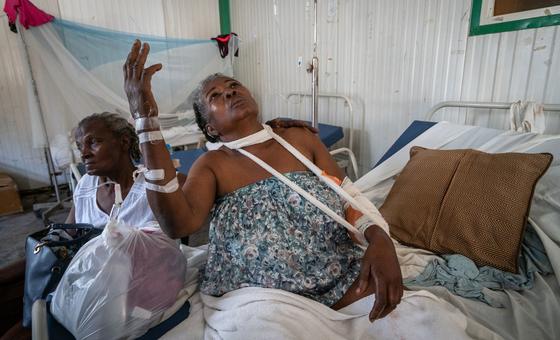
‘An unending horror story’: Gangs and human rights abuses expand in Haiti

Left vulnerable, communities then formed self-defence groups and Haitian security forces reinforced their operations and made small gains only to be rebuffed again by gangs.

And at all stages of this cycle, human rights violations are being committed against civilians, according to a report released on Friday by the UN office in Haiti (BINUH) and the UN human rights office (OHCHR).

“Caught in the middle of this unending horror story are the Haitian people, who are at the mercy of horrific violence by gangs and exposed to human rights violations from the security forces and abuses by the so-called ‘self-defence’ groups,” said Volker Türk, High Commissioner for Human Rights.

The report also warned about “early signs of criminal governance” in the Centre Department where gangs are beginning to consolidate their gains and act as a de facto governing authority.

Four years of horror

Since 2021 and the assassination of President Jovenel Moïse, gang violence has dominated the capital Port-au-Prince which is now 85 per cent controlled by gangs, says the UN.

Over 1.3 million Haitians have been displaced because of this violence, representing the largest displacement due to political upheaval in Haitian history.

Food insecurity among displaced Haitians is rampant, with Haiti one of five countries worldwide which is experiencing famine-like conditions.

As of March 2025, the violence has also expanded into previously untouched areas of the country, specifically the Artibonite and Centre Departments where 92,000 and 147,000 people have been displaced respectively.

The report also noted that recently, gangs have begun to expand beyond central Haiti towards the border of the Dominican Republic, with the apparent goal of controlling key roads through which much of the illegal weapons trafficking is happening.

“The expansion of gang territorial control poses a major risk of spreading violence and increasing transnational trafficking in arms and people,” said Ravina Shamdasani, a UNHCR spokesperson at a briefing in Geneva.

Human rights endangered

Between October 2024 and June 2025, 4,864 people in Haiti have been killed by gang violence. At least hundreds more have been injured, kidnapped, raped and trafficked.

“Human rights abuses outside Port-au-Prince are intensifying in areas of the country where the presence of the State is extremely limited,” said Ulrika Richardson, interim Head of BINUH and UN Resident Coordinator.

While many of these human rights violations – including the denial of the right to life and physical integrity, sexual violence and forced displacement — are being perpetrated by organized gangs, there are also documented human rights abuses at the hands of Haitian authorities.

Specifically, between October 2024 and June 2025, there were 19 extrajudicial executions by security forces in the Artibonite and Centre Departments – 17 of them in Artibonite.

Self-defence groups, which are increasingly prevalent as a result of inadequate State security, have also committed human rights violations, often in the form of lynchings of suspected gang members.

“The human rights violations and abuses that we have documented are further evidence of why Haiti and the international community urgently need to step up to end the violence,” Mr. Türk said.

At this point, there have been no documented human rights abuses committed by the Multinational Security Support (MSS) mission authorized by the United Nations and funded and staffed largely by Kenya.

No accountability

The Haitian National Police and MSS have launched multiple operations to regain territory lost to the gangs. While some have been briefly successful, the operations have been unable to maintain a lasting presence or protect local communities, according to the report.

In fact, the report suggests that in the Centre, the situation is trending in the opposite direction with gangs consolidating territorial gains outside the capital and beginning to institute forms of criminal governance.

As a result of this persistent insecurity, judicial operations are virtually at a standstill in the Centre and Artibonite Departments.

“The international community must strengthen its support to the authorities, who bear the primary responsibility for protecting the Haitian population,” said Ms. Richardson.

Source link

New horror in Gaza as double strike on school shelter kills 30

The UN agency for Palestine refugees, UNRWA, maintained that Israeli forces hit the school in Al Bureij, Middle Gaza, at around 6pm on Tuesday and again at 10.20pm.

The school sustained severe damage and a fire broke out in the shelter, making it difficult to evacuate the casualties. Residents had to open a hole in the wall to evacuate the dead and wounded,” UNRWA told UN News.

Since the start of the war between Hamas and Israel on 7 October 2023, more than 400 schools have received a direct hit, according to satellite imagery analyzed by the UN.

Deadly aftermath

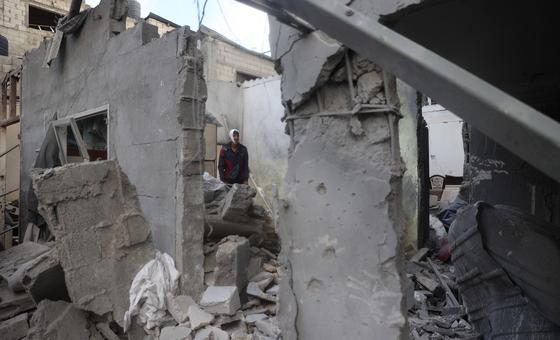
Footage from the scene provided by the UN agency showed walls and floors blown out in the main school building.

In the courtyard, hundreds of people can be seen standing amid crumpled metal sheeting on the morning after the attack, with rubble and wooden planks strewn around where their shelters had been standing just hours earlier.

“Our colleagues are reporting that surviving parents and children are trying to salvage their belongings among the blood and body parts of their relatives and neighbours,” UNRWA said.

The agency noted that fatalities included women and children, while search and rescue operations are ongoing for several people still missing.

Many of those living at the school when it was hit have been displaced “countless times” by the war, which began on 7 October 2023, following Hamas-led terror attacks on Israel, UNRWA stressed.

The attack also sparked a fire in an adjacent school where more tents and temporary shelters were burned and damaged.

Education destroyed

According to the UN Satellite Service, UNOSAT, 95.4 per cent of schools in Gaza have sustained damage since the start of the war.

Of the enclave’s 564 schools, 501 will either need full reconstruction or major rehabilitation work to be functional again.

“There is no humanity left in Gaza, and no humanity left as the world continues to watch day after day as families are bombed, burned alive and starved,” UNRWA said after the latest attack.

Failed strategy won’t work: Türk

In a related development, the UN human rights chief Volker Türk on Wednesday condemned Israel’s reported plans to forcibly transfer Gaza’s population to a small area in the south of the Strip.

The move fuels concern that Israel’s intention is to make life for Palestinians “increasingly incompatible with their continued existence in Gaza”, he said in a statement.

Surviving parents and children are trying to salvage their belongings among the blood and body parts of their relatives and neighbours – UNRWA

“There is no reason to believe that doubling down on military strategies, which, for a year and eight months, have not led to a durable resolution, including the release of all hostages, will now succeed,” insisted the UN High Commissioner for Human Rights.

Expanding the offensive on Gaza “will almost certainly cause further mass displacement, more deaths and injuries of innocent civilians, and the destruction of Gaza’s little remaining infrastructure”, he continued.

Rights experts warn of irreversible consequences

Escalating atrocities in Gaza mark a critical moral turning point and demand urgent international action, UN-appointed independent human rights experts said in a statement.

While States debate terminology – is it or is it not genocide? – Israel continues its relentless destruction of life in Gaza,” they warned, citing attacks by land, air and sea, and a soaring civilian death toll.

“No one is spared – not children, persons with disabilities, nursing mothers, journalists, health professionals, aid workers, or hostages,” they said, noting that on 18 March alone, 600 Palestinians were reportedly killed, 400 of them children. The independent experts are appointed by the Human Rights Council, are not UN staff members and receive no salary for their work.

Occupied West Bank update

In the occupied West Bank, meanwhile, UN aid teams warned of worsening conditions for Palestinian communities because of “violence by Israeli forces and settlers”.

The alert comes after Israeli forces on Monday demolished more than 30 structures in Khallet Athaba, a hamlet in Hebron governorate, displacing nearly a dozen families – or around 50 people.

“This constitutes most of the structures in the community and marks the third and largest demolition there since February,” said UN aid coordination office, OCHA. It noted that the area is designated by Israel as a military training zone.

In addition, Israeli forces also began demolishing six homes in Nur Shams refugee camp in Tulkarm on Monday, impacting 17 families. They are among more than 100 buildings slated for demolition, following an Israeli notice issued at the start of the month.

Forcible transfer fears

OCHA described how dozens of families in the camp were given little time on Monday to collect their belongings before their homes were demolished.

The agency highlighted the “strong push” to uproot Palestinians living in the area “once again raising concerns about the risks of forcible transfer of the population”.

Under international law, Israel as the occupying power, has the responsibility to protect Palestinians in the West Bank and ensure their safety and dignity, OCHA insisted.

Humanitarian partners are mobilizing assistance, but urgent international engagement is needed to stop these coercive measures and protect vulnerable communities, the UN aid office said.

Source link