
Torture, threats and arbitrary arrests: UN warns of ‘serious abuses’ against Afghans forced to return

These abuses include threats, cases of torture, mistreatment and arbitrary arrest and detention, according to the UN Assistance Mission in Afghanistan (UNAMA) and the Office of the UN High Commissioner for Human Rights (OHCHR).

The report said these violations were committed against Afghans “based on their profile” and targeted women, media workers and civil society members as well as individuals affiliated with the former government that fell in 2021 and its security forces, despite the Taliban’s claims that such individuals benefit from an amnesty.

No one should be returned to a country where they are at risk of being persecuted because of their identity or personal history,” said Volker Türk, the UN High Commissioner for Human Rights.

“In Afghanistan, this situation is even more pronounced for women and girls, who are subjected to a series of measures that amount to persecution solely on the basis of their gender.”

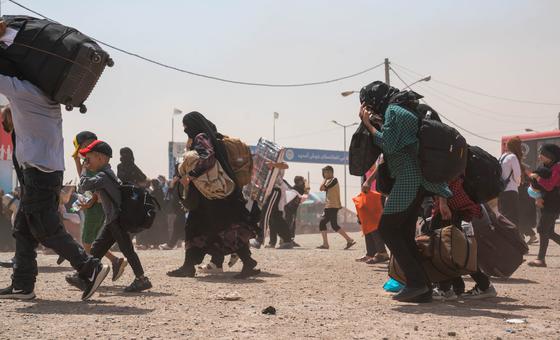
Since 2023 and the start of large-scale deportation campaigns launched by Iran and Pakistan, millions of Afghans have returned to their country. In 2025 alone, more than 1.8 million people have returned to Afghanistan, 1.5 million of them from Iran.

Women under house arrest

The UN refugee agency, UNHCR, recently estimated that the total could reach three million by the end of the year, returning to a country facing a severe humanitarian crisis.

The situation of women forcibly returned is particularly dire. A former television journalist, who left the country after the Taliban’s takeover in August 2021, described how, after being involuntarily returned to Afghanistan, she saw her prospects vanish.

“I am very worried for my personal safety and feel immense frustration with the current situation imposed on women in [my province]. I can unequivocally say that I am effectively under house arrest. There are no job opportunities, no freedom of movement and no access to education – whether to learn or to teach – for women and girls,” she testified.

Many people are also forced to live in hiding since returning to Afghanistan due to real or feared threats from the de facto authorities. This is the case for individuals affiliated with the former government and its security forces, who have had to go into hiding for fear of reprisals, despite the public amnesty announced by the de facto authorities.

Living in hiding

A former official described how, after returning in 2023, he was detained for two nights in a house where he was severely tortured, beaten with sticks, cables and wood, subjected to water torture and faced a mock execution.

Other refugees returned from Iran must frequently change locations to avoid being identified, such as one former judge.

I try to stay hidden because I know that the prisoners who were detained because of my decisions are now senior government officials and are still looking for me. If they find me, I’m sure they’ll kill me. They already threatened me when I was a judge,” they said.

Faced with these serious abuses, the UN is urging States not to return anyone to Afghanistan who faces a real risk of serious human rights violations.

Member States should expand resettlement opportunities for at-risk Afghans and ensure their protection, giving priority to those most likely to suffer human rights violations if returned to Afghanistan, including women and girls, individuals affiliated with the former government and security forces, media professionals, civil society activists and human rights defenders,” the report said.
Source link

‘An unending horror story’: Gangs and human rights abuses expand in Haiti

Left vulnerable, communities then formed self-defence groups and Haitian security forces reinforced their operations and made small gains only to be rebuffed again by gangs.

And at all stages of this cycle, human rights violations are being committed against civilians, according to a report released on Friday by the UN office in Haiti (BINUH) and the UN human rights office (OHCHR).

“Caught in the middle of this unending horror story are the Haitian people, who are at the mercy of horrific violence by gangs and exposed to human rights violations from the security forces and abuses by the so-called ‘self-defence’ groups,” said Volker Türk, High Commissioner for Human Rights.

The report also warned about “early signs of criminal governance” in the Centre Department where gangs are beginning to consolidate their gains and act as a de facto governing authority.

Four years of horror

Since 2021 and the assassination of President Jovenel Moïse, gang violence has dominated the capital Port-au-Prince which is now 85 per cent controlled by gangs, says the UN.

Over 1.3 million Haitians have been displaced because of this violence, representing the largest displacement due to political upheaval in Haitian history.

Food insecurity among displaced Haitians is rampant, with Haiti one of five countries worldwide which is experiencing famine-like conditions.

As of March 2025, the violence has also expanded into previously untouched areas of the country, specifically the Artibonite and Centre Departments where 92,000 and 147,000 people have been displaced respectively.

The report also noted that recently, gangs have begun to expand beyond central Haiti towards the border of the Dominican Republic, with the apparent goal of controlling key roads through which much of the illegal weapons trafficking is happening.

“The expansion of gang territorial control poses a major risk of spreading violence and increasing transnational trafficking in arms and people,” said Ravina Shamdasani, a UNHCR spokesperson at a briefing in Geneva.

Human rights endangered

Between October 2024 and June 2025, 4,864 people in Haiti have been killed by gang violence. At least hundreds more have been injured, kidnapped, raped and trafficked.

“Human rights abuses outside Port-au-Prince are intensifying in areas of the country where the presence of the State is extremely limited,” said Ulrika Richardson, interim Head of BINUH and UN Resident Coordinator.

While many of these human rights violations – including the denial of the right to life and physical integrity, sexual violence and forced displacement — are being perpetrated by organized gangs, there are also documented human rights abuses at the hands of Haitian authorities.

Specifically, between October 2024 and June 2025, there were 19 extrajudicial executions by security forces in the Artibonite and Centre Departments – 17 of them in Artibonite.

Self-defence groups, which are increasingly prevalent as a result of inadequate State security, have also committed human rights violations, often in the form of lynchings of suspected gang members.

“The human rights violations and abuses that we have documented are further evidence of why Haiti and the international community urgently need to step up to end the violence,” Mr. Türk said.

At this point, there have been no documented human rights abuses committed by the Multinational Security Support (MSS) mission authorized by the United Nations and funded and staffed largely by Kenya.

No accountability

The Haitian National Police and MSS have launched multiple operations to regain territory lost to the gangs. While some have been briefly successful, the operations have been unable to maintain a lasting presence or protect local communities, according to the report.

In fact, the report suggests that in the Centre, the situation is trending in the opposite direction with gangs consolidating territorial gains outside the capital and beginning to institute forms of criminal governance.

As a result of this persistent insecurity, judicial operations are virtually at a standstill in the Centre and Artibonite Departments.

“The international community must strengthen its support to the authorities, who bear the primary responsibility for protecting the Haitian population,” said Ms. Richardson.

Source link

World News in Brief: Rights abuses in Haiti, Sudan war sees exodus to Chad, food trade optimism

Between 1 January and 30 May, at least 2,680 people – including 54 children – were killed, 957 injured, 316 kidnapped for ransom, and many more subjected to sexual violence and child gang recruitment.

“Alarming as they are, numbers cannot express the horrors Haitians are being forced to endure daily,” said Mr. Türk.

Conflicts on all sides

In recent months, gangs have attacked Mirebalais in the centre of the country, looting police stations, destroying property and freeing over 500 inmates from the local prison.

Meanwhile, so-called self-defence groups have targeted individuals they suspect of gang affiliation. On 20 May, at least 25 people were killed and 10 injured by a group accusing them of supporting gangs.

Law enforcement has ramped up operations against them. Since January, police have killed at least 1,448 people, including 65 during extrajudicial executions.

Mr. Türk called on the international community to take decisive action to end the violence, including renewed support for the Security Council-backed Multinational Security Support (MSS) mission and full enforcement of the council’s arms embargo.

He also reiterated his call for States to not forcibly return anyone to Haiti.  

“The coming months will be crucial and will test the international community’s ability to take stronger, more coordinated action – action that will help determine the future stability of Haiti and the wider region,” Mr. Türk added.

Outlook for food trade ‘relatively optimistic’, FAO says

The Food and Agriculture Organization (FAO) released their annual Food Outlook report Thursday which provides a “relatively optimistic” look at international food markets.  

According to the report, production is expected to increase across almost all categories, with grain production expected to reach record levels. And while prices do remain higher this year than last, between April and May there was an overall decrease of almost one per cent. 

The report noted, however, that global trends — including rising geopolitical tensions, climate shocks and trade uncertainties — may still negatively impact production.  

“While agricultural production trends appear solid, drivers that could negatively impact global food security are increasing,” said FAO Chief Economist Máximo Torero.

Fowl, fish fraud and fertilizer flows

The report noted that outbreaks of avian influenza have become more persistent and constitute “one of the most significant biological threats to the global poultry sector.” Nevertheless, poultry exports have largely remained largely resilient so far.  

The issue of fish fraud – the misrepresentation of the location or manner of the catch – was also discussed, with FAO warning that risks are growing.  

Additionally, the report examined fertilizer flows, noting Russia’s growing exports and the decrease in fertilizer prices since the COVID pandemic.  

Overall, the report noted, the cost of imports worldwide has increased by 3.6 percent or nearly $2.1 trillion.  

Eastern Chad ‘reaching a breaking point’ as Sudan war refugees continue to arrive  

Aid teams in eastern Chad warn on Friday that host communities are reaching breaking point because of climate shocks and the pressure of hosting war refugees from neighbouring Sudan.

In an alert, the UN’s top aid official in Chad, François Batalingaya, warned that a humanitarian catastrophe is unfolding almost unnoticed by the world’s media.

“Right now, nearly 300,000 people are stranded at the border, waiting to be relocated inland,” he noted.  

“Tens of thousands, mostly women and children, are sleeping in the open without shelter, clean water and health care. These are survivors of war. They arrive traumatized, hungry, and with nothing. They recount stories of mass killings, sexual violence and entire communities destroyed.” 

Major exodus

Since the outbreak of war in Sudan in April 2023, more than 850,000 Sudanese refugees have crossed into Chad. They’ve joined the 400,000 existing Sudanese refugees who have arrived over the last 15 years.

The UN aid official explained that even before the latest Sudanese arrivals, nearly one million people in eastern Chad were in urgent need of help.  

Today, “they are sharing what little they have – food, water, and space – with those fleeing the war,” Mr. Batalingaya said.

In an appeal for international assistance, he warned that clinics are overwhelmed, malnutrition is rising and basic services are buckling.