

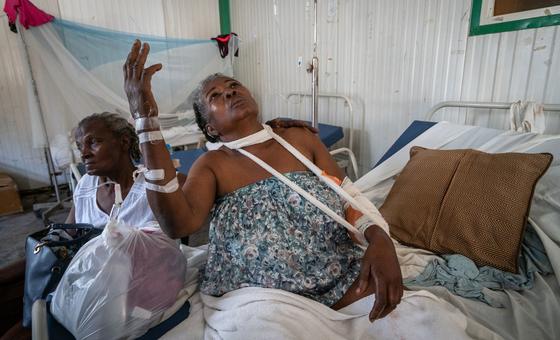

Left vulnerable, communities then formed self-defence groups and Haitian security forces reinforced their operations and made small gains only to be rebuffed again by gangs.
And at all stages of this cycle, human rights violations are being committed against civilians, according to a report released on Friday by the UN office in Haiti (BINUH) and the UN human rights office (OHCHR).
“Caught in the middle of this unending horror story are the Haitian people, who are at the mercy of horrific violence by gangs and exposed to human rights violations from the security forces and abuses by the so-called ‘self-defence’ groups,” said Volker Türk, High Commissioner for Human Rights.
The report also warned about “early signs of criminal governance” in the Centre Department where gangs are beginning to consolidate their gains and act as a de facto governing authority.
Four years of horror
Since 2021 and the assassination of President Jovenel Moïse, gang violence has dominated the capital Port-au-Prince which is now 85 per cent controlled by gangs, says the UN.
Over 1.3 million Haitians have been displaced because of this violence, representing the largest displacement due to political upheaval in Haitian history.
Food insecurity among displaced Haitians is rampant, with Haiti one of five countries worldwide which is experiencing famine-like conditions.
As of March 2025, the violence has also expanded into previously untouched areas of the country, specifically the Artibonite and Centre Departments where 92,000 and 147,000 people have been displaced respectively.
The report also noted that recently, gangs have begun to expand beyond central Haiti towards the border of the Dominican Republic, with the apparent goal of controlling key roads through which much of the illegal weapons trafficking is happening.
“The expansion of gang territorial control poses a major risk of spreading violence and increasing transnational trafficking in arms and people,” said Ravina Shamdasani, a UNHCR spokesperson at a briefing in Geneva.
Human rights endangered
Between October 2024 and June 2025, 4,864 people in Haiti have been killed by gang violence. At least hundreds more have been injured, kidnapped, raped and trafficked.
“Human rights abuses outside Port-au-Prince are intensifying in areas of the country where the presence of the State is extremely limited,” said Ulrika Richardson, interim Head of BINUH and UN Resident Coordinator.
While many of these human rights violations – including the denial of the right to life and physical integrity, sexual violence and forced displacement — are being perpetrated by organized gangs, there are also documented human rights abuses at the hands of Haitian authorities.
Specifically, between October 2024 and June 2025, there were 19 extrajudicial executions by security forces in the Artibonite and Centre Departments – 17 of them in Artibonite.
Self-defence groups, which are increasingly prevalent as a result of inadequate State security, have also committed human rights violations, often in the form of lynchings of suspected gang members.
“The human rights violations and abuses that we have documented are further evidence of why Haiti and the international community urgently need to step up to end the violence,” Mr. Türk said.
At this point, there have been no documented human rights abuses committed by the Multinational Security Support (MSS) mission authorized by the United Nations and funded and staffed largely by Kenya.
No accountability
The Haitian National Police and MSS have launched multiple operations to regain territory lost to the gangs. While some have been briefly successful, the operations have been unable to maintain a lasting presence or protect local communities, according to the report.
In fact, the report suggests that in the Centre, the situation is trending in the opposite direction with gangs consolidating territorial gains outside the capital and beginning to institute forms of criminal governance.
As a result of this persistent insecurity, judicial operations are virtually at a standstill in the Centre and Artibonite Departments.
“The international community must strengthen its support to the authorities, who bear the primary responsibility for protecting the Haitian population,” said Ms. Richardson.