Lightweight Crane Technology to be Tested on the Moon [ARTEMIS PROJECT]

Like a Swiss Army knife, NASA’s Lightweight Surface Manipulation System (LSMS) technology is likely to find many ways of usage on the surface of Moon as part of its Artemis moon program.

This lightweight robotic crane with a structurally efficient truss frame and cable actuation mimics the movement of a human arm, but with a much longer reach as seen in the visual provided by NASA. It is scalable to fit any sized lander, vehicle, or surface application and can use a toolbox of quick-interchange end-effectors, or tools, that allow it to act as a hoist, forklift, regolith scoop, welder, said the US space agency.

“The unique thing about the LSMS is its dexterity and multi-functionality,” said Barmac Taleghani, project manager at NASA’s Langley Research Center in Hampton, Virginia.

The LSMS tested at Langley more than a decade ago to demonstrate the concept for offloading large payloads, such as habitats and rovers, from landers on human exploration missions. Once it is used on the moon’s surface, it’s likely to be sent to Mars too in future NASSA programs.

“We started thinking about additional tools that could be useful so that when you land the LSMS it could be used for multiple tasks,” said Tom Jones.“You’ve already carried that mass there; why not reuse it?”

Meanwhile, LSMS has been upgraded to include a suite of new tools, such as a bucket truck end-effector for digging and maneuvering regolith, a forklift tine tool for lifting cargo pallets, and a welding tool, in addition to greater autonomous functionality. The next design is on a larger for a large cargo to lunar lander under the artemis project.

Although similar in structural design to a terrestrial crane, the LSMS uses a cable-driven actuation system to articulate its arm links and precisely maneuver payloads.
Credits: NASA

“As we establish a sustainable presence on the Moon under the Artemis missions, we will need to start setting up multiple elements, and there will be a wide range of tasks that could leverage the versatility and functionality of the LSMS,” Jones said.

The new LSMS will be similar in size to the original prototype with about a 25-foot reach and will be able to lift payloads weighing around one metric ton on the Moon, equal to approximately 2,200 pounds, or the size of an elephant.

Jones further said, “LSMS is designed to operate either on the Moon or Mars or really any kind of planetary body. There may be different environmental concerns depending on the destination, but the hardware would be very similar.”


NASA’s TESS Discovers New Worlds among many Young Stars

Using observations from NASA’s Transiting Exoplanet Survey Satellite (TESS), an international team of astronomers has discovered a trio of hot worlds larger than Earth orbiting a much younger version of our Sun called TOI 451. The system resides in the recently discovered Pisces-Eridanus stream, a collection of stars less than 3% the age of our solar system that stretches across one-third of the sky.

The planets were discovered in TESS images taken between October and December 2018. Follow-up studies of TOI 451 and its planets included observations made in 2019 and 2020 using NASA’s Spitzer Space Telescope, which has since been retired, as well as many ground-based facilities.

Archival infrared data from NASA’s Near-Earth Object Wide-Field Infrared Survey Explorer (NEOWISE) satellite – collected between 2009 and 2011 under its previous moniker, WISE – suggests the system retains a cool disk of dust and rocky debris. Other observations show that TOI 451 likely has two distant stellar companions circling each other far beyond the planets.

paper reporting the findings was published on Jan. 14 in The Astronomical Journal. Stellar streams form when the gravity of our Milky Way galaxy tears apart star clusters or dwarf galaxies. The individual stars move out along the cluster’s original orbit, forming an elongated group that gradually disperses.

Elisabeth Newton, an assistant professor of physics and astronomy at Dartmouth College in Hanover, New Hampshire, who led the research, said: “It’s only 120 million years old and just 400 light-years away, allowing detailed observations of this young planetary system. And because there are three planets between two and four times Earth’s size, they make especially promising targets for testing theories about how planetary atmospheres evolve.”

This illustration sketches out the main features of TOI 451, a triple-planet system located 400 light-years away in the constellation Eridanus. Credit: NASA’s Goddard Space Flight Center

In 2019, a team led by Stefan Meingast at the University of Vienna used data from the European Space Agency’s Gaia mission to discover the Pisces-Eridanus stream, named for the constellations containing the greatest concentrations of stars. Stretching across 14 constellations, the stream is about 1,300 light-years long. However, the age initially determined for the stream was much older than we now think.

Astronomers expect planets as big as these to retain much of their atmospheres despite the intense heat from their nearby star. Different theories of how atmospheres evolve by the time a planetary system reaches TOI 451’s age predict a wide range of properties.

“By measuring starlight penetrating a planet’s atmosphere at different wavelengths, we can infer its chemical composition and the presence of clouds or high-altitude hazes,” said Elisa Quintana, an astrophysicist at NASA’s Goddard Space Flight Center in Greenbelt, Maryland. “TOI 451’s planets offer excellent targets for such studies with Hubble and the upcoming James Webb Space Telescope.”


1,300-year-old Hindu temple of Ghandhara style discovered in Swat, Pakistan

A 1,300-year-old Hindu temple of Vishnu has been discovered by Pakistani and Italian archaeological team at a mountain in northwest Pakistan’s Swat district.

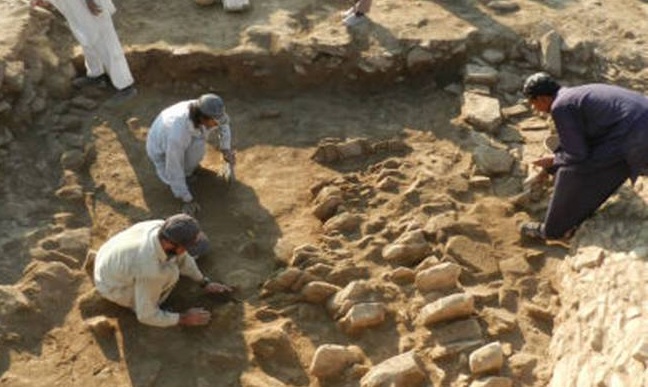
The temple was unearthed during an excavation at Barikot Ghundai. Built 1,300 years ago during the Hindu Shahi period, the temple site has traces of cantonment and watchtowers, said Fazle Khaliq of Khyber Pakhtunkhwa Department of Archaeology.

The Hindu Shahis or Kabul Shahis ruled present day Afghan and Pakistan region during 850 and 1026 AD centred around the Kabul Valley, including Gandhara (modern- Pakistan and Afghanistan) and northwestern India. With a water tank near the temple site, it reflected many ancient temple structures in south India.

Excavation under way at Barikot in Swat district of Pakistan’s Khyber Pakhtunkhwa Province. Photo: Italian Archaeological Mission to Pakistan

Fazle Khaliq said that Swat district is home to many thousand-year-old archaeological sites belonging to the Hindu Shahi period. Dr. Luca M. Olivieri, who is the current Director of the Italian Archaeological Mission in Pakistan and joint mission explorer of the temple, said this was the first temple of the Ghandhara civilisation discovered in Swat district.

Swat home to Hindu, Buddhist temples

Modern archaeological excavations began in Swat in 1955 and remained uninterrupted for 60 years, except for brief interruption between 2007 and 2010 due to insurgency in the valley.

The project has taken up conservation at Jahanabad, the colossal rock-cut Buddha mined by the Taliban, the excavation at two major protohistoric graveyards, the excavations and conservations at three major Buddhist sacred areas, and finally the large-scale excavation project at the historic settlement site of Bazira/Vajiristhana (Barikot) in the region.