Edward Stone: 50 Years at NASA ends, but his brainchild Voyager’s Project goes on

Stone’s remarkable tenure on NASA’s longest-operating mission spans decades of historic discoveries and firsts.

Edward Stone has retired as the project scientist for NASA’s Voyager mission a half-century after taking on the role. Stone accepted scientific leadership of the historic mission in 1972, five years before the launch of its two spacecraft, Voyager 1 and Voyager 2. Under his guidance, the Voyagers explored the four giant planets and became the first human-made objects to reach interstellar space, the region between the stars containing material generated by the death of nearby stars.

Until now, Stone was the only person to have served as project scientist for Voyager, maintaining his position even while serving as director of NASA’s Jet Propulsion Laboratory in Southern California from 1991 to 2001. JPL manages the Voyager mission for NASA. Stone retired from JPL in 2001 but continued to serve as the mission’s project scientist.

“It has been an honor and a joy to serve as the Voyager project scientist for 50 years,” Stone said. “The spacecraft have succeeded beyond expectation, and I have cherished the opportunity to work with so many talented and dedicated people on this mission. It has been a remarkable journey, and I’m thankful to everyone around the world who has followed Voyager and joined us on this adventure.”

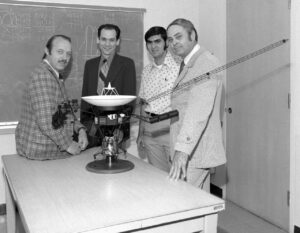
Edward Stone, second from left, and other members of the Voyager team pose with a model of the spacecraft in 1977, the year the twin probes launched. Credit: NASA/JPL-Caltech

Linda Spilker will succeed Stone as Voyager’s project scientist as the twin probes continue to explore interstellar space. Spilker was a member of the Voyager science team during the mission’s flybys of Jupiter, Saturn, Uranus, and Neptune. She later became project scientist for NASA’s now-retired Cassini mission to Saturn, and rejoined Voyager as deputy project scientist in 2021.

Jamie Rankin, a research scientist at Princeton University and a member of the Voyager science steering group, has been appointed deputy project scientist for the mission. Rankin received her Ph.D. in 2018 from Caltech, where Stone served as her advisor. Her research combines data from Voyager and other missions in NASA’s heliophysics fleet.

The twin Voyager spacecraft launched in 1977, on a mission to explore Jupiter and Saturn, ultimately revealing never-before-seen features of those planets and their moons. Voyager 1 continued its journey out of the solar system, while Voyager 2 continued on to Uranus and Neptune – and remains the only spacecraft to have visited the ice giants.


Edward Stone, left, talks to reporters at a news conference to announce findings from Voyager 2’s flyby of Uranus in 1986. Credit: NASA/JPL-Caltech

Following this “grand tour” of the outer planets, the Voyager Interstellar Mission began. The goal was to exit the heliosphere – a protective bubble created by the Sun’s magnetic field and outward flow of solar wind (charged particles from the Sun). Voyager 1 crossed the boundary of the heliosphere and entered interstellar space in 2012, followed by Voyager 2 (traveling slower and in a different direction) in 2018. Today, as part of NASA’s longest-running mission, both spacecraft continue to illuminate the interplay between our Sun, and the particles and magnetic fields in interstellar space.

“Ed likes to say that Voyager is a mission of discovery, and it certainly is,” said Suzanne Dodd, Voyager project manager. “From the flybys of the outer planets in the 1970s and ’80s, to the heliopause crossing and current travels through interstellar space, Voyager never ceases to surprise and amaze us. All those milestones and successes are due to Ed’s exceptional scientific leadership and his keen ability to share his excitement about these discoveries to the world.”

Among the many honors bestowed on him, Stone has been a member of the National Academy of Sciences since 1984. He was awarded the National Medal of Science from President George H.W. Bush in 1991. When Stone was interviewed on the late-night TV show “The Colbert Report” in 2013, NASA arranged for host Stephen Colbert to present him with the NASA Distinguished Public Service Medal, the agency’s highest honor for a nongovernment individual. In 2019, he received the Shaw Prize in Astronomy from the Shaw Foundation in Hong Kong for his work on the Voyager mission.

Also Read:

NASA’s Hubble finds spiraling stars ‘NGC 346’, providing window into early universe

US Postal Service Celebrates NASA’s Webb Telescope With New Postal Stamp

Cassini Takes Plunge Into Saturn, Scientists Cross-Fingered

Webb offers never-before-seen details of early universe, distant galaxy MACS0647-JD

NASA’s James Webb Space Telescope was specially designed to detect the faint infrared light from very distant galaxies and give astronomers a glimpse at the early universe. The nature of galaxies during this early period of our universe is not well known nor understood. But with the help of gravitational lensing by a cluster of galaxies in the foreground, faint background galaxies can be magnified and also appear multiple times in different parts of the image.

Today, we sit down with three astronomers working on Webb to talk about their latest findings. The team members are Dan Coe of AURA/STScI for the European Space Agency and the Johns Hopkins University; Tiger Hsiao of the Johns Hopkins University; and Rebecca Larson of the University of Texas at Austin. These scientists have been observing the distant galaxy MACS0647-JD with Webb, and they’ve found something interesting.

Dan Coe: I discovered this galaxy MACS0647-JD 10 years ago with the Hubble Space Telescope. At the time, I’d never worked on high redshift galaxies, and then I found this one that was potentially the most distant at redshift 11, about 97 percent of the way back to the big bang. With Hubble, it was just this pale, red dot. We could tell it was really small, just a tiny galaxy in the first 400 million years of the universe. Now we look with Webb, and we’re able to resolve TWO objects! We’re actively discussing whether these are two galaxies or two clumps of stars within a galaxy. We don’t know, but these are the questions that Webb is designed to help us answer.

Tiger Yu-Yang Hsiao: You can also see that the colors between the two objects are so different. One’s bluer; the other one is redder. The blue gas and the red gas have different characteristics. The blue one actually has very young star formation and almost no dust, but the small, red object has more dust inside, and is older. And their stellar masses are also probably different.

It’s really interesting that we see two structures in such a small system. We might be witnessing a galaxy merger in the very early universe. If this is the most distant merger, I will be really ecstatic!

Dan Coe: Due to the gravitational lensing of the massive galaxy cluster MACS0647, it’s lensed into three images: JD1, JD2, and JD3. They’re magnified by factors of eight, five, and two, respectively.

Rebecca Larson: Up to this point, we haven’t really been able to study galaxies in the early universe in great detail. We had only tens of them prior to Webb. Studying them can help us understand how they evolved into the ones like the galaxy we live in today. And also, how the universe evolved throughout time.

The U.S. Postal Service will issue a stamp highlighting NASA’s James Webb Space Telescope on Sept. 8, 2022. U.S. Postal Service Art Director Derry Noyes designed the stamp using existing art by James Vaughan and an image provided by NASA and the Space Telescope Science Institute.

Credits: U.S. Postal Service

I think my favorite part is, for so many new Webb image we get, if you look in the background, there are all these little dots—and those are all galaxies! Every single one of them. It’s amazing the amount of information that we’re getting that we just weren’t able to see before. And this is not a deep field. This is not a long exposure. We haven’t even really tried to use this telescope to look at one spot for a long time. This is just the beginning!

The James Webb Space Telescope is the world’s largest, most powerful, and most complex space science telescope ever built. Webb will solve mysteries in our solar system, look beyond to distant worlds around other stars, and probe the mysterious structures and origins of our universe and our place in it.

NASA: Are you in an area of Lucy then take a photograph, post it to social media

Using chirality for faster, smaller, and more efficient data storage devices

Researchers at Johannes Gutenberg University Mainz (JGU) are pursuing a completely new and unconventional strategy to improve the way data can be processed and – in particular – stored. The team members, based in Mainz and Jerusalem, have come up with the idea of bringing together two different forms of chirality to develop new data storage systems that are faster, smaller, and more efficient than those currently available.

Chirality, also known as handedness in this context, describes objects that come in two distinctly different configurations that are mirror images of each other such as our left and right hand. “We were inspired by nature, where chirality is a common phenomenon. Chiral molecules can act like a filter for electron spin and ensure functionality even on the smallest scale,” said Professor Angela Wittmann of the JGU Institute of Physics.

Combining the chirality of spin configurations and molecules

In their approach, the researchers from the fields of experimental solid state physics, atomic physics, and molecular chemistry will be using recently discovered chiral spin structures. These so-called skyrmions are tiny vortices in magnetic thin films protected by their chirality. It is this kind of chiral magnetic texture that the researchers intend to combine with chiral molecules over the course of the project. The assumption is that, based on the chiral-chiral interaction, they would have a unique, flexible, controllable, and efficient means of manipulating spin structures. “With the help of a chiral molecule, it should be possible to switch the handedness of the chiral magnetic textures in thin films, for instance, from clockwise to anticlockwise,” clarified Wittmann.


Two chiral molecules on chiral spin structures in a magnetic thin film/Two chiral molecules on chiral spin structures in a magnetic thin film (ill./©: Angela Wittmann)

In this case, the chiral molecule with its DNA-like helix structure would act like a spin filter, allowing only certain electrons moving in one direction to pass while holding others back. The researchers will use highly sophisticated sensor technologies to determine how and whether this interaction actually works.

“Our project is groundbreaking in that it brings together two different types of chirality,” emphasized Wittmann. According to the researchers, there is a very real chance that their innovative concept involving the utilization of spintronic components will result in the creation of the next generation of innovative storage, logic, and sensor devices that could be employed in unconventional computing.

The consortium consists of four members of Johannes Gutenberg University Mainz and two members of the Hebrew University of Jerusalem, who will be contributing their expertise in various disciplines. At JGU, these are Professor Angela Wittmann and Professor Mathias Kläui of the Condensed Matter Physics group, Professor Dmitry Budker of the Quantum, Atomic, and Neutron Physics group and the Helmholtz Institute Mainz (HIM), and Professor Eva Rentschler of the Department of Chemistry, collaborating with their partners Professor Yossi Paltiel and Professor Nir Bar-Gill of the Department of Applied Physics at the Hebrew University of Jerusalem.

Carl Zeiss Foundation sponsoring innovative projects through its new CZS Wildcard program

In early 2022, the Carl Zeiss Foundation launched its CZS Wildcard program with the objective of promoting unconventional, interdisciplinary research in the STEM field. Each team must consist of at least three researchers. The purpose of the program is to support projects that are still in a very early phase of realization and are built on original and unconventional concepts with a high potential for innovation. The first five teams will be starting work in early 2023

Also Read:

Detecting Alzheimer’s disease in the blood using Digital ICA

Turning fish waste into quality carbon-based nanomaterial

Imagine World Map Without Humans, Here It Is!

NASA’s Swift, Fermi missions detect exceptional cosmic blast

Astronomers around the world are captivated by an unusually bright and long-lasting pulse of high-energy radiation that swept over Earth Sunday, Oct. 9. The emission came from a gamma-ray burst (GRB) – the most powerful class of explosions in the universe – that ranks among the most luminous events known.

On Sunday morning Eastern time, a wave of X-rays and gamma rays passed through the solar system, triggering detectors aboard NASA’s Fermi Gamma-ray Space Telescope, Neil Gehrels Swift Observatory, and Wind spacecraft, as well as others. Telescopes around the world turned to the site to study the aftermath, and new observations continue.

Called GRB 221009A, the explosion provided an unexpectedly exciting start to the 10th Fermi Symposium, a gathering of gamma-ray astronomers now underway in Johannesburg, South Africa. “It’s safe to say this meeting really kicked off with a bang – everyone’s talking about this,” said Judy Racusin, a Fermi deputy project scientist at NASA’s Goddard Space Flight Center in Greenbelt, Maryland, who is attending the conference.


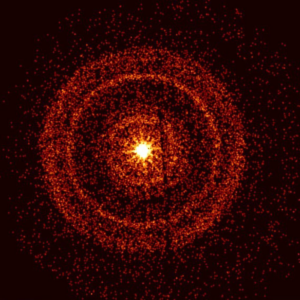
Swift’s X-Ray Telescope captured the afterglow of GRB 221009A about an hour after it was first detected. The bright rings form as a result of X-rays scattered from otherwise unobservable dust layers within our galaxy that lie in the direction of the burst./Credit: NASA/Swift/A. Beardmore (University of Leicester)

The signal, originating from the direction of the constellation Sagitta, had traveled an estimated 1.9 billion years to reach Earth. Astronomers think it represents the birth cry of a new black hole, one that formed in the heart of a massive star collapsing under its own weight. In these circumstances, a nascent black hole drives powerful jets of particles traveling near the speed of light. The jets pierce through the star, emitting X-rays and gamma rays as they stream into space.

The light from this ancient explosion brings with it new insights into stellar collapse, the birth of a black hole, the behavior and interaction of matter near the speed of light, the conditions in a distant galaxy – and much more. Another GRB this bright may not appear for decades.

According to a preliminary analysis, Fermi’s Large Area Telescope (LAT) detected the burst for more than 10 hours. One reason for the burst’s brightness and longevity is that, for a GRB, it lies relatively close to us.

NASA

“This burst is much closer than typical GRBs, which is exciting because it allows us to detect many details that otherwise would be too faint to see,” said Roberta Pillera, a Fermi LAT Collaboration member who led initial communications about the burst and a doctoral student at the Polytechnic University of Bari, Italy. “But it’s also among the most energetic and luminous bursts ever seen regardless of distance, making it doubly exciting.”

The burst also provided a long-awaited inaugural observing opportunity for a link between two experiments on the International Space Station – NASA’s NICER X-ray telescope and a Japanese detector called the Monitor of All-sky X-ray Image (MAXI). Activated in April, the connection is dubbed the Orbiting High-energy Monitor Alert Network (OHMAN). It allows NICER to rapidly turn to outbursts detected by MAXI, actions that previously required intervention by scientists on the ground.

“OHMAN provided an automated alert that enabled NICER to follow up within three hours, as soon as the source became visible to the telescope,” said Zaven Arzoumanian, the NICER science lead at Goddard. “Future opportunities could result in response times of a few minutes.”

Also Read:

Celebrate ‘International Observe the Moon Night’ with NASA [Details]

NASA’s Hubble finds spiraling stars ‘NGC 346’, providing window into early universe

NASA: Are you in an area of Lucy then take a photograph, post it to social media

NASA: Are you in an area of Lucy then take a photograph, post it to social media

On Oct. 16, at 7:04 a.m. EDT, NASA’s Lucy spacecraft, the first mission to the Jupiter Trojan asteroids, will skim the Earth’s atmosphere, passing a mere 220 miles (350 kilometers) above the surface. By sling-shotting past Earth on the first anniversary of its launch, Lucy will gain some of the orbital energy it needs to travel to this never-before-visited population of asteroids.

The Trojan asteroids are trapped in orbits around the Sun at the same distance as Jupiter, either far ahead of or behind the giant planet. Lucy is currently one year into a twelve-year voyage. This gravity assist will place Lucy on a new trajectory for a two-year orbit, at which time it will return to Earth for a second gravity assist. This second assist will give Lucy the energy it needs to cross the main asteroid belt, where it will observe asteroid Donaldjohanson, and then travel into the leading Trojan asteroid swarm. There, Lucy will fly past six Trojan asteroids: Eurybates and its satellite Queta, Polymele and its yet unnamed satellite, Leucus, and Orus. Lucy will then return to Earth for a third gravity assist in 2030 to re-target the spacecraft for a rendezvous with the Patroclus-Menoetius binary asteroid pair in the trailing Trojan asteroid swarm.

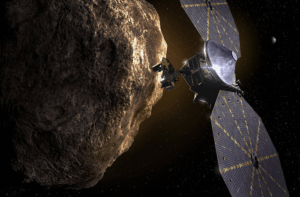
This illustration shows the Lucy spacecraft passing one of the Trojan Asteroids near Jupiter./CREDIT:Southwest Research Institute

For this first gravity assist, Lucy will appear to approach Earth from the direction of the Sun. While this means that observers on Earth will not be able to see Lucy in the days before the event, Lucy will be able to take images of the nearly full Earth and Moon. Mission scientists will use these images to calibrate the instruments.

Lucy’s trajectory will bring the spacecraft very close to Earth, lower even than the International Space Station, which means that Lucy will pass through a region full of earth-orbiting satellites and debris. To ensure the safety of the spacecraft, NASA developed procedures to anticipate any potential hazard and, if needed, to execute a small maneuver to avoid a collision.

“The Lucy team has prepared two different maneuvers,” says Coralie Adam, Lucy deputy navigation team chief from KinetX Aerospace in Simi Valley, California. “If the team detects that Lucy is at risk of colliding with a satellite or piece of debris, then–12 hours before the closest approach to Earth –the spacecraft will execute one of these, altering the time of closest approach by either two or four seconds. This is a small correction, but it is enough to avoid a potentially catastrophic collision.”

NASA/Photo: Nasa.gov

Lucy will be passing the Earth at such a low altitude that the team had to include the effect of atmospheric drag when designing this flyby. Lucy’s large solar arrays increase this effect.

“In the original plan, Lucy was actually going to pass about 30 miles closer to the Earth,” says Rich Burns, Lucy project manager at NASA’s Goddard Space Flight Center in Greenbelt, Maryland. “However, when it became clear that we might have to execute this flyby with one of the solar arrays unlatched, we chose to use a bit of our fuel reserves so that the spacecraft passes the Earth at a slightly higher altitude, reducing the disturbance from the atmospheric drag on the spacecraft’s solar arrays.”

At around 6:55 a.m. EDT, Lucy will first be visible to observers on the ground in Western Australia (6:55 p.m. for those observers). Lucy will quickly pass overhead, clearly visible to the naked eye for a few minutes before disappearing at 7:02 a.m. EDT as the spacecraft passes into the Earth’s shadow. Lucy will continue over the Pacific Ocean in darkness and emerge from the Earth’s shadow at 7:26 a.m. EDT. If the clouds cooperate, sky watchers in the western United States should be able to get a view of Lucy with the aid of binoculars.

“The last time we saw the spacecraft, it was being enclosed in the payload fairing in Florida,” said Hal Levison, Lucy principal investigator at the Southwest Research Institute (SwRI) Boulder, Colorado office. “It is exciting that we will be able to stand here in Colorado and see the spacecraft again. And this time Lucy will be in the sky.”

Lucy will then rapidly recede from the Earth’s vicinity, passing by the Moon and taking a few more calibration images before continuing out into interplanetary space.

“I’m especially excited by the final few images that Lucy will take of the Moon,” said John Spencer, acting deputy project scientist at SwRI. “Counting craters to understand the collisional history of the Trojan asteroids is key to the science that Lucy will carry out, and this will be the first opportunity to calibrate Lucy’s ability to detect craters by comparing it to previous observations of the Moon by other space missions.”

The public is invited to join the #WaveToLucy social media campaign by posting images of themselves waving towards the spacecraft and tagging the @NASASolarSystem account. Additionally, if you are in an area where Lucy will be visible, take a photograph of Lucy and post it to social media with the #SpotTheSpacecraft hashtag.

Instructions for observing Lucy from your location are available here.


NASA Awards $4 Million Through New Space Grant KIDS Opportunity

PM Modi pays tribute to Dr APJ Abdul Kalam on his birth anniversary

The Prime Minister, Narendra Modi has paid his tributes to Ex-President Dr APJ Abdul Kalam on his birth anniversary. The Prime Minister recalled the contributions of Dr Kalam as a scientist and as a President who struck a chord with every section of society.

The Prime Minister tweeted;

“Tributes to our former President Dr. APJ Abdul Kalam. He is greatly admired for his contribution to our nation as a scientist and as a President who struck a chord with every section of society.”

PM Modi flags off Vande Bharat Express from Una in Himachal Pradesh to New Delhi


The Prime Minister, Narendra Modi flagged off the inaugural run of the new Vande Bharat Express from Amb Andaura, Una to New Delhi, today.

The Prime Minister inspected the train coaches of the Vande Bharat Express and took stock of the onboard facilities. Shri Modi also inspected the control centre of the locomotive engine of Vande Bharat Express. He also inspected Una railway station.

The Prime Minister was accompanied by Chief Minister of Himachal Pradesh, Jai Ram Thakur, Governor of Himachal Pradesh,  Rajendra Vishwanath Arlekar, Union Minister of Railways, Ashvini Vaishnaw and Union Minister of Information & Broadcasting, Shri Anurag Singh Thakur when he arrived at Amb Andaura Railway Station in Una district of Himachal Pradesh.

The introduction of the train will help boost tourism in the region and provide a comfortable and faster mode of travel. The travel time from Una to New Delhi will be reduced by two hours. Running from Amb Andaura to New Delhi, it will be the fourth Vande Bharat train to be introduced in the country and is an advanced version compared to the earlier ones, being much lighter and capable of reaching higher speeds in a shorter duration. Vande Bharat 2.0 is equipped with more advancements and improved features such as reaching a speed of 0 to 100 kilometres per hour in just 52 seconds, and a maximum speed of up to 180 kilometres per hour. The improved Vande Bharat Express will weigh 392 tons when compared to the previous version of 430 tons. It will also have a Wi-Fi content on-demand facility. Every coach has 32” screens providing passenger information and infotainment compared to 24” in the previous version. Vande Bharat Express will also be environmentally friendly as the ACs will be 15 per cent more energy efficient. With dust-free clean air cooling of the traction motor, travel will become more comfortable. A side recliner seat facility provided only to Executive Class passengers earlier will now be made available for all classes. Executive Coaches have the added feature of 180-degree rotating seats

In the new design of Vande Bharat Express, a photo-catalytic ultraviolet air purification system is installed in the Roof-Mounted Package Unit (RMPU) for air purification.  As recommended by Central Scientific Instruments Organisation (CSIO), Chandigarh, this system is designed and installed on both ends of RMPU to filter and clean the air free from germs, bacteria, viruses etc. coming through fresh air and return air.

The Vande Bharat Express 2.0 offers a myriad of superior and aircraft-like travelling experiences. It is equipped with advanced state-of-the-art safety features including an indigenously developed Train Collision Avoidance System – KAVACH.

PM Modi greets Amitabh Bachchan on his 80th birthday

The Prime Minister, Shri Narendra Modi has greeted Amitabh Bachchan on his 80th birthday. Shri Modi has said that Amitabh Bachchan is one of India’s most remarkable film personalities who has enthralled and entertained audiences across generations.

In a tweet, the Prime Minister said;

“A very happy 80th birthday to Amitabh Bachchan Ji. He is one of India’s most remarkable film personalities who has enthralled and entertained audiences across generations. May he lead a long and healthy life.”

PM greets Amitabh Bachchan on his 80th birthday

Women may experience different PCOS or PCOD symptoms depending on where they live

Women with polycystic ovary syndrome (PCOS) in Alabama may be more likely to have excessive hair growth and insulin resistance, whereas women with PCOS in California may be more likely to have higher testosterone levels, according to new research published in the Endocrine Society’s Journal of Clinical Endocrinology & Metabolism.

PCOS affects 7–10% of women of childbearing age and is the most common cause of infertility. In the United States, an estimated 5 to 6 million women have PCOS, but the disorder is still underdiagnosed. Women are diagnosed with PCOS if they have two of the following criteria: androgen excess (excess male sex hormones such as testosterone), ovulatory dysfunction and polycystic ovaries.

“Our study found geographical differences in PCOS in black and white women, suggesting there are both genetic and environmental influences on how this disease manifests,” said Margareta D. Pisarska, M.D., of Cedars-Sinai Medical Center in Los Angeles, Calif. “Ongoing research is needed to identify modifiable risk factors for PCOS that may be race and ethnicity-specific to bring precision medicine to the management of this disease.”

PCOS/en.wikipedia.org

The researchers compared data from 1,620 back and white women with PCOS in Alabama and California. They found regional differences in the way these women met criteria for the diagnosis of PCOS and in symptoms associated with PCOS, with some variations among black and white women.

Overall, there were many similarities among the races. Women with PCOS in Alabama were more likely to have excessive hair growth and insulin resistance, whereas women with PCOS in California were more likely to have higher levels of testosterone.

When comparing black women with PCOS in Alabama and California, the average body mass index (BMI) did not differ between the locations, whereas in white women with PCOS, the average BMI was higher in Alabama than California.

“Since we have now identified that there are geo-epidemiologic differences, we intend to do follow up studies comparing black and white women with PCOS, controlling for geo-epidemiologic differences,” Pisarska said. “Furthermore, we are trying to look at factors that are contributing to these differences in order to tailor treatments based on specific needs for improvements in care for all women with PCOS.”

Also Read:

Study in mice may reveal insights into causes of miscarriages for some women

Some cancer immunotherapy treatments may damage fertility, women’s hormonal health

Mind your language when diagnosing women with polycystic ovary syndrome

Are we alone in the universe? JPL’s OWLS, other tools to help search for life in deep space

A team at the Lab has invented new technologies that could be used by future missions to analyze liquid samples from watery worlds and look for signs of alien life.

Are we alone in the universe? An answer to that age-old question has seemed tantalizingly within reach since the discovery of ice-encrusted moons in our solar system with potentially habitable subsurface oceans. But looking for evidence of life in a frigid sea hundreds of millions of miles away poses tremendous challenges. The science equipment used must be exquisitely complex yet capable of withstanding intense radiation and cryogenic temperatures. What’s more, the instruments must be able to take diverse, independent, complementary measurements that together could produce scientifically defensible proof of life.

To address some of the difficulties that future life-detection missions might encounter, a team at NASA’s Jet Propulsion Laboratory in Southern California has developed OWLS, a powerful suite of science instruments unlike any other. Short for Oceans Worlds Life Surveyor, OWLS is designed to ingest and analyze liquid samples. It features eight instruments – all automated – that, in a lab on Earth, would require the work of several dozen people.

JPL’s OWLS combines powerful chemical-analysis instruments that look for the building blocks of life with microscopes that search for cells. This version of OWLS would be miniaturized and customized for use on future missions. Credit: NASA/JPL-Caltech

One vision for OWLS is to use it to analyze frozen water from a vapor plume erupting from Saturn’s moon Enceladus. “How do you take a sprinkling of ice a billion miles from Earth and determine – in the one chance you’ve got, while everyone on Earth is waiting with bated breath – whether there’s evidence of life?” said Peter Willis, the project’s co-principal investigator and science lead. “We wanted to create the most powerful instrument system you could design for that situation to look for both chemical and biological signs of life.”

OWLS has been funded by JPL Next, a technology accelerator program run by the Lab’s Office of Space Technology. In June, after a half-decade of work, the project team tested its equipment – currently the size of a few filing cabinets – on the salty waters of Mono Lake in California’s Eastern Sierra. OWLS found chemical and cellular evidence of life, using its built-in software to identify that evidence without human intervention.

“We have demonstrated the first generation of the OWLS suite,” Willis said. “The next step is to customize and miniaturize it for specific mission scenarios.”

Challenges, Solutions

A key difficulty the OWLS team faced was how to process liquid samples in space. On Earth, scientists can rely on gravity, a reasonable lab temperature, and air pressure to keep samples in place, but those conditions don’t exist on a spacecraft hurtling through the solar system or on the surface of a frozen moon. So the team designed two instruments that can extract a liquid sample and process it in the conditions of space.

Since it’s not clear what form life might take on an ocean world, OWLS also needed to include the broadest possible array of instruments, capable of measuring a size range from single molecules to microorganisms. To that end, the project joined two subsystems: one that employs a variety of chemical analysis techniques using multiple instruments, and one with several microscopes to examine visual clues.

Water ice and vapor are seen spraying from Saturn’s frozen moon Enceladus, which hosts a hidden subsurface ocean, in this image captured by NASA’s Cassini mission during a 2010 flyby. OWLS is designed to ingest and analyze liquid samples from such plumes. Credit:NASA/JPL/Space Science Institute 

Full Image Details

OWLS’ microscope system would be the first in space capable of imaging cells. Developed in conjunction with scientists at Portland State University in Oregon, it combines a digital holographic microscope, which can identify cells and motion throughout the volume of a sample, with two fluorescent imagers, which use dyes to observe chemical content and cellular structures. Together, they provide overlapping views at a resolution of less than a single micron, or about 0.00004 inches.

Dubbed Extant Life Volumetric Imaging System (ELVIS), the microscope subsystem has no moving parts – a rarity. And it uses machine-learning algorithms to both home in on lifelike movement and detect objects lit up by fluorescent molecules, whether naturally occurring in living organisms or as added dyes bound to parts of cells.

“It’s like looking for a needle in a haystack without having to pick up and examine every single piece of hay,” said co-principal investigator Chris Lindensmith, who leads the microscope team. “We’re basically grabbing big armfuls of hay and saying, ‘Oh, there’s needles here, here, and here.’”

To examine much tinier forms of evidence, OWLS uses its Organic Capillary Electrophoresis Analysis System (OCEANS), which essentially pressure-cooks liquid samples and feeds them to instruments that search for the chemical building blocks of life: all varieties of amino acids, as well as fatty acids and organic compounds. The system is so sensitive, it can even detect unknown forms of carbon. Willis, who led development of OCEANS, compares it to a shark that can smell just one molecule of blood in a billion molecules of water – and also tell the blood type. It would be only the second instrument system to perform liquid chemical analysis in space, after the Microscopy, Electrochemistry, and Conductivity Analyzer (MECA) instrument on NASA’s Phoenix Mars Lander.

OCEANS uses a technique called capillary electrophoresis – basically, running an electric current through a sample to separate it into its components. The sample is then routed to three types of detectors, including a mass spectrometer, the most powerful tool for identifying organic compounds.

Sending It Home

These subsystems produce massive amounts of data, just an estimated 0.0001% of which could be sent back to faraway Earth because of data transmission rates that are more limited than dial-up internet from the 1980s. So OWLS has been designed with what’s called “onboard science instrument autonomy.” Using algorithms, computers would analyze, summarize, prioritize, and select only the most interesting data to be sent home while also offering a “manifest” of information still on board.

“We’re starting to ask questions now that necessitate more sophisticated instruments,” said Lukas Mandrake, the project’s instrument autonomy system engineer. “Are some of these other planets habitable? Is there defensible scientific evidence for life rather than a hint that it might be there? That requires instruments that take a lot of data, and that’s what OWLS and its science autonomy is set up to accomplish.”

Also Read:

NASA-Built ‘Weather Sensors’ Capture Vital Data on Hurricane Ian

NASA’s Perseverance Rover Investigates Geologically Rich Mars Terrain; Collects ‘Wildcat Ridge’, analyzes with SHERLOC instrument

No Picnic in the Clouds! It’s JPL aerobot

No Picnic in the Clouds! It’s JPL aerobot

JPL’s Venus Aerial Robotic Balloon Prototype Aces Test Flights

A scaled-down version of the aerobot that could one day take to the Venusian skies successfully completed two Nevada test flights, marking a milestone for the project.

The intense pressure, heat, and corrosive gases of Venus’ surface are enough to disable even the most robust spacecraft in a matter of hours. But a few dozen miles overhead, the thick atmosphere is far more hospitable to robotic exploration.

One concept envisions pairing a balloon with a Venus orbiter, the two working in tandem to study Earth’s sister planet. While the orbiter would remain far above the atmosphere, taking science measurements and serving as a communication relay, an aerial robotic balloon, or aerobot, about 40 feet (12 meters) in diameter would travel into it.

To test this concept, a team of scientists and engineers from NASA’s Jet Propulsion Laboratory in Southern California and the Near Space Corporation in Tillamook, Oregon, recently carried out two successful flights of a prototype balloon that’s about a third of that size.

The shimmering silver balloon ascended more than 4,000 feet (1 kilometer) over Nevada’s Black Rock Desert to a region of Earth’s atmosphere that approximates the temperature and density the aerobot would experience about 180,000 feet (55 kilometers) above Venus. Coordinated by Near Space, these tests represent a milestone in proving the concept’s suitability for accessing a region of Venus’ atmosphere too low for orbiters to reach, but where a balloon mission could operate for weeks or even months.

“We’re extremely happy with the performance of the prototype. It was launched, demonstrated controlled-altitude maneuvers, and was recovered in good condition after both flights,” said robotics technologist Jacob Izraelevitz, who leads the balloon development as the JPL principal investigator of the flight tests. “We’ve recorded a mountain of data from these flights and are looking forward to using it to improve our simulation models before exploring our sister planet.”

The only balloon-borne exploration of Venus’ atmosphere to date was a part of the twin Soviet Vega 1 and 2 missions that arrived at the planet in 1985. The two balloons (which were about 11.5 feet, or 3.6 meters, in diameter when filled with helium) lasted a little over 46 hours before their instruments’ batteries ran out. Their short time in the Venusian atmosphere provided a tantalizing hint of the science that could be achieved by a larger, longer-duration balloon platform floating within the planet’s atmosphere.

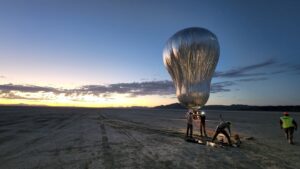
A prototype aerial robotic balloon, or aerobot, is readied for a sunrise test flight at Black Rock Desert, Nevada, in July 2022, by team members from JPL and Near Space Corporation. The aerobot successfully completed two flights, demonstrating controlled altitude flight. Credit: NASA/JPL-Caltech

‘Roving’ the Skies

The ultimate goal of the aerobot would be to travel on the Venusian winds, floating from east to west, circumnavigating the planet for at least 100 days. The aerobot would serve as a platform for a range of science investigations, from monitoring the atmosphere for acoustic waves generated by venusquakes to analyzing the chemical composition of the clouds. The accompanying orbiter would receive data from the aerobot and relay it to Earth while providing a global view of the planet.

Much like a Mars rover is commanded to drive to an interesting rock or other feature, the aerobot can be directed to raise and lower its altitude – something the Vega balloons couldn’t do – to conduct science between about 171,000 and 203,000 feet (52 and 62 kilometers) within Venus’ atmosphere.

The prototype balloon was fabricated using Near Space’s techniques for performance aerospace inflatables. Designed as a “balloon within a balloon,” it has a rigid inner reservoir filled with helium under high pressure and an encapsulating outer helium balloon that can expand and contract. To increase altitude, helium vents from the inner reservoir into the outer balloon, which expands to give the aerobot additional buoyancy. When it’s time to reduce altitude, helium is pumped back into the reservoir, causing the outer balloon to shrink and decrease the aerobot’s buoyancy.

“The success of these test flights is a huge deal for us: We’ve successfully demonstrated the technology we’ll need for investigating the clouds of Venus,” said Paul Byrne, an associate professor at Washington University in St. Louis and aerobot science collaborator. “These tests form the foundation for how we can achieve long-term robotic exploration high above Venus’ hellish surface.”

The one-third scale prototype aerobot is designed to withstand the corrosive chemicals in Venus’ atmosphere. During the flights, the balloon’s materials were tested for the first time, giving the team confidence that a larger aerobot design could operate in Venus skies. Credit: Near Space Corporation

No Picnic in the Clouds

While this region of Venus’ atmosphere is more forgiving than its lower reaches, long-duration flights in the rocky planet’s clouds, which contain sulfuric acid and other corrosive chemicals, would be no picnic. So the multilayered material developed for the aerobot’s outer balloon includes an acid-proof coating, a metallization layer to reduce solar heating, and a structural inner layer that keeps it strong enough to carry the science instruments below. New techniques have also been developed to ensure a long-duration acid-proof seal with minimal helium leakage from the seams.

“The materials being used for Venus survivability are challenging to fabricate with, and the robustness of handling we’ve demonstrated in the Nevada launch and recovery gives us confidence for balloon’s reliability on Venus,” said co-investigator Tim Lachenmeier, chief executive officer of Near Space.

While the recent Nevada tests were a milestone for a future concept designed with Venus in mind, the researchers say the technology could also be used by high-altitude science balloons that need to control their altitude in Earth’s skies.

Also Read:

Celebrate ‘International Observe the Moon Night’ with NASA [Details]

NASA’s Perseverance Rover Investigates Geologically Rich Mars Terrain; Collects ‘Wildcat Ridge’, analyzes with SHERLOC instrument

NASA Awards $4 Million Through New Space Grant KIDS Opportunity

Russia-Ukraine War: Kyiv becomes major target again, 11 killed in air strikes

On Monday, Russia pounded cities across Ukraine during rush hour, killing civilians and knocking out power and heat, in apparent revenge strikes after President Vladimir Putin declared a blast on Russia’s bridge to Crimea to be a terrorist attack.

Cruise missiles tore into busy intersections, parks and tourist sites in the center of downtown Kyiv with an intensity unseen even when Russian forces attempted to capture the capital early in the war, reported Reuters.

Belarusian President Alexander Lukashenko said he had ordered troops to deploy with Russian forces near Ukraine in response to what he said was a clear threat to Belarus from Kyiv and its backers in the West.

At least 11 people were reported killed and scores injured, with warning of even more “severe retaliation” in the event of further Ukrainian attacks. “Let there be no doubt,” Putin said in televised comments addressed to his security council, “if attempts at terrorist attacks continue, the response from Russia will be severe.”

Many of the locations hit by cruise missiles and kamikaze drones in the midst of the morning rush hour appeared to be solely civilian sites or key infrastructure, including the country’s electric grid, apparently chosen to terrorise Ukrainians.

As the scale of Monday morning’s assault emerged, Moscow faced a chorus of international condemnation with EU foreign policy chief, Josep Borrell, saying such acts have “no place” in the 21st century”.

The UN’s secretary general, António Guterres, said he was “deeply shocked” by Russia’s most widespread air strikes since the start of the Ukraine war, a spokesperson said.

In a statement, the UN spokesperson Stéphane Dujarric said:”This constitutes another unacceptable escalation of the war and, as always, civilians are paying the highest price.”

Due to the war, some 7.6 million Ukrainian refugees have scattered around Europe since Russian President Vladimir Putin sent troops over the border, but many are having difficulty finding jobs and homes.

The European Commission unveiled a new online tool to help Ukrainians find a job as the bloc looks to extend its protection for those displaced.

Apple to switch over to USB-C port in AirPods, Mac by 2024

Tech giant Apple might soon switch over to USB-C port in AirPods and Mac accessories by 2024, impacting many other gadget and smartphone makers to emulate or shun the new addition.

According to Bloomberg’s Mark Gurman, the company might introduce USB-C to its newest AirPods, AirPods Pro, and AirPods by the year 2024, while Mac accessories like the Magic Mouse, Magic Keyboard, and Magic Trackpad may convert to USB-C as soon as the next year.

“It’s a safe bet that those accessories will move to USB-C in their next incarnation”, Gurman said.

As the European Union moves to mandate USB-C charging on new smartphones, tablets, and headphones introduced in the territory in late 2024, there has been a rumoured shift away from Lightning ports.

Before EU legislation takes effect, Apple will replace its AirPods, the report said. Tony Fadell, inventor of the iPod, has said that Apple should include USB-C port in iPhones, as the European Union passed a resolution on USB Type-C as standard charging port.

The debate started when a Twitter user questioned if the iPod would succeed if Apple was forced to utilise USB 1.0 rather than the fast FireWire technology.

Stay Tuned for today’s Bollywood Updates [10th Oct 2022]

KBC 14: Jaya leaves hubby ‘Big B’ puzzled with her question

Megastar Amitabh Bachchan will be seen taking the hotseat along with his son and Bollywood actor Abhishek Bachchan, while veteran actress Jaya Bachchan is seen hosting the Big B’s birthday special episode of ‘Kaun Banega Crorepati 14’. Stay tuned to TV for the question on Tuesday.

Khushbu Sundar gets Golden Visa for UAE

Tamil and Telugu films yesteryears actress, and BJP leader Khushbu Sundar joins the ranks of many Indian film celebrities to get Golden Visa for United Arab Emirates. The UAE has granted her its prestigious Golden Visa.

95th Oscars: India’s entry ‘Chhello Show’ to release in 95 cinemas at Rs 95

The makers of ‘Last Film Show’ (‘Chhello Show’), have chosen to celebrate the fact that the film is India’s official entry to the 95th Oscars by releasing the film in 95 cinemas on Thursday night, a day before its actual date of release, and fixing the price of tickets for the show at a nominal Rs 95 each. Will JJ Rajamouli’s RRR in private category makes it to 100?

‘Bigg Boss 16’: Salman Khan asks Ankit to shun silence

Host Salman Khan was seen taking to task ‘Bigg Boss 16’ contestants during the first ‘Weekend Ka Vaar’ episode and he advised everyone to show their real side and make the otherwise becoming a boring game interesting. While pointing towards ‘Udaariyan’ actor Ankit Gupta, he asked him to be visible in the game and be vocal. May be lots of jumping around is what’s required.


Trailer of Sivakarthikeyan-starrer ‘Prince’ released, hilarious for a change?

Telugu star Vijay Deverakonda has launched the hilarious theatrical trailer of Tamil star Sivakarthikeyan’s first Tamil-Telugu bilingual film, titled ‘Prince’. See it here and decide yourself:

Another book on Amitabh Bachchan maturing over years

Stars have an innate age like the quizzes on gaming sites. Jaya Bhaduri is ‘Guddi’ at heart, a teenager with enthusiasm and Nirupa Roy has never been young. Shammi is a young man in his early twenties while Raj Kapoor and others are in their late twenties. The book takes you along the ages of contemporary actors of Big B and how grew up over the decades.

Sayantani Ghosh on how her look in ‘Alibaba’

TV actress Sayantani Ghosh, who is currently seen in the show ‘Alibaba Dastaan-e-Kabul’, talks about her look in the show and says she is happy with the response she is getting for her highlighted blue hair, blue eyes and a long blue dress for her character of SimSim.

Why Ayushmann Khurrana carries cricket kit in his vanity?

Actor Ayushmann Khurrana has been a cricket enthusiast since he was a child. He carries a cricket kit in his vanity van so that whenever the opportunity arises, he can play. So desperate? Where would he find a bowler?

Ranveer makes NBA star Trae Young to dance to this tune

After making Shaquille O’Neal dance to the number ‘Khalibali’, ever-active Ranveer Singh went on to make another basketball star dance to his number in Abu Dhabi. And to whose tune does he dance at home?


Puneeth Rajkumar’s dream project ‘Gandhada Gudi to release on Oct 28

Late Kannada superstar Puneeth Rajkumar’s dream project ‘Gandhada Gudi’ is fast moving towards completion and the makers released the trailer on Sunday. The docu-drama is set to release on October 28.

Neetu Kapoor shares pic of her shirtless son

Veteran actress Neetu Kapoor has shared a set of pictures showcasing her son Ranbir Kapoor’s well chiseled body from the look test of his latest release ‘Brahmastra’. But it’s too late as the film is already off many theatres.

Detecting Alzheimer’s disease in the blood using Digital ICA

Researchers from Hokkaido University and Toppan have developed a method to detect build-up of amyloid β in the brain, a characteristic of Alzheimer’s disease, from biomarkers in blood samples.

Alzheimer’s disease is a neurodegenerative disease, characterised by a gradual loss of neurons and synapses in the brain. One of the primary causes of Alzheimer’s disease is the accumulation of amyloid β (Aβ) in the brain, where it forms plaques. Alzheimer’s disease is mostly seen in individuals over 65 years of age, and cannot currently be stopped or reversed. Thus, Alzheimer’s disease is a major concern for nations with ageing populations, such as Japan.

A team of scientists from Hokkaido University and Toppan, led by Specially Appointed Associate Professor Kohei Yuyama at the Faculty of Advanced Life Science, Hokkaido University, have developed a biosensing technology that can detect Aβ-binding exosomes in the blood of mice, which increase as Aβ accumulates in the brain. Their research was published in the journal Alzheimer’s Research & Therapy.

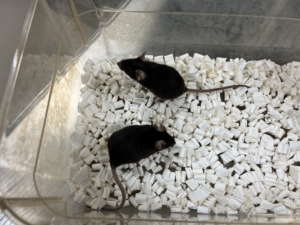
Alzheimer’s disease model mice (Photo: Kohei Yuyama)./CREDIT:Kohei Yuyama

When tested on mice models, the Aβ-binding exosome Digital ICATM (idICA) showed that the concentration of Aβ-binding exosomes increased with the increase in age of the mice. This is significant as the mice used were Alzheimer’s disease model mice, where Aβ builds up in the brain with age.

In addition to the lack of effective treatments of Alzheimer’s, there are few methods to diagnose Alzheimer’s. Alzheimer’s can only be definitively diagnosed by direct examination of the brain—which can only be done after death. Aβ accumulation in the brain can be measured by cerebrospinal fluid testing or by positron emission tomography; however, the former is an extremely invasive test that cannot be repeated, and the latter is quite expensive. Thus, there is a need for a diagnostic test that is economical, accurate and widely available.

Previous work by Yuyama’s group has shown that Aβ build-up in the brain is associated with Aβ-binding exosomes secreted from neurons, which degrade and transport Aβ to the microglial cells of the brain. Exosomes are membrane-enclosed sacs secreted by cells that possess cell markers on their surface. The team adapted Toppan’s proprietary Digital Invasive Cleavage Assay (Digital ICATM) to quantify the concentration of Aβ-binding exosomes in as little as 100 µL of blood. The device they developed traps molecules and particles in a sample one-by-one in a million micrometer-sized microscopic wells on a measurement chip and detects the presence or absence of fluorescent signals emitted by the cleaving of the Aβ-binding exosomes.

Clinical trials of the technology are currently underway in humans. This highly sensitive idICA technology is the first application of ICA that enables highly sensitive detection of exosomes that retain specific surface molecules from a small amount of blood without the need to learn special techniques; as it is applicable to exosome biomarkers in general, it can also be adapted for use in the diagnosis of other diseases.

Noninvasive eye scan could detect key signs of Alzheimer’s years before patients show symptoms

How the mother’s mood influences her baby’s ability to speak

Up to 70 percent of mothers develop postnatal depressive mood, also known as baby blues, after their baby is born. Analyses show that this can also affect the development of the children themselves and their speech. Until now, however, it was unclear exactly how this impairment manifests itself in early language development in infants.

In a study, scientists at the Max Planck Institute for Human Cognitive and Brain Sciences in Leipzig have now investigated how well babies can distinguish speech sounds from one another depending on their mother’s mood. This ability is considered an important prerequisite for the further steps towards a well-developed language. If sounds can be distinguished from one another, individual words can also be distinguished from one another. It became clear that if mothers indicate a more negative mood two months after birth, their children show on average a less mature processing of speech sounds at the age of six months.

The infants found it particularly difficult to distinguish between syllable-pitches. Specifically, they showed that the development of their so-called Mismatch Response was delayed than in those whose mothers were in a more positive mood. This Mismatch Response in turn serves as a measure of how well someone can separate sounds from one another. If this development towards a pronounced mismatch reaction is delayed, this is considered an indication of an increased risk of suffering from a speech disorder later in life.

“We suspect that the affected mothers use less infant-directed-speech,” explains Gesa Schaadt, postdoc at MPI CBS, professor of development in childhood and adolescence at FU Berlin and first author of the study, which has now appeared in the journal JAMA Network Open. “They probably use less pitch variation when directing speech to their infants.” This also leads to a more limited perception of different pitches in the children, she said. This perception, in turn, is considered a prerequisite for further language development.

The results show how important it is that parents use infant-directed speech for the further language development of their children. Infant-directed speech that varies greatly in pitch, emphasizes certain parts of words more clearly – and thus focuses the little ones’ attention on what is being said – is considered appropriate for children. Mothers, in turn, who suffer from depressive mood, often use more monotonous, less infant-directed speech. “To ensure the proper development of young children, appropriate support is also needed for mothers who suffer from mild upsets that often do not yet require treatment,” Schaadt says. That doesn’t necessarily have to be organized intervention measures. “Sometimes it just takes the fathers to be more involved.”

The researchers investigated these relationships with the help of 46 mothers who reported different moods after giving birth. Their moods were measured using a standardized questionnaire typically used to diagnose postnatal upset. They also used electroencephalography (EEG), which helps to measure how well babies can distinguish speech sounds from one another. The so-called Mismatch Response is used for this purpose, in which a specific EEG signal shows how well the brain processes and distinguishes between different speech sounds. The researchers recorded this reaction in the babies at the ages of two and six months while they were presented with various syllables such as “ba,” “ga” and “bu.

Also Read:

Evidence that babies react to taste, smell in the womb; Carrot for “laughter-face” response, kale for “cry-face” response: Study

Fish oil, vitamin D supplements during pregnancy lower risk of croup in babies

A scientific recipe that helps babies stop crying, calm down and sleep in bed

ANTI-NARCOTICS OPERATION

In a coordinated operation at sea, Narcotics Control Bureau (NCB) and Indian Navy apprehended a suspicious vessel carrying more than 200 kgs of narcotics.

The boat with its crew, has been escorted to Kochi for further investigation. This is significant not only in terms of quantity and cost but also signifies a focus on collaborative efforts for disruption of the illegal narcotics smuggling routes, which emanate from the Makran coast and flow towards various IOR countries.

Narcotics Control Bureau (NCB) and Indian Navy apprehended a suspicious vessel carrying more than 200 kgs of narcotics.

Apart from the human costs from drug addiction, the spoils of narcotics trade feed syndicates involved in terrorism, radicalization and criminal activities. Successful conduct of this operation reaffirms our strong commitment and resolve of not allowing seas as global commons being used for illegal activities especially in India’s maritime neighborhood.

Directorate of Revenue Intelligence foils attempts of gold smuggling, seizes 65.46 kg of gold at Mumbai, Patna, Delhi

Ashwini Ponnappa embarks on new Mixed Doubles journey with gold in National Games

Ever since she broke into the big league, the lissome Ashwini Ponnappa is used to being in the spotlight. But when she stepped into the badminton court earlier this week at the PDDU Indoor Stadium, she knew that the attention from the Indian badminton community would be even more intense.

After all, the Women’s Doubles’ specialist was embarking on a new journey as a Mixed Doubles player. Her first partner: her own Karnataka statemate K Sai Prateek in the 36th National Games.

On Thursday, she took a successful first step, beating Delhi’s Rohan Kapoor and Kanika Kanwal in straight games to win the gold.

“I am very happy that we started with the National Games title,” 33-year-old Ashwini said after wrapping up their victory. “Incidentally, this is my first gold in the National Games,” she pointed out.

Ashwini has without doubt been one of the finest doubles players in India, having successfully partnered with left-handers Jwala Gutta and N Sikki Reddy in her distinguished career.

After coming through a test by fire in the semifinals against Tamil Nadu’s VR Nardhana and Hariharan Amsakarunan, Ashwini Ponnappa and Sai Prateek were more at ease in the final with a 21-15, 21-13 victory.

Analysing the partnership in its early days, Ashwini said Prateek looks a very confident player.  “He hits the shuttle powerfully. He has a strong defence and has good court coverage. It is all about learning one another’s game and finding the right balance. Prateek is a quick learner,” she said.

The 33-year-old admitted the pair needs to be patient. “We don’t know one another’s styles yet and we didn’t have too much preparation. This gold will give us confidence,” she said.

Ashwini played the role of senior partner admirably. “I tell him to remain positive on court. We held our nerves. It was not easy. It was our first tournament and, being the top seeds, there was pressure. He dealt with it well. This is what makes a player stronger,” she said, hopeful of forging a strong combination with Sai Prateek.

On his part, 22-year-old Sai Prateek is intent on making the most of the experience of playing with Ashwini. “I have so much to learn from her. I believe she is the best mixed doubles player,’’ he said “I grew up admiring her game. I am now lucky enough to play alongside her. She is always calm on court.”

Talking about her career, Ashwini said her best moments as a doubles player was with Jwala Gutta. “We didn’t think or plan for any game. There was no match preparation as such. We just went into a match with a positive frame of mind. We were confident about one another’s game. It was a different experience. Jwala was a go-getter and very gutsy,” she said.

Ashwini said her partnerships with Sikki and Satwiksairraj Rankireddy were different. “We had to work on our game. It did not come easily. I tend to open up quickly. Now, I have become smarter with my game. I think I have been physically and mentally motivated in the last couple of years. In fact, I’m excited about my new partnership with Prateek.”

36th National Games update: Aakarshi, Sai Praneeth take home badminton crowns

Second-seeded Aakarshi Kashyap (Chhattisgarh) dominated top-seeded Malvika Bansod (Maharashtra) to win the Badminton Women’s Singles gold in the 36th National Games at the PDDU Indoor Stadium in Surat on Thursday.

B Sai Praneeth (Telangana) justified his top billing by taking the Men’s Singles gold after an intense battle with Mithun Manjunath (Karnataka). He eventually won 21-11, 12-21, 21-16 in 63 minutes.

Aakarshi, who has a 1-1 head-to-head record this year against Malvika, won 21-8, 22-20 in three-quarters of an hour, beating back a late attempt by the left-hander to take the match into the third game.

In Rajkot, a Diving gold through Surajit Rajbansi on the 1M Springboard helped Services take their tally of gold to 41 so far. With 26 silver and 25 bronze for a total of 92 medals, the defending champions have stood head and shoulders above all States and UTs.

Though Haryana have 25 gold and are in the second place on the table, Maharashtra are right behind them with 24 gold at the time of writing. Maharashtra are in the race for 100 medals too.

36th National Games

The fancied N Sikki Reddy and Pullela Gayatri Gopichand expectedly won the Women’s doubles title for Telangana, making it a happy outing for the State with three gold to show from the Badminton competition.

Telangana had more reason to celebrate when their Women’s Basketball team prevented a Tamil Nadu double in Bhavnagar. Telangana beat Tamil Nadu 67-62 in a thriller, after leading 35-31 at half-time. Coming on the heels of their 3×3 side’s gold, this win meant that Telangana women would complete the golden double in the National Games. The formidable Tamil Nadu Men’s squad beat Punjab 97-89 after holding a 46-42 lead at the break to take the crown.

At the Sardar Patel Swimming Complex in Rajkot, the experienced Surajit Rajbansi and H London Singh earned the top two medals for Services. With good execution of his routines, Surajit Rajbansi tallied 275.35 points, relegating team-mate London Singh who logged 254.75 points. This was the third successive 1-2 for Sevices in Men’s Diving.

“I’m feeling good today. At the recent National Championships in Guwahati, I was not in the best of form and only won silver. I wanted to better my performance and succeeded,” said the 23-year-old who took the help of a mind trained to settle his nerves. It helped as this time he was able to overcome his fears and give off his best.

Yet, it was Aakarshi Kashyap’s victory over Malvika Bansod in the Women’s Singles final that was the highlight of the morning session. The Chhattisgarh player was quick and meant business with her well-placed strokes that wrong-footed an error-prone Malvika. The Maharashtra star regrouped in the second game but Aakarshi was up to speed.

“It was tough. There were two long rallies and she had a lucky point through a net cord to take the second game into extra points. But I held my nerves to win the next two points,” Aakarshi Kashyap said.

The 30-year-old Sai Praneeth faced a tough contest against Mithun. “Any gold medal is good for any player. I’m happy I could get my first-ever National Games gold,” the Telangana star said, adding that he was happy with the way he played, staying calm when Mithun gained the upper hand in the second game and riding on his greater endurance to claim gold.

Ashwini Ponnappa and K Sai Prateek made a perfect start to their journey as a mixed doubles pair, eking out a 21-16, 21-13 victory over Rohan Kapoor and Kanika Kanwal (Delhi). Ashwini Ponnappa was all praise for her 22-year-old partner. “He played a strong game. He hit hard and covered the court well. I’m very happy to win my first ever National Games gold,” she said.

The results (finals)

Aquatics

Diving

1M Springboard: Surajit Rajbansi (Services) 275.35 points; 2. H London Singh (Services)

254.75; 3. Anuj Shah (Maharashtra) 227.60 points.

Archery (Recurve)

Men

Individual Bronze medal play-off: Tarundeep Rai (Services) beat Gaurav Trambak Lambe (Maharashtra) 7-3.

Team Bronze medal play-off: Maharashtra beat Jharkhand 5-4.

Women

Individual Bronze medal play-off: Simranjeet Kaur (Punjab) beat Avani (Haryana) 6-2.

Team Bronze medal play-off: Gujarat beat Assam 5-4.

Mixed Team Bronze medal play-off: Jharkhand beat Rajasthan 5-3.

Badminton

Men

Singles: B Sai Praneeth (Telangana) beat Mithun Manjunath (Karnataka) 21-11, 12-21, 21-16; Bronze medals: M Raghu (Karnataka) and Aryamann Tandon (Gujarat).

Doubles: PS Ravikrishna and Udaykimar Sankarprasad (Kerala) beat Hariharan Amsakarunan and R Ruban Kumar (Tamil Nadu) 21-19, 21-9; Bronze medals: HV Nithin and Vaibhaav (Karnataka) and Shyam Prasad and S Sunjith (Kerala)

Women

Singles: Aakarshi Kashyap (Chhattisgarh) beat Malvika Bansod 21-8, 22-20; Bronze medals: Aditi Bhatt (Uttarakhand) and Tanya Hemnath (Uttarakhand).

Doubles: N Sikki Reddy and Pullela Gayatri Gopichand (Telangana) beat Shikha Gautam and K Ashwini Bhat (Karnataka) 21-14; 21-11. Bronze medals: Kavya Gupta and Khushi Gupta (Delhi) and Mehreen Riza and Arathi Sara Sunil (Kerala).

Mixed Doubles: K Sai Pratheek and Ashwini Ponnappa (Karnataka) beat Rohan Kapoor and Kanika Kanwal (Delhi) 21-15, 21-13. Bronze medals: Hariharan Amsakarunan and VR Nardhana (Tamil Nadu) and S Sunjith and TR Gowrikrishna (Kerala).

Basketball (5×5)

Men: Tamil Nadu beat Punjab 97-89 (Half-time 46-42); Bronze medal play-off: Services beat Karnataka 94-67 (40-31).

Women: Telangana beat Tamil Nadu 67-62 (35-31); Bronze medal play-off: Kerala beat Madhya Pradesh 75-62 (33-32).

Other results:

Football

Men

Group A: Kerala beat Manipur 3-2 (Half-time 0-1).

Women

Group B: Assam beat Maharashtra 2-0 (1-0)

Hockey

Men

Group A: Haryana beat Gujarat 7-0 (Half-time: 3-0).

Water Polo

Men

Kerala beat Maharashtra 7-6; Punjab beat Manipur 8-7.

Women

Karnataka beat Manipur 13-2; Bengal beat Kerala beat 10-8.

PM Modi shares glimpses of Mysuru Dasara celebrations

The Prime Minister, Shri Narendra Modi has shared glimpses of the Mysuru Dasara celebrations and lauded the commitment of the people of Mysuru to preserving their culture and heritage in a beautiful way. The Prime Minister recalled fond memories of his visit to Mysuru, the most recent one on the occasion of 2022 Yoga Day.

Quoting a tweet by a citizen, the Prime Minister tweeted;

“Mysuru Dasara is spectacular. I commend the people of Mysuru for preserving their culture and heritage so beautifully. I have fond memories of my Mysuru visits, the most recent one being during 2022 Yoga Day.”

Mysuru-Dasara-2022