Government Holds Inter-Ministerial Briefing On West Asia Developments

As part of its ongoing efforts to keep the media apprised of developments in West Asia, the Government of India convened a briefing at the National Media Centre today. Representatives from the Ministries of Petroleum and Natural Gas, Ports, Shipping and Waterways, and External Affairs, shared updates on fuel availability, maritime operations, and assistance to Indian nationals in the region, along with measures to ensure stability across sectors. The Ministry of Consumer Affairs, Food and Public Distribution also provided updates on food security preparedness and prices of essential commodities.

Food security and prices update

The Ministry of Consumer Affairs, Food and Public Distribution shared an update on the availability of essential food items and the prevailing price situation. It also highlighted measures being taken to ensure adequate supply and maintain market stability. The Ministry said:

Food Security Preparedness

· The Government is closely monitoring the food security situation in view of the ongoing developments in West Asia.

· Adequate buffer stocks of rice and wheat are available to ensure sufficient supplies for the Public Distribution System (PDS) as well as to meet any emergency requirements.

· The National Food Security Act continues to ensure access to foodgrains for vulnerable populations.

Market Intervention – Open Market Sale Scheme (Domestic)

· The Government continues to monitor foodgrain prices and undertakes market interventions through the Open Market Sale Scheme (Domestic) (OMSS – D) whenever required.

· Under OMSS (D), FCI releases surplus wheat and rice in the open market to augment supply, stabilise prices and contain inflation.

· Adequate stocks are available with FCI to undertake such interventions if required.

· The scheme also enables sale of rice to State Governments at subsidised fixed prices to meet additional requirements.

Procurement – RMS 2026–27

· Procurement of wheat under MSP operations for Rabi Marketing Season (RMS) 2026–27 has commenced, primarily through State Government agencies.

· The Department is regularly reviewing preparedness in coordination with States.

· Adequate packaging materials are being ensured for procurement operations.

Foodgrain Packaging

· Proactive steps have been taken to ensure availability of packaging materials during RMS 2026–27.

· In coordination with the Ministry of Petroleum and Natural Gas and the Department of Chemicals and Petrochemicals, the Department is diversifying packaging sources and maintaining contingency measures to address any potential shortfall.

Edible Oil Scenario

· Domestic availability of edible oils remains comfortable despite global uncertainties.

· Imports from key partner countries including Indonesia, Malaysia, Argentina and Brazil continue steadily.

· Improved mustard production has strengthened domestic supply.

· Overall edible oil supply remains stable and the Government continues close monitoring with readiness to intervene if required.

Sugar Sector

· Adequate sugar buffer stocks are available and sugar production in 2025–26 is expected to remain sufficient.

· About 15.80 LMT of sugar has been permitted for export, of which 3.73 LMT has already been exported.

· Major export destinations include Sri Lanka, West Asia and East Africa.

· Retail sugar prices remain stable with inflation remaining around 3% over the past three years.

Prices of Essential Commodities

· The Department of Consumer Affairs monitors daily prices of 40 food commodities reported from 578 centres across the country.

· Price trends are being closely monitored in view of the ongoing developments in the Middle East.

· So far, no unusual volatility has been observed and prices remain stable for most commodities, indicating adequate availability.

· There is no evidence of generalized supply stress or inflationary transmission in essential food commodities.

Availability of Pulses

· Pulses production is estimated to be higher than the previous year at about 266 LMT compared to 257 LMT last year.

· Government stocks of pulses are around 28 LMT, while procurement of Tur and Rabi pulses under the Price Support Scheme is ongoing.

· So far, about 3.21 LMT of Tur and 5.71 LMT of Chana have been procured.

· The import policy for pulses in 2026–27 continues the existing framework of 2025-26 to ensure supply flexibility and stable availability.

· Import of Tur and Urad is allowed under the ‘Free’ category till 31 March 2027, while imports of Chana and Masoor attract 10% duty and Yellow Peas 30% duty.

Availability of Horticultural Crops (TOP)

· Production of major horticultural crops such as potato, tomato and onion are sufficient to meet domestic demand.

· Potato production is estimated at about 584 LMT (against 586 LMT last year), tomato at about 227 LMT, and onion at about 273 LMT.

· The Government of India has set a price stabilisation buffer target of 2 LMT for onion in 2026–27, with National Agricultural Cooperative Marketing Federation of India Ltd (NAFED) and National Cooperative Consumers’ Federation of India Limited (NCCF) initiating procurement preparations.

· Procurement of Rabi 2026 onion for buffer stocking is expected to support mandi prices and moderate volatility.

Monitoring and Enforcement

· The Department of Consumer Affairs has set up a Control Room to facilitate continuous interaction and information exchange with State Governments on prices and supply of food commodities.

· The Control Room also monitors enforcement of the Essential Commodities Act, 1955, including action against hoarding and black marketing of essential commodities.

· The Department is also keeping a close watch on the complaints being received on the National Consumer Helpline-1915, available in 17 languages across the country. The helpline is also available through multiple platforms, including WhatsApp and the INGRAM portal ,  enabling consumers to register grievances with ease.

Energy Supply and Fuel Availability

An update on the prevailing fuel supply situation was shared, highlighting the steps being taken to ensure uninterrupted availability of petroleum products and LPG in the context of the Strait of Hormuz closure. It was noted that:

Public Advisory and Citizen Awareness

· Citizens are advised to avoid panic purchase of petrol, diesel and LPG and rely only on official sources for information.

· LPG consumers are requested to use digital booking platforms and avoid visiting distributors.

· Citizens are encouraged to use alternate fuels such as PNG and electric or induction cooktops.

· All citizens are urged to conserve energy during the current situation.

Government Preparedness and Supply Management Measures

· Despite the ongoing geopolitical situation, the Government has prioritised domestic LPG and PNG supply, particularly for hospitals and educational institutions.

· The Government has already implemented several rationalisation measures on both the supply and demand side, including enhancing refinery production, increasing the booking interval from 21 to 25 days in urban areas and up to 45 days in rural areas and prioritising sectors for supply.

· Alternate fuels such as kerosene and coal have been made available to ease pressure on LPG demand.

· The Ministry of Coal has directed Coal India and Singareni Collieries to supply additional coal to States for distribution to small and medium consumers.

· States have been advised to facilitate new PNG connections for domestic and commercial consumers.

· A review meeting chaired by Secretary (MoPNG) with State officials highlighted measures to ensure adequate LPG supply and directed States to prioritise prioritize LPG distribution, especially for domestic and essential needs, while maintaining strict vigilance against hoarding, diversion, and misinformation. On reports concerning FTL LPG supplies to migrant workers, States clarified that there is no disruption in LPG supply affecting migrants and that supplies remain stable. Secretary informed that states may consider managing targeted distribution of 5 kg FTL LPG cylinders, based on local requirements along with OMCs.

Coordinated Efforts with States/UTs and Institutional Mechanisms

· State Governments are empowered under the Essential Commodities Act, 1955 and LPG Control Order, 2000 to monitor supply and act against hoarding and black marketing of petroleum products.

· All Chief Secretaries, ACS/Principal Secretary/Secretary Food & Civil supply of all the States/UTs are requested –

Ø To issue daily press briefings and issue regular public advisories.

Ø To actively monitor and counter fake news / misinformation on social media.

Ø To intensify daily enforcement drives by District admin and to continue raids and inspections in coordination with OMCs

Ø To issue Commercial LPG allocation orders within their States/UTs

Ø To issue SKO allocation orders for additional SKO allotted to the States/UTs.

Ø To promote PNG adoptions and alternate fuels.

· All States/UTs have established control rooms and district monitoring committees to curb hoarding and black marketing.

· The Government of India vide letter dated 27.03.2026 and 02.04.2026 have requested Chief Secretaries of all States/UTs to intensify proactive & regular public communication, conduct daily press briefs at appropriate senior level along with timely dissemination of accurate information through social and electronic media to effectively counter misinformation and to reassure citizens regarding adequate availability and smooth distribution of LPG.

· Currently, 23 States/UTs are issuing regular press briefings.

Enforcement and Monitoring Actions

· Enforcement actions continue across the country to curb hoarding and black marketing of LPG.

· More than 1 lakh raids have been conducted and over 52,000 cylinders seized.

· Over 850 FIRs have been registered and about 220 persons arrested.

· PSU Oil Marketing Companies have strengthened surprise inspections and issued over 1,500 show-cause notices, imposed penalties on 118 LPG distributorships and suspended 41 distributorships.

LPG Supply

Domestic LPG Supply Status:

· LPG supply continues to be affected by the prevailing geopolitical situation.

· No dry-outs have been reported at LPG distributorships.

· Online LPG bookings have increased to about 97% across the industry.

· Delivery Authentication Code (DAC) based deliveries have increased to around 90% to prevent diversion.

· Domestic LPG cylinder deliveries remain normal, with over 18 crore cylinders delivered to households since 1 March 2026.

Commercial LPG Supply and Allocation Measures:

  • To look into the issues of availability of petrochemicals like propylene, polypropylene, isopropyl alcohol, butadiene, butyl acrylate etc. for department of Pharmaceuticals, Animal Husbandry, Dept. of Chemicals and Petrochemicals, DPIIT etc, a Joint working group has been constituted which has recommended for diversion of certain volume of C3-C4 molecules by Refinery & Petrochemical complexes for these sectors. This group has also given recommendations for availability of feedstock for C2 based derivatives like LDPE, LLDPE, HDPE etc. and their supplies for the downstream units.
  • Total commercial LPG allocation has been increased to about 70% of pre-crisis levels, including 10% reform-linked allocation.

· Since 23 March 2026, about 6.75 lakh 5-kg Free Trade LPG cylinders have been sold.

· PSU OMCs have organised around 550 awareness camps for 5 Kg FTL Cylinders in Andhra Pradesh, Assam, Bihar, Chandigarh, Chhattisgarh, Delhi, Goa, Gujarat, Haryana, Himachal Pradesh, Jammu & Kashmir, Jharkhand, Karnataka, Keralam, Madhya Pradesh, Maharashtra, Odisha, Puducherry, Punjab, Rajasthan, Tamil Nadu, Telangana, Uttar Pradesh, Uttarakhand, West Bengal.

· More than 6,700 – 5Kg FTL cylinders were also sold in these camps.

· A three-member committee of Executive Directors from IOCL, HPCL and BPCL is coordinating with State authorities and industry bodies to plan commercial LPG distribution.

· About 79,909 MT of commercial LPG (equivalent to over 42 lakh 19-kg cylinders) has been sold since 14 March 2026.

Natural Gas Supply and PNG Expansion Initiatives

· Priority sectors continue to receive protected supplies, including 100% supply to domestic PNG and CNG transport.

· Gas supply to operating urea plants is currently around 70–75% of their six-month average consumption and is planned to increase to about 90% from 6 April 2026 (today).

· Gas supply to other industrial and commercial sectors, including City Gas Distribution (CGD) networks, will be increased by an additional 10% from 6 April 2026 (today).

· CGD entities have been advised to prioritise PNG connections for commercial establishments such as hotels, restaurants and canteens.

· CGD companies including IGL, MGL, GAIL Gas and BPCL are offering incentives for domestic and commercial PNG connections.

· States/UTs and Central Ministries have been requested to expedite approvals required for expansion of CGD networks.

· The Government of India vide letter dated 18.03.2026 has offered all States/UTs additional 10% allocation of commercial LPG to States provided they can help in long term transition from LPG to PNG.

· 17 States/UTs are already receiving additional commercial LPG allocation linked to PNG expansion reforms.

· PNGRB has directed CGD entities to connect institutions such as schools, hostels, community kitchens and anganwadi kitchens through PNG within five days where pipelines are available.

· The Ministry of Road Transport & Highways has adopted an Accelerated Approval Framework for CGD infrastructure for three months to process applications on priority.

· The Government of India vide Gazette dated 24.03.2026 has notified the Natural Gas and Petroleum Products Distribution (Through Laying, Building, Operation and Expansion of Pipelines and Other Facilities) Order, 2026 under the Essential Commodities Act, 1955.

· The Order provides a streamlined and time-bound framework for laying and expanding pipelines across the country, addressing delays in approvals and access to land, and enabling faster development of natural gas infrastructure, including in residential areas.

· It is expected to accelerate PNG network growth, enhance last-mile connectivity, and support the transition to cleaner fuels, thereby strengthening energy security and advancing India’s gas-based economy.

· The Ministry of Defence has issued a short-term policy modification till 30 June 2026 to expedite PNG infrastructure installation in defence residential areas.

· PNGRB has extended the National PNG Drive 2.0 till 30 June 2026 to sustain momentum in PNG expansion.

· Since March 2026, about 3.67 lakh PNG connections have been gasified and about 4 lakh additional customers have registered for new connections. 

Crude Position and Refinery Operations

· All refineries are operating at high capacity with adequate crude inventories, while sufficient stocks of petrol and diesel are being maintained.

· Domestic LPG production from refineries has been increased to support domestic consumption.

Retail Fuel Availability and pricing Measures

· Retail outlets across the country are operating normally.

· The Middle East crisis has led to an abnormal increase in crude prices; however, to protect consumers, the Government of India has reduced excise duty on petrol and diesel by ₹10 per litre.

· Export levy has been imposed at ₹21.5 per litre on diesel and ₹29.5 per litre on ATF to ensure adequate domestic availability.

· Retail prices of petrol and diesel remain unchanged with no increase at retail outlets.

· The Government has advised citizens not to believe rumours and requested State Governments to disseminate accurate information through press briefings.

Kerosene Availability and Distribution Measures

· An additional allocation of 48,000 KL of kerosene has been provided to States/UTs over and above regular allocation.

· A Gazette notification dated 29 March 2026 allows distribution of PDS Superior Kerosene Oil (SKO) in SKO-free States/UTs for cooking and lighting purposes through designated PSU OMC service stations.

· 18 States/UTs have issued SKO allocation orders, while Himachal Pradesh and Ladakh have indicated no requirement.

Maritime Safety and Shipping Operations

The current maritime situation in the Persian Gulf, along with measures being undertaken to safeguard Indian vessels and crew, was also briefed. It was stated that:

· The Ministry of Ports, Shipping and Waterways continues to closely monitor shipping movements, port operations and the safety of Indian seafarers, while ensuring continuity of maritime trade.

· All Indian seafarers in the region are safe and no incident involving Indian-flagged vessels has been reported in the past 24 hours.

· In the past two days, two Indian-flagged LPG vessels, Green Sanvi and Green Asha, safely crossed the Strait of Hormuz. Green Sanvi is carrying about 46,650 MT of LPG with 25 seafarers onboard, while Green Asha is carrying about 15,405 MT of LPG with 26 seafarers onboard.

· At present, 16 Indian-flagged vessels with 433 Indian seafarers remain in the western Persian Gulf region. The Directorate General of Shipping (DG Shipping) continues close monitoring in coordination with ship owners, RPSL agencies and Indian Missions.

· The DG Shipping Control Room remains operational 24×7 and has handled 5,113 calls and 10,647 emails since activation, including 25 calls and 100 emails in the past 24 hours.

· DG Shipping has facilitated the safe repatriation of over 1,599 Indian seafarers so far, including 120 in the last 24 hours from airports and various regional locations across the Gulf.

· Port operations across India remain normal with no congestion reported. State Maritime Boards of Gujarat, Maharashtra, Goa, Kerala, Andhra Pradesh and Puducherry have confirmed smooth functioning.

· The Ministry continues to coordinate with the Ministry of External Affairs, Indian Missions and maritime stakeholders to ensure welfare of Indian seafarers and uninterrupted maritime operations.

Safety of Indian Nationals in the Region

Recent developments in the region, including assistance through Indian Missions, were shared during the briefing. It was informed that:

· The External Affairs Minister held telephonic conversations with the Foreign Ministers of Qatar and the United Arab Emirates and discussed the evolving situation in West Asia.

· The External Affairs Minister also received a call from the Foreign Minister of Iran, during which both sides exchanged views on the ongoing conflict in the region.

· The Embassy of India in Tehran has so far facilitated the movement of 1,777 Indian nationals from Iran to Armenia and Azerbaijan for onward travel to India. This includes 895 Indian students and 345 Indian fishermen. The fishermen travelled from Armenia to Chennai on 4 April 2026. The Embassy also facilitated the transit of two foreign nationals—one from Bangladesh and one from Sri Lanka.

· Of the total evacuated, 1,545 crossed into Armenia and 234 into Azerbaijan. India has expressed appreciation to the authorities of Iran, Armenia and Azerbaijan for their support in facilitating safe transit of the evacuees.

· The Ministry of External Affairs continues to closely monitor the evolving situation in the Gulf and West Asia region, with the safety, security and welfare of the Indian community remaining the highest priority.

· A dedicated MEA Special Control Room remains operational to assist Indian nationals and their families, with close coordination ongoing with State Governments and Union Territories.

· Indian Missions and Posts across the region are functioning round the clock, maintaining 24×7 helplines, issuing updated advisories and staying in regular contact with Indian community associations, organisations and companies.

· Missions continue to assist Indian nationals, including visa facilitation, consular services, logistical support and facilitating transit through neighbouring countries where airspace restrictions apply. They remain in close contact with local governments.

· Welfare of Indian students in the Gulf countries remains a priority, with Missions coordinating with local authorities, Indian schools, educational boards and the National Testing Agency to ensure that academic schedules and examinations such as JEE and NEET are not adversely affected.

· Missions are also providing support to Indian seafarers in the region, including coordination with local authorities, consular assistance, facilitating communication with families and assisting requests for return to India.

· Since 28 February, around 7,30,000 passengers have travelled from the region to India.

· In the UAE, airlines continue to operate limited non-scheduled flights based on operational and safety considerations, with around 90 flights expected to operate today to India.

· Flights continue to operate from Saudi Arabia and Oman to various destinations in India.

· Qatar airspace remains partially open, with Qatar Airways expected to operate around 8–10 flights to India today.

· Kuwait airspace remains closed, with Jazeera Airways and Kuwait Airways operating non-scheduled flights from Dammam Airport in Saudi Arabia to India.

· Bahrain airspace also remains closed, with Gulf Air operating non-scheduled flights from Dammam Airport in Saudi Arabia to India.

· Due to flight restrictions and airspace closures, travel of Indian nationals continues to be facilitated through alternative transit routes.

Ø From Israel via Egypt and Jordan.

Ø From Iran via Armenia and Azerbaijan.

Ø From Iraq via Jordan and Saudi Arabia.

Ø From Kuwait and Bahrain via Saudi Arabia.


Also Read:

Waste enters, Work begins, Value Created: Navi Mumbai Turns Textile Waste Into Livelihood Opportunity for Local Women

UIDAI partners with MapmyIndia to show authorised Aadhaar Centres in Mappls App

PM Modi Lauds Retiring Rajya Sabha Members, Calls Their Experience ‘Nation’s Asset’

On Wednesday, Prime Minister Narendra Modi honored retiring Rajya Sabha members and said their experience in parliament was a lasting asset to the nation and advised young legislators to learn the lessons of their seniors.

In responding to the members who are leaving in the upper house, Modi stated that these events are beyond politics, but above all they show respect to serving the people. He commented that the parliamentary terms can end, yet the contribution of long-term leaders to the life of a country does not stop.

The Prime Minister said in politics, there are no full stops, that the experience and works of experienced lawmakers are also a part of a democratic process in the country.

Outlining the works of the old parliamentarians, Modi named several old members like H. D. Deve Gowda, Mallikarjun Kharge and Sharad Pawar as role models to be followed by the new members. He also stressed the need to commit itself to the duty of serving the people and that this commitment enhances the credibility of the institution.

The Prime Minister praised the behaviour of the Deputy Chairman of the Rajya Sabha, Harivansh Narayan Singh, in dealing with proceedings especially when situations are difficult and also keeping members of the opposite party in his trust.

Considering the changes in the way parliament operates, Modi noted that the emergence of twenty-four-seven media coverage has shifted the character of politicking. Nevertheless, he said that the traditions of wit, debate and intellectual exchange still prevail in the parliamentary culture.

He emphasized the importance of the session of turnover in the Rajya Sabha, where every three years, a third of the members retires, as a means of continuity, with new ideas coming in. This, he said, assists in sustaining institutional memory as well as reinforcing democratic performance.

Addressing the Rajya Sabha, which he referred to as an essential institution in the legislative process of India, Modi emphasized the role of the institution as a second opinion in legislation. He claimed that the bicameral form of governance enables more thorough questioning of decisions, which leads to more harmonious and sophisticated policy making.

The Prime Minister also reported that the retiring members were one of the members who served in the process of transferring the old building of Parliament to the new building to make a historical occasion in their careers.

He compared the Upper House to a great open university where members acquired experience about governance and national issues during their term in office. This is not just an experience that carries with it the contributions they make in Parliament but also prepares them to take further responsibility with the people even after leaving Parliament.

Ending his speech, Modi was sure that the members who are going will still have a significant role in the life of the people, whether in the formal political system or in the social work in general. He was appreciative of their efforts and he recognized their input in nation building.

Also Read:

India’s Silver Economy Emerges as ₹73,000 Crore Opportunity as Senior Citizens Double by 2050

India and Bhutan: Modi Opens ₹140-Cr Hospital in Thimphu; Joint Statement Issued on PM’s State Visit

PM Modi shares glimpses of Mysuru Dasara celebrations


What are PM MITRA Parks and where are they set up?

The Government has finalized setting up of PM Mega Integrated Textile Region and Apparel (PM MITRA) Parks at 7 sites viz. Tamil Nadu (Virudhnagar), Telangana (Warangal), Gujarat (Navasari), Karnataka (Kalaburagi), Madhya Pradesh (Dhar), Uttar Pradesh (Lucknow) and Maharashtra (Amravati) with an outlay of Rs. 4,445 cr for a period of seven years upto 2027-28.

A total of 18 proposals were received from 13 State Governments. After evaluating proposals received from different State Governments via a transparent challenge matrix, the 7 sites as above were finalized for setting up of PM MITRA Parks.

The state-wise details of land acquired, current status of land development and trunk infrastructure are as under:-

State Land acquired

(in Acres)

Current status of land development of core and external infrastructure (Upto 31.01.2026)
Madhya Pradesh 2,158 Works Worth Rs. 817.19 Cr. are under execution for development of core and/or External infrastructure
Tamil Nadu 1,052 Works Worth Rs. 577.8 Cr. are under execution for development of core and/or External infrastructure
Gujarat 1,142 Works Worth Rs. 496.4 Cr. are under execution for development of core and/or External infrastructure
Karnataka 1,000 Works Worth Rs. 50.9 Cr. are under execution for development of core and/or External infrastructure
Uttar Pradesh 1,000 Works Worth Rs. 990.71 Cr. are under execution for development of core and/or External infrastructure
Maharashtra 1,020 Works Worth Rs. 685.18 Cr. are under execution for development of core and/or External infrastructure
Telangana 1,327 Works Worth Rs. 759.99 Cr. are under execution for development of core and/or External infrastructure


Under the component of Development Capital Support (DCS) of PM MITRA Park Scheme, a total of Rs 160 cr has been released to the States of Madhya Pradesh, Tamil Nadu, Telangana and Maharashtra. In addition, infrastructure works worth Rs 2,160.17 cr for providing external infrastructure till the park gates have been started by the state governments and an expenditure of Rs. 564.72 cr has been incurred so far.

In PM MITRA Park Madhya Pradesh, 1,130.28 acres of land has been allotted to investors with a proposed investment of Rs 21,436.91 cr.  In Tamil Nadu, 190.44 acres of land have been allotted to investors with proposed investment of Rs 2,192.21 cr. In Telangana, an investment of Rs 3,862 cr has been grounded so far with 540.41 acres of land already allotted. The total investment interest received across all parks so far is Rs 63,177 Cr.  Once completed, it is expected that each PM MITRA Park will generate 3 lakh (direct/indirect) employment across all elements of textiles value chain benefitting all segments of the population including local comminutes

The PM MITRA Parks Scheme was approved for a period of seven years till 2027-28.

In the Union Budget 2026-27, an announcement regarding setting up of Mega Textile Parks in challenge mode along with a focus on bringing value addition to technical textiles was made by the Hon’ble Finance Minister.

In order to ensure early sanction and quick implementation of the Scheme, the Ministry has initiated a process of stakeholder consultation with State Governments and other stakeholders. It has also constituted a Joint Working Group to discuss scheme guidelines, eligibility criteria, selection process and evaluation parameters.

This information was provided by textiles minister Giriraj Singh in a written reply to a question in Lok Sabha on Tuesday.

Also Read:

Weekender: Inside India’s Global Capability Centre Boom

Sending Money Home? Everything Indians in America Need to Know in 2026

Palestine Issue Dominates UNGA, Overshadowing Other Global Crises

The question of Palestine has taken centre stage at the United Nations, overshadowing the annual high-level week of the General Assembly where world leaders traditionally outline their global visions from the iconic green marble podium.

Even as wars rage in Ukraine and elsewhere, and the UN itself confronts crises on its 80th anniversary, the Palestinian statehood debate has seized the spotlight. A summit on Palestine is set for Monday, a day before the formal opening of the high-level session.

The momentum accelerated on Sunday when Britain and several other Western nations announced formal recognition of Palestine. France, co-convening Monday’s summit with Saudi Arabia, is expected to follow suit, joining 152 of the UN’s 193 member states — including India — that already recognise Palestinian statehood.

US Denies Visa to Palestine President

Yet, Palestinian President Mahmoud Abbas will not attend in person. The US denied him a visa, forcing the Assembly to vote on allowing him to speak remotely. In a striking show of support, 145 countries backed the move, with only the US, Israel and three others opposed, and six abstentions.

The strong endorsement reflects the growing tide of sympathy for Palestinians amid Israel’s offensive in Gaza, where nearly 75,000 people — most of them civilians — are reported killed. Israeli Prime Minister Benjamin Netanyahu has further inflamed tensions by vowing to expand Jewish settlements in the West Bank.

Still, the surge of recognition will remain largely symbolic. The US is expected to veto any Security Council bid for full UN membership, while Netanyahu appears unmoved by international censure.

Beneath the headlines, the UN faces its own existential questions. Secretary-General Antonio Guterres had hoped the 80th anniversary would spotlight his UN80 reform agenda, “Shifting Paradigms: United to Deliver”, which seeks to streamline the body’s work around peace and security, sustainable development and human rights. The official theme of this year’s high-level week, “Better Together: 80 Years and More for Peace, Development and Human Rights,” reflects that ambition.

ALSO READ: Canada, Australia and UK Recognise Palestine’s Statehood, Palestine Welcomes

But enthusiasm is tempered. The UN confronts a severe financial crunch, worsened by US President Donald Trump’s threat to cut Washington’s contributions, and global confidence in the institution has waned, a recent poll found only 58% of people worldwide still trust it.

Modi Skips This Year’s Gathering

Adding to the uncertainty, key global leaders, Prime Minister Narendra Modi, Russian President Vladimir Putin and Chinese President Xi Jinping, are skipping this year’s gathering.

By tradition, Brazil will open the debate, with President Luiz Inácio Lula da Silva barely making it to New York after US visa complications hit members of his delegation. Trump will follow, also by tradition, and his speech is expected to set the tone, given his confrontational trade policies and geopolitical brinkmanship.

Meanwhile, real diplomacy will unfold on the sidelines, in bilateral and multilateral meetings aimed at navigating the increasingly unpredictable Trump era.

Representing India, External Affairs Minister S. Jaishankar began his diplomatic outreach on Sunday with a meeting with Philippine Foreign Secretary Theresa Lazaro. She later posted on X that the discussion “reaffirms our 2 countries’ commitment as Strategic Partners to actively develop cooperation in political, defence and security, the maritime domain, etc.”

As the General Assembly opens, the world’s attention may officially be on the UN’s 80th anniversary, but it is Palestine’s long-contested statehood that is commanding the spotlight.

Ratan Tata’s Demise: ‘Extremely Pained’, says Modi; Condolences Pour In

Prime Minister Narendra Modi expressed profound sorrow on Thursday following the demise of Ratan Tata, Chairman Emeritus of Tata Sons, who passed away at Mumbai’s Breach Candy Hospital due to age-related health issues.

Sharing his condolences on X (formerly Twitter), the Prime Minister wrote, “My mind is filled with countless interactions with Shri Ratan Tata Ji. During my tenure as Gujarat CM, we would meet frequently, discussing various issues. His insights were always deeply enriching. These meaningful interactions continued when I moved to Delhi. I am extremely pained by his passing. My thoughts are with his family, friends, and admirers during this difficult time. Om Shanti.”

Congress leader and LoP Rahul Gandhi tweeted:”Ratan Tata was a man with a vision. He has left a lasting mark on both business and philanthropy. My condolences to his family and the Tata community.”

Defence Minister Rajnath Singh also mourned Tata’s death, acknowledging his significant contributions to India’s economy. “Saddened by the passing away of Shri Ratan Tata. He was a Titan of Indian industry, renowned for his monumental impact on our economy, trade, and industry. My deepest condolences to his family, friends, and admirers. May his soul rest in peace,” Singh wrote on X.

Ratan Tata’s hospitalization on Monday had sparked widespread concern, with speculation circulating about his health. Although he had issued a statement assuring that it was a routine check-up for age-related issues, his condition reportedly worsened, leading to him being placed on life support.

Tata Sons Chairman N. Chandrasekaran also paid tribute, saying, “It is with a profound sense of loss that we bid farewell to Mr. Ratan Naval Tata, a truly uncommon leader whose immeasurable contributions have shaped not only the Tata Group but also the very fabric of our nation. To me, he was more than just a chairperson—he was a mentor, guide, and friend. His unwavering commitment to excellence, integrity, and innovation ensured the Tata Group’s global expansion, while always remaining grounded in strong ethical values.”

PM Modi pays tribute to Dr APJ Abdul Kalam on his birth anniversary

The Prime Minister, Narendra Modi has paid his tributes to Ex-President Dr APJ Abdul Kalam on his birth anniversary. The Prime Minister recalled the contributions of Dr Kalam as a scientist and as a President who struck a chord with every section of society.

The Prime Minister tweeted;

“Tributes to our former President Dr. APJ Abdul Kalam. He is greatly admired for his contribution to our nation as a scientist and as a President who struck a chord with every section of society.”

PM Modi flags off Vande Bharat Express from Una in Himachal Pradesh to New Delhi


The Prime Minister, Narendra Modi flagged off the inaugural run of the new Vande Bharat Express from Amb Andaura, Una to New Delhi, today.

The Prime Minister inspected the train coaches of the Vande Bharat Express and took stock of the onboard facilities. Shri Modi also inspected the control centre of the locomotive engine of Vande Bharat Express. He also inspected Una railway station.

The Prime Minister was accompanied by Chief Minister of Himachal Pradesh, Jai Ram Thakur, Governor of Himachal Pradesh,  Rajendra Vishwanath Arlekar, Union Minister of Railways, Ashvini Vaishnaw and Union Minister of Information & Broadcasting, Shri Anurag Singh Thakur when he arrived at Amb Andaura Railway Station in Una district of Himachal Pradesh.

The introduction of the train will help boost tourism in the region and provide a comfortable and faster mode of travel. The travel time from Una to New Delhi will be reduced by two hours. Running from Amb Andaura to New Delhi, it will be the fourth Vande Bharat train to be introduced in the country and is an advanced version compared to the earlier ones, being much lighter and capable of reaching higher speeds in a shorter duration. Vande Bharat 2.0 is equipped with more advancements and improved features such as reaching a speed of 0 to 100 kilometres per hour in just 52 seconds, and a maximum speed of up to 180 kilometres per hour. The improved Vande Bharat Express will weigh 392 tons when compared to the previous version of 430 tons. It will also have a Wi-Fi content on-demand facility. Every coach has 32” screens providing passenger information and infotainment compared to 24” in the previous version. Vande Bharat Express will also be environmentally friendly as the ACs will be 15 per cent more energy efficient. With dust-free clean air cooling of the traction motor, travel will become more comfortable. A side recliner seat facility provided only to Executive Class passengers earlier will now be made available for all classes. Executive Coaches have the added feature of 180-degree rotating seats

In the new design of Vande Bharat Express, a photo-catalytic ultraviolet air purification system is installed in the Roof-Mounted Package Unit (RMPU) for air purification.  As recommended by Central Scientific Instruments Organisation (CSIO), Chandigarh, this system is designed and installed on both ends of RMPU to filter and clean the air free from germs, bacteria, viruses etc. coming through fresh air and return air.

The Vande Bharat Express 2.0 offers a myriad of superior and aircraft-like travelling experiences. It is equipped with advanced state-of-the-art safety features including an indigenously developed Train Collision Avoidance System – KAVACH.

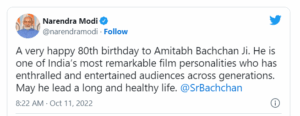
PM Modi greets Amitabh Bachchan on his 80th birthday

The Prime Minister, Shri Narendra Modi has greeted Amitabh Bachchan on his 80th birthday. Shri Modi has said that Amitabh Bachchan is one of India’s most remarkable film personalities who has enthralled and entertained audiences across generations.

In a tweet, the Prime Minister said;

“A very happy 80th birthday to Amitabh Bachchan Ji. He is one of India’s most remarkable film personalities who has enthralled and entertained audiences across generations. May he lead a long and healthy life.”

PM greets Amitabh Bachchan on his 80th birthday

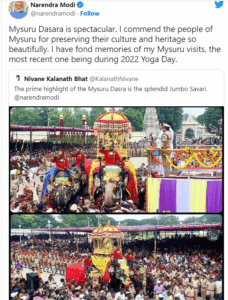
PM Modi shares glimpses of Mysuru Dasara celebrations

The Prime Minister, Shri Narendra Modi has shared glimpses of the Mysuru Dasara celebrations and lauded the commitment of the people of Mysuru to preserving their culture and heritage in a beautiful way. The Prime Minister recalled fond memories of his visit to Mysuru, the most recent one on the occasion of 2022 Yoga Day.

Quoting a tweet by a citizen, the Prime Minister tweeted;

“Mysuru Dasara is spectacular. I commend the people of Mysuru for preserving their culture and heritage so beautifully. I have fond memories of my Mysuru visits, the most recent one being during 2022 Yoga Day.”

Mysuru-Dasara-2022


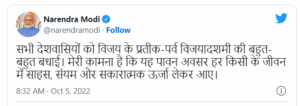
PM Narendra Modi greets everyone on Vijaya Dashami

The Prime Minister, Narendra Modi has greeted everyone on the occasion of Vijaya Dashami. Shri Modi also wished that may this auspicious occasion brings courage, restraint and positive energy in everyone’s life.
The Prime Minister tweeted;
“सभी देशवासियों को विजय के प्रतीक-पर्व विजयादशमी की बहुत-बहुत बधाई। मेरी कामना है कि यह पावन अवसर हर किसी के जीवन में साहस, संयम और सकारात्मक ऊर्जा लेकर आए।”

PM greets everyone on Vijaya Dashami

PM Narendra Modi to interact with winners of National Awards to Teachers on 5th Sep 2022

Centre extends ‘PM-GKAY’ Yojana for another 3 months (October 2022-December 2022)

Key Points:

  • Free good grains at 5 kg per person per month for all the beneficiaries of NFSA will be continued till December, 2022.
  • PMGKAY has so far had an estimated subsidy of Rs 3.45 lakh crore in six phases.
  • Phase VII of PMGKAY from Oct to Dec entails an estimated subsidy of Rs. 44,762 Crore.
  • The total outgo of foodgrains in Phase VII is expected to 122 LMT.
  • Decision will ensure that poor and vulnerable sections of society are supported for the forthcoming major festivals.


In pursuance of the pro-people announcement made by Hon’ble Prime Minister in 2021and successful implementation of additional food security under PMGKAY, the Union Cabinet has approved the extension for the  Pradhan Mantri Garib Kalyan Anna Yojana (PMGKAY-Phase VII) for a further  period of 3 months i.e. October to December 2022.

At a time when the world is battling with the effects of Covid on its decline and insecurity due to various reasons, India has been successfully maintaining food security for its vulnerable sections while taking necessary steps to keep availability and affordability for common man.

Recognising that people have gone through a difficult period of pandemic, Govt has decided to extend PMGKAY for a period of three months  so that  poor and vulnerable sections of society  are supported for the forthcoming major festivals like Navratri, Dussehra, Milad-un-nabi, Deepawali, Chhath pooja, Gurunanak dev Jayanti, Christmas, etc. which they can celebrate  with great gaiety and community for festivities.  With a view to ensuring this, Govt. has approved this extension of PMGKAY for three months, so that they continue to enjoy the benefits of easy availability of foodgrains without any financial distress.

Under this welfare scheme, 5 kg of food grain per person per month is provided free of cost for all the beneficiaries covered under the National Food Security Act (NFSA) [Antodaya Anna Yojana & Priority Households] including those covered under Direct Benefit Transfer (DBT).

Financial implication for the Government of India has been about  Rs. 3.45 Lakh Crore  upto Phase-VI of PMGKAY. With the additional expenditure of about Rs. 44,762 Crore for Phase-VII of this scheme, the overall expenditure of PMGKAY will be about Rs. 3.91 lakh crore for all the phases.

Rice/Ians

The total outgo in terms of food grains for PMGKAY Phase VII is likely to be about 122 LMT. The aggregate allocation of food grain for phases I- VII is about 1121 LMT.

So far, PMGKAY has been in operation for 25 months as under

  • Phase I and II ( 8 months) : April’20 to Nov.’20
  • Phase-III to V (11 months) : May’21 to March’22
  • Phase-VI    ( 6 months)  : April’22 to Sept.’22

PM Garib Kalyan Anna Yojana (PM-GKAY), started during difficult time of COVID-19 crisis, has provided food security to the poor, needy and the vulnerable households/beneficiaries so that they do not suffer on account of non-availability of adequate foodgrains. Effectively it has doubled the quantity of monthly foodgrains entitlements being normally delivered to beneficiaries.

Going by the experience of earlier phases, the performance of PMGKAY-VII is expected to be on the same high level as achieved before.

PM Modi congratulates Giorgia Meloni for leading in Italian General Elections

The Prime Minister, Narendra Modi has congratulated Giorgia Meloni for leading her party Fratelli d’Itaia in Italian General Elections.

The Prime Minister tweeted;

“Congratulations @GiorgiaMeloni for leading your party @FratellidItalia to victory in the Italian general elections. We look forward to working together to strengthen our ties.”


Japanese protesters oppose expensive state funeral to Shinzo Abe

For a pacifist nation like Japan, the assassination of Shinzo Abe would have been painful but the public outrage during the funeral is astounding in view of the state funeral at a cost of 1.7 billion yen ($12 million) at a time when the government is heavily indebted.

Former Japanese Prime Minister Shinzo Abe was assassinated during the campaign trail in July and the government’s plans to a state funeral have been opposed by many since then owing to the country’s fragile economy.

Japan’s prime minister Fumio Kishida has been unable to assuage public concerns as the controversy undermines his proposed record defense spending, which began with Shinzo Abe, whose legacy is left behind with the revision of the country’s post-war Pacifist Constitution and sending Japanese armed forces abroad.

PM Modi paying homage at the State Funeral Ceremony of the Former Prime Minister of Japan, Late Mr. Shinzo Abe, in Tokyo, Japan on September 27, 2022 / PIB

PM Kishida’s approval ratings have reached the lowest level since he became the country’s Prime Minister in October. Last week, a man has allegedly set himself on fire near the office of Japanese Prime Minister protesting against the expensive state funeral.

The funeral on Tuesday kept the capital under maximum security due to protests which began just before the funeral. About 4,300 attendees gathered in Tokyo to pay their respects at the funeral.

U.S. Vice President Kamala Harris, Australian Prime Minister Anthony Albanese, Indian Prime Minister Narendra Modi and South Korean Prime Minister Han Duck-soo were among 700 foreign dignitaries from 218 countries, regions and international organizations who attended the funeral.


PM greets people on the auspicious occasion of Navratri; Wishes happiness, prosperity, health

The Prime Minister, Narendra Modi has greeted people on the auspicious occasion of Navratri. On the beginning of Navratri, Modi also prayed to Goddess Shailaputri and wished happiness, health and fortune the grace of the goddess.

In a series of tweets, the Prime Minister tweeted;

“शक्ति की उपासना के महापर्व नवरात्रि की आप सभी को बहुत-बहुत शुभकामनाएं। आस्था और विश्वास का यह पावन अवसर हर किसी के जीवन में नई ऊर्जा और नए उत्साह का संचार करे। जय माता दी!”

“वन्दे वाञ्छितलाभाय चन्द्रार्धकृतशेखराम्‌।

वृषारूढां शूलधरां शैलपुत्रीं यशस्विनीम्‌ ।।

देवी शैलपुत्री की आराधना के साथ आज से नवरात्रि का शुभारंभ हो रहा है। मेरी कामना है कि उनकी कृपा से हर किसी का जीवन सुख, सौभाग्य और आरोग्य से परिपूर्ण हो।”


India wins UN awards for Initiative against Hypertension

In a significant achievement and recognition to country’s efforts against hypertension, India has won an UN award for its “India Hypertension Control Initiative (IHCI)”, a large-scale hypertension intervention under National Health Mission. IHCI has been recognized for its exceptional work within India’s existing primary healthcare system.

Complimenting the healthcare initiative, Dr. Mansukh Mandaviya, Union Minister of Health & Family Welfare stated in a tweet: “IHCI has strengthened PM @NarendraModi  Ji’s mission to ensure health & wellness for all”. We are committed to building a healthy & fit India, he further noted.

A collaborative initiative of Ministry of Health and Family Welfare, Indian Council of Medical Research (ICMR), State Governments and World Health Organization-India, IHCI has won the ‘2022 UN Interagency Task Force, and WHO Special Programme on Primary Health Care Award’ at the UN General Assembly side event held on 21st September 2022 at New York, USA. The award recognizes outstanding commitment and action of India to: (i) prevent and control Non-Communicable Diseases (NCDs) and (ii) deliver integrated people-centric primary care. The UN Task Force has identified organisation which has multisectoral approach in prevention and control of NCDs and multisectoral action with demonstrated results at primary care for prevention and control of NCDs and related Sustainable Development Goals (SDGs).

Significance of the initiative can be adjudged from the fact that one in four adults in India has high blood pressure. The control of hypertension at primary care system level will contribute  to reducing deaths due to heart attacks, stroke and kidney failures.

IHCI has been able to leverage and strengthen the existing healthcare delivery system, hypertension control interventions under National Health Mission and improve the linkages between populations-based screening initiative with health care.  The initiative was launched in 2017 and expanded in a phased manner to cover more than 130 districts across 23 states. Under the initiative, more than 34 lakh people with hypertension are taking treatment in government health facilities, including Ayushman Bharat Health Wellness Centres (HWCs).  The project strategies are easily scalable within the health system. The strategies include a simple drug-dose-specific standard treatment protocol, ensuring adequate quantity of protocol medications, decentralization of care with follow-up and refills of medicines at Health Wellness Centres, task sharing involving all health staff and a powerful real-time information system which can track every patient for follow-up and blood pressure control. Under IHCI, nearly half of those who were treated had blood pressure under control.

The IHCI complements the National Programme for Prevention and Control of Diabetes, Cardiovascular Disease and Stroke (NPCDCS) of the Ministry of Health & Family Welfare, Government of India. IHCI accelerates the achievement of targets of the Government of India by ensuring a continuum of care and giving a boost to the ongoing “Ayushman Bharat” programme.

Sudha Murthy nominated to Board of Trustees of PM CARES Fund

Prime Minister Narendra Modi chaired a meeting of the Board of Trustees of the PM CARES Fund on Tuesday in which new member Sudha Murthy from Bengaluru was appointed recently.

A presentation was made on the various initiatives undertaken with the help of PM CARES Fund, including the PM CARES for Children scheme which is supporting 4345 children. Trustees appreciated the role played by the fund at a crucial time for the country. PM Shri Narendra Modi appreciated the people of the country for contributing wholeheartedly to PM CARES Fund.

It was discussed that PM CARES has a larger vision on effectively responding to emergency and distress situations, not only through relief assistance, but also taking mitigation measures and capacity building.

Prime Minister welcomed the Trustees for becoming an integral part of the PM CARES Fund.

The meeting was attended by Trustees of the PM CARES Fund, i.e. Union Home Minister and Union Finance Minister as also, the newly nominated trustees of the PM CARES Fund:

  • Justice K.T. Thomas,  Former Judge, Supreme Court,
  • Kariya Munda, Former Deputy Speaker,
  • Ratan Tata, Chairman Emeritus, Tata Sons.

The Trust further decided to nominate following eminent persons for constitution of Advisory Board to PM CARES Fund:

  • Rajiv Mehrishi, Former Comptroller and Auditor General of India
  • Sudha Murthy, Former Chairperson, Infosys Foundation
  • Anand Shah, Co-founder of Teach for India and Former CEO of Indicorps and Piramal Foundation.

Prime Minister said that participation of new Trustees and Advisors will provide wider perspectives to the functioning of the PM CARES Fund. Their vast experience of public life would impart further vigour in making the fund more responsive to various public needs.

PM Modi condoles the demise of Bollywood comedian Raju Srivastava

The Prime Minister, Narendra Modi has condoled the demise of renowned comedian Raju Srivastava.

The Prime Minister tweeted;

“Raju Srivastava brightened our lives with laughter, humour and positivity. He leaves us too soon but he will continue to live in the hearts of countless people thanks to his rich work over the years. His demise is saddening. Condolences to his family and admirers. Om Shanti.”

Dalai Lama, others extend birthday greetings to PM Modi

Sep 17 (IANS) On the occasion of Prime Minister Narendra Modi’s 72nd birthday, Tibetan spiritual leader, the Dalai Lama has written to him offering his warmest wishes and prayers for his continued good health.

“It’s wonderful that India has successfully met the challenges posed by the coronavirus pandemic. Although we have not seen the complete end to it, India today is better placed to address similar challenges in the future,” His Holiness wrote in a letter.

“As the longest-staying guest in India I have observed its development first hand. Now the country is also a rising economic power and a leader in science and technology.

“India’s strong democratic foundation is an example of peace and stability. Having one of the youngest populations is an asset that will enable further development and the fulfilment of positive aspirations. I am delighted to say India is poised to assume its rightful place in the world.

“I have great admiration for the way Mahatma Gandhi made the age-old practice of ‘ahimsa’ appreciated across the world.”

The spiritual leader ended his letter with thanks.

“Once again, I would like to take this opportunity to express deep gratitude to the government and people of India for the warm and generous hospitality we Tibetans have enjoyed since we were forced into exile in 1959.”

Indian Prime Minister Narendra Modi

Wishes kept pouring in for Prime Minister Narendra Modi’s 72nd birthday on Saturday amidst a packed schedule for the day.

In her message on Twitter in Hindi, President Droupadi Murmu wished that the “nation-building campaign” being carried out by the Prime Minister with “incomparable hard work, dedication and creativity, continues to progress” under his leadership

Union Home Minister Amit Shah called him the creator of a “safe, strong and self-reliant New India” and a symbol of service and dedication.

In a series of tweets in Hindi, he said with the parallel coordination of welfare of poor, good governance, development, national security and historical reforms, the Prime Minister has fulfilled his resolve to establish ‘Maa Bharti’ again at the top of the world.

Shah said all this has been possible only because of a decisive leadership and the firm faith of the people.

“The life of the creator of a safe, strong and self-reliant New India Narendra Modi is a symbol of service and dedication. For the first time after independence, by giving their rights to crores of poor, Modi has instilled a sense of hope and faith in them. Today, every section of the country is standing with Modi like a rock,” the Union Minister said.

In his tweet, Shah hailed the Prime Minister as the flag-bearer of Indian culture and “someone who has connected the country to its roots and led it forward in every field”.

He said that under Modi’s farsighted leadership, India has emerged as a world power and the Prime Minister has distinguished himself as a global leader.

In his message, Union Defence Minister Rajnath Singh praised Modi’s governance and leadership.

“Hearty congratulations and best wishes to the illustrious Prime Minister of India on his birthday. He has given unprecedented strength to progress and good governance in the country under his leadership and has given new heights to India’s prestige and self-respect all over the world,” he said.

Meanwhile, BJP national president J.P. Nadda called Modi the “world’s most popular leader”, adding that the Prime Minister’s leadership has “given a new direction to the destiny and future of India”.

Congress leader Rahul Gandhi tweeted a one-line greeting, saying: “Wishing PM Narendra Modi a happy birthday.”

Delhi Chief Minister Arvind Kejriwal wished for the Prime Minister’s long and healthy life. “Birthday greetings to Hon’ble Prime Minister Shri @narendramodi ji. Praying for your long and healthy life,” he said on Twitter.

To mark the Prime Minister’s birthday, the BJP has planned several events.

Nadda will inaugurate an exhibition on Modi’s life and leadership at the party headquarters in New Delhi.

But the most notable project planned for the day will take place in Madhya Pradesh’s Kuno National Park where Modi will release eight African cheetahs from Namibia, into the wild.

A special Jumbo Jet Boeing 747 carrying the big cats landed at the Gwalior airport on Saturday morning.

Besides this, the Prime Minister is also scheduled to launch the National Logistic Policy at the Vigyan Bhawan later in the day.

PM releases wild Cheetahs in Kuno National Park, which had become extinct from India

The Prime Minister, Shri Narendra Modi today released wild Cheetahs – which had become extinct from India – in Kuno National Park. Cheetahs – brought from Namibia – are being introduced in India under Project Cheetah, which is world’s first inter-continental large wild carnivore translocation project. Out of the eight Cheetahs there are five female and three male Cheetahs.

The Prime Minister released Cheetahs at two release points in Kuno National Park. The Prime Minister also interacted with Cheetah Mitras, Cheetah Rehabilitation Management Group and students at the venue. The Prime Minister addressed the Nation on this historic occasion.

The release of wild Cheetahs by the Prime Minister in Kuno National Park is part of his efforts to revitalise and diversify India’s wildlife and its habitat. The cheetah was declared extinct from India in 1952. The Cheetahs that would be released are from Namibia and have been brought under an MoU signed earlier this year. The introduction of Cheetah in India is being done under Project Cheetah, the world’s first inter-continental large wild carnivore translocation project.

Cheetah

Cheetahs will help restore open forest and grassland ecosystems in India. This will help conserve biodiversity and enhance the ecosystem services like water security, carbon sequestration and soil moisture conservation, benefiting society at large. This effort, in line with the Prime Minister’s commitment to environmental protection and wildlife conservation, will also lead to enhanced livelihood opportunities for the local community through eco-development and ecotourism activities.

The historic reintroduction of Cheetahs in India is part of a long series of measures for ensuring sustainability and environment protection in the last eight years which has resulted in significant achievements in the area of environment protection and sustainability. . The coverage of Protected Areas which was 4.90% of the country’s geographical area in 2014 has now increased to 5.03%. This includes an increase in Protected Areas in the country from 740 with an area of 1,61,081.62 sq.kms. in 2014 to present 981 with an area of 1,71,921 sq.kms.

Forest and tree cover has increased by 16,000 square kms in the last four years. India is among few countries in the world where forest cover is consistently increasing.

Kuno national park

There has also been an increase in the number of community reserves. From just 43 in 2014 their numbers are more than 100 in 2019.

India is home to 52 Tiger Reserves covering approximately 75,000 Sq Km area in 18 States with  approximately 75% population of the wild tiger at global level. India achieved the goal of doubling the tiger numbers in 2018 itself, four years in advance from the targeted year 2022.  The Tiger Population in India has increased from 2,226 in 2014 to 2,967 in 2018.

The budgetary allocation for tiger conservation has increased from Rs 185 crore in 2014 to Rs 300 crore in 2022.

The population of Asiatic Lions has shown a steady increase with a population of 674 individuals with an increase rate of 28.87 per cent (one of the highest growth rates so far) from the 523 lions in 2015.

India now (2020) has 12,852 leopards as compared to the previous estimate of 7910 conducted in 2014. More than 60% increase in population has been recorded.

Governor, Madhya Pradesh Shri Mangubhai Patel; Chief Minister, Shri Shivraj Singh Chouhan; Union Ministers, Shri Narendra Singh Tomar, Shri Bhupender Yadav, Shri Jyotiraditya M Scindia and Shri Ashwini Chobey were among those present on the occasion.

Putin tells Modi: “Want Ukraine war to end”

Russian President Vladimir Putin has told Indian Prime Minister Narendra Modi that he is aware of India’s concerns over his country’s conflict with Ukraine, and wanted the war to end.

During the bilateral meeting between both the leaders on the sidelines of the SCO Summit in Samarkand, Putin was quoted on Friday as saying, “I know about your position on the conflict in Ukraine, and I know about your concerns. We want all of this to end as soon as possible. We will keep you abreast of what is happening there.”The Russian President said this after Modi told him that “today’s time is not the time for war”. This was the first face-to-face meeting between Modi and Putin after Russia had attacked Ukraine in February this year.