Cabinet Clears Emergency Credit Line Guarantee Scheme 5.0, Earmarks Rs 5,000 Crore Support For Airlines Amid West Asia Crisis

The Union Cabinet, chaired by Prime Minister Narendra Modi, has approved the Emergency Credit Line Guarantee Scheme (ECLGS) 5.0 to provide targeted financial assistance to Indian airlines grappling with mounting operational and liquidity pressures arising from the ongoing West Asia crisis.

The move comes amid a steep rise in Aviation Turbine Fuel (ATF) prices, airspace restrictions and reduced international flight operations, factors that have adversely impacted aircraft utilisation and strained airline finances.

Under the scheme, the government has earmarked ₹5,000 crore specifically for the aviation sector. The initiative will provide 100 per cent credit guarantee coverage for MSMEs and 90 per cent coverage for non-MSMEs and airlines through the National Credit Guarantee Trustee Company Limited to Member Lending Institutions against defaults on additional credit facilities extended to eligible borrowers.

The scheme allows airlines to avail loans of up to ₹1,000 crore per borrower, with an additional ₹500 crore permitted subject to matching equity infusion by the borrower. The loans will carry a repayment tenure of up to seven years, including a two-year moratorium, aimed at easing immediate liquidity stress.

The government said the latest version of ECLGS is intended to strengthen financial resilience among MSMEs and airlines during a challenging global environment. It also allows conversion of up to 50 per cent of interest liabilities into a Funded Interest Term Loan (FITL), a measure expected to improve cash flow management and reduce short-term repayment burdens.

Civil Aviation Minister Ram Mohan Naidu said India’s aviation sector had remained resilient despite global disruptions due to timely government intervention.

“Under the decisive leadership of Hon’ble Prime Minister Narendra Modi Ji, India’s aviation growth story today stands out globally as a success story built on the foundation of reforms, resilience and resurgence,” he said.

He added that Indian airlines had benefited from measures such as capping ATF prices during global fuel spikes and reductions in airport landing and parking charges.

“By approving the Emergency Credit Line Guarantee Scheme (ECLGS) 5.0, airlines will be enabled to navigate short-term liquidity challenges and maintain seamless operations amid global disruptions. It will provide strong financial backing to safeguard jobs, sustain connectivity and ensure resilience across the aviation ecosystem, while also supporting MSMEs,” the minister said.

The scheme will provide additional credit support of up to 20 per cent of peak working capital utilised during the fourth quarter of FY26, capped at ₹100 crore for eligible sectors. For airlines, the support can extend up to 100 per cent, subject to a ceiling of ₹1,500 crore per borrower and fulfilment of prescribed conditions.

According to the government, the guarantee coverage will remain valid for the entire tenure of the loan. The scheme will apply to all loans sanctioned from the date of issuance of guidelines by the NCGTC until March 31, 2027.

The Centre said the initiative is expected to cushion airlines against the impact of rising fuel prices, currency volatility and operational disruptions while improving lender confidence and ensuring steady credit flow to the aviation sector. The measure is also aimed at protecting jobs, preserving sectoral capacity and preventing higher operational costs from being passed on to passengers.

Also Read:

Inter-Ministerial Briefing on Recent Developments in West Asia; Update on Domestic LPG Supply, Fuel, Exports

Government Holds Inter-Ministerial Briefing On West Asia Developments

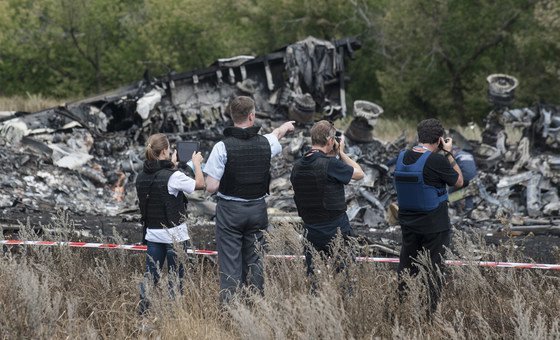
UN aviation council finds Russia responsible for downing of Malaysian Airlines flight

The council of the International Civil Aviation Organization (ICAO) voted on Monday that Russia failed to uphold its obligations under international air law which requires that States “refrain from resorting to the use of weapons against civil aircraft in flight.”

The case was brought by the Netherlands and Australia.

“This represents the first time in ICAO’s history that its Council has made a determination on the merits of a dispute between Member States under the Organization’s dispute settlement mechanism,” the UN agency said.

Caught in conflict

Flight MH17 was heading from Amsterdam to Kuala Lumpur when it was shot down over eastern Ukraine amid the armed conflict between pro-Russian rebels and Ukrainian military forces.

All 283 passengers and 15 crew members were killed.  They represented some 17 nationalities and included 196 Dutch citizens, 43 Malaysians and 38 Australian citizens or residents.

The Netherlands established a Joint Investigation Team (JIT) in August 2014 together with Australia, Malaysia and Belgium, as well as Ukraine.

The JIT determined that flight MH17 was shot down by a missile launched from a Buk TELAR installation that was transported from Russia to a farm field in eastern Ukraine in an area controlled by separatists.

In November 2022, a Dutch court convicted three men – two Russians and a Ukrainian – for murder.  They were tried in absentia and sentenced to life in prison. Another Russian man was acquitted.

Breach of civilian aviation treaty

That same year, the Netherlands and Australia launched the case with ICAO, the UN agency that develops and implements global aviation strategies and technical standards.

The case centered on allegations that Russia’s conduct in the downing of the aircraft by a surface-to-air missile over eastern Ukraine constituted a breach of Article 3 of the Convention on International Civil Aviation.

War in Ukraine has escalated since the crash following the start of Russia’s full-scale invasion of the country in February 2022.  

More than 13,000 civilians have been killed to date, and over 31,000 injured, according to the UN human rights office, OHCHR

Source link

Performance of Domestic Airlines for the year 2017

Traffic data submitted by various domestic airlines has been analysed for the month of July, 2017. Following are the salient features:

Passengers carried by domestic airlines during January-July, 2017 were 657.21 lakhs as against 560.87 lakhs during the corresponding period of previous year thereby registering a growth of 17.18%.

Click below to see the performance of domestic airlines for the year 2017

http://pibphoto.nic.in/documents/rlink/2017/aug/p201782101.pdf

Eligibility Criteria for Senior Citizens to be decided soon

Adoption of Uniform age criteria of sixty years for benefits of Senior Citizens being extended by different organizations (such as Airlines, Insurance companies, State Governments, etc) is under consideration in this Ministry, pursuant to the recommendation of the Group of Secretaries on Education and Social Development, Constituted by the Government. It is proposed to bring suitable amendment to the Maintenance and Welfare of Parents and Senior Citizens Act in this regard.

This information was given by Minister of State for Social Justice and Empowerment Shri Vijay Sampla in a written reply in Rajya Sabha today.

India Signed Air Services Agreements or Drafts with 114 Countries So Far

India has so far signed and initiated Air Services Agreement with 114 countries and latest one was with Rwanda, signed on 20th February 2017 at Kigali, informed Minister of State for Civil Aviation Jayant Sinha in written reply to a question in Lok Sabha on Wednesday.

The Air Services Agreements between India and other countries have the potential to spur greater trade, investment, tourism and cultural exchange and help rejunevate the civil aviation sector, he said.

The agreements enable an environment for enhanced and seamless connectivity, while providing commercial opportunities to the carriers of both the sides ensuring greater safety and security.

The same was discussed when the Deputy Foreign Minister of Afghanistan Mr. Hikmat Karzai visited India on Wednesday on the sidelines of the International Counter Terrorism Conference. Both sides discussed among others Air corridor for trade between Afghanistan and India.

Usually the Air Services agreements provide for both countries to designate one or more airlines with the right to establish offices in the territory of the other country for the promotion end sale of air services.

The designated airlines will have fair and equal opportunity to operate the agreed services on specified routes and they can enter into cooperative marketing arrangements with the designated carriers of same party, other party and third country.