Could oral health be affecting female fertility?

Chronic oral inflammation may impair female fertility by triggering a systemic immune response that affects the ovaries. A new study shows this leads to oxidative damage, reduced egg quality, disrupted follicle development and reduced live birth rate. These findings point to a potential biological link between oral health and unexplained infertility, opening new directions for future treatments.

[Hebrew University of Jerusalem]– A new study led by Prof. Michael Klutstein at the Hebrew University of Jerusalem and Prof. Asaf Wilensky at the Hebrew University-Hadassah Medical center and spearheaded by the students Dr. Paz Kles and Stephen Amehohas uncovered a striking biological link between chronic oral inflammation and female fertility, suggesting that conditions in the mouth may have far-reaching effects on reproductive health.

Published in the Journal of Dental Research, the study shows that persistent inflammation in the oral cavity can impair ovarian function, reduce egg quality, and ultimately lower fertility rates.

Researchers examined in a mouse model inflammation associated with dental implants, a common clinical scenario, and tracked how immune signals spread throughout the body. Their findings reveal that inflammation does not remain confined to the oral cavity but triggers a systemic immune response that reaches the ovaries.

The consequences were significant. Chronic oral inflammation in the animals was linked to increased levels of inflammatory cytokines in the ovaries, along with shifts in immune cell populations. This was accompanied by oxidative damage to ovarian tissue, impaired development of follicles, and reduced quality of oocytes.

These biological changes translated into measurable reproductive outcomes, with markedly reduced birth rates observed under inflammatory conditions in the animals.

The study also identified deeper cellular effects. Oocytes exhibited DNA damage and epigenetic alterations resembling those seen in reproductive aging, pointing to a possible mechanism by which inflammation accelerates the decline in fertility.

“Inflammation is often thought of as a localized response, but our findings show that it can have systemic consequences that extend as far as the reproductive system,” said Prof. Michael Klutstein. “This work suggests that chronic oral inflammation may be an underrecognized factor in female infertility, potentially contributing to cases that currently have no clear explanation.”

The findings add to growing evidence that oral health is closely linked to overall health. Chronic oral inflammatory conditions such as periodontitis are widespread and have already been associated with a range of systemic diseases.

The researchers note that further investigation in clinical settings will be essential to determine how these findings translate to patient care. If confirmed, the work could open new avenues for diagnosis and treatment, including the use of anti-inflammatory or antioxidant approaches to improve fertility outcomes.


Also Read:

Some cancer immunotherapy treatments may damage fertility, women’s hormonal health

Women may experience different PCOS or PCOD symptoms depending on where they live

CBSE Re-Evaluation Portal Delay Sparks New Anxiety Among Students

The Central Board of Secondary Education (CBSE) has come under criticism after its portal for Class XII answer-sheet re-evaluation remained non-functional throughout the fixed application window, raising fears that students could miss opportunities for next grade admissions at premier institutions.

The board had initially scheduled the re-evaluation application window from May 26 to May 29. However, students reported being unable to access the portal during the entire period. On Friday evening, CBSE announced that the portal would instead become operational on June 1, citing the need to ensure a glitch-free process.

The delay has triggered concerns among students, parents and school administrators, particularly because the re-evaluation process could now extend into a crucial phase of college admissions.

“If the CBSE accepts requests for re-evaluation on June 1, it may take about a week to complete the process and publish revised results,” a Delhi school principal said. “By then, many students may have lost opportunities to secure admission to institutions of their choice. The CBSE is playing with students’ futures.”

Anixiety over admission deadline for CUET ranking

Students seeking a review of their marks have expressed frustration over the prolonged uncertainty. One student who appeared for the Common University Entrance Test (CUET) on Friday said, on condition of anonymity, that she had repeatedly attempted to submit a re-evaluation request without success.

“I was unable to focus properly on preparing for my CUET papers because of the low marks awarded to me in Class XII,” she said. “I spent nearly an hour trying to submit a request in the morning and again after my exam, but the portal still did not work.”

The difficulties are linked to the CBSE’s introduction of the On-Screen Marking (OSM) system for Class XII answer sheets from this year. Under the new system, answer sheets are scanned, digitally transmitted to examiners and evaluated on-screen.

Several students have alleged that flaws in the digitisation process may have contributed to unexpectedly low scores. Concerns have been raised about blurred scans, illegible copies and other technical issues that may have affected evaluation accuracy.

Original application window for re-evaluation extended

Problems first emerged when students attempted to obtain copies of their evaluated answer sheets, a mandatory step before applying for re-evaluation. The portal used for this process reportedly functioned inconsistently, forcing CBSE to extend the original May 19–22 deadline multiple times.

In at least two cases, students alleged that their answer sheets had been swapped with those of other candidates, resulting in incorrect marks. The board has reportedly acknowledged these instances.

According to CBSE, answer-sheet copies have so far been provided to nearly four lakh students. In a post on social media at 4.50 pm on Friday, the board said the re-evaluation portal would be activated from June 1.

“In order to ensure a transparent and glitch-free process for verification and revaluation of answer books of students who intend to submit their applications on the Post-Result Activities portal, it has been decided that the designated portal will now be operational from 1st June 2026,” CBSE said.

JEE results to be announced on June 1

The announcement has intensified concerns because the results of the Joint Entrance Examination (JEE) Advanced are also scheduled to be declared on June 1, with counselling and seat allocation beginning the following day.

For admission to the Indian Institutes of Technology (IITs), candidates must either secure at least 75 per cent marks in their Class XII examinations or rank among the top 20 percentile of their respective boards, regardless of their JEE Advanced performance.

Educationists warn that students who narrowly missed the eligibility threshold due to potential evaluation errors could lose their chance to secure IIT seats if revised marks are not processed in time.

“It would be unfortunate if students with strong JEE Advanced performances miss IIT admission because they fall marginally short of the 75 per cent requirement due to issues associated with the new digital marking system,” the principal said.

The delay could also affect admissions to universities that continue to use Class XII board marks as a key admission criterion. Many institutions have already begun their admission processes.

CBSE re-assures students: ‘Don’t panic’

Meanwhile, CBSE has sought to reassure stakeholders by directing principals of affiliated schools to circulate video reels explaining the benefits of the new evaluation system.

The board provided schools with a scripted message praising the OSM system and describing the problems as temporary “bumps”. The message highlights the scale of the initiative, noting that nearly 98 lakh answer sheets were digitised under the new system.

“Please, do not panic,” the scripted message states. “I want to reassure every student and parent that no child will be allowed to suffer due to a technical error. CBSE has been highly proactive, empathetic, and communicative regarding these teething issues.”

Despite these assurances, the continuing technical problems have fuelled criticism of the board’s handling of the transition to digital evaluation, with many stakeholders demanding faster resolution and safeguards to ensure students are not disadvantaged during the ongoing admission season.

Siddaramaiah Set to Quit as Karnataka Chief Minister, DK Shivakumar Likely Successor

A major leadership transition appears imminent in Karnataka, with Chief Minister Siddaramaiah expected to resign on Thursday, paving the way for Deputy Chief Minister D.K. Shivakumar to take over the state’s top post after intense consultations within the Congress leadership.

According to multiple reports and party sources, Siddaramaiah has sought an appointment with Governor Thaawarchand Gehlot to formally submit his resignation later in the day. The development follows marathon discussions in New Delhi involving senior Congress leaders, including party president Mallikarjun Kharge, Rahul Gandhi and KC Venugopal.

The anticipated change in leadership marks the culmination of months of speculation over a power-sharing arrangement within the Karnataka Congress after the party’s emphatic victory in the 2023 Assembly elections. Siddaramaiah and Shivakumar had emerged as the two principal contenders for the chief minister’s post at the time, with the party eventually choosing Siddaramaiah as CM and appointing Shivakumar as his deputy.

Reports indicate that the Congress central leadership has now thrown its weight behind Shivakumar’s elevation. Sources said Siddaramaiah has agreed to abide by the party high command’s decision after discussions with loyalists and senior party functionaries.

While the Congress officially denied that any final decision had been taken earlier this week, political activity within the party intensified rapidly after legislators close to both camps began openly discussing a transition. Congress general secretary Randeep Singh Surjewala had maintained that discussions in Delhi were linked only to Rajya Sabha and Legislative Council elections.

However, senior party leaders and legislators later indicated that Siddaramaiah’s resignation was likely within days, triggering celebrations among Shivakumar supporters across Karnataka.

End of a Significant Political Chapter

If Siddaramaiah steps down, it would bring to a close one of the longest and most influential leadership tenures in Karnataka politics. He has served as chief minister across two terms, first from 2013 to 2018 and again since May 2023.

His latest tenure has been marked by the implementation of the Congress government’s flagship welfare guarantees, including free bus travel for women and direct-benefit schemes targeting economically weaker sections. Siddaramaiah also recently accepted the long-pending socio-educational survey, popularly known as the caste census report, from the State Backward Classes Commission, a politically significant move seen as central to the Congress’s backward-class outreach strategy.

Political observers say Siddaramaiah’s exit would signal not only a generational shift within the Karnataka Congress but also a recalibration of caste and regional equations ahead of future electoral battles.

Shivakumar’s Long Wait Nears Completion

For D.K. Shivakumar, the expected elevation would cap a long political journey marked by organisational influence, crisis management and loyalty to the Congress leadership. An eight-time MLA and current Karnataka Pradesh Congress Committee president, Shivakumar played a pivotal role in reviving the Congress in the state after the party’s setbacks in previous elections.

He is widely credited with managing coalition negotiations in Karnataka after the 2018 Assembly elections and safeguarding Congress legislators during periods of political instability. Shivakumar also emerged as a key strategist for the party nationally, particularly during crucial Rajya Sabha contests.

Known for his strong organisational grip and financial clout, Shivakumar has long been viewed as a natural claimant to the chief minister’s post. His supporters have repeatedly argued that his efforts in rebuilding the party machinery after 2019 were instrumental in Congress returning to power in 2023.

Siddaramaiah’s Future Role in Delhi

Amid the transition buzz, reports suggest the Congress leadership may offer Siddaramaiah a larger national role, potentially including a Rajya Sabha berth.

Though there has been no official confirmation, such a move could help the Congress retain Siddaramaiah’s influence within the party while facilitating a smoother leadership handover in Karnataka.

The leadership change is expected to have broader political implications in the state, where the Congress is seeking to consolidate its social coalition and maintain momentum against the BJP and Janata Dal (Secular) ahead of the next Assembly elections scheduled for 2028.

As Karnataka awaits an official announcement, the focus now shifts to the Congress Legislature Party meeting and the possible swearing-in timeline for Shivakumar, who appears poised to finally assume the state’s highest political office.

How Climate Change Weakens The Lakes’ Natural Ability To Purify Water

Lakes do far more than support fish, birds and recreation — they also act as crucial natural filters that remove excess nitrogen from water systems. However, new research led by scientists at the University of Basel and Eawag has found that climate change may significantly weaken this purification process, potentially triggering wider ecological consequences that extend to oceans and coastal regions.


New species of bizarre, bipedal, toothless crocodile relative from the Triassic discovered in Ghost Ranch

Unearthed in Ghost Ranch, New Mexico, Labrujasuchus expectatus—the ‘Witch Croc’—highlights the weirdness of life at the dawn of the dinosaurs and the legacy and ongoing discoveries at an iconic site 20 years into excavation

In the Triassic, the modern animals we know were just beginning to diversify into a menagerie of forms and body plans that rhyme with the lifestyles of extinct and living animals better known to the public, but nested in groups that ended up taking wildly divergent paths. Case in point: Labrujasuchus expectatus.

Described in the journal Journal of Vertebrate PaleontologyLabrujasuchus looked very much like ornithomimosaurs, a group of bipedal dinosaurs from the Cretaceous with body plans similar to those of modern ostriches. But Labrujasuchus comes from the branch of archosaurs that led to crocodiles, famously four-legged and full of teeth. The newly-described Labrujasuchus navigated the world on two legs with tiny arms and a toothless mouth tipped in a beak—about as far away from a crocodile as possible.

In the Triassic, you can expect the unexpected. 

The Triassic was the first period of the Mesozoic Era — often called the “Age of Dinosaurs.” It lasted from about 252 million to 201 million years ago, after the massive Permian extinction that wiped out most life on Earth.

Among the primordial Star Wars bar denizens of the epoch were the lagerpetids, bipedal dinosaur cousins whose relatives would take to the skies as pterosaurs; the funky tree-dwelling Drepanosaurus, with a single tree-sloth-like claw on its hands and a little one on its prehensile tail; and the aquatic reptilian mini-tank, Vancleavea, to name a few. Labrujasuchus expectatus, the newest identified member of Shuvosauridae—a group of ancient crocodile relatives with body plans resembling bipedal, small-armed theropod dinosaurs—stepped into this world of bizarre reptiles with both feet.

“We see a lot of the successful strategies for modern animals and non-avian dinosaurs first arise in the Triassic, and shuvosaurs are a great example of that convergent evolution,” says Dr. Alan Turner, lead author on the paper. “Bipedalism is certainly a unique path for crocodile relatives to take, but it’s a path well-trod by dinosaurs and later birds. It obviously worked for these animals.”

One of only five identified species, Labrujasuchus expectatus fills the gap between two earlier discovered shuvosaurs from the region, an evolutionary link paleontologists knew was waiting to be found. The discovery was the expected unexpected, which inspired the species name ‘expactatus’. The witchy genus moniker, Labrujasuchus, references the ‘Ranchos de los Brujos,’ or Ranch of the Witches, an old Spanish name for Ghost Ranch, and the Greek word Σοῦχος (suchus) meaning “crocodile”.

“Legend has it, the local rancheros gave the site the name ‘Ranchos de Los Brujos’ to keep folks away from the cattle-rustling operations of the Archuleta brothers,” says Dr. Nate Smith, co-author and Gretchen Augustyn Director & Curator of the NHMLAC Dinosaur Institute. “We wanted to give a nod to that colorful history, and honor the incredible role Ghost Ranch has played in expanding our view of the Triassic. We also wanted to highlight how the fossil record works—finding one shuvosaur from earlier in the Triassic and one from later meant that we paleontologists knew there were probably more from in-between waiting to be discovered and described.”

(Ghost Ranch is a famous desert retreat, fossil site, and cultural landmark in northern New Mexico)

Marking 20 Years of Collaboration at Ghost Ranch

With its bizarre assortment of creatures, the Triassic can feel like it belongs to another Earth entirely, but the body plans of long-gone weirdos reverberate through time, mirroring our modern weirdos, who are often in danger of going extinct. In short, understanding the Triassic past helps us better understand and protect our present, and perhaps nowhere on Earth gives a better view of that long-gone epoch than Ghost Ranch. Home to four quarries excavated by paleontologists for decades, Ghost Ranch continues to produce some of the most exquisitely produced fossils from the epoch.


Also Read:

‘Nagatitan’: Southeast Asia’s biggest long-necked dinosaur discovered

New dinosaur Mbiresaurus, a boon for Zimbabwe and Virginia Tech paleontology


Scientists Discover Hidden Superconducting Patterns Inside Diamond

Diamond’s importance in science extends far beyond its brilliance and luxury appeal. Researchers value the material for its exceptional hardness, remarkable ability to conduct heat, and transparency across much of the light spectrum. About 20 years ago, scientists uncovered another surprising property: under specific conditions, diamond can behave as a superconductor, allowing electrical current to move without resistance.

For years, however, researchers struggled to understand the physics behind this phenomenon, limiting efforts to use superconducting diamond in advanced technologies.

Now, scientists from Pennsylvania State University, the University of Chicago Pritzker School of Molecular Engineering and the U.S. Department of Energy-backed Q-NEXT, led by Argonne National Laboratory, say they have uncovered crucial clues explaining how superconductivity emerges inside diamond.

By engineering ultra-high-quality diamond structures and separating genuine electronic signals from background material noise, the team was able to reveal mechanisms that had remained hidden for decades.

The findings, published in the Proceedings of the National Academy of Sciences, could open the door to multifunction quantum chips capable of combining several quantum technologies within a single platform.

Researchers believe the breakthrough could help bridge one of quantum computing’s biggest challenges — connecting different types of qubits, or quantum bits, that often struggle to work together efficiently. Diamond, they say, may provide a rare material platform capable of supporting multiple quantum functions simultaneously while remaining thermally efficient and compatible with existing electronics.

“This offers a new way of thinking by integrating superconducting and semiconductor behavior to create opportunities for multifunction quantum devices,” said David Awschalom, professor of Quantum Science and Engineering and Physics at UChicago PME and director of the Chicago Quantum Exchange.

Awschalom said future technologies could potentially combine light, spin, superconductivity and magnetism within a single engineered material that also integrates with modern microelectronics.

“There’s enormous potential at the interface between these nominally disparate areas of science,” he said, adding that deeper atomic-scale engineering could unlock entirely new classes of quantum systems.

How it works

In order to become superconducting, diamond must be “doped” with atoms of boron. (Doping is the process of adding different atoms to a host material to control or change certain properties, such as electrical conductivity).

In the study, the scientists used a facility at Penn State’s Applied Research Lab to synthesize extremely high-quality diamond thin films doped with a random distribution of boron. Surprisingly, the research team found hidden order within this disordered distribution of boron in the form of a mosaic of superconducting “puddles” that must eventually link up to allow electricity to flow without resistance – which they describe as “granular superconductivity”. These puddles might form due to clustering of boron atoms within diamond, however even in microscopically uniform films, the superconductivity was found to be granular. More importantly, the superconducting mosaic is seemingly tunable and can be stretched and skewed by changing the magnetic field, electrical current and temperature.

“The graduate student leading the project discovered complex patterns in the electrical behavior of the films that could only be explained by intrinsic granularity,” said Nitin Samarth, Verne M. Willaman Professor of Physics and Materials Science and Engineering at Penn State and co-corresponding author of the paper. “This serendipitous discovery caught us totally by surprise because these are structurally homogeneous, crystalline films! So, the question was: where is this granularity coming from?”

By identifying how electrons move through and between these superconducting puddles, scientists can now begin to “stitch” these superconducting puddles together more effectively, which could significantly boost the performance and temperature range of future quantum devices. Currently, these systems require extreme cooling to function; raising that temperature would make quantum technology more accessible and energy-efficient.

Potential for new innovations

One of the most exciting implications of this research, says Awschalom, is the potential for multifunctional ‘quantum-on-chip’ applications, where multiple different types of quantum information technologies—like quantum communication and quantum computing—could coexist and work together on a single diamond chip. This is due to diamond’s built-in “spin-photon interface,” meaning it naturally connects light to matter without any other technology necessary.

As the quantum industry looks to develop a domestic diamond supply chain, this “all-in-one” diamond platform offers a path toward chips that are not only more powerful but also easier to integrate with the classical high-frequency electronics we use today.

These applications are only possibilities, but the study has taken a critical step: by understanding the underlying principles behind superconductivity in diamond, researchers can now move beyond simply observing it to actively engineering it.

“We now have a reliable roadmap for engineering diamond superconductors by independently adjusting the material’s core properties,” says Samarth, “By tuning parameters like boron doping density, crystalline orientation, mechanical strain, and dimensionality, we can move beyond simple observation and start designing diamond superconductors for specific roles. There are a lot of exciting possibilities here, for both quantum and classical technology.”


Also Read:

Diamond impurities indicate water flows deep in Earth’s mantle too

Recipe for safer batteries — Just add diamonds

Ocean Acidification Is Quietly Ruining Reef Fish Social Networks

Ocean acidification is doing more than damaging coral reefs — it may also be disrupting the social behaviour that helps reef fish survive, according to a new study by researchers at University of Adelaide.

( What is Ocean acidification: When humans burn fossil fuels such as coal, oil and gas, large amounts of CO₂ are released into the air. The oceans absorb nearly one-third of this carbon dioxide. Once absorbed, the CO₂ reacts with seawater to form carbonic acid, which increases the water’s acidity.Although the ocean is still slightly alkaline overall, even small changes in pH can seriously affect marine ecosystems.)

The research found that when reef habitats become less structurally complex due to rising ocean acidity, fish tend to form smaller shoals, weakening the group protection that many species rely on against predators.

“Watch a reef long enough and you realise that fish are almost never alone. They move in groups, feed in groups, and react to danger as a group,” lead author Dr Angus Mitchell said.

“For small reef fish, being part of a shoal is a survival strategy — more eyes spot predators sooner, and larger groups reduce the chance of any one fish becoming prey.”

The study showed that shoal size directly influences how fish behave individually and collectively. Fish in larger groups were generally bolder, spent more time foraging in open areas and hid less often, suggesting stronger social confidence within bigger schools.

The findings, published in the Journal of Animal Ecology, also revealed that the behavioural shifts were not primarily caused by warmer temperatures or lower ocean pH acting directly on individual fish.

“The direct effects of warming, acidification and heatwave stress on individual fish behaviour were mostly minimal,” said project leader Professor Ivan Nagelkerken.

“Across all reef types, even during a heatwave, the fish behaved in much the same way. They kept feeding and did not suddenly become more active.”

Instead, researchers said the real damage may come indirectly through the breakdown of reef habitats and social structures that shape fish behaviour over time.

Dr Mitchell said climate change impacts cannot be fully understood by studying animals in isolation.

“In the real world, fish experience climate change as part of communities shaped by their habitat and the individuals around them,” he said.

“Our results suggest that even when individual fish appear to cope behaviourally under climate stress, the social systems supporting those behaviours can quietly collapse.”

Ocean acidification, driven by the growing absorption of carbon dioxide from the atmosphere, is increasingly reducing reef complexity worldwide. As coral structures deteriorate, fish lose both shelter and the environmental conditions needed to maintain larger social groups.

To understand how future oceans may affect marine ecosystems, the researchers studied reef systems near underwater volcanic carbon dioxide seeps in Japan. These areas naturally create more acidic marine conditions similar to those scientists expect in coming decades.

“The reefs we work on in Japan are unique because volcanic CO2 seeps on the seafloor create conditions comparable to future ocean climates,” Professor Nagelkerken explained.

“Some reefs reflect present-day seawater chemistry, while others experience higher temperatures or elevated acidity — and some face both simultaneously.”

The naturally occurring “climate analogue” reefs allowed scientists to observe long-term ecological responses under realistic environmental conditions rather than laboratory simulations alone.

The study adds to growing scientific concern that climate change may alter marine ecosystems not only physically, but socially — reshaping the behaviour, survival strategies and interactions of species that depend on coral reefs.

Also Read:

Greed is driving oceans toward collapse

Aquatic plant reduces antibiotics in water and genetic damage in fish, but risks remain

Astronomers de-fog exoplanet atmospheres with new cloud-detecting method

Sand clouds form every morning but clear up by nightfall on WASP-94A b, a well-studied gas giant in a constellation located nearly 700 light years away from Earth.

The research, which uses data from the James Webb Space Telescope (JWST), is among the first to detect cloud cycles on a Hot Jupiter exoplanet. By isolating the clouds, researchers can more accurately measure the planet’s atmosphere and provide one of the clearest pictures to date of the planet’s composition — a significant advance in planetary science.

“I’ve been looking at exoplanets for 20 years, and general cloudiness has been a thorn in our side. We’ve known for quite a while that clouds are pervasive on Hot Jupiter planets, which is annoying because it’s like trying to look at the planet through a foggy window,” said co-author and program PI, David Sing, a Bloomberg Distinguished Professor of Earth and Planetary Sciences at Johns Hopkins. “Not only have we been able to clear the view, but we can finally pin down what the clouds are made out of and how they’re condensing and evaporating as they move around the planet.”

The results are published today in the journal Science.

To study WASP-94A b in the Microscopium constellation, Sing and his team of researchers gathered data as the planet passed directly in front of its star. Using the high-powered, space-based JWST, the researchers were able to take separate measurements of WASP-94A b’s leading edge as it started to cross in front of the star and the trailing edge as the planet completed its transit. At the leading edge, the air flows from the night side of the planet to the day side, effectively making it the morning. Air flows from day to night at the trailing edge, making it the evening.

Observations revealed that mornings and evenings on WASP-94A b have extremely different weather patterns: mornings are riddled with clouds made of magnesium silicate, a common mineral found in rocks, while the evening has clear skies.

The researchers think one of two things could be happening. Powerful winds might lift clouds high into the sky on the cooler side of the planet and then plunge downward on the hotter dayside, dragging the clouds deep into the planet’s interior and effectively burying them out of sight before sunset. Alternatively, the phenomenon may be akin to morning fog burning off on Earth, but on an extreme scale. Clouds would form in the darkness of the planet’s nightside. As they drift into the scorching heat of over 1,000 degrees on the day side, the chemicals that make up the clouds boil away, and the clouds simply vaporize.

“It was a huge surprise. People have expected some differences, like its cooler in the morning than the evening—that’s something natural that we experience here on Earth,” Sing said. “But what we saw was a real dichotomy between the weather on both sides of the planet, and huge differences in cloud coverage, and that changes our whole picture of the planet.”

Because the evenings are clear of clouds, the researchers could look to the trailing edge specifically to see what the atmosphere of the planet looked like—something the Hubble telescope could not provide.

Artistic representation of WASP-94A b, a gas giant in the Microscopium constellation. Clouds build as air flows over the dark side of the planet, reaching a large swell by daybreak. The clouds dissipate on the dayside, leaving clear skies in the early evening.  Credit:Hannah Robbins/Johns Hopkins University

“With the Hubble telescope, when we used to do this type of observation, we got an average view of the whole planet with data from the clouds and the atmosphere squished together and indistinguishable,” said first author Sagnick Mukherjee, a postdoctoral fellow at Arizona State University who was a student at Johns Hopkins and UC Santa Cruz at the time of the research. “This approach with the JWST lets us localize our observations, which helped us see the cloud cycle.”

When the researchers looked at the clear evening sky, they found that WASP-94A b was much more like Jupiter than they thought. Previously, when the clouds were averaged in, the data suggested the planet was made of hundreds of times more oxygen and carbon than Jupiter—a finding that baffled researchers given it couldn’t be explained by planet formation theory. The new data, however, shows WASP-94A b has only five times the amount of oxygen and carbon.

Hot Jupiter planets orbit much closer to their stars—closer even than Mercury to the sun—and therefore are much hotter and are exposed to more radiation. Because of their extreme environments, these planets also make good laboratories to study the chemistry and physics of cloud dynamics.

Using WASP-94 Ab as a benchmark, the team looked at eight other hot gas giants and discovered the same distinctive cloud cycle on two other worlds: WASP-39 b and WASP-17 b. Next, Sing and his team will be using data from a new large JWST program to study cloud cycling across a wide variety of exoplanets, including an eccentric gas giant planet in the habitable zone.


Also Read:

Space News: Planetary-scale ‘heat wave’ discovered in Jupiter’s atmosphere

Webb space Telescope Captures Clearest View of Neptune’s Rings, Unusual Moon ‘Triton’


Wildlife Now Responds To Human Presence In Surprising Ways

A new large-scale study led by a research team from the Yale Center for Biodiversity and Global Change has found that wildlife responds not only to how humans reshape their habitats, but also to the simple presence of humans — and sometimes in surprising ways.

Even small changes in how people move through environments can significantly affect animal behavior and could have implications for wildlife conservation efforts, the study finds.

“Our findings provide an important nuance in our understanding of wildlife in a rapidly changing world,” said Walter Jetz, a professor of ecology and evolutionary biology in Yale’s Faculty of Arts and Sciences and director of the Yale Center for Biodiversity and Global Change.

“Animals are affected by both direct human presence and by human-caused changes to the physical environment, such as agriculture and urbanization,” Jetz said. “This study is the first to directly assess at scale how both causes, separately and in combination, impact wildlife habitat usage.”

The study, published in Science, culminates a six-year, global collaboration between Yale researchers and colleagues from more than 5o academic and governmental organizations across the U.S. and abroad.

The study was led by Ruth Oliver, formerly a postdoctoral scientist in Yale’s Department of Ecology & Evolutionary Biology who is now an assistant professor at the University of California Santa Barbara’s Bren School of Environmental Science and Management; and Scott Yanco, another former Yale postdoctoral associate who is now a research ecologist at the Smithsonian’s National Zoo and Conservation Biology Institute.

The study’s overall findings suggest that to protect wildlife, conservationists should consider not just habitat loss, but also where and when people are physically present.

In their work, researchers used GPS devices to track 37 species (22 birds and 15 mammals) across the United States. Mammal species included white-tailed deer, wolves, coyotes, raccoons, skunks, and some of the “big cat” species. The birds included large species such as vultures, hawks, ducks, crane, and storks.

In all, researchers collected about 11.8 million location points from more than 4,500 animals.

For the first time ever, the team then used mobile phone data, paired with satellite-derived measurements of human habitat disturbance, to study how both aspects of human behavior affected animal movement and habitat use.

“It has been challenging to capture the impact of human presence on wildlife,” said Oliver. “Mobile device data are typically not available, but our study was made possible thanks to a unique partnership that made estimates of human presence available to researchers during the COVID-19 pandemic.”

COVID-19 lockdowns dramatically altered human movement patterns, allowing researchers to study differences in human presence between 2019 and 2020. This enabled researchers to separate the effects of human presence on animal behavior from longer-term landscape changes such as urban development and agriculture.

The researchers measured the space that animals used and the variety of habitats they occupied and then applied statistical models to link these behaviors to human activity and environmental conditions.

Results showed that more than 65% of species changed their behavior based on the presence of humans, and that this human presence tended to matter most in less-developed, natural settings. But different species responded in different ways. Many reduced the amount of space they used, probably to avoid people, but others had the opposite response.

Gray wolves, for example, expanded their range, possibly traveling farther to steer clear of humans. Ravens also covered more ground, likely taking advantage of food sources linked to people, while coyotes tended to restrict their movements.

The study also found that individual animals could adjust their behavior from year to year, demonstrating some flexibility in response to changing human activity.

“Habitat loss is the key driver of biodiversity loss, but as we show, human’s direct use of the landscape — say for recreation — also mediates this effect,” Jetz said. “Depending on the quality of remaining habitat, animals make behavioral adjustments that either amplify or dampen the negative effects of habitat loss.”

The study highlights how new technologies, such as GPS tracking combined with satellite data and measures of human presence, can uncover new insights into how wildlife responds to humans.

The findings also suggest that in addition to habitat preservation, efforts to skillfully manage the timing and intensity of human activity — such as limiting traffic during key periods or reducing disturbance in sensitive habitats — may help wildlife and people coexist.

“The cutting-edge technology used in this study allows us to see, with unprecedented detail, how variable wildlife responses to human activities really are,” Yanco said. “This means that conservation strategies need to be very targeted, not one-size-fits-all.”


Also Read:

Humans gobble it, birds and bees sip alcohol

Wolves kill, and ravens recall where: What is the scavenging strategy?

U.S. Secretary of State Marco Rubio calls on Prime Minister Narendra Modi

  • Secretary Rubio briefs PM on the sustained progress in bilateral cooperation.
  • Secretary Rubio shares US perspective on various regional and global issues.
  • PM reaffirms India’s consistent support for peace efforts and reiterates the call for peaceful resolution of the conflicts.
  • PM conveys warm greetings to President Trump.

The U.S. Secretary of State, H.E. Mr. Marco Rubio, called on Prime Minister Shri Narendra Modi today.

Secretary Rubio briefed Prime Minister on the sustained progress in bilateral cooperation across a wide range of sectors, including defence, strategic technologies, trade and investment, energy security, connectivity, education and people-to-people ties.

Secretary Rubio shared U.S. perspective on various regional and global issues, including the situation in West Asia.

Prime Minister reaffirmed India’s consistent support for peace efforts and reiterated the call for peaceful resolution of the conflicts through dialogue and diplomacy.

Prime Minister requested Secretary Rubio to convey his warm greetings to President Trump and said that he looked forward to their continued exchanges.


Also Read: 

Prime Minister receives the Grand Cross of the Royal Norwegian Order of Merit

Prime Minister inaugurates Sindhu Hospital in Hyderabad

Indian Students Leave For Japan Under Sakura Science Programme 2026

A group of Indian school students will travel to Japan next week under the Sakura Science Programme 2026, an academic exchange initiative aimed at exposing young learners to advanced scientific research and technological innovation.

The delegation was formally flagged off on Friday by the Department of School Education and Literacy under the Union Ministry of Education during a ceremony held at the campus of National Council of Educational Research and Training in New Delhi.

Among those present at the event were Archana Sharma Awasthi, Additional Secretary in the Department of School Education and Literacy, NCERT Director Prof. Dinesh Prasad Saklani, and Economic Advisor A. Srija.

The week-long visit to Japan will take place from May 24 to May 30 and will include 56 students and four supervisors from India. The Indian contingent will participate alongside students from Ghana, Nigeria and South Africa under the international youth exchange initiative.

Officials said the selected students include 24 boys and 32 girls studying in government schools across 15 states and Union Territories. The participants have been chosen from beneficiaries of the National Means-cum-Merit Scholarship (NMMS) Scheme, a centrally sponsored programme designed to support academically talented students from economically weaker backgrounds.

The students represent Assam, Dadra and Nagar Haveli and Daman and Diu, Goa, Gujarat, Haryana, Jharkhand, Karnataka, Madhya Pradesh, Maharashtra, Odisha, Punjab, Rajasthan, Tamil Nadu, Telangana and West Bengal.

The Sakura Science Programme, officially known as the Japan-Asia Youth Exchange Program in Science, has been run by the Japan Science and Technology Agency since 2014 to encourage scientific collaboration and cultural exchange among students across Asia and Africa. India joined the initiative in 2016.

Under the programme, students spend a week in Japan visiting educational institutions, research centres and technology facilities while also experiencing Japanese culture and society.

PIB

According to government data, 674 Indian students and 96 supervisors have visited Japan through the programme so far. The previous batch travelled to Japan in August 2025.

The Ministry of Education said the initiative aligns with the vision of the Ministry of Education under the National Education Policy 2020, which stresses experiential and interdisciplinary learning.

Officials said international exposure visits play an important role in helping students understand scientific developments, innovation ecosystems and cultural diversity beyond classroom education.

Japan is widely regarded for its technological capabilities in sectors such as robotics, electronics, manufacturing and scientific research, making it an important destination for educational exchange programmes focused on science and innovation.

Also Read:

2024 Nobel Peace Prize Goes to Japan’s Anti-Nuclear Movement ‘Nihon Hidankyo’

Japan commits ODA loan to India in urban Transport, health and agriculture sectors

Is listening to music while studying helpful or hidden distraction? Study reveals

A new study by researchers at Edith Cowan University has explored why many university students listen to music while studying and whether it actually improves concentration or becomes a distraction.


How can gold always keep its glitter? Researchers uncover atomic secret behind Gold’s lasting shine

Gold’s legendary resistance to tarnish may owe as much to the behavior of its surface atoms as to the metal’s chemical properties, according to a new study by researchers at Tulane University.

The study, published in Physical Review Letters, found that atoms on certain gold surfaces spontaneously rearrange themselves into protective patterns that sharply reduce reactions with oxygen.

The discovery sheds new light on why gold jewelry and artifacts can retain their shine for centuries and may also help scientists develop more efficient gold-based catalysts for industrial and energy applications.

“People have generally thought gold doesn’t tarnish simply because it doesn’t interact strongly with oxygen,” said Matthew Montemore, associate professor of chemical engineering at Tulane’s School of Science and Engineering. “What we show is that for two of the most common gold surface types, the surface atoms actually rearrange themselves in a way that makes the gold much more resistant to oxidation.”

Using advanced computer simulations, Montemore and co-author Santu Biswas examined how oxygen molecules interact with two widely occurring gold surface structures. The researchers discovered that without these atomic rearrangements, oxygen molecules could split apart and react with gold far more easily.

Instead, the self-organized surface patterns suppress oxygen reactions by factors ranging from a billion to a trillion, effectively creating an atomic-scale protective shield that allows gold to remain untarnished over long periods.

Beyond explaining gold’s enduring luster, the findings could have important implications for catalysis — the process of speeding up chemical reactions in industrial manufacturing and energy systems.

Gold-based catalysts are already used in several industrial oxidation processes. However, gold’s resistance to breaking apart oxygen molecules, while beneficial for jewelry and electronics, can also reduce its effectiveness in certain chemical reactions.

Gold-palladium catalysts, for example, are used in the production of vinyl acetate, a key ingredient in plastics and other materials. Scientists are also investigating gold catalysts for reducing carbon monoxide emissions in vehicle exhaust systems and producing propylene oxide, a widely used industrial chemical.

“If you can trick gold into dissociating oxygen, it can actually become a very effective catalyst for certain reactions,” Montemore said. “Our work suggests a new strategy for potentially doing that by preventing or reversing these surface rearrangements.”

Researchers have traditionally attempted to enhance gold catalysts by mixing gold with other metals or using nanoscale gold particles on oxide surfaces. The new study suggests that manipulating surface geometry itself could provide another pathway for improving gold’s catalytic performance.

Also Read:

Ultrathin Nanogold Films Enable Self-Powered Sensors and Smart Wearables

Green gold beneath the waves: How seaweed – and one man’s obsession – could save the world

Railways urges passengers to stay Alert and vigilant while travelling; What you need to do

Indian Railways is increasingly deploying advanced technologies such as artificial intelligence, drones and CCTV surveillance systems to strengthen the safety and security of trains, passengers, station premises and the country’s vast railway network.

The Railway Ministry on Wednesday held a high-level security review meeting in New Delhi, bringing together senior officials and field officers from across the country to assess security preparedness and improve intelligence coordination. The meeting, chaired by Railway Minister Ashwini Vaishnaw at Rail Bhawan, was attended by Ministers of State for Railways V. Somanna and Ravneet Singh Bittu, along with the Chairman of the Railway Board and other senior officials.

PIB

Railways stated that swift intervention and timely action by railway staff in several instances helped prevent major mishaps. Officials also stressed the need to strengthen intelligence gathering at the grassroots level, particularly through improved beat-level monitoring by the RPF.

PIB

The discussions focused on expanding the use of technology-driven security systems, including wider CCTV coverage across railway stations and rail corridors, deployment of AI-based monitoring tools and upgrades to surveillance camera specifications. Strengthening cyber security infrastructure and improving operational coordination between Railway Board headquarters and zonal field units also figured prominently during the review.

The ministry further emphasized the need for closer coordination between the RPF and the Government Railway Police (GRP) through enhanced information-sharing mechanisms to ensure more effective security management across the railway network.

What Passengers Need To Do

  • Remain alert and vigilant while travelling on trains and waiting at railway stations.
  • Immediately report any suspicious person, activity or unattended object noticed on railway premises.
  • Use the Railway helpline number 139 to report security concerns.
  • Cooperate with railway authorities and security personnel during checks and investigations.
  • Support Railways’ efforts to curb anti-social activities by sharing timely information.

What The Government/Railways Is Doing

  • Deploying advanced technologies such as AI-based surveillance systems, drones and CCTV networks to improve railway security.
  • Strengthening intelligence gathering mechanisms at the Railway Protection Force (RPF) beat level.
  • Conducting investigations into recent fire incidents and suspected anti-social activities.
  • Expanding CCTV coverage across railway stations and rail routes.
  • Upgrading surveillance camera specifications and monitoring systems.
  • Enhancing cyber security systems across the railway network.
  • Improving coordination and information-sharing between the RPF and Government Railway Police (GRP).
  • Holding high-level security review meetings with railway officials and field officers nationwide.
  • Improving operational coordination between Railway Board headquarters and field zones for faster response and monitoring.


Also Read:

Vacation Time: Indian Railways Plans 18,262 Summer Special Trips To Meet Seasonal Travel Surge [Trains Details]

Indian Railways Clears ₹1,364 Crore for Kavach Signalling across Multiple Zones

National Zoological Park Begins Summer Vacation Programme Under Mission LiFE Initiative

The National Zoological Park on Wednesday launched its Summer Vacation Programme (SVP) 2026 at the zoo’s Education Centre, drawing enthusiastic participation from students across the Delhi-NCR region.

Held under the Mass Mobilisation Campaign for Mission LiFE and aligned with the World Environment Day theme, “Inspired by Nature. For Climate. For Our Future.”, the initiative seeks to raise awareness among school students on biodiversity conservation, wildlife protection, climate action, cleanliness and sustainable living through a series of interactive learning activities.

National Zoological Park Launches Summer Vacation Programme 2026 PIB

According to zoo officials, 854 students registered online for the programme through a Google form hosted on the National Zoological Park’s official website. Of them, 60 participants were selected on a first-come, first-served basis and later contacted for confirmation. On the opening day, 39 students representing 15 schools from across Delhi-NCR attended the sessions.

The inaugural day began with an orientation programme introducing participants to the objectives and schedule of SVP 2026. Students were later taken on a guided tour of the zoo, including visits to herbivore and carnivore enclosures. An expert lecture on biodiversity was delivered by Dr. Faiyaz A. ahead of the International Day for Biological Diversity.

The two-week programme has been divided into two phases — Slot A and Slot B — each accommodating 50 students, including 25 junior and 25 senior participants.

National Zoological Park Launches Summer Vacation Programme 2026 PIB

The schedule features a diverse range of educational and creative activities, including wildlife photography, poster-making, slogan-writing, heritage walks, essay competitions, clay modelling, art and craft sessions, exhibitions, cleanliness awareness drives and Mission LiFE campaigns. Expert talks on conservation and environmental sustainability are also planned throughout the programme.

The Summer Vacation Programme will run from May 21 to June 6, 2026, engaging students from Classes VI to XII in experiential learning focused on conservation and environmental awareness.

Zoo Director Dr. Sanjeet Kumar interacted with the participants and stressed the need to involve young minds in biodiversity conservation through innovative and technology-driven educational initiatives.

Also Read:

Humans gobble it, birds and bees sip alcohol

Scared of spiders? A world without them is true nightmare tale: Study

Scientists Develop Cost-Effective Thermal Battery Material For Clean Energy Storage

Researchers have developed a cost-effective, efficient thermal energy storage material that can significantly improve the efficiency of thermal batteries used in concentrated solar power plants and industrial waste heat recovery systems.

Effective thermal energy storage (TES) systems are essential for efficient utilization of concentrated solar power (CSP) and capturing industrial waste heat. Scientists are trying to develop materials with enhanced specific heat capacity, thermal conductivity, and operating temperature range for improved performance of the TES system.

Researchers at the International Advanced Research Centre for Powder Metallurgy and New Materials (ARCI), an autonomous institution of the Department of Science and Technology (DST) have developed a cost-effective, scalable process to produce spinel nano composite Phase Change Material (PCM) with an unprecedented increase in specific heat capacity for thermal energy storage applications.

The process developed by ARCI team led by Dr. Mani Karthik, employs a simple co-precipitation method to produce spinel-type metal oxide nanoparticles with controlled particle size. These nanomaterials exhibited excellent thermal stability and uniform dispersion, making them suitable for producing high-performance nanocomposite PCM.

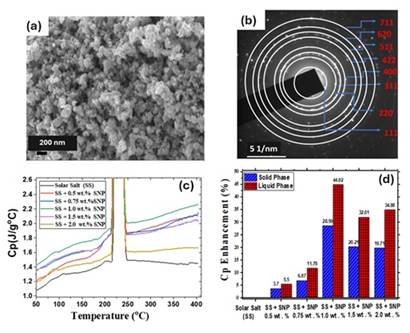
By the addition of only 1% spinel oxide nanoparticles to the PCM, the nanocomposite phase change material showed a remarkable increase in the specific heat capacity (ability to store the thermal energy) as high as 45% when compared to the PCM without nanocomposites.


Fig: (a) HR-TEM image of spinel nanoparticles, (b) Selected Area Electron

Diffraction (SAED) pattern of spinel nanoparticles, (c) Differential Scanning

Calorimetry (DSC) profile, (d) Cp enhancement of Spinel-PCM nanocomposite

When these nanoparticles are well dispersed in the PCM, they significantly improve its thermal properties by increasing the specific surface area. This leads to the formation of a stable spinel oxide layer at the interface, which increases surface energy and contributes to the nanocomposite’s higher specific heat capacity compared to the base PCM.

As a result, the material can store more thermal energy per unit mass, improving energy storage efficiency. This improvement results in smaller storage tanks with reduced construction materials, which significantly lowers both capital and operational costs.

Overall, this development offers a compact and cost‑effective thermal energy storage solution, paving the way for next‑generation materials with superior performance.

This research published in the Materials Today Chemistry (Elsevier) aligns with India’s clean energy objectives and the Aatma Nirbhar Bharat initiative by advancing indigenous expertise in next-generation energy storage materials. Furthermore, the superior thermal capacity of these materials enables the development of more compact, high-performance, and cost-efficient thermal energy storage systems.

Also Read:

Indian scientists convert discarded battery waste into high-value material for cleaner fuel cells

MIT engineers build a battery-free, wireless underwater camera; captures color photos even in unclear environment

How El Niño and La Niña events impact tourism industry, agriculture

Multi-year La Niña events — so-called “double-dip” or even “triple-dip” La Niñas — are becoming more common. But why do these events persist for multiple years in the first place?

Researchers from the Nanjing University of Information Science and Technology and the University of Hawaii discovered two distinct pathways that can lead to long-lasting La Niña conditions and highlighted an important mechanism that has been largely overlooked.

El Niño and La Niña are the warm and cool phases of a recurring climate pattern in the tropical Pacific Ocean that influences weather worldwide. El Niño is characterized by unusually warm sea surface temperatures in the central and eastern Pacific, while La Niña brings cooler-than-normal conditions to the same region.

Whilst it is rather uncommon for El Niño to last more than a year, it is no longer rare to see La Niña events persist for two years, a phenomenon often referred to as a “double-dip” La Niña. These prolonged events could result in extended climate extremes and devastating weather events that take a toll on community resilience, the tourism industry and agriculture.

“Currently, a widely accepted hypothesis is that multi-year La Niña events are triggered by preceding extreme El Niño events, but this mechanism explains only about 30% of the total multi-year La Niñas observed over the past century,” said Tim Li, the corresponding author of the study.

So, what accounts for the remaining 70%?

The answer, the team found, may lie in a pattern of anomalous sea surface temperatures south of the equator, known as the South Pacific Meridional Mode (SPMM).

When cooling extends farther into the South Pacific in spring, it alters atmospheric circulation by strengthening easterly winds along the equator. These winds enhance the upwelling of cold water from the deep ocean and push warm surface waters away, reinforcing the cooling at the ocean’s surface.

Using atmospheric model experiments, the researchers confirmed that such a wind response can further sustain La Niña by slowing its natural decay. As a result, the cooling persists through the summer and can re-intensify in the following autumn when ocean-atmosphere feedbacks become stronger. This process, known as a season-dependent coupled ocean-atmosphere instability, is a positive, or self-reinforcing, feedback between the ocean and atmosphere that becomes particularly strong at certain times of year.

The findings suggest that when determining whether La Niña will persist into the following year, how it evolves after it peaks is just as important as how it begins. Multi-year La Niña events can develop through two key routes.

“The first route is driven by strong upper-ocean heat discharge associated with a preceding super El Niño, which induces thermocline anomalies that slow La Niña decay via Bjerknes feedback,” Li said.

The Bjerknes feedback is a special type of ocean-atmosphere interaction where changes in sea surface temperatures affect atmospheric conditions, which in turn influence sub-surface ocean temperatures, creating a self-reinforcing cycle.

“The second route involves the influence of meridionally extended sea surface temperature anomalies, which strengthen equatorial easterlies, enhance upwelling, and delay the decay of La Niña,” Li said.

In both cases, the cold anomalies can persist through summer and re-develop in autumn, leading to multi-year events.

By uncovering this dual mechanism, the researchers provide a more complete framework for understanding one of the most influential drivers of global climate variability. Their findings could help improve predictions of prolonged La Niña events, which have been linked to extended droughts, flooding and other extreme weather impacts worldwide.

The researchers aim to test how well current climate models capture these two distinctive routes and to explore how longer-term climate conditions may influence their behavior.

“Our ultimate goal is to improve forecasts of multi-year La Niña events and their far-reaching impacts, an advance that could strengthen climate preparedness and resilience on seasonal to decadal timescales,” Li said.

The study is published in Advances in Atmospheric Sciences on May 15.


Also Read:

Ghost Forests Reveal Hidden Climate Threats Along U.S. Coasts, Study Finds

How climate change is threatening human rights


“one-pot” glue help address the massive e-waste problem

Reversible glue technology goes electric

A collaboration between electrical and chemical engineers at Newcastle University is responsible for a reversible glue that can change how we recycle electronic waste.

The team has already demonstrated reversible adhesive technology with wide applicability in general packaging applications, but this new glue is electrically conductive. This means that it can join electronic components, just like solder does. Unlike solder, however, a simple wash with a green solvent like acetone, or using an alkaline solution, will allow the components to be separated for reuse or recycling.

This is a “one-pot” glue and is water-based, so it does not emit organic solvent vapours and does not require a hardener, unlike some glues. It is also as strong as other water-based glues. The glue is made in the same way as a paint, but silver particles are added rather than pigments, and this gives the formulation its electrical properties. Other conducting glues exist, and many of these also include silver for optimal conductivity, but none can easily be debonded.

Electronic waste (e-waste) is a massive problem with 62 billion kilos produced globally (similar to the weight of a million semi-detached houses), and less than a quarter of this is recycled. Much of this electronic waste contains critical minerals that are mined in only very few locations, some of which are politically unstable. The glue will help address the e-waste problem.

The glue is based on current industrial manufacturing processes – those for making a paint – and is developed from cheap materials so it can be scaled up easily. It is water-based and so it does not have the volatile organic solvents used in many commercial glues, but unlike other water-based adhesives, exposure to humid environments does not cause bond failure.

The glue works very well on metal surfaces, but it also sticks to other surfaces too, such as plastics and printed circuit boards.

Published in the journal, Advanced Electronic Materials, the work was funded by the Engineering and Physical Sciences Research Council (EPSRC) and the Royal Commission for Jubail and Yanbu of the Kingdom of Saudi Arabia, which provided a PhD scholarship for the first author of the paper, Bassam Aljohani.

Bassam, a PhD student at the School of Engineering, said: “Electrically conductive adhesives have been around for a long time, and making them reversible provides the solution to a very real problem that urgently needs addressing.”

The lead investigator on the project, Mark Geoghegan, who is Roland Cookson Professor of Engineering Materials, added: “One of the reasons that conducting glues are rarely used is because silver is expensive and toxic in the environment. Being reversible, our glue means that the silver can be recovered and reused, which is important to keep costs down and the environment clean.”

Professor Volker Pickert, who is Professor of Power Electronics and co-investigator on the project, pointed out: “Solder has the best conductivity, but the best formulations contain lead and now companies need to ask themselves whether the conductivity outweighs environmental considerations. In some cases, it will, but there is an opportunity here to revisit how we join electrical components.”

Dr Ama Asiedu-Asante, who is a researcher in Professor Pickert’s group and a co-author of the work said: “It’s not just about solder. The electronics industry relies on permanent joining methods, including screws, which can make automated recycling more difficult. There is now increasing recognition that water-based formulations can support more sustainable electronics, and this work demonstrates how they can deliver both performance and reversibility.”

Dr Adriana Sierra-Romero, co-author of this publication, stated: “Alongside the article, the publication of our patent highlights the broader potential of this technology to enable more sustainable, repairable, and reusable electronic systems.”

Professor Katarina Novakovic, co-author on the paper and a project co-investigator commented: “As international policy focus shifts away from sustainability, we remain committed to advancing critical solutions for the unsustainable use of resources.”


Also Read:

Indian scientists convert discarded battery waste into high-value material for cleaner fuel cells

Turning fish waste into quality carbon-based nanomaterial

Honey-like heat flow: A new heat transport regime discovered in ultrathin semiconductors

Controlling heat flow is a major challenge for many technologies. In electronic and photonic devices, for example, heat dissipation can limit the performance and efficiency, as well as their potential for further miniaturisation. At the same time, two-dimensional (2D) materials, which are made of layers just a few atoms thick, have emerged as a promising platform in these fields. For example, 2D semiconductors are expected to be used in conduction channels of future transistors. However, their thermal behaviour remains difficult to predict and control.

Now, an international team of researchers led by ICN2, UAB, TU/e, and McGill has discovered a new regime of heat transport in ultrathin materials. The study shows that in 2D semiconductors, in particular molybdenum disulfide (MoS₂) and molybdenum diselenide (MoSe₂), heat can behave in a completely new way, known as hydro-thermoelastic transport, where thermal diffusion is highly impeded. These findings, published in Nature Physics, could have a significant impact on the development of new strategies for thermal management in devices.

A combination of unexpected phenomena

Under normal conditions, heat spreads gradually from hot regions to cold ones. However, in these ultrathin materials, more complex effects occur. As Dr Sebin Varghese, first author of the paper, remarks: “Our results challenge the conventional picture of diffusive heat transport and reveal a richer, more complex transport mechanism in ultrathin semiconductors.” One of the effects that occur is phonon hydrodynamics, whereby heat is carried collectively and behaves like a viscous fluid. At the same time, heating induces mechanical deformations in the material, which also affect how heat moves. Although these types of effects were already known, they had never been observed in this type of materials.

The interplay of these phenomena results in unexpected behaviour: heat propagates much more slowly than predicted, with the thermal diffusivity reduced by up to an order of magnitude. To reach these conclusions, the researchers used an advanced optothermal technique that enabled them to track heat flow in real time with nanometre resolution. Prof. F. Xavier Alvarez from the Department of Physics at the UAB, who led the theoretical part of the work, notes that “for the first time, we observe how mechanical stress can redirect — and even obstruct — the flow of heat in a material.”

Can heat flow “the opposite way”?

The experiments show that, in these ultrathin materials, heat tends to remain concentrated around the heated region for longer than expected. This happens because heating causes the material deformations that alter how heat moves through the material, even pushing the heat flow in unexpected directions.

As Prof. Klaas-Jan Tielrooij (ICN2 and TU/e), who led the study, explains: “What surprised us most is that heat can, under certain conditions, resist leaving the hot region, which is due to contributions to the heat flux that point from cold to hot regions, rather than the conventional flux that points from hot to cold regions. This opens up a completely new way to control heat flow intrinsically, without the need to modify the material’s structure.”

This discovery provides new fundamental insight into how heat is transported at the nanoscale and could pave the way for designing electronic, photonic, and thermal devices with new functionalities. The ability to control rather than simply dissipate heat could be pivotal for future technologies, from improving the thermal management of chips to making thermoelectric systems more efficient.


Also Read:

More power extraction from solar cells found

How mineral-rich Japan can dictate world now?

Precision Anti-Aging Therapies Focus On Targeting Harmful Senescent Cells, Review Finds

A new scientific review has highlighted a growing shift in anti-aging research toward highly targeted therapies designed to remove harmful senescent cells while preserving those that play beneficial roles in the body.

The review, published in Volume 18 of Aging-US on May 4, 2026, examines the complex role of cellular senescence in aging and age-related diseases.

The study was led by Jian Deng and Dong Yang from the Department of Targeting Therapy and Immunology at the Cancer Center of West China Hospital, part of Sichuan University.

Cellular senescence refers to a state in which cells permanently stop dividing and begin releasing inflammatory molecules. These cells have long been considered harmful contributors to aging and chronic disease. However, the review notes that emerging evidence suggests senescent cells can also support important biological processes such as wound healing, tissue repair, embryonic development and maintenance of tissue balance.

The researchers analysed how senescence affects multiple organs, including the liver, lungs, kidneys, heart, brain, skin and adipose tissue. They found that aging-related damage is driven by several interconnected factors, including oxidative stress, mitochondrial dysfunction, DNA damage, chronic inflammation, metabolic stress, telomere shortening and environmental exposure such as ultraviolet radiation and pollution.

According to the review, senescent cells accumulate across highly specialised cell types — including fibroblasts, macrophages, endothelial cells, hepatocytes, epithelial cells and astrocytes — where they can disrupt tissue structure and accelerate disease progression.

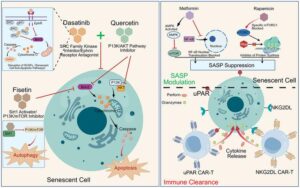
Mechanistic landscape of pro-longevity strategies. This figure illustrates the mechanistic action of key small-molecule drugs in clearing senescent cells, alongside immunotherapy strategies designed for the same purpose. Furthermore, it depicts the mechanisms by which anti-aging agents, such as SASP inhibitors, reduce the secretion of the senescence-associated secretory phenotype to achieve therapeutic anti-aging effects.
Credit  Creative Commons Attribution License (CC BY 4.0),

The paper stresses that senescent cells are not a single uniform group. Depending on their biological environment, some may help prevent fibrosis and support regeneration, while others promote inflammation, tissue degeneration, metabolic disorders and cancer development.

This growing understanding has led scientists to rethink anti-aging therapies. Instead of broadly eliminating all senescent cells, researchers are increasingly exploring “precision geroprotection” — a strategy aimed at selectively targeting harmful senescent cells while preserving beneficial ones important for tissue stability and recovery.

“Based on these insights, this review summarizes the induction mechanisms of cellular senescence and the subsequent evolution of their functional phenotypes across diverse tissues,” the authors wrote.

The review also outlines emerging anti-aging treatments. Early senolytic drugs such as Dasatinib, Quercetin and Fisetin were developed to destroy senescent cells by disrupting their survival pathways.

Newer approaches now include advanced immunotherapies such as CAR-T cell therapies targeting senescence-associated markers, along with “senomorphic” treatments that suppress harmful inflammatory signalling without killing the cells themselves.

The authors said technologies such as single-cell omics, lineage tracing and spatial profiling could help scientists better identify different senescent cell subtypes and develop safer, more precise therapies.

At the same time, the review warns that major clinical challenges remain. These include the lack of reliable biomarkers for senescent cells, difficulties in delivering targeted drugs, risks of unintended tissue damage and limited understanding of how senescent cells evolve over time in different organs.

The researchers cautioned that removing senescent cells indiscriminately could interfere with tissue repair, immune defence and structural stability in organs such as the brain, heart and lungs.

Overall, the review presents a more balanced understanding of cellular aging, arguing that future anti-aging medicine will likely depend on carefully tailored interventions rather than broad elimination of senescent cells.

Also Read:

Is your brain aging faster than you are? What holds the key

As a lifetime passes in front of our eyes, here’s the structure of how aging plays out