For decades, scientists have struggled to explain one of the biggest mysteries in human evolution: why nearly 90 per cent of people across cultures are right-handed, while no other primate species shows such a strong population-wide preference.
A new study led by researchers at the University of Oxford suggests the answer may be tied to two major evolutionary developments that helped shape modern humans — walking on two legs and the growth of larger brains.
The research, published in PLOS Biology, analysed data from 2,025 individuals across 41 species of monkeys and apes. The study was conducted by Thomas A. Püschel and Rachel M. Hurwitz from Oxford’s School of Anthropology and Museum Ethnography, along with Chris Venditti from the University of Reading.
Using Bayesian evolutionary modelling, the researchers tested several long-standing theories behind handedness, including the influence of tool use, diet, habitat, body size, social structure, brain development and movement patterns.
Humans initially appeared to be a clear outlier compared with other primates. However, when the researchers factored in brain size and the ratio between arm and leg length — an important anatomical indicator of upright walking — humans no longer stood apart from the broader evolutionary pattern.
The findings suggest that bipedalism and brain expansion together may have driven the development of strong right-handedness in humans.
The researchers also used the model to estimate handedness patterns among extinct human ancestors. Early hominins such as Ardipithecus and Australopithecus likely showed only mild right-hand preferences, similar to those seen in modern great apes.
The tendency appears to strengthen significantly with the emergence of the genus Homo, including species such as Homo erectus and Neanderthals, before reaching the strong right-handed dominance seen in modern Homo sapiens.
One notable exception was Homo floresiensis, often referred to as the “hobbit” species. Researchers predicted that this small-brained species had a much weaker right-hand preference, possibly because it retained a mix of climbing and upright walking adaptations rather than full bipedalism.
According to the study, the evolutionary shift likely occurred in two stages. Walking upright may have first freed the hands from locomotion, encouraging specialised manual activity. Later, as human brains expanded and reorganised, right-handedness became increasingly dominant.
“This is the first study to test several of the major hypotheses for human handedness within a single framework,” said Dr Püschel. “Our findings suggest handedness is closely linked to key traits that define humans, especially upright walking and larger brains.”
The researchers said several questions still remain unanswered, including why left-handedness continues to persist in human populations and whether similar limb preferences observed in animals like parrots and kangaroos reflect a broader evolutionary pattern across species.
Jaggery, commonly known as gur, is a traditional, unrefined, natural sweetener. It is produced by concentrating sugarcane juice without the use of chemicals. Often called “medicinal sugar”, it is nutritionally comparable to honey. Jaggery is widely consumed across Asia, Africa, Latin America, and the Caribbean under various local names. It is valued for its natural origin, traditional processing methods, and growing consumer preference for chemical-free sweeteners.
India accounts for over 70 percent of global jaggery production. This makes it the world’s largest jaggery producer. Nearly 20–30 percent of the country’s sugarcane production is used for jaggery production. It is one of the major agro-processing industries in rural India. The sector is marked by decentralized processing, low transport costs, small-scale entrepreneurship and cottage industries. It supports approximately 2.5 million livelihoods.
India’s jaggery sector is supported by substantial sugarcane production. In 2024-25, total sugarcane output was estimated at 444.9 million tonnes (MT). Uttar Pradesh contributed 48.5 percent of total production, followed by Maharashtra (24.1 percent) and Karnataka (10.5 percent). Other producing states include Gujarat, Tamil Nadu, Bihar, Uttarakhand, Punjab, Madhya Pradesh, and Haryana.[1]
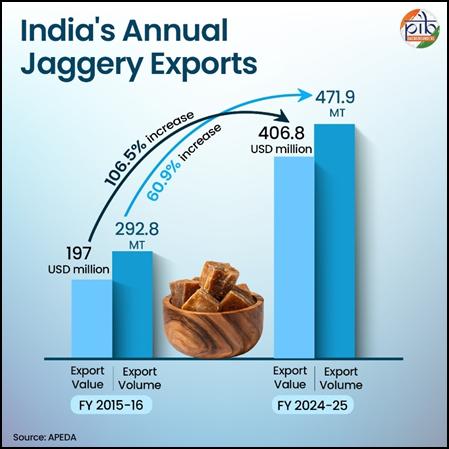
India is one of the leading exporters of jaggery and confectionery products (including traditional Indian sweets and candies). In 2015-16, exports stood at USD 197 million with a volume of 292.8 MT. By 2024-25, exports increased to USD 406.8 million with a volume of 471.9 MT. This is a rise of about 106.5% in value and 61.2% in volume over the period.[2] Major export destinations in 2024-25 included Indonesia, the USA, the UAE, Nigeria, and Nepal.[3]
If we compare year-on-year growth, exports during April-January (2025-26) reached 450.1 MT, valued at USD 384.4 million, registering an increase of about 16.5% in volume and 15.9% in value over the same period in 2024-25, when exports stood at 386.2 MT, valued at USD 331.4 million.
Domestic demand for natural sweeteners has also increased. In the sweetener segment, jaggery and honey have recorded a compound annual growth rate (CAGR) of 15–20 percent during 2021-24. Jaggery sales in domestic markets had reached approximately 5,000 metric tonnes annually by August 2024. This indicates growing consumer preference for traditional and natural sweetening products.
The Ancient Roots of India’s Jaggery Tradition
Jaggery is widely regarded as an indigenous Indian product. Its history is closely linked to the cultivation and processing of sugarcane, dating back to the Vedic period. Early references to sugarcane cultivation appear in Indian texts from around 1400–1000 BCE. Scholars have suggested that early thin varieties of sugarcane evolved in the moist regions of north-eastern India. Over time, sugarcane cultivation spread across tropical and subtropical regions, making it an important global crop. The word “sugar” is derived from the Sanskrit term sarkara, indicating deep cultural roots of sweetener production in the subcontinent. Historical accounts note that in 647 AD, a Chinese mission travelled to Magadha to learn sugarcane processing techniques. This demonstrates the early diffusion of Indian knowledge in the production of sweeteners. This long tradition of cultivation, processing, and knowledge transfer laid the foundation for India’s enduring prominence in jaggery production.
Jaggery for Nutrition and Public Health
Jaggery is increasingly recognized as a superfood, a natural, nutrient-rich alternative to refined sugar. Jaggery is produced from concentrated sugarcane juice without chemical refining. It therefore retains essential minerals and micronutrients that are typically lost during the sugar-refining process. In India, sugarcane is processed into jaggery, khandsari, and sugar through distinct production methods. Jaggery is the most naturally processed of the three, and nutritionally the richest. Jaggery is widely used in a range of traditional foods and in liquid form. Its demand is steadily increasing, driven by growing health consciousness and a consumer shift towards natural sweeteners.
Besides its traditional use, jaggery is increasingly recognized as a healthier sweetener in processed foods such as bakery and confectionery products. With the continued expansion of this sector, jaggery variants such as cane jaggery, palmyra jaggery, and raw jaggery are progressively gaining market presence. This shift reflects evolving consumer preferences for natural, minimally processed foods.
Nutritional Value of Jaggery
Jaggery retains most of the nutrients present in sugarcane juice, making it one of the most nutritionally rich natural sweeteners. It retains minerals like calcium, magnesium, potassium, phosphorus, sodium, iron, zinc, copper, and manganese that are lost in the intense refining for white sugar. A good-quality jaggery typically contains more than 70% sucrose, small amounts of glucose and fructose, and about 5% minerals, with low moisture content. Iron content (about 10-13 mg per 100 grams) contributes to improved haemoglobin levels, while potassium and magnesium support cardiovascular and muscle function.
Jaggery also contains trace amounts of vitamins, including folic acid and B-complex vitamins, as well as vitamins A, C, D, and E. These micronutrients make jaggery an energy-rich food that can help address deficiencies in these nutrients. Its mineral salt content is significantly higher than that of refined sugar. This makes it a suitable alternative for dietary supplementation, particularly in undernourished populations.
Integrating Jaggery into Nutrition Interventions
Jaggery has been included in Tamil Nadu’s nutrition interventions to address child malnutrition and support school participation. The state provides complementary weaning foods under its nutritious meal program and the Integrated Child Development Services (ICDS) framework. This is distributed as Take-Home Rations to eligible beneficiaries for 300 days each year. Jaggery constitutes approximately 27 percent of this complementary food mix, enhancing its energy value and micronutrient content. The supplementary food is popularly known as Sathumavu. It is procured from 25 women-run weaning food manufacturing cooperative societies and two private manufacturers in a 65:35 ratio.
These cooperatives collectively include about 1,450 members. A significant proportion of them are widows, deserted, or economically vulnerable women. Jaggery thus integrates nutrition support with livelihood generation. As per NITI Aayog, the program provides nutritious food to nearly 32.75 lakh beneficiaries across Tamil Nadu. While reducing malnutrition, the programme simultaneously promotes the use of nutrient-rich traditional ingredients such as jaggery.
Health Benefits of Jaggery
Jaggery provides sustained energy because its complex sucrose is digested slowly. It therefore releases energy gradually rather than causing rapid spikes in blood glucose. Iron gets absorbed during preparation in traditional iron vessels, making it beneficial to address anaemia. The presence of mineral salts and micronutrients supports overall health and strengthen immunity.
In traditional practices, like Ayurveda, jaggery has long been utilized as a therapeutic sweetener. Ayurvedic medicine considers it beneficial in treating throat and lung infections and supporting digestion. Its cleansing properties aid in detoxifying the respiratory tract and gastrointestinal system. This makes it especially beneficial for individuals exposed to dust and environmental pollutants. Its thermogenic (warming) effect is associated with relief from cough, congestion, and related respiratory discomfort.
Furthermore, jaggery is regarded as a natural detoxifying agent that supports blood purification. It is also believed to reduce fatigue, promote muscular and neural relaxation, and help maintain blood pressure. The presence of essential minerals such as calcium, phosphorus, and zinc supports bone health. Its reported anti-toxic and potential anti-carcinogenic properties contribute to overall physiological well-being.
From Cane to Livelihoods: Jaggery’s Role in Rural Development
Jaggery production in India forms part of the unorganized agro-processing sector. It plays a significant role in supporting rural livelihoods and local economies. As a leading producer and exporter, the sector sustains farmers while catering to both domestic consumption and growing export demand.
As consumer preferences evolve and global demand rises, it has become necessary to diversify along the sugarcane value chain. This is needed to enhance farm incomes and ensure environmentally and economically sustainable production systems. Value addition through Jaggery production offers substantially higher returns than selling raw sugarcane to mills. Empirical evidence indicates that integrating jaggery production with practices like crop diversification and intercropping can significantly improve net returns per unit area.
Jaggery processing contribute to rural development by fostering entrepreneurship, generating local employment, and strengthening regional economies. Jaggery processing generates year-round employment opportunities and supports migrant labour engagement. The production of high-quality jaggery enables access to premium markets, augmenting farmer incomes. Strengthening jaggery-based cottage industry thus represents a viable pathway for promoting value addition, livelihood enhancement, and inclusive agricultural growth.
Organic Jaggery Powder as a Profitable Value-Addition Enterprise
Anthonisamy, a farmer from Tirunelveli district, Tamil Nadu, has successfully demonstrated the viability of jaggery production as a value-added enterprise. He produces organic jaggery powder. His product is known for its purity and superior taste. It has gained strong demand across local markets, neighbouring states, and even export channels. By adopting organic cultivation practices and processing a local sugarcane variety, he has transformed a traditional activity into a profitable enterprise.
The value-added approach has significantly improved profitability. According to the farmer, organic jaggery powder is sold at about ₹75 per kg, compared to ₹50 per kg for conventional jaggery. Production costs, for both, are about ₹30 per kg.
Though production is seasonal, market demand for jaggery remains consistent throughout the year, ensuring steady income opportunities. Building on this success, diversified products like jaggery flavored chocolate and coconut, are further expanding market reach. Backed by central government support, the enterprise highlights how small-scale processing can enhance incomes, promote rural entrepreneurship, and strengthen agro-based livelihoods.
Unlocking the Sweet Value Chain: India’s Policy Push for Jaggery Ecosystem
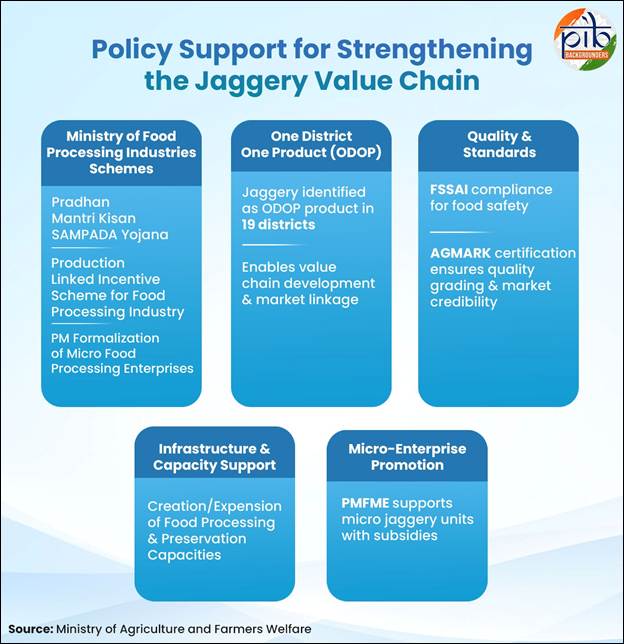
The Ministry of Food Processing Industries (MoFPI) promotes infrastructure development and enterprise growth for the food processing sector through several central sector schemes. These include
Pradhan Mantri Kisan SAMPADA Yojana (PMKSY),
Production Linked Incentive Scheme for Food Processing Industry (PLISFPI), and
Pradhan Mantri Formalization of Micro Food Processing Enterprises (PMFME) Scheme.
These demand-driven initiatives are implemented nationwide. They facilitate the establishment and expansion of processing units by adopting modern technologies. Beneficiary units are required to comply with Food Safety and Standards Authority of India (FSSAI) regulations. They are also encouraged to align with international food safety standards to improve export competitiveness.
PMKSY has a component called Creation/Expansion of Food Processing & Preservation Capacities (CEFPPC). Five jaggery processing units have been approved under this as of December 31, 2025.Total grants-in-aid for this was ₹17.07 crore. The PMFME Scheme has supported3,528 jaggery based micro food processing units with subsidiestotalling₹102.31 crore. The scheme also provides branding and marketing assistance of up to 50 percent to collectives. These may include Farmer-Producer Organizations (FPOs), Self-Help Groups (SHGs), cooperatives, or special-purpose vehicles of micro-enterprises.
The One District One Product (ODOP)promotes local agro-based industries by enabling economies of scale in input procurement, shared services, and market access. Jaggery and allied products have been identified as ODOP items in 19 districts. This has facilitated value chain development and strengthened support infrastructure.
Quality assurance and standardization are supported through the Directorate of Marketing & Inspection (DMI). Agricultural commodities that meet prescribed standards are certified under the AGMARK system. These standards define quality grades and enable consumers to access reliable products. They also ensure graded raw materials for producers’ remunerative prices for farmers. Jaggery is a notified commodity covered under AGMARK certification, reinforcing quality assurance, market credibility, and export readiness.
Geographical Indication (GI) Tagged Jaggery Varieties in India
A Geographical Indication (GI) is a name or sign given to certain products that relate to a specific geographical location or origins. This could be a region, town, or country. In the jaggery sector, GI recognition strengthens regional branding. It promotes traditional processing practices, and improves market access for rural producers. India has several GI-tagged jaggery varieties, each known for distinct regional qualities and traditional processing methods. Kolhapur jaggery (Maharashtra) is valued for its golden colour and high sucrose content. Muzaffarnagar gur (Uttar Pradesh) is export-oriented and made from high-quality cane. In Keralam, Marayoor and Central Travancore jaggery are recognized for their purity, medicinal value, traditional processing and regional distinctiveness.
Towards a Resilient and Value-Driven Jaggery Sector
Jaggery production and processing form an important pillar of India’s agro-processing economy. It links agriculture, nutrition, rural livelihoods, and export potential. As the world’s largest producer, India benefits from a strong sugarcane base. Traditional processing knowledge and rising domestic and global demand for natural sweeteners further strengthen the case. The sector supports millions of livelihoods through decentralized cottage industries, offering opportunities for value addition, rural entrepreneurship, and enhanced farmer incomes.
In addition to its economic role, jaggery’s mineral content and therapeutic properties make it a healthier alternative to refined sugar. It is a useful dietary supplement for addressing micronutrient deficiencies. Government initiatives promoting food processing infrastructure, micro-enterprises, quality certification, GI tagging, and value chain development are strengthening market access and product credibility. With continued policy support, improved processing practices, and diversification into value-added products, the jaggery sector holds strong potential to drive inclusive and sustainable rural growth.
It’s a choice you may face multiple times a day—and, at this point, your reaction is probably reflexive. Are you going to accept those internet cookies, reject them, or spend a little time customizing your settings?
Increasingly, internet users are pushing back against cookies—the digital crumbs used by websites and advertisers to spot returning customers—by choosing privacy-enhancing browsers or clicking that reject button. But ditching the cookies may have big implications for the free web. If digital companies, content creators, and advertisers aren’t making money from our surfing, the quality and usefulness of the products they offer might suffer too.
In a new study, Boston University researchers highlight the potential impact the loss of cookies has on advertisers and how alternative systems designed to balance privacy and revenue fail to recoup the costs.
They analyzed 200 million ad impressions—or views—worldwide and found that removing cookies cut website publishers’ revenue by more than a third. They also discovered that privacy-enhanced alternatives, notably a major Google project called Privacy Sandbox, only clawed back a small portion of that lost revenue. The findings were published in PNAS, the National Academy of Sciences’ flagship journal.
“Internet cookies—especially third-party cookies—have been central to how online advertising works,” says Garrett Johnson, a BU Questrom School of Business associate professor of marketing. Third-party cookies are those placed by an organization, like an advertiser, not connected to the site you’re on. “In our study, removing third-party cookies reduced publisher ad revenue by about 35 percent—and about 66 percent in the European Union—showing that cookies still play a major economic role in supporting the open web.” The European Union has tougher online privacy rules than much of the rest of the world.
According to Zhengrong Gu, a Questrom PhD candidate, because cookies help advertisers spot users around the web, they can better target and measure their ads. That makes advertisers’ spending more efficient, putting more ad money in the pockets of content creators and publishers. “If more users decline cookies, it would likely reduce the effectiveness of digital advertising and the revenue that supports much of the open web,” says Gu (Questrom’26).
The downside of cookies: no one really likes being followed. “Website cookies are online surveillance tools,” wrote Wayne State University researcher Elizabeth Stoycheff in a Conversation article, “and the commercial and government entities that use them would prefer people not read those notifications too closely.”
There have been a couple of different responses to the decline in cookie use. One is the implementation of paywalls and subscriptions to keep the cash flowing; another is requiring customers to use log-ins that work across multiple sites. Tech companies are also experimenting with privacy-enhancing technologies (PETs) that try to balance advertising needs with user privacy concerns. One of the best known PETs is Privacy Sandbox, Google’s now-defunct six-year experiment in cookie alternatives, which included innovations such as a browser tool that shared a customer’s interests rather than their detailed online history.
“In our study, Privacy Sandbox recovered only about 4 percent of the revenue lost when cookies were removed,” says Shunto J. Kobayashi, a Questrom assistant professor of marketing. That weak impact was in part due to the limited adoption of the new tools and because they changed the user experience, he says, introducing “technical frictions, especially slower ad loading times.”
In their paper, the researchers write that their findings, alongside those from other studies, “informed Google’s decision to abandon its plan to replace cookies with Privacy Sandbox. The episode underscores the difficulty of aligning privacy, performance, and competition goals in digital markets.”
To examine privacy technologies in a real-world setting, the BU team used data from ad management firm Raptive, and leveraged an experiment conducted by Google and overseen by the United Kingdom’s Competition and Markets Authority. During the study, Chrome users were randomly assigned to one of three groups: cookies-enabled, cookies-disabled, or cookies replaced by Privacy Sandbox. The study included around 60 million desktop and mobile Chrome users.
“The experiment created a rare opportunity for independent, large-scale evaluation open to external participants,” says Johnson, an expert on digital marketing who has studied privacy regulations, online ad effectiveness, and the economics of digital advertising.
He adds that many European regulators are considering even tighter online privacy rules, which could have a negative impact: “Our results provide unusually strong evidence—from a global, industry-wide field experiment—that restricting cookies carries significant economic downsides that regulators should consider.”
As for users faced with that daily accept or reject decision, Johnson recognizes that everyone will make the call that works for them—but he leans toward clicking “accept.”
“From my perspective, accepting cookies creates substantial benefits for the advertising ecosystem and the publishers I care about,” he says, “with what I perceive to be little personal risk.”
Northwestern University engineers have developed a small, wireless polygraph system you can wear.
Unlike polygraphs used in television crime dramas, this wearable version isn’t optimized to detect lies. Instead, engineers and physicians designed it to sense underlying stress hidden deep within the body — no interrogation room required.
The lightweight, bandage-like device gently adheres to the chest, where it simultaneously measures heart activity, breathing patterns, sweat response, blood flow and temperature. Together, these signals capture a real-time, whole-body view of stress.
By continuously tracking multiple physiological signals at once, the device could help clinicians detect stress and potential discomfort in patients — including infants or the elderly — who may be unable to communicate, diagnose sleep disorders without cumbersome in-laboratory equipment, monitor mental health over time and even sense early warning signs of medical complications.
“Sometimes, the body manifests signs of stress before a person is consciously aware of it,” said Northwestern’s John A. Rogers, who led the device development. “Even if people don’t realize how much pressure they are under, stress is quietly affecting their health. Prolonged stress can have adverse consequences, especially for pregnant mothers, children and critically ill patients. An ability to track stress based on quantitative measurements could empower people to take stress-relieving actions with direct benefits to their health. Importantly, we aimed to design a device, conceptually like a polygraph system, that operates on the basis of biophysical body responses, without requiring access to chemical biomarkers found in body fluids.”
A world-renowned bioelectronics pioneer, Rogers is the Louis Simpson and Kimberly Querrey Professor of Materials Science and Engineering, Biomedical Engineering and Neurological Surgery at Northwestern, where he has appointments in the McCormick School of Engineering and Northwestern University Feinberg School of Medicine. He also directs the Querrey Simpson Institute for Bioelectronics and the Querrey Simpson Institute for Translational Engineering and Advanced Medical Systems. Rogers is co-corresponding author of the study along with Dr. Debra E. Weese-Mayer, the Beatrice Cummings Mayer Professor of Pediatric Autonomic Medicine and professor of pediatrics (neurology) at Feinberg and Jae-Young Yoo of Sungkyunkwan University in Korea.
A voice for the vulnerable
The project started as a request from pediatricians at Ann & Robert H. Lurie Children’s Hospital of Chicago. Over the years, Rogers’ team has developed a suite of wireless, wearable electronics for infants and children — to track vital signs, monitor illness
, treat congenital conditions and diagnose disease. Now, pediatricians asked Rogers to create a soft, non-invasive device to detect and continuously track stress levels in babies throughout hospital stays, without measuring stress’ biochemical signatures in saliva and blood.
Currently, detecting babies’ stress often depends on what caregivers can see and hear — crying, facial expressions and movement — along with basic vital signs. But these signals can be subtle, inconsistent or even entirely absent.
“Stress is often scored using survey sheets and nursing assessments,” Rogers said. “The entries include things like tonality and volume of crying. Infants obviously cannot describe their own pain levels. So, unlike with adults, determining stress in babies can be incredibly challenging. We wanted to take subjectivity out of these assessments.”
“This new device tracks the body’s stress signals around the clock, helping quantify how long someone is stressed each day and how intense that stress is,” said Weese-Mayer, Rogers’ long-time collaborator. “The beauty of the device is that both individuals and healthcare providers can now identify stress and objectively monitor the effectiveness of interventions to decrease stress and restore a healthy balance, in a completely non-invasive manner.”
All-in-one stress sensing
To do that, Rogers and his team found inspiration in a surprising place: polygraphs. Although they are colloquially called “lie detectors,” polygraphs actually don’t detect lies. They measure the body’s response to stress, which can be triggered by many factors besides deception. Rogers saw an opportunity to build on that core idea. But, while traditional polygraph machines rely on a patchwork of bulky, wired sensors, Rogers aimed to capture those same physiological signals — and then some — in a more comprehensive, fully integrated, accurate and wearable form.
The resulting technology combines several tiny sensors into a single, soft device. Together, these sensors continuously track multiple physiological signals, all of which respond when the body senses stress. A built-in motion sensor and miniature microphone capture subtle mechanical and acoustic signals from the heart and lungs. Other sensors detect skin temperature and heat flow associated with near-surface blood circulation. And another sensor measures changes in the skin’s electrical conductivity caused by sweat gland activity — a well-known marker of stress.
“Measuring stress is a complex task because it’s multi-dimensional,” Rogers said. “It’s not possible to reliably determine stress by measuring just one or two, or even three or four, parameters. A broad collection of factors is necessary. So, we crammed as many sensors of physiological processes into this device platform as we could, while maintaining a compact size and lightweight construction and avoiding the need to access biofluids.”
The system wirelessly transmits these synchronized data streams to a smartphone, smart watch or tablet, where machine learning algorithms analyze patterns associated with stress in real time. Weighing less than 8 grams (equivalent to eight paperclips) and designed to move naturally with the skin, the device can operate continuously for more than 24 hours.
Proven across realistic scenarios
After developing the system, Rogers’ team validated it across a wide range of scenarios, including controlled experiments and real-world environments. During simulated lie-detector tests, the wearable device accurately captured stress responses triggered by sensitive questions and closely matched measurements from commercial polygraph systems.
In cognitive tests, such as understanding speech in noisy environments, the device detected clear increases in stress-related signals as tasks increased in difficulty. The results aligned with simultaneous, independent measurements of pupil dilation, a common method to determine stress.
In another experiment, study participants placed their hands in ice-cold water, and the system recorded coordinated changes across cardiac activity, breathing patterns, sweat responses and temperature signals. In pediatric sleep studies, the wearable device identified key clinical events, including breathing irregularities and nighttime awakenings, with accuracy comparable to hospital-grade sleep tests but with far fewer disruptions.
And, finally, during emergency room training sessions with medical students, the device revealed a striking pattern. Participants with stronger stress responses tended to perform worse, suggesting stress may impair decision-making in high-pressure situations.
“Ultimately, the device could send an alert to a user or caregiver when stress levels hit a certain limit,” Rogers said. “Many people might not fully appreciate the level of stress they are under and might not realize it’s affecting their performance.”
What’s next
Next, the team aims to move its technology beyond validation studies and into broader clinical use. Next steps will include testing the device in larger patient groups, refining its ability to personalize stress detection and integrating it into hospital and at-home monitoring systems to provide continuous, real-time insight into patient health.
Rogers also is exploring opportunities for incorporating even more sensors into the device, including the ability to measure brain activity. Adding electroencephalogram (EEG) capabilities would allow the device to move beyond measuring the body’s stress response to capturing how the brain perceives that stress. That could bring scientists closer to distinguishing stress from pain — even in the home setting — and understanding how it is experienced in the context of the simultaneously recorded stress biomarkers.
“We are living in stressful times, without sufficient measures to proactively detect stress,” Weese-Mayer said. “By identifying stress — whether environmental or disease-induced — earlier, we can introduce intervention before stress’ effects become irreversible.”
The study, “Wireless, skin-interfaced multimodal sensing system for continuous psychophysiological monitoring — a wearable polygraph device,” was supported by the Querrey Simpson Institute for Bioelectronics.
A new type of long-necked plant-eating dinosaur – the largest ever found in Southeast Asia – has been revealed in a study led by researchers at University College London (UCL), Mahasarakham University, Suranaree University of Technology and Sirindhorn Museum in Thailand.
The dinosaur, described in a new paper in the journal Scientific Reports, was identified from bones found at the edge of a pond in north-eastern Thailand 10 years ago.
Analysing spine, rib, pelvis and leg bones, including a front leg bone 1.78 metres long (as long as a human), the research team estimated that the dinosaur would have weighed 27 tonnes – about the same as nine adult Asian elephants – and measured 27 metres in length.
It has been named Nagatitan chaiyaphumensis, with“Naga” referring to a mythological aquatic serpent in Thai and Southeast Asian folklore, “Titan” referring to the giants of Greek mythology and chaiyaphumensis meaning “from Chaiyaphum”, the Thai province where the fossils were discovered. It is the 14th dinosaur to be named in Thailand.
It belonged to the sauropod family of dinosaurs – long-necked, long-tailed plant-eaters that included the Diplodocus and Brontosaurus – and lived in theEarly Cretaceous period between 100 and 120 million years ago.
Lead author Thitiwoot (Perth) Sethapanichsakul, a Thai PhD student at UCL Earth Sciences, said: “Our dinosaur is big by most people’s standards – it likely weighed at least 10 tonnes more than Dippy the Diplodocus (Diplodocus carnegii). However, it is still dwarfed by sauropods like Patagotitan (60 tonnes) or Ruyangosaurus (50 tonnes).
“We refer to Nagatitan as ‘the last titan’ of Thailand. That is because it was discovered in Thailand’s youngest dinosaur-bearing rock formation. Younger rocks laid down towards the end of the time of the dinosaurs are unlikely to contain dinosaur remains because the region by then had become a shallow sea. So this may be the last or most recent large sauropod we will find in Southeast Asia.”
During the Early Cretaceous the environment would have been arid to semi-arid – a preferred habitat for sauropods who appeared to thrive in these environments, relying on the surface area of their long necks and tails to shed heat and regulate their body temperature.
The area where the specimens were found also appeared to be part of a meandering river system, which would have been home to fish, freshwater sharks and crocodiles.
Nagatitan would have lived alongside smaller plant-eating dinosaurs such as iguanodontians and early branching ceratopsians (cousins of the Triceratops), as well as big meat-eaters including carcharodontosaurians and spinosaurids, and flying reptiles called pterosaurs eating fish from the river.
Nagatitan was a somphospondylan sauropod – a subgroup of sauropod that became widespread about 120 million years ago. The authors found that it specifically belonged to a narrower group within the somphospondylans called Euhelopodidae, which represents a group of somphospondylan sauropods only found in Asia.
Nagatitan is distinct from other species due to a combination of unique features on its spine, pelvis and legs. A life-size reconstruction of the dinosaur is on display at the Thainosaur Museum at Asiatique in Bangkok.
Sethapanichsakul said: “My dream is to continue pushing to get Southeast Asian dinosaurs recognised internationally. More international collaborations between Thailand and other institutions like UCL can further our understanding of the region’s palaeobiology and apply it to a global context. This all starts with identifying and describing the specimens we have found first. We have a large collection of sauropod fossils that have not yet been formally described – these may include a number of new species.
“I’ve always been a dinosaur kid. This study doesn’t just establish a new species but also fulfils a childhood promise of naming a dinosaur.”
Co-author Professor Paul Upchurch, based at UCL Earth Sciences, said: “This discovery comes out of a new collaboration between UCL and colleagues in Thailand. The material was studied both in Thailand and at UCL – 3D scanning and printing has meant that we can study the specimen and collect data without having to travel (good for reducing carbon footprint).
“We have had a long-standing interest in the evolution of these gigantic plant eaters and have good collaborative links with researchers around the world. It is great to work with Thai colleagues and start to get insights into what was happening in Southeast Asia during the Jurassic and Cretaceous.”
A team of five academics work on different aspects of dinosaur evolution at UCL, with strong collaborative links to the Natural History Museum. The extended research group comprises four research fellows and postdoc researchers, and more than 10 PhD students. At least four of the PhD students are working on dinosaur evolution, with the others looking at a wider array of other evolutionary questions relating to vertebrates, including crocodiles and birds.
Project leader and National Geographic Explorer Dr Sita Manitkoon, researcher at the Palaeontological Research and Education Centre, Mahasarakham University said: “Although Thailand is a small country within Asia, we have a very high diversity in dinosaur fossils, possibly the third most abundant in Asia in terms of dinosaur remains. We’ve only really been studying dinosaurs in Thailand about 40 years (since the first dinosaur was named in 1986), and already we have a surge of younger generation palaeontologists, who are actively undertaking research and promoting palaeontology and its importance within the country.”
In a special ceremony hosted in Oslo, His Majesty King Herald V of Norway conferred upon Prime Minister Shri Narendra Modi the ‘Grand Cross of the Royal Norwegian Order of Merit’. The award is Norway’s highest honour bestowed on foreign Heads of Government, and is conferred in recognition of the outstanding service in the interest of Norway and humankind.
Prime Minister @narendramodi awarded Grand Cross of the Royal Norwegian Order of Merit by His Majesty King Harald V of #Norway
Speaking on the occasion, Prime Minister Modi expressed his deep gratitude to His Majesty King Herald V and to the people of Norway for this honour. He dedicated the award to the historic friendship between India and Norway, calling it a tribute to the enduring warmth, trust, and affection shared between the people of India and the people of Norway.
The conferment stands as a symbol of the deep bonds of goodwill that exists between India and Norway, and will guide their journey of friendship and collaboration into the future.
Researchers have developed an ultrathin flexible film embedded with nanoscale gold particles that can efficiently convert tiny temperature changes into electrical signals — a breakthrough that could enable self-powered sensors, wearable electronics, smart photodetectors, low-grade heat harvesters, and next-generation energy-efficient devices for healthcare and environmental monitoring.
As demand rises for lightweight, flexible, and low-power materials capable of harvesting ambient thermal energy, scientists are increasingly exploring hybrid systems that combine plasmonic materials with pyroelectric polymers. While earlier plasmonic-pyroelectric and PVDF-based composite systems improved thermal-to-electrical conversion, many depended on micron-thick structures or poorly controlled interfaces, limiting their use in compact, wearable technologies.
Addressing these challenges, researchers from the Institute of Nano Science and Technology (INST), an autonomous institute under the Department of Science and Technology, demonstrated that incorporating a tiny amount of nanogold into polyvinylidene fluoride (PVDF) — a widely used ferroelectric polymer — significantly enhances its pyroelectric performance, or its ability to generate electricity from temperature fluctuations.
The research team, led by Dipankar Mandal along with collaborators including Sudip Naskar, engineered ultrathin PVDF films less than 100 nanometres thick containing hexagonal nanogold particles. Their approach focused on understanding how nanoscale gold-polymer interactions, dipole alignment, and confined plasmonic excitations influence pyroelectric behaviour in ultrathin films.
The researchers found that embedding hexagonal nanogold particles created a nearly pure polar phase in the PVDF matrix with highly ordered dipoles — a key requirement for efficient pyroelectric energy conversion. The study further revealed that a metastable hexagonal close-packed gold nanoparticle phase could be integrated into a robust two-dimensional hybrid thin film, where plasmon-dipole-electron coupling worked cooperatively to improve pyroelectricity, dipole ordering, and broadband optical absorption.
Published in Advanced Functional Materials, the study demonstrated efficient pyroelectric energy conversion within a narrow ambient temperature range of 294–301 K. The findings represent an important advance toward self-powered thermal sensing and wearable energy-harvesting technologies designed to operate under everyday environmental conditions.
Tehran has formally responded to a United States proposal aimed at ending the ongoing conflict and reopening negotiations over Iran’s nuclear program, according to Iranian state media and multiple international reports.
The Iranian response was reportedly delivered through Pakistan, which has emerged as a key intermediary in backchannel diplomacy between Washington and Tehran. Iranian officials said the current phase of negotiations should focus primarily on ending hostilities and easing tensions in the region.
US President Donald Trump, however, rejected Tehran’s latest position, calling it “totally unacceptable” amid continuing friction over the future of Iran’s uranium enrichment program and the status of the Strait of Hormuz.
According to reports, the US proposal includes a temporary 14-point memorandum designed to halt fighting, reopen shipping routes through the Strait of Hormuz and launch broader negotiations on Iran’s nuclear activities. Washington is seeking a long-term freeze on uranium enrichment, removal of highly enriched uranium stockpiles and dismantling of key nuclear facilities.
Iran has reportedly opposed dismantling its nuclear infrastructure and instead proposed a narrower agreement focused on ending military action, lifting sanctions and restoring commercial navigation in the Gulf.
The Strait of Hormuz remains at the centre of the crisis. The strategically vital waterway, through which a major share of the world’s oil shipments passes, has faced severe disruptions for more than two months amid the conflict. Oil prices rose sharply on Sunday after Trump rejected Iran’s response and tensions in the Gulf intensified further.
US Secretary of State Marco Rubio said Washington had largely achieved its military objectives in operations against Iran, but acknowledged that Tehran still retains significant quantities of enriched uranium.
Meanwhile, regional tensions remain high, with reports of drone incidents near Gulf states and continued military deployments linked to efforts to secure maritime routes through Hormuz.
Ukrainian President Volodymyr Zelensky said Ukraine has submitted a list of 1,000 detainees to Russia as part of preparations for a major prisoner exchange between the two sides amid the ongoing conflict.
According to Ukraine’s presidential press service, Zelensky said the proposed “1,000 for 1,000” prisoner exchange was being actively prepared and was expected to take place soon.
“The prisoner exchange, 1,000 for 1,000, is being prepared and must take place. The Americans assumed responsibility for these guarantees,” Zelensky said in his evening address on Sunday. He also reiterated the need to end the conflict with Russia and ensure long-term security guarantees for Ukraine.
Referring to Russian President Vladimir Putin, Zelensky said Moscow was now indicating readiness for direct talks. “Now Putin himself says that he is finally ready for real meetings. We pushed him a little toward this, and we have long been ready for such meetings ourselves, now a format must be found,” he said.
3-Day Ceasefire in Effect
Russia and Ukraine had on Friday agreed to a three-day ceasefire coinciding with Victory Day commemorations, along with the planned exchange of 1,000 prisoners from each side.
However, both countries on Sunday accused each other of repeatedly violating the temporary truce.
Russia’s Defence Ministry claimed Ukrainian forces committed 16,071 ceasefire violations over the previous 24 hours. Moscow said its troops responded with retaliatory strikes targeting artillery systems, command centres and drone launch sites. A day earlier, the ministry had reported 8,970 alleged ceasefire breaches across several regions.
Meanwhile, Ukrainian authorities said at least one person was killed and 15 others injured in Russian attacks across Ukraine despite the ceasefire arrangement. The General Staff of the Ukrainian Armed Forces said Russian troops carried out around 60 attacks on Ukrainian positions on Sunday.
The temporary ceasefire was scheduled to remain in effect from Saturday through Monday during Russia’s Victory Day celebrations.
The atmosphere of Bengaluru,the environment here, is something quite unique;This city is known worldwide for software and services, but this city has also taken India’s cultural identity, Spirituality, and spiritual consciousness to new heights: PM
Seva Paramo Dharma (Service is the supreme duty), is the natural character of our society: PM
Our Swachh Bharat Abhiyan, is not just a government programme, but it has become a natural part of people’s lives; Now, it is advancing driven by the strength of the society: PM
The realization of Viksit Bharat will only be possible through such youth, who are mentally calm, who are socially responsible, and who are sensitive towards society: PM
Prime Minister Shri Narendra Modi, today participated in the 45th Anniversary Celebrations of The Art of Living in Bengaluru, Karnataka. Reflecting on the auspiciousness of the occasion, the Prime Minister described the uniqueness of the morning enriched by the welcome through Vedic mantras by children, the darshan of Lord Ganesha, Shri Shri Ravi Shankar Ji’s 70th year, and Art of Living’s 45th anniversary celebrations. “These are moments that will always remain in my memories,” remarked Shri Modi.
Marking the inauguration of the divine and grand Meditation Temple, the Prime Minister affirmed the importance of such dedicated institutions and extended best wishes to the Art of Living family for their newest sanctuary. “When resolve is clear and work is done with the spirit of service, then every effort yields pleasant results,” Shri Modi asserted.
Appreciating the distinct ambience of Bengaluru, the Prime Minister highlighted how the city is globally recognized not only for software and services but also for elevating India’s cultural identity and spiritual consciousness. “Spirituality and spiritual consciousness too have been given new heights by this city,” observed Shri Modi.
Tracing the deep roots of yoga, meditation, and pranayama as integral parts of India’s values, the Prime Minister noted the global influence of India’s spiritual heritage and its role in inspiring numerous institutions. “Today people across the world are influenced by India’s spiritual values, and from these ancient values many institutions of India too have been drawing inspiration,” affirmed Shri Modi.
Drawing inspiration from these ancient spiritual values, the Prime Minister recalled how Shri Shri Ravi Shankar Ji sowed the seed of Art of Living 45 years ago, which has now grown into a huge banyan tree. “Today it stands before us as a huge banyan tree whose thousands of branches are touching the lives of countless people across the world,” remarked Shri Modi.
Highlighting India’s rich tapestry of diversity encompassing languages, traditions, customs, and worship practices, the Prime Minister posed the fundamental question about what binds these beautiful diversities together. “The answer is living not for oneself but for others,” asserted Shri Modi.
Quoting the ancient wisdom from the Puranas, the Prime Minister emphasized that serving others is virtue while causing pain is sin, underscoring that service is the natural character of Indian society. “Seva Paramo Dharma is the natural character of our society,” affirmed Shri Modi.
Noting that India’s many spiritual movements have ultimately expressed themselves through service to humanity, the Prime Minister expressed happiness at witnessing the same spirit reflected in every effort of Art of Living. Extending heartfelt wishes to every volunteer associated with Art of Living’s journey, the Prime Minister commended their dedication and service orientation.
Stressing that societal engagement is essential for any mission’s success, the Prime Minister emphasized that awakening social strength is fundamental to achieving important goals. He underscored his longstanding conviction that society possesses greater power than political systems and governments, and that no administration can truly succeed unless communities actively participate in nation-building. He cited the Swachh Bharat Mission as exemplary, noting that what began as a government initiative has become woven into the natural fabric of people’s lives, now advancing through society’s own momentum.Emphasizing that any campaign becomes successful when the power of society joins it, Shri Modi stressed, “Awakening the power of society for every such important mission is very necessary.”
सेवा परमो धर्मः …ये हमारे समाज का स्वाभाविक चरित्र है: PM @narendramodi
Observing that active societal engagement enables collective solutions to the nation’s greatest challenges, the Prime Minister commended Art of Living for consistently channeling society’s strength in its initiatives. He praised the organisation’s social approach across development programs, whether through tree-planting campaigns, rural smart village centers, women’s and tribal empowerment initiatives, or mental health programs for incarcerated individuals. “These efforts contribute significantly to the country’s and society’s development journey,” Shri Modi noted.
Commending every individual present for prioritising youth empowerment, the Prime Minister emphasized the urgency of this focus given today’s rapid global transformations driven by scientific advancement and innovation. He observed that India is not merely participating in these changes but leading in numerous sectors, with particular achievements in digital payments, infrastructure expansion, and startup ecosystems. He highlighted that India’s youth are pioneering space technology and contributing to all such national successes. “India is not just participating in this change, it is also leading in many areas,” asserted Shri Modi .Crediting India’s youth for these achievements, the Prime Minister acknowledged Art of Living’s role in helping youth find solutions to modern-era challenges.
Acknowledging technology’s power to instantly connect distant individuals, the Prime Minister stressed the parallel necessity of strengthening people’s ability to connect with themselves. He asserted that India’s developed future depends on cultivating youth who are mentally peaceful, socially responsible, and sensitive to societal needs. He emphasized the critical role of institutions working on spiritual wellbeing, mental health, yoga, and meditation in fostering connection, belongingness, and collective responsibility, while simultaneously providing opportunities for cultural understanding. “A Viksit Bharat will be built through such youth,mentally peaceful, socially responsible, and sensitive toward society,” Shri Modi asserted.
Expressing confidence that the newly inaugurated meditation temple will serve as a sanctuary of peace and healing for thousands, the Prime Minister acknowledged that while society is already fulfilling its duties toward the nation admirably, he wished to place before them several important appeals for holistic national development.
Highlighting the crucial role organisations like Art of Living must play in advancing India’s comprehensive development, the Prime Minister urged particular attention to connecting farmers with natural farming practices. He framed sustainable agriculture as an expression of the Art of Living itself, emphasizing that preserving Mother Earth from chemicals constitutes both spiritual practice and environmental stewardship. “Adopting natural farming and saving Mother Earth from chemicals,this too is Art of Living,” Shri Modi affirmed.
Encouraging broader expansion of the “Ek Ped Maa Ke Naam” campaign, the Prime Minister linked environmental protection directly to the philosophy of living well. “Protecting the environment is also Art of Living,” he asserted, calling for renewed commitment to this mission.
Advocating for improved water management practices among farming communities through the “Per Drop, More Crop” initiative, the Prime Minister emphasized that societal cooperation would enhance outcomes. He stressed the urgency of this work given the approaching monsoon season, making it the ideal moment for widespread water conservation awareness. “Saving every drop of water is also Art of Living,” Shri Modi affirmed.
Expanding this vision of responsible living to encompass electricity conservation, elimination of single-use plastics, and promotion of locally-produced goods, the Prime Minister connected all these practices to the Art of Living philosophy. He highlighted the government’s Mission LiFE initiative, which promotes living with greater responsibility and awareness while maintaining harmony with nature. “This lifestyle that balances with nature is also Art of Living,” asserted Shri Modi.
The Prime Minister concluded by expressing confidence that the organisation will increasingly prioritise such critical issues in the coming days.
The Prime Minister, Shri Narendra Modi today inaugurated Sindhu Hospital in Hyderabad.
The Prime Minister said that the hospital is a laudable effort to improve healthcare infrastructure in the city and surrounding areas. He also appreciated the emphasis on integrating latest technology and innovation by the hospital team.
The Prime Minister posted on X;
“Inaugurated the Sindhu Hospital in Hyderabad. It’s a laudable effort to improve healthcare infrastructure in the city and surrounding areas. The emphasis on integrating latest technology and innovation by the hospital team is appreciable.”
Inaugurated the Sindhu Hospital in Hyderabad. It’s a laudable effort to improve healthcare infrastructure in the city and surrounding areas. The emphasis on integrating latest technology and innovation by the hospital team is appreciable. pic.twitter.com/C48mHBbgTg
హైదరాబాద్లో సింధు హాస్పిటల్ను ప్రారంభించాను. నగరంలోనూ,పరిసర ప్రాంతాల్లోనూ ఆరోగ్య సేవారంగంలో మౌలిక సదుపాయాలను మెరుగుపరచడానికి ఇది ఒక ప్రశంసించదగ్గ ప్రయత్నం. అత్యాధునిక సాంకేతికతనూ,నవీన ఆవిష్కరణలనూ సమన్వయం చేసేందుకు ఆసుపత్రి బృందం ప్రత్యేక శ్రద్ధ వహించడం చాలా అభినందనీయం. pic.twitter.com/sByFppxgZZ
Russian President Vladimir Putin has said the war in Ukraine may be “coming to an end,” days after U.S. President Donald Trump announced a temporary three-day ceasefire and urged both Moscow and Kyiv to move toward a broader peace agreement.
Speaking after Russia’s Victory Day events in Moscow, Putin said he believed “the matter is coming to an end,” while indicating that direct negotiations with Ukrainian President Volodymyr Zelenskyy could be possible if both sides agree on a long-term settlement framework.
Putin’s remarks came after Trump earlier announced what he described as a “three-day ceasefire” between May 9 and May 11, brokered through U.S.-led diplomatic efforts. Trump said he hoped the temporary truce would become “the beginning of something much bigger” and lead to a permanent cessation of hostilities.
He also confirmed a major prisoner exchange involving 1,000 detainees from each side, calling it “an important first step toward peace.”
Trump had earlier described the war as “madness” and said Washington was prepared to send senior officials to Moscow to help facilitate negotiations if the ceasefire holds.
5 Years of Pain for Europe, Other Nations
The Russia-Ukraine war, now in its fifth year since Moscow’s full-scale invasion in February 2022, has become Europe’s deadliest conflict since World War II, killing or wounding hundreds of thousands and displacing millions.
Russia currently controls nearly 20 per cent of Ukrainian territory, though its military has failed to fully seize the eastern Donbas region despite sustained offensives.
This year’s Victory Day parade reflected the strain of the prolonged conflict. For the first time in nearly two decades, no tanks rolled through Red Square. Instead, large digital displays showcased missile systems and drones as heavily guarded troops marched before the Kremlin.
Zelenskyy responded cautiously to Putin’s comments, saying Ukraine would judge Russia by “actions, not statements.”
Although both Kyiv and Moscow have accused each other of minor ceasefire violations, no major escalation has been reported during the temporary truce.
Diplomatic observers say Putin’s statement appears to align with Trump’s recent push for direct negotiations, though Western governments remain cautious and insist that any peace agreement must guarantee Ukraine’s sovereignty and territorial integrity.
Nadu Chief Minister C. Joseph Vijay on Sunday unveiled a nine-member Cabinet that reflects a calibrated blend of political experience, administrative expertise and youthful representation as Tamilaga Vettri Kazhagam formally assumed power in the State.
The team includes former AIADMK heavyweights, ex-bureaucrats, political strategists, professionals and first-time legislators, signalling Vijay’s attempt to balance continuity with disruption.
N. Anand, popularly known as “Bussy” Anand, emerges as the second-most powerful figure in the new government. The TVK general secretary and Vijay’s longtime organisational lieutenant was elected from Chennai’s T. Nagar constituency. A former Puducherry MLA, Anand has remained central to Vijay’s political mobilisation since the fan-club days.
Veteran leader K.A. Sengottaiyan brings decades of legislative experience to the Cabinet. The 78-year-old 10-time MLA, who shifted from AIADMK to TVK in late 2025, served under both J. Jayalalithaa and Edappadi K. Palaniswami and is seen as the administration’s institutional anchor.
Aadhav Arjuna, elected from Villivakkam, represents Vijay’s strategic political expansion. A former DMK consultant and one-time VCK deputy general secretary, his earlier suspension from VCK following demands for greater power-sharing had sparked controversy. He is also known for his ties to lottery baron Santiago Martin through family connections and his leadership roles in sports administration.
Vijay Takes over as Tamil Nadu CM
Former Indian Revenue Service officer Dr. K.G. Arunraj adds technocratic heft. The Salem-based leader, an MBBS graduate who later served in the Income Tax Department, is expected to shape policy and governance reforms.
C.T.R. Nirmalkumar’s induction underlines TVK’s digital-era political strategy. The former Tamil Nadu BJP IT wing chief and later AIADMK social media functionary switched to TVK in 2025 and quickly became one of its sharpest public communicators.
A. Rajmohan’s rise from digital commentator to Cabinet minister marks one of the most unconventional political transitions. The Chennai-based YouTuber and public speaker built his profile through social advocacy content and Tamil political commentary.
P. Venkataramanan, an advocate and TVK treasurer elected from Mylapore, brings legal and financial expertise to the Cabinet. He is also among only two Brahmin legislators elected to the new Assembly.
Dr. T.K. Prabhu, a dentist from Karaikudi with international academic credentials, represents TVK’s outreach to professionals entering active politics.
At 29, S. Keerthana becomes one of the youngest ministers in Tamil Nadu’s history. The first-time MLA from Sivakasi, with degrees in mathematics and statistics, symbolises Vijay’s emphasis on youth leadership and women’s participation.
Political observers say the Cabinet’s composition reflects Vijay’s larger political message, combining cinematic mass appeal with administrative seriousness as Tamil Nadu enters a new political era after decades of DMK-AIADMK dominance.
Popular Tamil hero and Tamilaga Vettri Kazhagam founder C. Joseph Vijay on Sunday assumed office as the Chief Minister of Tamil Nadu and immediately announced a series of welfare and governance measures, marking an assertive start to his first term in office.
Soon after taking charge, Vijay signed official files approving 200 units of free electricity for domestic consumers, the formation of a dedicated women’s safety force, and the establishment of special anti-drug trafficking units across the State.
The actor-turned-politician was sworn in at a grand ceremony held at the Jawaharlal Nehru Indoor Stadium in Chennai, where Governor R.N. Ravi administered the oath of office to him and members of his Council of Ministers.
In his maiden address as Chief Minister, Vijay described his government as the beginning of “a new era of real secularism and social justice” and promised decisive governance.
“This is the start of a people-centric administration committed to justice, equality and development,” Vijay said, asserting that his government would function with clear leadership and accountability.
‘I alone will be responsible’: Vijay
He also underlined that there would be no parallel power structure in his administration. “I alone will remain the centre of responsibility and decision-making in this government,” he said.
Thanking alliance partners including the Congress, CPI, CPI(M), Viduthalai Chiruthaigal Katchi and the Indian Union Muslim League for supporting TVK in government formation, Vijay credited young voters and children for helping his party secure victory.
“It was the children who persuaded their families to believe in change and vote for us,” he said.
The new Chief Minister’s remarks triggered an immediate political response from DMK president and former Chief Minister M.K. Stalin, who rejected Vijay’s claim that the previous government had left the State with a debt burden of Rs 10 lakh crore.
Stalin urged the new administration to continue welfare schemes launched during the DMK’s tenure and called for political continuity in key public welfare programmes. Vijay’s swearing-in drew congratulatory messages from leading Tamil film personalities including Kamal Haasan, R. Madhavan, Prakash Raj and Sathyaraj, many describing the victory as historic.
With his first executive decisions focused on welfare relief, law enforcement and social security, Vijay has signalled a governance model aimed at delivering quick public impact as Tamil Nadu enters a new political chapter.
The Pentagon has released more than 160 declassified files related to unidentified aerial phenomena (UAP), marking one of the largest public disclosures of government records on unexplained sightings and renewing global interest in the decades-old mystery.
The records, published through the Pentagon’s transparency archive, include military incident reports, radar logs, witness statements, photographs and previously classified documents dating back to the late 1940s.
Among the most discussed disclosures is a 1969 Apollo 11 mission debriefing in which astronauts described observing a bright unidentified object during the historic lunar mission. The files also include details of more recent military encounters, including incidents over the East China Sea and other monitored regions where aerial objects displayed unusual movement patterns that investigators said could not be conclusively identified.
Pentagon officials stressed the release does not confirm extraterrestrial activity.
“The Department is committed to transparency while protecting national security interests,” a Pentagon spokesperson said, adding that unresolved cases often reflect insufficient sensor data rather than evidence of alien technology.
The newly released archive follows years of pressure from lawmakers and public advocacy groups demanding broader access to classified UAP records.
According to Pentagon figures, hundreds of UAP reports have been logged by military personnel over the past two decades, though the majority were later attributed to airborne clutter, weather anomalies, surveillance systems or sensor misidentification.
Some researchers called the release historic.
“This is the most substantial acknowledgment yet that unexplained aerial encounters are taken seriously at the highest levels of government,” said aerospace analyst Michael Reynolds.
Skeptics remained unconvinced.
“Most of this is still grainy footage and incomplete data, not evidence of extraterrestrial craft,” said scientific investigator Laura Simmons.
The Pentagon said this is only the first batch of disclosures, with additional files expected to be reviewed and released in the coming months as congressional scrutiny intensifies.
When Other Govts Release UFO Files
For decades, official disclosures of so-called UFO files have triggered global fascination but the mystery never died down. From declassified British defence archives to Brazil’s military records and France’s unusually transparent public investigations, governments across the world have periodically released documents tied to unexplained aerial sightings. Yet each release tends to raise more questions than it answers.
Online discussions reflect the enduring confusion surrounding what governments actually know about what are now formally termed Unidentified Aerial Phenomena, or UAPs. While conspiracy theories often dominate public imagination, analysts say the reality is usually more bureaucratic than sensational.
Many governments classify such records NOT because they confirm extraterrestrial contact, but because disclosure could reveal sensitive defence capabilities, surveillance systems or intelligence-gathering methods.
Former military planners and defence analysts have repeatedly pointed out that unexplained sightings are often logged alongside radar specifications, aircraft deployment patterns and classified operational details.
Releasing these records wholesale could expose vulnerabilities to rival states rather than reveal evidence of alien life.
This national security explanation has been particularly central to debates in the United States, where disclosures tied to the Pentagon’s former Advanced Aerospace Threat Identification Program intensified public interest.
The release of military footage showing unexplained airborne objects sparked widespread speculation, though officials stopped short of suggesting extraterrestrial origins.
Instead, investigators acknowledged only that certain incidents remained unresolved due to insufficient data.
How French, Brazil Are Open?
Other countries have taken more open approaches. France’s government-backed aerospace study group, often cited by researchers as one of the world’s most systematic public-facing efforts, has released detailed files examining unusual sightings.
Brazil has similarly declassified records tied to notable incidents such as the Colares case, while Britain transferred large archives of UFO-era defence investigations to public record repositories.
Still, even extensive disclosure rarely settles debate. That is partly because “unidentified” does not mean alien. Aerial anomalies can stem from sensor errors, atmospheric distortions, classified domestic technology, foreign surveillance platforms or simple misidentification.
Experts caution that gaps in explanation are not evidence of extraterrestrial visitation. At the same time, official ambiguity fuels public distrust.
Repeated historical reversals, where governments first dismissed incidents before later acknowledging investigations, have fed suspicion that authorities withhold more than they admit. The shift in language from “UFO” to “UAP” has also fueled public curiosity, with some interpreting it as rebranding rather than scientific precision.
For governments, however, the terminology change reflects an effort to reduce cultural baggage and treat unexplained aerial observations as aerospace and intelligence questions rather than science-fiction phenomena.
For the public, the mystery remains irresistible. And as long as governments continue releasing partial records while withholding classified context, the question will persist:
Are these files evidence of something extraordinary, or simply proof that even the world’s most advanced militaries do not always know what they are seeing in the sky?
For decades, Tata Consultancy Services has been considered one of India’s most stable career launchpads, a corporate finishing school for thousands of engineering graduates entering the software industry. But beneath the company’s image as a reliable gateway into India’s technology sector, employee testimonies reveal growing dissatisfaction among younger professionals, many of whom see TCS less as a destination and more as a stepping stone.
A widely discussed employee account on Quora offers a revealing glimpse into why many engineers are quietly walking away. A former software engineer who spent two years at TCS described leaving after feeling professionally stagnant despite securing what many would consider a coveted placement.
The engineer cited multiple frustrations: limited project learning opportunities, excessive micromanagement, denied leave requests, and compensation that no longer matched market realities.
The employee said they had been planning an exit for months, using lockdown restrictions as an opportunity to pursue online certifications and self-directed learning before eventually securing a higher-paying role elsewhere. “The project work hardly helped me learn anything,” the former employee wrote, describing an environment where hard work often went unrecognized.
The post resonated strongly, drawing thousands of reactions and sparking broader debate about the work culture within India’s large IT services firms.
The salary problem
Compensation remains one of the biggest flashpoints thoug.
Even employees in premium internal tracks such as TCS Digital, which pays significantly more than standard fresher salaries, increasingly compare their pay packages against booming external offers in cloud engineering, cybersecurity, artificial intelligence and product development roles.
Many feel salary increments fail to keep pace with both inflation and rapidly rising technology-sector benchmarks. The perception gap becomes sharper when engineers independently upskill in high-demand technologies only to discover they can command substantially higher salaries elsewhere.
Another recurring grievance is rigid project allocation.
Several engineers report being assigned repetitive maintenance work with limited exposure to modern engineering practices, making skill growth difficult without external effort. For many, this creates a paradox: they are employed in one of India’s largest tech companies but often must learn relevant technologies entirely on their own time to remain competitive.
One commenter summarized it bluntly: “People leave bad bosses, not the organisation.”
That sentiment reflects a broader truth inside large outsourcing firms where employee experience can vary dramatically depending on project managers, client assignments and internal leadership culture.
Despite criticism, even former employees acknowledge TCS’s critical role in India’s employment ecosystem.
The company remains one of the country’s largest private-sector recruiters, hiring tens of thousands of engineering graduates annually and offering structured onboarding that many smaller firms cannot match. Former employees often credit TCS for giving them their first break and foundational exposure to enterprise systems.
Some defended the company strongly in online discussions, arguing that large service firms serve as economic stabilizers and mass employment generators for India’s middle class. “These companies form a major driver of the nation’s employment generation,” one commenter noted.
Changing expectations
The exodus reflects a larger shift across India’s technology workforce.
Today’s engineers are entering the market with very different expectations from earlier generations. Career security alone is no longer enough; younger professionals increasingly prioritize accelerated learning, meaningful work, flexibility and compensation aligned with global standards.
For companies like TCS, the challenge is no longer simply hiring talent at scale. It is convincing ambitious engineers to stay once they realize what the wider technology market can offer.
And as India’s digital economy matures, that may prove to be the harder task.
As artificial intelligence is reaching its pinnacle, deeply embedded into the global economy, the world may no longer be divided merely by military power or economic influence. Instead, nations could increasingly be separated by access to computing power, semiconductor supply chains, data infrastructure and AI governance frameworks.
That emerging divide is now forcing countries across the Global South to confront an uncomfortable reality: while artificial intelligence promises to transform healthcare, education, agriculture, governance and industry, much of the technology remains concentrated in the hands of a few Western and Chinese corporations.
India appears determined to change that.
Over the past two years, New Delhi has quietly intensified efforts to position itself not merely as an AI consumer market, but as a bridge between advanced economies and developing nations seeking affordable, sovereign and inclusive technology systems.
The strategy is becoming increasingly visible through India’s digital diplomacy initiatives, AI governance proposals, semiconductor incentives, public digital infrastructure exports and South-South technology partnerships.
At the heart of this approach lies a larger geopolitical calculation. India understands that the next global power struggle may not revolve solely around oil, trade routes or manufacturing dominance, but around who controls the architecture of artificial intelligence.
Today, the global AI ecosystem remains heavily unequal. The United States dominates advanced AI models, cloud infrastructure and chip design. China controls major hardware supply chains, rare earth processing and state-backed AI deployment. Europe is attempting to shape regulation through its AI Act. Meanwhile, much of the developing world risks becoming dependent on foreign technology ecosystems with limited local control over data, language models or digital governance.
India Remains Vibrant
This is where India sees an opportunity.
Unlike many advanced economies, India has already built large-scale digital public infrastructure at population scale. Systems such as Aadhaar, UPI, DigiLocker and CoWIN demonstrated that low-cost digital architecture can serve hundreds of millions of people efficiently. For many developing countries struggling with fragmented digital systems, India’s model appears more adaptable and affordable than Western corporate platforms.
Several nations across Africa, Southeast Asia and Latin America have already expressed interest in adopting components of India’s digital stack.
Artificial intelligence now presents the next frontier.
India’s proposed approach is not necessarily about competing directly with Silicon Valley or Beijing in foundational AI supremacy. Instead, it may focus on creating a cooperative technology ecosystem among developing nations, one that prioritises affordable compute access, multilingual AI tools, open-source models, digital identity frameworks and localised governance systems.
Such an alliance could become strategically significant.
Friend Who Befriends South Easily
Many Global South countries face similar technological constraints: expensive cloud infrastructure, dependence on foreign platforms, lack of local-language AI models, cybersecurity vulnerabilities and limited semiconductor access. Individually, these nations have little bargaining power. Collectively, they represent billions of users, enormous datasets and rapidly growing digital economies.
India is increasingly positioning itself as the coordinator of that collective leverage.
This aligns with New Delhi’s broader diplomatic posture over the past decade. Whether through the International Solar Alliance, vaccine diplomacy during the pandemic or Global South summits, India has repeatedly attempted to frame itself as a voice for emerging economies navigating systems traditionally dominated by great powers.
AI governance may become the most consequential test of that ambition.
The debate is no longer purely technological. It is political, economic and civilisational. Questions around who owns training data, whose languages are represented in AI systems, which cultural norms shape moderation policies and who benefits economically from automation are becoming central to global policymaking.
Most large AI models today remain overwhelmingly English-centric and Western-trained. That creates structural disadvantages for countries with diverse linguistic ecosystems and different social realities. India, with its multilingual population and complex democratic environment, understands this challenge acutely.
Alternative to US or Chiinese AI Systems
If New Delhi successfully builds AI partnerships around multilingual development, open digital infrastructure and lower-cost deployment models, it could offer developing nations an alternative path that avoids total dependence on either American or Chinese ecosystems.
But the ambition faces serious obstacles.
India still lacks sufficient semiconductor manufacturing capacity, high-end GPU infrastructure and foundational model leadership compared to the United States and China. Private AI investment remains concentrated in a handful of global firms. Energy-intensive data centres require enormous capital and stable power infrastructure. Regulatory uncertainty around AI safety, copyright and data localisation also remains unresolved globally.
Moreover, geopolitical fragmentation could complicate coalition-building. Many developing countries continue balancing relations between Washington and Beijing, making technology alignment increasingly sensitive.
Still, India may possess one critical advantage: trust.
Unlike China, India’s digital outreach is often viewed as less coercive. Unlike Western technology giants, India’s public digital systems are seen as relatively affordable and interoperable. That positioning could allow New Delhi to emerge as a neutral technological partner for countries seeking digital modernisation without excessive strategic dependence.
The larger question is whether the Global South can avoid becoming merely a consumer base in the AI economy.
If artificial intelligence remains controlled by a handful of corporations and geopolitical blocs, the technological gap between developed and developing nations could widen dramatically over the next decade. Countries without sovereign digital infrastructure may eventually lose influence not only over their economies, but over information systems, labour markets and even public governance itself.
India appears to recognise that risk earlier than most.
Its push for a broader Global South technology alliance may therefore represent more than diplomatic branding. It could become an early attempt to reshape how emerging economies participate in the AI century, not simply as markets, but as stakeholders in building the rules, infrastructure and priorities of the next digital order.
In the coming years, that contest may prove as important as any traditional geopolitical rivalry unfolding today.
The controversy surrounding former JPMorgan Chase banker Chirayu Rana took another dramatic turn after his attorney said Rana did not falsely claim that his biological father had died, but was instead referring to a “dad-like figure” who helped raise him.
The clarification came days after reports alleged that Rana secured extended leave from JPMorgan in 2024 by informing the bank that his father had passed away, despite his father, Chaitanya Rana, being alive.
Rana’s lawyer, Daniel Kaiser, said the deceased person mentioned in connection with the leave was not Rana’s biological father but an individual who had played a significant paternal role in his life.
The dispute has become intertwined with a wider legal battle involving Rana’s allegations against senior JPMorgan executive Lorna Hajdini. Rana has accused Hajdini of sexual coercion, workplace intimidation, racial harassment and abuse during his time at the Wall Street bank.
JPMorgan Chase and Hajdini have strongly denied all allegations, calling the claims baseless and fabricated.
The case has intensified discussions around workplace misconduct investigations, corporate accountability and high-pressure environments in global financial institutions, themes which increasingly covered by Indian media.
According to earlier reports, Rana allegedly informed supervisors in late 2024 that his father had died and used bereavement leave along with other paid leave benefits while preparing legal action against the bank.
Rana’s Father Unaware of JP Morgan Controversy
The matter escalated after Rana’s biological father reportedly told reporters he was unaware of the controversy and said he “didn’t know anything” about the legal dispute.
The lawsuit itself has drawn widespread attention on Wall Street due to the serious nature of the allegations and the seniority of the individuals involved.
Court filings cited in multiple reports allege that Rana sought millions of dollars in settlement discussions before the case became public, while JPMorgan reportedly offered a lower private settlement amount during negotiations that ultimately collapsed.
Recent global debates surrounding workplace ethics, employee protections and corporate investigations have also been tracked as multinational firms face growing scrutiny over internal governance practices.
JPMorgan has said its internal investigation reviewed emails, electronic records and witness statements but found no evidence supporting Rana’s claims. The bank also stated that Hajdini never directly supervised Rana during his employment.
Despite mounting scrutiny around the leave controversy and questions over aspects of the case, Rana’s legal team continues to insist that the allegations against the bank and Hajdini are genuine.
The dispute is expected to continue through the courts as both sides prepare for what could become a prolonged legal battle attracting significant attention across the global financial industry.
Amazon’s Great Summer Sale 2026 in the country has rolled out major discounts on smart TVs across categories, with several 4K and QLED models from leading brands now available below the Rs 30,000 mark. The annual sale event, which began this week, is offering steep price cuts on televisions and home entertainment devices, along with additional bank offers, exchange bonuses and no-cost EMI options.
Brands including Xiaomi, TCL, Hisense, Acer and Vu are among those offering aggressive discounts during the ongoing sale as competition intensifies in India’s fast-growing smart TV market.
Industry experts say the Indian television market is witnessing a rapid shift toward affordable premium technology, with features such as QLED displays, Dolby Vision, Google TV integration and high-refresh-rate gaming support increasingly moving into the budget segment.
The trend has been closely tracked by India International Times in its coverage of India’s expanding consumer electronics and digital technology sector.
Among the notable deals currently available are:
Xiaomi X Pro Series 4K Ultra HD Google TV — available for around Rs 26,700
TCL P71B Pro QLED 4K Google TV — priced near Rs 25,400
TCL HDR Pro QLED 4K Smart TV — selling at roughly Rs 25,500
Acer Ultra I Series 4K Smart Google TV — available close to Rs 23,000
Acer Ultra V Series 4K QLED Google TV — discounted to nearly Rs 21,500
Hisense 43E75Q QLED 4K Smart TV — listed around Rs 25,000
Vu Premium Series 4K Ultra HD Smart Google TV — available for about Rs 26,500
TCL V6B 4K Ultra HD LED Google TV — priced near Rs 21,000
TCL P6K 4K Ultra HD Smart TV — available around Rs 27,000
Hisense 4K Smart LED TV — selling below Rs 25,000
Several brands are also offering additional discounts through select bank cards and EMI transactions, further reducing effective purchase prices for buyers.
The aggressive pricing strategy reflects the growing demand for connected televisions in India as streaming platforms, gaming and smart home integration continue to drive consumer upgrades.
Recent developments in India’s consumer technology ecosystem, including the expansion of affordable smart devices and AI-powered entertainment platforms, have also been covered extensively by India International Times as brands compete for a larger share of the country’s rapidly expanding electronics market.
Market analysts believe the ongoing price competition could accelerate adoption of larger-screen 4K televisions among middle-income households, particularly ahead of the festive shopping season later this year.
The sale also includes offers on streaming devices, projectors, sound systems and premium QLED television models across multiple screen sizes.
Meta Platforms has discontinued end-to-end encrypted direct messages on Instagram globally, marking a major reversal in the company’s earlier push toward privacy-focused messaging across its social media platforms.
The feature was officially withdrawn from May 8, 2026, ending Instagram’s optional encrypted messaging system that had allowed users to secure private conversations from third-party access, including access by the platform itself.
End-to-end encryption is considered one of the strongest forms of digital privacy protection because only the sender and recipient can view message content. Once the feature is removed, Meta will be able to access message data on Instagram where required, including text messages, images, voice notes and videos shared through direct messages.
Instagram users with existing encrypted chats are reportedly receiving in-app notifications advising them to download important conversations or media files before the feature is fully phased out.
The company will continue using standard encryption for Instagram messaging, which protects data while it travels between users and servers but still allows platform-level access to message content when necessary. Similar systems are widely used across conventional online communication services, including email platforms.
Once Central Focus, Disappears Now
Meta had previously promoted encrypted private messaging as a central part of its long-term strategy, particularly after expanding end-to-end encryption across Facebook Messenger and WhatsApp. However, encrypted messaging on Instagram remained optional and saw limited adoption among users.
According to reports, the company decided to discontinue the feature after internal assessments showed that only a small percentage of Instagram users actively enabled encrypted chats. Critics of the move argue that privacy features requiring manual activation often experience low usage rates because many users remain unaware of their availability.
Privacy vs Child Safety: Key Facts Behind The Encryption Debate
End-to-end encryption (E2EE) prevents platforms, hackers and even service providers from reading private messages, making it one of the strongest digital privacy protections available.
Child protection groups and law enforcement agencies argue that fully encrypted messaging systems can reduce the detection of child sexual abuse material (CSAM), online grooming and trafficking networks.
Internal Meta communications revealed during court proceedings showed company executives had previously warned that encryption could sharply reduce abuse reporting and detection capabilities.
Prosecutors in New Mexico claimed Meta’s encrypted systems reduced actionable child exploitation reports submitted to authorities and the US National Center for Missing & Exploited Children (NCMEC).
The UK’s National Crime Agency earlier warned that widespread encryption on platforms such as Facebook and Instagram could result in the loss of up to 92% of child abuse leads.
Several governments are increasing pressure on tech companies to provide mechanisms for detecting illegal material even inside encrypted services, intensifying the global privacy-versus-safety debate.
The European Union’s controversial “Chat Control” proposals sought mandatory scanning of digital communications for CSAM, prompting strong backlash from privacy and civil liberties groups.
Britain’s Online Safety Act triggered warnings from Apple, Meta and cybersecurity experts, who argued that forcing platforms to weaken encryption could expose users to surveillance and cyber risks.
Privacy advocates argue that weakening encryption can expose journalists, activists, children and ordinary users to hacking, identity theft, government surveillance and cybercrime.
Critics of Meta’s Instagram decision say the company may have intentionally kept encrypted chats optional and difficult to discover, leading to low adoption before discontinuing the feature entirely.
Despite removing encryption from Instagram DMs, Meta has said WhatsApp will continue using default end-to-end encryption for messages and calls.
Technology companies worldwide are increasingly facing legal, political and financial pressure over child safety failures, online harms and platform accountability.
As the policy reversal has reignited debate over the balance between online privacy and digital safety, particularly regarding child protection and harmful online activity, several child safety organisations welcomed the decision, arguing that fully encrypted messaging systems can make it more difficult for authorities and platforms to detect child exploitation, abuse-related communication and other harmful activity online.
The issue has become a growing point of tension globally, with governments, regulators and technology companies increasingly divided over how to balance user privacy rights with public safety concerns.
Meta has not indicated whether it plans to introduce alternative privacy controls for Instagram messaging in the future.