‘When finance flows, ambition grows’: COP30’s call for action

At every negotiation table and in every diplomatic statement lies a stark truth shared by nations on the front lines of the climate crisis: without funding, there is no path to safety, justice, or survival.

Many urgent actions are required to secure a livable planet and protect millions of lives. But all of them – every breakthrough, every shield of resilience – depend on one essential driver: financing.

On Saturday, discussions at the UN climate change conference, as the annual COPs are formally known, revolved around financial mobilization, or what leaders called the engine of climate transition.

A question of survival

Convening the Third High-Level Ministerial Dialogue on Climate Finance, COP30 heard from representatives of nations deeply affected by climate impacts, many of whom described access to financial resources as “a matter of survival.”

UN General Assembly President Annalena Baerbock said in her opening remarks that COP30 should mark the beginning of implementing up to $1.3 trillion in annual climate finance – disbursements that “reach those most in need, quickly, transparently and fairly.”

She stressed that climate action and social justice are “inseparable,” noting:

“Climate insecurity fuels hunger and poverty, poverty drives migration and conflict; and conflict, in turn, deepens poverty and deters investment.”

Breaking this vicious cycle, she said, is essential to deliver on global climate goals.

Renewable energy takes the lead

Reflecting on the 10th anniversary of the Paris Agreement, Ms. Baerbock recalled that in 2015, many delegates had been moved to tears by the historic outcome that produced the first legally binding global climate treaty, involving more than 190 countries.

She noted that at the time, renewable energy was widely considered “unrealistic.” Today, it is the fastest-growing energy source on Earth.

In 2024, global investment in clean energy reached $2 trillion – about $800 billion more than in fossil fuels. Solar power has become the cheapest form of electricity in history.

Africa’s untapped potential

Yet Ms. Baerbock warned that “vast potential remains untapped because capital is still not flowing to where it is most needed,” particularly in Africa.

More than 600 million Africans still lack access to electricity, even though the continent’s renewable energy potential is 50 times greater than the world’s projected electricity demand for 2040.

She urged developed nations to fulfill their technological and financial commitments and to advance reform of global financial institutions.

The ‘lifeblood’ of climate action

UN Climate Change Executive Secretary Simon Stiell also addressed the meeting, underscoring the transformative power of climate finance.

He described finance as the “lifeblood of climate action,” capable of turning “plans into progress” and “ambition into implementation.”

Mr. Stiell stressed that the most vulnerable countries continue to face major challenges, accessing funds that have long been pledged.

‘When finance flows, ambition grows’

Despite billions invested worldwide in clean energy, resilience and just transitions, Mr. Stiell said the total volume remains “neither sufficient nor predictable enough,” and not equitably shared.

At COP30, the world is looking for proof that climate cooperation delivers.

“Real finance, flowing fast and fair, is central to that proof,” he said, urging delegates to not only demonstrate that climate cooperation is working, but that investments made now can shape the “growth story of the 21st century.”

The UN climate chief emphasized:

“When finance flows, ambition grows,” enabling implementation that creates jobs, lowers the cost of living, improves health outcomes, protects communities and secures a more resilient, prosperous planet for all.

UN News is reporting from Belém, bringing you front-row coverage of everything unfolding at COP30.

Belém COP30 delivers climate finance boost and a pledge to plan fossil fuel transition

  • Climate disinformation: Commitment to promote information integrity and counter false narratives.

The final decision emphasises solidarity and investment, setting ambitious financial targets while leaving energy transition for later discussion. The burning of fossil fuels emits greenhouse gases that are by far the largest contributors to global warming, making this omission a point of concern for many nations, including negotiators from South America and the EU, as well as civil society groups.

Expectations were high that COP30’s final decision would include explicit reference to phasing out fossil fuels. More than 80 countries backed Brazil’s proposal for a formal ‘roadmap.’

A draft text had included it – until the final hours of talks. The adopted outcome refers only to the ‘UAE Consensus’, the COP28 decision calling for “transitioning away from fossil fuels.”

Before the final plenary, Brazilian scientist Carlos Nobre issued a stark warning: fossil fuel use must fall to zero by 2040 – 2045 at the latest to avoid catastrophic temperature rises of up to 2.5°C by mid-century. That trajectory, he said, would spell the near-total loss of coral reefs, the collapse of the Amazon rainforest and an accelerated melt of the Greenland ice sheet.

A closer look

After two weeks of intense negotiations, the adopted text calls for mobilizing at least $1.3 trillion per year by 2035 for climate action, alongside tripling adaptation finance and operationalizing the loss and damage fund agreed at COP28.  

It also launches two major initiatives – the Global Implementation Accelerator and the Belém Mission to 1.5°C – to help countries deliver on their nationally determined contributions (NDCs), or national climate action plans, and adaptation plans.

For the first time, the decision acknowledges the need to tackle climate disinformation, pledging to promote information integrity and counter narratives that undermine science-based action.  

Last week, Brazil’s President, Luiz Inácio Lula da Silva, opened the summit declaring it would be known as “the COP of truth,” and this landmark decision marks a significant step toward safeguarding public trust in climate policy – even as the absence of fossil fuel transition language underscores the complexity of energy negotiations.

Two new roadmaps

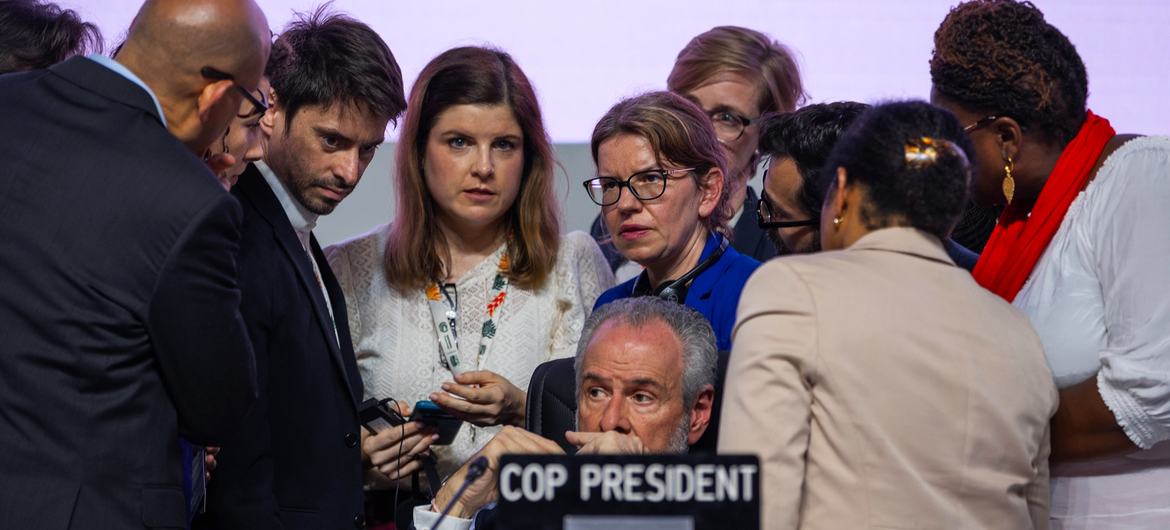
In the closing meeting, COP30 President André Corrêa do Lago acknowledged what was left out of the deal:  

“We know some of you had greater ambitions for some of the issues at hand,” he said, adding, “I know the youth civil society will demand us to do more to fight climate change. I want to reaffirm that I will try not to disappoint you during my presidency.”  

Reflecting on President Lula’s call at the opening of COP30 for ambition, Mr. do Lago announced plans to create two roadmaps: one to halt and reverse deforestation; and another to transition away from fossil fuels in a just, orderly and equitable manner, mobilizing resources for these purposes in a “just and planned manner.”

COP30 President André Corrêa do Lago (centre) confers with his team at the closing of the UN Climate Conference.

The road to consensus

The road to consensus at the latest Conference of the Parties to the UN Framework Convention on Climate Change (UNFCCC), as the annual COPs are formally known, was anything but smooth.  

Late last week, Indigenous groups staged blockades demanding stronger protections for the Amazon, and late Thursday afternoon, a fire at the conference venue disrupted talks during a critical phase. 

Negotiators worked through the night on Friday – to bridge gaps on finance and ambition, with Brazil’s presidency steering discussions toward a politically workable outcome focused on support and implementation of agreements from past COPs.

‘Multilateralism is alive’

From the G20 Summit in Johannesburg, UN Secretary-General António Guterres sent a clear message to COP30: At the gateway of the Amazon, Parties reached an agreement that shows nations can still unite to confront challenges no country can solve alone.  

The UN chief said that COP30 delivered progress, such as the launch of the Global Implementation Accelerator to close ambition gaps and reaffirmed the UAE Consensus, including a just, orderly and equitable transition away from fossil fuels.

“But COPs are consensus-based – and in a period of geopolitical divides, consensus is ever harder to reach. I cannot pretend that COP30 has delivered everything that is needed.” Overshoot of 1.5°C is a stark warning: deep, rapid emission cuts and massive climate finance are essential. “COP30 is over, but the work is not,” he said.  

Mr. Guterres vowed to keep pushing for higher ambition and solidarity, urging all who marched, negotiated and mobilized: “Do not give up. History – and the United Nations – are on your side.

Holding the line at 1.5 in ‘turbulent geopolitical waters’

UN climate chief Simon Stiell pointed to a series of major gains as COP30 closed in Belém: new strategies to accelerate Paris Agreement implementation, a push to triple adaptation finance, and commitments toward a just energy transition.

And despite what he called “turbulent geopolitical waters” – marked by polarization and climate denial – 194 nations stood together, “keeping humanity in the fight for a livable planet, determined to hold the line at 1.5°C.”

At the heart of this momentum is COP30’s flagship outcome: the Mutirão text, a sweeping deal that bundles four contentious negotiation tracks – from mitigation to finance and trade barriers – into a single, consensus-based agreement. Seventeen additional decisions were adopted alongside it.

The final document declares that the global shift toward low-emissions and climate-resilient development is “irreversible and the trend of the future.” It reaffirms that the Paris Agreement is working – and must “go further and faster” – strengthening the role of multilateral climate cooperation.

The text also recognizes the economic and social benefits of climate action, from growth and job creation to improved energy access, security and public health. Mr. Stiell pointed to a decisive trend: investments in renewable energy now outpace fossil fuels two to one – “a political and market signal that cannot be ignored,” he said.

A robust action agenda beyond negotiations

The Brazilian Presidency underscored that COP30’s success extends beyond negotiated agreements, highlighting a wave of voluntary commitments under the Action Agenda.

Among them:

  • Tropical Forests Forever Fund: Raised $5.5 billion and now includes 53 participating countries; at least 20 per cent of resources go directly to Indigenous Peoples and local communities.
  • Belém Health Action Plan: The first global initiative targeting climate-related health threats, launched with $300 million from 35 philanthropic organizations.
  • UNEZA Alliance: Public utility companies pledged $66 billion annually for renewable energy and $82 billion for transmission and storage.
  • Cities, regions and companies: A coalition spanning 25,000 buildings reported cutting over 850,000 tons of CO₂ in 2024.

Climate justice at the forefront

Countries also agreed to develop a just transition mechanism, enhancing cooperation, technical support and capacity-building.

It’s time to finance our future and ‘change course’, Guterres tells world leaders in Sevilla

António Guterres issued his clarion call noting that sustainable development powered by international cooperation, is now facing “massive headwinds.”

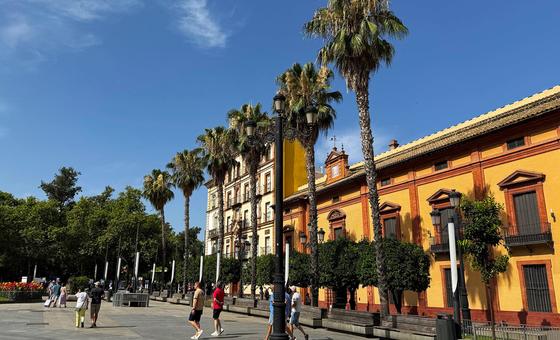
Addressing the opening session of the 4th Financing for Development Conference (FFD4) in baking hot Sevilla, Spain – basking in record high June temperatures – the Secretary-General noted multilateralism itself is also feeling the heat, while trust between nations and institutions fray.

The world is on fire, shaken by inequalities, climate chaos and raging conflicts: “Financing is the engine of development and right now, this engine is sputtering,” he told the conference, attended by more than 50 world leaders, over 150 nations and around 15,000 delegates.

“As we meet, the 2030 Agenda for Sustainable Development – our global promise to transform our world for a better, fairer future – is in danger.”

Some two-thirds of the ambitious Sustainable Development Goals (SDGs) targets agreed in 2015 are significantly off track – hence the staggering $4 trillion investment needed to turn it around.

“We are here in Sevilla to change course. To repair and rev up the engine of development to accelerate investment at the scale and speed required,” said Mr. Guterres.

He described the outcome known as the Sevilla Commitment adopted on Monday – without the United States which pulled out of the process earlier this month – as a “global promise” to low-income nations to lift them up the development ladder.

The UN chief outlined three key action areas:

  • First, get resources flowing fast at home to spur sustainable growth, and for richer countries to honour their pledge under the accord to double aid to poorer countries to boost development. This includes tripling the lending capacity of Multilateral Development Banks and innovative solutions to unlock private cash.
  • Second, fix the “unsustainable, unfair and unaffordable” global debt system. Right now, poorer countries are spending around $1.4 trillion just servicing their vast debts in the form of interest payments. Among the innovations, a new borrowers’ forum will ensure fairer debt resolution and action.
  • Third, reform the global financial architecture, with major shareholders playing their part, so that it empowers every country. “We need a fairer global tax system shaped by all, not just a few.”

The current crisis of affordability and stalled development is “a crisis of people,” he continued, which leaves families hungry, children unvaccinated, and girls left out of education.

“This conference is not about charity. It’s about restoring justice and to facilitate the ability of all people to live in dignity,” said Mr. Guterres.

This conference is not about money – it’s about investments in the future we wish to build together.”

A tangible and actionable’ roadmap

King Felipe of Spain spoke just ahead of the official opening, telling delegates the multicultural city of Sevilla welcomes the world “with open arms”.

He said a new roadmap would emerge that is based on what is “concrete and tangible and actionable”.

The conference must be a success, because cooperation is one of our fundamental pillars of the multilateral world and “the ultimate embodiment of the values that sustain it – especially at this particular point in history where many certainties are melting away and many fears and uncertainties are taking shape.”

‘Our time is now’

Spain’s President Pedro Sánchez told delegates “our time is now and our place is here.” Millions of lives will depend on the choices made in Sevilla and going forward.

We must choose “ambition over paralysis, solidarity over indifference and courage over convenience,” he continued, adding that the eyes of world are on this hall, to see what we are ready to do together and in the face of this historic challenge we must prove our worth.”

Sevilla was “the New York of the 16th century” in diplomatic terms he told delegates – and a cradle of globalism – we must all do that legacy justice today.

‘Sevilla is not an end point’

Secretary-General of the conference, Li Junhua – who’s in charge of the Department of Economic and Social Affairs (DESA) – said the week in Sevilla is key moment to mobilise the resources necessary to build a just, inclusive and sustainable future.

The UN effort to finance development has been anchored in multilateralism and solidarity – but today, the whole framework is under “profound stress.”

He said never has sustainable development been so tested but the pact made in Sevilla puts people back at the centre.

Sevilla is not an end point, it is a launch pad for a new era of implementation, accountability and solidarity.” UNDESA is ready to support all nations to translate the commitment into international action, he underscored.

President of the UN General Assembly Philémon Yang told delegates above all, “we need leadership to guide the world forward into a brighter more prosperous future for everyone, everywhere.”

He said the Sevilla framework will renew global partnership for the decade ahead and provide a focus on a debt burden which is crippling the developing world.

President of the UN Economic and Social Council Bob Rae said trust between countries had to be strengthened, because its absence “creates chaos.”

“Most of all I want to congratulate states for bringing forward the ambition, deepening engagement between financial institutions.”

The week represents a real commitment to action, he said.

Ajay Banga, President of the World Bank Group, told delegates ending poverty remains his key mission and the surge in population underway in developing countries requires resources “at an unprecedented scale and pace.”

He said everyone knew that governments, philanthropies and institutions are unable to meet every projection or promise – which is why the private sector is essential to the Sevilla Agreement so that capital can flow.

Mr. Banga added that the bank’s reforms of recent years are about being a better partner to the private sector and government clients.

Improving response time, boosting capital and systems of growth are key – but much more is needed to deliver for the next generation.

Exempt least-developed from punishing tariffs: WTO

Ngozi Okonjo-Iweala, Director-General of World Trade Organization said the conference was gathering at a time of unprecedented difficulty.

After decades of positive contributions, the global trading system has now been “severely disrupted” leaving exports so hampered by unilateral tariff measures and policy uncertainty that the WTO has sharply downgraded growth forecasts.

Further tariff barriers on 9 July – the deadline set by the US administration – will only make the contraction in global trade worse.

She reminded that the WTO has argued for the least developed nations and Africa overall to be exempted from the tariffs, “so we can better integrate them into the world trading system, not further exclude them.”

She said the Sevilla Agreement rightly recognises international trade as an engine of development.

“We therefore need to bolster stability and predictability in global trade,” through action at many levels that can grow national resources through exports, she told delegates.

IMF calls for broader tax base

Nigel Clarke, Deputy Managing Director of the International Monetary Fund (IMF), called for broadening the tax base, building strong financial management systems, coordinating support and addressing debt more sustainably.

“Many countries continue to struggle with high interest costs,” he said, calling on the international community to improve debt restructuring processes.  

Through its capacity development, the Fund is equipping members to chart their own paths and is also providing financial support when they need it most, he added.


Source link

LIVE: World leaders in Sevilla launch ambitious push to finance the future

From rising debt and shrinking investment, to the aid funding crisis and struggles to meet ambitious development goals, the global financial system is failing the people it’s supposed to serve: that’s the challenge facing world leaders gathered in Spain’s sweltering southern jewel of Sevilla this week, as the  UN’s 4th International Conference on Financing for Development gets underway. Follow our live Meetings Coverage below; app users can catch all the action from the opening day here and you’ll find all related stories on our special dedicated page right here.

Source link

Faith in finance: Indonesia’s innovative path to sustainable development

The Southeast Asian country has already raised close to $12 billion in thematic bonds, including blue bonds and Islamic investment instruments over the last seven years.

These efforts have been supported by development partners, including the United Nations.

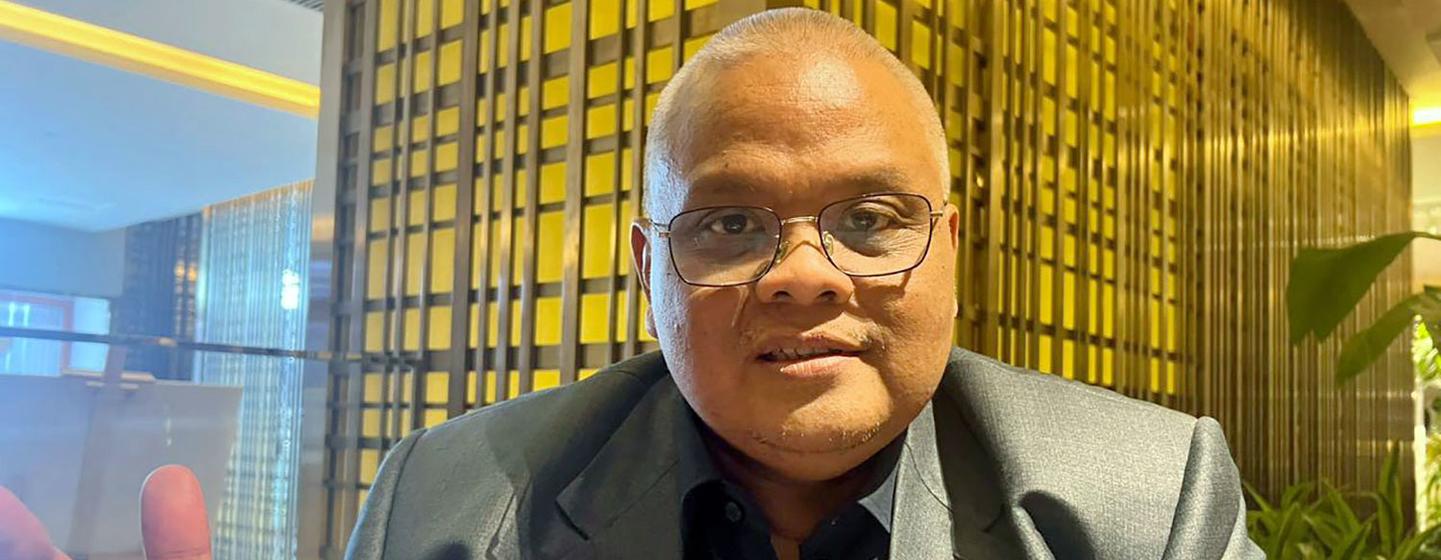
Putut Hari Satyaka, is the Deputy Minister for Development Financing and Investment at Indonesia’s Ministry of National Development Planning (Bappenas). He spoke to UN News ahead of a key UN conference on financing for development which begins in Sevilla on 30 June.

UN News: How much money is needed in Indonesia to achieve the SDGs and what is your estimated funding gap?

Putut Hari Satyaka: The existence of an SDG financing gap remains a significant challenge, especially to developing countries. Indonesia is no exception. The financing gap to fully achieve all 17 goals and their targets remains significant. With an estimated $4.2 trillion needed for Indonesia to achieve the SDGs, there is a $1.7 trillion financing gap that is yet to be resolved.

Putut Hari Satyaka, Deputy Minister for Development Financing and Investment at Indonesia’s Ministry of National Development Planning (Bappenas).

UN News: How can that gap be closed?

Putut Hari Satyaka:  We need an integrated and transformative approach, going beyond “business as usual”. For us, this means two things.

Firstly, we must enhance the use of public finances to be more efficient, resilient and transparent. This includes improving budgetary alignment with SDG targets, strengthening expenditure efficiency, and ensuring that resources are effectively prioritized and utilized for sectors generating spill-over transformative effects to sustainable development.

Secondly, we must be creative and innovative – meaning that we need to scale up the existing innovative financing methods and explore new ones. Some of the most prominent instruments and approaches are blended finance, thematic bonds and faith-based financing.

Indonesia has been making great progress in this regard. We have created an ecosystem of a wide range of innovative instruments, attracting a diverse range of stakeholders and entities, supporting necessary regulations, and developing the enabling environment to nurture the market.

UN News:  What is faith-based financing and what has been Indonesia’s experience so far?

Putut Hari Satyaka:  Faith-based financing, especially within the Indonesian context, refers to financial practices grounded in religious principles, most notably, in the principles of Sharia law in Islam.

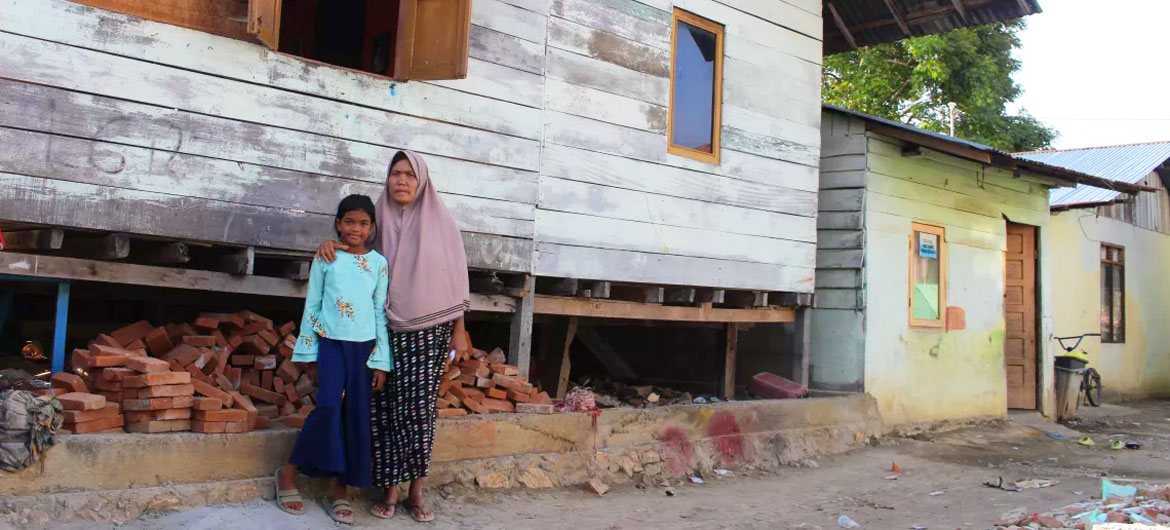
Families in Ache, Indonesia, have received faith-based cash grants to make improvements to their homes.

As Indonesia has 241.5 million Muslims, 85 per cent of the population, and faith-based social financing like zakat and waqf have been a long-standing practice, deeply rooted in our society.

What is new is the allocation of these instruments towards the SDGs. Indonesia has made strong progress in advancing Sharia finance as part of its inclusive growth agenda.

Sharia financing is now growing by 14 per cent a year, outpacing conventional finance. We are also championing scaling-up, green sukuk, which is a Sharia-compliant bond specifically issued to finance environmentally friendly projects.

This reflects Indonesia’s strong commitment to building a competitive financial ecosystem for faith-based instruments, and we will continue to strengthen collaboration, drive innovation, and ensure that faith-based financing plays a central role in our economic development.

UN News: Are you able to raise new funding through these faith-based instruments? Critics sometimes say this is just another way to reach the same funds you could get otherwise.

Putut Hari Satyaka: Yes, we are. With the world’s largest Muslim population, there is a massive potential in channeling faith-based financing towards the SDGs.

In 2018, Indonesia issued the world’s first sovereign green sukuk, raising $1.25 billion to fund renewable energy and climate adaptation projects.

Between 2019 and 2023, the government raised approximately $1.4 billion through domestic retail green sukuk, engaging individual investors in climate financing. This demonstrates the strong potential of green sukuk, both domestically and internationally.

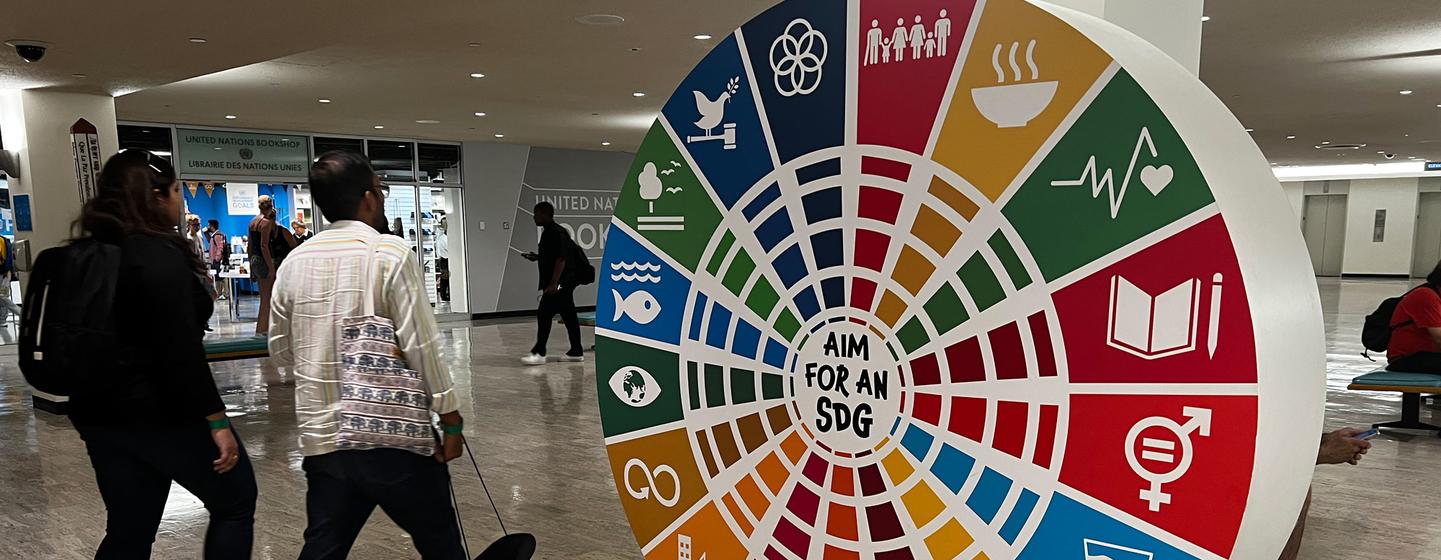
The 17 Sustainable Development Goals provide the blueprint for a more equitable world.


We also see great potential in Islamic Social Financing. Indonesia’s zakat potential is estimated at between $18 billion and $25 billion per year. The actual collection remains below 5 per cent of that potential, so there is clearly a vast opportunity to strengthen social finance.

UN News: What lessons have you learned over the years and what advice do you have for national or subnational governments interested in faith-based financing?

Putut Hari Satyaka: Although we have made great progress in faith-based financing, we have much room for enhancement, improvement and even exploration. Here are a few potential lessons:

First and foremost, awareness raising is key. As many view faith-based financing also as community-based financing, society’s participation in these instruments starts with their understanding of their importance and the way the money will be used.

Secondly, we see that the close coordination and concerted actions of relevant stakeholders are crucial. Overlaps are unavoidable without proper coordination. It is coordination – including with subnational governments, where we see room for improvement in order to scale-up faith-based financing in Indonesia.

Finally, building trust takes time. Faith-based financing relies heavily on public confidence, both in the institutions managing the funds and in how the funds are used.

Just like many other financing instruments, we have learned that transparency, accountability and consistent communication are essential to earn and maintain that trust.

Source link

British pound slumps to a 37-year low; Now 1 pound=1.14 US dollar or 91 INR

Sep 16 (IANS) The British pound slumped to a 37-year low on Friday after new data showed that shoppers are pulling back spending as inflation squeezes household budgets, underscoring fears that the economy may already be shrinking, media reports said.

The currency fell below $1.14, its lowest since 1985, after the Office for National Statistics said that retail sales in August dropped 1.6 per cent month-over-month, the biggest decline since December 2021 and significantly worse than economists had expected, CNN reported.

“I think the UK is in recession already,” said Michael Hewson, chief market analyst at CMC Markets UK, CNN reported.

Pounds/IANS

The pound has been hammered by a string of weak economic data, but also the steep ascent of the US dollar, a safe haven investment that sees inflows in times of uncertainty. The greenback is now near its strongest level in about two decades against a basket of top currencies, bolstered by expectations of another big rate hike by the Federal Reserve next week, the report said.

But the economic outlook in the United Kingdom means the pound is suffering more than most. It has lost more than 15 per cent of its value against the dollar this year, compared to a 12 per cent decline in the euro.

Rupee-dollar/IANS

A plan by Prime Minister Liz Truss to subsidise energy bills for households and businesses could ease the pain this winter, but may not be enough to restore growth. The Bank of England forecast a lingering recession before her plan was announced.

Investors have also been unsettled by indications that the government will pay for its energy program, which could cost as much as $171 billion, by sharply increasing the UK national debt.

Interest rates on small savings schemes remain unchanged

The government-run small savings schemes remained to provide the same interest rates since the past two years though the bank fixed deposit rates have considerably increased the interest rate.

The small savings schemes’ interest rates were last revised in the first quarter of 2020-21, though banks have drastically hiked their home loan and term deposit rates after the Reserve Bank of India (RBI) raised its repo rate by 140 basis points since May 2022.

Small savings schemes like Public Provident Fund (PPF), National Savings Certificate (NSC), Post Office Savings Scheme and Sukanya Samriddhi Yojana are vital savings instruments for the common man, as they provide long-term benefits.

Here are the current interest rates of key small savings schemes:

* Public Provident Fund (PPF): 7.1 per cent

* National Savings Certificate (NSC): 6.8 per cent

* Post Office Monthly Income Scheme: 6.6 per cent

* Sukanya Samriddhi Yojana: 7.6 per cent

* Five-year Senior Citizens Saving Scheme: 7.4 per cent

* Kisan Vikas Patra: 6.9 per cent


The RBI had brought down its benchmark repo rate by 75 basis points to 4.40 per cent on March 27, 2020 — just three days after a nationwide lockdown was announced but the government had not reduced interest rates of small savings schemes, keeping in mind the interests of the pensioners.

RBI sources said the government will monitor inflation as well as the liquidity position before taking any decision to raise interest rates of small savings schemes. “Depending on how much inflation rises and whether there is tightening of liquidity position in future, the government may take a call on small savings schemes rates,” said a senior banking official told IANS.

On June 30, 2022, the Finance Ministry had notified that interest rates of small savings schemes have been kept unchanged for the July-September quarter of the current fiscal, effective from July 1.

“The rates of interest on various small saving schemes for the second quarter of the financial year 2022-23, starting July 1, and ending September 30, shall remain unchanged from those notified for the first quarter (April 1 to June 30) for FY 2022-23,” the Finance Ministry notification had said.

Indian Minister to Participate in Nairobi Conference on Devolution

The Union Minister of State for Finance and Corporate Affairs, Mr. Arjun Ram Meghwal will represent the India in the 4th Annual Devolution Conference to be held from 6th to 9th March, 2017 at Nakuru County of Kenya.

He is expected to share the experience of devolution system and its progress in India and specifically highlight the 73rd-74th Constitutional Amendments and provisions their under for strengthening the local governance in India.

During his visit to Kenya, Mr. Meghwal will address the Devolution Conference and will brief the Conference on the revenue sharing between the Centre and the States as well as showcase the smooth devolution on the recommendations of 14th Finance Commission from the earlier 32% share in 13thFinance Commission to 42% of Union’s net tax receipts, to the States, said a statement.

To share the successful experience of the Urban and Rural Local Bodies, Mr. Meghwal will inaugurate the Conference with the objective of sharing of good experience of devolution system and through the platform of Devolution Conference and how it can be used to increase Good Governance and Public Accountability for the Social and Economic Development internationally.

About 10,000 delegates are expected to participate from different regions including African Nations and China in the conference, including Members of Parliament, Leaders of Opposition from several States, professionals, representatives of various civil societies, religious and social organizations from Kenya among others.