Pentagon Releases UFO Files, So Did Mexico and Brazil; Mystery Never Dies

The Pentagon has released more than 160 declassified files related to unidentified aerial phenomena (UAP), marking one of the largest public disclosures of government records on unexplained sightings and renewing global interest in the decades-old mystery.

The records, published through the Pentagon’s transparency archive, include military incident reports, radar logs, witness statements, photographs and previously classified documents dating back to the late 1940s.

Among the most discussed disclosures is a 1969 Apollo 11 mission debriefing in which astronauts described observing a bright unidentified object during the historic lunar mission. The files also include details of more recent military encounters, including incidents over the East China Sea and other monitored regions where aerial objects displayed unusual movement patterns that investigators said could not be conclusively identified.

Pentagon officials stressed the release does not confirm extraterrestrial activity.

“The Department is committed to transparency while protecting national security interests,” a Pentagon spokesperson said, adding that unresolved cases often reflect insufficient sensor data rather than evidence of alien technology.

The newly released archive follows years of pressure from lawmakers and public advocacy groups demanding broader access to classified UAP records.

According to Pentagon figures, hundreds of UAP reports have been logged by military personnel over the past two decades, though the majority were later attributed to airborne clutter, weather anomalies, surveillance systems or sensor misidentification.

Some researchers called the release historic.

“This is the most substantial acknowledgment yet that unexplained aerial encounters are taken seriously at the highest levels of government,” said aerospace analyst Michael Reynolds.

Skeptics remained unconvinced.

“Most of this is still grainy footage and incomplete data, not evidence of extraterrestrial craft,” said scientific investigator Laura Simmons.

The Pentagon said this is only the first batch of disclosures, with additional files expected to be reviewed and released in the coming months as congressional scrutiny intensifies.

When Other Govts Release UFO Files

For decades, official disclosures of so-called UFO files have triggered global fascination but the mystery never died down. From declassified British defence archives to Brazil’s military records and France’s unusually transparent public investigations, governments across the world have periodically released documents tied to unexplained aerial sightings. Yet each release tends to raise more questions than it answers.

Online discussions reflect the enduring confusion surrounding what governments actually know about what are now formally termed Unidentified Aerial Phenomena, or UAPs. While conspiracy theories often dominate public imagination, analysts say the reality is usually more bureaucratic than sensational.

Many governments classify such records NOT because they confirm extraterrestrial contact, but because disclosure could reveal sensitive defence capabilities, surveillance systems or intelligence-gathering methods.

Former military planners and defence analysts have repeatedly pointed out that unexplained sightings are often logged alongside radar specifications, aircraft deployment patterns and classified operational details.

Releasing these records wholesale could expose vulnerabilities to rival states rather than reveal evidence of alien life.

This national security explanation has been particularly central to debates in the United States, where disclosures tied to the Pentagon’s former Advanced Aerospace Threat Identification Program intensified public interest.

The release of military footage showing unexplained airborne objects sparked widespread speculation, though officials stopped short of suggesting extraterrestrial origins.

Instead, investigators acknowledged only that certain incidents remained unresolved due to insufficient data.

How French, Brazil Are Open?

Other countries have taken more open approaches. France’s government-backed aerospace study group, often cited by researchers as one of the world’s most systematic public-facing efforts, has released detailed files examining unusual sightings.

Brazil has similarly declassified records tied to notable incidents such as the Colares case, while Britain transferred large archives of UFO-era defence investigations to public record repositories.

Still, even extensive disclosure rarely settles debate.  That is partly because “unidentified” does not mean alien. Aerial anomalies can stem from sensor errors, atmospheric distortions, classified domestic technology, foreign surveillance platforms or simple misidentification.

Experts caution that gaps in explanation are not evidence of extraterrestrial visitation. At the same time, official ambiguity fuels public distrust.

Repeated historical reversals, where governments first dismissed incidents before later acknowledging investigations, have fed suspicion that authorities withhold more than they admit. The shift in language from “UFO” to “UAP” has also fueled public curiosity, with some interpreting it as rebranding rather than scientific precision.

For governments, however, the terminology change reflects an effort to reduce cultural baggage and treat unexplained aerial observations as aerospace and intelligence questions rather than science-fiction phenomena.

For the public, the mystery remains irresistible. And as long as governments continue releasing partial records while withholding classified context, the question will persist:

Are these files evidence of something extraordinary, or simply proof that even the world’s most advanced militaries do not always know what they are seeing in the sky?

Massive Stars Found To Control Star Formation In Nearby Molecular Cloud

New evidence has been unearthed which show that massive stars can initiate star formation in nearby areas thus helping shape the evolution of star-forming regions.

Stars are born inside vast clouds of gas and dust known as molecular clouds. While most stars in our Galaxy have masses similar to the Sun, a few are much larger (more than eight times the mass of the Sun). Although these massive stars are rare, they play a significant role in shaping their surroundings and sometimes even contribute to the formation of the next generation of stars.

Scientists from the Aryabhatta Research Institute of Observational Sciences (ARIES), Nainital, an autonomous research institute under the Department of Science and Technology (DST), Government of India,  investigated a region known as Bright Rimmed Cloud 44 (BRC 44), situated approximately 900 parsecs from Earth within the Cepheus OB2 star-forming complex and found that massive stars give out UV radiation that propagates into the cloud, giving birth to new stars.


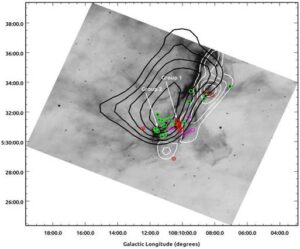
Fig: The CO (black color) and 1.4 GHz NVSS (white color) contours are overplotted on the 8 µm Spitzer image of the region. Circles represent the identified YSO candidates. The red circles are optically visible YSOs (Group 1), green circles are embedded. Young YSOs(Group 2), and magenta circles are identified as BD candidates.

Bright Rimmed Clouds get their name from their glowing edges, which shine brightly when exposed to intense ultraviolet (UV) radiation from nearby massive stars. In the case of BRC 44, the researchers found that UV radiation from a massive star ionizes the surface of the cloud, which leads to heating and compression of the gas. This compression creates shock waves that propagate into the cloud, increasing its density and triggering the formation of new stars.

The research, led by Mr. Rishi C., a PhD scholar along with Dr. Neelam Panwar and other researchers from India, UK, China & Thailand, employed a multi-wavelength approach to study the region. Observations were done using the 3.6-m Devasthal Optical Telescope (DOT) and the Devasthal Fast Optical Telescope (DFOT) in India, along with the data from the Spitzer Space Telescope and radio observations from the Purple Mountain Observatory in China. By combining optical, infrared, and radio data, the scientists were able to study both the stars and the surrounding gas in great detail.

One of the most exciting results of the study is the discovery of 22 new young stellar objects in BRC 44. Among these are several brown dwarfs—objects that are smaller than normal stars to sustain hydrogen fusion in their cores. Finding such low-mass objects provides essential clues about how stars and sub-stellar objects form under the influence of massive stars. Apart from this finding, they also found two groups of young stars, with one group formed from the interplay of cloud and radiation from the nearby massive star and the other group formed around the same time as the massive star.

The results, published in The Astrophysical Journal, show that massive stars play a complex role in the Galaxy. Instead of only destroying their surroundings, they can also trigger new star formation.


Also Read:

Astronomers Spot “Sneezing” Baby Stars Creating Massive Rings In Space

NASA’s Hubble finds spiraling stars ‘NGC 346’, providing window into early universe


Outer solar system object has an atmosphere but shouldn’t

A team of professional and amateur Japanese astronomers found evidence for a thin atmosphere around a small body in the outer Solar System. The object is so small that it should not have a sustainable atmosphere, raising questions about when and how the atmosphere formed. Future observations to better characterize the atmosphere will help solve these mysteries.

In the cold reaches of the outer Solar System lie thousands of small objects known as trans-Neptunian objects (TNOs) because they lie outside the orbit of Neptune. A thin atmosphere has been observed around Pluto, the most famous TNO, but studies of other TNOs have yielded negative results. Most TNOs are so cold, and their surface gravity so weak, that they are not expected to retain atmospheres.

But astronomers like to expect the unexpected, so they took advantage of a lucky “natural experiment” to look for an atmosphere around a TNO known as (612533) 2002 XV93. This object, abbreviated as 2002 XV93, has a diameter of approximately 500 km. For reference, Pluto’s diameter is 2,377 km. The orbit of 2002 XV93 is such that, as seen from Japan, it passed directly in front of a star on January 10, 2024. As the star disappears behind 2002 XV93, it might gradually fade, indicating that the light is being attenuated as it passes through a thin atmosphere; or it might suddenly wink out as it slips behind the solid surface of the TNO.

Artist’s conception of this research showing an imagined time sequence as a star passes behind a TNO with an atmosphere. Credit:NAOJ

A team of professional and amateur astronomers, led by Ko Arimatsu at NAOJ Ishigakijima Astronomical Observatory, observed the star as 2002 XV93 passed in front of it from multiple sites in Japan. The obtained data are consistent with attenuation by an atmosphere.

Calculations show that the atmosphere found around 2002 XV93 is expected to last less than 1000 years unless it is replenished. So it must have been created or replenished recently. Observations by the James Webb Space Telescope show no signs of frozen gases on the surface of 2002 XV93 that might sublimate to form an atmosphere. One possibility is that some event brought frozen or liquid gases from deep inside the TNO to the surface. Another possibility is that a comet crashed into 2002 XV93, releasing gas that formed a temporary atmosphere. Further observations are needed to distinguish between these two scenarios.


Also Read:

XRISM finally solves famous star’s 50-year space mystery

Watching water droplets merge on the International Space Station

Curiosity rover detects never-before-seen organic compounds on Mars in new experiment

NASA’s Curiosity Mars rover uncovered a diverse mix of organic molecules on Mars, including chemicals widely considered building blocks for the origin of life on Earth.

The findings, which come from a chemical experiment performed for the first time on another world, reveal that the Martian surface can preserve the kinds of molecules that could serve as signs of ancient life. However, this experiment cannot distinguish between organic compounds from potential past life on Mars and those formed through geologic processes or delivered by meteorites.

Definitively identifying signs of past life would require returning rock samples to Earth.

The study was led by Amy Williams, Ph.D., a professor of geological sciences at the University of Florida and a scientist on the Curiosity and Perseverance Mars rover missions. Curiosity landed on Mars in 2012 to find evidence that ancient Mars had conditions that could support microbial life billions of years ago; the Perseverance rover, which landed in 2021, was sent to look for signs of any ancient life that might have formed.

“We think we’re looking at organic matter that’s been preserved on Mars for 3.5 billion years,” said Williams, who helped develop this chemical experiment. “It’s really useful to have evidence that ancient organic matter is preserved, because that is a way to assess the habitability of an environment. And if we want to search for evidence of life in the form of preserved organic carbon, this demonstrates it’s possible.”

Williams and an international collaboration of researchers published their findings April 21 in the journal Nature Communications.

Among the 20-plus chemicals identified by the experiment, Curiosity spotted a nitrogen-bearing molecule with a structure similar to DNA precursors — a chemical never before spotted on Mars. The rover also identified benzothiophene, a large, double-ringed, sulfurous chemical often delivered to planets by meteorites.

“The same stuff that rained down on Mars from meteorites is what rained down on Earth, and it probably provided the building blocks for life as we know it on our planet,” Williams said.

NASA’s Curiosity Mars rover took this selfie at a location nicknamed “Mary Anning” after a 19th century English paleontologist. This was the site of the chemical experiment uncovering diverse organic molecules on Mars, in the Glen Torridon region, which scientists believe was a site where ancient conditions would have been favorable to supporting life, if it ever was present.Credit:NASA/JPL-Caltech/MSSS

Led by NASA’s Jet Propulsion Laboratory, Curiosity Mars landed in Gale crater, in a former lake bed, in August 2012. The rover conducted the experiment in 2020 in the Glen Torridon region of the crater, an area rich in the clay minerals that indicate the area once contained water. Those clays can hold on to and preserve organic chemicals better than other minerals, making them a prime target for uncovering these compounds.

The experiment was conducted by the instrument suite known as the Sample Analysis at Mars, or SAM. Led in part by Jennifer Eigenbrode, Ph.D., an astrobiologist at NASA’s Goddard Space Flight Center and co-author of the new study, SAM has been responsible for many of the mission’s most important discoveries about organic chemistry, atmosphere and habitability on Mars.

Using a chemical known as TMAH, the experiment broke apart larger organic molecules so they could be analyzed by onboard instruments within SAM. With only two cups of the TMAH chemical onboard Curiosity, success required careful planning and choosing the most favorable location to sample.

The promising results come as future missions — including the Rosalind Franklin mission to Mars and the Dragonfly expedition to Saturn’s moon Titan — plan to bring the TMAH test onboard to search for organic compounds.

“We now know that there are big complex organics preserved in the shallow subsurface of Mars, and that holds a lot of promise for preserving large complex organics that might be diagnostic of life,” Williams said.


Also Read:

NASA’s Perseverance Rover Gets the Dirt on Mars

What’s Mars made of ? Japanese study throws light and opens up new study

 

Blue Origin’s New Glenn NG-3 Achieves Booster Reuse Milestone [Watch Booster Touchdown]

The NG-3 mission marked the third flight of Blue Origin’s heavy-lift New Glenn rocket, and one of its most closely watched launches yet—both for commercial ambitions and reusable rocket technology.

Launch Overview:

  • Date: April 19, 2026
  • Launch site: Cape Canaveral, Florida
  • Rocket: New Glenn (two-stage heavy-lift vehicle)
  • Payload: BlueBird-7 satellite for AST SpaceMobile
  • Mission type: First commercial New Glenn launch

This was also the first time Blue Origin reused a New Glenn booster, a major milestone as it tries to compete with SpaceX in lowering launch costs through reusability.

Mission Objective:

The NG-3 flight aimed to deploy BlueBird-7, part of AST SpaceMobile’s next-generation satellite constellation designed to deliver direct-to-mobile broadband from space.

  • The satellite features a massive communications array and is part of a plan to build a global space-based cellular network.
  • Successful lifted off from Cape Canaveral
  • Booster recovery achieved
    • The first stage (named “Never Tell Me the Odds”) landed safely on a drone ship
    • This marked successful reuse on only the third flight, a significant technical step

This puts Blue Origin among group of companies capable of reusing large orbital-class boosters.

Watch Booster landing burn to Booster Touchdown in below Blue Origin video at  1:18: 04

Also Read:

Thousands Of Pico-Satellites Could Redefine Direct Smartphone Connectivity From Space

PSLV-C37 Launches 104 Satellites in One Flight, Sets New Record

‘Dancing Jets’ from black hole reveal extraordinary cosmic power

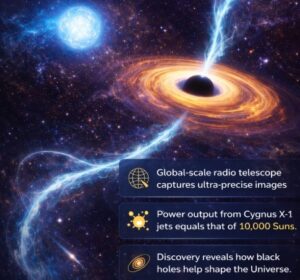
A new study led by Curtin University has harnessed a global-scale radio telescope network to capture detailed images revealing the extraordinary power of jets emitted by black holes, offering strong confirmation of long-standing theories about their role in shaping the Universe’s structure.

Published in Nature Astronomy, the research found that the jets from Cygnus X-1—a system containing the first confirmed black hole and a supergiant companion star—generate energy comparable to the output of around 10,000 Suns.

To record the measurement, researchers used an array of linked up telescopes separated by large distances to observe the black hole jets being buffeted by the winds of the star as the black hole moved around its orbit – much like how strong winds on Earth can push around water in a fountain.

By knowing the power of the wind and measuring how much the jets were bent, the researchers could determine the instantaneous power of the jets for the first time.

In addition, they were able to determine the speed of the black hole’s jets – about half the speed of light, or 150,000 km per second – another measurement that has challenged scientists for decades.

The strong stellar wind from the supergiant star pushes the jets launched by the black hole away from the star. This causes the jet direction to vary as the black hole and the supergiant star move around their orbit./ International Centre for Radio Astronomy Research (ICRAR)

The research was led from the Curtin Institute of Radio Astronomy (CIRA) and the Curtin node of the International Centre for Radio Astronomy Research (ICRAR), in collaboration with the University of Oxford.

Lead author Dr Steve Prabu, who worked at CIRA at the time of the research and who is now based at the University of Oxford, said researchers were able to make the measurement using a sequence of images of the “dancing jets” – a term he used to describe the jets’ movement pattern as they were repeatedly deflected in different directions by the supergiant star’s powerful winds as the star and black hole moved around their orbits.

Dr Prabu said the measurement allowed scientists to understand what fraction of the energy released around black holes could be deposited into the surrounding environment, thereby changing the environment.

“A key finding from this research is that about 10 per cent of the energy released as matter falls in towards the black hole is carried away by the jets,” Dr Prabu said.

“This is what scientists usually assume in large-scale simulated models of the Universe, but it has been hard to confirm by observation until now.”

Co-author Professor James Miller-Jones, from CIRA and the Curtin node of ICRAR, said previous methods could only measure the average jet power over thousands or even millions of years, preventing accurate comparisons with the X-ray energy released instantaneously from the infalling matter.

“And because our theories suggest that the physics around black holes is very similar, we can now use this measurement to anchor our understanding of jets, whether they are from black holes 10 or 10 million times the mass of the Sun,” Professor Miller-Jones said.

“With radio telescope projects such as the Square Kilometre Array Observatory currently under construction in Western Australia and South Africa, we expect to detect jets from black holes in millions of distant galaxies, and the anchor point provided by this new measurement will help calibrate their overall power output.

“Black hole jets provide an important source of feedback to the surrounding environment and are critical to understanding the evolution of galaxies.”


Also Read:

RRI scientists trace mysterious X-ray bursts to wobbling disk in distant galaxy

XRISM finally solves famous star’s 50-year space mystery

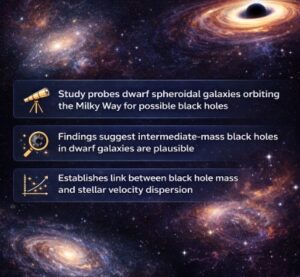
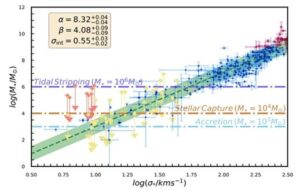
Scientists Explore Potential Black Holes In Dwarf Galaxies

A recent study has examined whether some of the universe’s smallest galaxies—particularly dwarf spheroidal galaxies orbiting the Milky Way—could host black holes, offering fresh insight into how these cosmic objects form and evolve over time.


Artemis II Update-24, Day 9: Second Return Correction Burn Complete

Thrusters Fire To Steer Orion Home:

At 10:53 p.m. EDT, the Orion spacecraft executed a brief nine-second thruster burn, increasing its velocity by 5.3 feet per second and nudging the Artemis II crew further along their return path to Earth.

With the maneuver complete, the crew has now crossed the halfway mark on their journey home.

Temporary Signal Loss Resolved

Roughly two hours before the burn, mission teams encountered an unexpected return link loss of signal during a data rate transition, briefly disrupting the flow of communications and telemetry from the spacecraft.

Two-way contact was subsequently restored, allowing flight controllers and crew to resume preparations for the scheduled maneuver without further delay.

art002e016204 (April 6, 2026) – NASA astronaut and Artemis II Pilot Victor Glover pictured here in the Orion spacecraft during the Artemis II lunar flyby. Glover and his fellow crewmates spent approximately seven hours taking turns at the Orion windows capturing science data to share with their team back on Earth. At closest approach, they came within 4,067 miles of the Moon’s surface.NASA

Re-Entry Briefings And Next Steps

Earlier in the day, officials from NASA provided additional details on re-entry and splashdown procedures during a mission status briefing.

The next key milestone—a third return trajectory correction burn—is planned for April 10 at approximately 1:53 p.m., ahead of final re-entry operations.

Splashdown Target Remains On Track

NASA continues to target splashdown at 8:07 p.m. (5:07 p.m. PDT) on Friday, April 10, off the coast of San Diego, as the Artemis II mission enters its final phase of return.

Also Read:

Artemis II Update-21, Day 7: First Return Correction Burn Complete

Monitoring over deep space network before artemis II signal acquisition

Who is Dan Florez in Artemis Mission Program

Dan Florez is one of the NASA test directors for the Exploration Ground Systems Program. The test directors are a group of 20 engineers at the agency’s Kennedy Space Center in Florida who plan and execute integrated testing for Artemis missions. Their work includes developing timelines and procedures for launch countdown, propellant loading, emergency egress, pad and launch abort scenarios, recovery operations, and more. They help lead the ground systems team in all areas of testing.

At the time of Artemis I launch, Florez and his fellow test directors had already developed the launch countdown timelines for Artemis II.

“We were really focused on loading that spacecraft with cryogenic propellants and successfully launching it. With Artemis II, we’re going to have to do all that again, but in the middle of that, we’re going to have to embed the crew timeline to get the crew safely inside the spacecraft, get all the systems checked out, and launch them into space,” Florez said. “And we have to do the same thing on the tail end through recovery. So, there’s a lot of complexities when you have the human element thrown into the operation.”

Since Artemis I, Florez has focused his work even more heavily on the human element, taking on rescue and recovery operations.

“We have to have a plan to go get to the crew if we have an abort, if we land anywhere in the world within 24 hours,” said Florez. “My role right now is to do a lot of that coordination to make sure we have all the assets and all the resources in place to get to the crew.”

When the Artemis II crew returns to Earth aboard the Orion spacecraft, Florez will be there, prepared and ready with NASA’s Landing and Recovery Team and the U.S. military.

“We have a great partnership with the military. We have the Human Spaceflight Support Office within the Air Force that support us directly for not just for recovery operations, but also for any of the rescue operations”.

Dan Florez, NASA Test Director, Exploration Ground Systems Program

Recovery operations are routinely verified and validated in what is called an underway recovery test. NASA and Navy teams board a U.S. Navy ship and travel off the coast of San Diego to test retrieving the capsule and getting the crew safely on the ship. In late February 2024, the Artemis II crew joined the recovery team’s eleventh iteration of testing called, URT-11.

“It was really great to have that perspective of having astronauts in the loop during our test operations,” said Florez. “Everywhere along the way, we got feedback from them.”

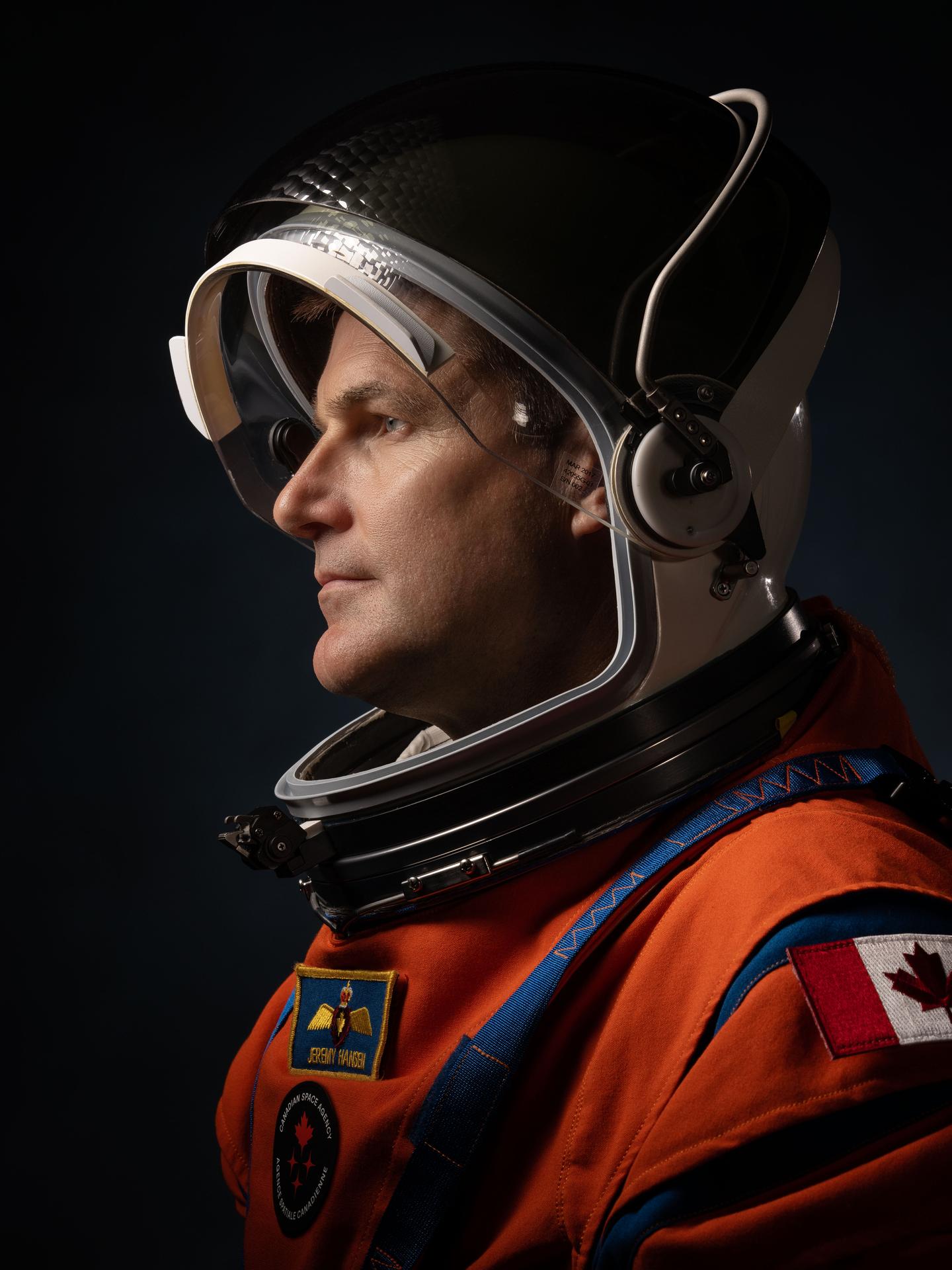
Artemis II launched at 6:35 p.m. EDT April 1, from Launch Complex 39B, sending NASA astronauts Reid Wiseman, Victor Glover, and Christina Koch, and CSA (Canadian Space Agency) astronaut Jeremy Hansen, on their approximately 10-day mission around the Moon.

A wave breaks inside the well deck of USS Somerset as teams work to recover the Crew Module Test Article (CMTA), a full scale replica of the Orion spacecraft, as they practice Artemis recovery operations during Underway Recovery Test-12 off the coast of California, Thursday, March 27, 2025. NASA/Joel Kowsky

Florez and his colleagues are prepared and ready to apply everything they tested to recover the crew.

“Watching them launch is going to be great. I’m going to be happier when they land”.

Dan Florez, NASA Test Director, Exploration Ground Systems Program

Also Read:

Deep Space Network Establishes Contact With Artemis II Spacecraft

JPL’s Mission Control Steps Up For Artemis II Deep Space Operations


Monitoring over deep space network before artemis II signal acquisition

Blanca Renteria, operations chief for the Artemis Deep Space Network (DSN), monitored incoming data from the Space Flight Operations Facility at Jet Propulsion Laboratory shortly after Artemis II lifted off on April 1, 2026.

The launch took place at 6:35 p.m. EDT from Kennedy Space Center, with mission control teams quickly transitioning to deep space communication support.

The Space Flight Operations Facility manages NASA’s DSN, a worldwide system consisting of three primary complexes located in Goldstone, California; Madrid, Spain; and Canberra, Australia.

Each site is equipped with multiple radio-frequency antennas that maintain continuous communication with numerous robotic missions across the solar system, alongside the crewed Artemis II spacecraft.

NASA

Backbone Of Deep Space Communication

The DSN is operated by JPL under NASA’s Space Communications and Navigation programme, based at the agency’s headquarters within the Space Operations Mission Directorate.

This network enables mission teams to track spacecraft, transmit commands, and receive scientific data across vast distances. The Jet Propulsion Laboratory itself is managed by the California Institute of Technology in Pasadena, California, on behalf of NASA.

Also Read:

What’s the longstanding tradition at JPL before any launch and other major space mission events

JPL’s Mission Control Steps Up For Artemis II Deep Space Operations

Artemis II mission: LUCA and LESA support Artemis safety, success as crew prepares return journey

NASA’s Artemis II mission is drawing support from a pair of nearly identical control rooms in Alabama, each playing a distinct role in keeping astronauts safe and operations on track as the crew heads back to Earth, Friday, April 10.

At the National Aeronautics and Space Administration’s Marshall Space Flight Center in Huntsville, two facilities, the Lunar Utilization Control Area (LUCA) and the Lander Engineering Support Area (LESA), are working in tandem during the mission. Both are housed within the Huntsville Operations Support Center, a hub designed to provide real-time technical and scientific support.

Though similar in appearance, the two rooms serve different purposes. LUCA focuses on science operations linked to Artemis, while LESA is geared toward engineering support, particularly for future missions that will land astronauts on the Moon.

LUCA (Lunar Utilization Control Area) at NASA Marshall is specially designed to support a wide variety of science operations on and around the Moon – and beyond. Engineers in the LUCA monitored operations for the Lunar Node-1 experiment, an autonomous navigation payload that was part of the first NASA Commercial Lunar Payload Services (CLPS) launch on Intuitive Machines’ Nova-C lunar lander in 2024. NASA Marshall flight controllers will use the LUCA again for Artemis II to monitor science operations.
NASA/Charles Beason

Officials say the flexibility of the Huntsville center allows it to adapt to evolving mission needs. The facility has previously supported programs including the Commercial Crew Program, the Space Launch System rocket and research aboard the International Space Station.

Teams operating from LUCA are currently supporting science experiments tied to deep space conditions. These include studies examining how microgravity and radiation affect the human body, including immune response and overall performance. Data gathered during Artemis II is expected to shape planning for future crewed missions beyond Earth orbit.

Support engineers will use the LESA (Lander Engineering Support Area) at NASA Marshall to monitor human landing system (HLS) for the first crewed Artemis missions.
NASA/Charles Beason

In parallel, LESA teams are monitoring Artemis II operations in real time, using the mission as a live test case to refine procedures ahead of future lunar landings. Engineers, safety specialists and flight operations experts form part of the Human Landing System Mission Insight Support Team, which will eventually play a central role in supporting lander systems during Moon missions.

The Huntsville Operations Support Center also provides a range of technical services, including spacecraft command and telemetry management, global voice communications, and live and recorded video support. It also deploys specialized software tools that enable seamless data exchange between systems located far apart, allowing teams across different locations to work in sync.

By integrating these capabilities into both LUCA and LESA, NASA enables continuous coordination between engineers, scientists and mission operators worldwide.

Artemis II, which recently carried astronauts around the Moon, is part of NASA’s broader Artemis program aimed at returning humans to the lunar surface. The program is also intended to lay the groundwork for future missions to Mars, with lessons from current flights feeding directly into long-term exploration plans.

Also Read:

Artemis II Update-22, Day 8: Crew conducts key tests as they begin their return journey

Artemis II Update-20, Day 7: ISS Crew Connects With Artemis II Astronauts Amid Busy Research Schedule

Artemis II Update-22, Day 8: Crew conducts key tests as they begin their return journey

Artemis II moved into another critical phase of its return journey as the crew began Flight Day 8 with a focus on testing systems and preparing for reentry.


Artemis II Update-20, Day 7: ISS Crew Connects With Artemis II Astronauts Amid Busy Research Schedule

Astronauts aboard the International Space Station spoke with the Artemis II crew on April 8 following their lunar flyby, marking a rare ship-to-ship exchange between deep space and low Earth orbit. The Artemis II crew is returning to Earth after circling the Moon, while Expedition 74 astronauts continued biomedical research and mission training aboard the station. The interaction highlighted how ongoing ISS science supports future lunar missions under NASA’s Artemis program.

For a few minutes on Tuesday, two crews separated by hundreds of thousands of miles shared the same conversation.

Astronauts aboard the International Space Station (ISS) connected with their counterparts on NASA’s Artemis II mission, offering a rare moment of overlap between low Earth orbit operations and deep space travel. The call came just a day after Artemis II astronauts completed a historic lunar flyby and began their journey home.

On one side were Expedition 74 crew members Chris Williams, Jack Hathaway and Jessica Meir of NASA, along with Sophie Adenot of the European Space Agency (ESA). On the other were Artemis II astronauts Reid Wiseman, Victor Glover and Christina Koch, joined by Jeremy Hansen of the Canadian Space Agency (CSA).

The Artemis II crew is traveling aboard Orion, returning to Earth after looping around the Moon in NASA’s first crewed lunar mission in decades.

ISS and Artemis II crew exchange experiences after lunar flyby

The conversation turned quickly to comparison.

Station astronauts asked about differences between spacecraft, while Artemis II crew members described the experience of seeing the Moon up close. Christina Koch, drawing on her own time aboard the ISS, linked the two missions directly.

“Every single thing that we learned on ISS is up here,” Koch said, referring to how station-based training translates to deep space operations.

The exchange underscored a key role of the ISS within the Artemis program. The orbiting laboratory functions as a proving ground where astronauts refine procedures, test systems and adapt to long-duration spaceflight before venturing farther from Earth.

For NASA and its partners, that continuity is central. The Artemis II mission builds on lessons accumulated over years of station operations.

The Artemis II crew – (clockwise from left) Mission Specialist Christina Koch, Mission Specialist Jeremy Hansen, Commander Reid Wiseman, and Pilot Victor Glover – pause for a group photo with their zero gravity indicator “Rise,” inside the Orion spacecraft on their way home. Following a swing around the far side of the Moon on April 6, 2026, the crew exited the lunar sphere of influence (the point at which the Moon’s gravity has a stronger pull on Orion than the Earth’s) on April 7, and are headed back to Earth for a splashdown in the Pacific Ocean on April 10.

Space station biomedical research supports Artemis and future missions

While the call captured public attention, the station’s daily schedule remained anchored in research.

Crew members conducted a series of biomedical scans using the Ultrasound 3 device, focusing on how spaceflight affects the human body. Doctors on the ground monitored the scans in real time, looking for signs of blood clots that can form in leg veins and travel to the lungs.

Such risks have become a growing area of study as missions extend beyond short orbital stays. Data collected aboard the ISS feeds directly into planning for longer journeys, including missions to the Moon and eventually Mars.

Jessica Meir also contributed to the RelaxPro investigation, an ESA-sponsored study examining stress and immune responses in space. She collected saliva and hair samples that researchers will analyze on Earth for hormonal and immune markers.

The study explores whether mindfulness and meditation techniques can improve sleep quality and reduce stress during long-duration missions.

Cargo mission training and robotic systems testing on ISS

Operational training continued alongside scientific work.

Williams and Hathaway simulated the capture of the Cygnus XL cargo spacecraft using the Canadarm2 robotic system. Mission planners are targeting April 10 for the launch of the resupply mission aboard a **SpaceX Falcon 9 rocket, which will deliver supplies and experiments to the station.

Elsewhere, Sophie Adenot worked inside the Japanese Kibo laboratory module, setting up a compact experimental robotic arm known as TUSK. The system is being tested for precise movements at sub-millimeter levels in microgravity, a capability that could support delicate operations in future missions.

Adenot later joined fellow astronauts for emergency response simulations, rehearsing procedures designed to prepare crews for unexpected situations in orbit.

Roscosmos crew studies teamwork and fitness in orbit

Russian crew members also focused on research tied to long-duration missions.

Station commander Sergey Kud-Sverchkov and flight engineer Sergei Mikaev, both representing Roscosmos, participated in experiments examining team dynamics and physical conditioning in space. One study involved progressively complex computer tasks requiring cooperation, allowing researchers to observe how crews adapt to working together in confined environments.

The findings may influence crew training for future missions beyond Earth orbit.

Kud-Sverchkov later completed a monitored exercise session using an onboard cycle, while Mikaev assisted with health data collection.

Meanwhile, Andrey Fedyaev continued training with the European robotic arm inside the Nauka module, practicing both primary and backup control modes to ensure operational readiness.

The day’s activities reflected a layered mission environment.

On one level, astronauts pushed the boundaries of human spaceflight, exchanging insights between deep space and orbit. On another, they maintained a steady cadence of experiments and training that will shape future exploration.

The Artemis II crew moves farther from the Moon with each passing hour. The ISS crew remains in orbit, continuing work that helps make those journeys possible.

Also Read:

Artemis II Update-19, Day 7: Crew Makes Long‑Distance Call, Prepares for Earth Return

President Trump Calls Artemis II Astronauts before crew wraps up historic Lunar Flyby [Watch Videos]

Artemis II Update-19, Day 7: Crew Makes Long‑Distance Call, Prepares for Earth Return

NASA’s Artemis II crew began their return journey to Earth on April 7 after completing a historic lunar flyby a day earlier. The crew, traveling aboard the Orion spacecraft about 236,000 miles from Earth, exited the Moon’s gravitational influence and initiated return procedures. The mission includes a call with International Space Station astronauts, scientific debriefs, and a planned trajectory correction burn to refine their path home.

The Artemis II crew woke to music and a long journey ahead.

Less than 24 hours after looping around the Moon, four astronauts aboard NASA’s Orion spacecraft began the slow pivot back toward Earth. They started Flight Day 7 roughly 236,000 miles from home, still carrying the momentum of a mission that marked humanity’s first crewed lunar flyby since Apollo-era flights more than five decades ago.

The crew of National Aeronautics and Space Administration (NASA) astronauts Reid Wiseman, Victor Glover and Christina Koch, along with Canadian Space Agency (CSA) astronaut Jeremy Hansen, crossed a key threshold early in the day. At 1:23 p.m. Eastern Time, Orion exited the Moon’s sphere of influence, the region where lunar gravity dominates spacecraft motion.

That transition marked a turning point. From that moment, Earth’s gravity again became the primary force shaping Orion’s path.

A quiet shift. But a decisive one.

Lunar Selfie
Midway through their lunar observation period, the Artemis II crew members – Reid Wiseman, Victor Glover, Christina Koch, and Jeremy Hansen – pause to turn the camera around for a selfie inside the Orion spacecraft.
Image Credit: NASA

Artemis II crew ISS call with Expedition 74 astronauts

Even as the spacecraft moved farther from the Moon, the crew maintained contact with colleagues in orbit closer to Earth.

At 2:40 p.m., Artemis II astronauts connected with crew members aboard the International Space Station (ISS) for a scheduled 15-minute audio call. On the station were NASA astronauts Jessica Meir, Jack Hathaway and Chris Williams, along with European astronaut Sophie Adenot of the European Space Agency (ESA).

The exchange, broadcast via NASA’s official channels, offered a rare ship-to-ship moment between astronauts operating at vastly different distances from Earth.

Such interactions serve both technical and symbolic purposes. They allow crews to compare conditions, share observations, and reinforce coordination across missions that together define current human spaceflight.

Lunar flyby data and science debrief after close Moon pass

Attention quickly shifted from conversation to analysis.

At 3 p.m., the Artemis II crew joined science teams on the ground for a detailed debrief. The timing was deliberate. Mission planners wanted to capture observations while impressions from the lunar flyby remained fresh.

The April 6 flyby carried Orion around the far side of the Moon, a region not visible from Earth. During that pass, astronauts documented surface features, lighting conditions and spacecraft performance, data expected to support planning for future Artemis missions.

NASA has positioned Artemis II as a test flight. Its purpose extends beyond demonstration to refinement. Every observation feeds into subsequent missions, including planned crewed landings under the Artemis program.

Engineers and scientists are expected to analyze crew feedback alongside telemetry data in the coming weeks.

(April 6, 2026) – Captured by the Artemis II crew during their lunar flyby on April 6, 2026, this image shows the Moon fully eclipsing the Sun. From the crew’s perspective, the Moon appears large enough to completely block the Sun, creating nearly 54 minutes of totality and extending the view far beyond what is possible from Earth. The corona forms a glowing halo around the dark lunar disk, revealing details of the Sun’s outer atmosphere typically hidden by its brightness. Also visible are stars, typically too faint to see when imaging the Moon, but with the Moon in darkness stars are readily imaged. This unique vantage point provides both a striking visual and a valuable opportunity for astronauts to document and describe the corona during humanity’s return to deep space. The faint glow of the nearside of the Moon is visible in this image, having been illuminated by light reflected off the Earth. NASA

Orion return trajectory correction burn details and timing

The most critical maneuver of the day was scheduled for later.

At 9:03 p.m., Orion’s thrusters were set to ignite for the first of three planned return trajectory correction burns. These burns are designed to fine-tune the spacecraft’s path toward Earth, ensuring precise reentry conditions.

Christina Koch and Jeremy Hansen were assigned to monitor spacecraft systems and oversee procedures during the maneuver. Such burns require exact timing and calibration, as even small deviations at this distance can translate into large trajectory changes closer to Earth.

NASA officials have described the return phase as a series of incremental adjustments rather than a single decisive action. Each burn builds on the last, gradually aligning Orion with its targeted splashdown corridor.

Between scheduled tasks, the crew was given staggered off-duty periods.

The downtime serves operational needs as much as personal ones. Rest cycles help maintain cognitive performance, particularly as the mission enters phases requiring sustained attention and procedural accuracy.

NASA scheduled a mission status briefing later in the day to provide updates on spacecraft systems, crew health and trajectory progress.

The Artemis II mission, part of NASA’s broader Artemis program, aims to reestablish human presence beyond low Earth orbit. Unlike earlier missions confined to orbital paths around Earth, Artemis II pushes into deep space, testing systems required for sustained lunar exploration.

Flight Day 7 marked a transition from exploration to return.

The Moon receded behind them. Earth, still distant, became the destination again.

The path home had begun.

Also Read:

Artemis II Update-18, Day 6: Crew Wraps Historic Lunar Flyby

Artemis II Update-17, Day 6: Lunar Flyby Updates

Artemis II Update-17, Day 6: Lunar Flyby Updates

Live lunar flyby updates for NASA’s Artemis II mission will be published on this page. All times are Eastern.

9:35 p.m.

The Artemis II crew has completed the mission’s lunar observation period and is now beginning the return trip home. On Tuesday, April 7, Orion will exit the lunar sphere of influence at approximately 1:25 p.m., at a distance of 41,072 miles from the Moon.

8:35 p.m. 

Artemis II is now entering a solar eclipse that will last for about an hour as Orion, the Moon and the Sun align. During this phase, the crew will see the Sun disappear behind a mostly darkened Moon.

The crew will use the opportunity to study the solar corona — the Sun’s outermost atmosphere — as it glows around the lunar edge. They also will watch for flashes of light from meteoroids striking the surface, which could offer insight into potential hazards on the Moon.

7:24 p.m.

The Artemis II crew witnessed an Earthrise as Orion emerged from behind the Moon, moments before the Deep Space Network reacquired the spacecraft’s signal and restored communications.

7:02 p.m. 

The Artemis II crew has reached the mission’s maximum distance from Earth at 252,756 miles, setting a new record for human spaceflight. This milestone places the crew 4,111 miles farther from Earth than the Apollo 13 mission in 1970.

7:00 p.m. 

Orion has reached its closest approach to the Moon at about 4,067 miles above the lunar surface. At this point, the spacecraft is traveling about 60,863 miles an hour relative to Earth, but only 3,139 miles an hour relative to the Moon.

6:44 p.m. 

“As we prepare to go out of radio communication, we’re still going to feel your love from Earth. And to all of you down there on Earth and around Earth, we love you, from the Moon. We will see you on the other side.” Victor Glover, Artemis II Pilot

Victor Glover, Artemis II Pilot

The Orion spacecraft has entered a planned communications blackout as it passes behind the Moon. For about 40 minutes, the lunar surface blocks the radio signals from NASA’s Deep Space Network on Earth needed to stay in contact with the crew.

Similar blackouts occurred during the Artemis I and Apollo missions and are expected when using an Earth-based communications system. Once Orion emerges from behind the Moon, the network will quickly reacquire the signal and restore communications with mission control.

6:41 p.m. 

As Orion traveled behind the Moon, the crew witnessed an “Earthset” — the moment Earth dropped below the lunar horizon — marking another milestone in the mission’s lunar flyby.

The Earth will re-emerge at “Earthrise” from the opposite edge of the Moon in about 40 minutes.

4:40 p.m.

A lively stream of science observations from the crew throughout the flyby has been received with grins, nods, and lots of chatter in the Science Evaluation Room, where lunar scientists are supporting the observations in mission control. The crew reported color nuances, which will help enhance scientific understandings of the Moon. Shades of browns and blues that can be picked out with human eyes can help reveal the mineral composition of a feature and its age. As crew reports are received, the science team is updating the observation plan based on their follow up questions and sending up new guidance to the crew.

2:45 p.m.

Due to last approximately seven hours, the lunar observation period is the duration of time that the crew is close enough to the Moon to make impactful science observations (4,070 miles altitude at closest approach) and the spacecraft is oriented such that the windows are pointed at the Moon.

At the beginning of the window, as Orion approaches the Moon on the near side, the side we can see from Earth, people in parts of the eastern hemisphere can view some of the same features the astronauts will observe. These include future CLPS landing site Reiner Gamma, a bright, mysterious swirl the origin of which scientists are still trying to understand, and Glushko, a bright, 27-mile-wide crater known for the white streaks that shoot out from it for up to 500 miles.

1:56 p.m. 

The Artemis II crew of NASA astronauts Reid WisemanVictor Glover, and Christina Koch, along with CSA (Canadian Space Agency) astronaut Jeremy Hansen have set the record for the farthest distance from Earth traveled by a human mission, surpassing the Apollo 13 record of 248,655 miles set in 1970.

“As we surpass the furthest distance humans have ever traveled from planet Earth, we do so in honoring the extraordinary efforts and feats of our predecessors in human space exploration. We will continue our journey even further into space before Mother Earth succeeds in pulling us back to everything that we hold dear. But we most importantly choose this moment to challenge this generation and the next to make sure this record is not long-lived.” Jeremy Hansen, Canadian Space Agency (CSA) Astronaut and Artemis II Mission Specialist

Jeremy Hansen, Canadian Space Agency (CSA) Astronaut and Artemis II Mission Specialist.
NASA Flight Director Brandon Lloyd, Capsule Communicator Amy Dill, and Command and Handling Data Officer Brandon Borter also marked a lighthearted milestone today by emailing the crew what is now assumed to be the longest person-to-person message ever sent in human history.

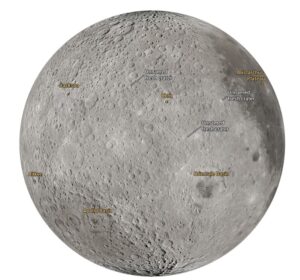
(Shortly after 2 p.m. EDT, the crew described two small, unnamed craters on the heavily pockmarked lunar surface. Calling down to Earth, they suggested provisional names for them. Just northwest of Orientale basin, highlighted above, is a crater they would like to name Integrity after their spacecraft and this historic mission. Just northeast of the Integrity crater, on the near and far side boundary, and sometimes visible from Earth, the crew suggested an unnamed crater be designated Carroll in honor of Reid Weisman’s late wife, Carroll Taylor Wiseman, who passed away on May 17, 2020. After this mission is complete, the crater name proposals will be formally submitted to the International Astronomical Union, an organization that governs the naming of celestial bodies and their surface features.NASA)

After breaking the record for human spaceflight, crew also took a moment to provisionally name a couple of craters on the Moon, noting they were able to see them with their naked eye.

Just northwest of Orientale basin highlighted above is a crater they would like to name Integrity after their spacecraft and this historic mission. Just northeast of Integrity, on the near and far side boundary, and sometimes visible from Earth, the crew suggested Carroll crater in honor of Reid Wiseman’s late wife, Carroll Taylor Wiseman. After this mission is complete, the crater name proposals will be formally submitted to the International Astronomical Union, the organization that governs the naming of celestial bodies and their surface features.

NASA astronaut Reid Wiseman is pictured with his late wife Carroll Taylor Wiseman.
Wiseman Family

1:30 p.m.

NASA’s lunar science officer briefed the crew on their science objectives for the upcoming lunar observation period.

On April 5, the science team sent the crew the final list of 30 lunar surface targets, including the Orientale basin, a nearly 600-mile-wide crater that straddles the Moon’s near and far sides. This 3.8-billion-year-old crater formed when a large object struck the lunar surface and retains clear evidence of that collision, including dramatic topography in its rings. The crew will study Orientale’s features up close and from multiple angles as they pass by.

Hertzsprung basin also is on the crew’s list of targets. Northwest of Orientale, it is a nearly 400-mile-wide crater on the Moon’s far side. An older ringed basin, Hertzsprung offers a unique contrast to Orientale because its features have been degraded by subsequent impacts. By comparing the topography of the two craters, the crew’s observations will help scientists gain insight into how lunar features evolve over geologic timescales.

1 p.m.

NASA’s live coverage of the Artemis II lunar flyby is underway on NASA+Amazon Prime, Apple TVHuluNetflixHBO Max, and Roku, alongside the agency’s 24/7 coverage on its YouTube channel. Learn how to stream NASA content through a variety of online platforms, including social media.

Coverage will include live views of the Moon from cameras mounted on Orion’s solar arrays. Image and view quality may vary throughout the lunar observation period due to distance from Earth, system limitations, and bandwidth across NASA’s communications network.

Note: The spacecraft will enter a planned communications blackout from 6:44 to 7:25 p.m. EDT as Orion passes behind the Moon. Spacecraft camera views will not be available during this time, but NASA’s live coverage will continue.

Also Read:

Artemis II Update-9, Day 3: NASA cancels first trajectory correction burn

NASA confirmed on April 4 that Artemis II’s first planned trajectory correction burn was canceled after Orion remained on its precise path to the Moon. The crew, traveling toward a scheduled lunar flyby on April 6, continues operations without the need for immediate adjustments. Mission controllers in Houston determined the spacecraft’s trajectory required no correction at this stage, with future burns still available if needed.