Artemis II Update-26, Day 10: Crew Completes Final Burn Before Splashdown

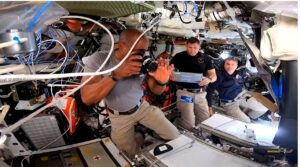
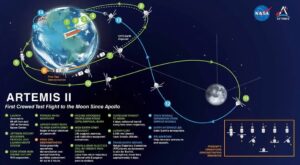
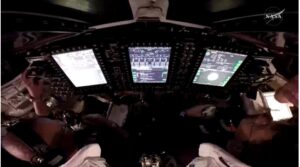
At 2:53 p.m. EDT, the Orion spacecraft ignited its thrusters for 8 seconds, producing a change in velocity of 4.2 feet-per-second and pushing Artemis II toward Earth. NASA astronauts Reid Wiseman, Victor Glover, Christina Koch and CSA (Canadian Space Agency) astronaut Jeremy Hansen reviewed procedures and monitored the spacecraft’s configuration and navigation data.

The crew continues to wrap up cabin configuration for re-entry and move into their entry checklist.

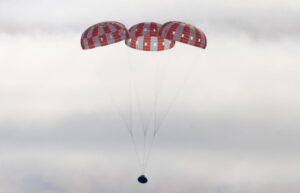
Splashdown is targeted for 8:07 p.m. EDT (5:07 p.m. PDT) off the coast of San Diego, where NASA’s recovery team will be standing by to welcome the Artemis II crew home.

Watch live return coverage on NASA+, Amazon PrimeApple TVNetflix, HBO Max, Discovery+, Peacock and Roku, starting at 6:30 p.m. Learn how to stream NASA content through a variety of online platforms, including social media. Coverage will continue until NASA and Department of War personnel safely assist the crew out of Orion and transport them to the USS John P. Murtha.


Also Read:

Deep Space Network Establishes Contact With Artemis II Spacecraft

JPL’s Mission Control Steps Up For Artemis II Deep Space Operations


Artemis II Update-24, Day 9: Second Return Correction Burn Complete

Thrusters Fire To Steer Orion Home:

At 10:53 p.m. EDT, the Orion spacecraft executed a brief nine-second thruster burn, increasing its velocity by 5.3 feet per second and nudging the Artemis II crew further along their return path to Earth.

With the maneuver complete, the crew has now crossed the halfway mark on their journey home.

Temporary Signal Loss Resolved

Roughly two hours before the burn, mission teams encountered an unexpected return link loss of signal during a data rate transition, briefly disrupting the flow of communications and telemetry from the spacecraft.

Two-way contact was subsequently restored, allowing flight controllers and crew to resume preparations for the scheduled maneuver without further delay.

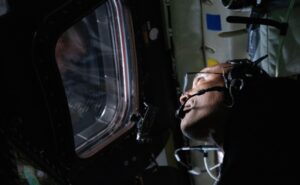
art002e016204 (April 6, 2026) – NASA astronaut and Artemis II Pilot Victor Glover pictured here in the Orion spacecraft during the Artemis II lunar flyby. Glover and his fellow crewmates spent approximately seven hours taking turns at the Orion windows capturing science data to share with their team back on Earth. At closest approach, they came within 4,067 miles of the Moon’s surface.NASA

Re-Entry Briefings And Next Steps

Earlier in the day, officials from NASA provided additional details on re-entry and splashdown procedures during a mission status briefing.

The next key milestone—a third return trajectory correction burn—is planned for April 10 at approximately 1:53 p.m., ahead of final re-entry operations.
Splashdown Target Remains On Track

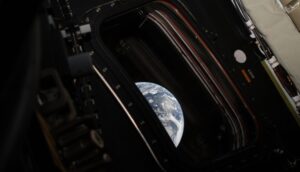
NASA continues to target splashdown at 8:07 p.m. (5:07 p.m. PDT) on Friday, April 10, off the coast of San Diego, as the Artemis II mission enters its final phase of return.

Also Read:

Artemis II Update-21, Day 7: First Return Correction Burn Complete

Monitoring over deep space network before artemis II signal acquisition

Who is Dan Florez in Artemis Mission Program

Dan Florez is one of the NASA test directors for the Exploration Ground Systems Program. The test directors are a group of 20 engineers at the agency’s Kennedy Space Center in Florida who plan and execute integrated testing for Artemis missions. Their work includes developing timelines and procedures for launch countdown, propellant loading, emergency egress, pad and launch abort scenarios, recovery operations, and more. They help lead the ground systems team in all areas of testing.

At the time of Artemis I launch, Florez and his fellow test directors had already developed the launch countdown timelines for Artemis II.

“We were really focused on loading that spacecraft with cryogenic propellants and successfully launching it. With Artemis II, we’re going to have to do all that again, but in the middle of that, we’re going to have to embed the crew timeline to get the crew safely inside the spacecraft, get all the systems checked out, and launch them into space,” Florez said. “And we have to do the same thing on the tail end through recovery. So, there’s a lot of complexities when you have the human element thrown into the operation.”

Since Artemis I, Florez has focused his work even more heavily on the human element, taking on rescue and recovery operations.

“We have to have a plan to go get to the crew if we have an abort, if we land anywhere in the world within 24 hours,” said Florez. “My role right now is to do a lot of that coordination to make sure we have all the assets and all the resources in place to get to the crew.”

When the Artemis II crew returns to Earth aboard the Orion spacecraft, Florez will be there, prepared and ready with NASA’s Landing and Recovery Team and the U.S. military.

“We have a great partnership with the military. We have the Human Spaceflight Support Office within the Air Force that support us directly for not just for recovery operations, but also for any of the rescue operations”.

Dan Florez, NASA Test Director, Exploration Ground Systems Program

Recovery operations are routinely verified and validated in what is called an underway recovery test. NASA and Navy teams board a U.S. Navy ship and travel off the coast of San Diego to test retrieving the capsule and getting the crew safely on the ship. In late February 2024, the Artemis II crew joined the recovery team’s eleventh iteration of testing called, URT-11.

“It was really great to have that perspective of having astronauts in the loop during our test operations,” said Florez. “Everywhere along the way, we got feedback from them.”

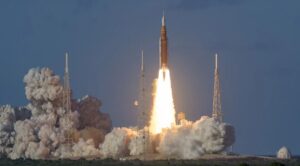
Artemis II launched at 6:35 p.m. EDT April 1, from Launch Complex 39B, sending NASA astronauts Reid Wiseman, Victor Glover, and Christina Koch, and CSA (Canadian Space Agency) astronaut Jeremy Hansen, on their approximately 10-day mission around the Moon.

A wave breaks inside the well deck of USS Somerset as teams work to recover the Crew Module Test Article (CMTA), a full scale replica of the Orion spacecraft, as they practice Artemis recovery operations during Underway Recovery Test-12 off the coast of California, Thursday, March 27, 2025. NASA/Joel Kowsky

Florez and his colleagues are prepared and ready to apply everything they tested to recover the crew.

“Watching them launch is going to be great. I’m going to be happier when they land”.

Dan Florez, NASA Test Director, Exploration Ground Systems Program

Also Read:

Deep Space Network Establishes Contact With Artemis II Spacecraft

JPL’s Mission Control Steps Up For Artemis II Deep Space Operations


Deep Space Network Establishes Contact With Artemis II Spacecraft

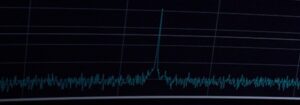
The acquisition of the radio frequency signal from the Artemis II crewed mission to the Moon by NASA’s Deep Space Network (DSN) is indicated by the peak in the data signal shown below on the computer screen.

Credits: NASA/JPL-Caltech

Soon after the mission’s launch on April 1, 2026, at 6:35 p.m. EDT, NASA’s Near Space Network led communications with the Orion capsule. Then, communications were handed off to the DSN, marking the first time in over 50 years that the network would be communicating with a crewed spacecraft traveling through deep space.

The Space Flight Operations Facility at NASA’s Jet Propulsion Laboratory in Southern California (where this photo was taken) operates the DSN, which comprises three complexes in Goldstone, California; Madrid, Spain; and Canberra, Australia. Each complex consists of several radio frequency antennas that communicate with dozens of robotic spacecraft exploring the solar system in addition to the Artemis II mission.

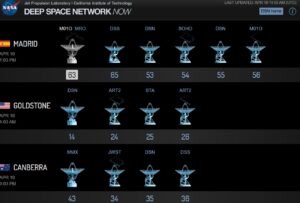
A graphical representation of the Deep Space Network’s radio frequency antennas indicate signal acquisition from NASA’s Artemis II mission to the Moon on April 1, 2026, inside the Space Flight Operations Facility at NASA’s Jet Propulsion Laboratory in Southern California. Two antennas at the Madrid Deep Space Communications Complex, Deep Space Station 54 and 56, can be seen communicating with Artemis II (the signals are labelled “EM2”, short for “Exploration Mission 2”; elsewhere they are labelled “ART2” for “Artemis II”).

A similar visualization can be found at DSN Now, which details all the missions that the network is communicating with 24 hours a day, seven days a week.

NASA

The DSN is managed by JPL for the agency’s Space Communications and Navigation program, which is located at NASA Headquarters within the Space Operations Mission Directorate. The DSN allows missions to track, send commands to, and receive scientific data from faraway spacecraft. JPL is managed by Caltech in Pasadena, California, for NASA.

Also Read:

Monitoring over deep space network before artemis II signal acquisition

JPL’s Mission Control Steps Up For Artemis II Deep Space Operations


Artemis II Update-22, Day 8: Crew conducts key tests as they begin their return journey

Artemis II moved into another critical phase of its return journey as the crew began Flight Day 8 with a focus on testing systems and preparing for reentry.


Artemis II Update-20, Day 7: ISS Crew Connects With Artemis II Astronauts Amid Busy Research Schedule

Astronauts aboard the International Space Station spoke with the Artemis II crew on April 8 following their lunar flyby, marking a rare ship-to-ship exchange between deep space and low Earth orbit. The Artemis II crew is returning to Earth after circling the Moon, while Expedition 74 astronauts continued biomedical research and mission training aboard the station. The interaction highlighted how ongoing ISS science supports future lunar missions under NASA’s Artemis program.

For a few minutes on Tuesday, two crews separated by hundreds of thousands of miles shared the same conversation.

Astronauts aboard the International Space Station (ISS) connected with their counterparts on NASA’s Artemis II mission, offering a rare moment of overlap between low Earth orbit operations and deep space travel. The call came just a day after Artemis II astronauts completed a historic lunar flyby and began their journey home.

On one side were Expedition 74 crew members Chris Williams, Jack Hathaway and Jessica Meir of NASA, along with Sophie Adenot of the European Space Agency (ESA). On the other were Artemis II astronauts Reid Wiseman, Victor Glover and Christina Koch, joined by Jeremy Hansen of the Canadian Space Agency (CSA).

The Artemis II crew is traveling aboard Orion, returning to Earth after looping around the Moon in NASA’s first crewed lunar mission in decades.

ISS and Artemis II crew exchange experiences after lunar flyby

The conversation turned quickly to comparison.

Station astronauts asked about differences between spacecraft, while Artemis II crew members described the experience of seeing the Moon up close. Christina Koch, drawing on her own time aboard the ISS, linked the two missions directly.

“Every single thing that we learned on ISS is up here,” Koch said, referring to how station-based training translates to deep space operations.

The exchange underscored a key role of the ISS within the Artemis program. The orbiting laboratory functions as a proving ground where astronauts refine procedures, test systems and adapt to long-duration spaceflight before venturing farther from Earth.

For NASA and its partners, that continuity is central. The Artemis II mission builds on lessons accumulated over years of station operations.

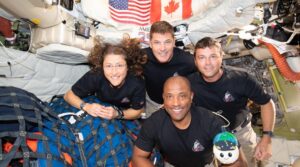
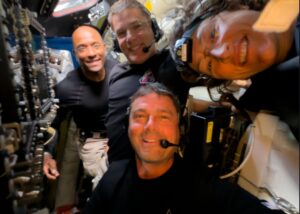
The Artemis II crew – (clockwise from left) Mission Specialist Christina Koch, Mission Specialist Jeremy Hansen, Commander Reid Wiseman, and Pilot Victor Glover – pause for a group photo with their zero gravity indicator “Rise,” inside the Orion spacecraft on their way home. Following a swing around the far side of the Moon on April 6, 2026, the crew exited the lunar sphere of influence (the point at which the Moon’s gravity has a stronger pull on Orion than the Earth’s) on April 7, and are headed back to Earth for a splashdown in the Pacific Ocean on April 10.

Space station biomedical research supports Artemis and future missions

While the call captured public attention, the station’s daily schedule remained anchored in research.

Crew members conducted a series of biomedical scans using the Ultrasound 3 device, focusing on how spaceflight affects the human body. Doctors on the ground monitored the scans in real time, looking for signs of blood clots that can form in leg veins and travel to the lungs.

Such risks have become a growing area of study as missions extend beyond short orbital stays. Data collected aboard the ISS feeds directly into planning for longer journeys, including missions to the Moon and eventually Mars.

Jessica Meir also contributed to the RelaxPro investigation, an ESA-sponsored study examining stress and immune responses in space. She collected saliva and hair samples that researchers will analyze on Earth for hormonal and immune markers.

The study explores whether mindfulness and meditation techniques can improve sleep quality and reduce stress during long-duration missions.

Cargo mission training and robotic systems testing on ISS

Operational training continued alongside scientific work.

Williams and Hathaway simulated the capture of the Cygnus XL cargo spacecraft using the Canadarm2 robotic system. Mission planners are targeting April 10 for the launch of the resupply mission aboard a **SpaceX Falcon 9 rocket, which will deliver supplies and experiments to the station.

Elsewhere, Sophie Adenot worked inside the Japanese Kibo laboratory module, setting up a compact experimental robotic arm known as TUSK. The system is being tested for precise movements at sub-millimeter levels in microgravity, a capability that could support delicate operations in future missions.

Adenot later joined fellow astronauts for emergency response simulations, rehearsing procedures designed to prepare crews for unexpected situations in orbit.

Roscosmos crew studies teamwork and fitness in orbit

Russian crew members also focused on research tied to long-duration missions.

Station commander Sergey Kud-Sverchkov and flight engineer Sergei Mikaev, both representing Roscosmos, participated in experiments examining team dynamics and physical conditioning in space. One study involved progressively complex computer tasks requiring cooperation, allowing researchers to observe how crews adapt to working together in confined environments.

The findings may influence crew training for future missions beyond Earth orbit.

Kud-Sverchkov later completed a monitored exercise session using an onboard cycle, while Mikaev assisted with health data collection.

Meanwhile, Andrey Fedyaev continued training with the European robotic arm inside the Nauka module, practicing both primary and backup control modes to ensure operational readiness.

The day’s activities reflected a layered mission environment.

On one level, astronauts pushed the boundaries of human spaceflight, exchanging insights between deep space and orbit. On another, they maintained a steady cadence of experiments and training that will shape future exploration.

The Artemis II crew moves farther from the Moon with each passing hour. The ISS crew remains in orbit, continuing work that helps make those journeys possible.

Also Read:

Artemis II Update-19, Day 7: Crew Makes Long‑Distance Call, Prepares for Earth Return

President Trump Calls Artemis II Astronauts before crew wraps up historic Lunar Flyby [Watch Videos]

Artemis II Update-19, Day 7: Crew Makes Long‑Distance Call, Prepares for Earth Return

NASA’s Artemis II crew began their return journey to Earth on April 7 after completing a historic lunar flyby a day earlier. The crew, traveling aboard the Orion spacecraft about 236,000 miles from Earth, exited the Moon’s gravitational influence and initiated return procedures. The mission includes a call with International Space Station astronauts, scientific debriefs, and a planned trajectory correction burn to refine their path home.

The Artemis II crew woke to music and a long journey ahead.

Less than 24 hours after looping around the Moon, four astronauts aboard NASA’s Orion spacecraft began the slow pivot back toward Earth. They started Flight Day 7 roughly 236,000 miles from home, still carrying the momentum of a mission that marked humanity’s first crewed lunar flyby since Apollo-era flights more than five decades ago.

The crew of National Aeronautics and Space Administration (NASA) astronauts Reid Wiseman, Victor Glover and Christina Koch, along with Canadian Space Agency (CSA) astronaut Jeremy Hansen, crossed a key threshold early in the day. At 1:23 p.m. Eastern Time, Orion exited the Moon’s sphere of influence, the region where lunar gravity dominates spacecraft motion.

That transition marked a turning point. From that moment, Earth’s gravity again became the primary force shaping Orion’s path.

A quiet shift. But a decisive one.

Lunar Selfie
Midway through their lunar observation period, the Artemis II crew members – Reid Wiseman, Victor Glover, Christina Koch, and Jeremy Hansen – pause to turn the camera around for a selfie inside the Orion spacecraft.
Image Credit: NASA

Artemis II crew ISS call with Expedition 74 astronauts

Even as the spacecraft moved farther from the Moon, the crew maintained contact with colleagues in orbit closer to Earth.

At 2:40 p.m., Artemis II astronauts connected with crew members aboard the International Space Station (ISS) for a scheduled 15-minute audio call. On the station were NASA astronauts Jessica Meir, Jack Hathaway and Chris Williams, along with European astronaut Sophie Adenot of the European Space Agency (ESA).

The exchange, broadcast via NASA’s official channels, offered a rare ship-to-ship moment between astronauts operating at vastly different distances from Earth.

Such interactions serve both technical and symbolic purposes. They allow crews to compare conditions, share observations, and reinforce coordination across missions that together define current human spaceflight.

Lunar flyby data and science debrief after close Moon pass

Attention quickly shifted from conversation to analysis.

At 3 p.m., the Artemis II crew joined science teams on the ground for a detailed debrief. The timing was deliberate. Mission planners wanted to capture observations while impressions from the lunar flyby remained fresh.

The April 6 flyby carried Orion around the far side of the Moon, a region not visible from Earth. During that pass, astronauts documented surface features, lighting conditions and spacecraft performance, data expected to support planning for future Artemis missions.

NASA has positioned Artemis II as a test flight. Its purpose extends beyond demonstration to refinement. Every observation feeds into subsequent missions, including planned crewed landings under the Artemis program.

Engineers and scientists are expected to analyze crew feedback alongside telemetry data in the coming weeks.

(April 6, 2026) – Captured by the Artemis II crew during their lunar flyby on April 6, 2026, this image shows the Moon fully eclipsing the Sun. From the crew’s perspective, the Moon appears large enough to completely block the Sun, creating nearly 54 minutes of totality and extending the view far beyond what is possible from Earth. The corona forms a glowing halo around the dark lunar disk, revealing details of the Sun’s outer atmosphere typically hidden by its brightness. Also visible are stars, typically too faint to see when imaging the Moon, but with the Moon in darkness stars are readily imaged. This unique vantage point provides both a striking visual and a valuable opportunity for astronauts to document and describe the corona during humanity’s return to deep space. The faint glow of the nearside of the Moon is visible in this image, having been illuminated by light reflected off the Earth. NASA

Orion return trajectory correction burn details and timing

The most critical maneuver of the day was scheduled for later.

At 9:03 p.m., Orion’s thrusters were set to ignite for the first of three planned return trajectory correction burns. These burns are designed to fine-tune the spacecraft’s path toward Earth, ensuring precise reentry conditions.

Christina Koch and Jeremy Hansen were assigned to monitor spacecraft systems and oversee procedures during the maneuver. Such burns require exact timing and calibration, as even small deviations at this distance can translate into large trajectory changes closer to Earth.

NASA officials have described the return phase as a series of incremental adjustments rather than a single decisive action. Each burn builds on the last, gradually aligning Orion with its targeted splashdown corridor.

Between scheduled tasks, the crew was given staggered off-duty periods.

The downtime serves operational needs as much as personal ones. Rest cycles help maintain cognitive performance, particularly as the mission enters phases requiring sustained attention and procedural accuracy.

NASA scheduled a mission status briefing later in the day to provide updates on spacecraft systems, crew health and trajectory progress.

The Artemis II mission, part of NASA’s broader Artemis program, aims to reestablish human presence beyond low Earth orbit. Unlike earlier missions confined to orbital paths around Earth, Artemis II pushes into deep space, testing systems required for sustained lunar exploration.

Flight Day 7 marked a transition from exploration to return.

The Moon receded behind them. Earth, still distant, became the destination again.

The path home had begun.

Also Read:

Artemis II Update-18, Day 6: Crew Wraps Historic Lunar Flyby

Artemis II Update-17, Day 6: Lunar Flyby Updates

Water on the moon? New Study Identifies South Pole Craters As Key Ice Locations Over Billions

An international team of scientists reported on April 7, 2026, that water on the Moon likely accumulated gradually over billions of years rather than from a single event. The study, published in Nature Astronomy, points to permanently shadowed craters near the lunar south pole as the most likely reservoirs of ice. Using data from NASA missions and simulations, researchers identified older craters as prime targets for future exploration and resource use.

For decades, scientists have known that water may exist on the Moon. What remained unclear was how it got there and why it appears unevenly spread across the surface.

A new study published April 7 in Nature Astronomy offers a clearer picture. The research suggests that lunar water did not arrive in a single dramatic event, such as a comet impact, but instead accumulated slowly over billions of years.

The study was led by Oded Aharonson of the Weizmann Institute of Science, with contributions from Paul Hayne at the University of Colorado Boulder and collaborators including Norbert Schörghofer. Their findings draw on years of observations and modeling to explain one of lunar science’s longest-standing questions.

Lunar south pole ice locations and cold traps explained

Evidence of water on the Moon has come primarily from missions led by NASA, including the Lunar Reconnaissance Orbiter. Instruments aboard the spacecraft detected signals consistent with ice inside deep craters near the Moon’s south pole. These craters, known as “cold traps,” remain in permanent shadow and can preserve ice for billions of years.

Observations from the orbiter’s Lyman Alpha Mapping Project instrument indicated that ice is not evenly distributed. Some craters appear rich in ice, while others show little to none. That patchy pattern has puzzled scientists for years.

The new study attempts to explain that uneven distribution by looking back at the Moon’s geological history. The researchers combined temperature data from the orbiter’s Diviner instrument with computer simulations that reconstructed how the Moon’s orientation has shifted over time.

The Moon’s tilt relative to Earth has not always been constant. As it shifted, craters that are permanently shadowed today may once have received sunlight, while others remained dark for much longer periods. This variation appears to have influenced where ice could accumulate and persist.

“It looks like the moon’s oldest craters also have the most ice,” Hayne said, noting that this pattern suggests a slow and continuous buildup of water over as much as 3 to 3.5 billion years.

How water may have formed and accumulated on the Moon

The study does not identify a single source of lunar water, but it narrows down the likely mechanisms. Researchers ruled out the idea that most of the Moon’s water arrived in one large delivery, such as a massive comet impact.

Instead, multiple processes likely contributed over time. Volcanic activity in the Moon’s distant past may have released water from its interior. Comets and asteroids could have delivered additional water through smaller impacts. Hydrogen from the solar wind may also have reacted with oxygen in lunar soil to form water molecules.

“Through the solar wind, a constant stream of hydrogen bombards the moon, and some of that hydrogen can be converted to water on the lunar surface,” Hayne said.

The researchers found that the craters that have remained in shadow the longest are also those most likely to contain ice today. One example is Haworth Crater near the Moon’s south pole, which may have been in continuous darkness for more than 3 billion years.

These findings could guide future lunar missions. Identifying where ice is most likely to be concentrated can help scientists and engineers plan landing sites and exploration strategies.

Water on the Moon is not just a scientific curiosity. It has practical implications for long-term human exploration. Ice deposits could be mined for drinking water, breathable oxygen and even rocket fuel by separating hydrogen and oxygen atoms.

“Finding water beyond Earth in liquid and usable form is one of the most important challenges in astronomy,” Aharonson said in a statement released by his institute.

Future missions aim to confirm lunar ice deposits

The study highlights the need for direct sampling to confirm the origin and distribution of lunar water. Observational data and simulations can narrow possibilities, but they cannot fully resolve the question.

Hayne and his colleagues are working on a new instrument, the Lunar Compact Infrared Imaging System, designed to study surface ice in greater detail. The instrument is expected to be deployed near the Moon’s south pole around 2027 as part of upcoming missions.

“Ultimately, the question of the source of the moon’s water will only be solved by sample analysis,” Hayne said. “We will need to go to the moon to analyze those samples there or find ways to bring them from the moon back to Earth.”

As space agencies and private companies accelerate plans for lunar exploration, the findings provide a clearer map of where to look. The Moon’s darkest craters, once seen as inaccessible voids, are emerging as some of the most valuable real estate beyond Earth.

Also Read:

What are the conditions suitable for life on distant moons

Artemis II Mission Launch: NASA Sends Crew on First Moon Flyby in 50 Years

Artemis II Update-16, Day 6: Crew Nears Historic Lunar Flyby

The four astronauts aboard NASA’s Artemis II mission woke up  to a milestone few humans have experienced. Less than 19,000 miles from the Moon, they began final preparations for a lunar flyby that will mark humanity’s return to deep space after more than five decades.


Artemis II Update-12, Day 4: Astronauts Hand-Fly Orion, Sharpen Lunar Flyby Plan in Deep Space

Astronauts aboard Artemis II completed a 41-minute manual piloting test of the Orion spacecraft on Flight Day 4, taking turns controlling the vehicle in deep space. The demonstration, carried out tested thruster modes and maneuvering capabilities as the crew also reviewed targets for an upcoming lunar flyby. The mission continues on a stable trajectory toward the Moon, with further piloting tests planned later in the flight.


Artemis II Update-10, Day 3: Crew Prepares Orion Cabin As Lunar Flyby Nears Milestone

The crew of Artemis II moved into preparation mode on April 6 as their spacecraft, Orion spacecraft, continued its trajectory toward a lunar flyby. The outbound trajectory correction burn was canceled after flight controllers confirmed the spacecraft remained on course. Astronauts focused on cabin readiness, medical drills, and system checks as the mission passed its halfway point to the Moon.

The four astronauts aboard Artemis II are settling into the rhythms of deep space travel as their spacecraft closes in on a critical phase of the mission. By Monday afternoon, the crew had shifted focus from major propulsion events to preparing the Orion capsule for sustained lunar observation, a period that will define the mission’s operational success.

“We all had a collective expression of joy at that… We can see the Moon out of the docking hatch right now. It’s a beautiful sight.” –Christina KOCH, NASA Astronaut (Artemis II Mission)

Mission controllers at the NASA Johnson Space Center confirmed that the first planned outbound trajectory correction burn was no longer necessary. The spacecraft’s path, they said, remained precise enough to meet mission parameters without adjustment. That decision removed one of three scheduled trajectory maneuvers designed to fine-tune Orion’s route to the Moon.

Inside the capsule, the change translated into a different kind of workload. Rather than executing propulsion tasks, the crew began configuring their living and observation environment for the upcoming lunar flyby window.

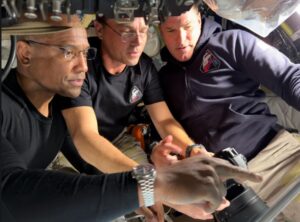
Victor Glover, Jeremy Hansen, and Reid Wiseman work together inside the Orion spacecraft on their way to the Moon.

Orion cabin preparation for lunar observation phase

Cabin preparation is not cosmetic. It involves reconfiguring equipment, securing loose items, and ensuring all observation tools are accessible during the Moon flyby. Astronauts must also adjust lighting, camera systems, and window access points to capture scientific data and imagery.

NASA officials have described this phase as one of the most human-centered parts of the mission. The spacecraft, which has operated largely as a transport vehicle until now, becomes a workspace and observation platform as it approaches lunar proximity.

Crew members spent part of the day organizing onboard equipment and verifying that all systems required for observation are functioning within expected parameters. This includes environmental controls, onboard computing systems, and manual override mechanisms.

Alongside technical preparation, astronauts continued routine health maintenance. Exercise sessions remain a daily requirement to counter the effects of microgravity on muscles and bone density. Medical response drills were also conducted, simulating potential emergencies that could arise far from Earth.

These drills are not theoretical. NASA requires crews to demonstrate the ability to respond to medical situations independently, given the communication delays and physical distance involved in deep space missions.

Deep space systems testing and mission timeline adjustments

The crew also tested Orion’s emergency communications system, a critical component designed to maintain contact with Earth under degraded conditions. Engineers on the ground monitor these tests closely, using them to validate system redundancy and resilience.

Deep space communication differs significantly from low Earth orbit operations. Signal delays increase, and the margin for error narrows. Testing ensures that backup systems can function if primary channels fail.

NASA’s decision to cancel the trajectory correction burn underscores the precision of the spacecraft’s navigation systems. According to mission control, Orion’s current trajectory aligns closely with pre-flight calculations, reducing the need for mid-course corrections.

That precision has operational consequences. Fewer burns mean conservation of fuel and reduced mechanical stress on propulsion systems, both of which can extend mission flexibility.

The Artemis II timeline continues to evolve in real time. While the crew prepared for rest around 3 a.m. Central Daylight Time, mission control scheduled their wake-up for the next operational phase. The timeline reflects both planned activities and adjustments based on spacecraft performance.

Despite the technical complexity, daily life aboard Orion follows a structured routine. Sleep cycles, exercise periods, and work blocks are carefully scheduled to maintain crew health and efficiency.

For the astronauts, the mission has now entered a quieter but equally demanding stage. The high-energy launch and orbital maneuvers have given way to sustained operations, where attention to detail becomes critical.

The lunar flyby, expected soon, will serve as both a technical demonstration and a symbolic milestone. Artemis II is the first crewed mission under NASA’s Artemis program, which aims to return humans to the Moon and establish a long-term presence.

The mission builds on decades of spaceflight experience while introducing new systems designed for deep space exploration. Orion, developed specifically for missions beyond low Earth orbit, represents a shift in spacecraft design priorities, emphasizing autonomy, durability, and crew safety over extended durations.

As the spacecraft moves closer to the Moon, the crew’s preparations inside the cabin will shape how effectively they can carry out observation tasks. Every adjustment made now, from equipment placement to system checks, feeds into that moment.

For mission control teams in Houston, the cancellation of a major burn signals confidence in both the spacecraft and the planning behind it. For the astronauts, it means more time to prepare for the view ahead.

The Moon is no longer a distant objective. It is approaching, steadily, on a trajectory that no longer requires correction.

Also Read:

Artemis II Update-9, Day 3: NASA cancels first trajectory correction burn

Artemis II Update-8, Day 3 : Crew prepares for first correction burn, readies lunar flyby tasks

Artemis II Update-9, Day 3: NASA cancels first trajectory correction burn

NASA confirmed on April 4 that Artemis II’s first planned trajectory correction burn was canceled after Orion remained on its precise path to the Moon. The crew, traveling toward a scheduled lunar flyby on April 6, continues operations without the need for immediate adjustments. Mission controllers in Houston determined the spacecraft’s trajectory required no correction at this stage, with future burns still available if needed.


Artemis II Update-8, Day 3 : Crew prepares for first correction burn, readies lunar flyby tasks

NASA’s Artemis II crew began Flight Day 3 on April 4 after departing Earth’s orbit earlier in the mission, preparing for their first trajectory correction burn as Orion heads toward the Moon. The four astronauts, currently nearly 100,000 miles from Earth, are also training for lunar observations scheduled during a flyby on April 6. The day’s schedule includes spacecraft operations, medical drills, and communication system tests as the mission advances deeper into space.


TOI-5205 b Exoplanet Around Red Dwarf Reveals Unusual Atmosphere: JWST Study

Astronomers studying the exoplanet TOI-5205 b have found unexpected atmospheric properties that challenge existing models of planet formation. Using the James Webb Space Telescope, researchers observed the Jupiter-sized planet orbiting a small red dwarf star and detected unusually low heavy-element content. The findings, published this week, suggest new mechanisms may shape how giant planets form around smaller stars.


Astronomers Spot “Sneezing” Baby Stars Creating Massive Rings In Space

Astronomers in Japan have identified a new phase in early star formation, where young protostars release magnetic energy and form large gas rings. The study, published in The Astrophysical Journal Letters, used observations from the Atacama Large Millimeter/submillimeter Array in Chile to examine a stellar nursery in the Taurus Molecular Cloud. Researchers say the findings help explain how newborn stars shed excess energy and stabilize during their earliest stages.


Artemis II Crew and Ground Teams Successfully Troubleshoot Orion’s Toilet Glitch

NASA confirmed the Artemis II crew resolved a toilet system fault aboard the Orion spacecraft on April 2 while in Earth orbit. The issue, first detected as a blinking fault light on April 1, was addressed through coordinated troubleshooting with mission control in Houston. The fix comes ahead of a scheduled perigee raise burn, a maneuver that will adjust Orion’s orbit for future deep space operations.

A minor but essential system aboard NASA’s Artemis II spacecraft briefly drew attention this week. It was not propulsion or navigation. It was the toilet.

Astronauts aboard Orion, the capsule named Integrity, reported a blinking fault light tied to the waste management system on April 1. Within hours, engineers on the ground and the crew in orbit worked through the problem together. By the next mission update, the system was back to normal operation.

The episode highlights how even routine spacecraft functions demand precision during crewed missions led by the National Aeronautics and Space Administration.

Orion spacecraft toilet issue and in-flight troubleshooting

The issue first surfaced ahead of a planned apogee raise burn, when the crew noticed a blinking fault indicator linked to Orion’s toilet system. Such warning signals are designed to flag irregularities early, even when the system continues functioning.

NASA’s mission control team at the Johnson Space Center in Houston began reviewing telemetry immediately. Engineers assessed system data while communicating directly with the astronauts to isolate the cause.

The troubleshooting process involved both software diagnostics and procedural checks inside the spacecraft. The agency did not report any hardware damage or safety risk tied to the issue.

By April 2, NASA confirmed that normal functionality had been restored. The resolution ensured that one of the spacecraft’s life-support subsystems remained fully operational as the mission continued.

Waste management systems in microgravity rely on airflow, pressure control, and precise mechanical components. Even minor anomalies require immediate attention, as they can affect crew comfort and long-duration mission readiness.

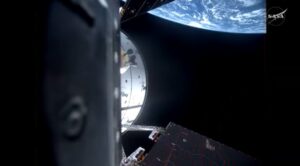
A view of the Earth’s horizon from NASA’s Orion spacecraft as it orbits above the planet during the first hours of the Artemis II test flight. NASA astronauts Commander Reid Wiseman, Pilot Victor Glover, and Mission Specialist Christina Koch, and CSA (Canadian Space Agency) astronaut Mission Specialist Jeremy Hansen, launched at 6:35 p.m. EDT on Wednesday, April 1, 2026, on an approximately 10-day mission around the Moon and back to Earth.
NASA 

Perigee raise burn timing and mission trajectory planning

With the issue resolved, the Artemis II crew is preparing for the next major step in the mission timeline. The perigee raise burn is scheduled after a planned rest period.

Perigee refers to the lowest point of a spacecraft’s orbit around Earth. Raising it changes the orbital shape, making it more stable and better suited for future maneuvers.

This burn follows an earlier apogee raise maneuver, which increased Orion’s highest orbital point. Together, the two burns define the spacecraft’s initial orbit and test its propulsion system under operational conditions.

NASA scheduled a four-hour rest period for the crew before the maneuver. Astronauts are set to wake at 7 a.m. Eastern Time on April 2 to begin preparations. After completing post-burn procedures, they will return to a second sleep cycle later in the morning.

The sequence reflects the structured rhythm of human spaceflight, where operational tasks alternate with carefully timed rest to maintain performance.

The Artemis II mission continues to build toward its broader objective: validating systems for future missions that will carry astronauts beyond Earth orbit and toward the Moon.

Also Read:

Artemis II Mission Launch: NASA Sends Crew on First Moon Flyby in 50 Years

Artemis II Update-1: Orion Completes Proximity Operations, Perigee Burn Next

Artemis II Update-3: Apogee Raise burn complete, Crew prepares critical Proximity Test

NASA confirmed the Artemis II crew completed the apogee raise burn on April 2, increasing Orion’s orbital high point. The mission now transitions toward a proximity operations demonstration that will test manual spacecraft control near another object. Engineers continue to monitor a minor onboard system issue as the crew prepares for the next phase.


Artemis II Update-2 : Perigee Raise Burn Completed with brief Communications Loss, NASA Probes

NASA confirmed the Artemis II crew completed a perigee raise maneuver on April 2, refining Orion’s orbit around Earth. A brief communications loss occurred shortly after the burn but was quickly resolved with no reported impact on crew safety. The agency will hold a press conference from Kennedy Space Center as the mission prepares for its next orbital milestone.


Artemis II Update-1: Orion Completes Proximity Operations, Perigee Burn Next

Astronauts aboard NASA’s Artemis II mission completed a key proximity operations test on April 2 while orbiting Earth. The maneuver involved controlled movements around a detached rocket stage to evaluate spacecraft handling. With CubeSat deployments ahead and a minor onboard system issue under review, the crew is now preparing for a perigee raise burn to refine Orion’s orbit.


Artemis II Mission Launch: NASA Sends Crew on First Moon Flyby in 50 Years

The National Aeronautics and Space Administration launched four astronauts on April 2 from Kennedy Space Center in Florida aboard the Artemis II mission. The crew is set for a 10-day test flight around the Moon, marking the first human lunar flyby since the Apollo era. The mission aims to validate spacecraft systems and pave the way for future Moon landings and Mars exploration.