NASA Hosts National Space Council Meeting, Vice President Kamala Harris Chairs Event

Vice President Kamala Harris highlighted the importance of climate, human spaceflight, and STEM education during the Biden-Harris Administration’s second National Space Council meeting Friday, held at NASA’s Johnson Space Center in Houston.

“For generations, with our allies and partners around the globe, America has led our world in the exploration and use of space,” said Harris. “Our leadership has been guided by a set of fundamental principles – cooperation, security, ambition, and public trust – which is the recognition, of course, that space can and must be protected for the benefit of all people.

There is so much we still don’t know and so much we still haven’t done – space remains a place of undiscovered and unrealized opportunity. Our test and our responsibility is to work together to guide humanity forward into this new frontier and to make real the incredible potential of space for all people.”

National Space Council Meeting led by Chairwoman, Vice President Kamala Harris. Photo Date: September 9, 2022. Location: Building 9NW, SVMF. Photographer: Robert Markowitz.

For more than 50 years, NASA satellites have provided open-source and publicly available data on Earth’s land, water, temperature, weather, and climate. Improving access to key climate information is a priority for the agency. Building on his previous announcement, NASA Administrator Bill Nelson released the first concept, and shared a new video for the Earth Information Center. The center will allow the public to see how the Earth is changing and guide decision makers to mitigate, adapt, and respond to climate change.

“Just like we use mission control to monitor operations during spaceflight, we’re embarking on this effort to monitor conditions here on our home planet, and it will be available to everyone in an easy-to-access format,” Nelson said.

Planning for the Earth Information Center is underway with the initial phase providing an interactive visual display of imagery and data from NASA and other government agencies. NASA Headquarters plans to house this initial interactive display with goals to expand in person and virtual access over the next five years.

The Vice President also underscored the important research conducted on the International Space Station that will enable long duration stays on the Moon and future human missions to Mars, in addition to benefits to life here on Earth.

NASA/Photo: Nasa.gov

NASA uses the International Space Station to conduct critical research on the risks associated with future Mars missions – space radiation, isolation, and distance from Earth, just to name a few. It’s also a testbed to develop the technologies we’ll need for long duration stays on the Moon, where we will build an Artemis Base Camp on the surface and Gateway outpost in lunar orbit,” Nelson said. “Research on the space station demonstrates that the benefits of microgravity are not just for discovery. We also develop new technologies that improve life on Earth, like treatments for cancer.”

In conjunction with the meeting, NASA announced a new Space Grant K-12 Inclusiveness and Diversity in STEM (SG KIDS) opportunity that will award more than $4 million to institutions across the U.S. to help bring the excitement of NASA and STEM to traditionally underserved and underrepresented groups of middle and high school students. The announcement is a part of a broader set of commitments made by public, private, and philanthropic partners announced by the Vice President to help in the recruitment and development of the next generation of the space workforce.

SG KIDS also addresses the White House Executive Order on Advancing Racial Equity and Support for Underserved Communities Through the Federal Government, as well as NASA Administrator Bill Nelson’s focus on providing authentic STEM opportunities to K-12 students.

While at NASA’s Johnson Space Center, Vice President Harris toured the agency’s mission control with Nelson and Johnson Center Director Vanessa Wyche. The Vice President also spoke with NASA astronauts Bob Hines, Kjell Lindgren, and Jessica Watkins, living and working aboard the International Space Station about how their research benefits life on Earth, supports long duration space flight, and protects our planet.

The Vice President also received a tour of the Space Vehicle Mockup Facility (SVMF), where space flight crews and their support personnel receive world class training on high-fidelity hardware for real-time mission support. The SVMF consists of space station, Orion, Commercial vehicle mockups, part-task trainers and rack interfaces, a Precision Air Bearing Floor, and a Partial Gravity Simulator.

A recording of the full National Space Council meeting is available online at:

https://go.nasa.gov/3eEGxEW

NASA’s Hubble finds spiraling stars ‘NGC 346’, providing window into early universe

Nature likes spirals – from the whirlpool of a hurricane, to pinwheel-shaped protoplanetary disks around newborn stars, to the vast realms of spiral galaxies across our universe.

Now astronomers are bemused to find young stars that are spiraling into the center of a massive cluster of stars in the Small Magellanic Cloud, a satellite galaxy of the Milky Way.

The outer arm of the spiral in this huge, oddly shaped stellar nursery called NGC 346 may be feeding star formation in a river-like motion of gas and stars. This is an efficient way to fuel star birth, researchers say.

The Small Magellanic Cloud has a simpler chemical composition than the Milky Way, making it similar to the galaxies found in the younger universe, when heavier elements were more scarce. Because of this, the stars in the Small Magellanic Cloud burn hotter and so run out of their fuel faster than in our Milky Way.

Though a proxy for the early universe, at 200,000 light-years away the Small Magellanic Cloud is also one of our closest galactic neighbors.

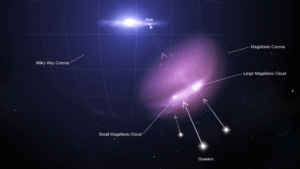
The massive star cluster NGC 346, located in the Small Magellanic Cloud, has long intrigued astronomers with its unusual shape. This shape is partly due to stars and gas spiraling into the center of this cluster in a river-like motion.
ILLUSTRATION: NASA, ESA, Andi James (STScI)

Learning how stars form in the Small Magellanic Cloud offers a new twist on how a firestorm of star birth may have occurred early in the universe’s history, when it was undergoing a “baby boom” about 2 to 3 billion years after the big bang (the universe is now 13.8 billion years old).

The new results find that the process of star formation there is similar to that in our own Milky Way.

Only 150 light-years in diameter, NGC 346 boasts the mass of 50,000 Suns. Its intriguing shape and rapid star formation rate has puzzled astronomers. It took the combined power of NASA’s Hubble Space Telescope and the European Southern Observatory’s Very Large Telescope (VLT) to unravel the behavior of this mysterious-looking stellar nesting ground.

“Stars are the machines that sculpt the universe. We would not have life without stars, and yet we don’t fully understand how they form,” explained study leader Elena Sabbi of the Space Telescope Science Institute in Baltimore. “We have several models that make predictions, and some of these predictions are contradictory. We want to determine what is regulating the process of star formation, because these are the laws that we need to also understand what we see in the early universe.”

Researchers determined the motion of the stars in NGC 346 in two different ways. Using Hubble, Sabbi and her team measured the changes of the stars’ positions over 11 years. The stars in this region are moving at an average velocity of 2,000 miles per hour, which means that in 11 years they move 200 million miles. This is about 2 times the distance between the Sun and the Earth.

Tarantula Nebula star-forming region in a new light, including tens of thousands of never-before-seen young stars that were previously shrouded in cosmic dust./Photo:NASA, ESA, CSA, STScI, Webb ERO Production Team

But this cluster is relatively far away, inside a neighboring galaxy. This means the amount of observed motion is very small and therefore difficult to measure. These extraordinarily precise observations were possible only because of Hubble’s exquisite resolution and high sensitivity. Also, Hubble’s three-decade-long history of observations provides a baseline for astronomers to follow minute celestial motions over time.

The second team, led by Peter Zeidler of AURA/STScI for the European Space Agency, used the ground-based VLT’s Multi Unit Spectroscopic Explorer (MUSE) instrument to measure radial velocity, which determines whether an object is approaching or receding from an observer.

“What was really amazing is that we used two completely different methods with different facilities and basically came to the same conclusion, independent of each other,” said Zeidler. “With Hubble, you can see the stars, but with MUSE we can also see the gas motion in the third dimension, and it confirms the theory that everything is spiraling inwards.”

But why a spiral?

“A spiral is really the good, natural way to feed star formation from the outside toward the center of the cluster,” explained Zeidler. “It’s the most efficient way that stars and gas fueling more star formation can move towards the center.”

Half of the Hubble data for this study of NGC 346 is archival. The first observations were taken 11 years ago. They were recently repeated to trace the motion of the stars over time. Given the telescope’s longevity, the Hubble data archive now contains more than 32 years of astronomical data powering unprecedented, long-term studies.

“The Hubble archive is really a gold mine,” said Sabbi. “There are so many interesting star-forming regions that Hubble has observed over the years. Given that Hubble is performing so well, we can actually repeat these observations. This can really advance our understanding of star formation.”

Observations with NASA’s James Webb Space Telescope should be able to resolve lower-mass stars in the cluster, giving a more holistic view of the region. Over Webb’s lifespan, astronomers will be able to repeat this experiment and measure the motion of the low-mass stars. They could then compare the high-mass stars and the low-mass stars to finally learn the full extent of the dynamics of this nursery.

The Hubble Space Telescope is a project of international cooperation between NASA and ESA. NASA’s Goddard Space Flight Center in Greenbelt, Maryland, manages the telescope. The Space Telescope Science Institute (STScI) in Baltimore conducts Hubble science operations. STScI is operated for NASA by the Association of Universities for Research in Astronomy, in Washington, D.C.

US Postal Service Celebrates NASA’s Webb Telescope With New Postal Stamp

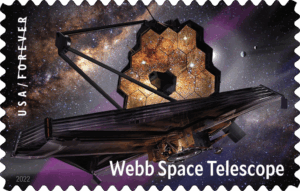
The U.S. Postal Service will issue a stamp celebrating NASA’s new James Webb Space Telescope, the largest, most powerful, and most complex science telescope ever put in space. The stamp, which features an illustration of the observatory, will be dedicated in a ceremony Thursday, Sept. 8, at the Smithsonian’s National Postal Museum in Washington.

“When anyone who uses these stamps looks at this telescope, I want them to see what I see: its incredible potential to reveal new and unexpected discoveries that help us understand the origins of the universe, and our place in it,” said NASA Associate Administrator Bob Cabana. “This telescope is the largest international space science program in U.S. history, and I can’t wait to see the scientific breakthroughs it will enable in astronomy.”

Webb, a mission led by NASA in partnership with ESA (European Space Agency) and CSA (Canadian Space Agency), launched Dec. 25, 2021, from Europe’s Spaceport in French Guiana. Over the following months, Webb traveled to its destination nearly one million miles (1.5 million kilometers) away from Earth, underwent weeks of complex deployments to unfold into its final configuration, and prepared its mirrors and science instruments to capture never-before-seen views of the universe.

The U.S. Postal Service will issue a stamp highlighting NASA’s James Webb Space Telescope on Sept. 8, 2022. U.S. Postal Service Art Director Derry Noyes designed the stamp using existing art by James Vaughan and an image provided by NASA and the Space Telescope Science Institute.
Credits: U.S. Postal Service

NASA released Webb’s first full-color images and spectra July 12 – providing a first look at the observatory’s powerful capabilities. The U.S. Postal Service stamp honors these achievements as Webb continues its mission to explore the unknown in our universe and study every phase in cosmic history.

“I am excited to add this beautiful stamp to our collection, as we watch from the ground as humanity’s newest and most capable telescope unlocks the greatest secrets of our cosmos that have been waiting to be revealed since the beginning of time,” said Thomas Zurbuchen, associate administrator for NASA’s Science Mission Directorate. “The Webb Telescope represents the start to a new era of what we can accomplish for the benefit of all.”

The stamp features an artist’s digital illustration of Webb against a background of stars. The selvage around each set of stamps showcases a sharp image of a star, captured while setting up the telescope in space to confirm precise alignment of Webb’s 18 hexagonal mirror segments.

The U.S. Postal Service’s first day of issue event is free and open to the public on Thursday, Sept. 8, at 11 a.m. EDT at the National Postal Museum. NASA Associate Administrator Bob Cabana; Lee Feinberg, Webb optical telescope element manager at NASA’s Goddard Space Flight Center; and Erin Smith, Webb deputy observatory project scientist at NASA Goddard will be among the speakers providing remarks.

NASA/Photo: Nasa.gov

To follow along with NASA’s Webb Telescope as it begins its mission to unfold the infrared universe, visit:
https://www.nasa.gov/webb

The James Webb Space Telescope is the world’s premier infrared space science observatory. Webb will solve mysteries in our solar system, look beyond to distant worlds around other stars, and probe the mysterious structures and origins of our universe and our place in it. Webb is an international program led by NASA with its partners, ESA (European Space Agency) and CSA (Canadian Space Agency).

30 Doradus: Thousands of stunning young stars in “cosmic tarantula”captured by James Webb telescope

Thousands of never-before-seen young stars spotted in a stellar nursery called 30 Doradus, captured by NASA’s James Webb Space Telescope, called Tarantula Nebula owing to its appearance in dusty filaments.

The nebula has long been a favorite for astronomers studying star formation and the  Webb has been revealing beautiful distant background galaxies, as well as the detailed structure and composition of the nebula’s gas and dust ever since it’s started capturing the deep space.

At only 161,000 light-years away in the Large Magellanic Cloud galaxy, the Tarantula Nebula is the largest and brightest star-forming region in the Local Group, the galaxies nearest our Milky Way. It is home to the hottest, most massive stars known. Astronomers focused three of Webb’s high-resolution infrared instruments on the Tarantula. Under the lens of Webb’s Near-Infrared Camera (NIRCam), the region resembles a burrowing tarantula’s home, lined with its silk.

The nebula’s cavity centered in the image above has been hollowed out by blistering radiation from a cluster of massive young stars, which sparkle pale blue in the image. Only the densest surrounding areas of the nebula resist erosion by these stars’ powerful stellar winds, forming pillars that appear to point back toward the cluster. These pillars contain forming protostars, which will eventually emerge from their dusty cocoons and take their turn shaping the nebula.

Caption: Nestled in the center of the Tarantula Nebula in the Large Magellanic Cloud is the largest star yet discovered, astronomers have produced the sharpest image ever of this star.  Photo:Observatory/NOIRLab/NSF/AURA Acknowledgment

Webb’s Near-Infrared Spectrograph (NIRSpec) caught one very young star doing precisely emerging out of the dust. Astronomers previously thought this star might be a bit older and already in the process of clearing out a bubble around itself. However, NIRSpec showed that the star was only just beginning to emerge from its pillar and still maintained an insulating cloud of dust around itself. Without Webb’s high-resolution spectra at infrared wavelengths, this episode of star formation-in-action could not have been revealed.

The region takes on a different appearance when viewed in the longer infrared wavelengths detected by Webb’s Mid-infrared Instrument (MIRI). The hot stars fade, and the cooler gas and dust glow. Within the stellar nursery clouds, points of light indicate embedded protostars, still gaining mass.

While shorter wavelengths of light are absorbed or scattered by dust grains in the nebula, and therefore never reach Webb to be detected, longer mid-infrared wavelengths penetrate that dust, ultimately revealing a previously unseen cosmic environment.
Caption: NASA’s James Webb Space Telescope

One of the reasons the Tarantula Nebula is interesting to astronomers is that the nebula has a similar type of chemical composition as the gigantic star-forming regions observed at the universe’s “cosmic noon,” when the cosmos was only a few billion years old and star formation was at its peak. Star-forming regions in our Milky Way galaxy are not producing stars at the same furious rate as the Tarantula Nebula, and have a different chemical composition.

Caption: In this mosaic image displays the Tarantula Nebula star, including tens of thousands of never-before-seen young stars that were previously shrouded in cosmic dust. The most active region appears to sparkle with massive young stars, appearing pale blue./Photo:NASA

This makes the Tarantula the closest (i.e., easiest to see in detail) example of what was happening in the universe as it reached its brilliant high noon. Webb will provide astronomers the opportunity to compare and contrast observations of star formation in the Tarantula Nebula with the telescope’s deep observations of distant galaxies from the actual era of cosmic noon.


First underground radar images from Mars Perseverance rover reveal some surprises

Key takeaways:

  • Roving the Red Planet. Perseverance landed on Mars in February 2021 and has been gathering data on the planet’s geology and climate and searching for signs of ancient life.​​​​​​
  • What lies beneath. The rover’s subsurface radar experiment, co-led by UCLA’s David Paige, has returned images showing unexpected variations in rock layers beneath the Jezero crater.
  • Probing the past. The variations could indicate past lava flows or possibly a river delta even older than the one currently being explored on the crater floor.

After a tantalizing year-and-a-half wait since NASA’s Mars Perseverance rover touched down on our nearest planetary neighbor, new data is arriving — and bringing with it a few surprises.

The rover, which is about the size of car and carries seven scientific instruments, has been probing Mars’ 30-mile-wide Jezero crater, once the site of a lake and an ideal spot to search for evidence of ancient life and information about the planet’s geological and climatic past.

Rendering of Perseverance, whose RIMFAX technology is exploring what lies beneath the Martian surface. Photo: NASA/JPL/Caltech/FFI

In a paper published today in the journal Science Advances, a research team led by UCLA and the University of Oslo reveals that rock layers beneath the crater’s floor, observed by the rover’s ground-penetrating radar instrument, are unexpectedly inclined. The slopes, thicknesses and shapes of the inclined sections suggest they were either formed by slowly cooling lava or deposited as sediments in the former lake.

Perseverance is currently exploring a delta on the western edge of the crater, where a river once fed the lake, leaving behind a large deposit of dirt and rocks it picked up along its course. As the rover gathers more data, the researchers hope to clear up the complex history of this part of the Red Planet.

“We were quite surprised to find rocks stacked up at an inclined angle,” said David Paige, a UCLA professor of Earth, planetary and space sciences and one of the lead researchers on the Radar Imager for Mars Subsurface Experiment, or RIMFAX. “We were expecting to see horizontal rocks on the crater floor. The fact that they are tilted like this requires a more complex geologic history. They could have been formed when molten rock rose up towards the surface, or, alternatively, they could represent an older delta deposit buried in the crater floor.”

Paige said that most of the evidence gathered by the rover so far points to an igneous, or molten, origin, but based on the RIMFAX data, he and the team can’t yet say for certain how the inclined layers formed. RIMFAX obtains a picture of underground features by sending bursts of radar waves below the surface, which are reflected by rock layers and other obstacles. The shapes, densities, thicknesses, angles and compositions of underground objects affect how the radar waves bounce back, creating a visual image of what lies beneath.

During Perseverance’s initial 3-kilometer traverse, the instrument has obtained a continuous radar image that reveals the electromagnetic properties and bedrock stratigraphy — the arrangement of rock layers — of Jezero’s floor to depths of 15 meters, or about 49 feet. The image reveals the presence of ubiquitous layered rock strata, including those that are inclined at up to 15 degrees. Compounding the mystery, within those inclined areas are some perplexing highly reflective rock layers that in fact tilt in multiple directions.

“RIMFAX is giving us a view of Mars stratigraphy similar to what you can see on Earth in highway road cuts, where tall stacks of rock layers are sometimes visible in a mountainside as you drive by,” Paige explained. “Before Perseverance landed, there were many hypotheses about the exact nature and origin of the crater floor materials. We’ve now been able to narrow down the range of possibilities, but the data we’ve acquired so far suggest that the history of the crater floor may be quite a bit more complicated than we had anticipated.”

The data collected by RIMFAX will provide valuable context to rock samples Perseverance is collecting, which will eventually be brought back to Earth.

“RIMFAX is giving us the backstory of the samples we’re going to analyze. It’s exciting that the rover’s instruments are producing data and we’re starting to learn, but there’s a lot more to come,” Paige said. “We landed on the crater floor, but now we’re driving up on the actual delta, which is the main target of the mission. This is just the beginning of what we’ll hopefully soon know about Mars.”

The paper, “Ground penetrating radar observations of subsurface structures in the floor of Jezero crater, Mars,” is one of three simultaneously published papers discussing some of the first data from Perseverance.

Explore the Solar System With NASA’s New, Improved 3D ‘Eyes’

The agency’s newly upgraded “Eyes on the Solar System” visualization tool includes Artemis I’s trajectory along with a host of other new features.

NASA has revamped its “Eyes on the Solar System” 3D visualization tool, making interplanetary travel easier and more interactive than ever. More than two years in the making, the update delivers better controls, improved navigation, and a host of new opportunities to learn about our incredible corner of the cosmos – no spacesuit required. All you need is a device with an internet connection.

 Trace the course Artemis I will take to lunar orbit, or touch down with Perseverance during its harrowing entry, descent, and landing on the Red Planet. Learn the basics about dwarf planets or the finer points of gas giants, and ride alongside no fewer than 126 space missions past and present. You can even follow the paths of spacecraft and celestial bodies as far back as 1949 and as far into the future as 2049.

While you’re at it, you can rotate objects, compare them side by side, and even modulate the perspective as well as the lighting. The visuals are striking. This latest version of “Eyes” also lets you scroll through rich interactive journeys, including Voyager’s Grand Tour of Jupiter, Saturn, Uranus, and Neptune.

“The beauty of the new browser-based ‘Eyes on the Solar System’ is that it really invites exploration. You just need an internet connection, a device that has a web browser, and some curiosity,” said Jason Craig, the producer of the “Eyes” software at NASA’s Jet Propulsion Laboratory.

NASA’s Webb Detects Carbon Dioxide in Exoplanet Atmosphere

NASA’s James Webb Space Telescope has captured the first clear evidence for carbon dioxide in the atmosphere of a planet outside the solar system. This observation of a gas giant planet orbiting a Sun-like star 700 light-years away provides important insights into the composition and formation of the planet. The finding, accepted for publication in Nature, offers evidence that in the future Webb may be able to detect and measure carbon dioxide in the thinner atmospheres of smaller rocky planets.

WASP-39 b is a hot gas giant with a mass roughly one-quarter that of Jupiter (about the same as Saturn) and a diameter 1.3 times greater than Jupiter. Its extreme puffiness is related in part to its high temperature (about 1,600 degrees Fahrenheit or 900 degrees Celsius). Unlike the cooler, more compact gas giants in our solar system, WASP-39 b orbits very close to its star – only about one-eighth the distance between the Sun and Mercury – completing one circuit in just over four Earth-days. The planet’s discovery, reported in 2011, was made based on ground-based detections of the subtle, periodic dimming of light from its host star as the planet transits, or passes in front of the star.

Previous observations from other telescopes, including NASA’s Hubble and Spitzer space telescopes, revealed the presence of water vapor, sodium, and potassium in the planet’s atmosphere. Webb’s unmatched infrared sensitivity has now confirmed the presence of carbon dioxide on this planet as well.

NASA Prepares Webb Telescope /NASA

Filtered Starlight

Transiting planets like WASP-39 b, whose orbits we observe edge-on rather than from above, can provide researchers with ideal opportunities to probe planetary atmospheres.

During a transit, some of the starlight is eclipsed by the planet completely (causing the overall dimming) and some is transmitted through the planet’s atmosphere.

Because different gases absorb different combinations of colors, researchers can analyze small differences in brightness of the transmitted light across a spectrum of wavelengths to determine exactly what an atmosphere is made of. With its combination of inflated atmosphere and frequent transits, WASP-39 b is an ideal target for transmission spectroscopy.

First Clear Detection of Carbon Dioxide

The research team used Webb’s Near-Infrared Spectrograph (NIRSpec) for its observations of WASP-39b. In the resulting spectrum of the exoplanet’s atmosphere, a small hill between 4.1 and 4.6 microns presents the first clear, detailed evidence for carbon dioxide ever detected in a planet outside the solar system.

“As soon as the data appeared on my screen, the whopping carbon dioxide feature grabbed me,” said Zafar Rustamkulov, a graduate student at Johns Hopkins University and member of the JWST Transiting Exoplanet Community Early Release Science team, which undertook this investigation. “It was a special moment, crossing an important threshold in exoplanet sciences.”

No observatory has ever measured such subtle differences in brightness of so many individual colors across the 3 to 5.5-micron range in an exoplanet transmission spectrum before. Access to this part of the spectrum is crucial for measuring abundances of gases like water and methane, as well as carbon dioxide, which are thought to exist in many different types of exoplanets.

“Detecting such a clear signal of carbon dioxide on WASP-39 b bodes well for the detection of atmospheres on smaller, terrestrial-sized planets,” said Natalie Batalha of the University of California at Santa Cruz, who leads the team.

Understanding the composition of a planet’s atmosphere is important because it tells us something about the origin of the planet and how it evolved. “Carbon dioxide molecules are sensitive tracers of the story of planet formation,” said Mike Line of Arizona State University, another member of this research team. “By measuring this carbon dioxide feature, we can determine how much solid versus how much gaseous material was used to form this gas giant planet. In the coming decade, JWST will make this measurement for a variety of planets, providing insight into the details of how planets form and the uniqueness of our own solar system.”

NASA hopes to Launch Artemis I Moon Mission on Sept 3

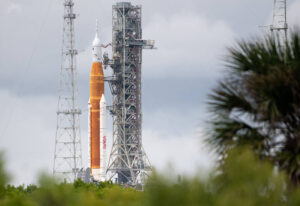
NASA will target Saturday, Sept. 3 at 2:17 p.m. EDT, the beginning of a two-hour window, for the launch of Artemis I, the first integrated test of NASA’s Orion spacecraft, Space Launch System (SLS) rocket, and the ground systems at the agency’s Kennedy Space Center in Florida.

Mission managers met Tuesday to discuss data and develop a forward plan to address issues that arose during an Aug. 29 launch attempt for the flight test. During that launch attempt, teams were not able to chill down the four RS-25 engines to approximately minus 420 degrees F, with engine 3 showing higher temperatures than the other engines. Teams also saw a hydrogen leak on a component of the tail service mast umbilical quick disconnect, called the purge can, and managed the leak by manually adjusting propellant flow rates.

Artemis I launch on Aug 27, 2022 / NASA

In the coming days, teams will modify and practice propellant loading procedures to follow a procedure similar to what was successfully performed during the Green Run at NASA’s Stennis Space Center in Mississippi. The updated procedures would perform the chilldown test of the engines, also called the kick start bleed test, about 30 to 45 minutes earlier in the countdown during the liquid hydrogen fast fill liquid phase for the core stage.

Teams also are configuring platforms at Launch Pad 39B to enable engineers access to the purge can on the tail service mast umbilical. Once access is established, technicians will perform assessments and torque connection points where necessary.

Meteorologists with the U.S. Space Force Space Launch Delta 45 predict favorable weather conditions for Saturday. While rain showers are expected, they are predicted to be sporadic during the launch window.

The mission management team will reconvene Thursday to review data and overall readiness.

Sharpest image ever of universe’s most massive known star

By harnessing the capabilities of the 8.1-meter Gemini South telescope in Chile, which is part of the International Gemini Observatory operated by NSF’s NOIRLab, astronomers have obtained the sharpest image ever of the star R136a1, the most massive known star in the Universe. Their research, led by NOIRLab astronomer Venu M. Kalari, challenges our understanding of the most massive stars and suggests that they may not be as massive as previously thought.

Astronomers have yet to fully understand how the most massive stars — those more than 100 times the mass of the Sun — are formed. One particularly challenging piece of this puzzle is obtaining observations of these giants, which typically dwell in the densely populated hearts of dust-shrouded star clusters. Giant stars also live fast and die young, burning through their fuel reserves in only a few million years. In comparison, our Sun is less than halfway through its 10 billion year lifespan. The combination of densely packed stars, relatively short lifetimes, and vast astronomical distances makes distinguishing individual massive stars in clusters a daunting technical challenge.

By pushing the capabilities of the Zorro instrument on the Gemini South telescope of the International Gemini Observatory, operated by NSF’s NOIRLab, astronomers have obtained the sharpest-ever image of R136a1 — the most massive known star. This colossal star is a member of the R136 star cluster, which lies about 160,000 light-years from Earth in the center of the Tarantula Nebula in the Large Magellanic Cloud, a dwarf companion galaxy of the Milky Way.

Previous observations suggested that R136a1 had a mass somewhere between 250 to 320 times the mass of the Sun. The new Zorro observations, however, indicate that this giant star may be only 170 to 230 times the mass of the Sun. Even with this lower estimate, R136a1 still qualifies as the most massive known star.

Astronomers are able to estimate a star’s mass by comparing its observed brightness and temperature with theoretical predictions. The sharper Zorro image allowed NSF’s NOIRLab astronomer Venu M. Kalari and his colleagues to more accurately separated the brightness of R136a1 from its nearby stellar companions, which led to a lower estimate of its brightness and therefore its mass.

Our results show us that the most massive star we currently know is not as massive as we had previously thought,” explained Kalari, lead author of the paper announcing this result. “This suggests that the upper limit on stellar masses may also be smaller than previously thought.

This result also has implications for the origin of elements heavier than helium in the Universe. These elements are created during the cataclysmicly explosive death of stars more than 150 times the mass of the Sun in events that astronomers refer to as pair-instability supernovae. If R136a1 is less massive than previously thought, the same could be true of other massive stars and consequently pair instability supernovae may be rarer than expected.

The star cluster hosting R136a1 has previously been observed by astronomers using the NASA/ESA Hubble Space Telescope and a variety of ground-based telescopes, but none of these telescopes could obtain images sharp enough to pick out all the individual stellar members of the nearby cluster.

Gemini South’s Zorro instrument was able to surpass the resolution of previous observations by using a technique known as speckle imaging, which enables ground-based telescopes to overcome much of the blurring effect of Earth’s atmosphere [1]. By taking many thousands of short-exposure images of a bright object and carefully processing the data, it is possible to cancel out almost all this blurring [2]. This approach, as well as the use of adaptive optics, can dramatically increase the resolution of ground-based telescopes, as shown by the team’s sharp new Zorro observations of R136a1 [3].

This result shows that given the right conditions an 8.1-meter telescope pushed to its limits can rival not only the Hubble Space Telescope when it comes to angular resolution, but also the James Webb Space Telescope,” commented Ricardo Salinas, a co-author of this paper and the instrument scientist for Zorro. “This observation pushes the boundary of what is considered possible using speckle imaging.

We began this work as an exploratory observation to see how well Zorro could observe this type of object,” concluded Kalari. “While we urge caution when interpreting our results, our observations indicate that the most massive stars may not be as massive as once thought.

Zorro and its twin instrument `Alopeke are identical imagers mounted on the Gemini South and Gemini North telescopes, respectively. Their names are the Hawaiian and Spanish words for “fox” and represent the telescopes’ respective locations on Maunakea in Hawai‘i and on Cerro Pachón in Chile. These instruments are part of the Gemini Observatory’s Visiting Instrument Program, which enables new science by accommodating innovative instruments and enabling exciting research. Steve B. Howell, current chair of the Gemini Observatory Board and senior research scientist at the NASA Ames Research Center in Mountain View, California, is the principal investigator on both instruments.

Gemini South continues to enhance our understanding of the Universe, transforming astronomy as we know it. This discovery is yet another example of the scientific feats we can accomplish when we combine international collaboration, world-class infrastructure, and a stellar team,” said NSF Gemini Program Officer Martin Still.

Team Indus Pitches for $40 Mln Funding to Emerge as India’s Equivalent of SpaceX

Team Indus, the only Indian team competing for the Google Lunar XPRIZE, wants to go beyond the challenge and emerge as India’s equivalent of SpaceX, US private space company, with an eye on additional fund-raising to the tune of $40 million in the next round.

With its lunar rover mission launch set for December aboard ISRO’s PSLV rocket, Team Indus wants to expand its operational capabilities in launching and managing communication satellites.

The $30M Google Lunar XPRIZE challenge is a global competition to inspire engineers and entrepreneurs to develop low-cost methods of robotic space exploration by a privately funded team. The team must successfully place a robot on the Moon that explores at least 500 meters and transmits high-definition video and images back to Earth.

Team Indus has already raised $20 million in its first round from the country’s top investors such as Ratan Tata, Nandan Nilekani, Sachin Bansal, Binny Bansal, Subrata Mitra and Shekhar Kirani. The next round of funding will be utilized for expansion of its North Bangalore facility to undertake more space launches, said Team Indus founder Rahul Narayan.

The upcoming mission will carry its rover and 11 other payloads from Japan, France and UAE in the moon-laning mission. The spacecraft is under development at National Aerospace Laboratories (NAL) and the final assembly will be done at the Team Indus facility in North Bengaluru.

Elaborating on their moon landing mission, Narayan told TOI: “ISRO’s Chandrayaan 1 was an orbital mission, while our spacecraft has to land on the Moon.” The flight testing of the spacecraft and payloads will be done at ISRO’s facility, before the final launch, he said.

Since ISRO is planning to employ a private launch vehicle by 2020, Team Indus sees imense potential and emerge as the country’s top private spacecraft manufacturer. “We see ourselves augmenting ISRO’s capacities, not capabilities,” Narayan said.

Team Indus is among the five teams to have been awarded a combined $5.25 million in recognition of “key technological advancements toward their quest to land a private spacecraft on the surface of the moon,” said the Xprize Foundation. The successful landing will get the team the final prize amount of $15 million.

Peter Diamandis, Lunar XPRIZE founder, while announcing the prize, said:”It has been many decades since we explored the Moon from the lunar surface, and it could be another 6–8 years before any government returns. Even then, it will be at a large expense, and probably with little public involvement.”

While the ideas initially mooted by Peter Diamandis, NASA was facing budget constraints, he approached Google founders Larry Page and Sergey Brin, at an X Prize Foundation fundraiser and they agreed to sponsor it, and raise the amount of the prize money to $30 million, including a second prize, besides some bonus prizes. However, it was brought down to $15 million later.