Artemis II Update-25, Day 10: Crew Sets for Final Burn, Splashdown

The Artemis II crew — NASA astronauts Reid Wiseman, Victor Glover, Christina Koch and CSA (Canadian Space Agency) astronaut Jeremy Hansen — began the final phase of their journey home to the songs “Run to the Water” by Live, selected by the crew, and “Free” by Zac Brown Band, as they prepared for their third return trajectory correction burn and shifted into full re-entry and splashdown preparations. When they woke up, they were 61,326 miles from Earth.

Splashdown is targeted for 8:07 p.m. EDT (5:07 p.m. PDT) off the coast of San Diego, where a combined NASA and U.S. military recovery team will be standing by to welcome the Artemis II crew home.

Watch live return coverage on NASA+, Amazon PrimeApple TVNetflixHBO MaxDiscovery+Peacock and Roku starting at 6:30 p.m. Learn how to stream NASA content through a variety of online platforms, including social media.

Final return burn sets Orion for home

The third return burn will occur at 2:53 p.m., refining Orion’s path for atmospheric entry and splashdown. During the maneuver, the spacecraft will make precise adjustments to stay on its targeted course home.

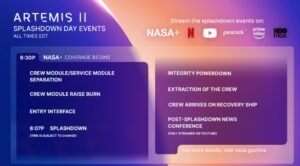
NASA’s Artemis II re-entry and splashdown timeline and streaming coverage. Splashdown is targeted for 8:07 p.m. EDT (5:07 p.m. PDT) off the coast of San Diego, where NASA’s recovery team will be standing by to welcome the Artemis II crew home.NASA

Artemis II splashdown timeline

A carefully timed sequence will guide Orion through the final stages of descent:

  • 7:33 p.m.: Orion’s crew module will separate from the service module, exposing its heat shield for the spacecraft’s return through Earth’s atmosphere, where it will encounter temperatures of about 3,000 degrees Fahrenheit.
  • 7:37 p.m.: Following separation, Orion will perform an 18 second crew module raise burn beginning to set the proper entry angle and align the heat shield for atmospheric interface.
  • 7:53 p.m.: When Orion reaches 400,000 feet above Earth’s surface while traveling nearly 35 times the speed of sound. The crew is expected to experience up to 3.9 Gs in the planned entry profile. This moment marks the spacecraft’s first contact with the upper atmosphere and the start of a planned six-minute communications blackout as plasma builds around the capsule.
  • 8:03 p.m.: Around 22,000 feet in altitude, the drogue parachutes will deploy, slowing and stabilizing the capsule as Orion nears splashdown.
  • 8:04 p.m.: At around 6,000 feet, the drogues will release, and the three main parachutes will deploy, reducing Orion’s speed to less than 136 mph.
  • 8:07 p.m.: Slowing to 20 mph, Orion will splash down in the Pacific Ocean off the coast of San Diego, completing the Artemis II crew’s return to Earth and a 694,481-mile journey.
  • From there, teams from NASA and the U.S. military will extract the crew from Orion and fly them via helicopter to the USS John P. Murtha.
  • Within two hours after splashdown, the crew will be extracted from Orion and flown to the USS Murtha. Recovery teams will retrieve the crew, assist them onto an inflatable raft, and then use helicopters to deliver them to the ship. Once aboard, the astronauts will undergo post‑mission medical evaluations before returning to shore where awaiting aircraft will take them to NASA’s Johnson Space Center in Houston.

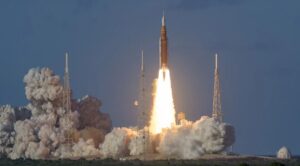
The Artemis II mission began with the successful liftoff of NASA’s SLS (Space Launch System) rocket on April 1 at 6:35 p.m. from Launch Pad 39B at Kennedy Space Center in Florida, sending the first humans toward the Moon since 1972.

During the mission, the astronauts completed a historic lunar flyby, marking humanity’s return to the vicinity of the Moon for the first time in more than 50 years. Throughout the flight, the crew and teams on the ground have evaluated Orion’s systems in the deep‑space environment, including a series of tests in which astronauts directly operated and interacted with the spacecraft.

Also Read:

Artemis II Update-24, Day 9: Second Return Correction Burn Complete

What’s the longstanding tradition at JPL before any launch and other major space mission events
 

Artemis II Update-9, Day 3: NASA cancels first trajectory correction burn

NASA confirmed on April 4 that Artemis II’s first planned trajectory correction burn was canceled after Orion remained on its precise path to the Moon. The crew, traveling toward a scheduled lunar flyby on April 6, continues operations without the need for immediate adjustments. Mission controllers in Houston determined the spacecraft’s trajectory required no correction at this stage, with future burns still available if needed.


Artemis II Update-1: Orion Completes Proximity Operations, Perigee Burn Next

Astronauts aboard NASA’s Artemis II mission completed a key proximity operations test on April 2 while orbiting Earth. The maneuver involved controlled movements around a detached rocket stage to evaluate spacecraft handling. With CubeSat deployments ahead and a minor onboard system issue under review, the crew is now preparing for a perigee raise burn to refine Orion’s orbit.


NASA to live coverage Artemis I mission Demonstration Test, Host Media Call [Live schedule, streaming website details]

NASA will provide live coverage with commentary of the upcoming Artemis I cryogenic demonstration test beginning at 7:15 a.m. EDT on Wednesday, Sept. 21.

The demonstration test will allow teams to confirm the repair to a hydrogen leak seen during an early September Artemis I launch attempt, evaluate updated propellant loading procedures, and conduct additional evaluations. The demonstration will conclude when the objectives for the test have been met.+

Live coverage of the test will air on NASA Television, the NASA app, and the agency’s website. While NASA is airing coverage of the launch, rendezvous, docking, and hatch opening of the Soyuz MS-22 carrying NASA Astronaut Frank Rubio to the International Space Station on NASA’s Television’s Public Channel, the Artemis I demonstration test will air only on the Media Channel. During all other times, the test will air on both the Public and Media Channels.

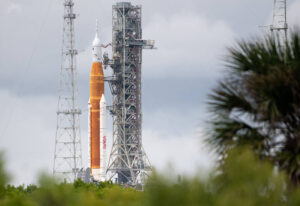
NASA’s Space Launch System (SLS) rocket with the Orion spacecraft aboard is seen atop a mobile launcher at Launch Pad 39B as preparations for launch continue, Sunday, Aug. 28, 2022, at NASA’s Kennedy Space Center in Florida. NASA’s Artemis I flight test is the first integrated test of the agency’s deep space exploration systems: the Orion spacecraft, SLS rocket, and supporting ground systems. Launch of the uncrewed flight test is targeted for no earlier than Aug. 29 at 8:33 a.m. ET. Photo Credit: (NASA/Joel Kowsky)

The agency also will host a media teleconference to preview the test at 11:30 a.m. Monday, Sept. 19. Participants include:

  • Tom Whitmeyer, deputy associate administrator for Common Exploration Systems Development, NASA Headquarters
  • Mike Sarafin, Artemis mission manager, NASA Headquarters
  • Jeremy Parsons, deputy manager, Exploration Ground Systems Program, NASA’s Kennedy Space Center
  • John Blevins, chief engineer, Space Launch System Program, NASA’s Marshall Space Flight Center

Audio of the media call will stream live on the agency’s website at:

https://www.nasa.gov/live

To participate by telephone, media must RSVP no later than two hours prior to the start of the event to: ksc-newsroom@mail.nasa.gov.

Artemis I is an uncrewed flight test. It is the first in a series of increasingly complex missions to provide a foundation for human exploration in deep space and demonstrate our commitment and capability to extend human existence to the Moon and beyond.

Through Artemis missions, NASA will land the first woman and the first person of color on the Moon, paving the way for a long-term lunar presence and serving as a steppingstone to send astronauts to Mars.

For updates, follow along on NASA’s Artemis blog at:

https://blogs.nasa.gov/artemis

NASA Hosts National Space Council Meeting, Vice President Kamala Harris Chairs Event

Vice President Kamala Harris highlighted the importance of climate, human spaceflight, and STEM education during the Biden-Harris Administration’s second National Space Council meeting Friday, held at NASA’s Johnson Space Center in Houston.

“For generations, with our allies and partners around the globe, America has led our world in the exploration and use of space,” said Harris. “Our leadership has been guided by a set of fundamental principles – cooperation, security, ambition, and public trust – which is the recognition, of course, that space can and must be protected for the benefit of all people.

There is so much we still don’t know and so much we still haven’t done – space remains a place of undiscovered and unrealized opportunity. Our test and our responsibility is to work together to guide humanity forward into this new frontier and to make real the incredible potential of space for all people.”

National Space Council Meeting led by Chairwoman, Vice President Kamala Harris. Photo Date: September 9, 2022. Location: Building 9NW, SVMF. Photographer: Robert Markowitz.

For more than 50 years, NASA satellites have provided open-source and publicly available data on Earth’s land, water, temperature, weather, and climate. Improving access to key climate information is a priority for the agency. Building on his previous announcement, NASA Administrator Bill Nelson released the first concept, and shared a new video for the Earth Information Center. The center will allow the public to see how the Earth is changing and guide decision makers to mitigate, adapt, and respond to climate change.

“Just like we use mission control to monitor operations during spaceflight, we’re embarking on this effort to monitor conditions here on our home planet, and it will be available to everyone in an easy-to-access format,” Nelson said.

Planning for the Earth Information Center is underway with the initial phase providing an interactive visual display of imagery and data from NASA and other government agencies. NASA Headquarters plans to house this initial interactive display with goals to expand in person and virtual access over the next five years.

The Vice President also underscored the important research conducted on the International Space Station that will enable long duration stays on the Moon and future human missions to Mars, in addition to benefits to life here on Earth.

NASA/Photo: Nasa.gov

NASA uses the International Space Station to conduct critical research on the risks associated with future Mars missions – space radiation, isolation, and distance from Earth, just to name a few. It’s also a testbed to develop the technologies we’ll need for long duration stays on the Moon, where we will build an Artemis Base Camp on the surface and Gateway outpost in lunar orbit,” Nelson said. “Research on the space station demonstrates that the benefits of microgravity are not just for discovery. We also develop new technologies that improve life on Earth, like treatments for cancer.”

In conjunction with the meeting, NASA announced a new Space Grant K-12 Inclusiveness and Diversity in STEM (SG KIDS) opportunity that will award more than $4 million to institutions across the U.S. to help bring the excitement of NASA and STEM to traditionally underserved and underrepresented groups of middle and high school students. The announcement is a part of a broader set of commitments made by public, private, and philanthropic partners announced by the Vice President to help in the recruitment and development of the next generation of the space workforce.

SG KIDS also addresses the White House Executive Order on Advancing Racial Equity and Support for Underserved Communities Through the Federal Government, as well as NASA Administrator Bill Nelson’s focus on providing authentic STEM opportunities to K-12 students.

While at NASA’s Johnson Space Center, Vice President Harris toured the agency’s mission control with Nelson and Johnson Center Director Vanessa Wyche. The Vice President also spoke with NASA astronauts Bob Hines, Kjell Lindgren, and Jessica Watkins, living and working aboard the International Space Station about how their research benefits life on Earth, supports long duration space flight, and protects our planet.

The Vice President also received a tour of the Space Vehicle Mockup Facility (SVMF), where space flight crews and their support personnel receive world class training on high-fidelity hardware for real-time mission support. The SVMF consists of space station, Orion, Commercial vehicle mockups, part-task trainers and rack interfaces, a Precision Air Bearing Floor, and a Partial Gravity Simulator.

A recording of the full National Space Council meeting is available online at:

https://go.nasa.gov/3eEGxEW

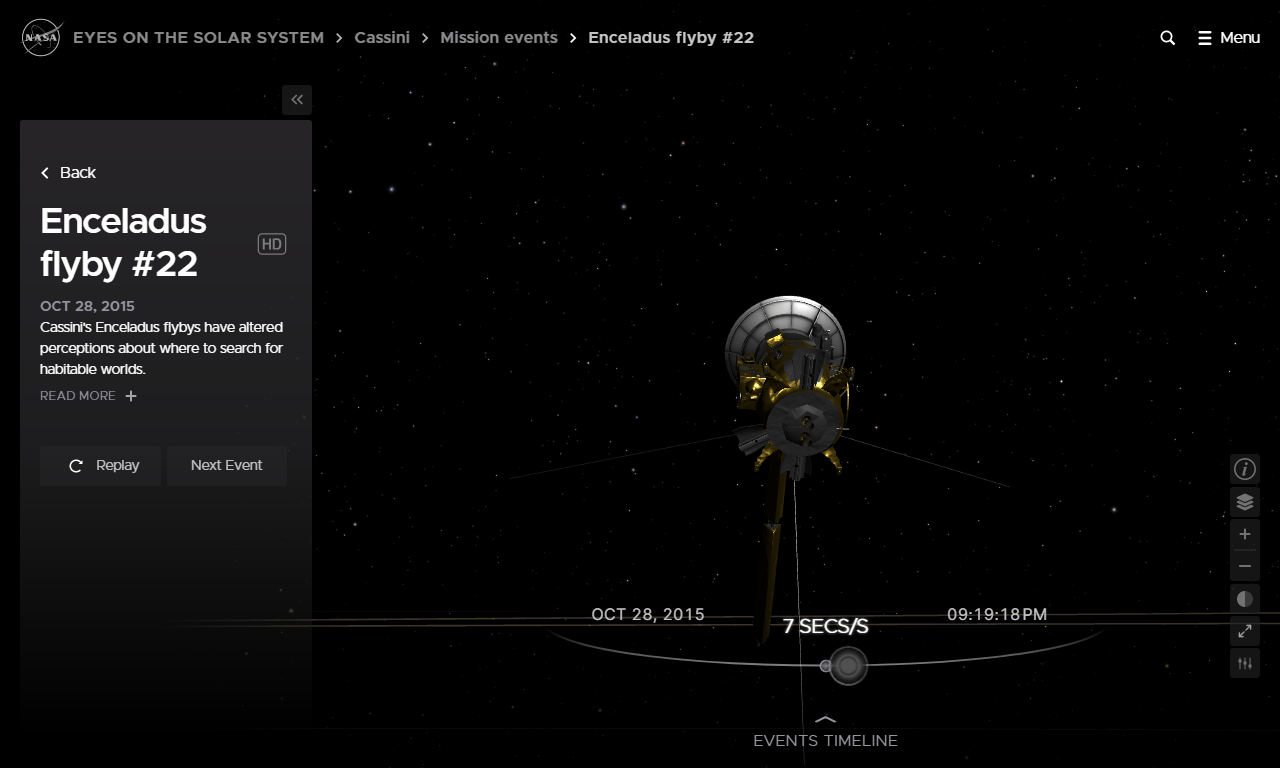
Explore the Solar System With NASA’s New, Improved 3D ‘Eyes’

The agency’s newly upgraded “Eyes on the Solar System” visualization tool includes Artemis I’s trajectory along with a host of other new features.

NASA has revamped its “Eyes on the Solar System” 3D visualization tool, making interplanetary travel easier and more interactive than ever. More than two years in the making, the update delivers better controls, improved navigation, and a host of new opportunities to learn about our incredible corner of the cosmos – no spacesuit required. All you need is a device with an internet connection.

 Trace the course Artemis I will take to lunar orbit, or touch down with Perseverance during its harrowing entry, descent, and landing on the Red Planet. Learn the basics about dwarf planets or the finer points of gas giants, and ride alongside no fewer than 126 space missions past and present. You can even follow the paths of spacecraft and celestial bodies as far back as 1949 and as far into the future as 2049.

While you’re at it, you can rotate objects, compare them side by side, and even modulate the perspective as well as the lighting. The visuals are striking. This latest version of “Eyes” also lets you scroll through rich interactive journeys, including Voyager’s Grand Tour of Jupiter, Saturn, Uranus, and Neptune.

“The beauty of the new browser-based ‘Eyes on the Solar System’ is that it really invites exploration. You just need an internet connection, a device that has a web browser, and some curiosity,” said Jason Craig, the producer of the “Eyes” software at NASA’s Jet Propulsion Laboratory.