Engineers are making progress repairing the area where a liquid hydrogen leak was detected during the Artemis I launch attempt Sept. 3, and NASA is preserving options for the next launch opportunity as early as Friday, Sept. 23.
Technicians constructed a tent-like enclosure around the work area to protect the hardware and teams from weather and other environmental conditions at Launch Pad 39B. They have disconnected the ground- and rocket-side plates on the interface, called a quick disconnect, for the liquid hydrogen fuel feed line, performed initial inspections, and began replacing two seals – one surrounding the 8-inch line used to fill and drain liquid hydrogen from the core stage, and another surrounding the 4-inch bleed line used to redirect some of the propellant during tanking operations. The SLS rocket and Orion spacecraft are in good condition while remaining at the launch pad.
Once the work is complete, engineers will reconnect the plates and perform initial tests to evaluate the new seals. Teams will check the new seals under cryogenic, or supercold, conditions no earlier than Sept. 17 in which the rocket’s core stage and interim cryogenic propulsion stage will be loaded with liquid oxygen and liquid hydrogen to validate the repair under the conditions it would experience on launch day. Engineers are in the process of developing a full plan for the checkouts.
Artemis I logo/NASA
NASA has submitted a request to the Eastern Range for an extension of the current testing requirement for the flight termination system. NASA is respecting the range’s processes for review of the request, and the agency continues to provide detailed information to support a range decision.
In the meantime, NASA is instructing the Artemis team to move forward with all preparations required for testing, followed by launch, including preparations to ensure adequate supplies of propellants and gases used in tanking operations, as well as flight operations planning for the mission. NASA has requested the following launch opportunities:
Sept 23: Two-hour launch window opens at 6:47 a.m. EDT; landing on Oct. 18
Sept. 27: 70-minute launch window opens at 11:37 a.m.; landing on Nov. 5
NASA’s teams internally are preparing to support additional dates in the event flexibility is required. The agency will evaluate and adjust launch opportunities and alternate dates based on progress at the pad and to align with other planned activities, including DART’s planned impact with an asteroid, the west coast launch of a government payload, and the launch of Crew-5 to the International Space Station.
NASA/Photo: Nasa.gov
Listen to a replay of today’s media teleconference on the status of the Artemis I mission. Artemis I is an uncrewed flight test to provide a foundation for human exploration in deep space and demonstrate our commitment and capability to extend human existence to the Moon and beyond.
Vice President Kamala Harris highlighted the importance of climate, human spaceflight, and STEM education during the Biden-Harris Administration’s second National Space Council meeting Friday, held at NASA’s Johnson Space Center in Houston.
“For generations, with our allies and partners around the globe, America has led our world in the exploration and use of space,” said Harris. “Our leadership has been guided by a set of fundamental principles – cooperation, security, ambition, and public trust – which is the recognition, of course, that space can and must be protected for the benefit of all people.
There is so much we still don’t know and so much we still haven’t done – space remains a place of undiscovered and unrealized opportunity. Our test and our responsibility is to work together to guide humanity forward into this new frontier and to make real the incredible potential of space for all people.”
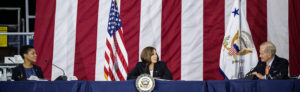
National Space Council Meeting led by Chairwoman, Vice President Kamala Harris. Photo Date: September 9, 2022. Location: Building 9NW, SVMF. Photographer: Robert Markowitz.
For more than 50 years, NASA satellites have provided open-source and publicly available data on Earth’s land, water, temperature, weather, and climate. Improving access to key climate information is a priority for the agency. Building on his previous announcement, NASA Administrator Bill Nelson released the first concept, and shared a new video for the Earth Information Center. The center will allow the public to see how the Earth is changing and guide decision makers to mitigate, adapt, and respond to climate change.
“Just like we use mission control to monitor operations during spaceflight, we’re embarking on this effort to monitor conditions here on our home planet, and it will be available to everyone in an easy-to-access format,” Nelson said.
Planning for the Earth Information Center is underway with the initial phase providing an interactive visual display of imagery and data from NASA and other government agencies. NASA Headquarters plans to house this initial interactive display with goals to expand in person and virtual access over the next five years.
The Vice President also underscored the important research conducted on the International Space Station that will enable long duration stays on the Moon and future human missions to Mars, in addition to benefits to life here on Earth.
NASA/Photo: Nasa.gov
“NASA uses the International Space Station to conduct critical research on the risks associated with future Mars missions – space radiation, isolation, and distance from Earth, just to name a few. It’s also a testbed to develop the technologies we’ll need for long duration stays on the Moon, where we will build an Artemis Base Camp on the surface and Gateway outpost in lunar orbit,” Nelson said. “Research on the space station demonstrates that the benefits of microgravity are not just for discovery. We also develop new technologies that improve life on Earth, like treatments for cancer.”
In conjunction with the meeting, NASA announced a new Space Grant K-12 Inclusiveness and Diversity in STEM (SG KIDS) opportunity that will award more than $4 million to institutions across the U.S. to help bring the excitement of NASA and STEM to traditionally underserved and underrepresented groups of middle and high school students. The announcement is a part of a broader set of commitments made by public, private, and philanthropic partners announced by the Vice President to help in the recruitment and development of the next generation of the space workforce.
SG KIDS also addresses the White House Executive Order on Advancing Racial Equity and Support for Underserved Communities Through the Federal Government, as well as NASA Administrator Bill Nelson’s focus on providing authentic STEM opportunities to K-12 students.
While at NASA’s Johnson Space Center, Vice President Harris toured the agency’s mission control with Nelson and Johnson Center Director Vanessa Wyche. The Vice President also spoke with NASA astronauts Bob Hines, Kjell Lindgren, and Jessica Watkins, living and working aboard the International Space Station about how their research benefits life on Earth, supports long duration space flight, and protects our planet.
The Vice President also received a tour of the Space Vehicle Mockup Facility (SVMF), where space flight crews and their support personnel receive world class training on high-fidelity hardware for real-time mission support. The SVMF consists of space station, Orion, Commercial vehicle mockups, part-task trainers and rack interfaces, a Precision Air Bearing Floor, and a Partial Gravity Simulator.
A recording of the full National Space Council meeting is available online at:
Digital content creators are invited to register to attend the launch of the fifth SpaceX Crew Dragon spacecraft and Falcon 9 rocket that will carry astronauts to the International Space Station for a science expedition mission. This mission is part of NASA’s Commercial Crew Program.
The earliest targeted launch date for the agency’s SpaceX Crew-5 mission is Oct. 3, from Kennedy’s Launch Complex 39A. The launch will carry NASA astronauts Nicole Mann, commander; Josh Cassada, pilot; and mission specialists Koichi Wakata, of JAXA (Japan Aerospace Exploration Agency), and Roscosmos cosmonaut Anna Kikina.
If your passion is to communicate and engage the world online, then this is the event for you! Seize the opportunity to be on the front line to see and share the #Crew5 mission launch.
A maximum of 35 social media users will be selected to attend this two-day event and will be given access similar to news media.
NASA Social participants will have the opportunity to:
View a launch of the SpaceX Falcon 9 rocket
Tour NASA facilities at Kennedy Space Center
Meet and interact with Crew-5 subject matter experts
Meet fellow space enthusiasts who are active on social media
NASA Social registration for the Crew-5 launch opens on August 31 and the deadline to apply is September 6 at 3 p.m. EDT. All social applications will be considered on a case-by-case basis.
Do I need to have a social media account to register?
Yes. This event is designed for people who:
Actively use multiple social networking platforms and tools to disseminate information to a unique audience.
Regularly produce new content that features multimedia elements.
Have the potential to reach a large number of people using digital platforms.
Reach a unique audience, separate and distinctive from traditional news media and/or NASA audiences.
Must have an established history of posting content on social media platforms.
Have previous postings that are highly visible, respected and widely recognized.
Users on all social networks are encouraged to use the hashtag #NASASocial, and #Crew5. Updates and information about the event will be shared on Twitter via @NASASocial and @NASAKennedy, and via posts to Facebook and Instagram.
How do I register?
Registration for this event opens August 31 and closes at 3 p.m. EDT on September 6. Registration is for one person only (you) and is non-transferable. Each individual wishing to attend must register separately. Each application will be considered on a case-by-case basis.
Can I register if I am not a U.S. citizen?
Because of the security deadlines, registration is limited to U.S. citizens. If you have a valid permanent resident card you will be processed as a U.S. citizen.
When will I know if I am selected?
After registrations have been received and processed, an email with confirmation information and additional instructions will be sent to those selected. We expect to send the first notifications on September 13 and waitlist notifications on September 14.
What are NASA Social credentials?
All social applications will be considered on a case-by-case basis. Those chosen must prove through the registration process they meet specific engagement criteria.
If you do not make the registration list for this NASA Social, you still can attend the launch offsite and participate in the conversation online. Find out about ways to experience a launch here.
What are the registration requirements?
Registration indicates your intent to travel to NASA’s Kennedy Space Center in Florida and attend the two-day event in person. You are responsible for your own expenses for travel, accommodation, food, and other amenities.
Some events and participants scheduled to appear at the event are subject to change without notice. NASA is not responsible for loss or damage incurred as a result of attending. NASA, moreover, is not responsible for loss or damage incurred if the event is cancelled with limited or no notice. Please plan accordingly.
Kennedy is a government facility. Those who are selected will need to complete an additional registration step to receive clearance to enter the secure areas.
IMPORTANT: To be admitted, you will need to provide two forms of unexpired government-issued identification; one must be a photo ID and match the name provided on the registration. Those without proper identification cannot be admitted. For a complete list of acceptable forms of ID, please visit: NASA Credentialing Identification Requirements.
All registrants must be at least 18 years old.
Photo: Nasa.gov
What if the launch date changes?
Hundreds of different factors can cause a scheduled launch date to change multiple times. The launch date will not be official until after the Flight Readiness Review. If the launch date changes prior to then, NASA may adjust the date of the NASA Social accordingly to coincide with the new target launch date. NASA will notify registrants of any changes by email.
If the launch is postponed, attendees will be invited to attend a later launch date. NASA cannot accommodate attendees for delays beyond 72 hours.
NASA Social attendees are responsible for any additional costs they incur related to any launch delay. We strongly encourage participants to make travel arrangements that are refundable and/or flexible.
What if I cannot come to the Kennedy Space Center?
If you cannot come to the Kennedy Space Center and attend in person, you should not register for the NASA Social. You can follow the conversation using the #NASASocial hashtag on Twitter. You can watch the launch on NASA Television or www.nasa.gov/live. NASA will provide regular launch and mission updates on @NASA, @NASAKennedy, and @Commercial_Crew.
What are the safety protocols for this event? COVID-19 safety protocols for this event will be communicated closer to the date of the event.
If you cannot make this NASA Social, don’t worry; NASA is planning many other Socials in the near future at various locations! Check back here for updates.