U.S. Immigration Policy Shift: No Renewal for Humanitarian ‘Migrant Parole’ Program

The Biden administration has announced a significant shift in its immigration policy as the U.S. Department of Homeland Security (DHS) said that it will not renew a temporary humanitarian entry program for hundreds of thousands of migrants who have U.S. sponsors and entered the country in recent years.

The program, known as the parole program, has allowed approximately 530,000 migrants from Cuba, Haiti, Nicaragua, and Venezuela to enter the U.S. since October 2022. These migrants were granted two-year permits under the program, which will begin to expire in the coming weeks.

Despite the non-renewal of the program for current beneficiaries, it will continue to accept new applications from those abroad. This indicates that while the current beneficiaries will not be renewed, the program itself is not being entirely discontinued.

The parole program was launched by the Biden administration as a strategy to provide legal avenues for migrants to enter the U.S. and decrease illegal crossings at the U.S.-Mexico border. The program allows migrants with existing U.S. sponsors to enter the country for humanitarian reasons or if their entry is deemed a significant public benefit.

Future of Migrants in US

The decision not to renew the parole program has raised concerns about the future of the migrants who have benefited from it. “Migrants without permission to remain in the U.S. will need to depart the United States prior to the expiration of their authorized parole period or may be placed in removal proceedings,” DHS spokesperson Naree Ketudat said.

However, other parole programs for Ukrainians and Afghans have been extended, indicating that the administration is not entirely moving away from such programs. Despite the end of the parole program, many of these migrants could remain in the country under other programs. For instance, many Cubans are eligible for permanent residence and eventual citizenship under the 1966 Cuban Adjustment Act.

Most Haitians and Venezuelans in the U.S. are eligible for Temporary Protected Status, which grants them deportation relief and work permits. All four nationalities could apply for asylum.

Not Unprecedented

The Biden administration’s decision to not renew the parole program is reminiscent of previous shifts in U.S. immigration policy. For instance, in the 1980s, the Reagan administration granted amnesty to millions of undocumented immigrants, a move that was controversial but also recognized the reality of large-scale undocumented migration.

Similarly, the Obama administration implemented the Deferred Action for Childhood Arrivals (DACA) program, which provided temporary relief from deportation for undocumented immigrants brought to the U.S. as children. These historical precedents highlight the ongoing evolution of U.S. immigration policy in response to changing circumstances and policy priorities.

The decision comes at a time when immigration is a top voter issue in the upcoming Nov. 5 election that will pit Democratic Vice President Kamala Harris against Republican Donald Trump, who has criticized the parole program. The Biden administration’s immigration policies have been a point of contention, with record numbers of migrants caught crossing illegally during Biden’s presidency.

However, crossings have plummeted in recent months as Biden rolled out new border restrictions. As the country moves forward, the management of migration flows and the balance between humanitarian concerns and national security will continue to be key issues in immigration policy.


Trump Threatens ‘Dire Consequences’ If Loses Presidential Race, Biden Team Calls Him ‘Loser’

Former President Donald Trump rallied supporters in Ohio over the weekend, declaring the upcoming November presidential election as pivotal in American history. Trump, who recently secured the presumptive Republican nomination, emphasized the significance of the date, November 5, while lambasting his opponent, President Joe Biden.

During his speech in Vandalia, Ohio, Trump criticized Chinese plans to manufacture cars in Mexico for the American market, asserting that such endeavors would falter under his leadership. He issued a stark warning, suggesting dire consequences for the nation should he not be re-elected, albeit without specifying details.

Following Trump’s remarks, Biden’s campaign swiftly responded, labeling the former president as a “loser” and condemning his rhetoric as a veiled incitement to political violence, alluding to the events of January 6, 2021, when the Capitol was stormed by Trump supporters.

Later, speaking at a dinner in Washington, Biden reiterated the gravity of the moment, highlighting threats to democracy posed by falsehoods surrounding the 2020 election and attempts to overturn its results.

Trump’s and Biden’s victories in securing their party nominations for the 2024 presidential race virtually guarantee a rematch, setting the stage for an extended campaign period. Among Trump’s focal points is a critique of Biden’s immigration policies, which he denounces as a “horror show,” particularly targeting their impact on minority communities.

Trump’s rally in Ohio, a state historically regarded as a battleground, underscores the enduring importance of its electoral influence despite shifting political landscapes. The event followed a notable announcement from Trump’s former vice president, Mike Pence, who declared his decision not to endorse Trump for a second term.

Bell at Westminster Abbey to toll for 96 minutes today, marking life of Queen Elizabeth II

A bell will toll for 96 consecutive minutes, marking the length of the Queen’s life on Monday at 11 a.m., as more than 2,000 guests will gather in London’s Westminster Abbey for the funeral of Queen Elizabeth II, who passed away on September 8, aged 96.

Towards the end of the service, the Last Post will be played, followed by a two-minute silence and a lament from the Queen’s piper at the 13th Century church and King Charles III and the Queen Consort will lead the procession behind the Queen’s coffin.

Queen Elizabeth II

The Prince and Princess of Wales will walk ahead of their nine-year-old son George and seven-year-old daughter Charlotte, followed by their uncle and aunt, the Duke and Duchess of Sussex, and other members of the Royal Family.

George and Charlotte’s younger brother Louis, four, is not expected to attend. Once the funeral ends, a committal service will follow in the evening at St George’s Chapel in Windsor and the bells of Westminster Abbey will later be rung, but muffled, as is tradition following the funeral of a sovereign.

Who is attending?

Some of the European royal families who will attend Monday’s funeral are Belgium’s King Philippe and Queen Mathilde; King Willem-Alexander of the Netherlands and his wife, Queen Maxima, along with his mother, former Dutch queen Princess Beatrix; and King Felipe and Queen Letizia of Spain.

Emperor Naruhito and Empress Masako of Japan will also attend the service, as well as the King of Bhutan Jigme Khesar Namgyel Wangchuk.

Other expected guests include Sultan of Brunei, Hassanal Bolkiah; Jordan’s King Abdullah; Crown Prince of Kuwait, Sheikh Meshal al-Ahmad al-Sabah; King of Lesotho, Letsie III; and Hereditary Prince Alois of Liechtenstein. Royal leaders from Luxembourg, Malaysia, Monaco, Morocco, Oman, Qatar, and Tonga are also expected.

The Prime Minister, Mr Narendra Modi visits the Queen Elizabeth II, of the United Kingdom, in London on November 13, 2015. (PIB)

Leaders from across the Commonwealth, including India‘s President Droupadi Murmu and Bangladeshi Prime Minister Sheikh Hasina are attending the funeral. Australian Prime Minister Anthony Albanese has arrived in the UK, as have New Zealand Prime Minister Jacinda Ardern and Canadian Prime Minister Justin Trudeau.

The other world leaders to be attending the funeral include US President and First Lady, Joe and Jill Biden; Irish Taoiseach Micheal Martin and President Michael Higgins; German President Frank-Walter Steinmeier; Italian President Sergio Mattarella; and French President Emmanuel Macron.


NASA Hosts National Space Council Meeting, Vice President Kamala Harris Chairs Event

Vice President Kamala Harris highlighted the importance of climate, human spaceflight, and STEM education during the Biden-Harris Administration’s second National Space Council meeting Friday, held at NASA’s Johnson Space Center in Houston.

“For generations, with our allies and partners around the globe, America has led our world in the exploration and use of space,” said Harris. “Our leadership has been guided by a set of fundamental principles – cooperation, security, ambition, and public trust – which is the recognition, of course, that space can and must be protected for the benefit of all people.

There is so much we still don’t know and so much we still haven’t done – space remains a place of undiscovered and unrealized opportunity. Our test and our responsibility is to work together to guide humanity forward into this new frontier and to make real the incredible potential of space for all people.”

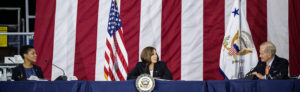
National Space Council Meeting led by Chairwoman, Vice President Kamala Harris. Photo Date: September 9, 2022. Location: Building 9NW, SVMF. Photographer: Robert Markowitz.

For more than 50 years, NASA satellites have provided open-source and publicly available data on Earth’s land, water, temperature, weather, and climate. Improving access to key climate information is a priority for the agency. Building on his previous announcement, NASA Administrator Bill Nelson released the first concept, and shared a new video for the Earth Information Center. The center will allow the public to see how the Earth is changing and guide decision makers to mitigate, adapt, and respond to climate change.

“Just like we use mission control to monitor operations during spaceflight, we’re embarking on this effort to monitor conditions here on our home planet, and it will be available to everyone in an easy-to-access format,” Nelson said.

Planning for the Earth Information Center is underway with the initial phase providing an interactive visual display of imagery and data from NASA and other government agencies. NASA Headquarters plans to house this initial interactive display with goals to expand in person and virtual access over the next five years.

The Vice President also underscored the important research conducted on the International Space Station that will enable long duration stays on the Moon and future human missions to Mars, in addition to benefits to life here on Earth.

NASA/Photo: Nasa.gov

NASA uses the International Space Station to conduct critical research on the risks associated with future Mars missions – space radiation, isolation, and distance from Earth, just to name a few. It’s also a testbed to develop the technologies we’ll need for long duration stays on the Moon, where we will build an Artemis Base Camp on the surface and Gateway outpost in lunar orbit,” Nelson said. “Research on the space station demonstrates that the benefits of microgravity are not just for discovery. We also develop new technologies that improve life on Earth, like treatments for cancer.”

In conjunction with the meeting, NASA announced a new Space Grant K-12 Inclusiveness and Diversity in STEM (SG KIDS) opportunity that will award more than $4 million to institutions across the U.S. to help bring the excitement of NASA and STEM to traditionally underserved and underrepresented groups of middle and high school students. The announcement is a part of a broader set of commitments made by public, private, and philanthropic partners announced by the Vice President to help in the recruitment and development of the next generation of the space workforce.

SG KIDS also addresses the White House Executive Order on Advancing Racial Equity and Support for Underserved Communities Through the Federal Government, as well as NASA Administrator Bill Nelson’s focus on providing authentic STEM opportunities to K-12 students.

While at NASA’s Johnson Space Center, Vice President Harris toured the agency’s mission control with Nelson and Johnson Center Director Vanessa Wyche. The Vice President also spoke with NASA astronauts Bob Hines, Kjell Lindgren, and Jessica Watkins, living and working aboard the International Space Station about how their research benefits life on Earth, supports long duration space flight, and protects our planet.

The Vice President also received a tour of the Space Vehicle Mockup Facility (SVMF), where space flight crews and their support personnel receive world class training on high-fidelity hardware for real-time mission support. The SVMF consists of space station, Orion, Commercial vehicle mockups, part-task trainers and rack interfaces, a Precision Air Bearing Floor, and a Partial Gravity Simulator.

A recording of the full National Space Council meeting is available online at:

https://go.nasa.gov/3eEGxEW