NASA will provide live coverage of key events as a NASA astronaut and two cosmonauts launch and dock to the International Space Station on Wednesday, Sept. 21.
NASA astronaut Frank Rubio and Roscosmos cosmonauts Sergey Prokopyev and Dmitri Petelin will launch aboard the Soyuz MS-22 spacecraft from the Baikonur Cosmodrome in Kazakhstan at 9:54 a.m. EDT Wednesday, Sept. 21 (6:54 p.m. Baikonur time). Coverage will begin at 9 a.m. on NASA Television’s Public Channel, the NASA app, and on the agency’s website.
NASA also will air continuous coverage of an Artemis I tanking test on NASA TV’s Media Channel beginning at 7:15 a.m.
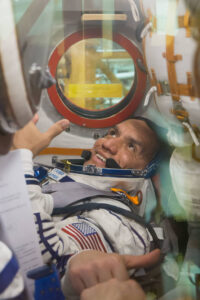
At the Baikonur Cosmodrome in Kazakhstan, NASA astronaut Frank Rubio performs preflight checkouts in the Soyuz MS-22 spacecraft. Rubio is scheduled to launch with crewmates Roscosmos cosmonaut Sergey Prokopyev and Dmitri Petelin Sept. 21 for a six-month mission on the International Space Station. Credits: NASA/Victor Zelentsov
Soyuz MS-22 launch and key events as well of coverage of the Artemis I tanking test will be available to watch online at:
After a two-orbit, three-hour journey, the Soyuz will dock to the space station’s Rassvet module at 1:11 p.m. About two hours after docking, hatches between the Soyuz and the station will open and the crew members will greet each other.
Once aboard station, the trio will join Expedition 67 Commander Oleg Artemyev, cosmonauts Denis Matveev and Sergey Korsakov of Roscosmos, as well as NASA astronauts Bob Hines, Kjell Lindgren, and Jessica Watkins, and ESA (European Space Agency) astronaut Samantha Cristoforetti. Rubio, Prokopyev, and Petelin will spend six months aboard the orbital laboratory.
This will be Prokopyev’s second flight into space and the first for Rubio and Petelin.
Mission coverage is as follows (all times Eastern):
Wednesday, Sept. 21
9 a.m. – Coverage begins on NASA TV’s Public Channel for 9:54 a.m. launch.
12:15 p.m. – Coverage begins on NASA TV’s Public Channel for 1:11 p.m. docking.
3:30 p.m. – Coverage begins on NASA TV for hatch opening and welcome remarks.
Vice President Kamala Harris highlighted the importance of climate, human spaceflight, and STEM education during the Biden-Harris Administration’s second National Space Council meeting Friday, held at NASA’s Johnson Space Center in Houston.
“For generations, with our allies and partners around the globe, America has led our world in the exploration and use of space,” said Harris. “Our leadership has been guided by a set of fundamental principles – cooperation, security, ambition, and public trust – which is the recognition, of course, that space can and must be protected for the benefit of all people.
There is so much we still don’t know and so much we still haven’t done – space remains a place of undiscovered and unrealized opportunity. Our test and our responsibility is to work together to guide humanity forward into this new frontier and to make real the incredible potential of space for all people.”
National Space Council Meeting led by Chairwoman, Vice President Kamala Harris. Photo Date: September 9, 2022. Location: Building 9NW, SVMF. Photographer: Robert Markowitz.
For more than 50 years, NASA satellites have provided open-source and publicly available data on Earth’s land, water, temperature, weather, and climate. Improving access to key climate information is a priority for the agency. Building on his previous announcement, NASA Administrator Bill Nelson released the first concept, and shared a new video for the Earth Information Center. The center will allow the public to see how the Earth is changing and guide decision makers to mitigate, adapt, and respond to climate change.
“Just like we use mission control to monitor operations during spaceflight, we’re embarking on this effort to monitor conditions here on our home planet, and it will be available to everyone in an easy-to-access format,” Nelson said.
Planning for the Earth Information Center is underway with the initial phase providing an interactive visual display of imagery and data from NASA and other government agencies. NASA Headquarters plans to house this initial interactive display with goals to expand in person and virtual access over the next five years.
The Vice President also underscored the important research conducted on the International Space Station that will enable long duration stays on the Moon and future human missions to Mars, in addition to benefits to life here on Earth.
NASA/Photo: Nasa.gov
“NASA uses the International Space Station to conduct critical research on the risks associated with future Mars missions – space radiation, isolation, and distance from Earth, just to name a few. It’s also a testbed to develop the technologies we’ll need for long duration stays on the Moon, where we will build an Artemis Base Camp on the surface and Gateway outpost in lunar orbit,” Nelson said. “Research on the space station demonstrates that the benefits of microgravity are not just for discovery. We also develop new technologies that improve life on Earth, like treatments for cancer.”
In conjunction with the meeting, NASA announced a new Space Grant K-12 Inclusiveness and Diversity in STEM (SG KIDS) opportunity that will award more than $4 million to institutions across the U.S. to help bring the excitement of NASA and STEM to traditionally underserved and underrepresented groups of middle and high school students. The announcement is a part of a broader set of commitments made by public, private, and philanthropic partners announced by the Vice President to help in the recruitment and development of the next generation of the space workforce.
SG KIDS also addresses the White House Executive Order on Advancing Racial Equity and Support for Underserved Communities Through the Federal Government, as well as NASA Administrator Bill Nelson’s focus on providing authentic STEM opportunities to K-12 students.
While at NASA’s Johnson Space Center, Vice President Harris toured the agency’s mission control with Nelson and Johnson Center Director Vanessa Wyche. The Vice President also spoke with NASA astronauts Bob Hines, Kjell Lindgren, and Jessica Watkins, living and working aboard the International Space Station about how their research benefits life on Earth, supports long duration space flight, and protects our planet.
The Vice President also received a tour of the Space Vehicle Mockup Facility (SVMF), where space flight crews and their support personnel receive world class training on high-fidelity hardware for real-time mission support. The SVMF consists of space station, Orion, Commercial vehicle mockups, part-task trainers and rack interfaces, a Precision Air Bearing Floor, and a Partial Gravity Simulator.
A recording of the full National Space Council meeting is available online at:
NASA will target Saturday, Sept. 3 at 2:17 p.m. EDT, the beginning of a two-hour window, for the launch of Artemis I, the first integrated test of NASA’s Orion spacecraft, Space Launch System (SLS) rocket, and the ground systems at the agency’s Kennedy Space Center in Florida.
Mission managers met Tuesday to discuss data and develop a forward plan to address issues that arose during an Aug. 29 launch attempt for the flight test. During that launch attempt, teams were not able to chill down the four RS-25 engines to approximately minus 420 degrees F, with engine 3 showing higher temperatures than the other engines. Teams also saw a hydrogen leak on a component of the tail service mast umbilical quick disconnect, called the purge can, and managed the leak by manually adjusting propellant flow rates.
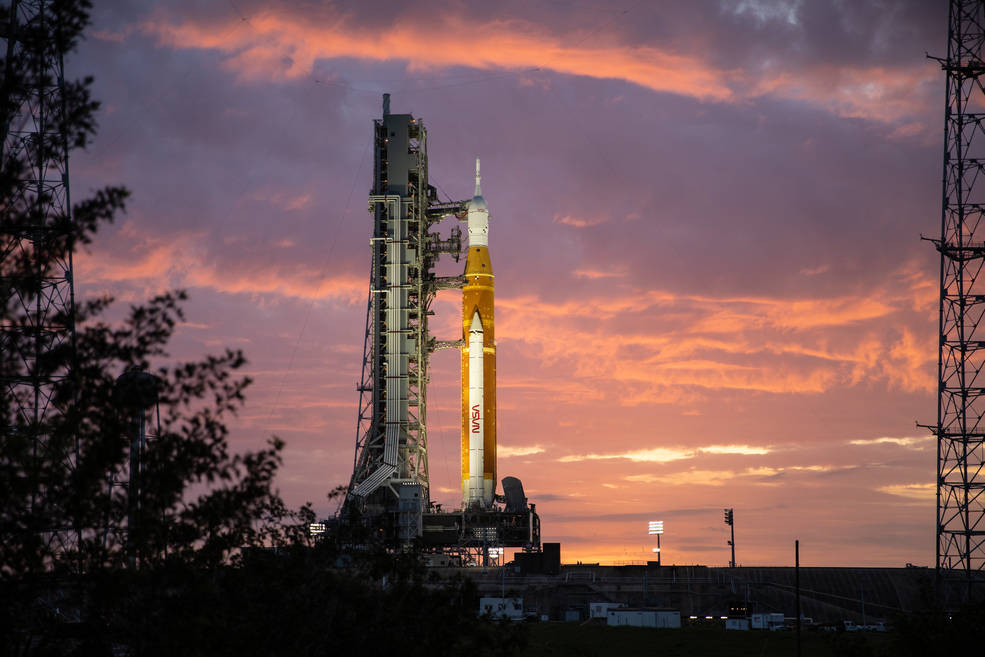
Artemis I launch on Aug 27, 2022 / NASA
In the coming days, teams will modify and practice propellant loading procedures to follow a procedure similar to what was successfully performed during the Green Run at NASA’s Stennis Space Center in Mississippi. The updated procedures would perform the chilldown test of the engines, also called the kick start bleed test, about 30 to 45 minutes earlier in the countdown during the liquid hydrogen fast fill liquid phase for the core stage.
Teams also are configuring platforms at Launch Pad 39B to enable engineers access to the purge can on the tail service mast umbilical. Once access is established, technicians will perform assessments and torque connection points where necessary.
Meteorologists with the U.S. Space Force Space Launch Delta 45 predict favorable weather conditions for Saturday. While rain showers are expected, they are predicted to be sporadic during the launch window.
The mission management team will reconvene Thursday to review data and overall readiness.
As the SLS rocket is scheduled for launch during a two-hour window that opens at 8:33 a.m. EDT Monday, Aug. 29, from Launch Pad 39B at Kennedy Space Center, NASA is planning to provide a wide coverage of prelaunch, launch, and postlaunch activities for Artemis I.
Artemis I will be the first integrated test of NASA’s Orion spacecraft, Space Launch System (SLS) rocket, and the ground systems at the launch center in Florida, heralding future crewed flight test and future human lunar exploration.
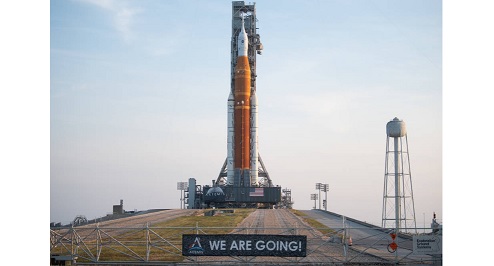
The rocket and spacecraft have already reached the launch pad last week after the nearly 10-hour, four-mile trek from the Vehicle Assembly Building and a livestream of the rocket and spacecraft at the launch pad has been made available on the NASA Kennedy YouTube channel.
Live coverage of events will air on NASA Television, the NASA app, and the agency’s website, with prelaunch events starting Monday, Aug. 22. The launch countdown will begin Saturday, Aug. 27, at 10:23 a.m.
Artemis I set for launch / NASA
A live broadcast of the launch includes celebrity appearances by Jack Black, Chris Evans, and Keke Palmer, as well as a special performance of “The Star-Spangled Banner” by Josh Grobin and Herbie Hancock. It also will feature a performance of “America the Beautiful” by The Philadelphia Orchestra and cellist Yo-Yo Ma, conducted by Yannick Nézet-Séguin.
The first in a series of complex missions, Artemis I is an uncrewed flight test that will provide a foundation to extend human presence to the Moon and beyond. The mission will test the performance of the SLS rocket and test Orion’s capabilities over a period of about six weeks while on its travel that covers about 40,000 miles beyond the Moon and back to Earth.