Reuters/Ipsos Poll: Kamala Harris Leads Trump 46% to 43%; Tight Race Ahead for US Presidential Elections

As per the latest Reuters/Ipsos poll, Democratic Vice President Kamala Harris is leading Republican Donald Trump by a narrow margin of 46% to 43% in the 2024 U.S. presidential election, reflecting the sentiments of voters as the November 5, 2024 vote is nearing.

The poll reveals that voters consider the economy as the top issue facing the country. Within this context, the cost of living was identified as the most important economic concern, with 70% of respondents considering it a key issue while other economic issues like the job market, taxes, or improving personal finances received significantly less attention.

When it comes to addressing these economic issues, voters’ opinions diverge. Donald Trump was seen as the preferred candidate for addressing the cost of living, with 44% of respondents supporting his approach compared to 38% for Kamala Harris. However, when it comes to addressing the gap between wealthy and average Americans, Harris was favored by a margin of 42% to 35%.

The poll also touched on the contentious issue of immigration, which is currently at its highest level in America in over a century. Some 53% of voters in the poll agreed with the statement that immigrants who are in the country illegally are a danger to public safety, compared to 41% who disagreed. This shows that Trump’s claims about immigrants being prone to crime might have swayed some voters, despite these assertions being largely discredited by academics and think tanks.

State-by-State Results

In terms of trust, voters favoured Kamala Harris more than Donald Trump. The poll found that 55% of respondents agreed that Harris was mentally sharp and able to deal with challenges, compared to 46% who held the same view about Trump. This could be a significant factor in the election, as voters may prioritize a candidate’s mental sharpness when making their decision.

The poll, which had a margin of error of about 3 percentage points, also highlighted the importance of state-by-state results in determining the winner of the election. The Electoral College’s state-by-state results are crucial, with seven battleground states likely to be decisive. Polls have shown Harris and Trump are neck-and-neck in those battleground states, with many results within the margins of error.

Historically, close races like this one have been decided by a few key factors, including the candidates’ performance in debates, their ability to mobilize their base, and their success in swaying undecided voters.

In 2000, George W. Bush and Al Gore were locked in a tight race that was ultimately decided by a few hundred votes in Florida. Similarly, in 2016, Donald Trump’s victory was secured by narrow margins in key swing states. As the 2024 election approaches, both Harris and Trump will need to focus their efforts on these crucial areas if they hope to secure victory.

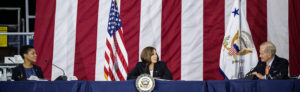
‘Call Her Daddy’ Podcast: Kamala Harris Defends Modern Families, Rebuts Criticism Over ‘No Biological Kids’

In a recent appearance on the popular podcast Call Her Daddy, Vice President Kamala Harris addressed criticism from Arkansas Governor Sarah Huckabee Sanders, who questioned Harris’ understanding of family due to her lack of biological children. Harris firmly rejected the criticism, stating that families take many forms, rooted not just in blood but in love.

“We have our family by blood, and then we have our family by love, and I have both,” Harris said, defending the evolving concept of family in modern society. The remarks came as part of Harris’ broader media push ahead of the upcoming November 5 election, where she faces a heated battle against Donald Trump.

Governor Sanders had implied during a Michigan town hall that Harris, without children of her own, lacked humility. Harris countered that Sanders’ views were outdated, noting that she has two stepchildren through her marriage to Doug Emhoff and emphasizing the value of women supporting each other rather than tearing each other down.

Harris also responded to derogatory remarks from Trump’s running mate, JD Vance, who once ridiculed women without children as “cat ladies” unfit to lead. She dismissed his comments as “mean-spirited,” further emphasizing the need to move beyond stereotypes that tie a woman’s worth to her role as a biological mother.

Harris’ appearance on Call Her Daddy, which touched on other pressing issues like reproductive rights and student debt, is part of a strategic media blitz. Along with this podcast, she’s set to appear on prominent shows like 60 Minutes, The View, and The Late Show with Stephen Colbert in a bid to strengthen support as the election nears.

The vice president’s stance reflects a larger shift in societal attitudes toward nontraditional families and challenges long-held views on women in leadership roles. Harris’ message—that family can be defined by love and choice, not just biology—resonates with many who believe that modern family structures and women’s roles in society should not be confined to outdated norms.

Harris’ strong stance on the podcast has been widely praised, sparking further debate about the intersection of gender, family, and leadership. With the election looming, these discussions may influence voters as they consider what leadership in the 21st century looks like.

U.S. Immigration Policy Shift: No Renewal for Humanitarian ‘Migrant Parole’ Program

The Biden administration has announced a significant shift in its immigration policy as the U.S. Department of Homeland Security (DHS) said that it will not renew a temporary humanitarian entry program for hundreds of thousands of migrants who have U.S. sponsors and entered the country in recent years.

The program, known as the parole program, has allowed approximately 530,000 migrants from Cuba, Haiti, Nicaragua, and Venezuela to enter the U.S. since October 2022. These migrants were granted two-year permits under the program, which will begin to expire in the coming weeks.

Despite the non-renewal of the program for current beneficiaries, it will continue to accept new applications from those abroad. This indicates that while the current beneficiaries will not be renewed, the program itself is not being entirely discontinued.

The parole program was launched by the Biden administration as a strategy to provide legal avenues for migrants to enter the U.S. and decrease illegal crossings at the U.S.-Mexico border. The program allows migrants with existing U.S. sponsors to enter the country for humanitarian reasons or if their entry is deemed a significant public benefit.

Future of Migrants in US

The decision not to renew the parole program has raised concerns about the future of the migrants who have benefited from it. “Migrants without permission to remain in the U.S. will need to depart the United States prior to the expiration of their authorized parole period or may be placed in removal proceedings,” DHS spokesperson Naree Ketudat said.

However, other parole programs for Ukrainians and Afghans have been extended, indicating that the administration is not entirely moving away from such programs. Despite the end of the parole program, many of these migrants could remain in the country under other programs. For instance, many Cubans are eligible for permanent residence and eventual citizenship under the 1966 Cuban Adjustment Act.

Most Haitians and Venezuelans in the U.S. are eligible for Temporary Protected Status, which grants them deportation relief and work permits. All four nationalities could apply for asylum.

Not Unprecedented

The Biden administration’s decision to not renew the parole program is reminiscent of previous shifts in U.S. immigration policy. For instance, in the 1980s, the Reagan administration granted amnesty to millions of undocumented immigrants, a move that was controversial but also recognized the reality of large-scale undocumented migration.

Similarly, the Obama administration implemented the Deferred Action for Childhood Arrivals (DACA) program, which provided temporary relief from deportation for undocumented immigrants brought to the U.S. as children. These historical precedents highlight the ongoing evolution of U.S. immigration policy in response to changing circumstances and policy priorities.

The decision comes at a time when immigration is a top voter issue in the upcoming Nov. 5 election that will pit Democratic Vice President Kamala Harris against Republican Donald Trump, who has criticized the parole program. The Biden administration’s immigration policies have been a point of contention, with record numbers of migrants caught crossing illegally during Biden’s presidency.

However, crossings have plummeted in recent months as Biden rolled out new border restrictions. As the country moves forward, the management of migration flows and the balance between humanitarian concerns and national security will continue to be key issues in immigration policy.

Who’s Rajeev Badyal? New Indian American chosen to serve in National Space Council

Indian-American Rajeev Badyal has been chosen to be one the 30 members selected by US Vice President Kamala Harris to serve on the National Space Council’s Users Advisory Group (UAG) to provide advice on space-related projects and issues.

Rajeev Badyal presently leads Amazon’s Project Kuiper — an initiative to launch a constellation of Low Earth Orbit satellites to provide low-latency, high-speed broadband connectivity to unserved and underserved communities around the world.

As a selected member of the UAG, Badyal will serve to enable the Biden-Harris Administration’s effort to maintain a robust and responsible US space enterprise and preserve space for current and future generations, according to a White House statement.

The UAG will provide the National Space Council advice and recommendations on matters related to space policy and strategy, including but not limited to, government policies, laws, regulations, treaties, international instruments, programmes, and practices across the civil, commercial, international, and national security space sectors, the statement further read.

The candidates selected by Kamala Harris, who is Chair of the National Space Council, represent a cross-section of companies and organisations that support the large and highly skilled space workforce; users of space services, including climate scientists and agriculture providers; individuals focused on developing the next generation of space professionals; and leading experts in space.

The members are currently awaiting their official appointment by Bill Nelson, Administrator of the National Aeronautics and Space Administration (NASA).

The board will be chaired by retired US Air Force general Lester Lyles, Harris had announced at a space council meeting in September. Lyles also serves as chair of the NASA Advisory Council.

Before joining Amazon, Badyal was the vice president of Satellites at SpaceX. He is armed with a Masters in Electrical and Computer Engineering from Oregon State University.

NASA Hosts National Space Council Meeting, Vice President Kamala Harris Chairs Event

Vice President Kamala Harris highlighted the importance of climate, human spaceflight, and STEM education during the Biden-Harris Administration’s second National Space Council meeting Friday, held at NASA’s Johnson Space Center in Houston.

“For generations, with our allies and partners around the globe, America has led our world in the exploration and use of space,” said Harris. “Our leadership has been guided by a set of fundamental principles – cooperation, security, ambition, and public trust – which is the recognition, of course, that space can and must be protected for the benefit of all people.

There is so much we still don’t know and so much we still haven’t done – space remains a place of undiscovered and unrealized opportunity. Our test and our responsibility is to work together to guide humanity forward into this new frontier and to make real the incredible potential of space for all people.”

National Space Council Meeting led by Chairwoman, Vice President Kamala Harris. Photo Date: September 9, 2022. Location: Building 9NW, SVMF. Photographer: Robert Markowitz.

For more than 50 years, NASA satellites have provided open-source and publicly available data on Earth’s land, water, temperature, weather, and climate. Improving access to key climate information is a priority for the agency. Building on his previous announcement, NASA Administrator Bill Nelson released the first concept, and shared a new video for the Earth Information Center. The center will allow the public to see how the Earth is changing and guide decision makers to mitigate, adapt, and respond to climate change.

“Just like we use mission control to monitor operations during spaceflight, we’re embarking on this effort to monitor conditions here on our home planet, and it will be available to everyone in an easy-to-access format,” Nelson said.

Planning for the Earth Information Center is underway with the initial phase providing an interactive visual display of imagery and data from NASA and other government agencies. NASA Headquarters plans to house this initial interactive display with goals to expand in person and virtual access over the next five years.

The Vice President also underscored the important research conducted on the International Space Station that will enable long duration stays on the Moon and future human missions to Mars, in addition to benefits to life here on Earth.

NASA/Photo: Nasa.gov

NASA uses the International Space Station to conduct critical research on the risks associated with future Mars missions – space radiation, isolation, and distance from Earth, just to name a few. It’s also a testbed to develop the technologies we’ll need for long duration stays on the Moon, where we will build an Artemis Base Camp on the surface and Gateway outpost in lunar orbit,” Nelson said. “Research on the space station demonstrates that the benefits of microgravity are not just for discovery. We also develop new technologies that improve life on Earth, like treatments for cancer.”

In conjunction with the meeting, NASA announced a new Space Grant K-12 Inclusiveness and Diversity in STEM (SG KIDS) opportunity that will award more than $4 million to institutions across the U.S. to help bring the excitement of NASA and STEM to traditionally underserved and underrepresented groups of middle and high school students. The announcement is a part of a broader set of commitments made by public, private, and philanthropic partners announced by the Vice President to help in the recruitment and development of the next generation of the space workforce.

SG KIDS also addresses the White House Executive Order on Advancing Racial Equity and Support for Underserved Communities Through the Federal Government, as well as NASA Administrator Bill Nelson’s focus on providing authentic STEM opportunities to K-12 students.

While at NASA’s Johnson Space Center, Vice President Harris toured the agency’s mission control with Nelson and Johnson Center Director Vanessa Wyche. The Vice President also spoke with NASA astronauts Bob Hines, Kjell Lindgren, and Jessica Watkins, living and working aboard the International Space Station about how their research benefits life on Earth, supports long duration space flight, and protects our planet.

The Vice President also received a tour of the Space Vehicle Mockup Facility (SVMF), where space flight crews and their support personnel receive world class training on high-fidelity hardware for real-time mission support. The SVMF consists of space station, Orion, Commercial vehicle mockups, part-task trainers and rack interfaces, a Precision Air Bearing Floor, and a Partial Gravity Simulator.

A recording of the full National Space Council meeting is available online at:

https://go.nasa.gov/3eEGxEW

It’s Official: Kamala Harris Becomes Joe Biden’s pick for Vice President

As expected, Joe Biden has chosen Kamala Harris, the voice for coloured people as well as Indian Americans and prominent senator from California, as his Vice President running mate, setting the speculations to rest on Tuesday. Her selection is likely to send shockwaves even among her own followers and India as well.

Harris, who was among those who pitched for Presidential race but withdrew later faced off Joe Biden in the 2020 first primary debate on racial issues. Her views, however, stood the ground that Biden has chosen her as she represents not onl the Indian-origin community but also the Black due to her descent.

Kamala’s grandfather was from Chennai who had participated in India’s freedom movement and later served as a senior diplomat when India attained independence. Moreover, she would be the first woman American vice president, if elected.

Harris represents the racial diversity that Biden wanted prominently to reassure the huge number of voters when the Black Lives Matter movement is knocking the very roots of the United states political system despite the vicious Covid-19 is downrating the country’s economy. Kamala Harris, 55, will be 22 years younger to Biden, who would be the oldest president-elect in U.S. history.

22 Years Younger

“You make a lot of important decisions as president. But the first one is who you select to be your Vice President. I’ve decided that Kamala Harris is the best person to help me take this fight to Donald Trump and Mike Pence and then to lead this nation starting in January 2021,” Biden wrote in an email from his campaign to supporters. “I need someone working alongside me who is smart, tough, and ready to lead. Kamala is that person,” he wrote. “I need someone who understands the pain that so many people in our nation are suffering. Whether they’ve lost their job, their business, a loved one to this virus.”

“This president says he ‘doesn’t want to be distracted by it.’ He doesn’t understand that taking care of the people of this nation — all the people — isn’t a distraction — it’s the job,” Biden continued. “Kamala understands that. I need someone who understands that we are in a battle for the soul of this nation. And that if we’re going to get through these crises — we need to come together and unite for a better America. Kamala gets that.”

In her reply, Kamala Harris tweeted, “can unify the American people because he’s spent his life fighting for us. And as president, he’ll build an America that lives up to our ideals. I’m honored to join him as our party’s nominee for Vice President, and do what it takes to make him our Commander-in-Chief.”

Joint Campaign Ahead

Both Biden and Harris will appear together at the campaign from Biden’s hometown of Wilmington, Delaware, on Wednesday.

Harris, a native of Oakland, California, and the child of Jamaican and Indian immigrants, worked as attorney general, closely with Biden’s late son, Beau Biden, when he was Delaware’s attorney general, particularly in challenging big banks amid the housing crisis. She also wrote a book, “The Truths We Hold: An American Journey,” where she revealed how she worked with Beau Biden.

Though Miami debate left behind a bad taste in their views, which Trump immediately tried to focus on. Soon after the announcement, at a White House press conference, Trump said Harris was “nasty” and “disrespectful” to Biden during the primary. “She was nasty to a level that was just a horrible thing, the way she was,” Trump said. “I won’t forget that soon.”

However, after she left the race, Harris had extended her full support to the Biden campaign, holding joint fundraisers and roundtables around issues like the racial disparities in coronavirus cases and protecting the Affordable Care Act. In a June she went on successfully raising $3.5 million for the campaign.

Kamala Opposed India’s Policies

However, back home in India, her selection and possibility to become the US Vice President may send shockwaves as she was among those who opposed New Delhi’s policies in Jammu and Kashmir and revocation of autonomy.

She has reportedly said: “We have to remind the Kashmiri people that they are not alone in the world. We are keeping track on the situation. There is a need to intervene if the situation demands.” Notably, Harris was among the India-origin Democrats, barring Raja Krishnamoorthy, who boycotted the Howdy Modi event in Texas.

When Biden wins the November Presidential election, it will be pertinent for Indian forign minister and the Indian diplomats to work their way through to meet her expectations, especially on Jammu and Kashmir issue.