At 2:53 p.m. EDT, the Orion spacecraft ignited its thrusters for 8 seconds, producing a change in velocity of 4.2 feet-per-second and pushing Artemis II toward Earth. NASA astronauts Reid Wiseman, Victor Glover, Christina Koch and CSA (Canadian Space Agency) astronaut Jeremy Hansen reviewed procedures and monitored the spacecraft’s configuration and navigation data.
The crew continues to wrap up cabin configuration for re-entry and move into their entry checklist.
Splashdown is targeted for 8:07 p.m. EDT (5:07 p.m. PDT) off the coast of San Diego, where NASA’s recovery team will be standing by to welcome the Artemis II crew home.
Watch live return coverage on NASA+, Amazon Prime, Apple TV, Netflix, HBO Max, Discovery+, Peacock and Roku, starting at 6:30 p.m. Learn how to stream NASA content through a variety of online platforms, including social media. Coverage will continue until NASA and Department of War personnel safely assist the crew out of Orion and transport them to the USS John P. Murtha.
The Artemis II crew — NASA astronauts Reid Wiseman, Victor Glover, Christina Koch and CSA (Canadian Space Agency) astronaut Jeremy Hansen — began the final phase of their journey home to the songs “Run to the Water” by Live, selected by the crew, and “Free” by Zac Brown Band, as they prepared for their third return trajectory correction burn and shifted into full re-entry and splashdown preparations. When they woke up, they were 61,326 miles from Earth.
Splashdown is targeted for 8:07 p.m. EDT (5:07 p.m. PDT) off the coast of San Diego, where a combined NASA and U.S. military recovery team will be standing by to welcome the Artemis II crew home.
The third return burn will occur at 2:53 p.m., refining Orion’s path for atmospheric entry and splashdown. During the maneuver, the spacecraft will make precise adjustments to stay on its targeted course home.
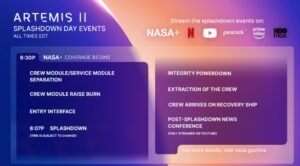
NASA’s Artemis II re-entry and splashdown timeline and streaming coverage. Splashdown is targeted for 8:07 p.m. EDT (5:07 p.m. PDT) off the coast of San Diego, where NASA’s recovery team will be standing by to welcome the Artemis II crew home.NASA
Artemis II splashdown timeline
A carefully timed sequence will guide Orion through the final stages of descent:
7:33 p.m.: Orion’s crew module will separate from the service module, exposing its heat shield for the spacecraft’s return through Earth’s atmosphere, where it will encounter temperatures of about 3,000 degrees Fahrenheit.
7:37 p.m.: Following separation, Orion will perform an 18 second crew module raise burn beginning to set the proper entry angle and align the heat shield for atmospheric interface.
7:53 p.m.: When Orion reaches 400,000 feet above Earth’s surface while traveling nearly 35 times the speed of sound. The crew is expected to experience up to 3.9 Gs in the planned entry profile. This moment marks the spacecraft’s first contact with the upper atmosphere and the start of a planned six-minute communications blackout as plasma builds around the capsule.
8:03 p.m.: Around 22,000 feet in altitude, the drogue parachutes will deploy, slowing and stabilizing the capsule as Orion nears splashdown.
8:04 p.m.: At around 6,000 feet, the drogues will release, and the three main parachutes will deploy, reducing Orion’s speed to less than 136 mph.
8:07 p.m.: Slowing to 20 mph, Orion will splash down in the Pacific Ocean off the coast of San Diego, completing the Artemis II crew’s return to Earth and a 694,481-mile journey.
From there, teams from NASA and the U.S. military will extract the crew from Orion and fly them via helicopter to the USS John P. Murtha.
Within two hours after splashdown, the crew will be extracted from Orion and flown to the USS Murtha. Recovery teams will retrieve the crew, assist them onto an inflatable raft, and then use helicopters to deliver them to the ship. Once aboard, the astronauts will undergo post‑mission medical evaluations before returning to shore where awaiting aircraft will take them to NASA’s Johnson Space Center in Houston.
The Artemis II mission began with the successful liftoff of NASA’s SLS (Space Launch System) rocket on April 1 at 6:35 p.m. from Launch Pad 39B at Kennedy Space Center in Florida, sending the first humans toward the Moon since 1972.
During the mission, the astronauts completed a historic lunar flyby, marking humanity’s return to the vicinity of the Moon for the first time in more than 50 years. Throughout the flight, the crew and teams on the ground have evaluated Orion’s systems in the deep‑space environment, including a series of tests in which astronauts directly operated and interacted with the spacecraft.
Live lunar flyby updates for NASA’s Artemis II mission will be published on this page. All times are Eastern.
9:35 p.m.
The Artemis II crew has completed the mission’s lunar observation period and is now beginning the return trip home. On Tuesday, April 7, Orion will exit the lunar sphere of influence at approximately 1:25 p.m., at a distance of 41,072 miles from the Moon.
8:35 p.m.
Artemis II is now entering a solar eclipse that will last for about an hour as Orion, the Moon and the Sun align. During this phase, the crew will see the Sun disappear behind a mostly darkened Moon.
The crew will use the opportunity to study the solar corona — the Sun’s outermost atmosphere — as it glows around the lunar edge. They also will watch for flashes of light from meteoroids striking the surface, which could offer insight into potential hazards on the Moon.
7:24 p.m.
The Artemis II crew witnessed an Earthrise as Orion emerged from behind the Moon, moments before the Deep Space Network reacquired the spacecraft’s signal and restored communications.
7:02 p.m.
The Artemis II crew has reached the mission’s maximum distance from Earth at 252,756 miles, setting a new record for human spaceflight. This milestone places the crew 4,111 miles farther from Earth than the Apollo 13 mission in 1970.
7:00 p.m.
Orion has reached its closest approach to the Moon at about 4,067 miles above the lunar surface. At this point, the spacecraft is traveling about 60,863 miles an hour relative to Earth, but only 3,139 miles an hour relative to the Moon.
6:44 p.m.
“As we prepare to go out of radio communication, we’re still going to feel your love from Earth. And to all of you down there on Earth and around Earth, we love you, from the Moon. We will see you on the other side.” Victor Glover, Artemis II Pilot
Victor Glover, Artemis II Pilot
The Orion spacecraft has entered a planned communications blackout as it passes behind the Moon. For about 40 minutes, the lunar surface blocks the radio signals from NASA’s Deep Space Network on Earth needed to stay in contact with the crew.
Similar blackouts occurred during the Artemis I and Apollo missions and are expected when using an Earth-based communications system. Once Orion emerges from behind the Moon, the network will quickly reacquire the signal and restore communications with mission control.
6:41 p.m.
As Orion traveled behind the Moon, the crew witnessed an “Earthset” — the moment Earth dropped below the lunar horizon — marking another milestone in the mission’s lunar flyby.
The Earth will re-emerge at “Earthrise” from the opposite edge of the Moon in about 40 minutes.
4:40 p.m.
A lively stream of science observations from the crew throughout the flyby has been received with grins, nods, and lots of chatter in the Science Evaluation Room, where lunar scientists are supporting the observations in mission control. The crew reported color nuances, which will help enhance scientific understandings of the Moon. Shades of browns and blues that can be picked out with human eyes can help reveal the mineral composition of a feature and its age. As crew reports are received, the science team is updating the observation plan based on their follow up questions and sending up new guidance to the crew.
2:45 p.m.
Due to last approximately seven hours, the lunar observation period is the duration of time that the crew is close enough to the Moon to make impactful science observations (4,070 miles altitude at closest approach) and the spacecraft is oriented such that the windows are pointed at the Moon.
At the beginning of the window, as Orion approaches the Moon on the near side, the side we can see from Earth, people in parts of the eastern hemisphere can view some of the same features the astronauts will observe. These include future CLPS landing site Reiner Gamma, a bright, mysterious swirl the origin of which scientists are still trying to understand, and Glushko, a bright, 27-mile-wide crater known for the white streaks that shoot out from it for up to 500 miles.
1:56 p.m.
The Artemis II crew of NASA astronauts Reid Wiseman, Victor Glover, and Christina Koch, along with CSA (Canadian Space Agency) astronaut Jeremy Hansen have set the record for the farthest distance from Earth traveled by a human mission, surpassing the Apollo 13 record of 248,655 miles set in 1970.
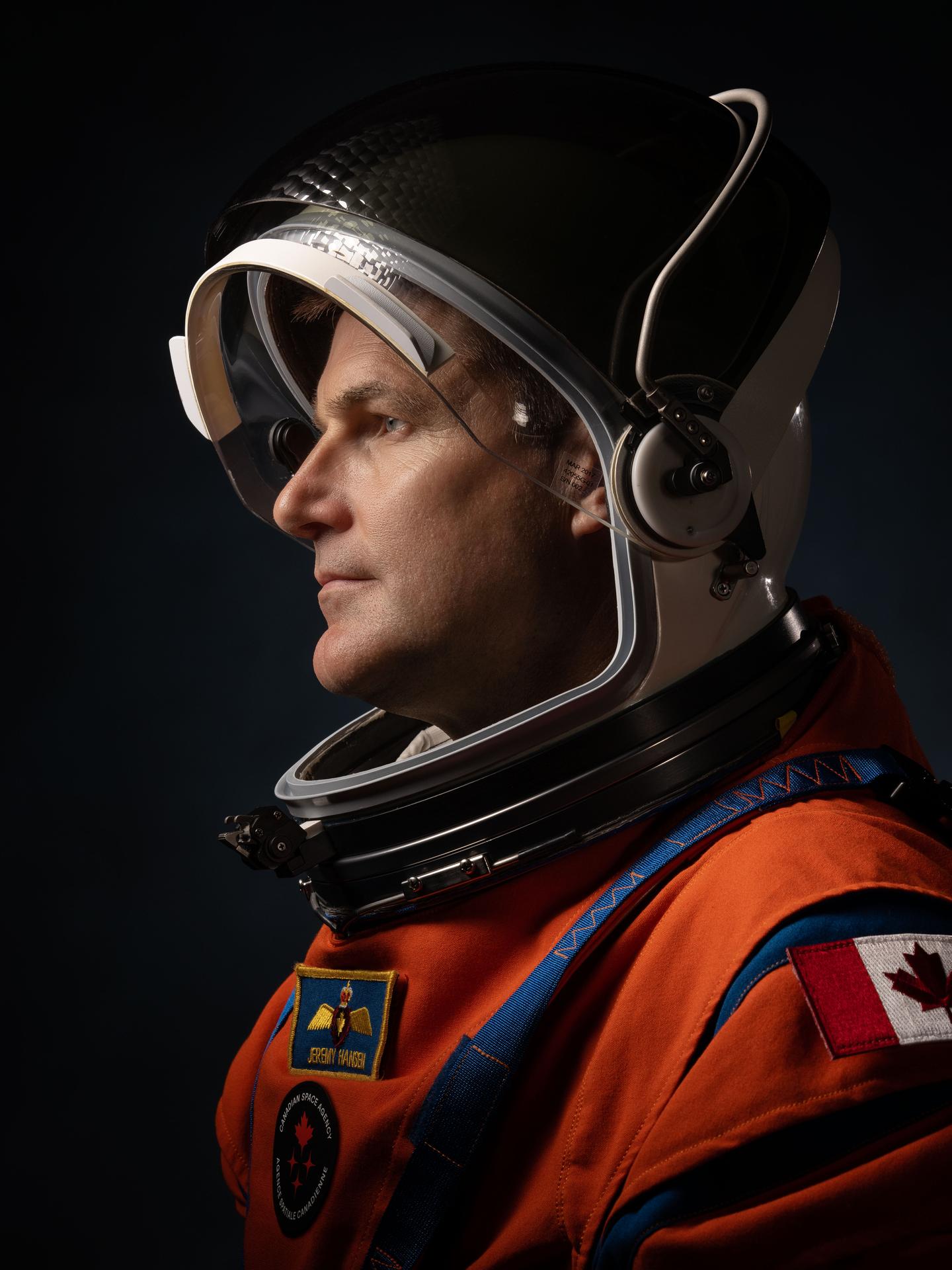
“As we surpass the furthest distance humans have ever traveled from planet Earth, we do so in honoring the extraordinary efforts and feats of our predecessors in human space exploration. We will continue our journey even further into space before Mother Earth succeeds in pulling us back to everything that we hold dear. But we most importantly choose this moment to challenge this generation and the next to make sure this record is not long-lived.” Jeremy Hansen, Canadian Space Agency (CSA) Astronaut and Artemis II Mission Specialist
Jeremy Hansen, Canadian Space Agency (CSA) Astronaut and Artemis II Mission Specialist.
NASA Flight Director Brandon Lloyd, Capsule Communicator Amy Dill, and Command and Handling Data Officer Brandon Borter also marked a lighthearted milestone today by emailing the crew what is now assumed to be the longest person-to-person message ever sent in human history.
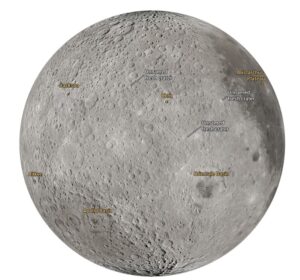
(Shortly after 2 p.m. EDT, the crew described two small, unnamed craters on the heavily pockmarked lunar surface. Calling down to Earth, they suggested provisional names for them. Just northwest of Orientale basin, highlighted above, is a crater they would like to name Integrity after their spacecraft and this historic mission. Just northeast of the Integrity crater, on the near and far side boundary, and sometimes visible from Earth, the crew suggested an unnamed crater be designated Carroll in honor of Reid Weisman’s late wife, Carroll Taylor Wiseman, who passed away on May 17, 2020. After this mission is complete, the crater name proposals will be formally submitted to the International Astronomical Union, an organization that governs the naming of celestial bodies and their surface features.NASA)
After breaking the record for human spaceflight, crew also took a moment to provisionally name a couple of craters on the Moon, noting they were able to see them with their naked eye.
Just northwest of Orientale basin highlighted above is a crater they would like to name Integrity after their spacecraft and this historic mission. Just northeast of Integrity, on the near and far side boundary, and sometimes visible from Earth, the crew suggested Carroll crater in honor of Reid Wiseman’s late wife, Carroll Taylor Wiseman. After this mission is complete, the crater name proposals will be formally submitted to the International Astronomical Union, the organization that governs the naming of celestial bodies and their surface features.
NASA astronaut Reid Wiseman is pictured with his late wife Carroll Taylor Wiseman. Wiseman Family
1:30 p.m.
NASA’s lunar science officer briefed the crew on their science objectives for the upcoming lunar observation period.
On April 5, the science team sent the crew the final list of 30 lunar surface targets, including the Orientale basin, a nearly 600-mile-wide crater that straddles the Moon’s near and far sides. This 3.8-billion-year-old crater formed when a large object struck the lunar surface and retains clear evidence of that collision, including dramatic topography in its rings. The crew will study Orientale’s features up close and from multiple angles as they pass by.
Hertzsprung basin also is on the crew’s list of targets. Northwest of Orientale, it is a nearly 400-mile-wide crater on the Moon’s far side. An older ringed basin, Hertzsprung offers a unique contrast to Orientale because its features have been degraded by subsequent impacts. By comparing the topography of the two craters, the crew’s observations will help scientists gain insight into how lunar features evolve over geologic timescales.
Coverage will include live views of the Moon from cameras mounted on Orion’s solar arrays. Image and view quality may vary throughout the lunar observation period due to distance from Earth, system limitations, and bandwidth across NASA’s communications network.
Note: The spacecraft will enter a planned communications blackout from 6:44 to 7:25 p.m. EDT as Orion passes behind the Moon. Spacecraft camera views will not be available during this time, but NASA’s live coverage will continue.
NASA’s Artemis II crew began Flight Day 3 on April 4 after departing Earth’s orbit earlier in the mission, preparing for their first trajectory correction burn as Orion heads toward the Moon. The four astronauts, currently nearly 100,000 miles from Earth, are also training for lunar observations scheduled during a flyby on April 6. The day’s schedule includes spacecraft operations, medical drills, and communication system tests as the mission advances deeper into space.
The four astronauts aboard NASA’s Artemis II mission woke to music drifting through the Orion capsule, nearly 100,000 miles from Earth. Hours earlier, they had been asleep inside a spacecraft racing toward the Moon, farther from home than any crew in more than half a century.
Commander Reid Wiseman, pilot Victor Glover, mission specialist Christina Koch, and Canadian Space Agency astronaut Jeremy Hansen are now settling into the cadence of deep-space flight. Their journey marks the first time humans have traveled beyond low Earth orbit since NASA’s Apollo program ended in 1972.
Mission controllers at NASA Johnson Space Center in Houston signaled the start of the day at 1 p.m. EDT, playing “…In a Daydream,” by the Freddy Jones Band. By then, Orion was roughly 99,900 miles from Earth, closing in on the Moon, which lay about 161,750 miles ahead.
A view of Earth taken by NASA astronaut and Artemis II commander Reid Wiseman from one of the Orion spacecraft’s four main windows after completing the translunar injection burn on April 2, 2026. NASA
Trajectory correction burn Artemis II timing and purpose
The crew’s primary task later Friday is preparing for the first outbound trajectory correction burn, scheduled for 6:49 p.m. The maneuver will last about eight seconds and slightly adjust Orion’s speed by 0.7 feet per second.
That small change carries weight in deep space navigation. Engineers design these burns to fine-tune the spacecraft’s path after major propulsion events, such as the translunar injection burn completed on April 2. Using Orion’s onboard thrusters, the adjustment ensures the capsule remains precisely aligned for upcoming lunar operations.
Inside the spacecraft, the preparation involves verifying propulsion systems, monitoring navigation data, and coordinating closely with mission control. Even minor deviations can compound over hundreds of thousands of miles, making these early corrections essential.
The Artemis II crew is experiencing this process in real time, managing both the technical and human demands of deep-space travel. It is the kind of operational rhythm that defined earlier lunar missions but has not been practiced by a human crew in decades.
Lunar flyby science targets and far side observations
While engineers refine Orion’s trajectory, scientists are focusing on what the crew will see once they reach the Moon.
Teams on the ground are selecting geological targets that will be visible during a six-hour observation window on April 6, when Orion loops around the lunar surface. The alignment of the Sun, Moon, and spacecraft is expected to illuminate about 20 percent of the Moon’s far side, a region never visible from Earth.
Among the features expected to come into view are the Orientale basin, a massive impact structure, along with Pierazzo crater and Ohm crater. Some of these formations have rarely been seen directly by human eyes without optical aid.
Inside Orion, the astronauts are rehearsing for that moment. The cabin, roughly the size of two minivans, requires careful choreography in microgravity. Equipment must be secured, camera positions planned, and movement coordinated to avoid disrupting observations.
The crew will use handheld cameras equipped with 80-400 millimeter and 14-24 millimeter lenses. These tools are expected to capture high-resolution imagery of the lunar surface, contributing to scientific analysis and public engagement with the mission.
A view of Earth taken by NASA astronaut and Artemis II Commander Reid Wiseman from one of the Orion spacecraft’s window after completing the translunar injection burn on April 2, 2026. The image features two auroras (top right and bottom left) and zodiacal light (bottom right) is visible as the Earth eclipses the Sun.
Orion spacecraft health tests and deep space communications
Beyond navigation and science, Flight Day 3 also includes routine but critical health and safety exercises.
The astronauts are scheduled to conduct demonstrations of cardiopulmonary resuscitation and choking response procedures. These drills aim to evaluate how emergency medical protocols function in microgravity, where movement and physical coordination differ significantly from Earth.
Physical fitness remains another priority. Each crew member continues daily exercise using Orion’s flywheel device, designed to maintain cardiovascular health during extended missions.
Later in the day, Christina Koch will test Orion’s emergency communication systems using NASA Deep Space Network, a worldwide array of antennas that supports spacecraft far beyond Earth orbit. The test will assess how effectively Orion can transmit data as it moves deeper into space.
The spacecraft’s optical communications system has already demonstrated its ability to send high-definition video and mission data back to Earth through U.S.-based ground stations. That information is relayed directly to mission control in Houston, allowing engineers to monitor the spacecraft’s performance in near real time.
As Artemis II advances toward its lunar flyby, the crew’s day-to-day work blends precision engineering with human adaptability. Each scheduled task, from an eight-second burn to a medical drill, contributes to a mission that is reestablishing a path last traveled more than five decades ago.
For the astronauts aboard Orion, the distance from Earth continues to grow. So does the scope of what lies ahead.