

The four astronauts aboard NASA’s Artemis II mission woke up to a milestone few humans have experienced. Less than 19,000 miles from the Moon, they began final preparations for a lunar flyby that will mark humanity’s return to deep space after more than five decades.
Reid Wiseman, Victor Glover, Christina Koch, and Canadian astronaut Jeremy Hansen are expected to guide the Orion spacecraft through a carefully timed trajectory past the Moon later in the day. The moment carries symbolic weight. The last time humans ventured this far was during Apollo 17 in December 1972.
The crew’s wake-up call came with music. “Good Morning,” by Mandisa and TobyMac played through the spacecraft, followed by a recorded message from Apollo-era astronaut Jim Lovell, who died in 2025. Lovell commanded Apollo 13, the mission that previously held the record for the farthest distance traveled by humans from Earth.
That record is expected to fall at approximately 1:56 p.m. Eastern Time. Orion will surpass Apollo 13’s maximum distance of 248,655 miles, eventually reaching about 252,760 miles from Earth later in the evening.
“Hello, Artemis II! This is Apollo astronaut Jim Lovell. Welcome to my old neighborhood! When Frank Borman, Bill Anders, and I orbited the Moon on Apollo 8, we got humanity’s first up-close look at the Moon and got a view of the home planet that inspired and united people around the world. I’m proud to pass that torch on to you — as you swing around the Moon and lay the groundwork for missions to Mars … for the benefit of all. It’s a historic day, and I know how busy you’ll be. But don’t forget to enjoy the view. So, Reid, Victor, Christina, and Jeremy, and all the great teams supporting you – good luck and Godspeed from all of us here on the good Earth.”


Lovell,Gemini VII, Gemini XII, Apollo 8, and Apollo 13 Astronaut
Lunar Flyby Timeline And Observation Plans
The flyby itself is scheduled to begin around 2:45 p.m. Eastern Time and will span roughly seven hours. During this window, Orion will pass close enough to the lunar surface to allow astronauts to observe geological features in detail.
NASA has indicated that cameras mounted on Orion’s solar arrays will transmit live views of the Moon back to Earth. The agency plans to stream coverage across multiple platforms, including NASA+, YouTube, and major streaming services.
Engineers have cautioned that image quality may fluctuate. The distance from Earth, along with bandwidth constraints across NASA’s Deep Space Network, could affect transmission clarity during portions of the flyby.
The spacecraft’s closest approach is expected shortly after a planned communications blackout. At about 6:44 p.m., Orion will pass behind the Moon, temporarily losing contact with Earth as lunar mass blocks radio signals. The blackout is expected to last around 40 minutes.
Within that window, at approximately 7:02 p.m., Orion will reach its nearest point to the lunar surface, about 4,070 miles above it. This maneuver is critical for setting up the spacecraft’s trajectory for its return journey.


Final Flyby Preparations
art002e009294 (April 6, 2026) – Artemis II Pilot Victor Glover, Commander Reid Wiseman, and Mission Specialist Jeremy Hansen prepare for their journey around the far side of the Moon by configuring their camera equipment shortly before beginning their lunar flyby observations.
Image Credit: NASA
Solar Eclipse Viewed From Deep Space
As the flyby concludes, the crew will witness a rare celestial alignment. Beginning around 8:35 p.m., the astronauts are expected to see a solar eclipse from their vantage point in space.
From Orion, the Moon will move directly between the spacecraft and the Sun, blocking sunlight for nearly an hour. The crew will observe the solar corona, the outermost layer of the Sun’s atmosphere, which becomes visible during such eclipses.
NASA officials have said this phase of the mission offers both scientific and experiential value. Observing the corona from deep space provides a unique opportunity to study solar activity without atmospheric interference.
The Artemis II mission is designed as a test flight, evaluating systems that will support future lunar landings under NASA’s Artemis program. Unlike later missions, Artemis II does not include a landing. Its focus remains on validating life support systems, navigation, and crew operations in deep space.
Still, Tuesday’s flyby represents a turning point. For the first time in more than 50 years, humans are returning to the Moon’s vicinity, setting the stage for a sustained presence in lunar orbit and, eventually, on its surface.
The spacecraft will continue its journey following the flyby, looping back toward Earth in the coming days.
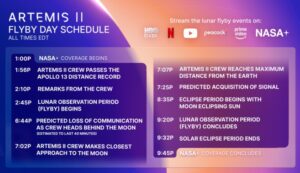
Key moments for the lunar flyby include this following. All times are Eastern and may be adjusted based on real-time operations:

NASA
Monday, April 6
- 1:30 p.m.: The science officer in the Mission Control Center at NASA’s Johnson Space Center in Houston will brief the crew on their science goals for the upcoming flyby.
- 1:56 p.m.: The Artemis II crew is expected to surpass the record previously set by the Apollo 13 crew in 1970 for the farthest humans have ever traveled from Earth.
- 2:45 p.m.: Lunar observations begin.
- 6:44 p.m.: Mission control expects to temporarily lose communication with the crew as the Orion spacecraft passes behind the Moon.
- 6:45 p.m.: During “Earthset,” Earth will glide behind the Moon from Orion’s perspective.
- 7:02 p.m.: Orion reaches its closest approach to the Moon at 4,070 miles above the surface.
- 7:07 p.m.: Crew reach their maximum distance from Earth during the mission (252,706 miles).
- 7:25 p.m.: “Earthrise” marks Earth coming back into view on the opposite edge of the Moon.
- 7:25 p.m.: Mission control will re-acquire communication with the astronauts.
- 8:35-9:32 p.m.: During a solar eclipse, the Sun will pass behind the Moon from the crew’s perspective.
- 9:20 p.m.: Lunar observations conclude.
Tuesday, April 7
- 1:25 p.m.: Orion exits the lunar sphere of influence at 41,072 miles from the Moon.