

Researchers at Princeton University have found that high-fat diets may make certain breast cancers more invasive by altering tumor structure. The study, published March 3 in APL Bioengineering, examined triple-negative breast cancer using advanced 3D models. Scientists say the findings could help explain why diet influences cancer outcomes, though results remain limited to lab conditions.
In a controlled lab setting, researchers watched tumors change shape.
Not grow faster. Not shrink. Change form.
That shift, they say, may help explain why diet influences how some cancers behave.
A team at Princeton University has identified new links between high-fat diets and aggressive breast cancer, focusing on how fat alters the structure of tumors rather than simply accelerating their growth.
The study examined triple-negative breast cancer, a subtype that does not respond to many conventional therapies and is often associated with poorer outcomes.
High-fat nutrients linked to invasive tumor structure
Using 3D tumor models designed to mimic human biological conditions, researchers exposed cancer cells to different nutrient environments, including fats, cholesterol, insulin, and ketones.
The results showed a clear structural difference.
Tumors exposed to fatty acids and cholesterol developed hollow, branching extensions that spread outward from the tumor core. These structures are associated with invasive behavior, allowing cancer cells to penetrate surrounding tissue and potentially spread through the body.
Celeste Nelson, the study’s lead investigator, described these formations as characteristic of aggressive cancers.
“Aggressive cancers have these tendrils, and it’s the leading edges that end up invading into our normal tissues and making it into either a lymphatic or a blood vessel and escaping and metastasizing,” she said.
Notably, the tumors did not grow significantly faster under high-fat conditions. Instead, cells redistributed, moving from the center toward the edges, reshaping the tumor’s structure.
Gene activity points to possible mechanism
The team also identified increased activity of a gene known as MMP1, which is associated with the breakdown of collagen, a key structural component of tissue.
Higher MMP1 levels were strongly correlated with the structural changes observed in the tumors.
Researchers believe this may allow cancer cells to break down surrounding tissue more easily, creating pathways for invasion.
However, the study stops short of proving direct causation. Nelson said further research is needed to determine whether high-fat diets directly trigger this gene activity or if other factors are involved.
Future experiments may test whether blocking MMP1 changes how tumors respond to high-fat conditions.

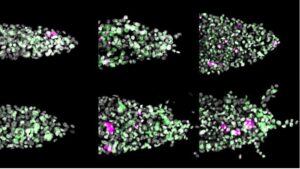
Fluorescence images of sample tumors show invasions into surrounding tissue over several days. Branching invasions are most pronounced in the lower right frame. (Photo illustration from image provided by the researchers/Princeton University.)
Credit:Princeton University
Other diets showed limited impact in the model
The study also tested tumor responses under different nutrient conditions, including high insulin, glycerol, and ketones.
These conditions showed little difference from baseline tumors, which remained relatively compact and did not develop invasive structures.
One unexpected result involved a simulated ketogenic diet, which is typically high in fat and low in carbohydrates.
Researchers had expected it might slow tumor progression. Instead, the tumors did not show improved outcomes compared to baseline conditions within the model.
“We were expecting a ketogenic diet to be protective,” Nelson said. “Yet we didn’t see that here.”
She added that the model may not fully capture the complexity of how such diets interact with the human body, particularly immune responses and other systemic factors.
Study highlights limits of lab-based cancer models
The findings are based on 3D microfluidic tumor models, which aim to replicate aspects of real biological environments more accurately than traditional lab methods.
Unlike 2D cell cultures, which grow in simplified conditions, these models simulate both the physical and chemical environment of tumors. At the same time, they remain more controlled than animal studies, allowing researchers to isolate specific variables such as diet.
Even so, the researchers caution that the results are limited.
The tumors studied are simplified representations and do not include the full range of interactions present in the human body. That means the findings cannot be directly translated into dietary recommendations or clinical outcomes.
“Every tumor is an individual’s tumor,” Nelson said, noting the challenge of capturing the full diversity of cancer behavior in a single study.
New direction for diet and cancer research
The study adds to a growing body of evidence suggesting that diet influences cancer progression, though the mechanisms remain unclear.
By focusing on structural changes rather than growth rates, the Princeton team offers a different lens for understanding how nutrients interact with tumors.
The research also points to potential targets for future therapies, particularly genes involved in tissue breakdown and tumor invasion.
For now, the findings remain an early step.
They show how fat may change the way tumors behave under controlled conditions, opening new questions about how those processes unfold inside the human body.