

Mission Control Comes Alive In California
Inside the Space Flight Operations Facility at Jet Propulsion Laboratory, the Artemis II mission took center stage on April 1, 2026, moments before liftoff. The central display featured the mission patch, while adjacent screens mapped real-time activity across the agency’s Deep Space Network (DSN), with active antennas highlighted as they transmitted and received signals.
From Launch To Deep Space Communication
Shortly after launch at 6:35 p.m. EDT from Kennedy Space Center, initial communications were managed through NASA’s Near Space Network.
Control was then handed over to the DSN, marking a significant milestone—the first time in more than five decades that the network was tasked with maintaining contact with a crewed spacecraft journeying through deep space.

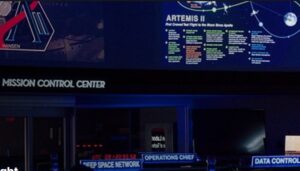
Credits: NASA/JPL-Caltec
A Global Network Tracking The Mission
The DSN, operated from the Space Flight Operations Facility, consists of three major complexes located in Goldstone, California; Madrid, Spain; and Canberra, Australia.
Each site houses multiple high-powered radio antennas, forming a global system capable of maintaining continuous communication with spacecraft across the solar system—including Artemis II.
The Backbone Of Space Communication
Managed by JPL under NASA’s Space Communications and Navigation programme at headquarters, the DSN serves as a critical link between Earth and deep-space missions.
It enables mission teams to track spacecraft, transmit commands, and receive scientific data from vast distances. The Jet Propulsion Laboratory itself is operated by the California Institute of Technology in Pasadena, California, on behalf of NASA.
Also Read:
Artemis II Update-23, Day 9: Crew Prepares To Come Home