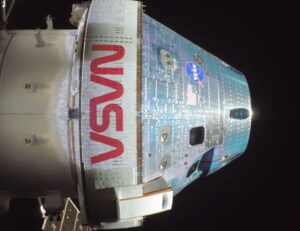
Artemis II Mission Accomplished: Crew Re-Entry Updates, Splash down and Safe return home [Watch Videos]

  • Artemis II launched aboard NASA’s Space Launch System, carrying four astronauts in the Orion spacecraft on a deep-space mission beyond low Earth orbit.
  • The crew conducted system checks and performed a historic lunar flyby, travelling thousands of kilometres beyond the Moon before beginning their return journey.
  • After completing a roughly 10-day mission, Orion safely re-entered Earth’s atmosphere and splashed down in the Pacific Ocean, marking the first crewed lunar mission since Apollo.

Watch as the Artemis II crew returns to Earth, splashing down.

See visualization of plasma build up around the space craft, repelling of that heat on Integrity seat shield To splash down in pacific ocean( from timestamp 1:26:15)  in below  video posted by NASA on X.

NASA’s Artemis II mission return home details:

6:25 p.m.

NASA’s Artemis II mission is scheduled to splash down at about 8:07 p.m. EDT (5:07 p.m. PDT) off the coast of San Diego. After splashdown, a combined NASA and U.S. military team, will retrieve the crew and transport them by helicopter to the USS John P. Murtha. Once aboard the ship, the astronauts will undergo post-mission medical evaluations before returning to shore to board an aircraft bound for NASA’s Johnson Space Center in Houston.

Watch live return coverage on NASA+, Amazon PrimeApple TVNetflixHBO MaxDiscovery+Peacock and Roku. Learn how to stream NASA content through a variety of online platforms, including social media.

7:15 p.m.
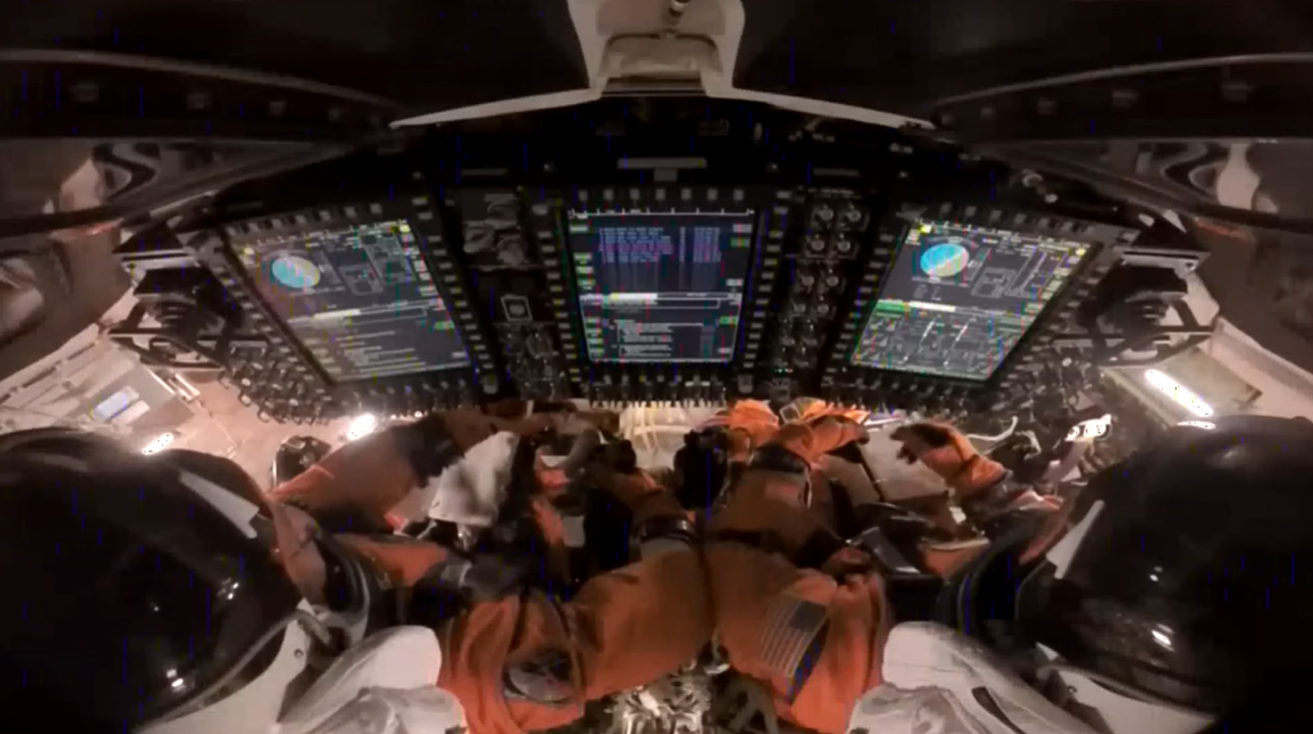
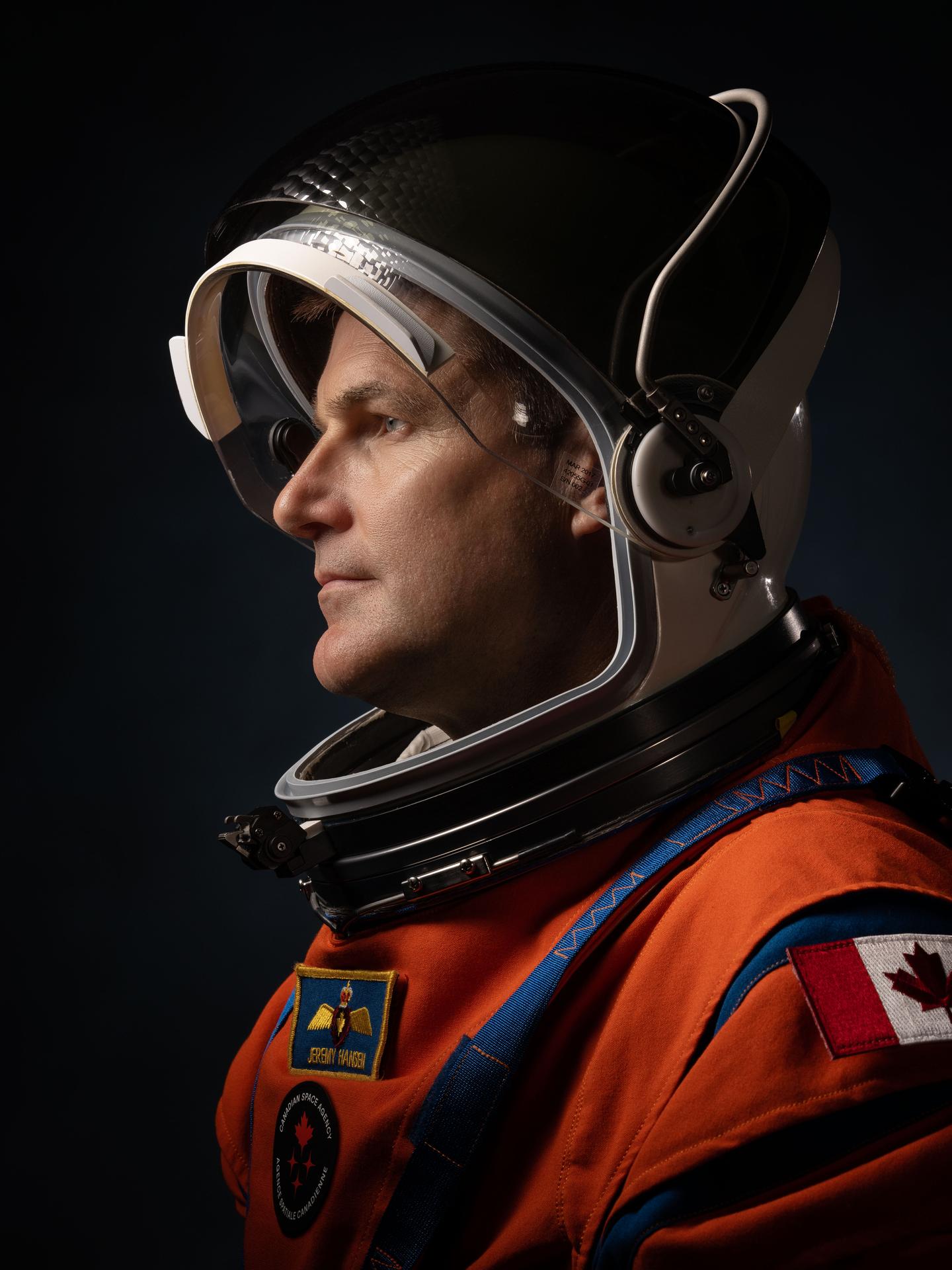
The Artemis II Crew – NASA astronauts Reid Wiseman, Victor Glover, Christina Koch and CSA (Canadian Space Agency) astronaut Jeremy Hansen are preparing for re-entry aboard the Orion spacecraft/NASA

7:33 p.m.

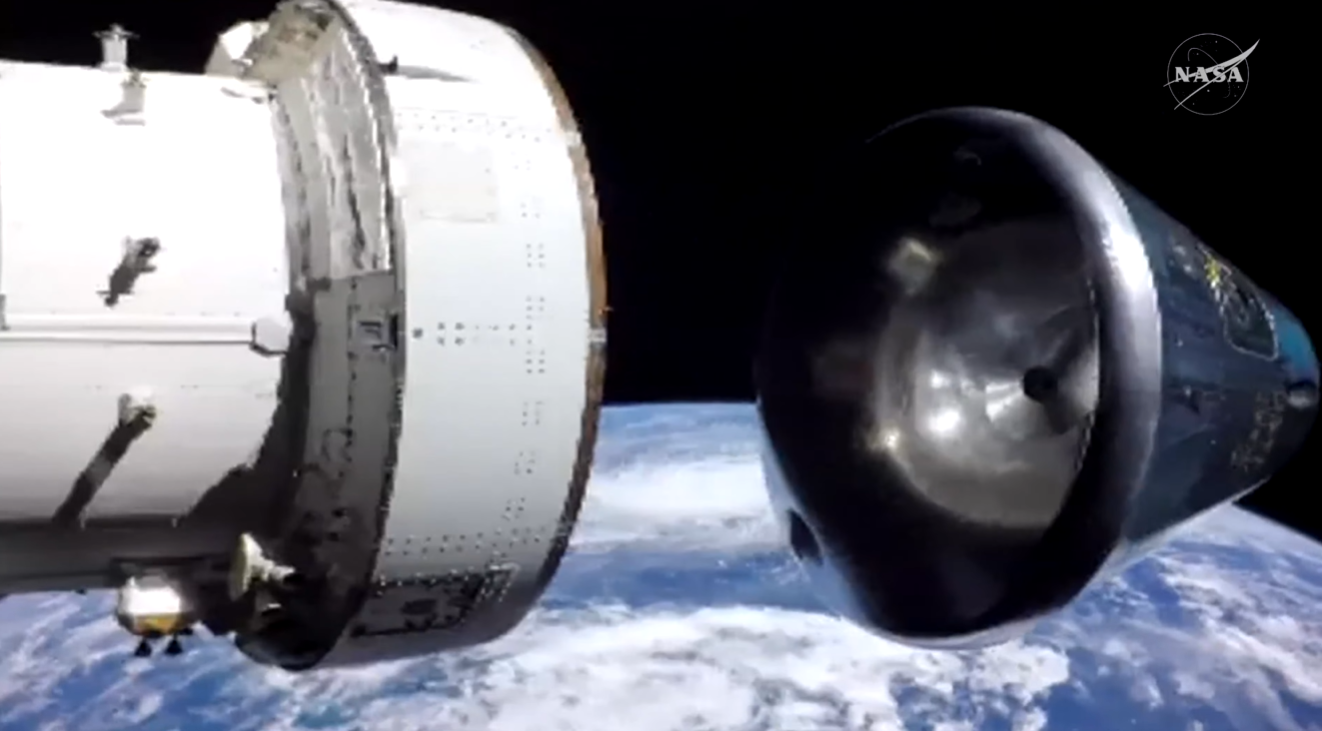
Orion’s crew and service module have separated. The crew module continues on its path towards Earth while the service module will harmlessly burn up in Earth’s atmosphere over the Pacific Ocean. The Artemis II return trajectory is designed to ensure any remaining debris does not pose a hazard to land, people, or shipping lanes.

7:37 p.m.

Orion performed the crew module raise burn, adjusting the spacecraft’s orientation to align its heat shield for re-entry.

7:53 p.m.
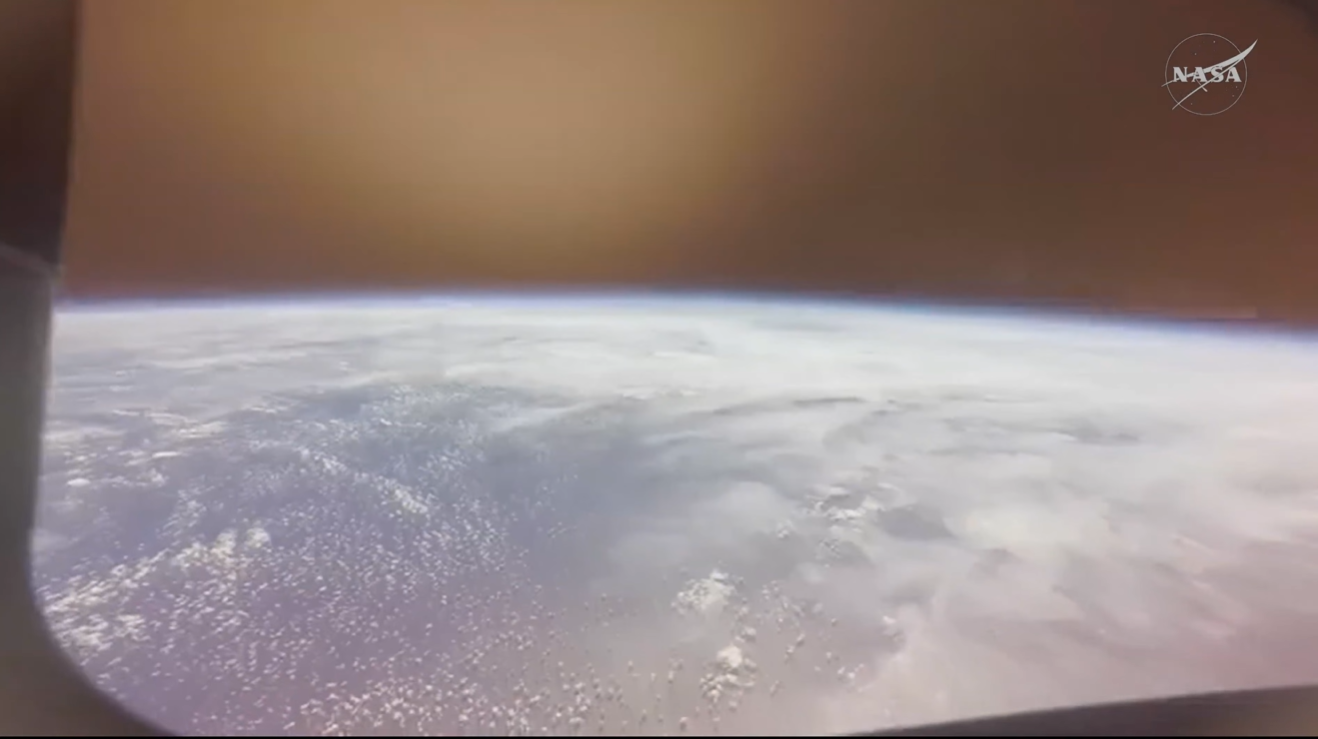
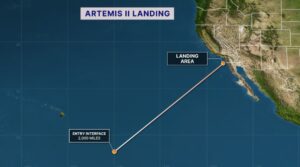
At 7:53 p.m. EDT,  The Orion spacecraft reached Earth’s atmosphere 400,000 feet above the planet’s surface, traveling 35 times the speed of sound and about 1,956 statute miles from the splashdown site. This is where the spacecraft first encounters the upper atmosphere and begins its guided descent. Shortly after, Orion is in a planned communications blackout expected to last about six minutes as plasma built around the crew capsule during heating.

8:00 p.m.

NASA has reestablished communications contact with the Artemis II crew aboard the Orion spacecraft as it returns to Earth.

8:03 p.m.

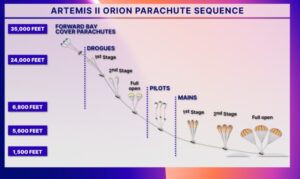
At 23,400 feet, the drogue parachutes on Orion deployed to slow and stabilize the spacecraft. Orion’s velocity drops to 479 feet per second and is .8 miles from splashdown.

8:04 p.m.

At 5,400 feet, Orion’s drogue parachutes were cut and the three main parachutes deployed, reducing velocity to less than 200 feet per second and guiding Orion on its final descent and splashdown.

8:07 p.m.

SPLASHDOWN!
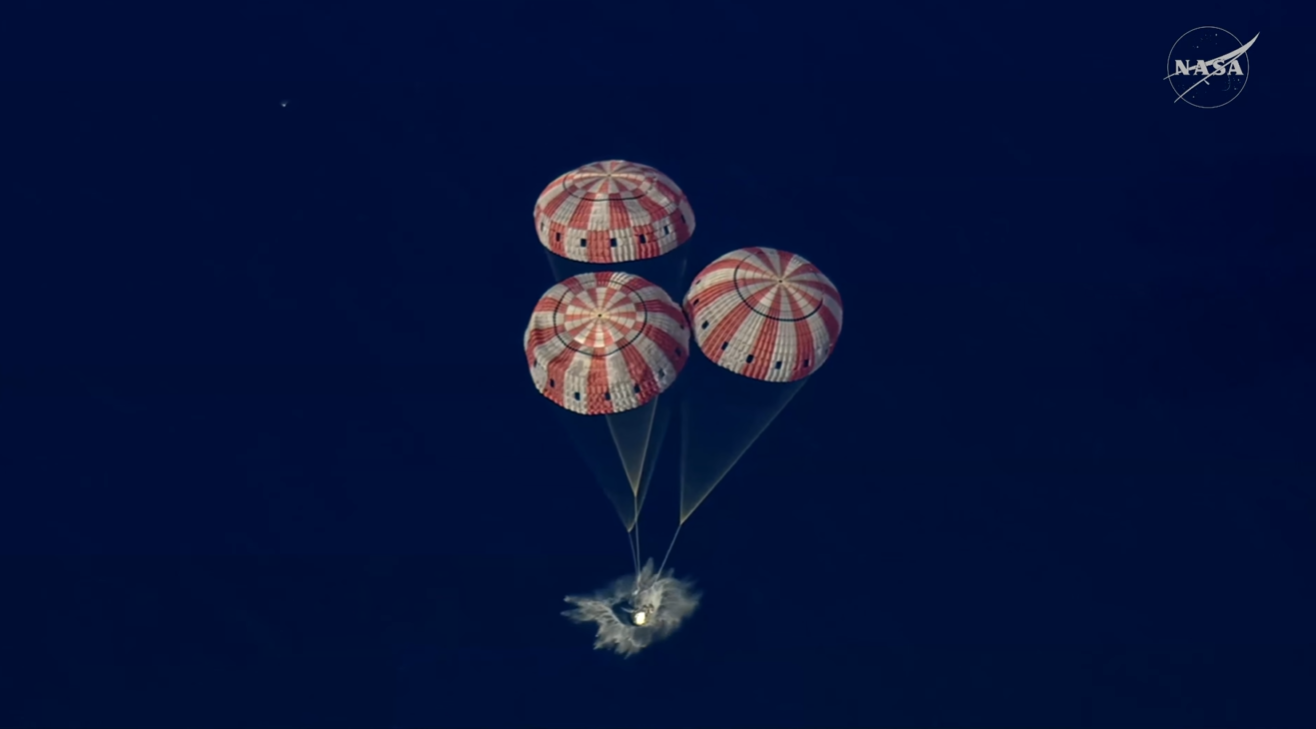
NASA’s Artemis II crew in their Orion spacecraft is back on Earth. They successfully completed a parachute-assisted splashdown in the Pacific Ocean off the coast of San Diego at 8:07 p.m. EDT (5:07 p.m. PDT).
NASA

NASA’s Artemis II crew in their Orion spacecraft is back on Earth. They successfully completed a parachute-assisted splashdown in the Pacific Ocean off the coast of San Diego at 8:07 p.m. EDT (5:07 p.m. PDT).

Engineers will conduct several additional tests while Orion is in the water before powering down the spacecraft and handing it over to the recovery team aboard the USS John P. Murtha. The recovery team is on site and headed to the capsule to begin assisting the crew out of Orion.
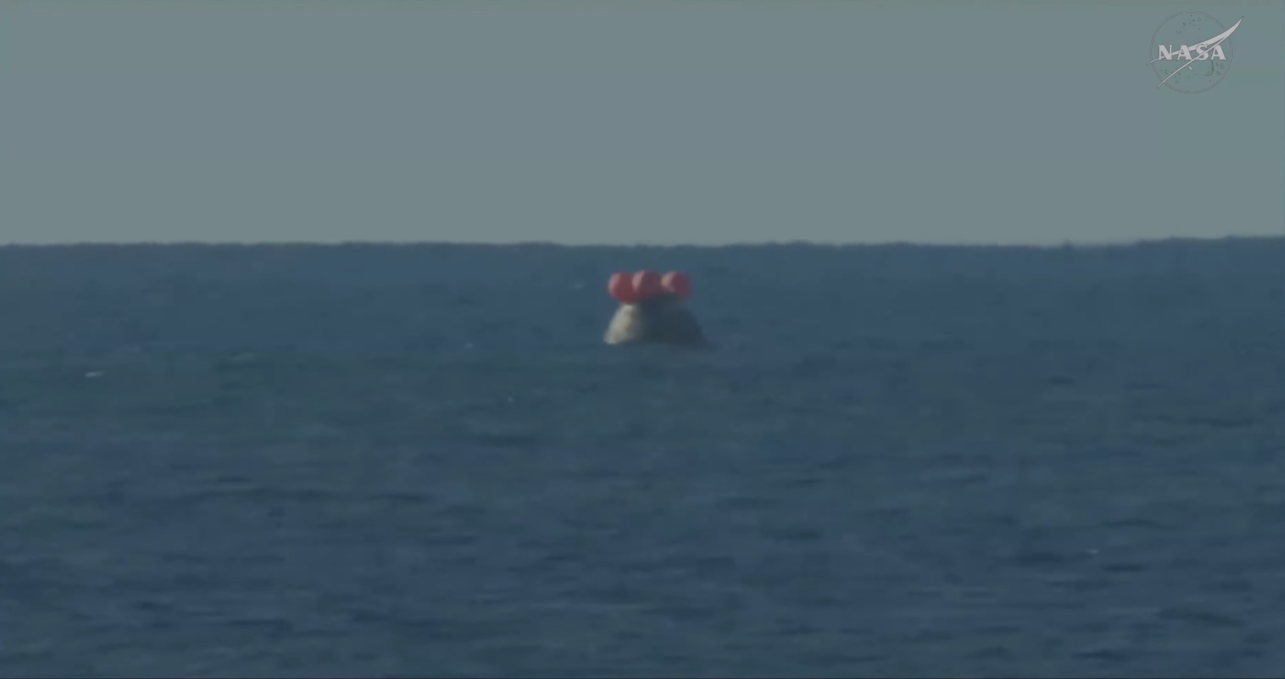
The Orion spacecraft with the Artemis II crew inside is seen floating in the Pacific Ocean after splashing down at 8:07 p.m. EDT on April 10, 2026.
NASA

Orion has begun crew module power down, a planned post-splashdown step in which flight controllers shut down nonessential systems and transition the capsule into its recovery configuration. This reduces power demand and prepares the spacecraft for crew extraction as recovery teams move in.

8:12 p.m.

At the direction of the NASA recovery director, team members from the agency and the U.S. military now are approaching the spacecraft in inflatable boats.

Approximately an hour after splashdown, the crew will be extracted from Orion and then flown to the USS John P. Murtha. U.S. Navy helicopters will then transport them to the ship. Once aboard, the astronauts will undergo post-mission medical evaluations before returning to shore to board an aircraft bound for NASA’s Johnson Space Center in Houston.

When ready, Navy divers will attach a cable, called the winch line, to Orion to pull the spacecraft into a specially designed cradle inside the ship’s well deck. Four additional tending lines will be secured to attachment points on the crew module while under tow.

Once Orion is positioned above the cradle assembly, technicians will drain the well deck and secure the capsule.

After it is secure aboard the ship, teams will return Orion to U.S. Naval Base San Diego before returning it to NASA’s Kennedy Space Center in Florida for inspection. Once there, technicians will thoroughly examine the spacecraft, retrieve onboard data, remove payloads, and conduct additional post-flight checks.

9:34 p.m.

The Artemis II crew – NASA astronauts Reid WisemanVictor Glover, and Christina Koch, and CSA (Canadian Space Agency) astronaut Jeremy Hansen — have been safely extracted from the Orion spacecraft.
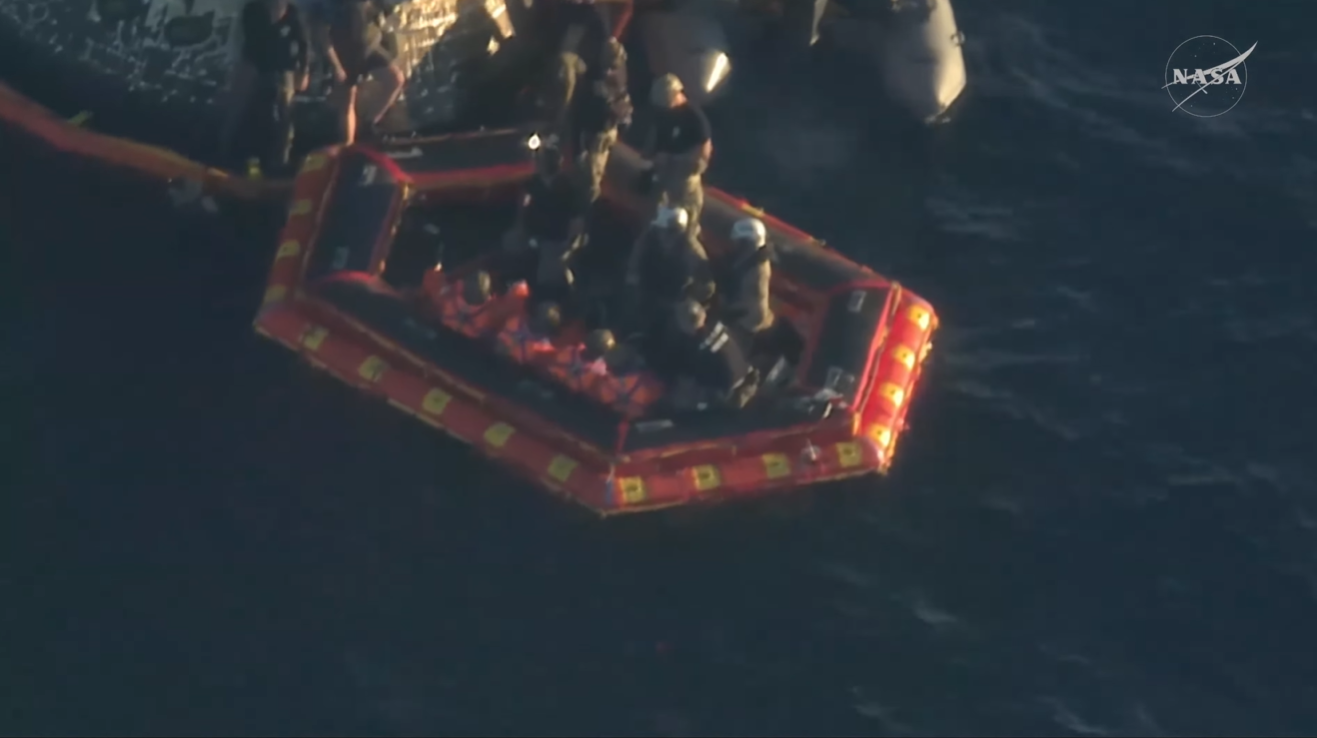
The Artemis II crew is seen on an inflatable raft, called the front porch, after exiting the spacecraft. The Artemis II mission successfully splashed down in the Pacific Ocean at 8:07 p.m. EDT on April 10, 2026.
9:56 p.m.

The Artemis II crew has been hoisted into U.S. helicopters and are being flown to the USS John P. Murtha.
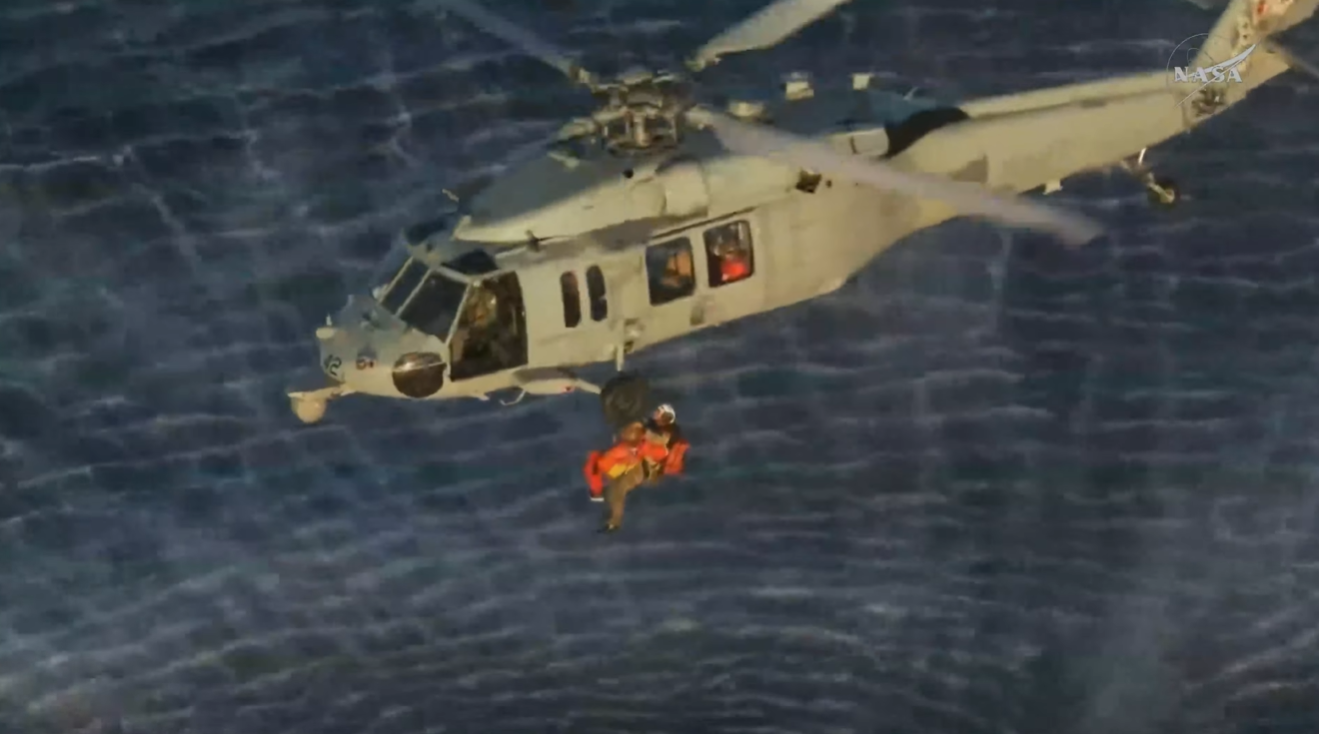
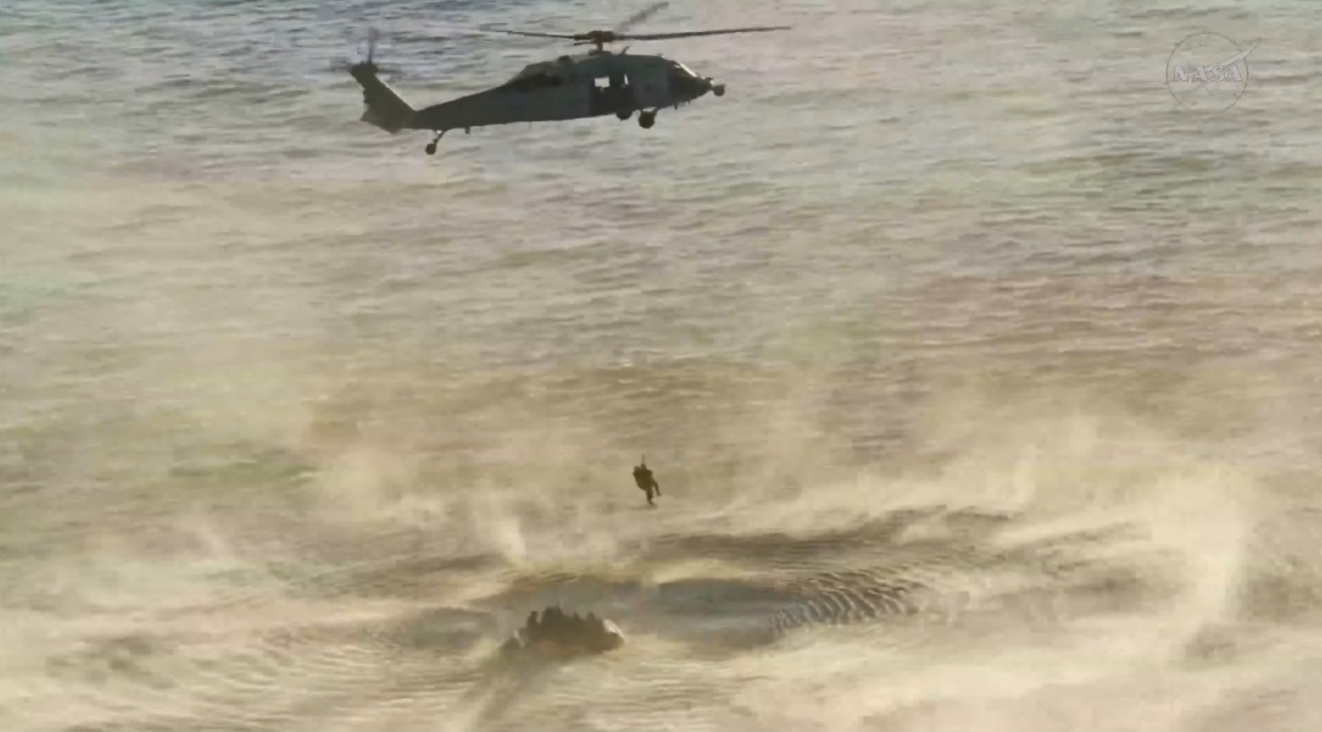
Artemis II Commander and NASA astronaut Reid Wiseman is being hoisted into a U.S. military helicopter before being transported to the USS John P. Murtha.
Artemis II mission specialist and NASA astronaut Christina Koch is being hosted into a U.S. military helicopter before being flown to the USS John P. Murtha. NASA

9:58 p.m.

The Artemis II crew is safely aboard the USS John P. Murtha, where they will undergo post-mission medical evaluations in the ship’s medical bay before traveling back to shore to board a NASA aircraft bound for the agency’s Johnson Space Center in Houston.

NASA will hold a post-splashdown news conference at 10:35 p.m. EDT from the agency’s Johnson Space Center in Houston. Participants include:

  • NASA Associate Administrator Amit Kshatriya
  • Lori Glaze, acting associate administrator, Exploration Systems Development Mission Directorate
  • Rick Henfling, entry flight director, Artemis II
  • Howard Hu, manager, Orion Program
  • Shawn Quinn, manager, Exploration Ground Systems Program

Also Read:

Artemis II Update-25, Day 10: Crew Sets for Final Burn, Splashdown

What’s the longstanding tradition at JPL before any launch and other major space mission events


Artemis II Update-25, Day 10: Crew Sets for Final Burn, Splashdown

The Artemis II crew — NASA astronauts Reid Wiseman, Victor Glover, Christina Koch and CSA (Canadian Space Agency) astronaut Jeremy Hansen — began the final phase of their journey home to the songs “Run to the Water” by Live, selected by the crew, and “Free” by Zac Brown Band, as they prepared for their third return trajectory correction burn and shifted into full re-entry and splashdown preparations. When they woke up, they were 61,326 miles from Earth.

Splashdown is targeted for 8:07 p.m. EDT (5:07 p.m. PDT) off the coast of San Diego, where a combined NASA and U.S. military recovery team will be standing by to welcome the Artemis II crew home.

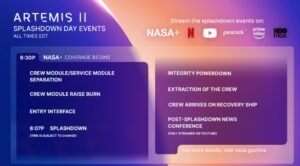
Watch live return coverage on NASA+, Amazon PrimeApple TVNetflixHBO MaxDiscovery+Peacock and Roku starting at 6:30 p.m. Learn how to stream NASA content through a variety of online platforms, including social media.

Final return burn sets Orion for home

The third return burn will occur at 2:53 p.m., refining Orion’s path for atmospheric entry and splashdown. During the maneuver, the spacecraft will make precise adjustments to stay on its targeted course home.

NASA’s Artemis II re-entry and splashdown timeline and streaming coverage. Splashdown is targeted for 8:07 p.m. EDT (5:07 p.m. PDT) off the coast of San Diego, where NASA’s recovery team will be standing by to welcome the Artemis II crew home.NASA

Artemis II splashdown timeline

A carefully timed sequence will guide Orion through the final stages of descent:

  • 7:33 p.m.: Orion’s crew module will separate from the service module, exposing its heat shield for the spacecraft’s return through Earth’s atmosphere, where it will encounter temperatures of about 3,000 degrees Fahrenheit.
  • 7:37 p.m.: Following separation, Orion will perform an 18 second crew module raise burn beginning to set the proper entry angle and align the heat shield for atmospheric interface.
  • 7:53 p.m.: When Orion reaches 400,000 feet above Earth’s surface while traveling nearly 35 times the speed of sound. The crew is expected to experience up to 3.9 Gs in the planned entry profile. This moment marks the spacecraft’s first contact with the upper atmosphere and the start of a planned six-minute communications blackout as plasma builds around the capsule.
  • 8:03 p.m.: Around 22,000 feet in altitude, the drogue parachutes will deploy, slowing and stabilizing the capsule as Orion nears splashdown.
  • 8:04 p.m.: At around 6,000 feet, the drogues will release, and the three main parachutes will deploy, reducing Orion’s speed to less than 136 mph.
  • 8:07 p.m.: Slowing to 20 mph, Orion will splash down in the Pacific Ocean off the coast of San Diego, completing the Artemis II crew’s return to Earth and a 694,481-mile journey.
  • From there, teams from NASA and the U.S. military will extract the crew from Orion and fly them via helicopter to the USS John P. Murtha.
  • Within two hours after splashdown, the crew will be extracted from Orion and flown to the USS Murtha. Recovery teams will retrieve the crew, assist them onto an inflatable raft, and then use helicopters to deliver them to the ship. Once aboard, the astronauts will undergo post‑mission medical evaluations before returning to shore where awaiting aircraft will take them to NASA’s Johnson Space Center in Houston.

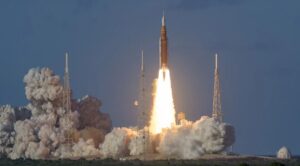
The Artemis II mission began with the successful liftoff of NASA’s SLS (Space Launch System) rocket on April 1 at 6:35 p.m. from Launch Pad 39B at Kennedy Space Center in Florida, sending the first humans toward the Moon since 1972.

During the mission, the astronauts completed a historic lunar flyby, marking humanity’s return to the vicinity of the Moon for the first time in more than 50 years. Throughout the flight, the crew and teams on the ground have evaluated Orion’s systems in the deep‑space environment, including a series of tests in which astronauts directly operated and interacted with the spacecraft.

Also Read:

Artemis II Update-24, Day 9: Second Return Correction Burn Complete

What’s the longstanding tradition at JPL before any launch and other major space mission events
 

Artemis II Update-24, Day 9: Second Return Correction Burn Complete

Thrusters Fire To Steer Orion Home:

At 10:53 p.m. EDT, the Orion spacecraft executed a brief nine-second thruster burn, increasing its velocity by 5.3 feet per second and nudging the Artemis II crew further along their return path to Earth.

With the maneuver complete, the crew has now crossed the halfway mark on their journey home.

Temporary Signal Loss Resolved

Roughly two hours before the burn, mission teams encountered an unexpected return link loss of signal during a data rate transition, briefly disrupting the flow of communications and telemetry from the spacecraft.

Two-way contact was subsequently restored, allowing flight controllers and crew to resume preparations for the scheduled maneuver without further delay.

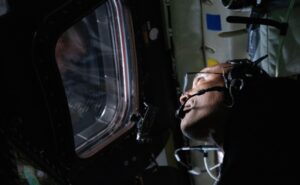
art002e016204 (April 6, 2026) – NASA astronaut and Artemis II Pilot Victor Glover pictured here in the Orion spacecraft during the Artemis II lunar flyby. Glover and his fellow crewmates spent approximately seven hours taking turns at the Orion windows capturing science data to share with their team back on Earth. At closest approach, they came within 4,067 miles of the Moon’s surface.NASA

Re-Entry Briefings And Next Steps

Earlier in the day, officials from NASA provided additional details on re-entry and splashdown procedures during a mission status briefing.

The next key milestone—a third return trajectory correction burn—is planned for April 10 at approximately 1:53 p.m., ahead of final re-entry operations.

Splashdown Target Remains On Track

NASA continues to target splashdown at 8:07 p.m. (5:07 p.m. PDT) on Friday, April 10, off the coast of San Diego, as the Artemis II mission enters its final phase of return.

Also Read:

Artemis II Update-21, Day 7: First Return Correction Burn Complete

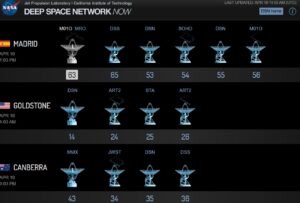
Monitoring over deep space network before artemis II signal acquisition

Who is Dan Florez in Artemis Mission Program

Dan Florez is one of the NASA test directors for the Exploration Ground Systems Program. The test directors are a group of 20 engineers at the agency’s Kennedy Space Center in Florida who plan and execute integrated testing for Artemis missions. Their work includes developing timelines and procedures for launch countdown, propellant loading, emergency egress, pad and launch abort scenarios, recovery operations, and more. They help lead the ground systems team in all areas of testing.

At the time of Artemis I launch, Florez and his fellow test directors had already developed the launch countdown timelines for Artemis II.

“We were really focused on loading that spacecraft with cryogenic propellants and successfully launching it. With Artemis II, we’re going to have to do all that again, but in the middle of that, we’re going to have to embed the crew timeline to get the crew safely inside the spacecraft, get all the systems checked out, and launch them into space,” Florez said. “And we have to do the same thing on the tail end through recovery. So, there’s a lot of complexities when you have the human element thrown into the operation.”

Since Artemis I, Florez has focused his work even more heavily on the human element, taking on rescue and recovery operations.

“We have to have a plan to go get to the crew if we have an abort, if we land anywhere in the world within 24 hours,” said Florez. “My role right now is to do a lot of that coordination to make sure we have all the assets and all the resources in place to get to the crew.”

When the Artemis II crew returns to Earth aboard the Orion spacecraft, Florez will be there, prepared and ready with NASA’s Landing and Recovery Team and the U.S. military.

“We have a great partnership with the military. We have the Human Spaceflight Support Office within the Air Force that support us directly for not just for recovery operations, but also for any of the rescue operations”.

Dan Florez, NASA Test Director, Exploration Ground Systems Program

Recovery operations are routinely verified and validated in what is called an underway recovery test. NASA and Navy teams board a U.S. Navy ship and travel off the coast of San Diego to test retrieving the capsule and getting the crew safely on the ship. In late February 2024, the Artemis II crew joined the recovery team’s eleventh iteration of testing called, URT-11.

“It was really great to have that perspective of having astronauts in the loop during our test operations,” said Florez. “Everywhere along the way, we got feedback from them.”

Artemis II launched at 6:35 p.m. EDT April 1, from Launch Complex 39B, sending NASA astronauts Reid Wiseman, Victor Glover, and Christina Koch, and CSA (Canadian Space Agency) astronaut Jeremy Hansen, on their approximately 10-day mission around the Moon.

A wave breaks inside the well deck of USS Somerset as teams work to recover the Crew Module Test Article (CMTA), a full scale replica of the Orion spacecraft, as they practice Artemis recovery operations during Underway Recovery Test-12 off the coast of California, Thursday, March 27, 2025. NASA/Joel Kowsky

Florez and his colleagues are prepared and ready to apply everything they tested to recover the crew.

“Watching them launch is going to be great. I’m going to be happier when they land”.

Dan Florez, NASA Test Director, Exploration Ground Systems Program

Also Read:

Deep Space Network Establishes Contact With Artemis II Spacecraft

JPL’s Mission Control Steps Up For Artemis II Deep Space Operations


Deep Space Network Establishes Contact With Artemis II Spacecraft

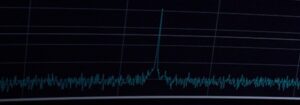
The acquisition of the radio frequency signal from the Artemis II crewed mission to the Moon by NASA’s Deep Space Network (DSN) is indicated by the peak in the data signal shown below on the computer screen.

Credits: NASA/JPL-Caltech

Soon after the mission’s launch on April 1, 2026, at 6:35 p.m. EDT, NASA’s Near Space Network led communications with the Orion capsule. Then, communications were handed off to the DSN, marking the first time in over 50 years that the network would be communicating with a crewed spacecraft traveling through deep space.

The Space Flight Operations Facility at NASA’s Jet Propulsion Laboratory in Southern California (where this photo was taken) operates the DSN, which comprises three complexes in Goldstone, California; Madrid, Spain; and Canberra, Australia. Each complex consists of several radio frequency antennas that communicate with dozens of robotic spacecraft exploring the solar system in addition to the Artemis II mission.

A graphical representation of the Deep Space Network’s radio frequency antennas indicate signal acquisition from NASA’s Artemis II mission to the Moon on April 1, 2026, inside the Space Flight Operations Facility at NASA’s Jet Propulsion Laboratory in Southern California. Two antennas at the Madrid Deep Space Communications Complex, Deep Space Station 54 and 56, can be seen communicating with Artemis II (the signals are labelled “EM2”, short for “Exploration Mission 2”; elsewhere they are labelled “ART2” for “Artemis II”).

A similar visualization can be found at DSN Now, which details all the missions that the network is communicating with 24 hours a day, seven days a week.

NASA

The DSN is managed by JPL for the agency’s Space Communications and Navigation program, which is located at NASA Headquarters within the Space Operations Mission Directorate. The DSN allows missions to track, send commands to, and receive scientific data from faraway spacecraft. JPL is managed by Caltech in Pasadena, California, for NASA.

Also Read:

Monitoring over deep space network before artemis II signal acquisition

JPL’s Mission Control Steps Up For Artemis II Deep Space Operations


Monitoring over deep space network before artemis II signal acquisition

Blanca Renteria, operations chief for the Artemis Deep Space Network (DSN), monitored incoming data from the Space Flight Operations Facility at Jet Propulsion Laboratory shortly after Artemis II lifted off on April 1, 2026.

The launch took place at 6:35 p.m. EDT from Kennedy Space Center, with mission control teams quickly transitioning to deep space communication support.

The Space Flight Operations Facility manages NASA’s DSN, a worldwide system consisting of three primary complexes located in Goldstone, California; Madrid, Spain; and Canberra, Australia.

Each site is equipped with multiple radio-frequency antennas that maintain continuous communication with numerous robotic missions across the solar system, alongside the crewed Artemis II spacecraft.

NASA

Backbone Of Deep Space Communication

The DSN is operated by JPL under NASA’s Space Communications and Navigation programme, based at the agency’s headquarters within the Space Operations Mission Directorate.

This network enables mission teams to track spacecraft, transmit commands, and receive scientific data across vast distances. The Jet Propulsion Laboratory itself is managed by the California Institute of Technology in Pasadena, California, on behalf of NASA.

Also Read:

What’s the longstanding tradition at JPL before any launch and other major space mission events

JPL’s Mission Control Steps Up For Artemis II Deep Space Operations

What’s the longstanding tradition at JPL before any launch and other major space mission events
A Ritual Before Liftoff

A container of “lucky peanuts” was placed above workstations inside the Space Flight Operations Facility at Jet Propulsion Laboratory ahead of the Artemis II launch on April 1, 2026.

The quirky ritual—eating peanuts before major mission events—has long been observed at JPL, seen by teams as a symbol of good fortune before critical operations.

Control Centre Behind Deep Space Communication

The Space Flight Operations Facility oversees NASA’s Deep Space Network (DSN), a global communication system comprising three major complexes located in Goldstone, California; Madrid, Spain; and Canberra, Australia.

Each site houses multiple radio-frequency antennas that maintain constant contact with dozens of spacecraft across the solar system, including the crewed Artemis II mission.

NASA

A Critical Link To Spacecraft

Managed by JPL under NASA’s Space Communications and Navigation programme, the DSN operates from the agency’s headquarters within the Space Operations Mission Directorate.

The network plays a vital role in tracking spacecraft, transmitting commands, and receiving scientific data from distant missions. The Jet Propulsion Laboratory itself is run by the California Institute of Technology in Pasadena, California, on behalf of NASA.

Also Read:

JPL’s Mission Control Steps Up For Artemis II Deep Space Operations

Artemis II Update-23, Day 9: Crew Prepares To Come Home

JPL’s Mission Control Steps Up For Artemis II Deep Space Operations

Mission Control Comes Alive In California

Inside the Space Flight Operations Facility at Jet Propulsion Laboratory, the Artemis II mission took center stage on April 1, 2026, moments before liftoff. The central display featured the mission patch, while adjacent screens mapped real-time activity across the agency’s Deep Space Network (DSN), with active antennas highlighted as they transmitted and received signals.
From Launch To Deep Space Communication

Shortly after launch at 6:35 p.m. EDT from Kennedy Space Center, initial communications were managed through NASA’s Near Space Network.

Control was then handed over to the DSN, marking a significant milestone—the first time in more than five decades that the network was tasked with maintaining contact with a crewed spacecraft journeying through deep space.

Credits: NASA/JPL-Caltec

A Global Network Tracking The Mission

The DSN, operated from the Space Flight Operations Facility, consists of three major complexes located in Goldstone, California; Madrid, Spain; and Canberra, Australia.

Each site houses multiple high-powered radio antennas, forming a global system capable of maintaining continuous communication with spacecraft across the solar system—including Artemis II.

The Backbone Of Space Communication

Managed by JPL under NASA’s Space Communications and Navigation programme at headquarters, the DSN serves as a critical link between Earth and deep-space missions.

It enables mission teams to track spacecraft, transmit commands, and receive scientific data from vast distances. The Jet Propulsion Laboratory itself is operated by the California Institute of Technology in Pasadena, California, on behalf of NASA.

Also Read:

Artemis II Update-23, Day 9: Crew Prepares To Come Home

Artemis II astronauts actively shared experiences via live calls, press conferences from Orion [Watch]


Artemis II Update-23, Day 9: Crew Prepares To Come Home

Final Day In Orbit

On their final full day in space, the Artemis II crew began the morning with “Lonesome Drifter” by Charley Crockett as their spacecraft closed in on Earth from a distance of 147,337 miles.

Astronauts Reid Wiseman, Victor Glover, and Christina Koch of NASA, along with Jeremy Hansen of the Canadian Space Agency, are spending the day preparing for their scheduled return on Friday, April 10. Activities include reviewing re-entry protocols and executing a trajectory correction maneuver.

Securing The Cabin For Re-Entry

Christina Koch and Jeremy Hansen are leading preparations inside the capsule, securing loose equipment, removing storage netting, and adjusting crew seating configurations for re-entry.

The crew will also assess updated weather forecasts, recovery team readiness, and the mission timeline. Simultaneously, they are reviewing post-landing procedures to ensure a smooth transition once back on Earth.

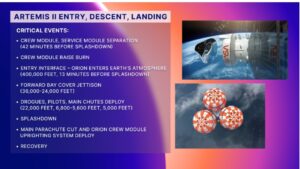
Artemis II infographic showcasing the missions entry, descent, and landing milestones. This graphic was presented by Artemis II Flight Director Rick Henfling during the mission status briefing to the media and public on April 8, 2026 at NASA’s Johnson Space Center in Houston.NASA

Trajectory Correction Burn

A key maneuver is scheduled for 9:53 p.m. EDT, when Orion’s thrusters will fire for a second return trajectory correction burn.

This adjustment is designed to fine-tune the spacecraft’s path toward Earth and align it precisely for atmospheric entry. During the burn, Jeremy Hansen will oversee procedure execution and monitor navigation and propulsion systems.

Infographic featuring the Artemis II Orion lofted entry sequence. This graphic was presented by Artemis II Flight Director Rick Henfling during the mission status briefing to the media and public on April 8, 2026 at NASA’s Johnson Space Center in Houston.
NASA

Countdown To Splashdown

Ground teams are making final preparations for splashdown, expected around 8:07 p.m. (5:07 p.m. PDT) on April 10 off the coast of San Diego.

The re-entry sequence will begin with the separation of Orion’s service module at approximately 7:33 p.m., followed by a final trajectory adjustment at 7:37 p.m. The spacecraft will then execute roll maneuvers and accelerate to nearly 23,864 mph before entering Earth’s atmosphere.

A communications blackout is expected at 7:53 p.m. as plasma builds up around the capsule, lasting about six minutes. During this phase, astronauts may experience forces up to 3.9 Gs.

Infographic displaying the Artemis II Orion parachute sequence. This graphic was presented by Artemis II Flight Director Rick Henfling during the mission status briefing to the media and public on April 8, 2026 at NASA’s Johnson Space Center in Houston.
NASA

Parachute Deployment And Landing

After re-establishing communication, Orion will jettison its forward bay cover and deploy drogue parachutes at around 22,000 feet. Main parachutes will follow at approximately 6,000 feet, slowing the capsule for a safe ocean landing.

Ground track map displaying the Artemis II Orion parachute sequence. This graphic was presented by Artemis II Flight Director Rick Henfling during the mission status briefing to the media and public on April 8, 2026 at NASA’s Johnson Space Center in Houston.
NASA

Recovery And Return To Houston

Within two hours of splashdown, the crew will be retrieved and transported to the USS John P. Murtha via helicopter.

Once aboard, astronauts will undergo initial medical evaluations before returning to shore and boarding a flight to Johnson Space Center in Houston for post-mission debriefing and recovery.

U.S. Navy MH-60 Seahawks from Helicopter Sea Combat Squadron (HSC) 23 are seen arriving on the flight deck of USS John P. Murtha as they prepare to conduct air operations training as NASA, U.S. Navy, and U.S. Air Force teams prepare for the the return of the Artemis II crewmembers to Earth, Monday, April 6, 2026, in the Pacific Ocean off the coast of California. NASA’s Artemis II mission is taking NASA astronauts Reid Wiseman, commander; Victor Glover, pilot; Christina Koch, mission specialist; and CSA (Canadian Space Agency) astronaut Jeremy Hansen, mission specialist on a 10-day journey around the Moon and back aboard their Orion spacecraft. Wiseman, Glover, Koch, and Hansen are scheduled to splash down off the coast of San Diego at approximately 5:07 p.m. PDT (8:07 p.m. EDT) on Friday, April 10.
NASA/Bill Ingalls


Also Read:

Artemis II astronauts actively shared experiences via live calls, press conferences from Orion [Watch]

Artemis II mission: LUCA and LESA support Artemis safety, success as crew prepares return journey


Artemis II Update-22, Day 8: Crew conducts key tests as they begin their return journey

Artemis II moved into another critical phase of its return journey as the crew began Flight Day 8 with a focus on testing systems and preparing for reentry.


Artemis II Update-21, Day 7: First Return Correction Burn Complete

Artemis II marked a key step in its return to Earth late Tuesday, as the Orion spacecraft fired its engines to fine-tune its path home.

At 8:03 p.m. Eastern Time, Orion, named Integrity, performed its first return trajectory correction burn. The 15-second firing adjusted the spacecraft’s velocity by 1.6 feet per second, a small but critical change that aligned the crew’s course back toward Earth. NASA astronaut Christina Koch and Canadian Space Agency astronaut Jeremy Hansen oversaw the maneuver, reviewing procedures and closely tracking navigation and system data.

During a mission status briefing the same day, officials from the National Aeronautics and Space Administration released the first images captured during the crew’s lunar flyby, offering early visual data from the historic pass around the Moon. The agency also confirmed that the USS John P. Murtha (LPD-26) has departed port and is en route to a staging position in the Pacific Ocean, where it will support recovery operations following splashdown.

NASA said it will continue to share updates on recovery logistics and weather conditions in its daily briefings.

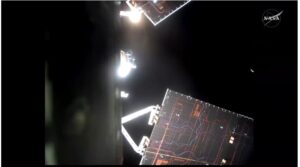
A live view shows the Orion spacecraft and its solar arrays as the Artemis II crew completed the mission’s first return correction burn on Flight Day 7.

With the burn complete, the crew is expected to rest before beginning a new round of flight objectives on Wednesday, April 8, focused on preparing for reentry.

Among the scheduled tasks is a test of an orthostatic intolerance garment, equipment designed to help astronauts regulate blood pressure and circulation as they transition from microgravity to Earth’s gravity. Reid Wiseman, Victor Glover, Koch and Hansen will evaluate how effectively the garment supports cardiovascular stability during the return phase.

Later in the day, the crew will take manual control of Orion as part of a piloting demonstration. Using the spacecraft’s viewing systems, they will align with a designated target and guide Orion into a tail-to-Sun orientation while comparing its control modes.

The manual piloting test is scheduled to begin at 9:59 p.m., adding another layer of real-time data to NASA’s assessment of the spacecraft’s performance during its journey home.

Also Read:

Artemis II Update-20, Day 7: ISS Crew Connects With Artemis II Astronauts Amid Busy Research Schedule

President Trump Calls Artemis II Astronauts before crew wraps up historic Lunar Flyby [Watch Videos]

Artemis II Update-20, Day 7: ISS Crew Connects With Artemis II Astronauts Amid Busy Research Schedule

Astronauts aboard the International Space Station spoke with the Artemis II crew on April 8 following their lunar flyby, marking a rare ship-to-ship exchange between deep space and low Earth orbit. The Artemis II crew is returning to Earth after circling the Moon, while Expedition 74 astronauts continued biomedical research and mission training aboard the station. The interaction highlighted how ongoing ISS science supports future lunar missions under NASA’s Artemis program.

For a few minutes on Tuesday, two crews separated by hundreds of thousands of miles shared the same conversation.

Astronauts aboard the International Space Station (ISS) connected with their counterparts on NASA’s Artemis II mission, offering a rare moment of overlap between low Earth orbit operations and deep space travel. The call came just a day after Artemis II astronauts completed a historic lunar flyby and began their journey home.

On one side were Expedition 74 crew members Chris Williams, Jack Hathaway and Jessica Meir of NASA, along with Sophie Adenot of the European Space Agency (ESA). On the other were Artemis II astronauts Reid Wiseman, Victor Glover and Christina Koch, joined by Jeremy Hansen of the Canadian Space Agency (CSA).

The Artemis II crew is traveling aboard Orion, returning to Earth after looping around the Moon in NASA’s first crewed lunar mission in decades.

ISS and Artemis II crew exchange experiences after lunar flyby

The conversation turned quickly to comparison.

Station astronauts asked about differences between spacecraft, while Artemis II crew members described the experience of seeing the Moon up close. Christina Koch, drawing on her own time aboard the ISS, linked the two missions directly.

“Every single thing that we learned on ISS is up here,” Koch said, referring to how station-based training translates to deep space operations.

The exchange underscored a key role of the ISS within the Artemis program. The orbiting laboratory functions as a proving ground where astronauts refine procedures, test systems and adapt to long-duration spaceflight before venturing farther from Earth.

For NASA and its partners, that continuity is central. The Artemis II mission builds on lessons accumulated over years of station operations.

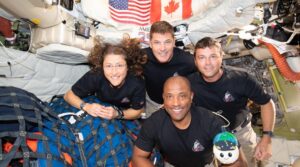
The Artemis II crew – (clockwise from left) Mission Specialist Christina Koch, Mission Specialist Jeremy Hansen, Commander Reid Wiseman, and Pilot Victor Glover – pause for a group photo with their zero gravity indicator “Rise,” inside the Orion spacecraft on their way home. Following a swing around the far side of the Moon on April 6, 2026, the crew exited the lunar sphere of influence (the point at which the Moon’s gravity has a stronger pull on Orion than the Earth’s) on April 7, and are headed back to Earth for a splashdown in the Pacific Ocean on April 10.

Space station biomedical research supports Artemis and future missions

While the call captured public attention, the station’s daily schedule remained anchored in research.

Crew members conducted a series of biomedical scans using the Ultrasound 3 device, focusing on how spaceflight affects the human body. Doctors on the ground monitored the scans in real time, looking for signs of blood clots that can form in leg veins and travel to the lungs.

Such risks have become a growing area of study as missions extend beyond short orbital stays. Data collected aboard the ISS feeds directly into planning for longer journeys, including missions to the Moon and eventually Mars.

Jessica Meir also contributed to the RelaxPro investigation, an ESA-sponsored study examining stress and immune responses in space. She collected saliva and hair samples that researchers will analyze on Earth for hormonal and immune markers.

The study explores whether mindfulness and meditation techniques can improve sleep quality and reduce stress during long-duration missions.

Cargo mission training and robotic systems testing on ISS

Operational training continued alongside scientific work.

Williams and Hathaway simulated the capture of the Cygnus XL cargo spacecraft using the Canadarm2 robotic system. Mission planners are targeting April 10 for the launch of the resupply mission aboard a **SpaceX Falcon 9 rocket, which will deliver supplies and experiments to the station.

Elsewhere, Sophie Adenot worked inside the Japanese Kibo laboratory module, setting up a compact experimental robotic arm known as TUSK. The system is being tested for precise movements at sub-millimeter levels in microgravity, a capability that could support delicate operations in future missions.
Adenot later joined fellow astronauts for emergency response simulations, rehearsing procedures designed to prepare crews for unexpected situations in orbit.

Roscosmos crew studies teamwork and fitness in orbit

Russian crew members also focused on research tied to long-duration missions.

Station commander Sergey Kud-Sverchkov and flight engineer Sergei Mikaev, both representing Roscosmos, participated in experiments examining team dynamics and physical conditioning in space. One study involved progressively complex computer tasks requiring cooperation, allowing researchers to observe how crews adapt to working together in confined environments.

The findings may influence crew training for future missions beyond Earth orbit.

Kud-Sverchkov later completed a monitored exercise session using an onboard cycle, while Mikaev assisted with health data collection.

Meanwhile, Andrey Fedyaev continued training with the European robotic arm inside the Nauka module, practicing both primary and backup control modes to ensure operational readiness.

The day’s activities reflected a layered mission environment.

On one level, astronauts pushed the boundaries of human spaceflight, exchanging insights between deep space and orbit. On another, they maintained a steady cadence of experiments and training that will shape future exploration.

The Artemis II crew moves farther from the Moon with each passing hour. The ISS crew remains in orbit, continuing work that helps make those journeys possible.

Also Read:

Artemis II Update-19, Day 7: Crew Makes Long‑Distance Call, Prepares for Earth Return

President Trump Calls Artemis II Astronauts before crew wraps up historic Lunar Flyby [Watch Videos]

Artemis II Update-17, Day 6: Lunar Flyby Updates

Live lunar flyby updates for NASA’s Artemis II mission will be published on this page. All times are Eastern.

9:35 p.m.

The Artemis II crew has completed the mission’s lunar observation period and is now beginning the return trip home. On Tuesday, April 7, Orion will exit the lunar sphere of influence at approximately 1:25 p.m., at a distance of 41,072 miles from the Moon.

8:35 p.m. 

Artemis II is now entering a solar eclipse that will last for about an hour as Orion, the Moon and the Sun align. During this phase, the crew will see the Sun disappear behind a mostly darkened Moon.

The crew will use the opportunity to study the solar corona — the Sun’s outermost atmosphere — as it glows around the lunar edge. They also will watch for flashes of light from meteoroids striking the surface, which could offer insight into potential hazards on the Moon.

7:24 p.m.

The Artemis II crew witnessed an Earthrise as Orion emerged from behind the Moon, moments before the Deep Space Network reacquired the spacecraft’s signal and restored communications.

7:02 p.m. 

The Artemis II crew has reached the mission’s maximum distance from Earth at 252,756 miles, setting a new record for human spaceflight. This milestone places the crew 4,111 miles farther from Earth than the Apollo 13 mission in 1970.

7:00 p.m. 

Orion has reached its closest approach to the Moon at about 4,067 miles above the lunar surface. At this point, the spacecraft is traveling about 60,863 miles an hour relative to Earth, but only 3,139 miles an hour relative to the Moon.

6:44 p.m. 

“As we prepare to go out of radio communication, we’re still going to feel your love from Earth. And to all of you down there on Earth and around Earth, we love you, from the Moon. We will see you on the other side.” Victor Glover, Artemis II Pilot

Victor Glover, Artemis II Pilot

The Orion spacecraft has entered a planned communications blackout as it passes behind the Moon. For about 40 minutes, the lunar surface blocks the radio signals from NASA’s Deep Space Network on Earth needed to stay in contact with the crew.

Similar blackouts occurred during the Artemis I and Apollo missions and are expected when using an Earth-based communications system. Once Orion emerges from behind the Moon, the network will quickly reacquire the signal and restore communications with mission control.

6:41 p.m. 

As Orion traveled behind the Moon, the crew witnessed an “Earthset” — the moment Earth dropped below the lunar horizon — marking another milestone in the mission’s lunar flyby.

The Earth will re-emerge at “Earthrise” from the opposite edge of the Moon in about 40 minutes.

4:40 p.m.

A lively stream of science observations from the crew throughout the flyby has been received with grins, nods, and lots of chatter in the Science Evaluation Room, where lunar scientists are supporting the observations in mission control. The crew reported color nuances, which will help enhance scientific understandings of the Moon. Shades of browns and blues that can be picked out with human eyes can help reveal the mineral composition of a feature and its age. As crew reports are received, the science team is updating the observation plan based on their follow up questions and sending up new guidance to the crew.

2:45 p.m.

Due to last approximately seven hours, the lunar observation period is the duration of time that the crew is close enough to the Moon to make impactful science observations (4,070 miles altitude at closest approach) and the spacecraft is oriented such that the windows are pointed at the Moon.

At the beginning of the window, as Orion approaches the Moon on the near side, the side we can see from Earth, people in parts of the eastern hemisphere can view some of the same features the astronauts will observe. These include future CLPS landing site Reiner Gamma, a bright, mysterious swirl the origin of which scientists are still trying to understand, and Glushko, a bright, 27-mile-wide crater known for the white streaks that shoot out from it for up to 500 miles.

1:56 p.m. 

The Artemis II crew of NASA astronauts Reid WisemanVictor Glover, and Christina Koch, along with CSA (Canadian Space Agency) astronaut Jeremy Hansen have set the record for the farthest distance from Earth traveled by a human mission, surpassing the Apollo 13 record of 248,655 miles set in 1970.

“As we surpass the furthest distance humans have ever traveled from planet Earth, we do so in honoring the extraordinary efforts and feats of our predecessors in human space exploration. We will continue our journey even further into space before Mother Earth succeeds in pulling us back to everything that we hold dear. But we most importantly choose this moment to challenge this generation and the next to make sure this record is not long-lived.” Jeremy Hansen, Canadian Space Agency (CSA) Astronaut and Artemis II Mission Specialist

Jeremy Hansen, Canadian Space Agency (CSA) Astronaut and Artemis II Mission Specialist.
NASA Flight Director Brandon Lloyd, Capsule Communicator Amy Dill, and Command and Handling Data Officer Brandon Borter also marked a lighthearted milestone today by emailing the crew what is now assumed to be the longest person-to-person message ever sent in human history.

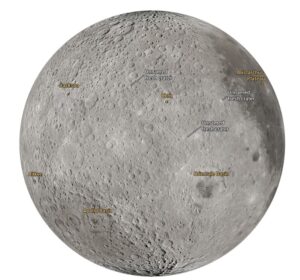
(Shortly after 2 p.m. EDT, the crew described two small, unnamed craters on the heavily pockmarked lunar surface. Calling down to Earth, they suggested provisional names for them. Just northwest of Orientale basin, highlighted above, is a crater they would like to name Integrity after their spacecraft and this historic mission. Just northeast of the Integrity crater, on the near and far side boundary, and sometimes visible from Earth, the crew suggested an unnamed crater be designated Carroll in honor of Reid Weisman’s late wife, Carroll Taylor Wiseman, who passed away on May 17, 2020. After this mission is complete, the crater name proposals will be formally submitted to the International Astronomical Union, an organization that governs the naming of celestial bodies and their surface features.NASA)

After breaking the record for human spaceflight, crew also took a moment to provisionally name a couple of craters on the Moon, noting they were able to see them with their naked eye.

Just northwest of Orientale basin highlighted above is a crater they would like to name Integrity after their spacecraft and this historic mission. Just northeast of Integrity, on the near and far side boundary, and sometimes visible from Earth, the crew suggested Carroll crater in honor of Reid Wiseman’s late wife, Carroll Taylor Wiseman. After this mission is complete, the crater name proposals will be formally submitted to the International Astronomical Union, the organization that governs the naming of celestial bodies and their surface features.

NASA astronaut Reid Wiseman is pictured with his late wife Carroll Taylor Wiseman.
Wiseman Family

1:30 p.m.

NASA’s lunar science officer briefed the crew on their science objectives for the upcoming lunar observation period.

On April 5, the science team sent the crew the final list of 30 lunar surface targets, including the Orientale basin, a nearly 600-mile-wide crater that straddles the Moon’s near and far sides. This 3.8-billion-year-old crater formed when a large object struck the lunar surface and retains clear evidence of that collision, including dramatic topography in its rings. The crew will study Orientale’s features up close and from multiple angles as they pass by.

Hertzsprung basin also is on the crew’s list of targets. Northwest of Orientale, it is a nearly 400-mile-wide crater on the Moon’s far side. An older ringed basin, Hertzsprung offers a unique contrast to Orientale because its features have been degraded by subsequent impacts. By comparing the topography of the two craters, the crew’s observations will help scientists gain insight into how lunar features evolve over geologic timescales.

1 p.m.

NASA’s live coverage of the Artemis II lunar flyby is underway on NASA+Amazon Prime, Apple TVHuluNetflixHBO Max, and Roku, alongside the agency’s 24/7 coverage on its YouTube channel. Learn how to stream NASA content through a variety of online platforms, including social media.

Coverage will include live views of the Moon from cameras mounted on Orion’s solar arrays. Image and view quality may vary throughout the lunar observation period due to distance from Earth, system limitations, and bandwidth across NASA’s communications network.

Note: The spacecraft will enter a planned communications blackout from 6:44 to 7:25 p.m. EDT as Orion passes behind the Moon. Spacecraft camera views will not be available during this time, but NASA’s live coverage will continue.

Also Read:

Artemis II Update-11, Day 4: Crew Enters Deep Space, Lunar Flyby Prep

 As the Orion spacecraft continues its path toward the Moon, the Artemis II crew will spend their fourth flight day preparing for their lunar flyby on Monday, April 6. Traveling more than 169,000 miles from Earth aboard the Orion spacecraft, astronauts are set to manually pilot the vehicle and study the Moon from a distant vantage point. The mission will also include a planned communications blackout and record-breaking distance milestone as Orion moves deeper into space.


Artemis II Update-6, Day 2 : Crew, houston poll ‘Go’ for Translunar injection burn, crew prepares for Moon flight

NASA approved the translunar injection burn for Artemis II on April 2, clearing the Orion spacecraft to leave Earth orbit at 7:49 p.m. EDT. The burn will send astronauts Reid Wiseman, Victor Glover, Christina Koch, and Jeremy Hansen toward the Moon for the first time since 1972. The decision follows a mission management review confirming spacecraft readiness and system performance.

The call came from Houston after a day of checks and calculations. The answer was simple. Go.

With that, NASA cleared Artemis II to attempt the maneuver that will send its crew beyond Earth orbit. If executed as planned, the burn will place humans on a path toward the Moon for the first time in more than five decades.

The mission marks a major step for the National Aeronautics and Space Administration and its Artemis program, which aims to return astronauts to deep space operations.

Translunar injection burn timing and Orion engine performance

The translunar injection burn is scheduled to begin at 7:49 p.m. Eastern Time. Orion’s main engine will fire for five minutes and 49 seconds, providing the acceleration needed to break free from Earth’s orbit.

The engine, located on the spacecraft’s service module, produces up to 6,000 pounds of thrust. NASA compares that output to accelerating a car from zero to 60 miles per hour in about 2.7 seconds.

The burn must be executed with precise timing and orientation. Even minor deviations can alter the spacecraft’s path over the hundreds of thousands of miles between Earth and the Moon.

Flight controllers will track engine performance, guidance systems, and navigation data in real time to ensure Orion remains aligned with its intended trajectory.

NASA flight directors Rick Henfling (right) and Judd Frieling (left) sit on console in Mission Control’s White Flight Control room during NASA’s Artemis II mission launch on Wednesday, April 1, 2026.
ROBERT MARKOWITZ NASA-JSC

Crew activities and first full day operations in space

Earlier in the day, the Artemis II crew began their first full schedule of in-space operations. NASA astronauts Reid Wiseman, Victor Glover, and Christina Koch were joined by Jeremy Hansen of the Canadian Space Agency.

Mission control woke the crew at 2:35 p.m. Eastern Time with the song “Green Light” by John Legend and Andre 3000, continuing a long-standing NASA tradition of musical wake-up calls.

The astronauts moved into preparations for the burn, reviewing procedures and monitoring spacecraft systems. They also conducted their first exercise session using Orion’s flywheel-based device, designed to help maintain muscle and bone health in microgravity.

Exercise equipment is a standard feature for crewed missions, particularly those that extend beyond low Earth orbit. Maintaining physical conditioning becomes critical as mission duration increases.

The hours leading up to the burn are structured around system checks, communication with ground teams, and final readiness confirmations.

The Artemis II mission is designed as a test flight. Yet the stakes of this maneuver are clear. Once the engine fires, the crew will begin a journey that carries them away from Earth and toward the Moon, retracing a path last taken during the Apollo era.

Also Read:

Artemis II Update-5: perigee raise burn complete, translunar injection burn next

Artemis II Update-4: Crew completes proximity test, perigee raise burn up next