
Deep Space Network Establishes Contact With Artemis II Spacecraft

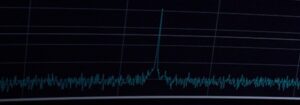
The acquisition of the radio frequency signal from the Artemis II crewed mission to the Moon by NASA’s Deep Space Network (DSN) is indicated by the peak in the data signal shown below on the computer screen.

Credits: NASA/JPL-Caltech

Soon after the mission’s launch on April 1, 2026, at 6:35 p.m. EDT, NASA’s Near Space Network led communications with the Orion capsule. Then, communications were handed off to the DSN, marking the first time in over 50 years that the network would be communicating with a crewed spacecraft traveling through deep space.

The Space Flight Operations Facility at NASA’s Jet Propulsion Laboratory in Southern California (where this photo was taken) operates the DSN, which comprises three complexes in Goldstone, California; Madrid, Spain; and Canberra, Australia. Each complex consists of several radio frequency antennas that communicate with dozens of robotic spacecraft exploring the solar system in addition to the Artemis II mission.

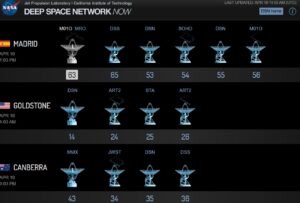
A graphical representation of the Deep Space Network’s radio frequency antennas indicate signal acquisition from NASA’s Artemis II mission to the Moon on April 1, 2026, inside the Space Flight Operations Facility at NASA’s Jet Propulsion Laboratory in Southern California. Two antennas at the Madrid Deep Space Communications Complex, Deep Space Station 54 and 56, can be seen communicating with Artemis II (the signals are labelled “EM2”, short for “Exploration Mission 2”; elsewhere they are labelled “ART2” for “Artemis II”).

A similar visualization can be found at DSN Now, which details all the missions that the network is communicating with 24 hours a day, seven days a week.

NASA

The DSN is managed by JPL for the agency’s Space Communications and Navigation program, which is located at NASA Headquarters within the Space Operations Mission Directorate. The DSN allows missions to track, send commands to, and receive scientific data from faraway spacecraft. JPL is managed by Caltech in Pasadena, California, for NASA.

Also Read:

Monitoring over deep space network before artemis II signal acquisition

JPL’s Mission Control Steps Up For Artemis II Deep Space Operations


NASA Successfully Tests Mini Methane Sensor for Future Mars Exploration

NASA researchers have developed a mini drone-like methane sensor that can fly and successfully tested it on a Vertical Take-off and Landing like any small unmanned aerial system (sUAS). The sensor, developed by JPL for use on Mars, will be used to detect methane with much higher sensitivity than previously available, especially in NASA’s next mission to Mars in 2018.

The tests were conducted in central California at the Merced Vernal Pools and Grassland Reserve, in partnership with Pipeline Research Council International (PRCI). The jointly conducted test of NASA’s Open Path Laser Spectrometer (OPLS) sensor also helps to detect methane in parts per billion by volume could help the pipeline industry more accurately pinpoint small methane leaks.

“These tests mark the latest chapter in the development of what we believe will eventually be a universal methane monitoring system for detecting fugitive natural-gas emissions and contributing to studies of climate change,” said Lance Christensen, OPLS principal investigator at JPL.

Researchers from JPL and the Mechatronics, Embedded Systems and Automation (MESA) Lab at the University of California, Merced, conducted the flight tests in late February. They flew a small unmanned aerial system equipped with the OPLS sensor at various distances from methane-emitting gas sources. Tests were done in a controlled setting to test the accuracy and robustness of the system, said NASA.

Next stage of testing later this year will feature a fixed-wing UAS, which can fly longer and farther so as to monitor natural-gas transmission pipeline systems, which are often hundreds of miles long and can be located in rural or remote areas.

A JPL mini methane gas sensor is flight tested on a small unmanned aerial system (sUAS) under a project to improve energy pipeline industry safety. The sensor enables methane detection with higher sensitivity than previously available for the industry in hand-carried or sUAS-deployable instruments.Credit: University of California, Merced.