

NASA’s Artemis II mission is drawing support from a pair of nearly identical control rooms in Alabama, each playing a distinct role in keeping astronauts safe and operations on track as the crew heads back to Earth, Friday, April 10.
At the National Aeronautics and Space Administration’s Marshall Space Flight Center in Huntsville, two facilities, the Lunar Utilization Control Area (LUCA) and the Lander Engineering Support Area (LESA), are working in tandem during the mission. Both are housed within the Huntsville Operations Support Center, a hub designed to provide real-time technical and scientific support.
Though similar in appearance, the two rooms serve different purposes. LUCA focuses on science operations linked to Artemis, while LESA is geared toward engineering support, particularly for future missions that will land astronauts on the Moon.

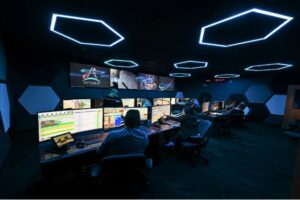
LUCA (Lunar Utilization Control Area) at NASA Marshall is specially designed to support a wide variety of science operations on and around the Moon – and beyond. Engineers in the LUCA monitored operations for the Lunar Node-1 experiment, an autonomous navigation payload that was part of the first NASA Commercial Lunar Payload Services (CLPS) launch on Intuitive Machines’ Nova-C lunar lander in 2024. NASA Marshall flight controllers will use the LUCA again for Artemis II to monitor science operations.
NASA/Charles Beason
Officials say the flexibility of the Huntsville center allows it to adapt to evolving mission needs. The facility has previously supported programs including the Commercial Crew Program, the Space Launch System rocket and research aboard the International Space Station.
Teams operating from LUCA are currently supporting science experiments tied to deep space conditions. These include studies examining how microgravity and radiation affect the human body, including immune response and overall performance. Data gathered during Artemis II is expected to shape planning for future crewed missions beyond Earth orbit.

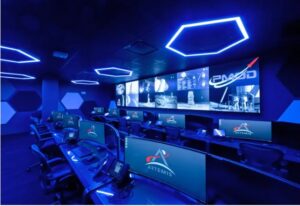
Support engineers will use the LESA (Lander Engineering Support Area) at NASA Marshall to monitor human landing system (HLS) for the first crewed Artemis missions.
NASA/Charles Beason
In parallel, LESA teams are monitoring Artemis II operations in real time, using the mission as a live test case to refine procedures ahead of future lunar landings. Engineers, safety specialists and flight operations experts form part of the Human Landing System Mission Insight Support Team, which will eventually play a central role in supporting lander systems during Moon missions.
The Huntsville Operations Support Center also provides a range of technical services, including spacecraft command and telemetry management, global voice communications, and live and recorded video support. It also deploys specialized software tools that enable seamless data exchange between systems located far apart, allowing teams across different locations to work in sync.
By integrating these capabilities into both LUCA and LESA, NASA enables continuous coordination between engineers, scientists and mission operators worldwide.
Artemis II, which recently carried astronauts around the Moon, is part of NASA’s broader Artemis program aimed at returning humans to the lunar surface. The program is also intended to lay the groundwork for future missions to Mars, with lessons from current flights feeding directly into long-term exploration plans.
Also Read:
Artemis II Update-22, Day 8: Crew conducts key tests as they begin their return journey