Artemis II Mission Accomplished: Crew Re-Entry Updates, Splash down and Safe return home [Watch Videos]

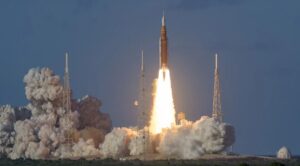
  • Artemis II launched aboard NASA’s Space Launch System, carrying four astronauts in the Orion spacecraft on a deep-space mission beyond low Earth orbit.
  • The crew conducted system checks and performed a historic lunar flyby, travelling thousands of kilometres beyond the Moon before beginning their return journey.
  • After completing a roughly 10-day mission, Orion safely re-entered Earth’s atmosphere and splashed down in the Pacific Ocean, marking the first crewed lunar mission since Apollo.

Watch as the Artemis II crew returns to Earth, splashing down.

See visualization of plasma build up around the space craft, repelling of that heat on Integrity seat shield To splash down in pacific ocean( from timestamp 1:26:15)  in below  video posted by NASA on X.

NASA’s Artemis II mission return home details:

6:25 p.m.

NASA’s Artemis II mission is scheduled to splash down at about 8:07 p.m. EDT (5:07 p.m. PDT) off the coast of San Diego. After splashdown, a combined NASA and U.S. military team, will retrieve the crew and transport them by helicopter to the USS John P. Murtha. Once aboard the ship, the astronauts will undergo post-mission medical evaluations before returning to shore to board an aircraft bound for NASA’s Johnson Space Center in Houston.

Watch live return coverage on NASA+, Amazon PrimeApple TVNetflixHBO MaxDiscovery+Peacock and Roku. Learn how to stream NASA content through a variety of online platforms, including social media.

7:15 p.m.
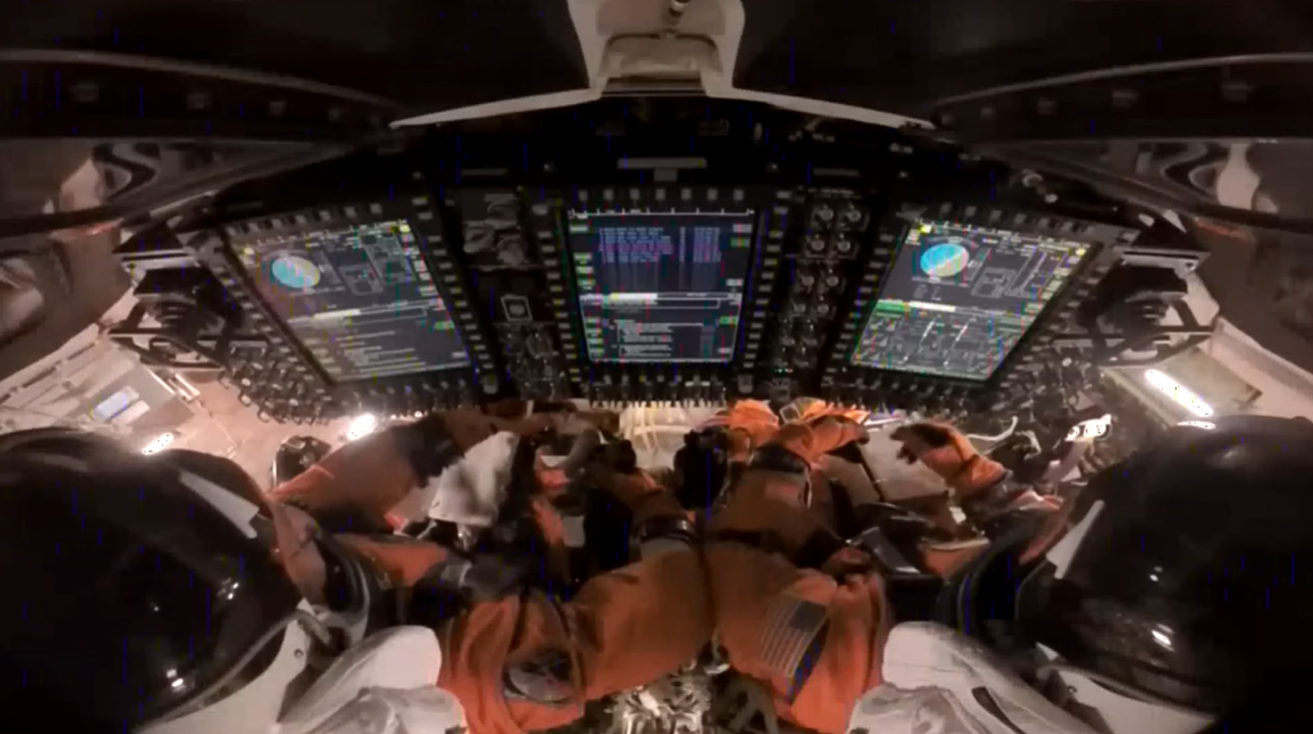
The Artemis II Crew – NASA astronauts Reid Wiseman, Victor Glover, Christina Koch and CSA (Canadian Space Agency) astronaut Jeremy Hansen are preparing for re-entry aboard the Orion spacecraft/NASA

7:33 p.m.

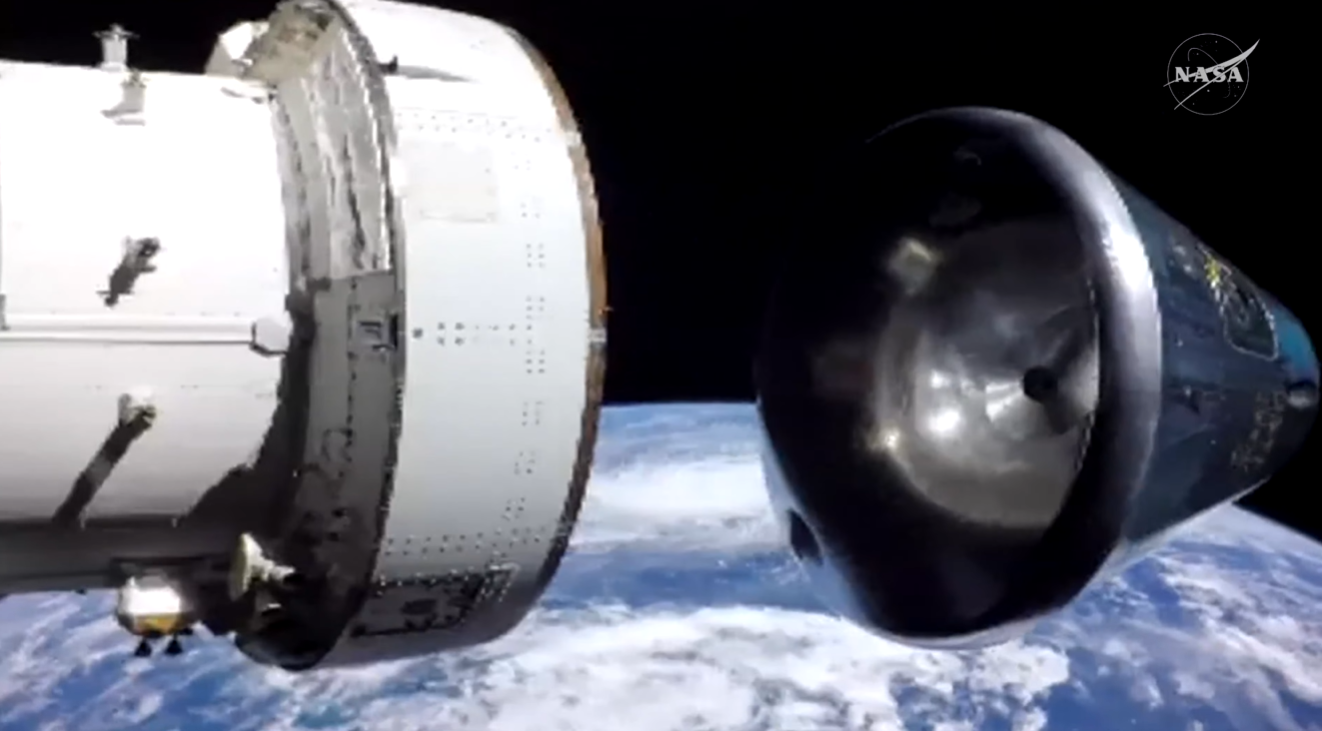
Orion’s crew and service module have separated. The crew module continues on its path towards Earth while the service module will harmlessly burn up in Earth’s atmosphere over the Pacific Ocean. The Artemis II return trajectory is designed to ensure any remaining debris does not pose a hazard to land, people, or shipping lanes.

7:37 p.m.

Orion performed the crew module raise burn, adjusting the spacecraft’s orientation to align its heat shield for re-entry.

7:53 p.m.
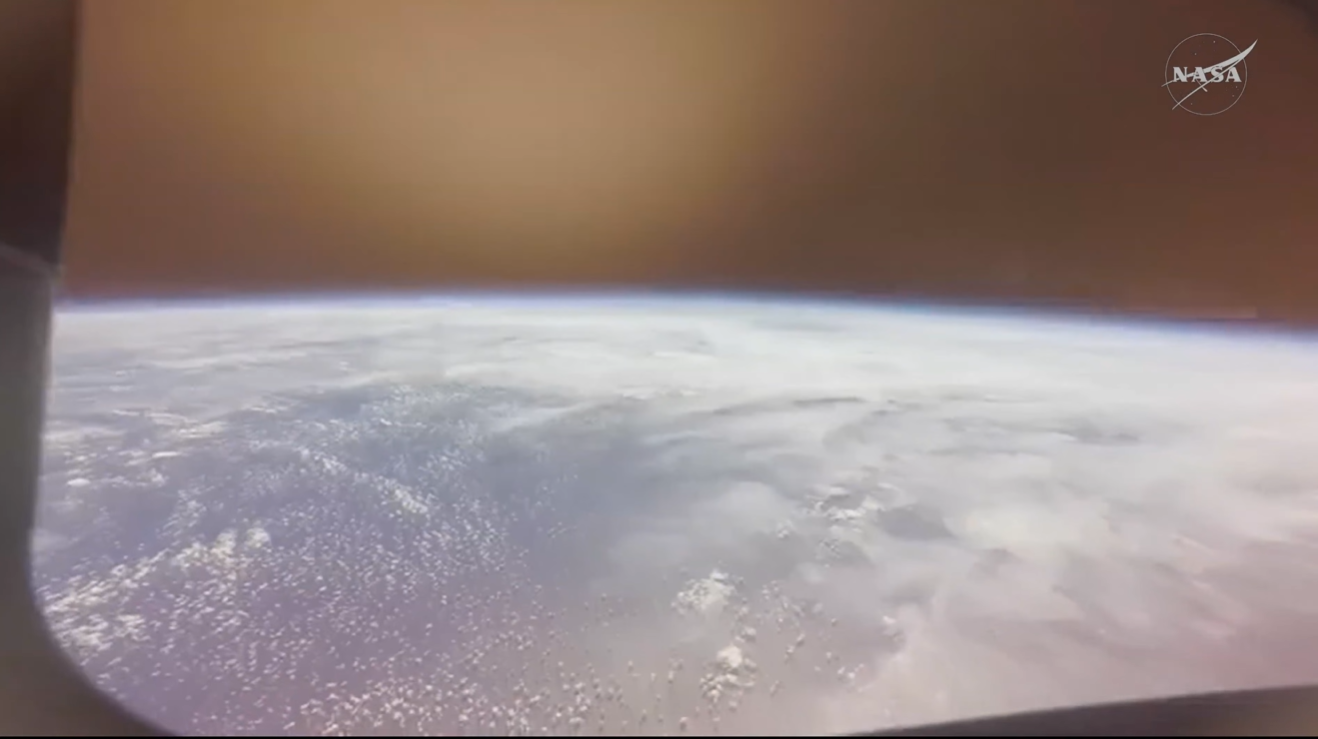
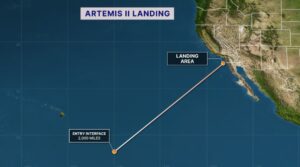
At 7:53 p.m. EDT,  The Orion spacecraft reached Earth’s atmosphere 400,000 feet above the planet’s surface, traveling 35 times the speed of sound and about 1,956 statute miles from the splashdown site. This is where the spacecraft first encounters the upper atmosphere and begins its guided descent. Shortly after, Orion is in a planned communications blackout expected to last about six minutes as plasma built around the crew capsule during heating.

8:00 p.m.

NASA has reestablished communications contact with the Artemis II crew aboard the Orion spacecraft as it returns to Earth.

8:03 p.m.

At 23,400 feet, the drogue parachutes on Orion deployed to slow and stabilize the spacecraft. Orion’s velocity drops to 479 feet per second and is .8 miles from splashdown.

8:04 p.m.

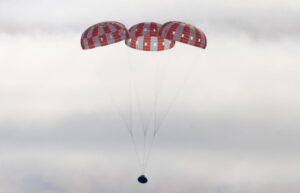
At 5,400 feet, Orion’s drogue parachutes were cut and the three main parachutes deployed, reducing velocity to less than 200 feet per second and guiding Orion on its final descent and splashdown.

8:07 p.m.

SPLASHDOWN!
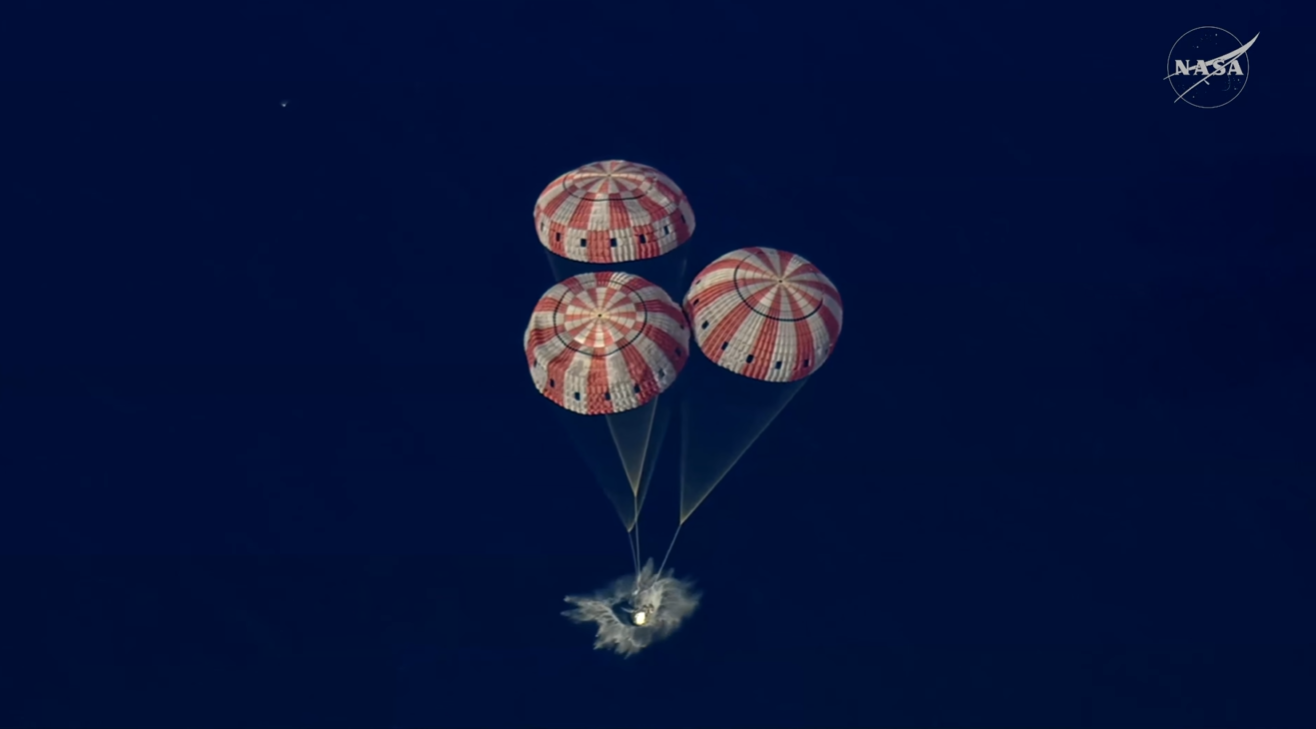
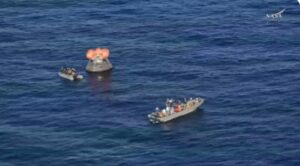
NASA’s Artemis II crew in their Orion spacecraft is back on Earth. They successfully completed a parachute-assisted splashdown in the Pacific Ocean off the coast of San Diego at 8:07 p.m. EDT (5:07 p.m. PDT).
NASA

NASA’s Artemis II crew in their Orion spacecraft is back on Earth. They successfully completed a parachute-assisted splashdown in the Pacific Ocean off the coast of San Diego at 8:07 p.m. EDT (5:07 p.m. PDT).

Engineers will conduct several additional tests while Orion is in the water before powering down the spacecraft and handing it over to the recovery team aboard the USS John P. Murtha. The recovery team is on site and headed to the capsule to begin assisting the crew out of Orion.
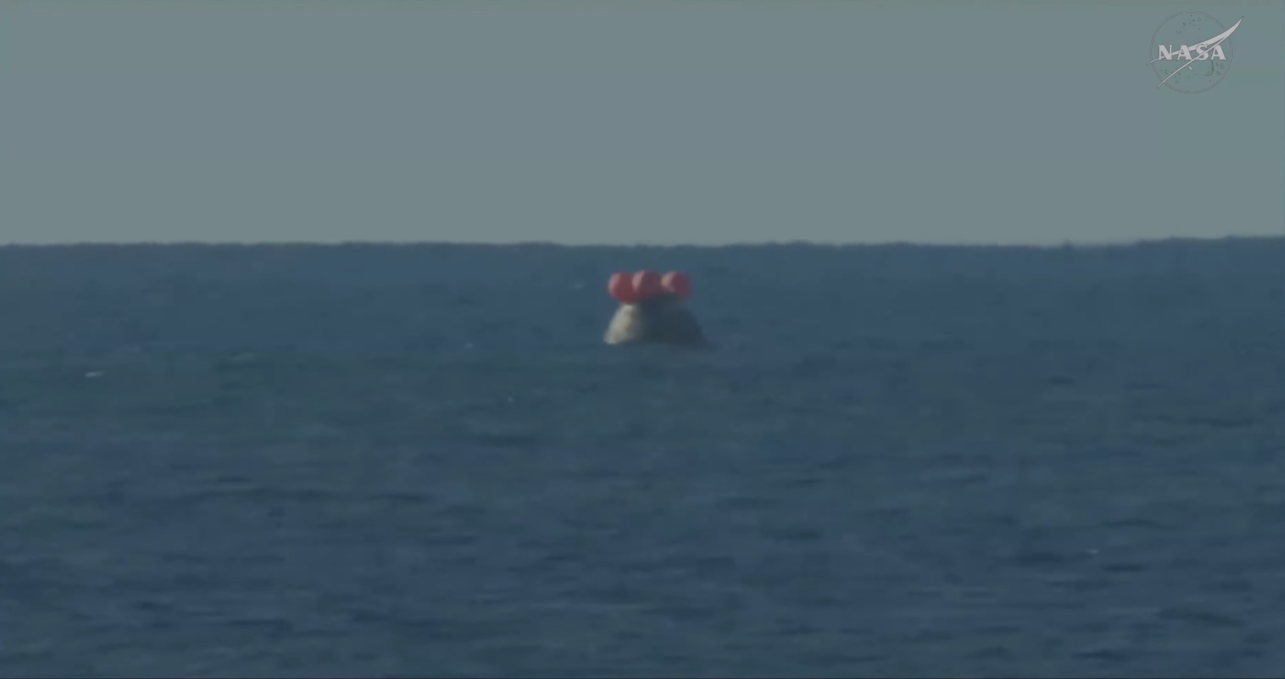
The Orion spacecraft with the Artemis II crew inside is seen floating in the Pacific Ocean after splashing down at 8:07 p.m. EDT on April 10, 2026.
NASA

Orion has begun crew module power down, a planned post-splashdown step in which flight controllers shut down nonessential systems and transition the capsule into its recovery configuration. This reduces power demand and prepares the spacecraft for crew extraction as recovery teams move in.

8:12 p.m.

At the direction of the NASA recovery director, team members from the agency and the U.S. military now are approaching the spacecraft in inflatable boats.

Approximately an hour after splashdown, the crew will be extracted from Orion and then flown to the USS John P. Murtha. U.S. Navy helicopters will then transport them to the ship. Once aboard, the astronauts will undergo post-mission medical evaluations before returning to shore to board an aircraft bound for NASA’s Johnson Space Center in Houston.

When ready, Navy divers will attach a cable, called the winch line, to Orion to pull the spacecraft into a specially designed cradle inside the ship’s well deck. Four additional tending lines will be secured to attachment points on the crew module while under tow.

Once Orion is positioned above the cradle assembly, technicians will drain the well deck and secure the capsule.

After it is secure aboard the ship, teams will return Orion to U.S. Naval Base San Diego before returning it to NASA’s Kennedy Space Center in Florida for inspection. Once there, technicians will thoroughly examine the spacecraft, retrieve onboard data, remove payloads, and conduct additional post-flight checks.

9:34 p.m.

The Artemis II crew – NASA astronauts Reid WisemanVictor Glover, and Christina Koch, and CSA (Canadian Space Agency) astronaut Jeremy Hansen — have been safely extracted from the Orion spacecraft.
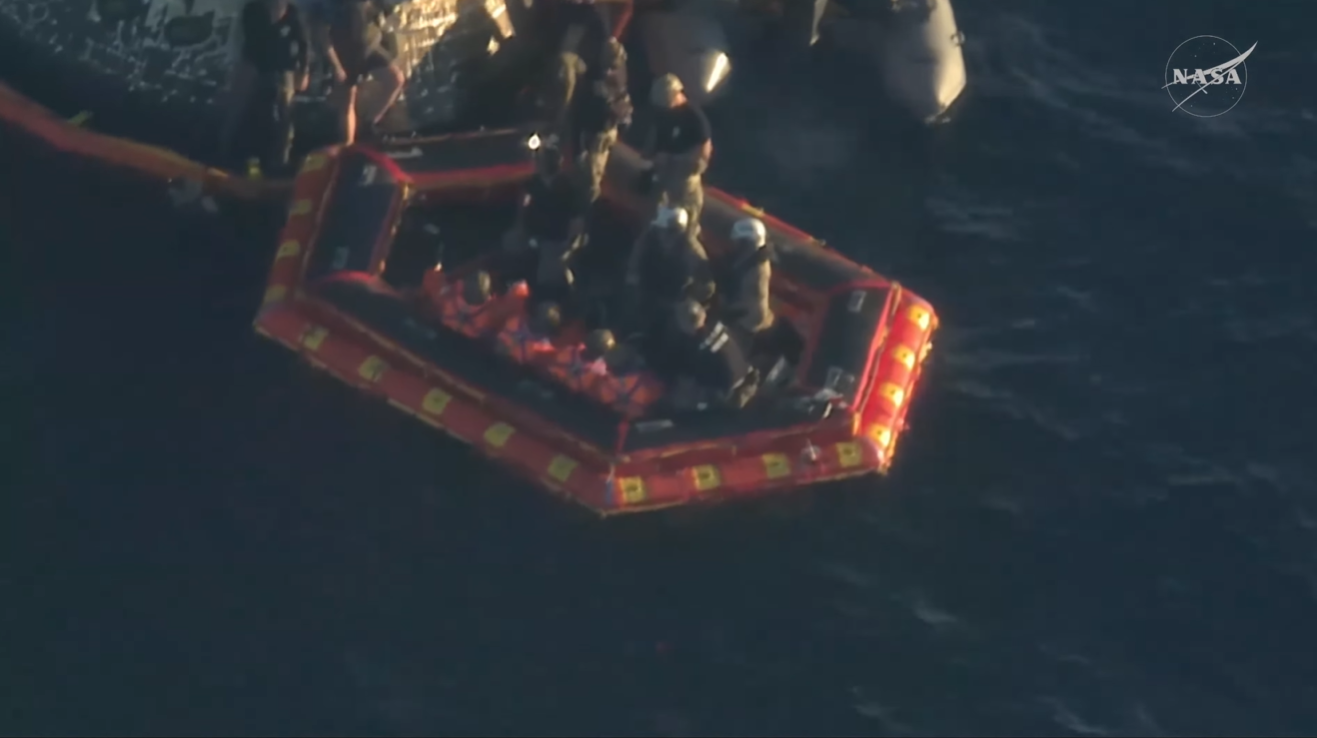
The Artemis II crew is seen on an inflatable raft, called the front porch, after exiting the spacecraft. The Artemis II mission successfully splashed down in the Pacific Ocean at 8:07 p.m. EDT on April 10, 2026.
9:56 p.m.

The Artemis II crew has been hoisted into U.S. helicopters and are being flown to the USS John P. Murtha.
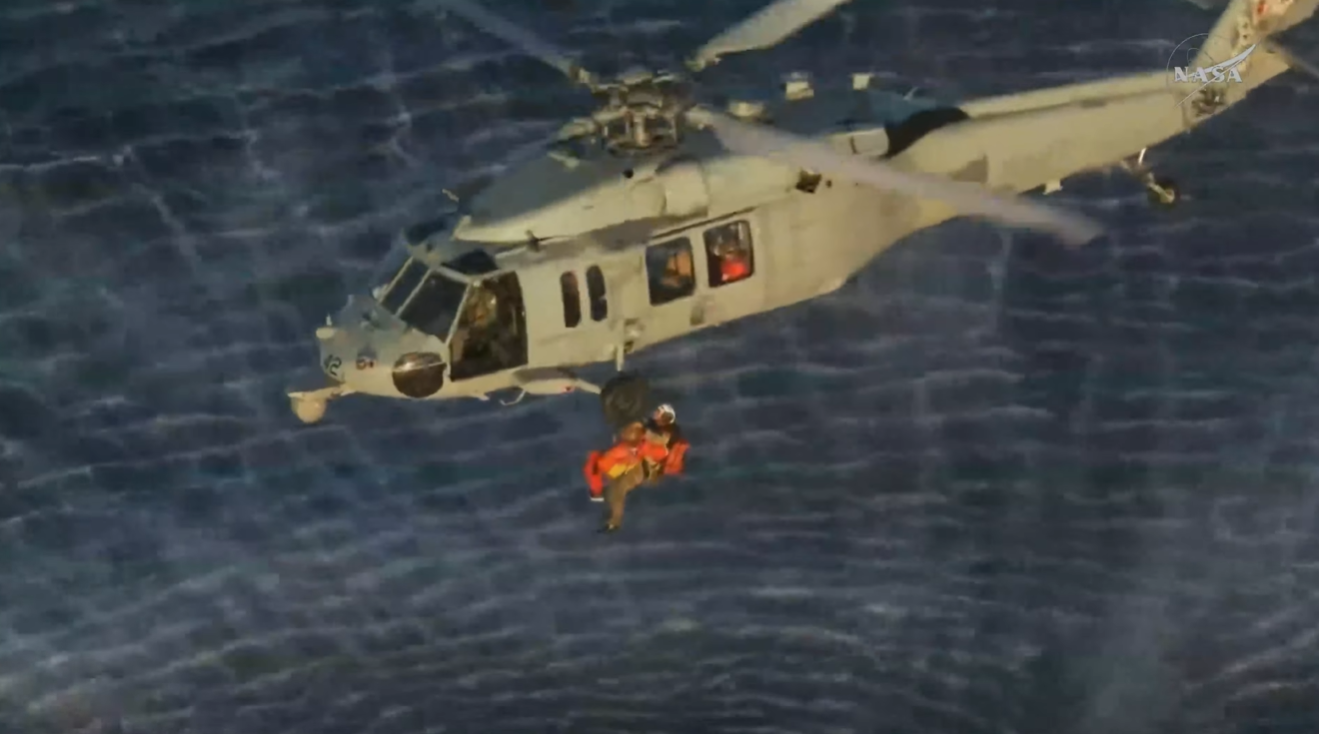
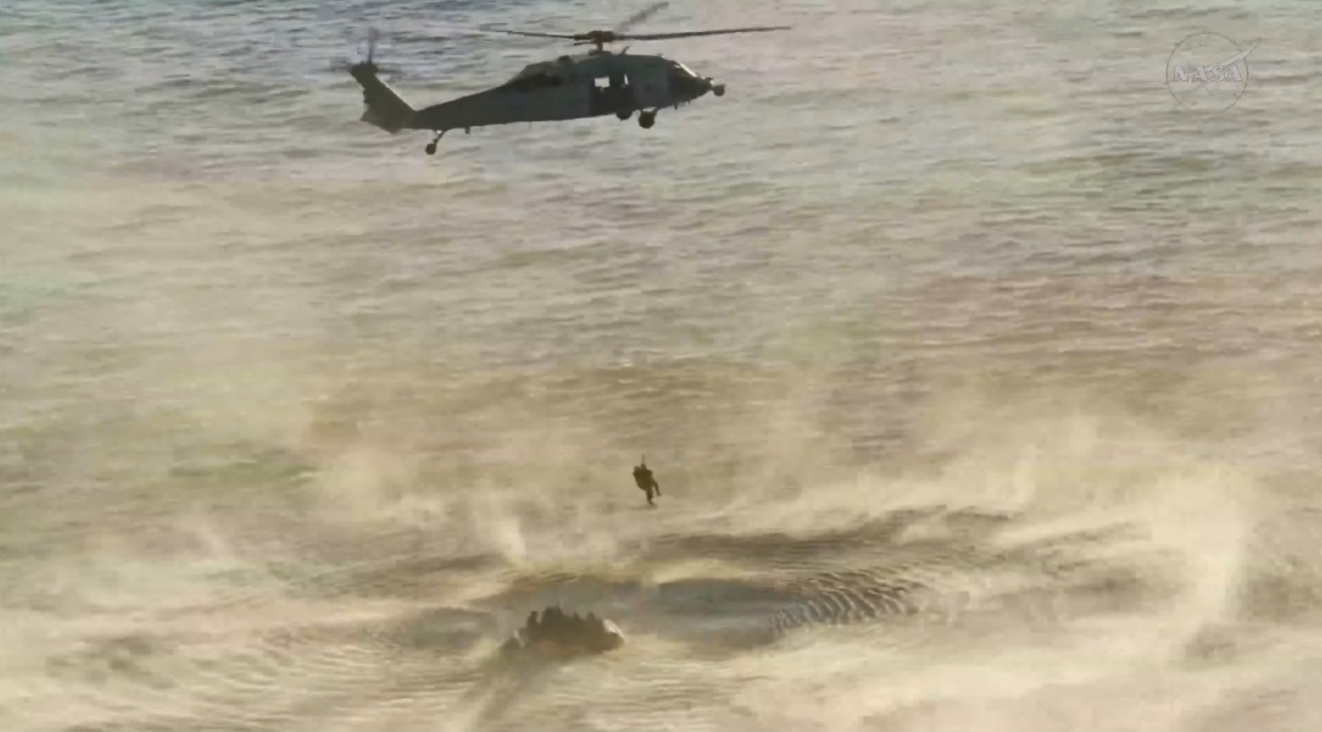
Artemis II Commander and NASA astronaut Reid Wiseman is being hoisted into a U.S. military helicopter before being transported to the USS John P. Murtha.
Artemis II mission specialist and NASA astronaut Christina Koch is being hosted into a U.S. military helicopter before being flown to the USS John P. Murtha. NASA

9:58 p.m.

The Artemis II crew is safely aboard the USS John P. Murtha, where they will undergo post-mission medical evaluations in the ship’s medical bay before traveling back to shore to board a NASA aircraft bound for the agency’s Johnson Space Center in Houston.

NASA will hold a post-splashdown news conference at 10:35 p.m. EDT from the agency’s Johnson Space Center in Houston. Participants include:

  • NASA Associate Administrator Amit Kshatriya
  • Lori Glaze, acting associate administrator, Exploration Systems Development Mission Directorate
  • Rick Henfling, entry flight director, Artemis II
  • Howard Hu, manager, Orion Program
  • Shawn Quinn, manager, Exploration Ground Systems Program

Also Read:

Artemis II Update-25, Day 10: Crew Sets for Final Burn, Splashdown

What’s the longstanding tradition at JPL before any launch and other major space mission events


Artemis II Update-26, Day 10: Crew Completes Final Burn Before Splashdown

At 2:53 p.m. EDT, the Orion spacecraft ignited its thrusters for 8 seconds, producing a change in velocity of 4.2 feet-per-second and pushing Artemis II toward Earth. NASA astronauts Reid Wiseman, Victor Glover, Christina Koch and CSA (Canadian Space Agency) astronaut Jeremy Hansen reviewed procedures and monitored the spacecraft’s configuration and navigation data.

The crew continues to wrap up cabin configuration for re-entry and move into their entry checklist.

Splashdown is targeted for 8:07 p.m. EDT (5:07 p.m. PDT) off the coast of San Diego, where NASA’s recovery team will be standing by to welcome the Artemis II crew home.

Watch live return coverage on NASA+, Amazon PrimeApple TVNetflix, HBO Max, Discovery+, Peacock and Roku, starting at 6:30 p.m. Learn how to stream NASA content through a variety of online platforms, including social media. Coverage will continue until NASA and Department of War personnel safely assist the crew out of Orion and transport them to the USS John P. Murtha.


Also Read:

Deep Space Network Establishes Contact With Artemis II Spacecraft

JPL’s Mission Control Steps Up For Artemis II Deep Space Operations


Artemis II Update-24, Day 9: Second Return Correction Burn Complete

Thrusters Fire To Steer Orion Home:

At 10:53 p.m. EDT, the Orion spacecraft executed a brief nine-second thruster burn, increasing its velocity by 5.3 feet per second and nudging the Artemis II crew further along their return path to Earth.

With the maneuver complete, the crew has now crossed the halfway mark on their journey home.

Temporary Signal Loss Resolved

Roughly two hours before the burn, mission teams encountered an unexpected return link loss of signal during a data rate transition, briefly disrupting the flow of communications and telemetry from the spacecraft.

Two-way contact was subsequently restored, allowing flight controllers and crew to resume preparations for the scheduled maneuver without further delay.

art002e016204 (April 6, 2026) – NASA astronaut and Artemis II Pilot Victor Glover pictured here in the Orion spacecraft during the Artemis II lunar flyby. Glover and his fellow crewmates spent approximately seven hours taking turns at the Orion windows capturing science data to share with their team back on Earth. At closest approach, they came within 4,067 miles of the Moon’s surface.NASA

Re-Entry Briefings And Next Steps

Earlier in the day, officials from NASA provided additional details on re-entry and splashdown procedures during a mission status briefing.

The next key milestone—a third return trajectory correction burn—is planned for April 10 at approximately 1:53 p.m., ahead of final re-entry operations.

Splashdown Target Remains On Track

NASA continues to target splashdown at 8:07 p.m. (5:07 p.m. PDT) on Friday, April 10, off the coast of San Diego, as the Artemis II mission enters its final phase of return.

Also Read:

Artemis II Update-21, Day 7: First Return Correction Burn Complete

Monitoring over deep space network before artemis II signal acquisition

Monitoring over deep space network before artemis II signal acquisition

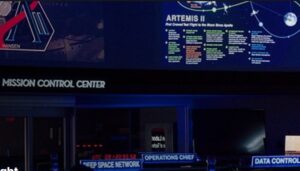
Blanca Renteria, operations chief for the Artemis Deep Space Network (DSN), monitored incoming data from the Space Flight Operations Facility at Jet Propulsion Laboratory shortly after Artemis II lifted off on April 1, 2026.

The launch took place at 6:35 p.m. EDT from Kennedy Space Center, with mission control teams quickly transitioning to deep space communication support.

The Space Flight Operations Facility manages NASA’s DSN, a worldwide system consisting of three primary complexes located in Goldstone, California; Madrid, Spain; and Canberra, Australia.

Each site is equipped with multiple radio-frequency antennas that maintain continuous communication with numerous robotic missions across the solar system, alongside the crewed Artemis II spacecraft.

NASA

Backbone Of Deep Space Communication

The DSN is operated by JPL under NASA’s Space Communications and Navigation programme, based at the agency’s headquarters within the Space Operations Mission Directorate.

This network enables mission teams to track spacecraft, transmit commands, and receive scientific data across vast distances. The Jet Propulsion Laboratory itself is managed by the California Institute of Technology in Pasadena, California, on behalf of NASA.

Also Read:

What’s the longstanding tradition at JPL before any launch and other major space mission events
JPL’s Mission Control Steps Up For Artemis II Deep Space Operations

What’s the longstanding tradition at JPL before any launch and other major space mission events

A Ritual Before Liftoff

A container of “lucky peanuts” was placed above workstations inside the Space Flight Operations Facility at Jet Propulsion Laboratory ahead of the Artemis II launch on April 1, 2026.

The quirky ritual—eating peanuts before major mission events—has long been observed at JPL, seen by teams as a symbol of good fortune before critical operations.

Control Centre Behind Deep Space Communication

The Space Flight Operations Facility oversees NASA’s Deep Space Network (DSN), a global communication system comprising three major complexes located in Goldstone, California; Madrid, Spain; and Canberra, Australia.

Each site houses multiple radio-frequency antennas that maintain constant contact with dozens of spacecraft across the solar system, including the crewed Artemis II mission.

NASA

A Critical Link To Spacecraft

Managed by JPL under NASA’s Space Communications and Navigation programme, the DSN operates from the agency’s headquarters within the Space Operations Mission Directorate.

The network plays a vital role in tracking spacecraft, transmitting commands, and receiving scientific data from distant missions. The Jet Propulsion Laboratory itself is run by the California Institute of Technology in Pasadena, California, on behalf of NASA.

Also Read:

JPL’s Mission Control Steps Up For Artemis II Deep Space Operations

Artemis II Update-23, Day 9: Crew Prepares To Come Home

JPL’s Mission Control Steps Up For Artemis II Deep Space Operations

Mission Control Comes Alive In California

Inside the Space Flight Operations Facility at Jet Propulsion Laboratory, the Artemis II mission took center stage on April 1, 2026, moments before liftoff. The central display featured the mission patch, while adjacent screens mapped real-time activity across the agency’s Deep Space Network (DSN), with active antennas highlighted as they transmitted and received signals.

From Launch To Deep Space Communication

Shortly after launch at 6:35 p.m. EDT from Kennedy Space Center, initial communications were managed through NASA’s Near Space Network.

Control was then handed over to the DSN, marking a significant milestone—the first time in more than five decades that the network was tasked with maintaining contact with a crewed spacecraft journeying through deep space.

Credits: NASA/JPL-Caltec

A Global Network Tracking The Mission

The DSN, operated from the Space Flight Operations Facility, consists of three major complexes located in Goldstone, California; Madrid, Spain; and Canberra, Australia.

Each site houses multiple high-powered radio antennas, forming a global system capable of maintaining continuous communication with spacecraft across the solar system—including Artemis II.

The Backbone Of Space Communication

Managed by JPL under NASA’s Space Communications and Navigation programme at headquarters, the DSN serves as a critical link between Earth and deep-space missions.

It enables mission teams to track spacecraft, transmit commands, and receive scientific data from vast distances. The Jet Propulsion Laboratory itself is operated by the California Institute of Technology in Pasadena, California, on behalf of NASA.

Also Read:

Artemis II Update-23, Day 9: Crew Prepares To Come Home

Artemis II astronauts actively shared experiences via live calls, press conferences from Orion [Watch]


Artemis II Update-23, Day 9: Crew Prepares To Come Home

Final Day In Orbit

On their final full day in space, the Artemis II crew began the morning with “Lonesome Drifter” by Charley Crockett as their spacecraft closed in on Earth from a distance of 147,337 miles.

Astronauts Reid Wiseman, Victor Glover, and Christina Koch of NASA, along with Jeremy Hansen of the Canadian Space Agency, are spending the day preparing for their scheduled return on Friday, April 10. Activities include reviewing re-entry protocols and executing a trajectory correction maneuver.

Securing The Cabin For Re-Entry

Christina Koch and Jeremy Hansen are leading preparations inside the capsule, securing loose equipment, removing storage netting, and adjusting crew seating configurations for re-entry.

The crew will also assess updated weather forecasts, recovery team readiness, and the mission timeline. Simultaneously, they are reviewing post-landing procedures to ensure a smooth transition once back on Earth.

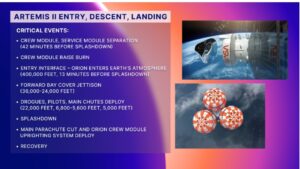
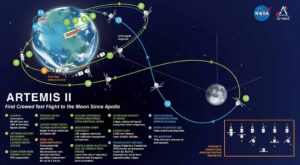
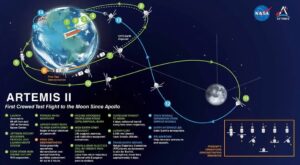
Artemis II infographic showcasing the missions entry, descent, and landing milestones. This graphic was presented by Artemis II Flight Director Rick Henfling during the mission status briefing to the media and public on April 8, 2026 at NASA’s Johnson Space Center in Houston.NASA

Trajectory Correction Burn

A key maneuver is scheduled for 9:53 p.m. EDT, when Orion’s thrusters will fire for a second return trajectory correction burn.

This adjustment is designed to fine-tune the spacecraft’s path toward Earth and align it precisely for atmospheric entry. During the burn, Jeremy Hansen will oversee procedure execution and monitor navigation and propulsion systems.

Infographic featuring the Artemis II Orion lofted entry sequence. This graphic was presented by Artemis II Flight Director Rick Henfling during the mission status briefing to the media and public on April 8, 2026 at NASA’s Johnson Space Center in Houston.
NASA

Countdown To Splashdown

Ground teams are making final preparations for splashdown, expected around 8:07 p.m. (5:07 p.m. PDT) on April 10 off the coast of San Diego.

The re-entry sequence will begin with the separation of Orion’s service module at approximately 7:33 p.m., followed by a final trajectory adjustment at 7:37 p.m. The spacecraft will then execute roll maneuvers and accelerate to nearly 23,864 mph before entering Earth’s atmosphere.

A communications blackout is expected at 7:53 p.m. as plasma builds up around the capsule, lasting about six minutes. During this phase, astronauts may experience forces up to 3.9 Gs.

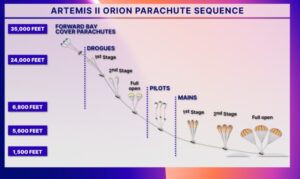
Infographic displaying the Artemis II Orion parachute sequence. This graphic was presented by Artemis II Flight Director Rick Henfling during the mission status briefing to the media and public on April 8, 2026 at NASA’s Johnson Space Center in Houston.
NASA

Parachute Deployment And Landing

After re-establishing communication, Orion will jettison its forward bay cover and deploy drogue parachutes at around 22,000 feet. Main parachutes will follow at approximately 6,000 feet, slowing the capsule for a safe ocean landing.

Ground track map displaying the Artemis II Orion parachute sequence. This graphic was presented by Artemis II Flight Director Rick Henfling during the mission status briefing to the media and public on April 8, 2026 at NASA’s Johnson Space Center in Houston.
NASA

Recovery And Return To Houston

Within two hours of splashdown, the crew will be retrieved and transported to the USS John P. Murtha via helicopter.

Once aboard, astronauts will undergo initial medical evaluations before returning to shore and boarding a flight to Johnson Space Center in Houston for post-mission debriefing and recovery.

U.S. Navy MH-60 Seahawks from Helicopter Sea Combat Squadron (HSC) 23 are seen arriving on the flight deck of USS John P. Murtha as they prepare to conduct air operations training as NASA, U.S. Navy, and U.S. Air Force teams prepare for the the return of the Artemis II crewmembers to Earth, Monday, April 6, 2026, in the Pacific Ocean off the coast of California. NASA’s Artemis II mission is taking NASA astronauts Reid Wiseman, commander; Victor Glover, pilot; Christina Koch, mission specialist; and CSA (Canadian Space Agency) astronaut Jeremy Hansen, mission specialist on a 10-day journey around the Moon and back aboard their Orion spacecraft. Wiseman, Glover, Koch, and Hansen are scheduled to splash down off the coast of San Diego at approximately 5:07 p.m. PDT (8:07 p.m. EDT) on Friday, April 10.
NASA/Bill Ingalls


Also Read:

Artemis II astronauts actively shared experiences via live calls, press conferences from Orion [Watch]

Artemis II mission: LUCA and LESA support Artemis safety, success as crew prepares return journey


Artemis II mission: LUCA and LESA support Artemis safety, success as crew prepares return journey

NASA’s Artemis II mission is drawing support from a pair of nearly identical control rooms in Alabama, each playing a distinct role in keeping astronauts safe and operations on track as the crew heads back to Earth, Friday, April 10.

At the National Aeronautics and Space Administration’s Marshall Space Flight Center in Huntsville, two facilities, the Lunar Utilization Control Area (LUCA) and the Lander Engineering Support Area (LESA), are working in tandem during the mission. Both are housed within the Huntsville Operations Support Center, a hub designed to provide real-time technical and scientific support.

Though similar in appearance, the two rooms serve different purposes. LUCA focuses on science operations linked to Artemis, while LESA is geared toward engineering support, particularly for future missions that will land astronauts on the Moon.

LUCA (Lunar Utilization Control Area) at NASA Marshall is specially designed to support a wide variety of science operations on and around the Moon – and beyond. Engineers in the LUCA monitored operations for the Lunar Node-1 experiment, an autonomous navigation payload that was part of the first NASA Commercial Lunar Payload Services (CLPS) launch on Intuitive Machines’ Nova-C lunar lander in 2024. NASA Marshall flight controllers will use the LUCA again for Artemis II to monitor science operations.
NASA/Charles Beason

Officials say the flexibility of the Huntsville center allows it to adapt to evolving mission needs. The facility has previously supported programs including the Commercial Crew Program, the Space Launch System rocket and research aboard the International Space Station.

Teams operating from LUCA are currently supporting science experiments tied to deep space conditions. These include studies examining how microgravity and radiation affect the human body, including immune response and overall performance. Data gathered during Artemis II is expected to shape planning for future crewed missions beyond Earth orbit.

Support engineers will use the LESA (Lander Engineering Support Area) at NASA Marshall to monitor human landing system (HLS) for the first crewed Artemis missions.
NASA/Charles Beason

In parallel, LESA teams are monitoring Artemis II operations in real time, using the mission as a live test case to refine procedures ahead of future lunar landings. Engineers, safety specialists and flight operations experts form part of the Human Landing System Mission Insight Support Team, which will eventually play a central role in supporting lander systems during Moon missions.

The Huntsville Operations Support Center also provides a range of technical services, including spacecraft command and telemetry management, global voice communications, and live and recorded video support. It also deploys specialized software tools that enable seamless data exchange between systems located far apart, allowing teams across different locations to work in sync.

By integrating these capabilities into both LUCA and LESA, NASA enables continuous coordination between engineers, scientists and mission operators worldwide.

Artemis II, which recently carried astronauts around the Moon, is part of NASA’s broader Artemis program aimed at returning humans to the lunar surface. The program is also intended to lay the groundwork for future missions to Mars, with lessons from current flights feeding directly into long-term exploration plans.

Also Read:

Artemis II Update-22, Day 8: Crew conducts key tests as they begin their return journey

Artemis II Update-20, Day 7: ISS Crew Connects With Artemis II Astronauts Amid Busy Research Schedule

President Trump Calls Artemis II Astronauts before crew wraps up historic Lunar Flyby [Watch Videos]

The National Aeronautics and Space Administration launched four astronauts on April 2 from Kennedy Space Center in Florida aboard the Artemis II mission. The crew is set for a 10-day test flight around the Moon, marking the first human lunar flyby since the Apollo era. The mission aims to validate spacecraft systems and pave the way for future Moon landings and Mars exploration.

NASA’s Artemis II mission has marked humanity’s return to deep space, becoming the first crewed journey near the Moon since Apollo 17. Four astronauts aboard the Orion spacecraft completed a seven-hour lunar flyby, capturing detailed observations of the Moon’s far side. The crew also set a new record for the farthest distance traveled by humans, surpassing Apollo 13. During the mission, they witnessed a solar eclipse from space and observed rare meteoroid impacts on the lunar surface. The spacecraft is now on its return trajectory, while scientists analyze data collected during the flyby.

Aboard the Orion spacecraft were NASA astronauts Reid Wiseman, Victor Glover and Christina Koch, along with Canadian Space Agency astronaut Jeremy Hansen who completed their lunar flyby, broke the Apollo 13 distance record (252,756 miles from Earth), and regained contact after passing the Moon’s far side.

US President Donald J.Trump calls the Artemis II Astronauts in space:

The White House shared video of President Trump phoning the Artemis II crew to congratulate them after breaking the human spaceflight distance record during their lunar flyby. Artemis II astronauts reached about 252,757 miles from Earth on April 6, 2026, surpassing Apollo 13’s 1970 mark of 248,655 miles by over 4,000 miles while passing the Moon’s far side.

Trump told the crew their mission paves the way for America’s return to the lunar surface, highlighting it as a historic step in U.S. space leadership.

Trump further said , “Thank you very much Jared and you are doing a fantastic job and hello very special hello to Artemis II. Today you’ve made history and made all America really proud, incredibly proud. We have a lot of things to be proud of lately, but there’s nothing like what you’re doing, circling around the moon for the first time in more than a half a century and breaking the all-time record for the farthest distance from planet Earth.

“Humans have really never seen anything quite like what you’re doing in a manned spacecraft. It’s really special. I wanted to congratulate each and every one of you. I want to personally salute and congratulate Commander Reid Wiseman, Pilot Victor Glover, Mission Specialist Christina Koch and Jeremy Hansen, and I also want to thank the entire amazing team at NASA, headed by Jared [Isaacman], who’s a very special guy, by the way. You have made this day possible, you’ve really inspired the entire world, really, everybody’s watching it”, Trump added.

And also there were few question from Trump to Artemis Crew about the mission where Trump asked “about most unforgettable part of this really historic day, and was there any difference in feel between the far side of the moon and the near side of the Moon, to which the Astronauts explained the differences due to Earth’s gravitational pull creating dramatic variations in the lunar landscapes. They described views of the Orientale crater, a solar eclipse from space, and Earthshine.


Also Read:

Artemis II Update-17, Day 6: Lunar Flyby Updates

Artemis II Update-8, Day 3 : Crew prepares for first correction burn, readies lunar flyby tasks

Artemis II Update-13, Day 5: Crew Tests Survival Suits As Spacecraft Nears Lunar Gravity Zone

Astronauts aboard Artemis II began Flight Day 5 by testing their Orion survival suits as the Orion spacecraft closed to within 65,235 miles of the Moon. The activities include a full suit evaluation, a planned trajectory correction burn, and entry into the Moon’s gravitational sphere of influence. The mission is transitioning into its final approach phase ahead of a scheduled lunar flyby.


Artemis II Update-12, Day 4: Astronauts Hand-Fly Orion, Sharpen Lunar Flyby Plan in Deep Space

Astronauts aboard Artemis II completed a 41-minute manual piloting test of the Orion spacecraft on Flight Day 4, taking turns controlling the vehicle in deep space. The demonstration, carried out tested thruster modes and maneuvering capabilities as the crew also reviewed targets for an upcoming lunar flyby. The mission continues on a stable trajectory toward the Moon, with further piloting tests planned later in the flight.


Artemis II Update-8, Day 3 : Crew prepares for first correction burn, readies lunar flyby tasks

NASA’s Artemis II crew began Flight Day 3 on April 4 after departing Earth’s orbit earlier in the mission, preparing for their first trajectory correction burn as Orion heads toward the Moon. The four astronauts, currently nearly 100,000 miles from Earth, are also training for lunar observations scheduled during a flyby on April 6. The day’s schedule includes spacecraft operations, medical drills, and communication system tests as the mission advances deeper into space.


Artemis II Update-4: Crew completes proximity test, perigee raise burn up next

NASA’s Artemis II crew completed a proximity operations test on April 2, maneuvering the Orion spacecraft near a detached rocket stage in Earth orbit. The demonstration, lasting about 70 minutes, tested manual control systems and gathered data critical for future lunar missions. The crew now prepares for a perigee raise burn, while engineers continue troubleshooting a minor onboard toilet system issue.

The astronauts aboard NASA’s Artemis II mission spent part of April 2 guiding their spacecraft through a tightly choreographed exercise hundreds of miles above Earth.

Inside Orion, the capsule named Integrity, the crew manually steered within close range of a discarded rocket stage, testing how precisely humans can control the spacecraft in space. The task lasted just over an hour. It marked one of the first hands-on demonstrations of Orion’s maneuverability under crew control.

The exercise is part of a broader effort by the National Aeronautics and Space Administration (NASA) to validate systems before sending astronauts farther into deep space, including eventual missions to the Moon under the Artemis program.

The proximity operations demonstration centered on Orion’s ability to approach and move away from another object in orbit. For this test, the crew used the detached interim cryogenic propulsion stage, or ICPS, as a reference target.

The ICPS, a temporary upper stage used during launch, had already separated from the spacecraft. It remained nearby long enough for the astronauts to conduct controlled approach and retreat maneuvers.

During the roughly 70-minute session, the crew adjusted Orion’s position repeatedly, testing navigation, thruster response, and onboard guidance systems. These maneuvers simulate conditions required for future missions that may involve docking or operating near other spacecraft.

At the end of the exercise, Orion executed an automated departure burn, increasing its distance from the ICPS. The stage is scheduled to perform a disposal burn, sending it into Earth’s atmosphere over a remote Pacific region, according to NASA mission updates.

The demonstration provides engineers with real-time data on how Orion performs under manual control, a capability considered essential for complex operations during lunar missions.

Alongside the crewed mission, four small satellites known as CubeSats launched as secondary payloads aboard the Space Launch System (SLS).

CubeSats are compact, shoebox-sized spacecraft designed for targeted scientific experiments. They will deploy after the Orion stage adapter separates from the main spacecraft.

Each satellite carries a distinct research objective:

  • ATENEA, developed by Argentina’s national space agency, focuses on radiation shielding and communication systems in high Earth orbit.
  • Space Weather CubeSat-1, built by the Saudi Space Agency, will measure solar radiation, X-rays, and magnetic field activity.
  • TACHELES, from the German Aerospace Center, is testing electrical systems for future lunar logistics vehicles.
  • K-Rad Cube, developed by the Korea AeroSpace Administration, will study radiation effects across the Van Allen belts, regions of charged particles surrounding Earth.

The CubeSat deployments expand the mission’s scientific output, offering data on space weather and radiation environments that astronauts may encounter during longer missions.

Trajectory for Artemis II, NASA’s first flight with crew aboard SLS, Orion to pave the way for long-term return to the Moon, missions to Mars

Perigee raise burn planned as engineers monitor onboard issue

Attention now shifts to the next key maneuver, the perigee raise burn, scheduled after the crew’s rest period.

Perigee refers to the lowest point in a spacecraft’s orbit around Earth. Raising it adjusts the shape of the orbit and prepares Orion for later phases of the mission, including potential translunar trajectories.

The maneuver follows an earlier apogee raise burn, which increased the spacecraft’s highest orbital point. Together, these burns define Orion’s initial orbital path and test propulsion performance under operational conditions.

Before the next burn, the crew completed routine spacecraft checks. During a systems review, they reported a blinking fault light in the onboard toilet system.

NASA ground teams are analyzing the data and working with the crew to diagnose the issue. No broader system impacts have been reported in official updates.

After a scheduled four-hour rest period, the astronauts are set to wake at 7 a.m. Eastern Time on April 2 to prepare for the maneuver. The timeline includes post-burn activities followed by another sleep cycle later in the morning.

The sequence of tests, adjustments, and troubleshooting reflects the mission’s dual purpose: demonstrating Orion’s readiness for deep space while gathering operational data from a live crewed environment.

Also Read:

Artemis II Mission Launch: NASA Sends Crew on First Moon Flyby in 50 Years

Artemis II Update-2 : Perigee Raise Burn Completed with brief Communications Loss, NASA Probes

Artemis II Update-3: Apogee Raise burn complete, Crew prepares critical Proximity Test