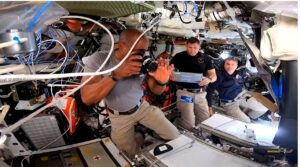
Astronauts aboard Artemis II continue their workday aboard the Orion spacecraft, testing survival suits and preparing for a lunar flyby set for Monday, April 6. The crew is set to enter the Moon’s gravitational influence just after midnight and execute a key trajectory correction burn later in the day. Final science targets, including major lunar basins, have been assigned ahead of a six-hour observation window.
Inside Orion, the workday has shifted toward final preparations for one of the mission’s defining moments.
With the Moon now close enough to begin shaping the spacecraft’s path, the four astronauts are balancing system checks with scientific planning, moving through a schedule that blends engineering discipline with observation readiness.
Commander Reid Wiseman, pilot Victor Glover, and mission specialists Christina Koch and Jeremy Hansen are continuing a full evaluation of the Orion Crew Survival System suits, a system designed for worst-case scenarios in spaceflight.
Orion spacesuit testing and emergency readiness in deep space
The suit demonstration involves a complete operational sequence. Astronauts are performing leak checks, simulating seat entry, and testing how well they can move, eat, and drink while fully suited.
NASA designed the suits to function across multiple mission phases. They provide life support if cabin pressure is lost, protect crew members during launch and reentry, and support survival after splashdown in the ocean.
Engineers are using this test to understand how the suits perform over extended use in microgravity. Comfort and flexibility are critical, especially for missions that will last longer than earlier lunar programs.
The evaluation also feeds into planning for future deep space missions, where astronauts may need to rely on such systems for longer durations and under more demanding conditions.

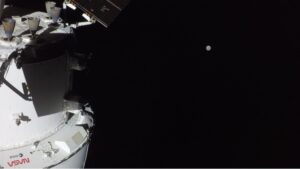
(This photo shows the Orion spacecraft with the Moon in the distance, as captured by a camera on the tip of one of its solar array wings during flight day 2 of the mission.
NASA)
Outbound trajectory correction burn and lunar approach timing
Following the suit tests, the crew is scheduled to carry out an outbound trajectory correction burn at approximately 11:03 p.m. Eastern Daylight Time.
The maneuver will refine Orion’s path toward the Moon, ensuring that the spacecraft is correctly aligned for its flyby observation window. Earlier in the mission, two planned burns were canceled after flight controllers confirmed the spacecraft was already on an accurate trajectory.
Ahead of the maneuver, Koch and Hansen are reviewing procedures, with Hansen assigned to monitor navigation data and spacecraft configuration during the burn.
The mission timeline also includes a key milestone. Orion is expected to enter the Moon’s gravitational sphere of influence at about 12:41 a.m. on April 6, marking the transition from transit to direct lunar interaction.

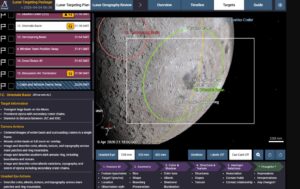
(A screenshot of the application the Artemis II crew sees on their PCDs that guides them in the execution of the lunar science observation plan. This custom software was built by the Crew Lunar Observations Team, a subset of the Artemis II lunar science team. In this screenshot you can see Orientale basin, target number 12 circled on the bottom right of the Moon, and to its left, target number 13, Hertzsprung basin.
NASA)
Lunar flyby science targets include major impact basins
Mission control has delivered the final list of lunar observation targets, giving the crew a defined set of features to document during the flyby.
Among the most prominent is the Orientale basin, a massive impact structure nearly 600 miles wide that spans the boundary between the Moon’s near and far sides.
Formed roughly 3.8 billion years ago, the basin preserves clear evidence of a large collision, including concentric rings and dramatic surface topography. Its visibility during the flyby makes it a priority for imaging and analysis.
Another key target is the Hertzsprung basin, located northwest of Orientale on the Moon’s far side. At roughly 400 miles across, it represents an older and more degraded structure.
By comparing the two basins, astronauts will help scientists study how lunar features evolve over time. Differences in structure, erosion, and impact history offer clues about the Moon’s geological development.
The crew is expected to review these targets in detail and coordinate with mission controllers to finalize observation techniques before the flyby begins.
Final preparations inside Orion as flyby approaches
As the spacecraft moves deeper into the Moon’s gravitational influence, operations inside Orion are becoming more tightly focused.
Each task, from suit testing to trajectory adjustments, is tied directly to the upcoming flyby. The six-hour observation window will require precise timing, coordination, and execution.
The astronauts are working through final checklists, ensuring that both human and mechanical systems are ready. Cameras must be positioned, observation plans synchronized, and spacecraft orientation carefully controlled.
The mission has reached a stage where preparation outweighs transit. The spacecraft continues along a stable path, but the emphasis has shifted to how effectively the crew can carry out their objectives once they reach lunar proximity.
For the Artemis II team, the work now is less about getting to the Moon and more about what they will do when they get there.
Key moments for the lunar flyby include the following. All times are Eastern and may change based on real-time operations:
Monday, April 6
- 12:41 a.m.: Orion enters lunar sphere of influence at 41,072 miles from the Moon.
- 1:30 p.m.: The science officer in mission control will brief the crew on their science goals for the upcoming flyby.
- 1:56 p.m.: The Artemis II crew is expected surpass the record previously set by the Apollo 13 crew in 1970 for the farthest humans have ever traveled from Earth.
- 2:45 p.m.: Lunar observations begin.
- 6:44 p.m.: Mission control expects to temporarily lose communication with the crew as the Orion spacecraft passes behind the Moon.
- 6:45 p.m.: During “Earthset,” Earth will glide behind the Moon from Orion’s perspective.
- 7:02 p.m.: Orion reaches its closest approach to the Moon at 4,070 miles above the surface.
- 7:07 p.m.: Crew reach their maximum distance from Earth during the mission.
- 7:25 p.m.: “Earthrise” marks Earth coming back into view on the opposite edge of the Moon.
- 7:25 p.m.: NASA’s Mission Control Center should re -acquire communication with the astronauts.
- 8:35-9:32 p.m.: During a solar eclipse, the Sun will pass behind the Moon from the crew’s perspective.
- 9:20 p.m.: Lunar observations conclude.
Tuesday, April 7
- 1:25 p.m.: Orion exits the lunar sphere of influence at 41,072 miles from the Moon.
During the flyby, the spacecraft will break the record for the farthest distance from Earth traveled by any human mission, surpassing the mark set by Apollo 13 in April 1970 during its emergency return to Earth. The spacecraft is expected to break the record at 1:56 p.m. and will reach its maximum distance at 7:07 p.m., a total of 252,760 miles from Earth; Apollo 13 reached 248,655 miles from Earth.
When Orion passes behind the Moon, the mission will enter a planned communications blackout of about 40 minutes as the lunar surface blocks the radio signals needed for the Deep Space Network to connect with the spacecraft. Similar blackouts occurred during the Artemis I and Apollo missions and are expected with an Earth-based communications infrastructure. Once Orion reemerges, the network will quickly reacquire its signal and restore contact with mission control.
Also Read:
Artemis II Update-12, Day 4: Astronauts Hand-Fly Orion, Sharpen Lunar Flyby Plan in Deep Space
Artemis II Update-11, Day 4: Crew Enters Deep Space, Lunar Flyby Prep