

NASA’s Artemis II crew began Flight Day 3 on April 4 after departing Earth’s orbit earlier in the mission, preparing for their first trajectory correction burn as Orion heads toward the Moon. The four astronauts, currently nearly 100,000 miles from Earth, are also training for lunar observations scheduled during a flyby on April 6. The day’s schedule includes spacecraft operations, medical drills, and communication system tests as the mission advances deeper into space.
The four astronauts aboard NASA’s Artemis II mission woke to music drifting through the Orion capsule, nearly 100,000 miles from Earth. Hours earlier, they had been asleep inside a spacecraft racing toward the Moon, farther from home than any crew in more than half a century.
Commander Reid Wiseman, pilot Victor Glover, mission specialist Christina Koch, and Canadian Space Agency astronaut Jeremy Hansen are now settling into the cadence of deep-space flight. Their journey marks the first time humans have traveled beyond low Earth orbit since NASA’s Apollo program ended in 1972.
Mission controllers at NASA Johnson Space Center in Houston signaled the start of the day at 1 p.m. EDT, playing “…In a Daydream,” by the Freddy Jones Band. By then, Orion was roughly 99,900 miles from Earth, closing in on the Moon, which lay about 161,750 miles ahead.

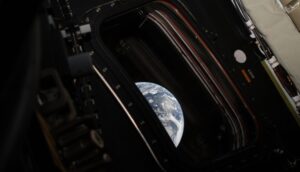
A view of Earth taken by NASA astronaut and Artemis II commander Reid Wiseman from one of the Orion spacecraft’s four main windows after completing the translunar injection burn on April 2, 2026.
NASA
Trajectory correction burn Artemis II timing and purpose
The crew’s primary task later Friday is preparing for the first outbound trajectory correction burn, scheduled for 6:49 p.m. The maneuver will last about eight seconds and slightly adjust Orion’s speed by 0.7 feet per second.
That small change carries weight in deep space navigation. Engineers design these burns to fine-tune the spacecraft’s path after major propulsion events, such as the translunar injection burn completed on April 2. Using Orion’s onboard thrusters, the adjustment ensures the capsule remains precisely aligned for upcoming lunar operations.
Inside the spacecraft, the preparation involves verifying propulsion systems, monitoring navigation data, and coordinating closely with mission control. Even minor deviations can compound over hundreds of thousands of miles, making these early corrections essential.
The Artemis II crew is experiencing this process in real time, managing both the technical and human demands of deep-space travel. It is the kind of operational rhythm that defined earlier lunar missions but has not been practiced by a human crew in decades.
Lunar flyby science targets and far side observations
While engineers refine Orion’s trajectory, scientists are focusing on what the crew will see once they reach the Moon.
Teams on the ground are selecting geological targets that will be visible during a six-hour observation window on April 6, when Orion loops around the lunar surface. The alignment of the Sun, Moon, and spacecraft is expected to illuminate about 20 percent of the Moon’s far side, a region never visible from Earth.
Among the features expected to come into view are the Orientale basin, a massive impact structure, along with Pierazzo crater and Ohm crater. Some of these formations have rarely been seen directly by human eyes without optical aid.
Inside Orion, the astronauts are rehearsing for that moment. The cabin, roughly the size of two minivans, requires careful choreography in microgravity. Equipment must be secured, camera positions planned, and movement coordinated to avoid disrupting observations.
The crew will use handheld cameras equipped with 80-400 millimeter and 14-24 millimeter lenses. These tools are expected to capture high-resolution imagery of the lunar surface, contributing to scientific analysis and public engagement with the mission.


A view of Earth taken by NASA astronaut and Artemis II Commander Reid Wiseman from one of the Orion spacecraft’s window after completing the translunar injection burn on April 2, 2026. The image features two auroras (top right and bottom left) and zodiacal light (bottom right) is visible as the Earth eclipses the Sun.
Orion spacecraft health tests and deep space communications
Beyond navigation and science, Flight Day 3 also includes routine but critical health and safety exercises.
The astronauts are scheduled to conduct demonstrations of cardiopulmonary resuscitation and choking response procedures. These drills aim to evaluate how emergency medical protocols function in microgravity, where movement and physical coordination differ significantly from Earth.
Physical fitness remains another priority. Each crew member continues daily exercise using Orion’s flywheel device, designed to maintain cardiovascular health during extended missions.
Later in the day, Christina Koch will test Orion’s emergency communication systems using NASA Deep Space Network, a worldwide array of antennas that supports spacecraft far beyond Earth orbit. The test will assess how effectively Orion can transmit data as it moves deeper into space.
The spacecraft’s optical communications system has already demonstrated its ability to send high-definition video and mission data back to Earth through U.S.-based ground stations. That information is relayed directly to mission control in Houston, allowing engineers to monitor the spacecraft’s performance in near real time.
As Artemis II advances toward its lunar flyby, the crew’s day-to-day work blends precision engineering with human adaptability. Each scheduled task, from an eight-second burn to a medical drill, contributes to a mission that is reestablishing a path last traveled more than five decades ago.
For the astronauts aboard Orion, the distance from Earth continues to grow. So does the scope of what lies ahead.
Also Read:
Artemis II Update-7, Day 2 : Orion completes Translunar Injection burn , crew begins journey to Moon