At 10:53 p.m. EDT, the Orion spacecraft executed a brief nine-second thruster burn, increasing its velocity by 5.3 feet per second and nudging the Artemis II crew further along their return path to Earth.
With the maneuver complete, the crew has now crossed the halfway mark on their journey home.
Temporary Signal Loss Resolved
Roughly two hours before the burn, mission teams encountered an unexpected return link loss of signal during a data rate transition, briefly disrupting the flow of communications and telemetry from the spacecraft.
Two-way contact was subsequently restored, allowing flight controllers and crew to resume preparations for the scheduled maneuver without further delay.
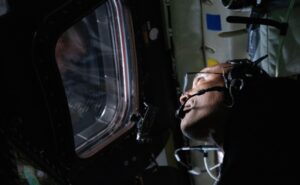
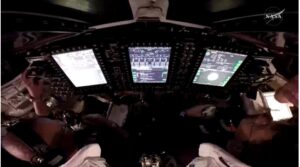
art002e016204 (April 6, 2026) – NASA astronaut and Artemis II Pilot Victor Glover pictured here in the Orion spacecraft during the Artemis II lunar flyby. Glover and his fellow crewmates spent approximately seven hours taking turns at the Orion windows capturing science data to share with their team back on Earth. At closest approach, they came within 4,067 miles of the Moon’s surface.NASA
Re-Entry Briefings And Next Steps
Earlier in the day, officials from NASA provided additional details on re-entry and splashdown procedures during a mission status briefing.
The next key milestone—a third return trajectory correction burn—is planned for April 10 at approximately 1:53 p.m., ahead of final re-entry operations.
Splashdown Target Remains On Track
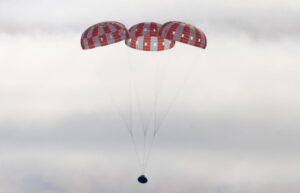
NASA continues to target splashdown at 8:07 p.m. (5:07 p.m. PDT) on Friday, April 10, off the coast of San Diego, as the Artemis II mission enters its final phase of return.
A container of “lucky peanuts” was placed above workstations inside the Space Flight Operations Facility at Jet Propulsion Laboratory ahead of the Artemis II launch on April 1, 2026.
The quirky ritual—eating peanuts before major mission events—has long been observed at JPL, seen by teams as a symbol of good fortune before critical operations.
Control Centre Behind Deep Space Communication
The Space Flight Operations Facility oversees NASA’s Deep Space Network (DSN), a global communication system comprising three major complexes located in Goldstone, California; Madrid, Spain; and Canberra, Australia.
Each site houses multiple radio-frequency antennas that maintain constant contact with dozens of spacecraft across the solar system, including the crewed Artemis II mission.
NASA
A Critical Link To Spacecraft
Managed by JPL under NASA’s Space Communications and Navigation programme, the DSN operates from the agency’s headquarters within the Space Operations Mission Directorate.
The network plays a vital role in tracking spacecraft, transmitting commands, and receiving scientific data from distant missions. The Jet Propulsion Laboratory itself is run by the California Institute of Technology in Pasadena, California, on behalf of NASA.
Also Read:
JPL’s Mission Control Steps Up For Artemis II Deep Space Operations
NASA’s Artemis II mission is drawing support from a pair of nearly identical control rooms in Alabama, each playing a distinct role in keeping astronauts safe and operations on track as the crew heads back to Earth, Friday, April 10.
At the National Aeronautics and Space Administration’s Marshall Space Flight Center in Huntsville, two facilities, the Lunar Utilization Control Area (LUCA) and the Lander Engineering Support Area (LESA), are working in tandem during the mission. Both are housed within the Huntsville Operations Support Center, a hub designed to provide real-time technical and scientific support.
Though similar in appearance, the two rooms serve different purposes. LUCA focuses on science operations linked to Artemis, while LESA is geared toward engineering support, particularly for future missions that will land astronauts on the Moon.
LUCA (Lunar Utilization Control Area) at NASA Marshall is specially designed to support a wide variety of science operations on and around the Moon – and beyond. Engineers in the LUCA monitored operations for the Lunar Node-1 experiment, an autonomous navigation payload that was part of the first NASA Commercial Lunar Payload Services (CLPS) launch on Intuitive Machines’ Nova-C lunar lander in 2024. NASA Marshall flight controllers will use the LUCA again for Artemis II to monitor science operations. NASA/Charles Beason
Officials say the flexibility of the Huntsville center allows it to adapt to evolving mission needs. The facility has previously supported programs including the Commercial Crew Program, the Space Launch System rocket and research aboard the International Space Station.
Teams operating from LUCA are currently supporting science experiments tied to deep space conditions. These include studies examining how microgravity and radiation affect the human body, including immune response and overall performance. Data gathered during Artemis II is expected to shape planning for future crewed missions beyond Earth orbit.
Support engineers will use the LESA (Lander Engineering Support Area) at NASA Marshall to monitor human landing system (HLS) for the first crewed Artemis missions. NASA/Charles Beason
In parallel, LESA teams are monitoring Artemis II operations in real time, using the mission as a live test case to refine procedures ahead of future lunar landings. Engineers, safety specialists and flight operations experts form part of the Human Landing System Mission Insight Support Team, which will eventually play a central role in supporting lander systems during Moon missions.
The Huntsville Operations Support Center also provides a range of technical services, including spacecraft command and telemetry management, global voice communications, and live and recorded video support. It also deploys specialized software tools that enable seamless data exchange between systems located far apart, allowing teams across different locations to work in sync.
By integrating these capabilities into both LUCA and LESA, NASA enables continuous coordination between engineers, scientists and mission operators worldwide.
Artemis II, which recently carried astronauts around the Moon, is part of NASA’s broader Artemis program aimed at returning humans to the lunar surface. The program is also intended to lay the groundwork for future missions to Mars, with lessons from current flights feeding directly into long-term exploration plans.
Astronauts aboard Artemis II continue their workday aboard the Orion spacecraft, testing survival suits and preparing for a lunar flyby set for Monday, April 6. The crew is set to enter the Moon’s gravitational influence just after midnight and execute a key trajectory correction burn later in the day. Final science targets, including major lunar basins, have been assigned ahead of a six-hour observation window.
Inside Orion, the workday has shifted toward final preparations for one of the mission’s defining moments.
With the Moon now close enough to begin shaping the spacecraft’s path, the four astronauts are balancing system checks with scientific planning, moving through a schedule that blends engineering discipline with observation readiness.
Commander Reid Wiseman, pilot Victor Glover, and mission specialists Christina Koch and Jeremy Hansen are continuing a full evaluation of the Orion Crew Survival System suits, a system designed for worst-case scenarios in spaceflight.
Orion spacesuit testing and emergency readiness in deep space
The suit demonstration involves a complete operational sequence. Astronauts are performing leak checks, simulating seat entry, and testing how well they can move, eat, and drink while fully suited.
NASA designed the suits to function across multiple mission phases. They provide life support if cabin pressure is lost, protect crew members during launch and reentry, and support survival after splashdown in the ocean.
Engineers are using this test to understand how the suits perform over extended use in microgravity. Comfort and flexibility are critical, especially for missions that will last longer than earlier lunar programs.
The evaluation also feeds into planning for future deep space missions, where astronauts may need to rely on such systems for longer durations and under more demanding conditions.
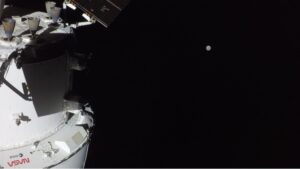
(This photo shows the Orion spacecraft with the Moon in the distance, as captured by a camera on the tip of one of its solar array wings during flight day 2 of the mission. NASA)
Outbound trajectory correction burn and lunar approach timing
Following the suit tests, the crew is scheduled to carry out an outbound trajectory correction burn at approximately 11:03 p.m. Eastern Daylight Time.
The maneuver will refine Orion’s path toward the Moon, ensuring that the spacecraft is correctly aligned for its flyby observation window. Earlier in the mission, two planned burns were canceled after flight controllers confirmed the spacecraft was already on an accurate trajectory.
Ahead of the maneuver, Koch and Hansen are reviewing procedures, with Hansen assigned to monitor navigation data and spacecraft configuration during the burn.
The mission timeline also includes a key milestone. Orion is expected to enter the Moon’s gravitational sphere of influence at about 12:41 a.m. on April 6, marking the transition from transit to direct lunar interaction.
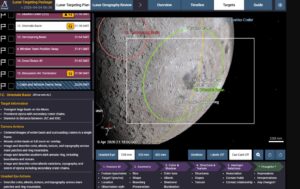
(A screenshot of the application the Artemis II crew sees on their PCDs that guides them in the execution of the lunar science observation plan. This custom software was built by the Crew Lunar Observations Team, a subset of the Artemis II lunar science team. In this screenshot you can see Orientale basin, target number 12 circled on the bottom right of the Moon, and to its left, target number 13, Hertzsprung basin. NASA)
Lunar flyby science targets include major impact basins
Mission control has delivered the final list of lunar observation targets, giving the crew a defined set of features to document during the flyby.
Among the most prominent is the Orientale basin, a massive impact structure nearly 600 miles wide that spans the boundary between the Moon’s near and far sides.
Formed roughly 3.8 billion years ago, the basin preserves clear evidence of a large collision, including concentric rings and dramatic surface topography. Its visibility during the flyby makes it a priority for imaging and analysis.
Another key target is the Hertzsprung basin, located northwest of Orientale on the Moon’s far side. At roughly 400 miles across, it represents an older and more degraded structure.
By comparing the two basins, astronauts will help scientists study how lunar features evolve over time. Differences in structure, erosion, and impact history offer clues about the Moon’s geological development.
The crew is expected to review these targets in detail and coordinate with mission controllers to finalize observation techniques before the flyby begins.
Final preparations inside Orion as flyby approaches
As the spacecraft moves deeper into the Moon’s gravitational influence, operations inside Orion are becoming more tightly focused.
Each task, from suit testing to trajectory adjustments, is tied directly to the upcoming flyby. The six-hour observation window will require precise timing, coordination, and execution.
The astronauts are working through final checklists, ensuring that both human and mechanical systems are ready. Cameras must be positioned, observation plans synchronized, and spacecraft orientation carefully controlled.
The mission has reached a stage where preparation outweighs transit. The spacecraft continues along a stable path, but the emphasis has shifted to how effectively the crew can carry out their objectives once they reach lunar proximity.
For the Artemis II team, the work now is less about getting to the Moon and more about what they will do when they get there.
Key moments for the lunar flyby include the following. All times are Eastern and may change based on real-time operations:
Monday, April 6
12:41 a.m.: Orion enters lunar sphere of influence at 41,072 miles from the Moon.
1:30 p.m.: The science officer in mission control will brief the crew on their science goals for the upcoming flyby.
1:56 p.m.: The Artemis II crew is expected surpass the record previously set by the Apollo 13 crew in 1970 for the farthest humans have ever traveled from Earth.
2:45 p.m.: Lunar observations begin.
6:44 p.m.: Mission control expects to temporarily lose communication with the crew as the Orion spacecraft passes behind the Moon.
6:45 p.m.: During “Earthset,” Earth will glide behind the Moon from Orion’s perspective.
7:02 p.m.: Orion reaches its closest approach to the Moon at 4,070 miles above the surface.
7:07 p.m.: Crew reach their maximum distance from Earth during the mission.
7:25 p.m.: “Earthrise” marks Earth coming back into view on the opposite edge of the Moon.
7:25 p.m.: NASA’s Mission Control Center should re -acquire communication with the astronauts.
8:35-9:32 p.m.: During a solar eclipse, the Sun will pass behind the Moon from the crew’s perspective.
9:20 p.m.: Lunar observations conclude.
Tuesday, April 7
1:25 p.m.: Orion exits the lunar sphere of influence at 41,072 miles from the Moon.
During the flyby, the spacecraft will break the record for the farthest distance from Earth traveled by any human mission, surpassing the mark set by Apollo 13 in April 1970 during its emergency return to Earth. The spacecraft is expected to break the record at 1:56 p.m. and will reach its maximum distance at 7:07 p.m., a total of 252,760 miles from Earth; Apollo 13 reached 248,655 miles from Earth.
When Orion passes behind the Moon, the mission will enter a planned communications blackout of about 40 minutes as the lunar surface blocks the radio signals needed for the Deep Space Network to connect with the spacecraft. Similar blackouts occurred during the Artemis I and Apollo missions and are expected with an Earth-based communications infrastructure. Once Orion reemerges, the network will quickly reacquire its signal and restore contact with mission control.
Astronauts aboard Artemis II began Flight Day 5 by testing their Orion survival suits as the Orion spacecraft closed to within 65,235 miles of the Moon. The activities include a full suit evaluation, a planned trajectory correction burn, and entry into the Moon’s gravitational sphere of influence. The mission is transitioning into its final approach phase ahead of a scheduled lunar flyby.
As CeeLo Green’s “Working Class Heroes (Work)” played through the cabin, the four astronauts shifted quickly into one of the mission’s most practical tests: evaluating the suits designed to keep them alive if something goes wrong.
At this stage of the mission, the spacecraft is about 65,235 miles from the Moon. The distance marks a transition point, where lunar gravity begins to shape the trajectory more strongly than Earth’s pull.
The crew also heard a special message from Apollo astronaut Charlie Duke.
“John Young and I landed on the Moon in 1972 in a lunar module we named Orion. I’m glad to see a different kind of Orion helping return humans to the Moon as America charts the course to the lunar surface. Below you on the Moon is a photo of my family. I pray it reminds you that we and America and all of the world are cheering you on.”
Charlie duke, Apollo 16 Astronaut
Orion Crew Survival System suit test in microgravity
Commander Reid Wiseman, pilot Victor Glover, and mission specialists Christina Koch and Jeremy Hansen are conducting a full operational sequence using the Orion Crew Survival System suit.
The test is structured to mirror real mission scenarios. Astronauts will don the suits, pressurize them, and perform leak checks. They will then simulate entering their seats and assess how easily they can move, eat, and drink while fully suited.
NASA engineers are particularly focused on how the suits perform over extended periods in microgravity. Unlike earlier programs, Artemis missions are designed for longer durations, making comfort and mobility as critical as protection.
The suit itself serves multiple purposes. It is built to provide life support if the cabin loses pressure, protect astronauts during high-risk phases such as launch and reentry, and support survival operations after splashdown in the ocean.
Enhanced thermal regulation, improved communication systems, and greater flexibility are among the features being evaluated during this demonstration. The data collected will shape how future crews operate during longer missions beyond the Moon.
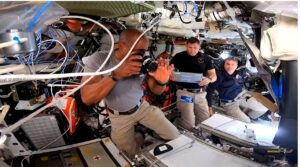
Victor Glover, Jeremy Hansen, and Reid Wiseman work together inside the Orion spacecraft on their way to the Moon.
Final trajectory adjustments and lunar approach phase
Later in the day, the crew is scheduled to execute an outbound trajectory correction burn, one of the final planned propulsion maneuvers before the lunar flyby.
These burns fine-tune the spacecraft’s path, ensuring that Orion reaches the correct position and orientation for its observation window around the Moon. Earlier in the mission, several planned burns were canceled due to the spacecraft’s precise trajectory. This maneuver is expected to proceed as scheduled.
The crew will also receive their final set of lunar science targets, completing the preparation phase for the flyby. These targets include specific surface features identified by NASA scientists for observation and imaging.
By the end of the day, Orion is expected to enter the Moon’s gravitational sphere of influence, a region where lunar gravity becomes the dominant force acting on the spacecraft.
This shift has both symbolic and operational significance. It marks the point where the mission transitions from transit to direct lunar interaction.
(The Artemis II crew took this photo on day 4 of their journey to the Moon. In it, the Moon is oriented with the South Pole at the top and are beginning to see parts of the lunar far side. Orientale basin is on the right edge of the lunar disk in this image. Artemis II marks the first time that humans have seen the entire basin. The Artemis II crew will continue to observe Orientale from multiple angles as they approach the Moon and throughout the lunar flyby. Orientale is the textbook multi-ring impact basin used as a baseline to compare other impact craters on rocky worlds from Mercury to Pluto. NASA)
Mission operations continue under close ground coordination
Mission managers and scientists are scheduled to provide a detailed update during a briefing streamed on NASA’s official channels later in the day.
The briefings serve as a key link between the spacecraft and the public, offering updates on system performance, crew health, and mission progress.
Inside the capsule, the crew’s schedule remains tightly controlled. Each task, from suit testing to propulsion maneuvers, is timed to align with both spacecraft operations and communication windows with Earth.
The suit demonstration stands out as one of the more human-centered activities in the mission. It focuses not on where the spacecraft is going, but on how the crew will function if conditions change rapidly.
As Orion continues its approach, the astronauts are balancing technical precision with preparation for the unexpected. The systems being tested now, including the suits, are designed for scenarios that mission planners hope never occur but must be ready to handle.
The Moon is now close enough to influence the spacecraft’s path. Inside Orion, the crew is working through the final checklists that will carry them into the flyby phase, where observation, timing, and coordination will define the mission’s next milestone.
The crew of Artemis II moved into preparation mode on April 6 as their spacecraft, Orion spacecraft, continued its trajectory toward a lunar flyby. The outbound trajectory correction burn was canceled after flight controllers confirmed the spacecraft remained on course. Astronauts focused on cabin readiness, medical drills, and system checks as the mission passed its halfway point to the Moon.
The four astronauts aboard Artemis II are settling into the rhythms of deep space travel as their spacecraft closes in on a critical phase of the mission. By Monday afternoon, the crew had shifted focus from major propulsion events to preparing the Orion capsule for sustained lunar observation, a period that will define the mission’s operational success.
“We all had a collective expression of joy at that… We can see the Moon out of the docking hatch right now. It’s a beautiful sight.” –Christina KOCH, NASA Astronaut (Artemis II Mission)
Mission controllers at the NASA Johnson Space Center confirmed that the first planned outbound trajectory correction burn was no longer necessary. The spacecraft’s path, they said, remained precise enough to meet mission parameters without adjustment. That decision removed one of three scheduled trajectory maneuvers designed to fine-tune Orion’s route to the Moon.
Inside the capsule, the change translated into a different kind of workload. Rather than executing propulsion tasks, the crew began configuring their living and observation environment for the upcoming lunar flyby window.
Victor Glover, Jeremy Hansen, and Reid Wiseman work together inside the Orion spacecraft on their way to the Moon.
Orion cabin preparation for lunar observation phase
Cabin preparation is not cosmetic. It involves reconfiguring equipment, securing loose items, and ensuring all observation tools are accessible during the Moon flyby. Astronauts must also adjust lighting, camera systems, and window access points to capture scientific data and imagery.
NASA officials have described this phase as one of the most human-centered parts of the mission. The spacecraft, which has operated largely as a transport vehicle until now, becomes a workspace and observation platform as it approaches lunar proximity.
Crew members spent part of the day organizing onboard equipment and verifying that all systems required for observation are functioning within expected parameters. This includes environmental controls, onboard computing systems, and manual override mechanisms.
Alongside technical preparation, astronauts continued routine health maintenance. Exercise sessions remain a daily requirement to counter the effects of microgravity on muscles and bone density. Medical response drills were also conducted, simulating potential emergencies that could arise far from Earth.
These drills are not theoretical. NASA requires crews to demonstrate the ability to respond to medical situations independently, given the communication delays and physical distance involved in deep space missions.
Deep space systems testing and mission timeline adjustments
The crew also tested Orion’s emergency communications system, a critical component designed to maintain contact with Earth under degraded conditions. Engineers on the ground monitor these tests closely, using them to validate system redundancy and resilience.
Deep space communication differs significantly from low Earth orbit operations. Signal delays increase, and the margin for error narrows. Testing ensures that backup systems can function if primary channels fail.
NASA’s decision to cancel the trajectory correction burn underscores the precision of the spacecraft’s navigation systems. According to mission control, Orion’s current trajectory aligns closely with pre-flight calculations, reducing the need for mid-course corrections.
That precision has operational consequences. Fewer burns mean conservation of fuel and reduced mechanical stress on propulsion systems, both of which can extend mission flexibility.
The Artemis II timeline continues to evolve in real time. While the crew prepared for rest around 3 a.m. Central Daylight Time, mission control scheduled their wake-up for the next operational phase. The timeline reflects both planned activities and adjustments based on spacecraft performance.
Despite the technical complexity, daily life aboard Orion follows a structured routine. Sleep cycles, exercise periods, and work blocks are carefully scheduled to maintain crew health and efficiency.
For the astronauts, the mission has now entered a quieter but equally demanding stage. The high-energy launch and orbital maneuvers have given way to sustained operations, where attention to detail becomes critical.
The lunar flyby, expected soon, will serve as both a technical demonstration and a symbolic milestone. Artemis II is the first crewed mission under NASA’s Artemis program, which aims to return humans to the Moon and establish a long-term presence.
The mission builds on decades of spaceflight experience while introducing new systems designed for deep space exploration. Orion, developed specifically for missions beyond low Earth orbit, represents a shift in spacecraft design priorities, emphasizing autonomy, durability, and crew safety over extended durations.
As the spacecraft moves closer to the Moon, the crew’s preparations inside the cabin will shape how effectively they can carry out observation tasks. Every adjustment made now, from equipment placement to system checks, feeds into that moment.
For mission control teams in Houston, the cancellation of a major burn signals confidence in both the spacecraft and the planning behind it. For the astronauts, it means more time to prepare for the view ahead.
The Moon is no longer a distant objective. It is approaching, steadily, on a trajectory that no longer requires correction.
NASA’s Artemis II crew began Flight Day 3 on April 4 after departing Earth’s orbit earlier in the mission, preparing for their first trajectory correction burn as Orion heads toward the Moon. The four astronauts, currently nearly 100,000 miles from Earth, are also training for lunar observations scheduled during a flyby on April 6. The day’s schedule includes spacecraft operations, medical drills, and communication system tests as the mission advances deeper into space.
The four astronauts aboard NASA’s Artemis II mission woke to music drifting through the Orion capsule, nearly 100,000 miles from Earth. Hours earlier, they had been asleep inside a spacecraft racing toward the Moon, farther from home than any crew in more than half a century.
Commander Reid Wiseman, pilot Victor Glover, mission specialist Christina Koch, and Canadian Space Agency astronaut Jeremy Hansen are now settling into the cadence of deep-space flight. Their journey marks the first time humans have traveled beyond low Earth orbit since NASA’s Apollo program ended in 1972.
Mission controllers at NASA Johnson Space Center in Houston signaled the start of the day at 1 p.m. EDT, playing “…In a Daydream,” by the Freddy Jones Band. By then, Orion was roughly 99,900 miles from Earth, closing in on the Moon, which lay about 161,750 miles ahead.
A view of Earth taken by NASA astronaut and Artemis II commander Reid Wiseman from one of the Orion spacecraft’s four main windows after completing the translunar injection burn on April 2, 2026. NASA
Trajectory correction burn Artemis II timing and purpose
The crew’s primary task later Friday is preparing for the first outbound trajectory correction burn, scheduled for 6:49 p.m. The maneuver will last about eight seconds and slightly adjust Orion’s speed by 0.7 feet per second.
That small change carries weight in deep space navigation. Engineers design these burns to fine-tune the spacecraft’s path after major propulsion events, such as the translunar injection burn completed on April 2. Using Orion’s onboard thrusters, the adjustment ensures the capsule remains precisely aligned for upcoming lunar operations.
Inside the spacecraft, the preparation involves verifying propulsion systems, monitoring navigation data, and coordinating closely with mission control. Even minor deviations can compound over hundreds of thousands of miles, making these early corrections essential.
The Artemis II crew is experiencing this process in real time, managing both the technical and human demands of deep-space travel. It is the kind of operational rhythm that defined earlier lunar missions but has not been practiced by a human crew in decades.
Lunar flyby science targets and far side observations
While engineers refine Orion’s trajectory, scientists are focusing on what the crew will see once they reach the Moon.
Teams on the ground are selecting geological targets that will be visible during a six-hour observation window on April 6, when Orion loops around the lunar surface. The alignment of the Sun, Moon, and spacecraft is expected to illuminate about 20 percent of the Moon’s far side, a region never visible from Earth.
Among the features expected to come into view are the Orientale basin, a massive impact structure, along with Pierazzo crater and Ohm crater. Some of these formations have rarely been seen directly by human eyes without optical aid.
Inside Orion, the astronauts are rehearsing for that moment. The cabin, roughly the size of two minivans, requires careful choreography in microgravity. Equipment must be secured, camera positions planned, and movement coordinated to avoid disrupting observations.
The crew will use handheld cameras equipped with 80-400 millimeter and 14-24 millimeter lenses. These tools are expected to capture high-resolution imagery of the lunar surface, contributing to scientific analysis and public engagement with the mission.
A view of Earth taken by NASA astronaut and Artemis II Commander Reid Wiseman from one of the Orion spacecraft’s window after completing the translunar injection burn on April 2, 2026. The image features two auroras (top right and bottom left) and zodiacal light (bottom right) is visible as the Earth eclipses the Sun.
Orion spacecraft health tests and deep space communications
Beyond navigation and science, Flight Day 3 also includes routine but critical health and safety exercises.
The astronauts are scheduled to conduct demonstrations of cardiopulmonary resuscitation and choking response procedures. These drills aim to evaluate how emergency medical protocols function in microgravity, where movement and physical coordination differ significantly from Earth.
Physical fitness remains another priority. Each crew member continues daily exercise using Orion’s flywheel device, designed to maintain cardiovascular health during extended missions.
Later in the day, Christina Koch will test Orion’s emergency communication systems using NASA Deep Space Network, a worldwide array of antennas that supports spacecraft far beyond Earth orbit. The test will assess how effectively Orion can transmit data as it moves deeper into space.
The spacecraft’s optical communications system has already demonstrated its ability to send high-definition video and mission data back to Earth through U.S.-based ground stations. That information is relayed directly to mission control in Houston, allowing engineers to monitor the spacecraft’s performance in near real time.
As Artemis II advances toward its lunar flyby, the crew’s day-to-day work blends precision engineering with human adaptability. Each scheduled task, from an eight-second burn to a medical drill, contributes to a mission that is reestablishing a path last traveled more than five decades ago.
For the astronauts aboard Orion, the distance from Earth continues to grow. So does the scope of what lies ahead.
NASA’s Artemis II crew began their journey to the Moon on April 2 after Orion completed a translunar injection burn lasting nearly six minutes. The maneuver sent astronauts Reid Wiseman, Victor Glover, Christina Koch, and Jeremy Hansen out of Earth orbit for the first time since 1972. The spacecraft is now on a trajectory toward a planned lunar flyby, with scientific observations scheduled in the coming days.
For the first time in more than half a century, humans are no longer orbiting Earth. They are heading for the Moon.
At 7:49 p.m. Eastern Time on April 2, NASA’s Orion spacecraft ignited its engine and began accelerating out of Earth’s gravitational hold. The burn lasted five minutes and 50 seconds. When it ended, Artemis II had crossed a threshold not reached since the Apollo era.
The mission, led by the National Aeronautics and Space Administration, is now on a trajectory that will carry its crew around the Moon and back.
Translunar injection burn performance and Orion trajectory
The translunar injection burn marked the mission’s most consequential maneuver to date. Orion’s main engine, capable of producing up to 6,000 pounds of thrust, fired as planned, pushing the spacecraft onto a path toward the Moon.
At the time of ignition, Orion had a mass of about 58,000 pounds. During the burn, it consumed roughly 1,000 pounds of propellant, according to NASA mission data.
The maneuver required precise timing and alignment. Even small deviations could shift the spacecraft’s trajectory over the distance between Earth and the Moon.
With the burn complete, Orion is no longer bound to low Earth orbit. It is now traveling along a translunar path that will bring the crew into the Moon’s vicinity in the coming days.
The milestone places Artemis II alongside historic missions such as Apollo 17, which marked the last time astronauts traveled beyond Earth orbit.
NASA
Crew operations, exercise systems, and onboard experiments
As Orion moves deeper into space, the crew has begun settling into daily operations designed for long-duration missions.
NASA astronauts Reid Wiseman, Victor Glover, and Christina Koch are joined by Jeremy Hansen of the Canadian Space Agency.
The astronauts are using a compact flywheel exercise device to maintain physical conditioning. The system relies on a cable-based mechanism that provides resistance based on applied force, supporting both aerobic and strength exercises. It can generate loads of up to 400 pounds while weighing only about 30 pounds, a design suited to the mass constraints of deep space missions.
By comparison, exercise equipment aboard the International Space Station weighs several thousand pounds and occupies far more space. Orion’s system is designed to deliver similar benefits in a much smaller footprint.
During exercise sessions, ground teams monitored Orion’s air revitalization system, which regulates oxygen, carbon dioxide, and cabin conditions. Engineers also assessed how crew movement affects spacecraft stability.
The crew has also completed checks on the AVATAR scientific payload, part of the mission’s broader research objectives.
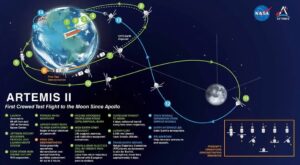
Trajectory for Artemis II, NASA’s first flight with crew aboard SLS, Orion to pave the way for long-term return to the Moon, missions to Mars
Communications glitch resolved and lunar science plan begins
Engineers investigated a brief loss of two-way communication that occurred earlier in the mission. NASA determined the issue stemmed from a ground configuration problem involving the Tracking and Data Relay Satellite system.
The system, which supports communication between spacecraft and Earth, was quickly reconfigured. NASA reported no impact on mission operations.
Attention is now shifting toward the upcoming lunar flyby. A dedicated science team has begun developing a Lunar Targeting Plan, which will guide what the crew observes during a roughly six-hour window near the Moon on April 6.
The plan includes studying surface features such as impact craters, ancient lava plains, and tectonic structures. These observations are intended to support research into the Moon’s formation and the broader history of the solar system.
One planned highlight is a solar eclipse visible from Orion’s vantage point. As the Moon blocks the Sun, the crew will have an opportunity to observe the solar corona, the Sun’s outer atmosphere, and look for flashes caused by meteoroid impacts on the lunar surface.
The sequence of events marks a transition point. Artemis II has moved beyond Earth orbit and into deep space, carrying its crew toward a destinatio:n that has not hosted human visitors in decades.
Astronauts aboard NASA’s Artemis II mission completed a key proximity operations test on April 2 while orbiting Earth. The maneuver involved controlled movements around a detached rocket stage to evaluate spacecraft handling. With CubeSat deployments ahead and a minor onboard system issue under review, the crew is now preparing for a perigee raise burn to refine Orion’s orbit.
A shoebox-sized satellite deployment and a blinking fault light now share space in NASA’s latest Moon mission update.
The National Aeronautics and Space Administration confirmed that astronauts aboard Artemis II have completed one of the mission’s earliest and most technical tests. The crew piloted the Orion spacecraft, named Integrity, through a series of close-range maneuvers around a detached rocket stage, simulating scenarios required for future docking and deep-space operations.
The 70-minute exercise marked the mission’s proximity operations demonstration. Using the interim cryogenic propulsion stage, or ICPS, as a reference point, astronauts conducted controlled approach and retreat sequences to assess manual navigation capabilities in orbit.
At the end of the test, Orion executed an automated departure burn to safely distance itself from the stage. NASA said the ICPS will later perform a disposal burn, re-entering Earth’s atmosphere over a remote part of the Pacific Ocean.
A view over the shoulders of NASA astronauts Victor Glover (left) and Reid Wiseman (right), pilot and commander, respectively, inside the Orion spacecraft as they participate in a proximity operations demonstration. This demonstration tests the spacecraft’s ability to manually maneuver relative to another spacecraft, the interim cryogenic propulsion stage, after separation, using its onboard navigation sensors and reaction control thrusters. NASA
Orion proximity operations test and orbital maneuver plan
The proximity operations test is central to Artemis II’s role as a proving mission. Unlike future lunar landings, this flight focuses on validating systems and crew performance under real spaceflight conditions.
NASA officials said the demonstration provided critical data on how Orion behaves during manual piloting near another object. These conditions are expected to be essential for future missions involving docking, assembly, or logistics operations in lunar orbit.
The crew now turns to the next phase of orbital adjustments. After completing an earlier apogee raise maneuver, mission controllers are preparing for a perigee raise burn. This engine firing will increase the lowest point of Orion’s orbit around Earth, refining its trajectory for eventual translunar injection.
The sequence of burns shapes the spacecraft’s path before it departs Earth’s gravitational influence. These adjustments are necessary to ensure precision as the mission transitions toward its planned lunar flyby.
CubeSat deployments expand international science efforts
Alongside the crewed mission, Artemis II is carrying four CubeSats, compact satellites designed for scientific research and technology demonstrations.
These payloads, housed within the Space Launch System adapter, will deploy after separation from Orion. Each satellite represents an international collaboration and targets a different aspect of space science.
Argentina’s ATENEA CubeSat will study radiation shielding and communication systems. The Saudi Space Agency’s Space Weather CubeSat-1 will measure solar radiation and magnetic fields. Germany’s TACHELES mission will test components for future lunar logistics systems. South Korea’s K-Rad Cube will analyze radiation exposure and its biological effects across the Van Allen belts.
NASA describes CubeSats as small but versatile tools that can extend mission science at relatively low cost. Their deployment during Artemis II adds a layer of experimentation beyond the primary crewed objectives.
Toilet system issue under review during mission operations
Amid the technical milestones, engineers are also tracking a minor onboard issue.
During routine spacecraft configuration checks, the crew reported a blinking fault light in Orion’s toilet system. Mission control teams at Johnson Space Center are analyzing telemetry and working with astronauts to troubleshoot the problem.
NASA has not indicated that the issue poses a risk to crew safety or mission objectives. Such anomalies are not uncommon during test flights, where systems are evaluated under operational conditions for the first time.
The crew’s schedule includes carefully timed rest periods between mission activities. After a four-hour sleep cycle, astronauts are set to wake at 7 a.m. EDT to prepare for the upcoming burn, before returning to rest later in the day.
Public reaction to the update has reflected both enthusiasm and curiosity about the mission’s technical details. “It’s fascinating to see them actually test manual flying like this,” wrote Reddit user OrbitalWatcher, in a post that drew more than 1,200 upvotes, noting that such maneuvers are rarely visible to the public.
Preparing for deeper space operations
Artemis II continues to function as a systems validation mission, bridging the gap between uncrewed tests and future lunar landings.
Each milestone, from proximity operations to orbital burns, contributes to a broader objective. NASA aims to confirm that Orion and its supporting systems can reliably carry astronauts beyond low Earth orbit and back.
The upcoming perigee raise burn represents another step in that process. Once completed, it will help finalize the spacecraft’s orbit before the mission advances toward its lunar trajectory.
For engineers and mission planners, these incremental steps are essential. They provide the data needed to support more complex operations in future Artemis missions, including sustained human presence on the Moon.