The crew of Artemis II moved into preparation mode on April 6 as their spacecraft, Orion spacecraft, continued its trajectory toward a lunar flyby. The outbound trajectory correction burn was canceled after flight controllers confirmed the spacecraft remained on course. Astronauts focused on cabin readiness, medical drills, and system checks as the mission passed its halfway point to the Moon.
The four astronauts aboard Artemis II are settling into the rhythms of deep space travel as their spacecraft closes in on a critical phase of the mission. By Monday afternoon, the crew had shifted focus from major propulsion events to preparing the Orion capsule for sustained lunar observation, a period that will define the mission’s operational success.
“We all had a collective expression of joy at that… We can see the Moon out of the docking hatch right now. It’s a beautiful sight.” –Christina KOCH, NASA Astronaut (Artemis II Mission)


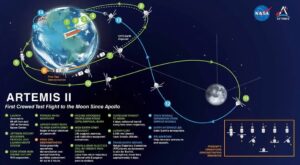
Mission controllers at the NASA Johnson Space Center confirmed that the first planned outbound trajectory correction burn was no longer necessary. The spacecraft’s path, they said, remained precise enough to meet mission parameters without adjustment. That decision removed one of three scheduled trajectory maneuvers designed to fine-tune Orion’s route to the Moon.
Inside the capsule, the change translated into a different kind of workload. Rather than executing propulsion tasks, the crew began configuring their living and observation environment for the upcoming lunar flyby window.

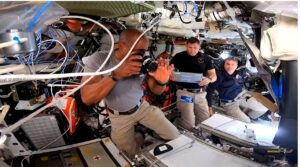
Victor Glover, Jeremy Hansen, and Reid Wiseman work together inside the Orion spacecraft on their way to the Moon.
Orion cabin preparation for lunar observation phase
Cabin preparation is not cosmetic. It involves reconfiguring equipment, securing loose items, and ensuring all observation tools are accessible during the Moon flyby. Astronauts must also adjust lighting, camera systems, and window access points to capture scientific data and imagery.
NASA officials have described this phase as one of the most human-centered parts of the mission. The spacecraft, which has operated largely as a transport vehicle until now, becomes a workspace and observation platform as it approaches lunar proximity.
Crew members spent part of the day organizing onboard equipment and verifying that all systems required for observation are functioning within expected parameters. This includes environmental controls, onboard computing systems, and manual override mechanisms.
Alongside technical preparation, astronauts continued routine health maintenance. Exercise sessions remain a daily requirement to counter the effects of microgravity on muscles and bone density. Medical response drills were also conducted, simulating potential emergencies that could arise far from Earth.
These drills are not theoretical. NASA requires crews to demonstrate the ability to respond to medical situations independently, given the communication delays and physical distance involved in deep space missions.
Deep space systems testing and mission timeline adjustments
The crew also tested Orion’s emergency communications system, a critical component designed to maintain contact with Earth under degraded conditions. Engineers on the ground monitor these tests closely, using them to validate system redundancy and resilience.
Deep space communication differs significantly from low Earth orbit operations. Signal delays increase, and the margin for error narrows. Testing ensures that backup systems can function if primary channels fail.
NASA’s decision to cancel the trajectory correction burn underscores the precision of the spacecraft’s navigation systems. According to mission control, Orion’s current trajectory aligns closely with pre-flight calculations, reducing the need for mid-course corrections.
That precision has operational consequences. Fewer burns mean conservation of fuel and reduced mechanical stress on propulsion systems, both of which can extend mission flexibility.
The Artemis II timeline continues to evolve in real time. While the crew prepared for rest around 3 a.m. Central Daylight Time, mission control scheduled their wake-up for the next operational phase. The timeline reflects both planned activities and adjustments based on spacecraft performance.
Despite the technical complexity, daily life aboard Orion follows a structured routine. Sleep cycles, exercise periods, and work blocks are carefully scheduled to maintain crew health and efficiency.
For the astronauts, the mission has now entered a quieter but equally demanding stage. The high-energy launch and orbital maneuvers have given way to sustained operations, where attention to detail becomes critical.
The lunar flyby, expected soon, will serve as both a technical demonstration and a symbolic milestone. Artemis II is the first crewed mission under NASA’s Artemis program, which aims to return humans to the Moon and establish a long-term presence.
The mission builds on decades of spaceflight experience while introducing new systems designed for deep space exploration. Orion, developed specifically for missions beyond low Earth orbit, represents a shift in spacecraft design priorities, emphasizing autonomy, durability, and crew safety over extended durations.
As the spacecraft moves closer to the Moon, the crew’s preparations inside the cabin will shape how effectively they can carry out observation tasks. Every adjustment made now, from equipment placement to system checks, feeds into that moment.
For mission control teams in Houston, the cancellation of a major burn signals confidence in both the spacecraft and the planning behind it. For the astronauts, it means more time to prepare for the view ahead.
The Moon is no longer a distant objective. It is approaching, steadily, on a trajectory that no longer requires correction.
Also Read:
Artemis II Update-9, Day 3: NASA cancels first trajectory correction burn
Artemis II Update-8, Day 3 : Crew prepares for first correction burn, readies lunar flyby tasks