A container of “lucky peanuts” was placed above workstations inside the Space Flight Operations Facility at Jet Propulsion Laboratory ahead of the Artemis II launch on April 1, 2026.
The quirky ritual—eating peanuts before major mission events—has long been observed at JPL, seen by teams as a symbol of good fortune before critical operations.
Control Centre Behind Deep Space Communication
The Space Flight Operations Facility oversees NASA’s Deep Space Network (DSN), a global communication system comprising three major complexes located in Goldstone, California; Madrid, Spain; and Canberra, Australia.
Each site houses multiple radio-frequency antennas that maintain constant contact with dozens of spacecraft across the solar system, including the crewed Artemis II mission.
NASA
A Critical Link To Spacecraft
Managed by JPL under NASA’s Space Communications and Navigation programme, the DSN operates from the agency’s headquarters within the Space Operations Mission Directorate.
The network plays a vital role in tracking spacecraft, transmitting commands, and receiving scientific data from distant missions. The Jet Propulsion Laboratory itself is run by the California Institute of Technology in Pasadena, California, on behalf of NASA.
Also Read:
JPL’s Mission Control Steps Up For Artemis II Deep Space Operations
NASA’s Artemis II crew began their return journey to Earth on April 7 after completing a historic lunar flyby a day earlier. The crew, traveling aboard the Orion spacecraft about 236,000 miles from Earth, exited the Moon’s gravitational influence and initiated return procedures. The mission includes a call with International Space Station astronauts, scientific debriefs, and a planned trajectory correction burn to refine their path home.
The Artemis II crew woke to music and a long journey ahead.
Less than 24 hours after looping around the Moon, four astronauts aboard NASA’s Orion spacecraft began the slow pivot back toward Earth. They started Flight Day 7 roughly 236,000 miles from home, still carrying the momentum of a mission that marked humanity’s first crewed lunar flyby since Apollo-era flights more than five decades ago.
The crew of National Aeronautics and Space Administration (NASA) astronauts Reid Wiseman, Victor Glover and Christina Koch, along with Canadian Space Agency (CSA) astronaut Jeremy Hansen, crossed a key threshold early in the day. At 1:23 p.m. Eastern Time, Orion exited the Moon’s sphere of influence, the region where lunar gravity dominates spacecraft motion.
That transition marked a turning point. From that moment, Earth’s gravity again became the primary force shaping Orion’s path.
A quiet shift. But a decisive one.
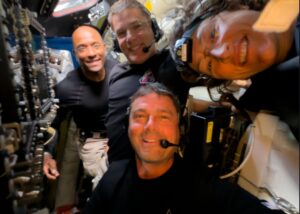
Lunar Selfie Midway through their lunar observation period, the Artemis II crew members – Reid Wiseman, Victor Glover, Christina Koch, and Jeremy Hansen – pause to turn the camera around for a selfie inside the Orion spacecraft. Image Credit: NASA
Artemis II crew ISS call with Expedition 74 astronauts
Even as the spacecraft moved farther from the Moon, the crew maintained contact with colleagues in orbit closer to Earth.
At 2:40 p.m., Artemis II astronauts connected with crew members aboard the International Space Station (ISS) for a scheduled 15-minute audio call. On the station were NASA astronauts Jessica Meir, Jack Hathaway and Chris Williams, along with European astronaut Sophie Adenot of the European Space Agency (ESA).
The exchange, broadcast via NASA’s official channels, offered a rare ship-to-ship moment between astronauts operating at vastly different distances from Earth.
Such interactions serve both technical and symbolic purposes. They allow crews to compare conditions, share observations, and reinforce coordination across missions that together define current human spaceflight.
Lunar flyby data and science debrief after close Moon pass
Attention quickly shifted from conversation to analysis.
At 3 p.m., the Artemis II crew joined science teams on the ground for a detailed debrief. The timing was deliberate. Mission planners wanted to capture observations while impressions from the lunar flyby remained fresh.
The April 6 flyby carried Orion around the far side of the Moon, a region not visible from Earth. During that pass, astronauts documented surface features, lighting conditions and spacecraft performance, data expected to support planning for future Artemis missions.
NASA has positioned Artemis II as a test flight. Its purpose extends beyond demonstration to refinement. Every observation feeds into subsequent missions, including planned crewed landings under the Artemis program.
Engineers and scientists are expected to analyze crew feedback alongside telemetry data in the coming weeks.
(April 6, 2026) – Captured by the Artemis II crew during their lunar flyby on April 6, 2026, this image shows the Moon fully eclipsing the Sun. From the crew’s perspective, the Moon appears large enough to completely block the Sun, creating nearly 54 minutes of totality and extending the view far beyond what is possible from Earth. The corona forms a glowing halo around the dark lunar disk, revealing details of the Sun’s outer atmosphere typically hidden by its brightness. Also visible are stars, typically too faint to see when imaging the Moon, but with the Moon in darkness stars are readily imaged. This unique vantage point provides both a striking visual and a valuable opportunity for astronauts to document and describe the corona during humanity’s return to deep space. The faint glow of the nearside of the Moon is visible in this image, having been illuminated by light reflected off the Earth. NASA
Orion return trajectory correction burn details and timing
The most critical maneuver of the day was scheduled for later.
At 9:03 p.m., Orion’s thrusters were set to ignite for the first of three planned return trajectory correction burns. These burns are designed to fine-tune the spacecraft’s path toward Earth, ensuring precise reentry conditions.
Christina Koch and Jeremy Hansen were assigned to monitor spacecraft systems and oversee procedures during the maneuver. Such burns require exact timing and calibration, as even small deviations at this distance can translate into large trajectory changes closer to Earth.
NASA officials have described the return phase as a series of incremental adjustments rather than a single decisive action. Each burn builds on the last, gradually aligning Orion with its targeted splashdown corridor.
Between scheduled tasks, the crew was given staggered off-duty periods.
The downtime serves operational needs as much as personal ones. Rest cycles help maintain cognitive performance, particularly as the mission enters phases requiring sustained attention and procedural accuracy.
NASA scheduled a mission status briefing later in the day to provide updates on spacecraft systems, crew health and trajectory progress.
The Artemis II mission, part of NASA’s broader Artemis program, aims to reestablish human presence beyond low Earth orbit. Unlike earlier missions confined to orbital paths around Earth, Artemis II pushes into deep space, testing systems required for sustained lunar exploration.
Flight Day 7 marked a transition from exploration to return.
The Moon receded behind them. Earth, still distant, became the destination again.
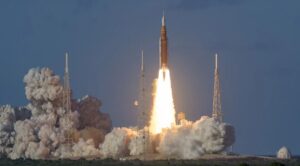
The National Aeronautics and Space Administration launched four astronauts on April 2 from Kennedy Space Center in Florida aboard the Artemis II mission. The crew is set for a 10-day test flight around the Moon, marking the first human lunar flyby since the Apollo era. The mission aims to validate spacecraft systems and pave the way for future Moon landings and Mars exploration.
NASA’s Artemis II mission has marked humanity’s return to deep space, becoming the first crewed journey near the Moon since Apollo 17. Four astronauts aboard the Orion spacecraft completed a seven-hour lunar flyby, capturing detailed observations of the Moon’s far side. The crew also set a new record for the farthest distance traveled by humans, surpassing Apollo 13. During the mission, they witnessed a solar eclipse from space and observed rare meteoroid impacts on the lunar surface. The spacecraft is now on its return trajectory, while scientists analyze data collected during the flyby.
Aboard the Orion spacecraft were NASA astronauts Reid Wiseman, Victor Glover and Christina Koch, along with Canadian Space Agency astronaut Jeremy Hansen who completed their lunar flyby, broke the Apollo 13 distance record (252,756 miles from Earth), and regained contact after passing the Moon’s far side.
🚀 LIVE FROM SPACE: President Donald J. Trump Calls Artemis II Astronauts After Breaking the Farthest Distance Record in Human Spaceflight 🇺🇸 HISTORIC!
“Your mission paves the way for America’s return to the lunar surface very soon.” pic.twitter.com/1TzmIEQG0l
US President Donald J.Trump calls the Artemis II Astronauts in space:
The White House shared video of President Trump phoning the Artemis II crew to congratulate them after breaking the human spaceflight distance record during their lunar flyby. Artemis II astronauts reached about 252,757 miles from Earth on April 6, 2026, surpassing Apollo 13’s 1970 mark of 248,655 miles by over 4,000 miles while passing the Moon’s far side.
Trump told the crew their mission paves the way for America’s return to the lunar surface, highlighting it as a historic step in U.S. space leadership.
Trump further said , “Thank you very much Jared and you are doing a fantastic job and hello very special hello to Artemis II. Today you’ve made history and made all America really proud, incredibly proud. We have a lot of things to be proud of lately, but there’s nothing like what you’re doing, circling around the moon for the first time in more than a half a century and breaking the all-time record for the farthest distance from planet Earth.
“Humans have really never seen anything quite like what you’re doing in a manned spacecraft. It’s really special. I wanted to congratulate each and every one of you. I want to personally salute and congratulate Commander Reid Wiseman, Pilot Victor Glover, Mission Specialist Christina Koch and Jeremy Hansen, and I also want to thank the entire amazing team at NASA, headed by Jared [Isaacman], who’s a very special guy, by the way. You have made this day possible, you’ve really inspired the entire world, really, everybody’s watching it”, Trump added.
And also there were few question from Trump to Artemis Crew about the mission where Trump asked “about most unforgettable part of this really historic day, and was there any difference in feel between the far side of the moon and the near side of the Moon, to which the Astronauts explained the differences due to Earth’s gravitational pull creating dramatic variations in the lunar landscapes. They described views of the Orientale crater, a solar eclipse from space, and Earthshine.
Astronauts aboard Artemis II completed a 41-minute manual piloting test of the Orion spacecraft on Flight Day 4, taking turns controlling the vehicle in deep space. The demonstration, carried out tested thruster modes and maneuvering capabilities as the crew also reviewed targets for an upcoming lunar flyby. The mission continues on a stable trajectory toward the Moon, with further piloting tests planned later in the flight.
The astronauts aboard Orion spent part of their fourth day in space doing something few humans have ever done: manually steering a spacecraft far beyond Earth orbit.
Late in the day, Christina Koch and Jeremy Hansen took control of the capsule, guiding it through a series of controlled maneuvers designed to test how the spacecraft responds to human input in deep space.
The exercise began at 9:09 p.m. Eastern Daylight Time and lasted 41 minutes, giving engineers a detailed look at Orion’s handling under different conditions.
Orion manual piloting test evaluates deep space handling
During the demonstration, the astronauts tested two distinct thruster configurations. One allowed full six degrees of freedom, enabling movement and rotation across all axes. The other restricted motion to three degrees of freedom, simplifying control inputs and simulating different operational scenarios.
The goal is data. NASA engineers are studying how Orion behaves when astronauts take direct control, measuring responsiveness, stability, and precision. These findings will inform how future crews operate spacecraft during longer missions, where autonomy becomes essential.
Commander Reid Wiseman and pilot Victor Glover are scheduled to repeat the test on Flight Day 8, allowing ground teams to compare performance across different crew members.
Manual control remains a backup capability in modern spacecraft, but NASA continues to treat it as a core skill. In deep space, where delays in communication can limit ground intervention, astronauts must be able to operate independently if needed.
Lunar flyby imaging plan finalized ahead of observation window
While piloting tests drew focus late in the day, earlier hours were spent preparing for the mission’s next major milestone: the lunar flyby.
The crew reviewed a list of imaging targets prepared by NASA’s science team, outlining specific features on the Moon that astronauts will photograph and analyze during a six-hour observation period.
That window begins at approximately 2:45 p.m. on April 6, when Orion’s main cabin windows will be oriented toward the lunar surface.
The targets include impact craters, volcanic plains formed by ancient lava flows, and structural features such as ridges and fractures. By documenting variations in brightness, texture, and color, astronauts will contribute data that helps scientists interpret the Moon’s geological history.
Unlike earlier missions that passed close to the surface, Orion will observe the Moon from thousands of miles away. That distance allows the crew to capture a broader view, including polar regions that are difficult to study from low-altitude trajectories.
The planning session ensures that each crew member understands their role during the flyby. Timing, camera positioning, and observational priorities must align precisely during the limited window available.
Crew life aboard Orion blends routine with milestone moments
Even as the mission advances toward the Moon, daily life aboard Orion continues to follow a structured routine.
Earlier in the day, the astronauts used one of the spacecraft’s external solar array cameras to capture selfies, offering a glimpse of the crew inside the capsule as Earth recedes in the distance. The images are expected to be transmitted to mission control in the coming days.
Such moments, while informal, serve a broader purpose. NASA often shares these images to document the human experience of spaceflight, providing visual context for missions that otherwise unfold far from public view.
The crew is scheduled to begin their sleep period at 3:15 a.m., with mission control at the NASA Johnson Space Center set to wake them at noon Central Daylight Time to begin Flight Day 5.
Structured sleep cycles remain essential. Maintaining physical and cognitive performance is critical as the mission approaches its most observation-intensive phase.
Precision trajectory allows focus on operations
Artemis II continues along a stable trajectory toward the Moon, allowing astronauts to dedicate more time to operational tasks rather than propulsion adjustments.
NASA flight controllers have already canceled multiple planned trajectory correction burns, citing the spacecraft’s accurate path. That precision reduces workload on both the crew and ground teams while conserving fuel for later mission phases.
Inside Orion, that translates into a shift in focus. The early days of the mission emphasized propulsion and navigation. Now, attention has turned to piloting validation, scientific preparation, and system monitoring.
The manual piloting demonstration is part of that transition. It marks a point where the spacecraft is no longer just being guided by automated systems but is also being tested as a vehicle that astronauts can control directly in deep space.
As the Moon draws closer, the crew’s preparations inside the capsule are becoming more deliberate. Every maneuver, checklist review, and system test feeds into the upcoming flyby.
For now, the spacecraft continues forward on a steady path, with astronauts alternating between routine tasks and moments that underscore the scale of the mission.
As the Orion spacecraft continues its path toward the Moon, the Artemis II crew will spend their fourth flight day preparing for their lunar flyby on Monday, April 6. Traveling more than 169,000 miles from Earth aboard the Orion spacecraft, astronauts are set to manually pilot the vehicle and study the Moon from a distant vantage point. The mission will also include a planned communications blackout and record-breaking distance milestone as Orion moves deeper into space.
Inside the Orion capsule, the day began with music and routine. The four astronauts, already days into deep space travel, woke to Chappell Roan’s “Pink Pony Club” before shifting into a tightly scheduled slate of mission tasks.
By the time they started work, the spacecraft had already crossed roughly 169,000 miles from Earth and was closing in on the Moon, which lay about 110,700 miles ahead. The numbers mark a point where Earth is no longer the dominant visual reference, and operational focus shifts toward lunar proximity.
Manual control test of Orion in deep space
Later in the day, pilot Victor Glover is scheduled to take manual control of Orion, a rare exercise designed to evaluate how the spacecraft responds to human input far beyond Earth orbit.
NASA officials have framed the test as critical for future missions, where astronauts may need to intervene directly in spacecraft navigation. The maneuver will provide engineers with data on handling characteristics, including responsiveness and stability under manual control.
The crew is also running a 24-hour acoustics test inside the cabin. Engineers are using the data to map the spacecraft’s sound environment, which affects both crew comfort and communication clarity during extended missions.
These activities reflect a broader goal of Artemis II. Beyond reaching the Moon, the mission is designed to validate systems that astronauts will rely on during longer journeys, including eventual missions to Mars.
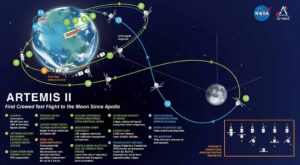
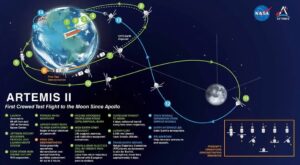
(This artist’s concept depicts the nominal trajectory for NASA’s Artemis II test flight, an approximately 10-day mission that will send four astronauts around the Moon and back. The agency’s SLS (Space Launch System) rocket and Orion spacecraft will launch from Kennedy Space Center in Florida. Orion will fly two orbits of Earth and then venture around the Moon in a figure-eight pattern before returning to Earth.NASA/JSC/Goddard)
Lunar flyby observations and scientific targets
Preparation for the lunar flyby dominates the schedule. The six-hour observation window begins at approximately 2:45 p.m., when Orion’s main windows will face the Moon, allowing astronauts to begin detailed visual and photographic analysis.
Unlike the Apollo missions, which passed about 70 miles above the lunar surface, Orion will remain roughly 4,066 miles away at its closest point. From that distance, the crew will see the Moon as a full disk, including polar regions rarely observed in a single view.
Astronauts Reid Wiseman, Christina Koch, and Jeremy Hansen will work through a checklist of surface features identified by NASA’s science team.
They are expected to document impact craters, ancient lava plains, and fractures in the Moon’s crust. Variations in brightness and color will also be recorded, offering clues about the composition and geological history of the lunar surface.
The flyby will also create a rare viewing condition. As Orion, the Moon, and the Sun align, astronauts will witness a solar eclipse from space lasting about an hour. During that period, they will study the Sun’s outer atmosphere, known as the corona, as it becomes visible around the Moon’s edge.
NASA has also tasked the crew with watching for flashes of light caused by meteoroid impacts on the lunar surface. These observations could help scientists better understand surface hazards for future missions.
(This visualization follows the trajectory of the Orion spacecraft during the Artemis II flyby of the Moon, showing what astronauts will see out the window as they approach the Moon and fly around its far side. The flyby will last from 2:45 – 9:40 PM EDT on April 6, 2026, and marks the window of time that the Artemis II crew will be close enough to the Moon to make scientific observations and Orion’s windows will be pointed toward the Moon. The angle of the Sun’s illumination of the Moon will change throughout the period based on the shifting positions of the Sun, Moon, and spacecraft — revealing both familiar nearside terrain and portions of the far side not visible from Earth. This visualization, compressed from seven hours to one minute, includes Earthrise and Earthset, and a solar eclipse, which will be visible to the crew at the end of the flyby window, when the Sun will glide behind the Moon for nearly an hour from the perspective of Orion.NASA/Ernie Wright)
Communications blackout and record distance milestone
A planned communications blackout is expected when Orion passes behind the Moon. The interruption will begin around 5:47 p.m. and last approximately 40 minutes, as the Moon blocks signals between the spacecraft and NASA’s Deep Space Network.
Such blackouts are standard in lunar missions and were also experienced during earlier programs. Once Orion emerges from behind the Moon, ground stations are expected to quickly reestablish contact.
During this phase, Artemis II is also set to surpass a long-standing distance record. Orion will travel about 252,757 miles from Earth at its farthest point, exceeding the distance reached by the Apollo 13 crew.
The milestone reflects both trajectory design and the mission’s broader objective of pushing human spaceflight deeper into space than previous crewed missions.
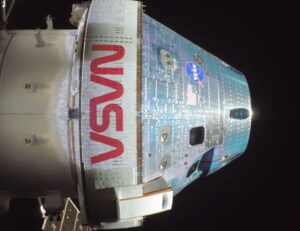
(Orion snapped this high-resolution selfie in space with a camera mounted on one of its solar array wings during a routine external inspection of the spacecraft on the second day into the Artemis II mission. The image was downlinked by the Orion Artemis II Optical Communications System.NASA)
Life sciences research and onboard system challenges
Beyond navigation and observation, Artemis II is carrying a suite of experiments aimed at understanding how humans and biological systems respond to deep space.
One payload, known as AVATAR, includes bone marrow cells derived from crew blood samples to study immune system behavior in space. The astronauts are also collecting saliva samples as part of ongoing biomedical research.
Radiation exposure remains a key concern. Sensors provided by the German Aerospace Center, along with NASA instruments, are measuring radiation levels throughout the spacecraft.
Crew members are also wearing actigraphy devices that track sleep patterns, movement, and overall health. These data sets will inform planning for longer missions, where maintaining crew performance becomes increasingly complex.
Not all systems have operated without issue. Engineers are working to clear a wastewater vent line after a partial blockage. The crew has been instructed to use backup collection methods if necessary, although the main system remains functional.
Mission controllers at the NASA Johnson Space Center have again canceled a planned trajectory correction burn, confirming that Orion remains on its intended path. Instead, the spacecraft will be oriented toward the Sun to help resolve the vent issue.
Expanding communications capabilities in deep space
In parallel with crew operations, Orion’s optical communications system has surpassed 100 gigabytes of data transmitted back to Earth.
The system uses laser-based transmission, allowing higher data rates than traditional radio signals. NASA officials see the technology as essential for future missions that will require rapid transmission of high-resolution imagery and scientific data.
As Artemis II approaches its lunar flyby, the mission has shifted into a phase where precision operations, scientific observation, and human endurance intersect. The spacecraft continues on a trajectory that requires no correction, while inside, astronauts prepare to document the Moon from a distance no crew has experienced in decades.
NASA confirmed the Artemis II crew completed the perigee raise burn on April 2, firing Orion’s engine for 43 seconds to refine its orbit around Earth. The maneuver placed the spacecraft into a stable high Earth orbit ahead of a planned translunar injection later the same day. Mission managers will review system performance before approving the burn that would send astronauts toward the Moon for the first time since 1972.
The Artemis II crew woke to music and a tightly timed task. Minutes later, they were watching their spacecraft reshape its path around Earth.
Inside Orion, the capsule named Integrity, astronauts monitored systems as the engine fired for just over 40 seconds. The burn was brief. Its impact on the mission trajectory was not.
The maneuver marked another step in a sequence designed by the National Aeronautics and Space Administration to prepare astronauts for a return to deep space operations.
Perigee raise burn details and Orion orbit adjustment
The perigee raise burn began after a scheduled wake-up at 7:06 a.m. Eastern Time, when mission control in Houston signaled the crew with the song “Sleepyhead” by Young and Sick.
Shortly after, Orion’s service module main engine ignited. It burned for 43 seconds, increasing the spacecraft’s perigee, the lowest point in its orbit around Earth.
This adjustment refined Orion’s trajectory, placing it into a stable high Earth orbit. The new orbit aligns with the spacecraft’s planned path for departure toward the Moon.
Engineers design these burns to test propulsion precision under real mission conditions. Small timing or thrust variations can significantly alter a spacecraft’s trajectory over long distances.
Following the maneuver, astronauts returned to a rest cycle lasting about four and a half hours, part of a schedule structured to balance workload and recovery during the mission’s early phase.
Trajectory for Artemis II, NASA’s first flight with crew aboard SLS, Orion to pave the way for long-term return to the Moon, missions to Mars
Translunar injection burn timing and mission approval process
Attention now shifts to the next and more consequential maneuver, the translunar injection burn.
Mission management teams are scheduled to meet later in the day to assess spacecraft health, propulsion data, and navigation accuracy. Their approval is required before proceeding.
If cleared, the translunar injection burn is set for 7:49 p.m. Eastern Time. The maneuver will last five minutes and 49 seconds and is expected to increase Orion’s velocity by 1,274 feet per second.
That acceleration would push the spacecraft out of Earth orbit and onto a trajectory toward the Moon. It would mark the first time humans leave low Earth orbit since the Apollo era, which concluded with the final Moon mission in 1972.
Flight controllers will monitor engine performance and guidance systems throughout the burn. Navigation data must remain within tight tolerances to ensure Orion stays aligned with its intended path.
The Artemis II mission is designed as a test flight, but each milestone carries operational weight. With the perigee burn complete, the next decision point will determine whether the crew begins its journey beyond Earth orbit.
NASA confirmed the Artemis II crew resolved a toilet system fault aboard the Orion spacecraft on April 2 while in Earth orbit. The issue, first detected as a blinking fault light on April 1, was addressed through coordinated troubleshooting with mission control in Houston. The fix comes ahead of a scheduled perigee raise burn, a maneuver that will adjust Orion’s orbit for future deep space operations.
A minor but essential system aboard NASA’s Artemis II spacecraft briefly drew attention this week. It was not propulsion or navigation. It was the toilet.
Astronauts aboard Orion, the capsule named Integrity, reported a blinking fault light tied to the waste management system on April 1. Within hours, engineers on the ground and the crew in orbit worked through the problem together. By the next mission update, the system was back to normal operation.
The episode highlights how even routine spacecraft functions demand precision during crewed missions led by the National Aeronautics and Space Administration.
Orion spacecraft toilet issue and in-flight troubleshooting
The issue first surfaced ahead of a planned apogee raise burn, when the crew noticed a blinking fault indicator linked to Orion’s toilet system. Such warning signals are designed to flag irregularities early, even when the system continues functioning.
NASA’s mission control team at the Johnson Space Center in Houston began reviewing telemetry immediately. Engineers assessed system data while communicating directly with the astronauts to isolate the cause.
The troubleshooting process involved both software diagnostics and procedural checks inside the spacecraft. The agency did not report any hardware damage or safety risk tied to the issue.
By April 2, NASA confirmed that normal functionality had been restored. The resolution ensured that one of the spacecraft’s life-support subsystems remained fully operational as the mission continued.
Waste management systems in microgravity rely on airflow, pressure control, and precise mechanical components. Even minor anomalies require immediate attention, as they can affect crew comfort and long-duration mission readiness.
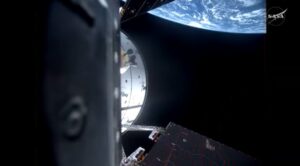
A view of the Earth’s horizon from NASA’s Orion spacecraft as it orbits above the planet during the first hours of the Artemis II test flight. NASA astronauts Commander Reid Wiseman, Pilot Victor Glover, and Mission Specialist Christina Koch, and CSA (Canadian Space Agency) astronaut Mission Specialist Jeremy Hansen, launched at 6:35 p.m. EDT on Wednesday, April 1, 2026, on an approximately 10-day mission around the Moon and back to Earth. NASA
Perigee raise burn timing and mission trajectory planning
With the issue resolved, the Artemis II crew is preparing for the next major step in the mission timeline. The perigee raise burn is scheduled after a planned rest period.
Perigee refers to the lowest point of a spacecraft’s orbit around Earth. Raising it changes the orbital shape, making it more stable and better suited for future maneuvers.
This burn follows an earlier apogee raise maneuver, which increased Orion’s highest orbital point. Together, the two burns define the spacecraft’s initial orbit and test its propulsion system under operational conditions.
NASA scheduled a four-hour rest period for the crew before the maneuver. Astronauts are set to wake at 7 a.m. Eastern Time on April 2 to begin preparations. After completing post-burn procedures, they will return to a second sleep cycle later in the morning.
The sequence reflects the structured rhythm of human spaceflight, where operational tasks alternate with carefully timed rest to maintain performance.
The Artemis II mission continues to build toward its broader objective: validating systems for future missions that will carry astronauts beyond Earth orbit and toward the Moon.
Astronauts aboard NASA’s Artemis II mission completed a key proximity operations test on April 2 while orbiting Earth. The maneuver involved controlled movements around a detached rocket stage to evaluate spacecraft handling. With CubeSat deployments ahead and a minor onboard system issue under review, the crew is now preparing for a perigee raise burn to refine Orion’s orbit.
A shoebox-sized satellite deployment and a blinking fault light now share space in NASA’s latest Moon mission update.
The National Aeronautics and Space Administration confirmed that astronauts aboard Artemis II have completed one of the mission’s earliest and most technical tests. The crew piloted the Orion spacecraft, named Integrity, through a series of close-range maneuvers around a detached rocket stage, simulating scenarios required for future docking and deep-space operations.
The 70-minute exercise marked the mission’s proximity operations demonstration. Using the interim cryogenic propulsion stage, or ICPS, as a reference point, astronauts conducted controlled approach and retreat sequences to assess manual navigation capabilities in orbit.
At the end of the test, Orion executed an automated departure burn to safely distance itself from the stage. NASA said the ICPS will later perform a disposal burn, re-entering Earth’s atmosphere over a remote part of the Pacific Ocean.
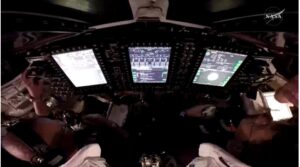
A view over the shoulders of NASA astronauts Victor Glover (left) and Reid Wiseman (right), pilot and commander, respectively, inside the Orion spacecraft as they participate in a proximity operations demonstration. This demonstration tests the spacecraft’s ability to manually maneuver relative to another spacecraft, the interim cryogenic propulsion stage, after separation, using its onboard navigation sensors and reaction control thrusters. NASA
Orion proximity operations test and orbital maneuver plan
The proximity operations test is central to Artemis II’s role as a proving mission. Unlike future lunar landings, this flight focuses on validating systems and crew performance under real spaceflight conditions.
NASA officials said the demonstration provided critical data on how Orion behaves during manual piloting near another object. These conditions are expected to be essential for future missions involving docking, assembly, or logistics operations in lunar orbit.
The crew now turns to the next phase of orbital adjustments. After completing an earlier apogee raise maneuver, mission controllers are preparing for a perigee raise burn. This engine firing will increase the lowest point of Orion’s orbit around Earth, refining its trajectory for eventual translunar injection.
The sequence of burns shapes the spacecraft’s path before it departs Earth’s gravitational influence. These adjustments are necessary to ensure precision as the mission transitions toward its planned lunar flyby.
CubeSat deployments expand international science efforts
Alongside the crewed mission, Artemis II is carrying four CubeSats, compact satellites designed for scientific research and technology demonstrations.
These payloads, housed within the Space Launch System adapter, will deploy after separation from Orion. Each satellite represents an international collaboration and targets a different aspect of space science.
Argentina’s ATENEA CubeSat will study radiation shielding and communication systems. The Saudi Space Agency’s Space Weather CubeSat-1 will measure solar radiation and magnetic fields. Germany’s TACHELES mission will test components for future lunar logistics systems. South Korea’s K-Rad Cube will analyze radiation exposure and its biological effects across the Van Allen belts.
NASA describes CubeSats as small but versatile tools that can extend mission science at relatively low cost. Their deployment during Artemis II adds a layer of experimentation beyond the primary crewed objectives.
Toilet system issue under review during mission operations
Amid the technical milestones, engineers are also tracking a minor onboard issue.
During routine spacecraft configuration checks, the crew reported a blinking fault light in Orion’s toilet system. Mission control teams at Johnson Space Center are analyzing telemetry and working with astronauts to troubleshoot the problem.
NASA has not indicated that the issue poses a risk to crew safety or mission objectives. Such anomalies are not uncommon during test flights, where systems are evaluated under operational conditions for the first time.
The crew’s schedule includes carefully timed rest periods between mission activities. After a four-hour sleep cycle, astronauts are set to wake at 7 a.m. EDT to prepare for the upcoming burn, before returning to rest later in the day.
Public reaction to the update has reflected both enthusiasm and curiosity about the mission’s technical details. “It’s fascinating to see them actually test manual flying like this,” wrote Reddit user OrbitalWatcher, in a post that drew more than 1,200 upvotes, noting that such maneuvers are rarely visible to the public.
Preparing for deeper space operations
Artemis II continues to function as a systems validation mission, bridging the gap between uncrewed tests and future lunar landings.
Each milestone, from proximity operations to orbital burns, contributes to a broader objective. NASA aims to confirm that Orion and its supporting systems can reliably carry astronauts beyond low Earth orbit and back.
The upcoming perigee raise burn represents another step in that process. Once completed, it will help finalize the spacecraft’s orbit before the mission advances toward its lunar trajectory.
For engineers and mission planners, these incremental steps are essential. They provide the data needed to support more complex operations in future Artemis missions, including sustained human presence on the Moon.