At 10:53 p.m. EDT, the Orion spacecraft executed a brief nine-second thruster burn, increasing its velocity by 5.3 feet per second and nudging the Artemis II crew further along their return path to Earth.
With the maneuver complete, the crew has now crossed the halfway mark on their journey home.
Temporary Signal Loss Resolved
Roughly two hours before the burn, mission teams encountered an unexpected return link loss of signal during a data rate transition, briefly disrupting the flow of communications and telemetry from the spacecraft.
Two-way contact was subsequently restored, allowing flight controllers and crew to resume preparations for the scheduled maneuver without further delay.
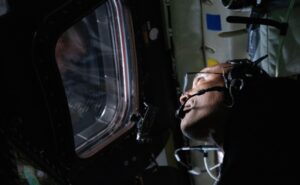
art002e016204 (April 6, 2026) – NASA astronaut and Artemis II Pilot Victor Glover pictured here in the Orion spacecraft during the Artemis II lunar flyby. Glover and his fellow crewmates spent approximately seven hours taking turns at the Orion windows capturing science data to share with their team back on Earth. At closest approach, they came within 4,067 miles of the Moon’s surface.NASA
Re-Entry Briefings And Next Steps
Earlier in the day, officials from NASA provided additional details on re-entry and splashdown procedures during a mission status briefing.
The next key milestone—a third return trajectory correction burn—is planned for April 10 at approximately 1:53 p.m., ahead of final re-entry operations.
Splashdown Target Remains On Track
NASA continues to target splashdown at 8:07 p.m. (5:07 p.m. PDT) on Friday, April 10, off the coast of San Diego, as the Artemis II mission enters its final phase of return.
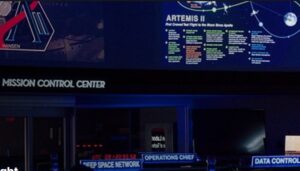
Inside the Space Flight Operations Facility at Jet Propulsion Laboratory, the Artemis II mission took center stage on April 1, 2026, moments before liftoff. The central display featured the mission patch, while adjacent screens mapped real-time activity across the agency’s Deep Space Network (DSN), with active antennas highlighted as they transmitted and received signals.
From Launch To Deep Space Communication
Shortly after launch at 6:35 p.m. EDT from Kennedy Space Center, initial communications were managed through NASA’s Near Space Network.
Control was then handed over to the DSN, marking a significant milestone—the first time in more than five decades that the network was tasked with maintaining contact with a crewed spacecraft journeying through deep space.
Credits: NASA/JPL-Caltec
A Global Network Tracking The Mission
The DSN, operated from the Space Flight Operations Facility, consists of three major complexes located in Goldstone, California; Madrid, Spain; and Canberra, Australia.
Each site houses multiple high-powered radio antennas, forming a global system capable of maintaining continuous communication with spacecraft across the solar system—including Artemis II.
The Backbone Of Space Communication
Managed by JPL under NASA’s Space Communications and Navigation programme at headquarters, the DSN serves as a critical link between Earth and deep-space missions.
It enables mission teams to track spacecraft, transmit commands, and receive scientific data from vast distances. The Jet Propulsion Laboratory itself is operated by the California Institute of Technology in Pasadena, California, on behalf of NASA.
On their final full day in space, the Artemis II crew began the morning with “Lonesome Drifter” by Charley Crockett as their spacecraft closed in on Earth from a distance of 147,337 miles.
Astronauts Reid Wiseman, Victor Glover, and Christina Koch of NASA, along with Jeremy Hansen of the Canadian Space Agency, are spending the day preparing for their scheduled return on Friday, April 10. Activities include reviewing re-entry protocols and executing a trajectory correction maneuver.
Securing The Cabin For Re-Entry
Christina Koch and Jeremy Hansen are leading preparations inside the capsule, securing loose equipment, removing storage netting, and adjusting crew seating configurations for re-entry.
The crew will also assess updated weather forecasts, recovery team readiness, and the mission timeline. Simultaneously, they are reviewing post-landing procedures to ensure a smooth transition once back on Earth.
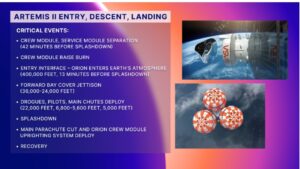
Artemis II infographic showcasing the missions entry, descent, and landing milestones. This graphic was presented by Artemis II Flight Director Rick Henfling during the mission status briefing to the media and public on April 8, 2026 at NASA’s Johnson Space Center in Houston.NASA
Trajectory Correction Burn
A key maneuver is scheduled for 9:53 p.m. EDT, when Orion’s thrusters will fire for a second return trajectory correction burn.
This adjustment is designed to fine-tune the spacecraft’s path toward Earth and align it precisely for atmospheric entry. During the burn, Jeremy Hansen will oversee procedure execution and monitor navigation and propulsion systems.
Infographic featuring the Artemis II Orion lofted entry sequence. This graphic was presented by Artemis II Flight Director Rick Henfling during the mission status briefing to the media and public on April 8, 2026 at NASA’s Johnson Space Center in Houston. NASA
Countdown To Splashdown
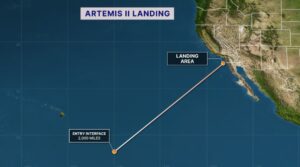
Ground teams are making final preparations for splashdown, expected around 8:07 p.m. (5:07 p.m. PDT) on April 10 off the coast of San Diego.
The re-entry sequence will begin with the separation of Orion’s service module at approximately 7:33 p.m., followed by a final trajectory adjustment at 7:37 p.m. The spacecraft will then execute roll maneuvers and accelerate to nearly 23,864 mph before entering Earth’s atmosphere.
A communications blackout is expected at 7:53 p.m. as plasma builds up around the capsule, lasting about six minutes. During this phase, astronauts may experience forces up to 3.9 Gs.
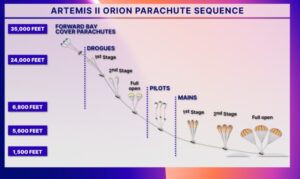
Infographic displaying the Artemis II Orion parachute sequence. This graphic was presented by Artemis II Flight Director Rick Henfling during the mission status briefing to the media and public on April 8, 2026 at NASA’s Johnson Space Center in Houston. NASA
Parachute Deployment And Landing
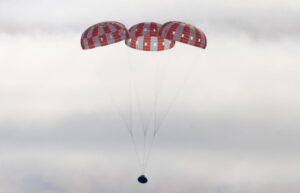
After re-establishing communication, Orion will jettison its forward bay cover and deploy drogue parachutes at around 22,000 feet. Main parachutes will follow at approximately 6,000 feet, slowing the capsule for a safe ocean landing.
Ground track map displaying the Artemis II Orion parachute sequence. This graphic was presented by Artemis II Flight Director Rick Henfling during the mission status briefing to the media and public on April 8, 2026 at NASA’s Johnson Space Center in Houston. NASA
Recovery And Return To Houston
Within two hours of splashdown, the crew will be retrieved and transported to the USS John P. Murtha via helicopter.
Once aboard, astronauts will undergo initial medical evaluations before returning to shore and boarding a flight to Johnson Space Center in Houston for post-mission debriefing and recovery.
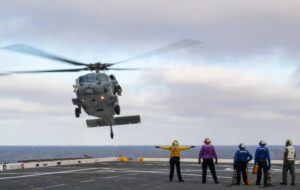
U.S. Navy MH-60 Seahawks from Helicopter Sea Combat Squadron (HSC) 23 are seen arriving on the flight deck of USS John P. Murtha as they prepare to conduct air operations training as NASA, U.S. Navy, and U.S. Air Force teams prepare for the the return of the Artemis II crewmembers to Earth, Monday, April 6, 2026, in the Pacific Ocean off the coast of California. NASA’s Artemis II mission is taking NASA astronauts Reid Wiseman, commander; Victor Glover, pilot; Christina Koch, mission specialist; and CSA (Canadian Space Agency) astronaut Jeremy Hansen, mission specialist on a 10-day journey around the Moon and back aboard their Orion spacecraft. Wiseman, Glover, Koch, and Hansen are scheduled to splash down off the coast of San Diego at approximately 5:07 p.m. PDT (8:07 p.m. EDT) on Friday, April 10. NASA/Bill Ingalls
Astronauts aboard the International Space Station spoke with the Artemis II crew on April 8 following their lunar flyby, marking a rare ship-to-ship exchange between deep space and low Earth orbit. The Artemis II crew is returning to Earth after circling the Moon, while Expedition 74 astronauts continued biomedical research and mission training aboard the station. The interaction highlighted how ongoing ISS science supports future lunar missions under NASA’s Artemis program.
For a few minutes on Tuesday, two crews separated by hundreds of thousands of miles shared the same conversation.
Astronauts aboard the International Space Station (ISS) connected with their counterparts on NASA’s Artemis II mission, offering a rare moment of overlap between low Earth orbit operations and deep space travel. The call came just a day after Artemis II astronauts completed a historic lunar flyby and began their journey home.
On one side were Expedition 74 crew members Chris Williams, Jack Hathaway and Jessica Meir of NASA, along with Sophie Adenot of the European Space Agency (ESA). On the other were Artemis II astronauts Reid Wiseman, Victor Glover and Christina Koch, joined by Jeremy Hansen of the Canadian Space Agency (CSA).
The Artemis II crew is traveling aboard Orion, returning to Earth after looping around the Moon in NASA’s first crewed lunar mission in decades.
ISS and Artemis II crew exchange experiences after lunar flyby
The conversation turned quickly to comparison.
Station astronauts asked about differences between spacecraft, while Artemis II crew members described the experience of seeing the Moon up close. Christina Koch, drawing on her own time aboard the ISS, linked the two missions directly.
“Every single thing that we learned on ISS is up here,” Koch said, referring to how station-based training translates to deep space operations.
The exchange underscored a key role of the ISS within the Artemis program. The orbiting laboratory functions as a proving ground where astronauts refine procedures, test systems and adapt to long-duration spaceflight before venturing farther from Earth.
For NASA and its partners, that continuity is central. The Artemis II mission builds on lessons accumulated over years of station operations.
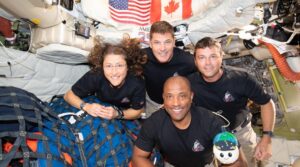
The Artemis II crew – (clockwise from left) Mission Specialist Christina Koch, Mission Specialist Jeremy Hansen, Commander Reid Wiseman, and Pilot Victor Glover – pause for a group photo with their zero gravity indicator “Rise,” inside the Orion spacecraft on their way home. Following a swing around the far side of the Moon on April 6, 2026, the crew exited the lunar sphere of influence (the point at which the Moon’s gravity has a stronger pull on Orion than the Earth’s) on April 7, and are headed back to Earth for a splashdown in the Pacific Ocean on April 10.
Space station biomedical research supports Artemis and future missions
While the call captured public attention, the station’s daily schedule remained anchored in research.
Crew members conducted a series of biomedical scans using the Ultrasound 3 device, focusing on how spaceflight affects the human body. Doctors on the ground monitored the scans in real time, looking for signs of blood clots that can form in leg veins and travel to the lungs.
Such risks have become a growing area of study as missions extend beyond short orbital stays. Data collected aboard the ISS feeds directly into planning for longer journeys, including missions to the Moon and eventually Mars.
Jessica Meir also contributed to the RelaxPro investigation, an ESA-sponsored study examining stress and immune responses in space. She collected saliva and hair samples that researchers will analyze on Earth for hormonal and immune markers.
The study explores whether mindfulness and meditation techniques can improve sleep quality and reduce stress during long-duration missions.
Cargo mission training and robotic systems testing on ISS
Operational training continued alongside scientific work.
Williams and Hathaway simulated the capture of the Cygnus XL cargo spacecraft using the Canadarm2 robotic system. Mission planners are targeting April 10 for the launch of the resupply mission aboard a **SpaceX Falcon 9 rocket, which will deliver supplies and experiments to the station.
Elsewhere, Sophie Adenot worked inside the Japanese Kibo laboratory module, setting up a compact experimental robotic arm known as TUSK. The system is being tested for precise movements at sub-millimeter levels in microgravity, a capability that could support delicate operations in future missions.
Adenot later joined fellow astronauts for emergency response simulations, rehearsing procedures designed to prepare crews for unexpected situations in orbit.
Roscosmos crew studies teamwork and fitness in orbit
Russian crew members also focused on research tied to long-duration missions.
Station commander Sergey Kud-Sverchkov and flight engineer Sergei Mikaev, both representing Roscosmos, participated in experiments examining team dynamics and physical conditioning in space. One study involved progressively complex computer tasks requiring cooperation, allowing researchers to observe how crews adapt to working together in confined environments.
The findings may influence crew training for future missions beyond Earth orbit.
Kud-Sverchkov later completed a monitored exercise session using an onboard cycle, while Mikaev assisted with health data collection.
Meanwhile, Andrey Fedyaev continued training with the European robotic arm inside the Nauka module, practicing both primary and backup control modes to ensure operational readiness.
The day’s activities reflected a layered mission environment.
On one level, astronauts pushed the boundaries of human spaceflight, exchanging insights between deep space and orbit. On another, they maintained a steady cadence of experiments and training that will shape future exploration.
The Artemis II crew moves farther from the Moon with each passing hour. The ISS crew remains in orbit, continuing work that helps make those journeys possible.