NASA’s Artemis II crew completed a proximity operations test on April 2, maneuvering the Orion spacecraft near a detached rocket stage in Earth orbit. The demonstration, lasting about 70 minutes, tested manual control systems and gathered data critical for future lunar missions. The crew now prepares for a perigee raise burn, while engineers continue troubleshooting a minor onboard toilet system issue.
The astronauts aboard NASA’s Artemis II mission spent part of April 2 guiding their spacecraft through a tightly choreographed exercise hundreds of miles above Earth.
Inside Orion, the capsule named Integrity, the crew manually steered within close range of a discarded rocket stage, testing how precisely humans can control the spacecraft in space. The task lasted just over an hour. It marked one of the first hands-on demonstrations of Orion’s maneuverability under crew control.
The exercise is part of a broader effort by the National Aeronautics and Space Administration (NASA) to validate systems before sending astronauts farther into deep space, including eventual missions to the Moon under the Artemis program.
The proximity operations demonstration centered on Orion’s ability to approach and move away from another object in orbit. For this test, the crew used the detached interim cryogenic propulsion stage, or ICPS, as a reference target.
The ICPS, a temporary upper stage used during launch, had already separated from the spacecraft. It remained nearby long enough for the astronauts to conduct controlled approach and retreat maneuvers.
During the roughly 70-minute session, the crew adjusted Orion’s position repeatedly, testing navigation, thruster response, and onboard guidance systems. These maneuvers simulate conditions required for future missions that may involve docking or operating near other spacecraft.
At the end of the exercise, Orion executed an automated departure burn, increasing its distance from the ICPS. The stage is scheduled to perform a disposal burn, sending it into Earth’s atmosphere over a remote Pacific region, according to NASA mission updates.
The demonstration provides engineers with real-time data on how Orion performs under manual control, a capability considered essential for complex operations during lunar missions.
Alongside the crewed mission, four small satellites known as CubeSats launched as secondary payloads aboard the Space Launch System (SLS).
CubeSats are compact, shoebox-sized spacecraft designed for targeted scientific experiments. They will deploy after the Orion stage adapter separates from the main spacecraft.
Each satellite carries a distinct research objective:
ATENEA, developed by Argentina’s national space agency, focuses on radiation shielding and communication systems in high Earth orbit.
Space Weather CubeSat-1, built by the Saudi Space Agency, will measure solar radiation, X-rays, and magnetic field activity.
TACHELES, from the German Aerospace Center, is testing electrical systems for future lunar logistics vehicles.
K-Rad Cube, developed by the Korea AeroSpace Administration, will study radiation effects across the Van Allen belts, regions of charged particles surrounding Earth.
The CubeSat deployments expand the mission’s scientific output, offering data on space weather and radiation environments that astronauts may encounter during longer missions.
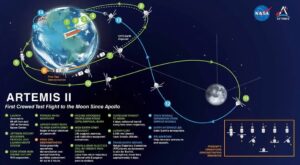
Trajectory for Artemis II, NASA’s first flight with crew aboard SLS, Orion to pave the way for long-term return to the Moon, missions to Mars
Perigee raise burn planned as engineers monitor onboard issue
Attention now shifts to the next key maneuver, the perigee raise burn, scheduled after the crew’s rest period.
Perigee refers to the lowest point in a spacecraft’s orbit around Earth. Raising it adjusts the shape of the orbit and prepares Orion for later phases of the mission, including potential translunar trajectories.
The maneuver follows an earlier apogee raise burn, which increased the spacecraft’s highest orbital point. Together, these burns define Orion’s initial orbital path and test propulsion performance under operational conditions.
Before the next burn, the crew completed routine spacecraft checks. During a systems review, they reported a blinking fault light in the onboard toilet system.
NASA ground teams are analyzing the data and working with the crew to diagnose the issue. No broader system impacts have been reported in official updates.
After a scheduled four-hour rest period, the astronauts are set to wake at 7 a.m. Eastern Time on April 2 to prepare for the maneuver. The timeline includes post-burn activities followed by another sleep cycle later in the morning.
The sequence of tests, adjustments, and troubleshooting reflects the mission’s dual purpose: demonstrating Orion’s readiness for deep space while gathering operational data from a live crewed environment.