On brink of famine, Gazans forced to scour dirt for food

Without fuel, many basic facilities cannot function, from water treatment plants to medical infrastructure.

Meanwhile, Gazans now on the brink of famine have been reduced to taking desperate measures in their search for food, scouring the roads taken by aid convoys, UN aid worker Olga Cherevko told UN News.

“While we were driving, I saw an elderly man on the side of the road completely alone, kneeling down, and he was picking up handfuls of lentils that had spilled on the ground from one of the previous convoys that had been passing,” she said.

“He was picking them up with his hands and just putting them into his t-shirt as this is obviously the only option he has right now to find food because this is how desperate the situation has become.”

Desperate actions

The latest reports from Gaza indicate that mothers who are unable to breastfeed because they are not eating enough now feed their babies ground chickpeas, bread and rice, which are not suitable for infants.

In a social media post, the UN Children’s Fund (UNICEF) stressed that “this is a condition that we can prevent,” calling for increased humanitarian access. 

Separately, the UN World Health Organization (WHOemphasised that “the health needs in Gaza are immense. A continuous flow of medical supplies is critical.”

Meanwhile, health workers on Wednesday reported that at least 50 Gazans were killed and 400 others injured while waiting for food near Zikim crossing in the north.

Ms. Cherevko, who works with the UN aid coordination office, OCHA, explained that her mission to Kerem Shalom on Thursday morning had been delayed at a “holding point” for two hours before being allowed to proceed to the crossing point separating Gaza from Israel.

‘Tactical pauses’ are not enough

Although the fuel supplies are welcome, they are far from enough, she insisted.

“We need hundreds of thousands of litres of fuel to be entering every day so that we can power even the most basic of our facilities to power, water, sanitation, healthcare, emergency telecommunications and other critical facilities effectively,” she said.

The announcement of daytime military pauses by Israel last weekend appears to have slightly reduced the amount of time aid convoys now wait for permission to proceed, the OCHA worker noted.

There has also been a “slight reduction” in security incidents involving Gazans taking food from UN trucks, she said.

In its latest update on the emergency, OCHA said that four days since the start of tactical pauses declared by Israel, “we are still seeing casualties among those seeking aid and more deaths due to hunger and malnutrition…Unilateral tactical pauses alone do not allow for the continuous flow of supplies required to meet immense needs levels in Gaza.”  

Source link

From diamonds to dirt: Sierra Leone youth bring land back to life

But now, parts of the land have been restored. Crops are beginning to flourish and bees are buzzing around once again.

The people responsible for this change are a hodgepodge group – former taxi drivers and miners, people who barely finished secondary school and some with higher education degrees. The unifying factor? Most have youth on their side.

There is life beyond mining [but] we all grew up with the mentality that diamond is the only solution,” said Sahr Fallah, chairman of the Youth Council in Kono.

Over 44 percent of the 1.3 billion people aged 15-24 are employed in agrifood systems. However, this group often does not have the same access to resources as older generations. Moreover, they are sidelined in the conversations which might change this systemic exclusion.

© UNICEF/Olivier Asselin

Young men work on a diamond mining site near Koidu, Sierra Leone. (file)

A lot of the time, what we find is that young people are included in policy processes but it is a little bit tokenistic. They don’t feel like their voice really matters,” said Lauren Phillips, a deputy director at the Food and Agriculture Organization (FAO).

Decent work = economic growth

The High-Level Political Forum on Sustainable Development in New York has been convened this week and next, to discuss progress – or lack thereof – towards the globally agreed Sustainable Development Goals (SDGs), one of which guarantees decent work for all.

Despite this commitment, over half of the global workforce remains in informal employment, according to the Secretary-General’s report on the SDGs released Monday. This means that they do not have adequate social or legal protections.

Decent work must be at the heart of macroeconomic planning, climate and diesel transitions and social recovery strategies,” said Sangheon Lee, director of employment policy at the International Labor Organization (ILO).

Don’t ignore youth

Like other vulnerable groups, young people face unique challenges in the agrifood sector. Specifically, they often lack land rights and will struggle to act collectively to protect their interests.

“If you are not looking at data with a lens of age or gender, you are actually missing part of the story,” Ms. Phillips said.

Among these assets are land titles – which the elderly may be reluctant to pass down because of insufficient social protections. Youth also are less able to access credit so they can invest in themselves and their families.

Betty Seray Sam, one of the young farmers in Kono, said that her family never used to come to her when they were going through a crisis – they knew that she had no money and a child to support.

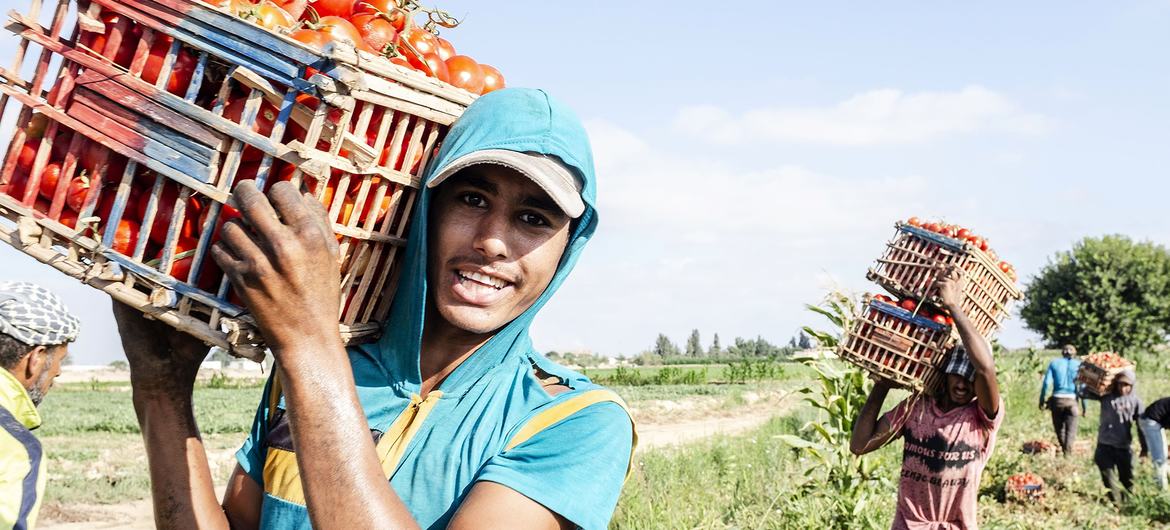
Young farmers load tomatoes onto trucks in Nubaria, Egypt.

But now, through an agricultural job in Kono, she can support her family during times of crisis.

This project has had a rippling effect for the youth in terms of not only improving their livelihoods but also the livelihoods of their families,” said Abdul Munu, president of Mabunduku, a community-based farmer’s organization in Kono.

Bee a farmer

Providing training to young people in agrifood systems is absolutely essential to ensure that they can practice sustainable agriculture.

In Chegutu, Zimbabwe, FAO has helped establish Bee Farmers Schools where young people are taught how to support apiaries through hands-on training activities.

“The idea is that one of the apiaries can be turned into a classroom where youth from different parts of a district can come just like a school,” said Barnabas Mawire, a natural resource specialist at FAO.

This training has helped support local youth beekeepers to move beyond local and small-scale honey production to a fully-fledged business model that has the potential to not just fight poverty but actually create local wealth.

Evelyn Mutuda, the young entrepreneurs representative in Chegutu, aspires to plant Jacaranda trees which she says will improve the quality of the bees’ honey and enable the beekeepers to export beyond local markets.

“We want to maximize all the profits so we can become better and bigger,” Ms. Mutuda said.

From Facebook to TikTok

Being able to form labour associations is one of the key factors of decent work. This sort of collective action is even more important for youth in agrifood who often lack the social capital to enact real policy change.

“Young people are just starting out, making bonds within their group but also with people outside of their group. Those bonds are important…because there is power in numbers,” Ms. Phillips said.

She also noted that young people are forming these bonds across geographic distances, often by using technology. Agrifood influencers on Instagram and TikTok, for example, are increasingly shaping conversations about the sector.

Ms. Phillips also noted that it is important to think of collective action for youth as intergenerational.

“While the report is focused on young people, it’s not ignorant of the fact that young people live in families…There is a lot which talks about the need for solidarity between generations,” Ms. Phillips said.

Youth optimism

The next generation will be the stewards of the food we eat, so integrating them into that system now is essential for future food security and sustainability.

Many youth integrate tradition with innovation, creating sustainability and community resilience,” said Venedio Nala Ardisa, a youth representative at the Asia Indigenous Peoples Pact, at an online side event during the high-level forum.

Angeline Manhanzva, one of the beekeepers in Chegutu, said that the opportunity to become a beekeeper changed her life. One day, she dreams of owning her own bee farm.

“I will be an old person who has so much wealth and is able to buy her own big land to keep my hives and process my own honey.” 

Source link

NASA’s Perseverance Rover Gets the Dirt on Mars

The mission’s first two samples of regolith – broken rock and dust – could help scientists better understand the Red Planet and engineers prepare for future missions there.

NASA’s Perseverance rover snagged two new samples from the Martian surface on Dec. 2 and 6. But unlike the 15 rock cores collected to date, these newest samples came from a pile of wind-blown sand and dust similar to but smaller than a dune. Now contained in special metal collection tubes, one of these two samples will be considered for deposit on the Martian surface sometime this month as part of the Mars Sample Return campaign.

Scientists want to study Martian samples with powerful lab equipment on Earth to search for signs of ancient microbial life and to better understand the processes that have shaped the surface of Mars. Most of the samples will be rock; however, researchers also want to examine regolith – broken rock and dust – not only because of what it can teach us about geological processes and the environment on Mars, but also to mitigate some of the challenges astronauts will face on the Red Planet. Regolith can affect everything from spacesuits to solar panels, so it’s just as interesting to engineers as it is to scientists.

Two holes are left in the Martian surface after NASA’s Perseverance rover used a specialized drill bit to collect the mission’s first samples of regolith on Dec. 2 and 6, 2022. Credit: NASA/JPL-Caltech

As with rock cores, these latest samples were collected using a drill on the end of the rover’s robotic arm. But for the regolith samples, Perseverance used a drill bit that looks like a spike with small holes on one end to gather loose material.

Engineers designed the special drill bit after extensive testing with simulated regolith developed by JPL. Called Mojave Mars Simulant, it’s made of volcanic rock crushed into a variety of particle sizes, from fine dust to coarse pebbles, based on images of regolith and data collected by previous Mars missions.

NASA’s Perseverance Mars rover took this image of regolith – broken rock and dust – on Dec. 2, 2022. This regolith will be considered for deposit on the Martian surface as part of the Mars Sample Return campaign. Credit: NASA/JPL-Caltech

“Everything we learn about the size, shape, and chemistry of regolith grains helps us design and test better tools for future missions,” said Iona Tirona of NASA’s Jet Propulsion Laboratory in Southern California, which leads the Perseverance mission. Tirona was the activity lead for operations to collect the recent regolith sample. “The more data we have, the more realistic our simulants can be.”

The Challenge of Dust

Studying regolith up close could help engineers design future Mars missions – as well as the equipment used by future Martian astronauts. Dust and regolith can damage spacecraft and science instruments alike. Regolith can jam sensitive parts and slow down rovers on the surface. The grains could also pose unique challenges to astronauts: Lunar regolith was discovered to be sharp enough to tear microscopic holes in spacesuits during the Apollo missions to the Moon.

Regolith could be helpful if packed against a habitat to shield astronauts from radiation, but it also contains risks: The Martian surface contains perchlorate, a toxic chemical that could threaten the health of astronauts if large amounts were accidentally inhaled or ingested.

“If we have a more permanent presence on Mars, we need to know how the dust and regolith will interact with our spacecraft and habitats,” said Perseverance team member Erin Gibbons, a McGill University doctoral candidate who uses Mars regolith simulants as part of her work with the rover’s rock-vaporizing laser, called SuperCam.

“Some of those dust grains could be as fine as cigarette smoke, and could get into an astronaut’s breathing apparatus,” added Gibbons, who was previously part of a NASA program studying human-robot exploration of Mars. “We want a fuller picture of which materials would be harmful to our explorers, whether they’re human or robotic.”

Besides answering questions about health and safety hazards, a tube of Martian regolith could inspire scientific wonder. Looking at it under a microscope would reveal a kaleidoscope of grains in different shapes and colors. Each one would be like a jigsaw puzzle piece, all of them joined together by wind and water over billions of years.

“There are so many different materials mixed into Martian regolith,” said Libby Hausrath of University of Nevada, Las Vegas, one of Perseverance’s sample return scientists. “Each sample represents an integrated history of the planet’s surface.”

As an expert on Earth’s soils, Hausrath is most interested in finding signs of interaction between water and rock. On Earth, life is found practically everywhere there’s water. The same could have been true for Mars billions of years ago, when the planet’s climate was much more like Earth’s.

Also Read:

Wind blows, ground moves on Mars, says study after INSIGHT lander findings

Mars cracks show water dried up 3.5 billion years ago on Red Planet

Are we alone in the universe? JPL’s OWLS, other tools to help search for life in deep space

PM salutes all the women & men who took part in the Quit India movement

PM salutes all the women & men who took part in the Quit India movement, on the 75th anniversary; Urges people to take pledge for creating a ‘New India’ by 2022

The Prime Minister, Shri Narendra Modi has saluted all the women and men who took part in the Quit India movement, on the 75th anniversary. The Prime Minister has also urged people to take pledge for creating a ‘New India’ by 2022.

“On the 75th anniversary of the historic Quit India movement, we salute all the great women & men who took part in the movement.

Under the leadership of Mahatma Gandhi, the entire nation came together with the aim of attaining freedom.

In 1942, the need of the hour was to free India from colonialism. Today, 75 years later the issues are different.

Let us pledge to free India from poverty, dirt, corruption, terrorism, casteism, communalism & create a ‘New India’ of our dreams by 2022.

Let us work shoulder to shoulder to create the India that our freedom fighters would be proud of. #SankalpSeSiddhi”, the Prime Minister said.