NASA’s Perseverance Rover Gets the Dirt on Mars

The mission’s first two samples of regolith – broken rock and dust – could help scientists better understand the Red Planet and engineers prepare for future missions there.

NASA’s Perseverance rover snagged two new samples from the Martian surface on Dec. 2 and 6. But unlike the 15 rock cores collected to date, these newest samples came from a pile of wind-blown sand and dust similar to but smaller than a dune. Now contained in special metal collection tubes, one of these two samples will be considered for deposit on the Martian surface sometime this month as part of the Mars Sample Return campaign.

Scientists want to study Martian samples with powerful lab equipment on Earth to search for signs of ancient microbial life and to better understand the processes that have shaped the surface of Mars. Most of the samples will be rock; however, researchers also want to examine regolith – broken rock and dust – not only because of what it can teach us about geological processes and the environment on Mars, but also to mitigate some of the challenges astronauts will face on the Red Planet. Regolith can affect everything from spacesuits to solar panels, so it’s just as interesting to engineers as it is to scientists.

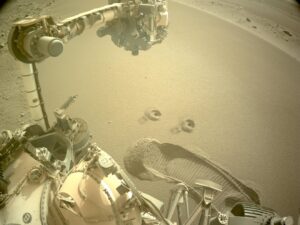
Two holes are left in the Martian surface after NASA’s Perseverance rover used a specialized drill bit to collect the mission’s first samples of regolith on Dec. 2 and 6, 2022. Credit: NASA/JPL-Caltech

As with rock cores, these latest samples were collected using a drill on the end of the rover’s robotic arm. But for the regolith samples, Perseverance used a drill bit that looks like a spike with small holes on one end to gather loose material.

Engineers designed the special drill bit after extensive testing with simulated regolith developed by JPL. Called Mojave Mars Simulant, it’s made of volcanic rock crushed into a variety of particle sizes, from fine dust to coarse pebbles, based on images of regolith and data collected by previous Mars missions.
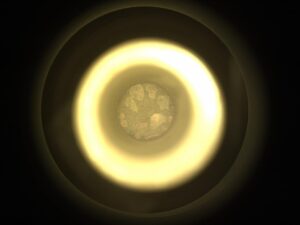
NASA’s Perseverance Mars rover took this image of regolith – broken rock and dust – on Dec. 2, 2022. This regolith will be considered for deposit on the Martian surface as part of the Mars Sample Return campaign. Credit: NASA/JPL-Caltech

“Everything we learn about the size, shape, and chemistry of regolith grains helps us design and test better tools for future missions,” said Iona Tirona of NASA’s Jet Propulsion Laboratory in Southern California, which leads the Perseverance mission. Tirona was the activity lead for operations to collect the recent regolith sample. “The more data we have, the more realistic our simulants can be.”

The Challenge of Dust

Studying regolith up close could help engineers design future Mars missions – as well as the equipment used by future Martian astronauts. Dust and regolith can damage spacecraft and science instruments alike. Regolith can jam sensitive parts and slow down rovers on the surface. The grains could also pose unique challenges to astronauts: Lunar regolith was discovered to be sharp enough to tear microscopic holes in spacesuits during the Apollo missions to the Moon.

Regolith could be helpful if packed against a habitat to shield astronauts from radiation, but it also contains risks: The Martian surface contains perchlorate, a toxic chemical that could threaten the health of astronauts if large amounts were accidentally inhaled or ingested.

“If we have a more permanent presence on Mars, we need to know how the dust and regolith will interact with our spacecraft and habitats,” said Perseverance team member Erin Gibbons, a McGill University doctoral candidate who uses Mars regolith simulants as part of her work with the rover’s rock-vaporizing laser, called SuperCam.

“Some of those dust grains could be as fine as cigarette smoke, and could get into an astronaut’s breathing apparatus,” added Gibbons, who was previously part of a NASA program studying human-robot exploration of Mars. “We want a fuller picture of which materials would be harmful to our explorers, whether they’re human or robotic.”

Besides answering questions about health and safety hazards, a tube of Martian regolith could inspire scientific wonder. Looking at it under a microscope would reveal a kaleidoscope of grains in different shapes and colors. Each one would be like a jigsaw puzzle piece, all of them joined together by wind and water over billions of years.

“There are so many different materials mixed into Martian regolith,” said Libby Hausrath of University of Nevada, Las Vegas, one of Perseverance’s sample return scientists. “Each sample represents an integrated history of the planet’s surface.”

As an expert on Earth’s soils, Hausrath is most interested in finding signs of interaction between water and rock. On Earth, life is found practically everywhere there’s water. The same could have been true for Mars billions of years ago, when the planet’s climate was much more like Earth’s.

Also Read:

Wind blows, ground moves on Mars, says study after INSIGHT lander findings

Mars cracks show water dried up 3.5 billion years ago on Red Planet

Are we alone in the universe? JPL’s OWLS, other tools to help search for life in deep space

NASA’s Perseverance Rover Investigates Geologically Rich Mars Terrain; Collects ‘Wildcat Ridge’, analyzes with SHERLOC instrument

NASA’s Perseverance rover is well into its second science campaign, collecting rock-core samples from features within an area long considered by scientists to be a top prospect for finding signs of ancient microbial life on Mars. The rover has collected four samples from an ancient river delta in the Red Planet’s Jezero Crater since July 7, bringing the total count of scientifically compelling rock samples to 12.

“We picked the Jezero Crater for Perseverance to explore because we thought it had the best chance of providing scientifically excellent samples – and now we know we sent the rover to the right location,” said Thomas Zurbuchen, NASA’s associate administrator for science in Washington. “These first two science campaigns have yielded an amazing diversity of samples to bring back to Earth by the Mars Sample Return campaign.

Twenty-eight miles (45 kilometers) wide, Jezero Crater hosts a delta – an ancient fan-shaped feature that formed about 3.5 billion years ago at the convergence of a Martian river and a lake. Perseverance is currently investigating the delta’s sedimentary rocks, formed when particles of various sizes settled in the once-watery environment. During its first science campaign, the rover explored the crater’s floor, finding igneous rock, which forms deep underground from magma or during volcanic activity at the surface.

“The delta, with its diverse sedimentary rocks, contrasts beautifully with the igneous rocks – formed from crystallization of magma – discovered on the crater floor,” said Perseverance project scientist Ken Farley of Caltech in Pasadena, California. “This juxtaposition provides us with a rich understanding of the geologic history after the crater formed and a diverse sample suite. For example, we found a sandstone that carries grains and rock fragments created far from Jezero Crater – and a mudstone that includes intriguing organic compounds.”

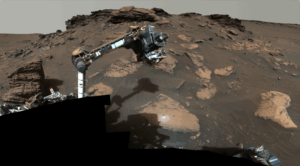
NASA’s Perseverance rover puts its robotic arm to work around a rocky outcrop called “Skinner Ridge” in Mars’ Jezero Crater. Composed of multiple images, this mosaic shows layered sedimentary rocks in the face of a cliff in the delta, as well as one of the locations where the rover abraded a circular patch to analyze a rock’s composition.
Credits: NASA/JPL-Caltech/ASU/MSSS

“Wildcat Ridge” is the name given to a rock about 3 feet (1 meter) wide that likely formed billions of years ago as mud and fine sand settled in an evaporating saltwater lake. On July 20, the rover abraded some of the surface of Wildcat Ridge so it could analyze the area with the instrument called Scanning Habitable Environments with Raman & Luminescence for Organics & Chemicals, or SHERLOC.  

SHERLOC’s analysis indicates the samples feature a class of organic molecules that are spatially correlated with those of sulfate minerals. Sulfate minerals found in layers of sedimentary rock can yield significant information about the aqueous environments in which they formed.

What Is Organic Matter?

Organic molecules consist of a wide variety of compounds made primarily of carbon and usually include hydrogen and oxygen atoms. They can also contain other elements, such as nitrogen, phosphorus, and sulfur. While there are chemical processes that produce these molecules that don’t require life, some of these compounds are the chemical building blocks of life. The presence of these specific molecules is considered to be a potential biosignature – a substance or structure that could be evidence of past life but may also have been produced without the presence of life.

In 2013, NASA’s Curiosity Mars rover found evidence of organic matter in rock-powder samples, and Perseverance has detected organics in Jezero Crater before. But unlike that previous discovery, this latest detection was made in an area where, in the distant past, sediment and salts were deposited into a lake under conditions in which life could potentially have existed. In its analysis of Wildcat Ridge, the SHERLOC instrument registered the most abundant organic detections on the mission to date.

“In the distant past, the sand, mud, and salts that now make up the Wildcat Ridge sample were deposited under conditions where life could potentially have thrived,” said Farley. “The fact the organic matter was found in such a sedimentary rock – known for preserving fossils of ancient life here on Earth – is important. However, as capable as our instruments aboard Perseverance are, further conclusions regarding what is contained in the Wildcat Ridge sample will have to wait until it’s returned to Earth for in-depth study as part of the agency’s Mars Sample Return campaign.”

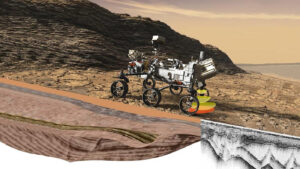
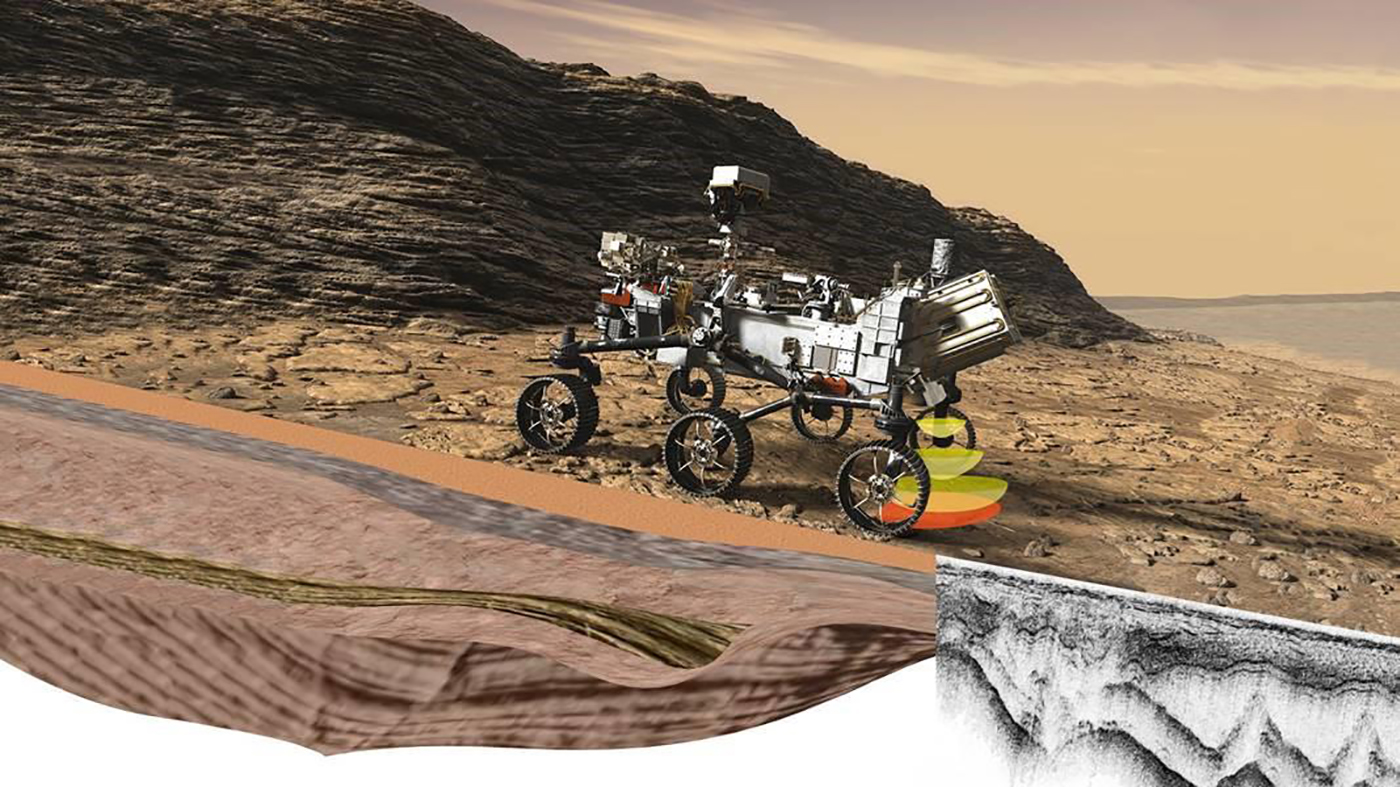
Rendering of Perseverance, whose RIMFAX technology is exploring what lies beneath the Martian surface. Photo: NASA/JPL/Caltech/FFI

The first step in the NASA-ESA (European Space Agency) Mars Sample Return campaign began when Perseverance cored its first rock sample in September 2021. Along with its rock-core samples, the rover has collected one atmospheric sample and two witness tubes, all of which are stored in the rover’s belly.

The geologic diversity of the samples already carried in the rover is so good that the rover team is looking into depositing select tubes near the base of the delta in about two months. After depositing the cache, the rover will continue its delta explorations.

“I’ve studied Martian habitability and geology for much of my career and know first-hand the incredible scientific value of returning a carefully collected set of Mars rocks to Earth,” said Laurie Leshin, director of NASA’s Jet Propulsion Laboratory in Southern California. “That we are weeks from deploying Perseverance’s fascinating samples and mere years from bringing them to Earth so scientists can study them in exquisite detail is truly phenomenal. We will learn so much.”

More About the Mission

A key objective for Perseverance’s mission on Mars is astrobiology, including caching samples that may contain signs of ancient microbial life. The rover will characterize the planet’s geology and past climate, pave the way for human exploration of the Red Planet, and be the first mission to collect and cache Martian rock and regolith.

Subsequent NASA missions, in cooperation with ESA, would send spacecraft to Mars to collect these sealed samples from the surface and return them to Earth for in-depth analysis.

The Mars 2020 Perseverance mission is part of NASA’s Moon to Mars exploration approach, which includes Artemis missions to the Moon that will help prepare for human exploration of the Red Planet.

NASA/Photo: Nasa.gov

JPL, which is managed for NASA by Caltech, built and manages operations of the Perseverance rover.

First underground radar images from Mars Perseverance rover reveal some surprises

Key takeaways:

  • Roving the Red Planet. Perseverance landed on Mars in February 2021 and has been gathering data on the planet’s geology and climate and searching for signs of ancient life.​​​​​​
  • What lies beneath. The rover’s subsurface radar experiment, co-led by UCLA’s David Paige, has returned images showing unexpected variations in rock layers beneath the Jezero crater.
  • Probing the past. The variations could indicate past lava flows or possibly a river delta even older than the one currently being explored on the crater floor.

After a tantalizing year-and-a-half wait since NASA’s Mars Perseverance rover touched down on our nearest planetary neighbor, new data is arriving — and bringing with it a few surprises.

The rover, which is about the size of car and carries seven scientific instruments, has been probing Mars’ 30-mile-wide Jezero crater, once the site of a lake and an ideal spot to search for evidence of ancient life and information about the planet’s geological and climatic past.

Rendering of Perseverance, whose RIMFAX technology is exploring what lies beneath the Martian surface. Photo: NASA/JPL/Caltech/FFI

In a paper published today in the journal Science Advances, a research team led by UCLA and the University of Oslo reveals that rock layers beneath the crater’s floor, observed by the rover’s ground-penetrating radar instrument, are unexpectedly inclined. The slopes, thicknesses and shapes of the inclined sections suggest they were either formed by slowly cooling lava or deposited as sediments in the former lake.

Perseverance is currently exploring a delta on the western edge of the crater, where a river once fed the lake, leaving behind a large deposit of dirt and rocks it picked up along its course. As the rover gathers more data, the researchers hope to clear up the complex history of this part of the Red Planet.

“We were quite surprised to find rocks stacked up at an inclined angle,” said David Paige, a UCLA professor of Earth, planetary and space sciences and one of the lead researchers on the Radar Imager for Mars Subsurface Experiment, or RIMFAX. “We were expecting to see horizontal rocks on the crater floor. The fact that they are tilted like this requires a more complex geologic history. They could have been formed when molten rock rose up towards the surface, or, alternatively, they could represent an older delta deposit buried in the crater floor.”

Paige said that most of the evidence gathered by the rover so far points to an igneous, or molten, origin, but based on the RIMFAX data, he and the team can’t yet say for certain how the inclined layers formed. RIMFAX obtains a picture of underground features by sending bursts of radar waves below the surface, which are reflected by rock layers and other obstacles. The shapes, densities, thicknesses, angles and compositions of underground objects affect how the radar waves bounce back, creating a visual image of what lies beneath.

During Perseverance’s initial 3-kilometer traverse, the instrument has obtained a continuous radar image that reveals the electromagnetic properties and bedrock stratigraphy — the arrangement of rock layers — of Jezero’s floor to depths of 15 meters, or about 49 feet. The image reveals the presence of ubiquitous layered rock strata, including those that are inclined at up to 15 degrees. Compounding the mystery, within those inclined areas are some perplexing highly reflective rock layers that in fact tilt in multiple directions.

“RIMFAX is giving us a view of Mars stratigraphy similar to what you can see on Earth in highway road cuts, where tall stacks of rock layers are sometimes visible in a mountainside as you drive by,” Paige explained. “Before Perseverance landed, there were many hypotheses about the exact nature and origin of the crater floor materials. We’ve now been able to narrow down the range of possibilities, but the data we’ve acquired so far suggest that the history of the crater floor may be quite a bit more complicated than we had anticipated.”

The data collected by RIMFAX will provide valuable context to rock samples Perseverance is collecting, which will eventually be brought back to Earth.

“RIMFAX is giving us the backstory of the samples we’re going to analyze. It’s exciting that the rover’s instruments are producing data and we’re starting to learn, but there’s a lot more to come,” Paige said. “We landed on the crater floor, but now we’re driving up on the actual delta, which is the main target of the mission. This is just the beginning of what we’ll hopefully soon know about Mars.”

The paper, “Ground penetrating radar observations of subsurface structures in the floor of Jezero crater, Mars,” is one of three simultaneously published papers discussing some of the first data from Perseverance.